
A complete issue · 32 pages · 1916
Judge — October 21, 1916
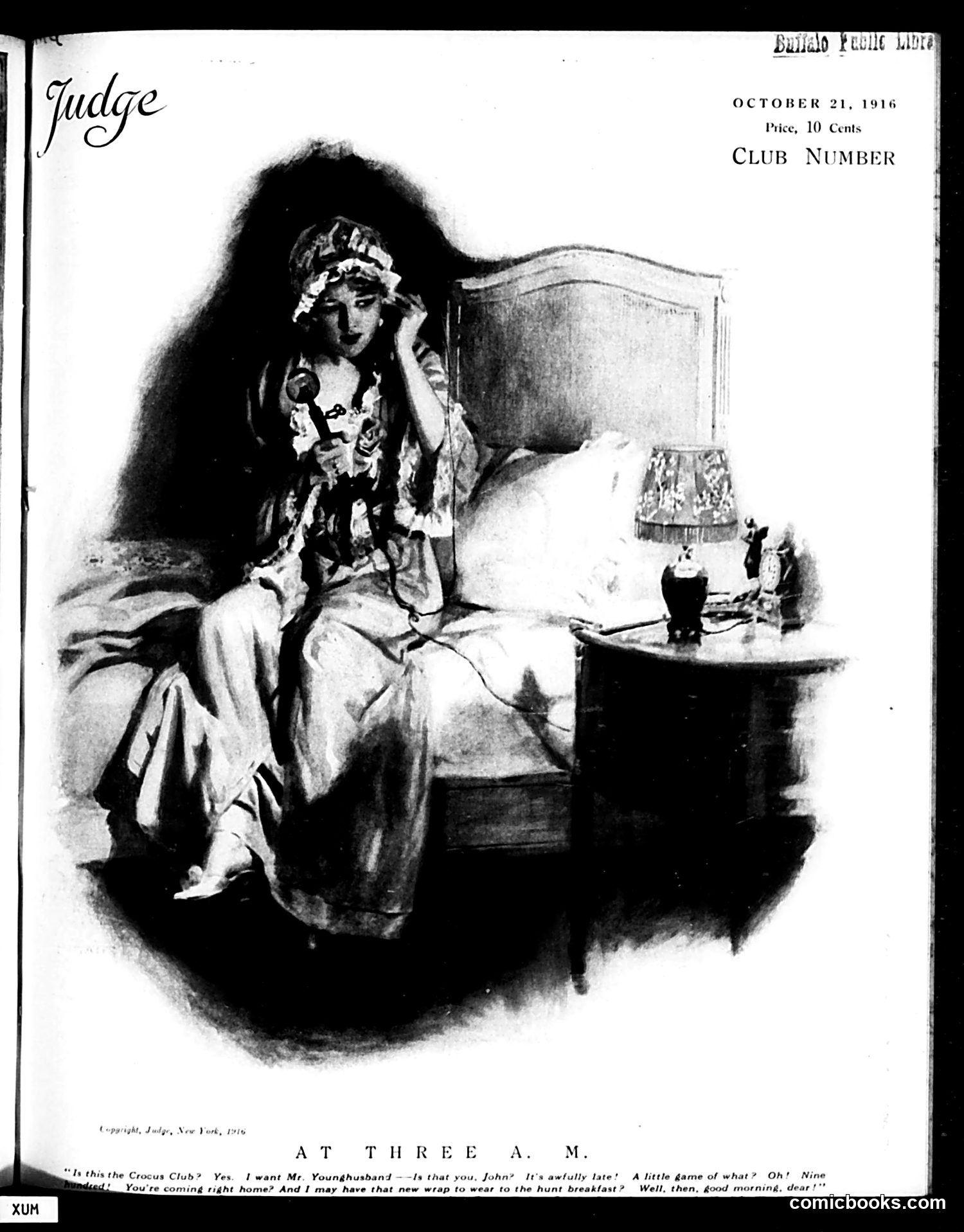
This illustration satirizes wealthy socialites and their leisure activities. The image shows a woman in an elaborate dress and headpiece reclining in a bedroom, depicted in a style suggesting indolence or vanity. The dialogue references "the Crocus Club" and mentions a "new wrap" for a "hunt breakfast"—details suggesting upper-class recreational pursuits. The humor appears to target the frivolous concerns of wealthy women: coordinating clothing for social events, arriving late, and engaging in gossip about trivial matters. The satire critiques how privileged women occupied their time with fashionable social circuits and material concerns rather than more substantive pursuits, a common theme in early 20th-century American humor magazines that mocked both wealth and gender roles.
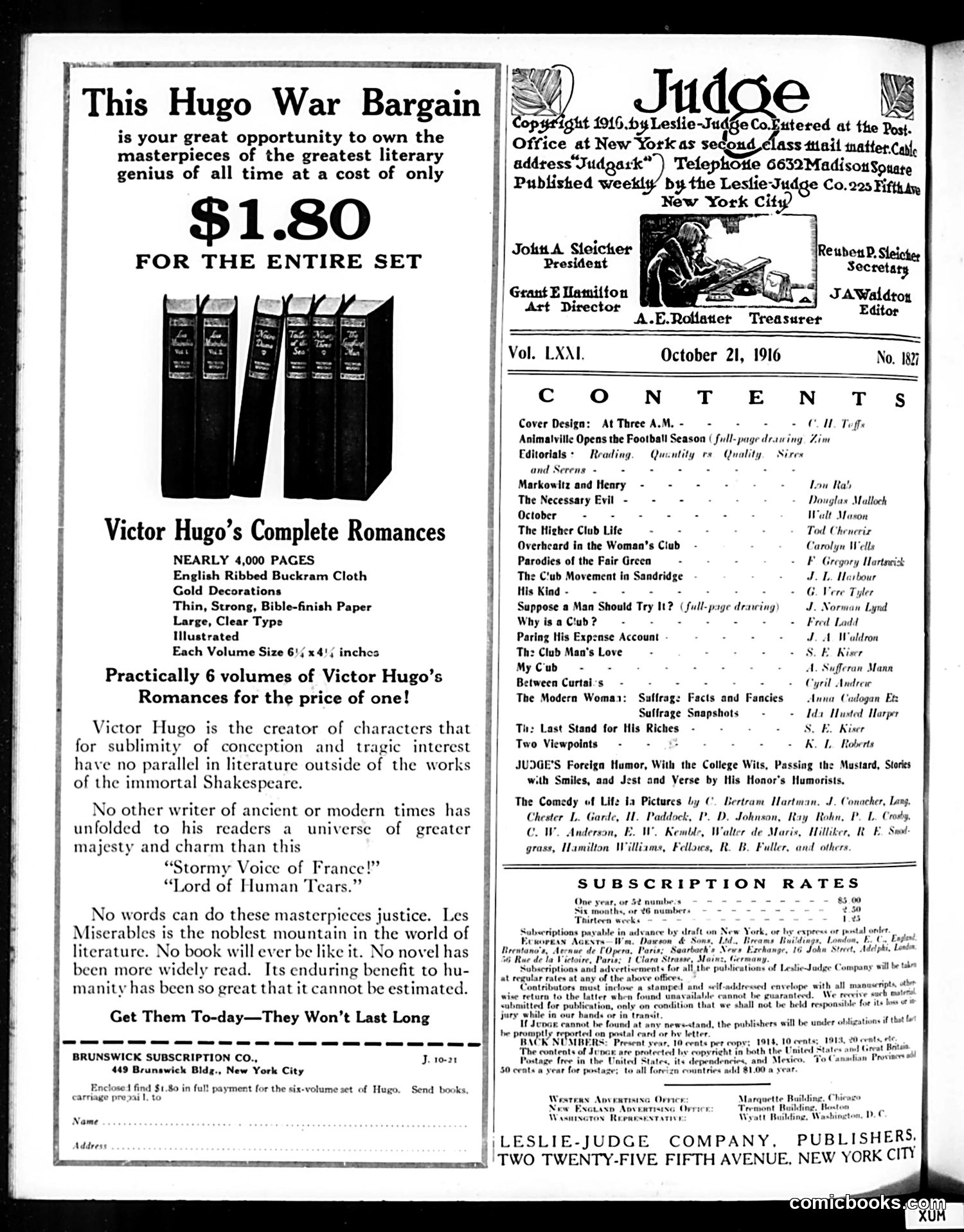
This page is primarily **advertising and editorial content** rather than political cartoons. The left side features a large advertisement for Victor Hugo's Complete Romances (6 volumes for $1.80), emphasizing Hugo's literary genius by comparing him to Shakespeare. The right side shows the magazine's masthead and table of contents for Vol. LXXI, No. 1827. The contents list various articles including pieces on clubs, sports (football), and social commentary typical of Judge's satirical approach. The small illustration near the masthead shows an editor or writer at work—standard decorative imagery for the era. Without seeing the actual interior cartoons referenced in the contents, I cannot identify specific political references or satirical targets from this page alone.
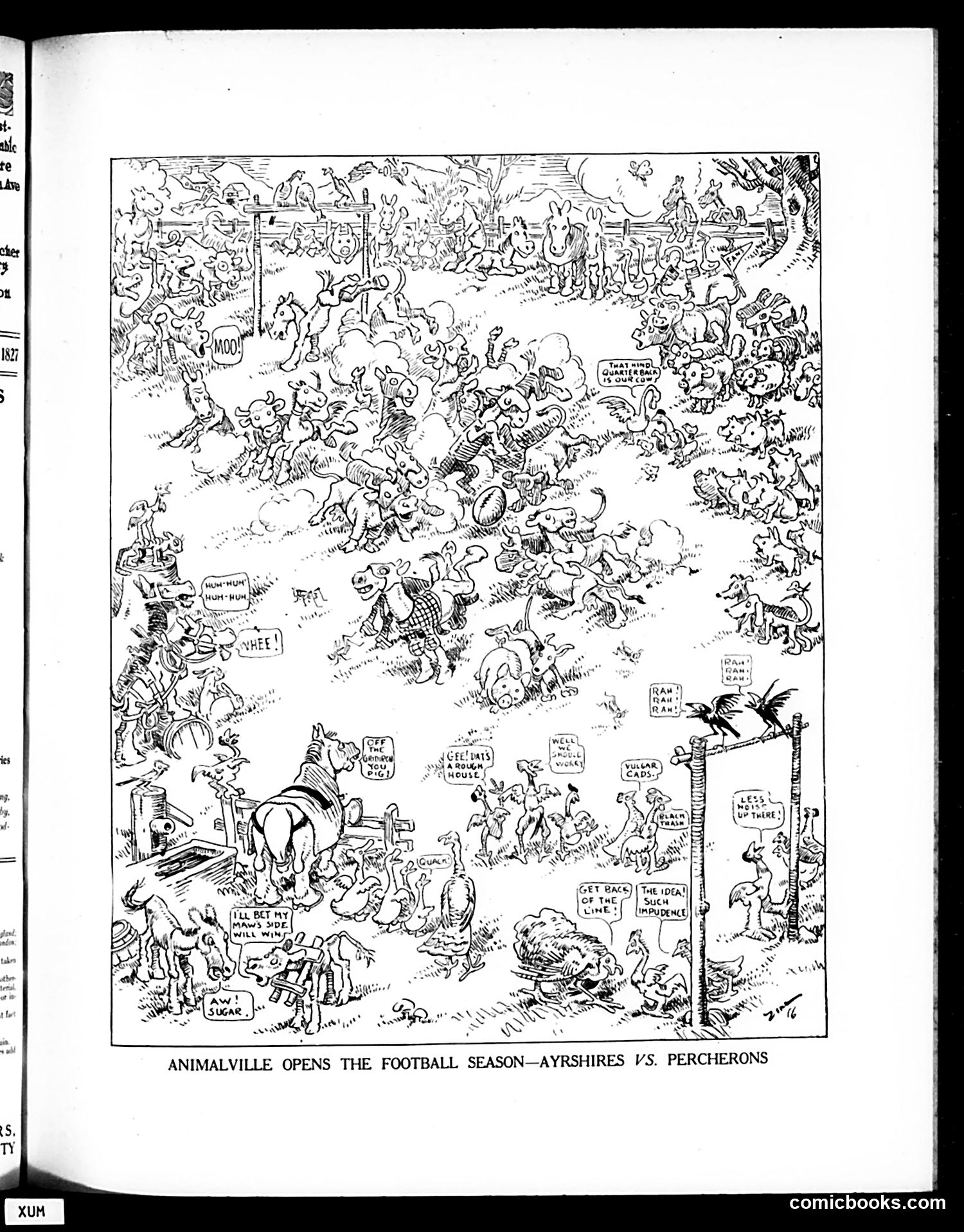
This is a humorous cartoon depicting an anthropomorphized animal football match. The title identifies the teams as "Ayrshires" (a dairy cattle breed) versus "Percherons" (a draft horse breed), transforming livestock into sports competitors. The cartoon is a visual joke playing on animal characteristics: the Percherons' strength and size versus the Ayrshires' smaller stature. Various animal spectators crowd a makeshift field with crude goalposts, creating chaotic game action filled with physical comedy typical of Judge magazine's slapstick humor. The satire likely mocks the era's obsession with competitive sports while anthropomorphizing animals provides lighthearted entertainment. Speech bubbles with animal sounds ("MOO," "NEIGH," "BAAA") emphasize the absurdist nature of the scenario, appealing to Judge's middle-class readership seeking comedic relief.
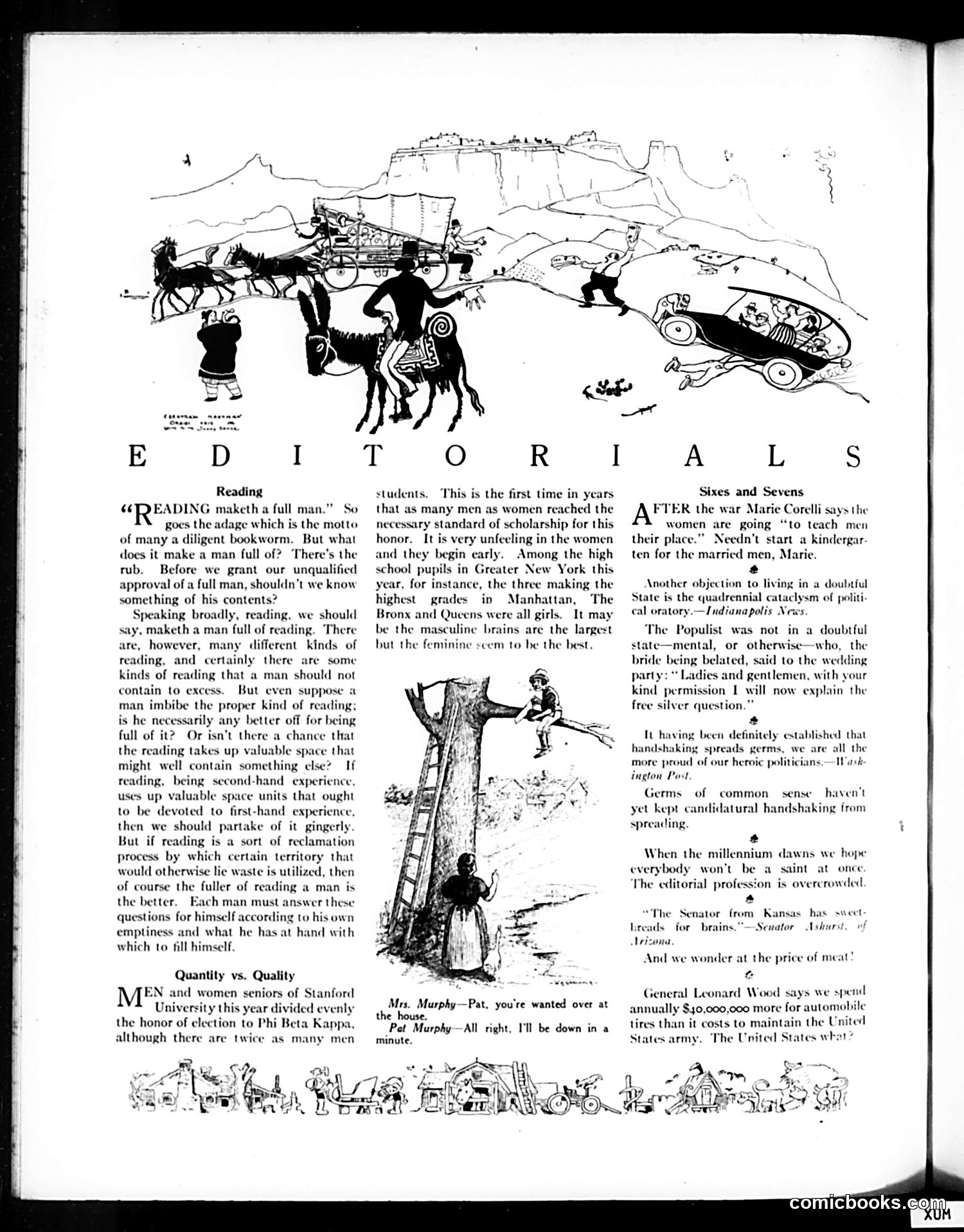
This page contains three distinct sections: **Top illustration ("Editorials")**: A satirical cartoon depicting the collision between old and new—a horse-drawn wagon laden with traditional goods meeting a modern automobile on a road. The imagery critiques the rapid technological disruption of early 20th-century American life. **Left column ("Reading")**: An editorial essay debating what constitutes proper reading material for men, questioning whether men should read "valuable space that might well contain something else." **Right columns**: Brief satirical commentary on post-WWI social issues, including women's suffrage ("the free silver question"), concerns about disease transmission ("handswiping spreads germs"), and military spending on automobiles versus Army maintenance. The overall theme appears to be contemporary anxieties about modernization, changing gender roles, and government priorities during the interwar period.
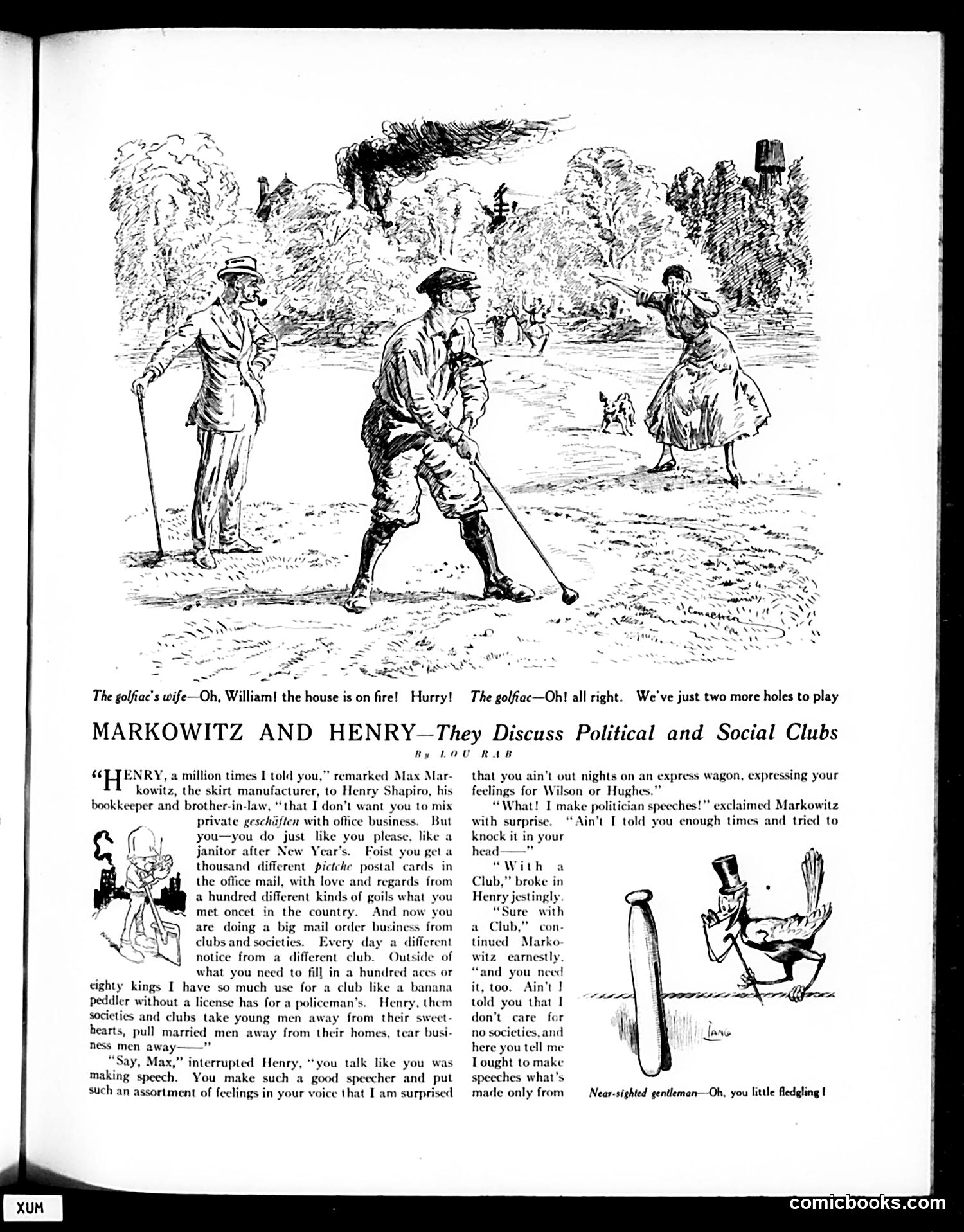
This satirical piece mocks turn-of-century American club culture. Markowitz, a skirt manufacturer, complains to his bookkeeper Henry Shapiro about receiving countless postcards from different clubs soliciting business. He's frustrated that clubs—which ostensibly keep young men away from homes, wives, and "tear business men away"—somehow expect his commercial support. Henry responds by praising clubs' social value, but Markowitz dismissively counters that clubs are merely excuses for men to escape domestic life. The accompanying golf scene illustration reinforces the leisure-class absurdity. The satire targets both excessive club proliferation and the expectation that businesses fund organizations whose primary purpose appears to be extracting men from productive home life and family responsibilities.
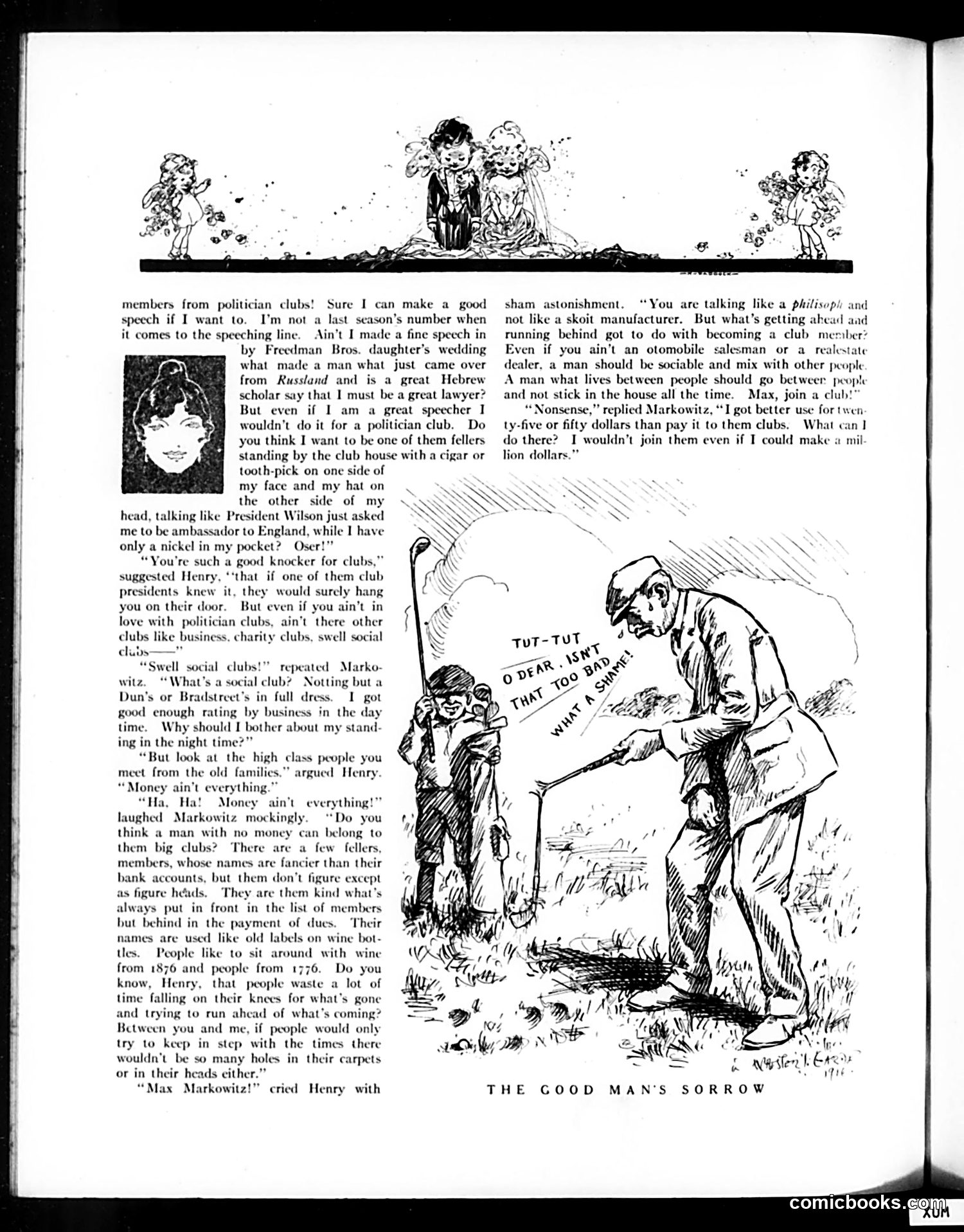
This satirical dialogue depicts a debate between **Max Markowitz** (a Jewish businessman/skirt manufacturer) and **Henry** (his friend) about joining social clubs. The humor targets **class pretension and American social climbing**. Henry urges Markowitz to join clubs for sociability and status, citing prestigious old families and high-class connections. Markowitz refuses, mocking the absurdity: clubs are either business fronts (like Dun's or Bradstreet's credit ratings in formal dress) or repositories of fake prestige—people with fancy names but empty bank accounts, kept as "figure heads." The satire criticizes how Americans waste time worshipping the past ("wine from 1876") while scrambling for future status, when they should focus on present reality. Markowitz's final point—people have "holes in their carpets or in their heads"—suggests this status-seeking reflects intellectual poverty. The title "The Good Man's Sorrow" implies Markowitz's tragedy: being sensible and frugal in a society obsessed with hollow social standing.
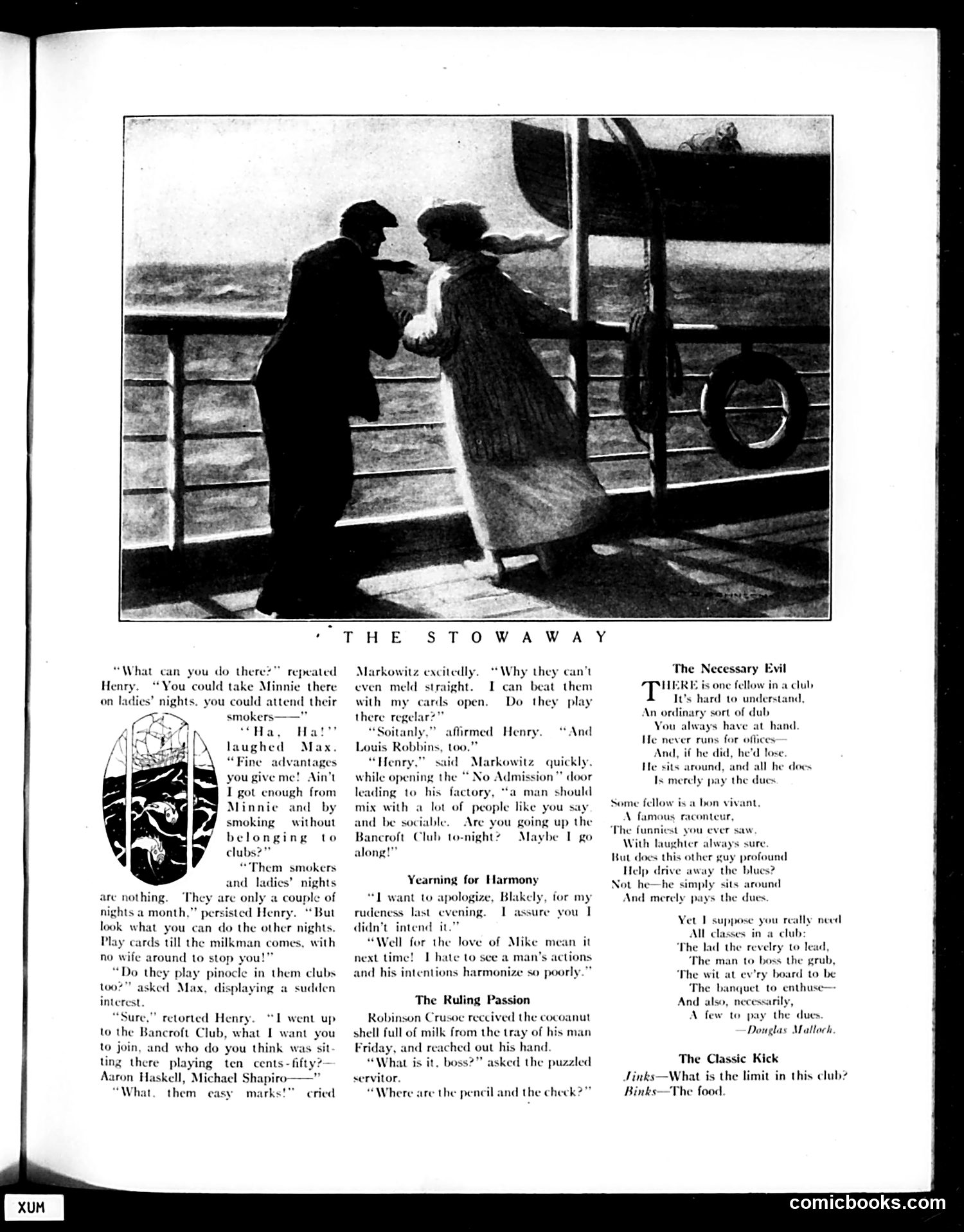
This Judge page satirizes urban male club culture of the early 20th century. The main cartoon shows two men on a ship's deck discussing membership in exclusive clubs like the Bancroft Club—social venues where working-class and middle-class men could escape domestic life, play cards, smoke, and socialize. The satire targets the **appeal of clubs as refuges from wives and family obligations**. Characters like Henry and Markowitz debate whether membership offers real value, mentioning card games where members can exploit easier players. The humor lies in the transparent male desire to escape domestic supervision. Supporting pieces mock various club types: the forgettable member who merely pays dues, the man obsessed with coconut shells (possibly referencing pretentious dining), and the complaint about poor food quality. The underlying joke is that clubs attract all types—some vibrant, most ordinary—yet all are necessary to the institution's functioning, particularly those funding it through membership fees.
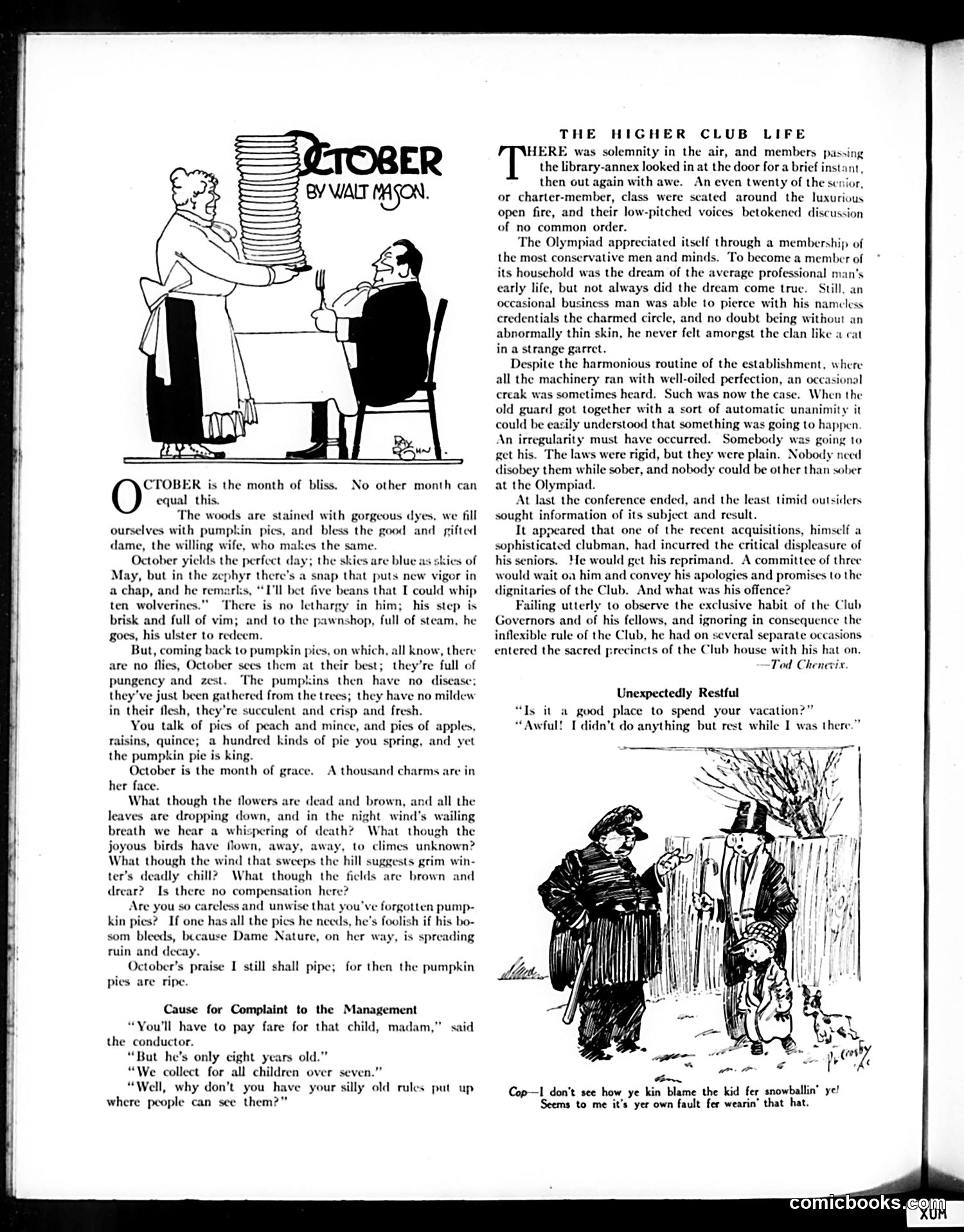
**Main Cartoons:** 1. **"October" by Walt Mason** (top left): A humorous illustrated poem celebrating October as "the month of bliss," focusing on pumpkin pies and autumn's restorative effects. The cartoon shows a waiter serving pumpkins to a diner—a visual pun on the text's obsession with pumpkin pie as the month's defining feature. 2. **"The Higher Club Life"** (top right): Satirizes exclusive club culture, depicting serious deliberation among conservative members about disciplining a newly admitted "sophisticated clubman" who violated the establishment's rigid rules. The satire mocks the self-importance and inflexibility of such institutions. 3. **"Unexpectedly Restful"** (bottom right): A small cartoon showing two figures discussing vacation, illustrating idle relaxation—likely contrasting with productive pursuits. 4. **"Cause for Complaint to the Management"** (middle left): A brief dialogue satirizing unreasonable transit rules requiring fare for children under eight, mocking the conductor's rigidity and poor communication of policies.
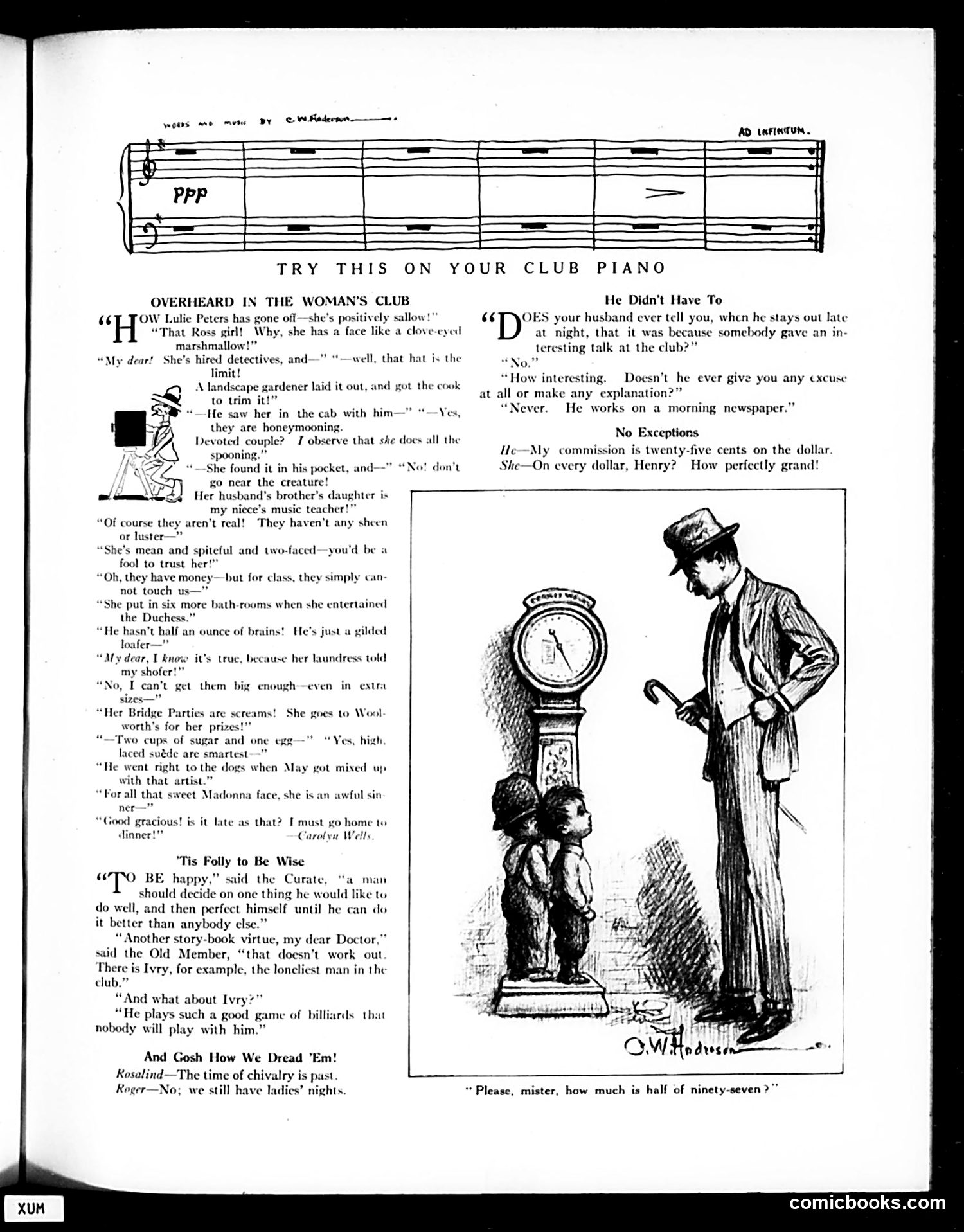
This page from *Judge* magazine contains several short humorous pieces satirizing early 20th-century club and domestic life. **"Overheard in the Woman's Club"** mocks wealthy women's gossip and cattiness—their obsession with appearances, wealth displays, and social climbing. The satire targets their superficiality and how they judge each other harshly while claiming refinement. **"He Didn't Have To"** and **"No Exceptions"** are brief marital humor pieces. The first jokes that a newspaper worker needn't fabricate excuses because he genuinely works late. The second plays on a wife misunderstanding her husband's commission structure as more generous than it is. **"'Tis Folly to Be Wise"** satirizes the paradox of Ivry, who is so skilled at billiards that no one will play with him—his excellence isolates him rather than brings social reward. The illustration shows a well-dressed man consulting a public scale while a child asks about arithmetic, likely illustrating one of the jokes about calculation or value. The overall tone mocks pretension, marital misunderstandings, and social hypocrisy of the era's leisure classes.
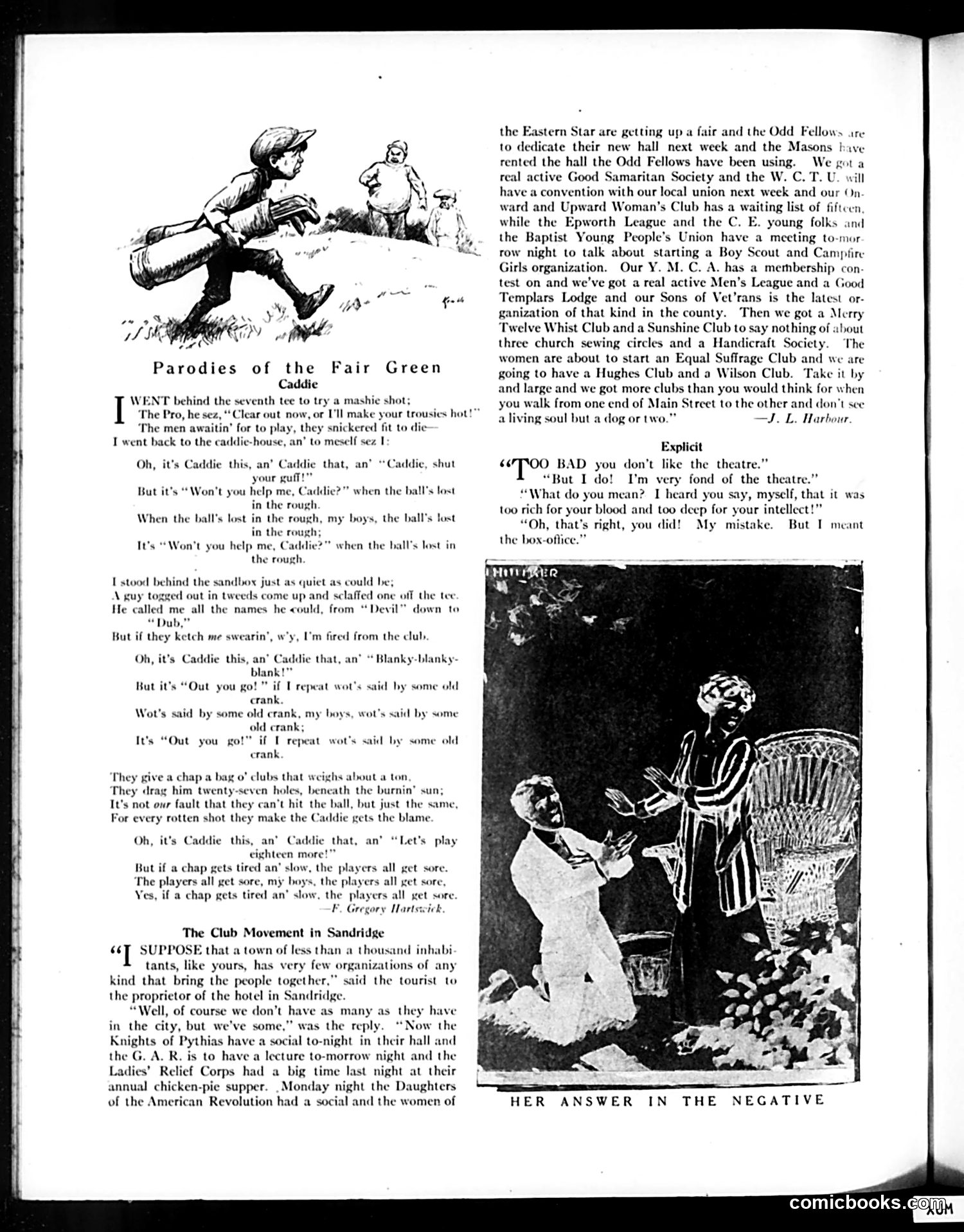
**The Caddie Poem** (left): This satirical verse mocks the class dynamics of golf caddies. The poem, by F. Gregory Hartswick, depicts a caddie's mistreatment by golfers—called insulting names, blamed for poor shots, worked exhaustingly, yet expected to remain respectful. The refrain "it's Caddie this, an' Caddie that" echoes Kipling's "Tommy," inverting the famous poem about soldiers' disrespect into commentary on working-class service workers. The joke exposes the hypocrisy: golfers demand obedience while treating caddies contemptuously. **"Her Answer in the Negative"** (cartoon, right): Shows a woman rejecting a man's proposal or romantic advance—her answer is "no." The illustration appears to accompany the "Explicit" dialogue below discussing theatre attendance, though the exact connection is unclear from the visible text. **The Club Movement in Sandridge** (bottom): This satirical piece parodies small-town American civic life—the proprietor proudly lists dozens of organizations (fraternal lodges, women's clubs, church groups) in a town of fewer than 1,000 people. The satire suggests Americans' obsession with joining clubs and organizations, implying these groups are proliferating absurdly.
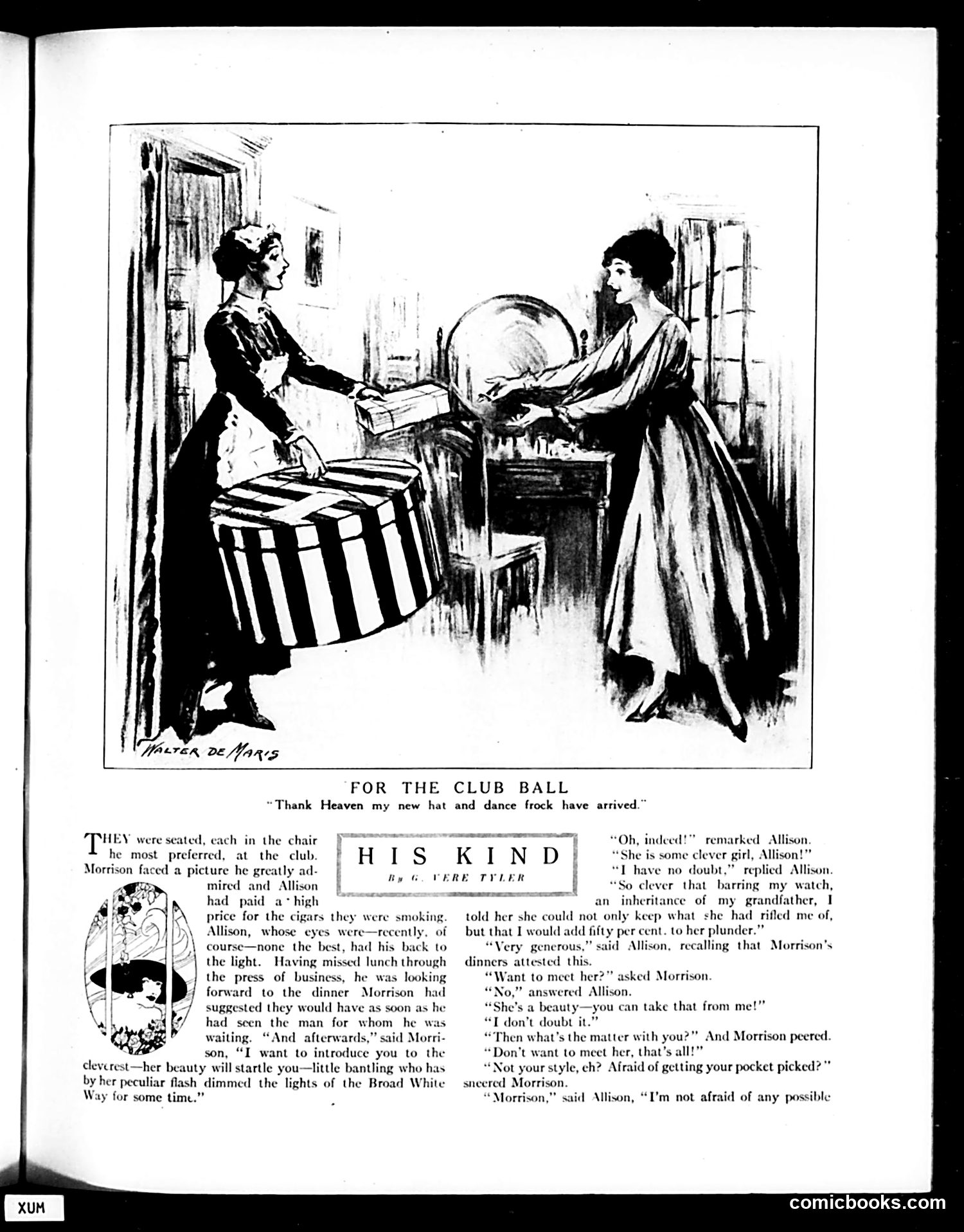
This is a society-humor cartoon depicting two wealthy clubmen, Morrison and Allison, discussing their evening plans. Morrison enthusiastically wants to introduce Allison to a glamorous woman—a "clever" entertainer who has become famous on Broadway (the "Broad White Way"), captivating audiences with her charm and talent. The joke centers on Allison's reluctance and his caustic response: he's so distrustful of this woman's character that he preemptively told her she could keep whatever she might steal from him, and he'd even add fifty percent more as a "plunder" payment. When Morrison needles him about fearing pickpockets, Allison clarifies his real concern: he simply doesn't want to meet her—implying she's a fortune-hunter or social climber unworthy of his time. The satire targets both the pretensions of wealthy leisure-class men and the perceived predatory nature of attractive women in turn-of-the-century urban entertainment circles. It reflects period anxieties about class, morality, and women's economic opportunism.
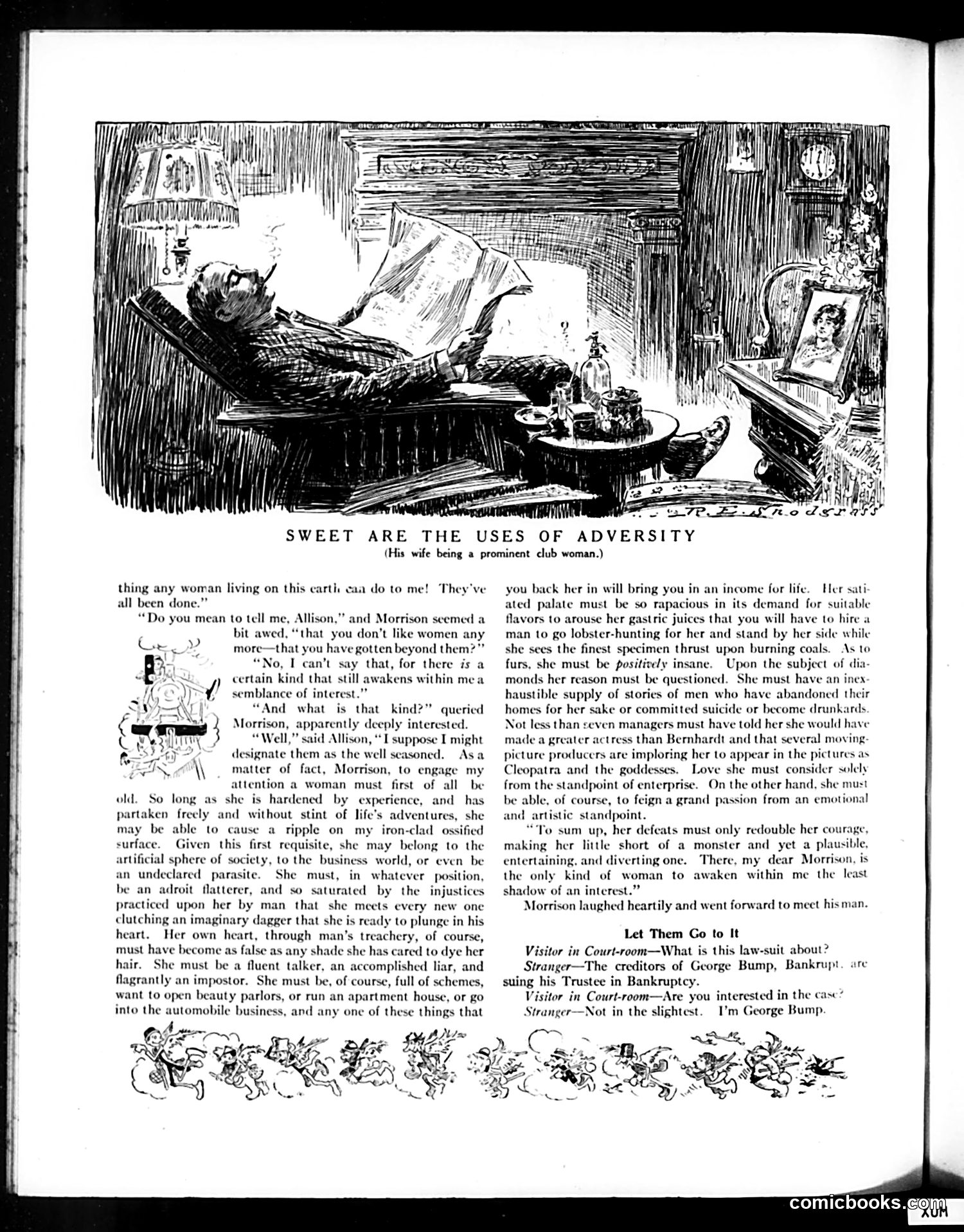
This satirical piece mocks wealthy male attitudes toward society wives. A man named Allison describes to Morrison the *only* type of woman who interests him: one hardened by life's disappointments and betrayals—a woman who is ambitious, scheming, materialistic, and morally compromised. She must want to open business ventures (beauty parlors, apartments), demand expensive luxuries (lobster, furs, diamonds), and possess fabricated tales of romantic conquests and near-miss theatrical stardom. The satire targets both genders: husbands who've become jaded by their wives' social climbing and self-promotion, and the "prominent club women" themselves—depicted as calculating, dishonest entrepreneurs using charm and deception to extract financial support from men. The second item, "Let Them Go to It," is a brief joke about bankruptcy litigation that's self-explanatory wordplay. The cartoon illustrates a man lounging while reading, surrounded by domestic comforts—the scene of leisure disrupted by marital ambition.
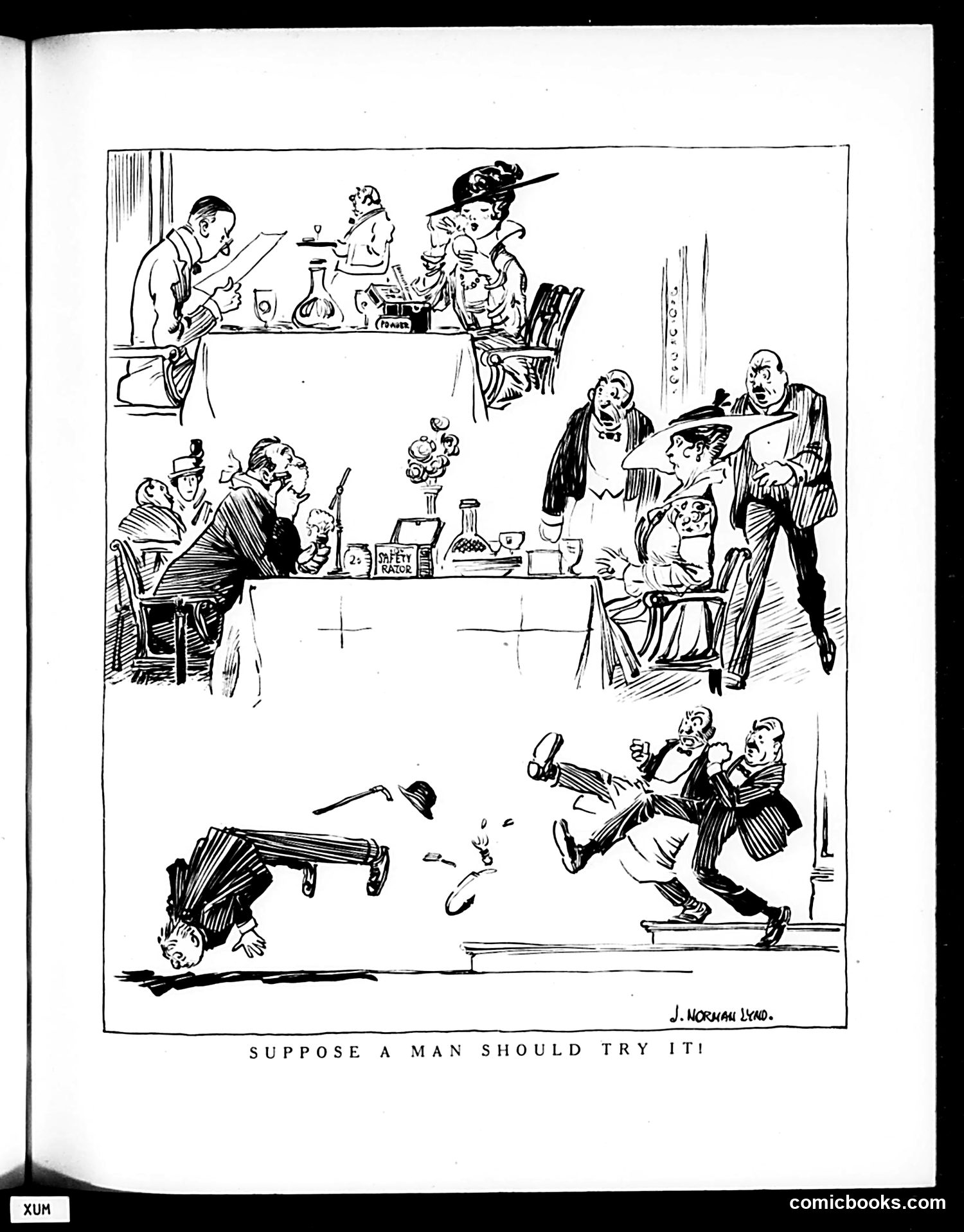
This cartoon satirizes domestic life and gender roles. The top panels show a sophisticated dinner party with well-dressed men and women dining elegantly. The bottom panels depict chaos: a man attempting household tasks (cooking, cleaning, childcare) while guests look on in shock and amusement. One man has literally flipped upside down in apparent disaster. The title's rhetorical question mocks the notion that men could successfully manage "women's work." The satire operates on two levels: it ridicules both the idea that domestic tasks are impossibly difficult and, implicitly, the rigid gender divisions of early 20th-century society that made men utterly incompetent in home management. The cartoon reflects contemporary anxieties about gender roles during a period of social change.
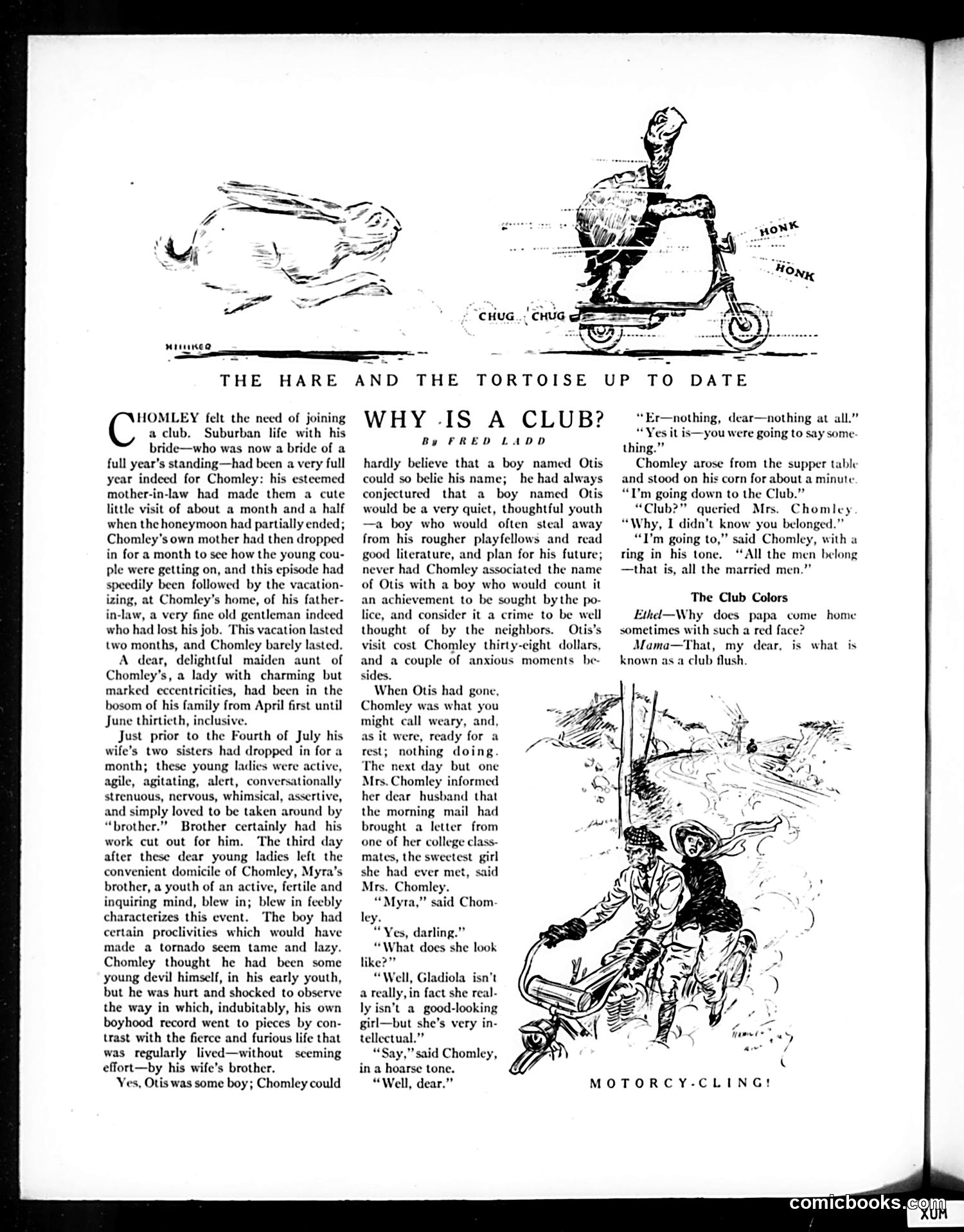
This story satirizes the exhausting demands of suburban married life in early 20th-century America. Chomley, a newly married man, endures an endless parade of visiting in-laws and relatives—his mother-in-law, mother, father-in-law, aunt, and wife's hyperactive brother Otis—each staying for extended periods and draining his patience and finances. When his wife mentions an upcoming visit from a college friend (Gladiola, described as plain but "intellectual"), Chomley reaches his breaking point. He announces he's joining "the Club"—a gentlemen's retreat where married men escape domestic chaos. The cartoons reinforce this: the opening contrasts the leisurely hare with a harried man on a motorized scooter, while the lower illustration shows a couple enjoying winter sports—escapism from married life. The final joke equates a "club flush" (reddened face from club activities, likely drinking) with masculine stress relief. The satire critiques how marriage, particularly in-law obligations, drives men to seek refuge in bachelor-style clubs.
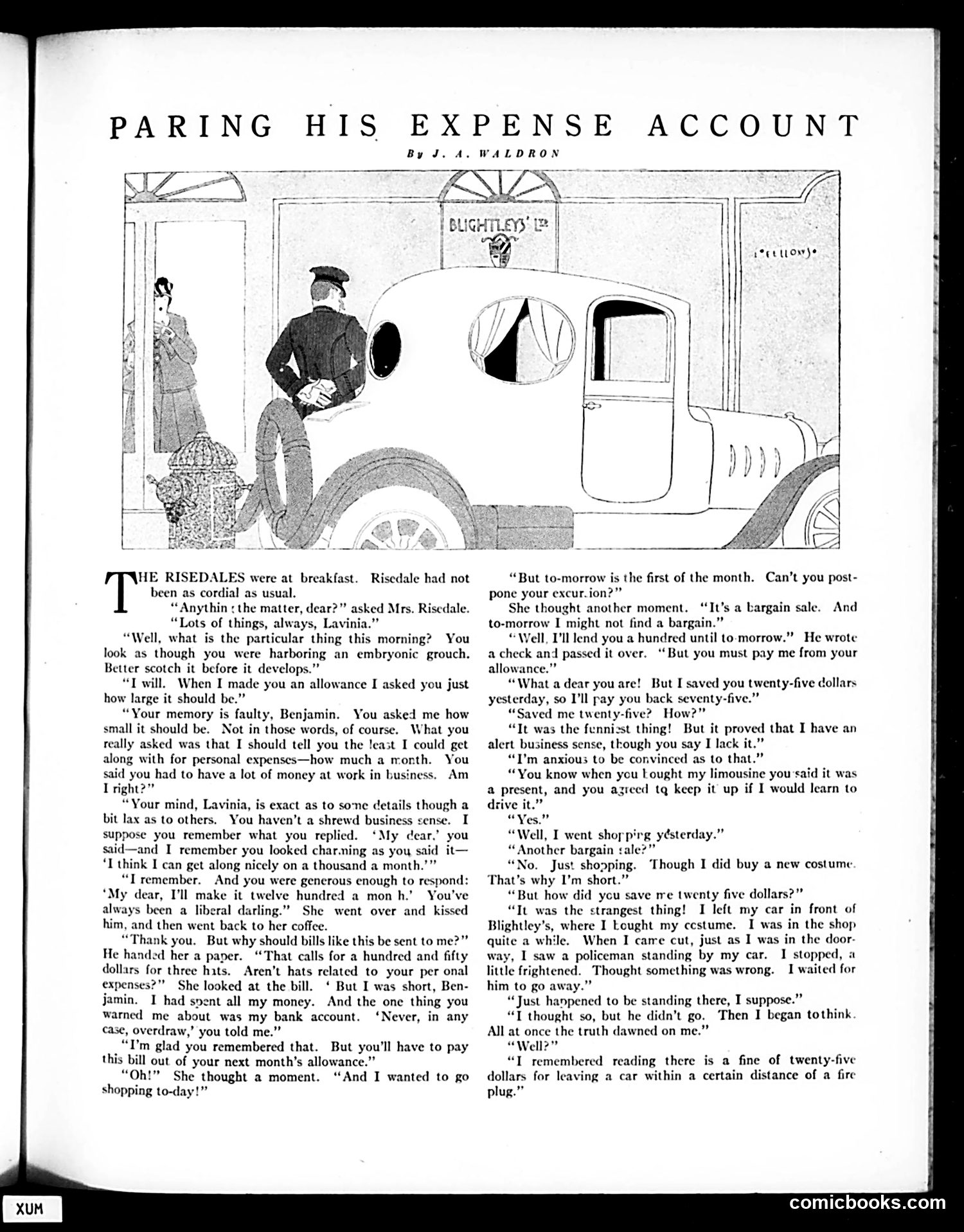
This satirical story by J.A. Waldron depicts a domestic argument over Mrs. Risedale's spending habits. Benjamin Risedale gives his wife a monthly allowance ($1,200) for "personal expenses," but she's exceeded it with hat purchases. When he threatens to cut her shopping trip, she negotiates a loan against future allowance funds. The satire's punch comes in her claimed "business sense": she avoided a $25 parking fine by leaving her car near a fire plug—which she frames as *saving* him money, rather than admitting her carelessness. Her logic exemplifies the cartoon's title: she's essentially "paring" (reducing or justifying) her expense account through creative accounting and self-serving rationalization. The humor targets both spendthrift wives and husbands who indulge them through financial negotiation rather than firm boundaries—typical Jazz Age domestic comedy about class and consumer culture.
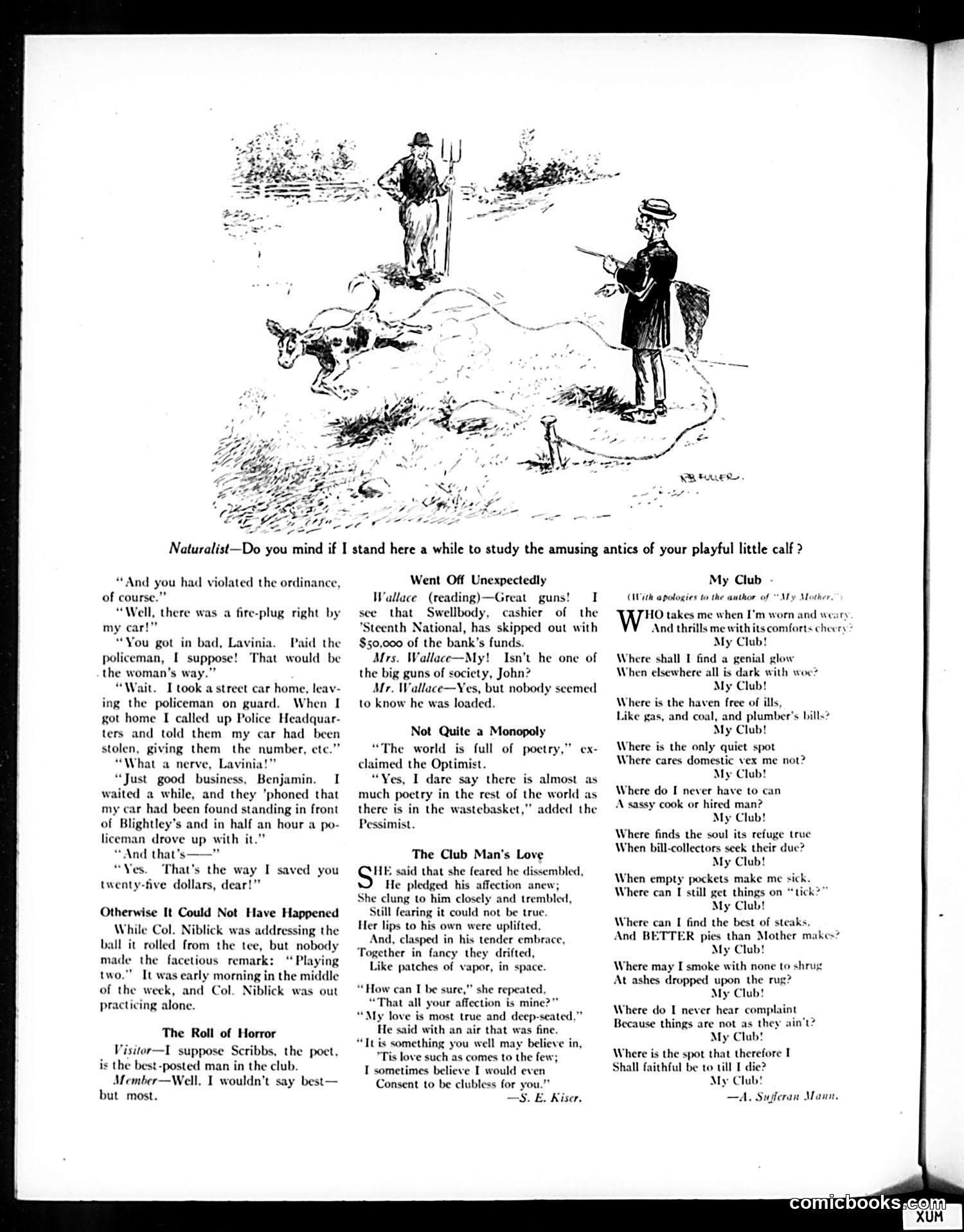
This page from *Judge* contains several satirical pieces mocking upper-middle-class social life, circa early 1900s. **The cartoon** shows a naturalist studying a calf while two well-dressed figures observe—likely satirizing overly earnest scientific observation or pretentious intellectualism. **The vignettes mock club culture:** One story jokes about a woman outsmarting her husband by reporting their car stolen (to avoid paying him back $25), playing on stereotypes about women's cunning. Another mocks Col. Niblick's lonely golf practice—the humor being that no one was around to hear the typical "playing two" golf joke. **"Went Off Unexpectedly"** puns on a banker's embezzlement: nobody realized Swellbody was "loaded" (wealthy/criminal) despite his high social standing. **The poems** satirize club life as masculine refuge—a place to escape wives, domestic complaints, and bill collectors. The final poem parodies sentimental verse ("My Mother") but substitutes "My Club" as the idealized sanctuary. The punchline suggests men value their club more than marriage or responsibility. The satire targets affluent leisure culture and marital dynamics of the era.
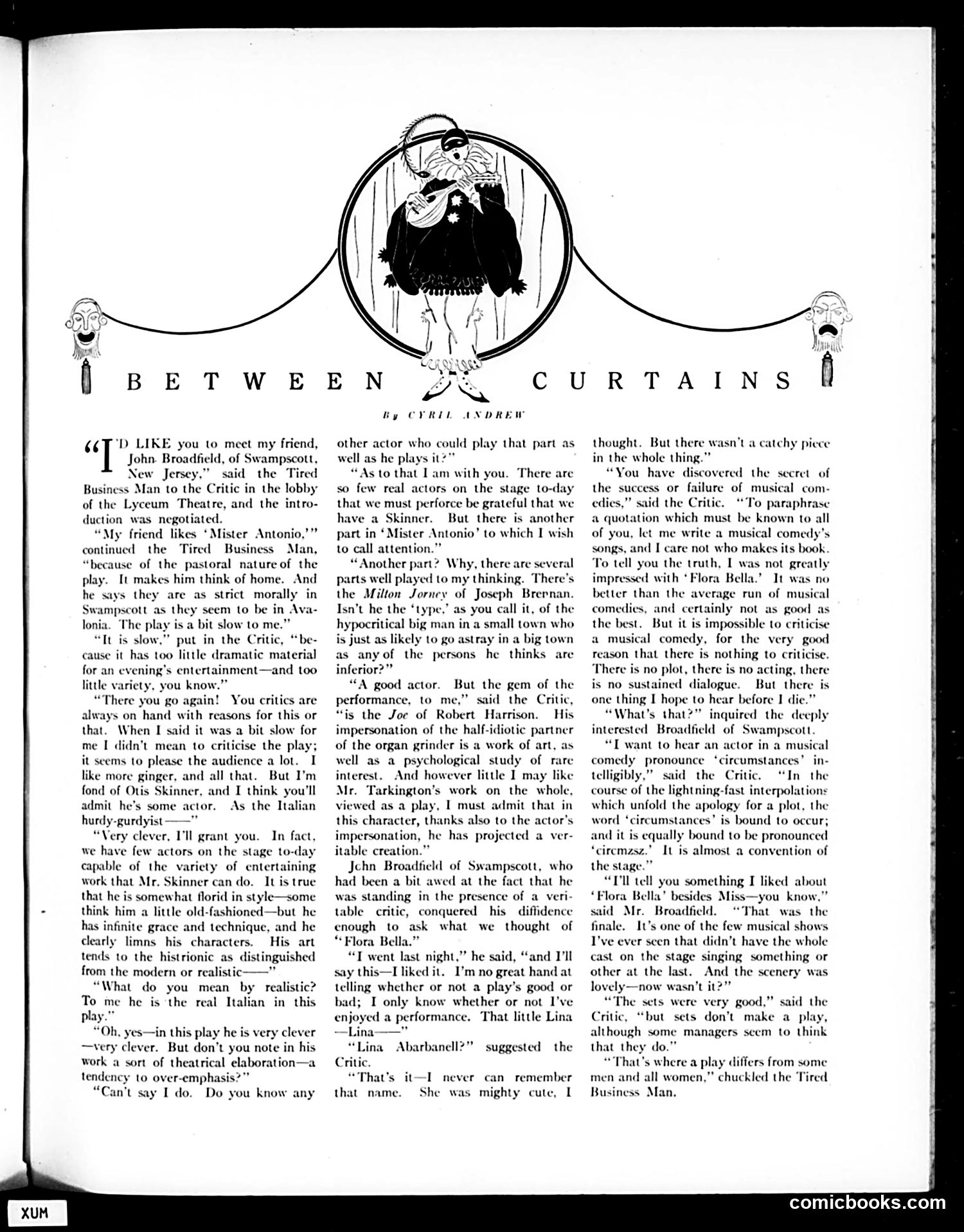
This theatrical dialogue satirizes the tension between professional drama critics and ordinary theatergoers. The "Tired Business Man" represents the average audience member who enjoys entertainment without analytical pretense, while the "Critic" embodies the pretentious, over-analytical theater reviewer. The humor centers on their debate about a play called "Mister Antonio" starring **Otis Skinner**, a famous actor of the period. The Critic dismisses the production as slow and lacking dramatic material, while the Business Man simply enjoyed it and admires Skinner's performance. The Critic accuses Skinner of being "florid" and overly theatrical rather than realistic. The satire mocks critics who prioritize intellectual frameworks over genuine audience enjoyment. The Business Man's pragmatic response—that he only cares whether he enjoyed himself—contrasts with the Critic's elaborate justifications for disliking the show. Judge suggests critics often complicate simple entertainment with unnecessary sophistication.
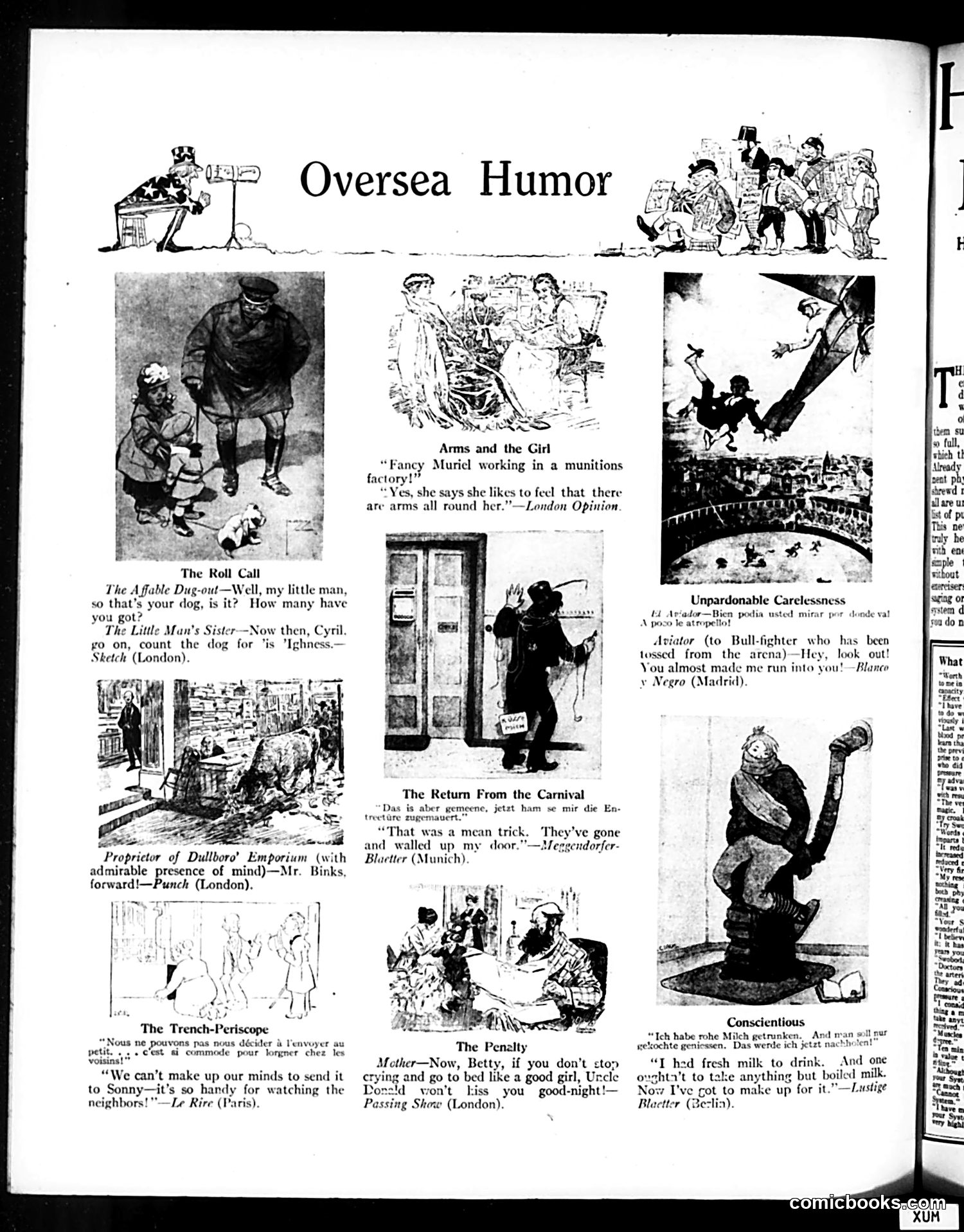
This page compiles humorous cartoons from international publications (London, Paris, Munich, Madrid, Berlin), showcasing how different countries satirized WWI-era life. **Key cartoons:** - **"The Roll Call"**: A soldier counts his dog as a troop member to inflate numbers for inspection—mocking military bureaucracy. - **"Arms and the Girl"**: A woman working in munitions enjoys being surrounded by "arms" (weaponry/male attention)—wartime gender role commentary. - **"Trench-Periscope"**: A family debates sending a periscope to their son because it's useful for spying on neighbors—satirizing civilian priorities over wartime needs. - **"The Penalty"**: A mother threatens withholding affection unless her child behaves—domestic discipline humor. Other cartoons mock carnival accidents, milk pasteurization debates, and aviation mishaps. The collection illustrates how Allied and neutral nations used satire to comment on wartime absurdities and daily life disruptions.
This is **not a satirical cartoon** but rather a **full-page advertisement** disguised as editorial content. It promotes "The Swoboda System," a pseudoscientific health method claiming to boost mental and physical energy without drugs, medicine, exercise, or dieting. The page lists numerous prominent businessmen and public figures (politicians, judges, financiers) allegedly endorsing the system. This was a common marketing tactic of the early 20th century—leveraging celebrity endorsements to sell dubious health schemes. The irony for modern readers: Judge magazine, known for satire, is printing what appears to be legitimate testimonials, though the grandiose claims ("billions of cells," "ten times as healthy") suggest this was likely a scam or quackery. The prominent names listed may have been used without permission—a practice that preceded modern celebrity endorsement regulations.
This page from *Judge* magazine contains **primarily advertisements** (Club Cocktails, Old Overholt Rye whiskey, Cortes cigars) alongside a satirical article titled "Suffrage Facts and Fancies" by Anna Cadogan Etz. The article uses **humorous argumentation** to defend women's suffrage against anti-suffrage opponents. Etz argues that suffrage is "coming" (progressing), not "going" (disappearing), using examples: Kansas voting on women's suffrage since 1867, Oregon eventually granting it after multiple votes, and Michigan's 1912 referendum loss being explained away—farmers opposed it in April only because they were distracted by crop concerns, not because they genuinely changed their minds. The satire mocks anti-suffrage logic by suggesting suffragists can rationalize any setback as temporary. The final metaphor advises readers to judge suffrage's inevitability by observing whether presidential candidates support it—implying they inevitably will. The piece reflects **early 1910s suffrage debates**, when women's voting rights remained contested and *Judge* apparently took a pro-suffrage editorial stance through satire.
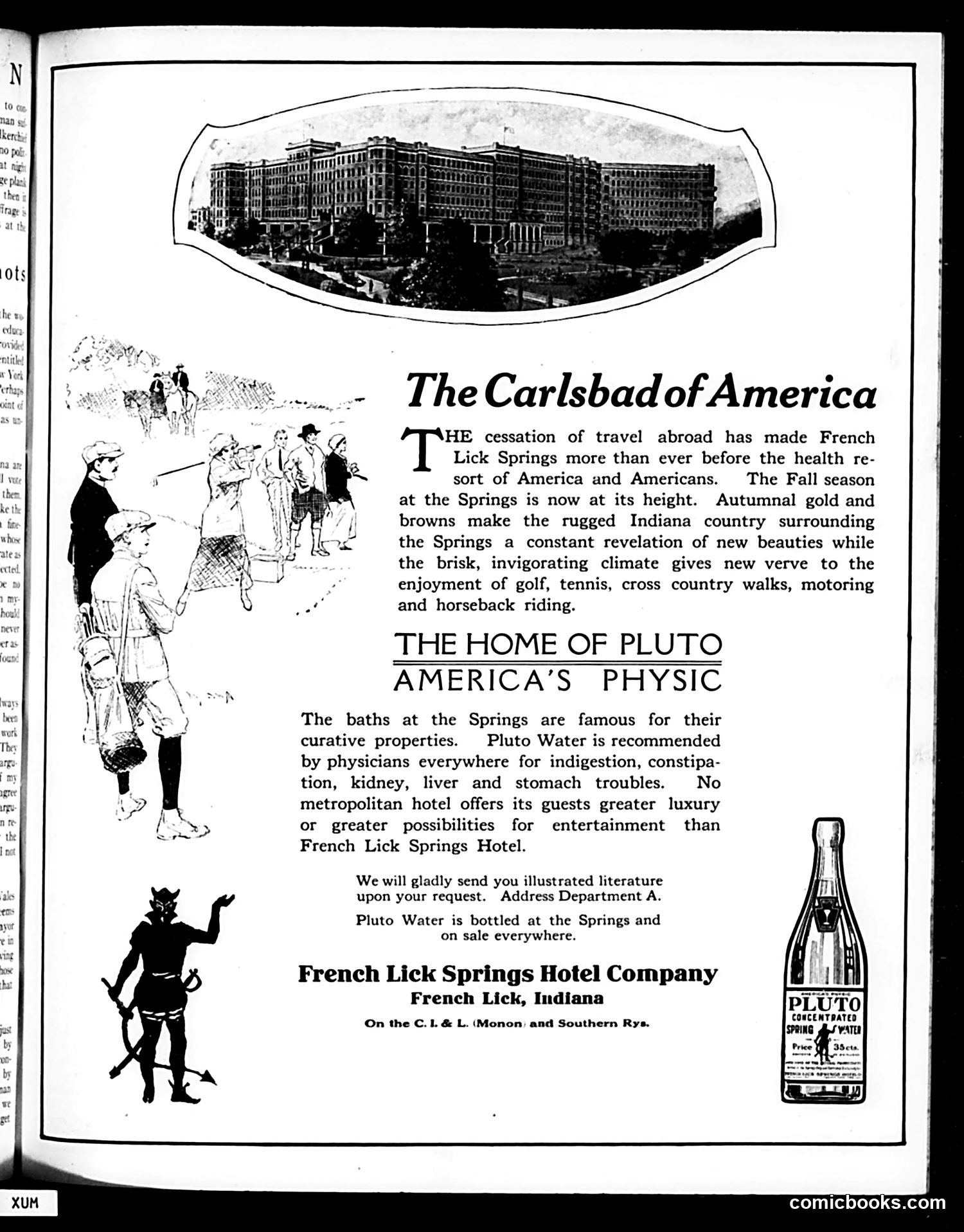
This is primarily a **full-page advertisement** rather than satire or political commentary. It promotes French Lick Springs Hotel in Indiana as a health resort and spa destination. The page references "Carlsbad of America"—comparing the Indiana springs to Carlsbad, a famous European spa town—capitalizing on the fact that World War I had made European travel difficult ("cessation of travel abroad"). The cartoon figures (a well-dressed couple and the mythological figure Pluto) are decorative elements supporting the marketing message. "Pluto" is the brand name for the mineral water sold at the springs; the classical god figure was a common advertising trope suggesting health and vitality. The emphasis on "Pluto Water" as a cure for digestive ailments reflects early 20th-century patent medicine marketing, when mineral waters were genuinely promoted by physicians for various conditions—practices that would later be heavily criticized. **This is commercial advertising, not political satire.**
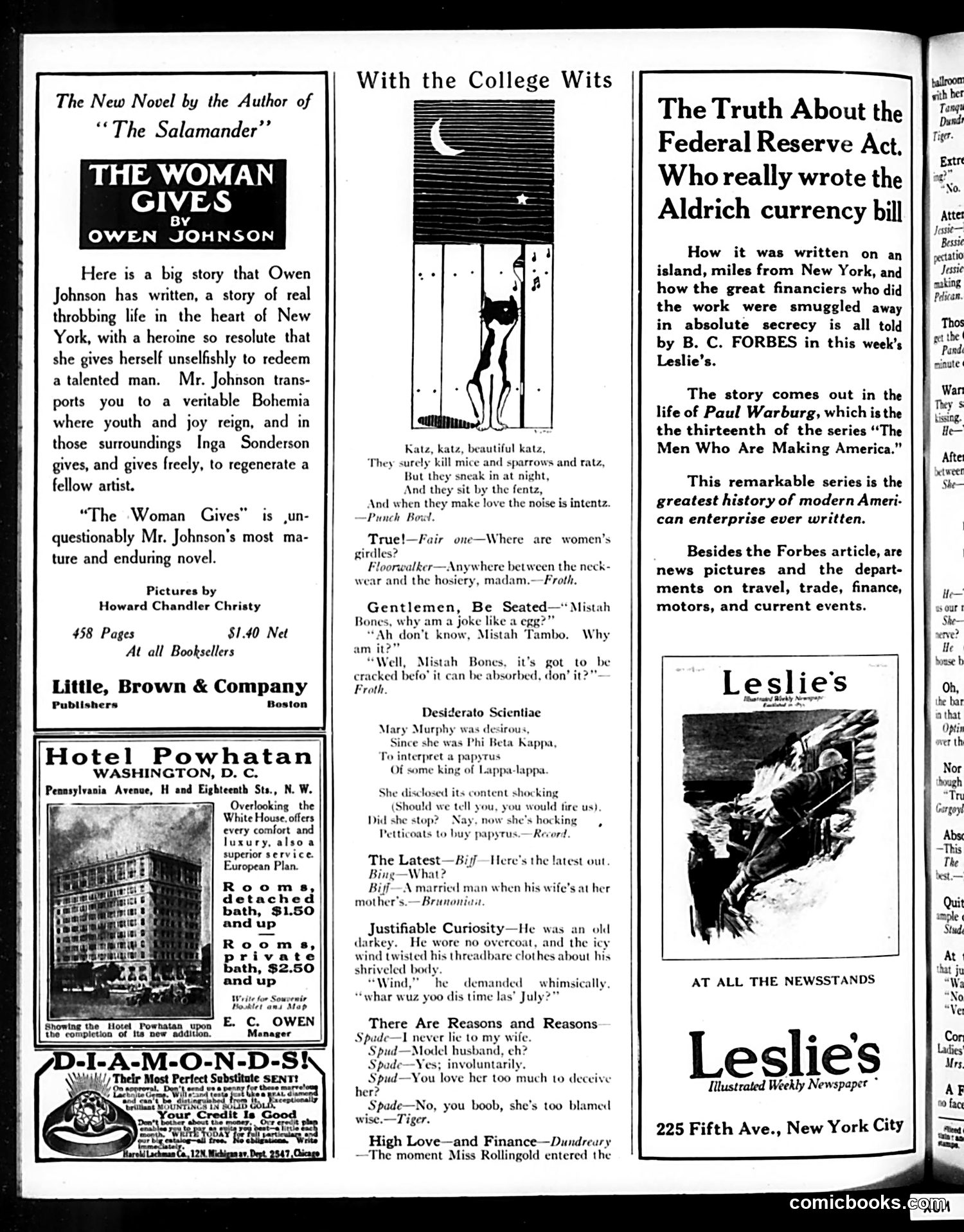
This page is primarily **advertising and editorial content** rather than political cartoons. The main items are: 1. **Book advertisement** for Owen Johnson's novel "The Woman Gives"—a romance set in bohemian New York about a selfless woman redeeming an artist. 2. **"With the College Wits" section**—a collection of campus humor jokes from various college publications (Punch Bowl, Froth, Record), including mild racial dialect humor typical of the era ("Mistah Bones" minstrel-style joke). 3. **Leslie's magazine advertisement** highlighting B.C. Forbes's article about Paul Warburg and the controversial origins of the Federal Reserve Act—suggesting the bill was written secretly by financiers away from public scrutiny. 4. **Hotel Powhatan advertisement** for a Washington D.C. luxury hotel. The page reflects early 20th-century satirical magazine content: light collegiate humor, literary promotion, and advertising mixed with occasional pointed commentary (the Federal Reserve article implies financial conspiracy).
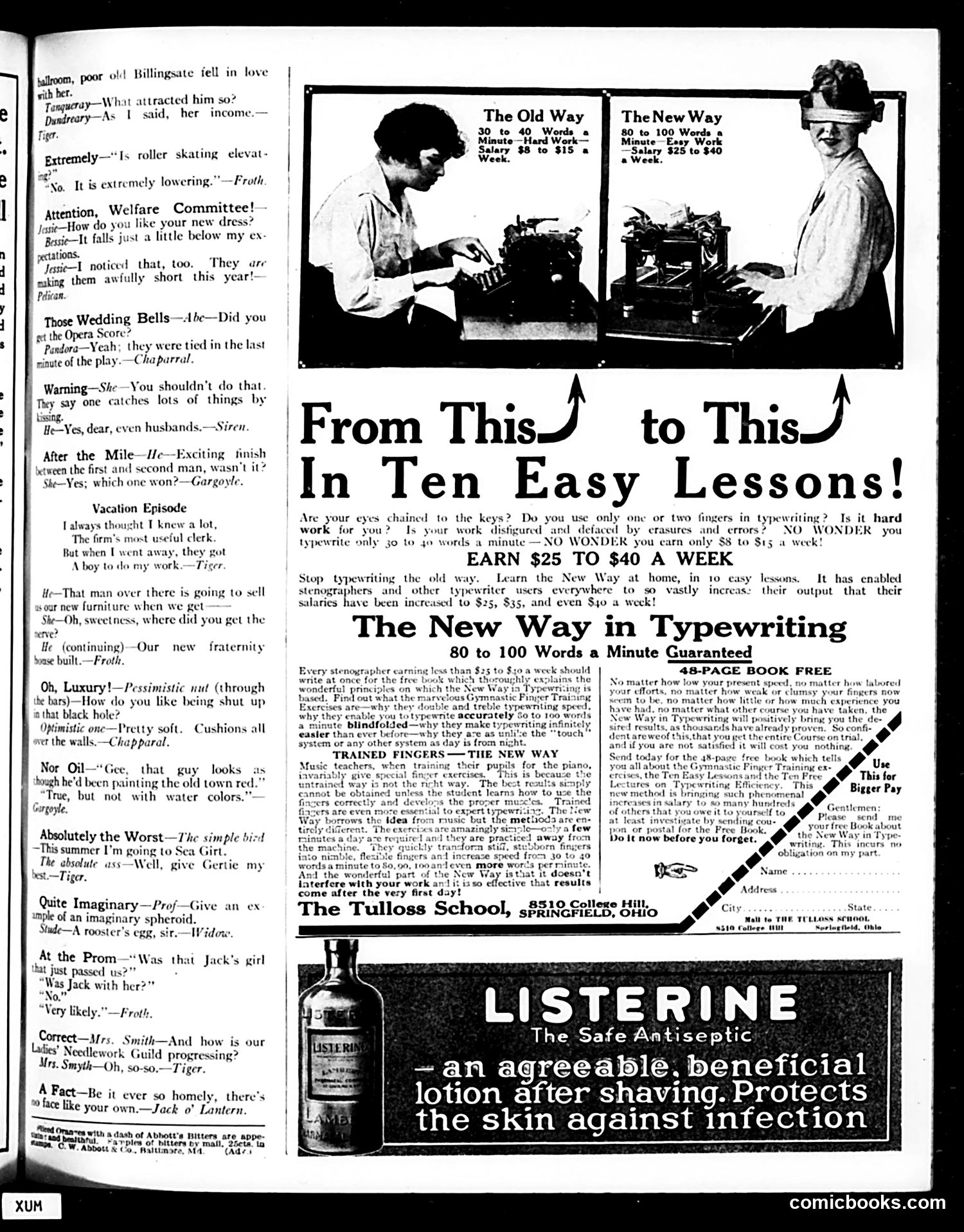
This page contains **humor columns and advertisements**, not political cartoons. The left side features brief comic anecdotes—short jokes about romance, social situations, and workplace observations typical of early 20th-century magazine humor. References like "Welfare Committee" and comments about women's dress lengths reflect 1920s-era social concerns. The dominant content is a **large advertisement for The Tulloss School** promoting a typewriting course. It contrasts "The Old Way" (30-40 words/minute, $8-15/week salary) with "The New Way" (80-100 words/minute, $25-40/week). This reflects genuine economic opportunity: fast typing was a marketable skill offering substantial wage increases. The guarantee of learning "in ten easy lessons" and the emphasis on proper finger technique represent contemporary vocational training marketing. At bottom is a **Listerine advertisement**, positioning mouthwash as an "antiseptic" lotion—reflecting early advertising's tendency to claim medical/health benefits for consumer products.
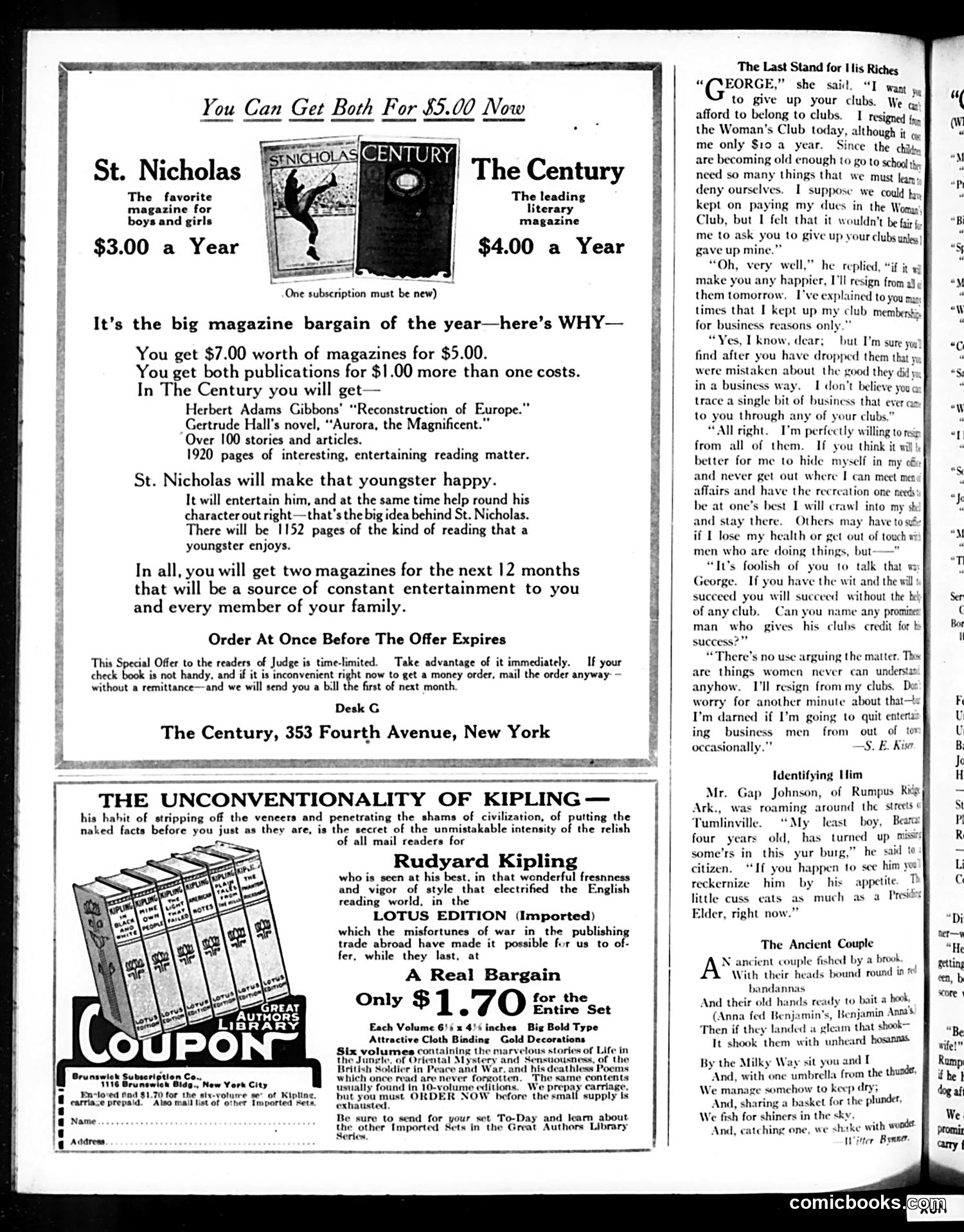
This page is primarily **advertising**, not satire or political commentary. The top half promotes a magazine subscription bundle: two publications (*St. Nicholas* for children, *The Century* literary magazine) sold together for $5 instead of their combined $7 value. The appeal emphasizes family entertainment and character-building for youngsters. Below is an advertisement for Rudyard Kipling's "Lotus Edition" — an imported, six-volume set priced at $1.70, highlighting Kipling's unflinching style and the scarcity caused by wartime publishing disruptions. At bottom right is a brief domestic fiction excerpt titled "The Last Stand for His Riches" about a wife pressuring her husband to resign from his clubs to economize. It illustrates early 20th-century gender dynamics regarding household finances and leisure spending. None of this constitutes political cartooning or satire — it's standard magazine advertising and serialized fiction typical of *Judge*'s commercial pages.
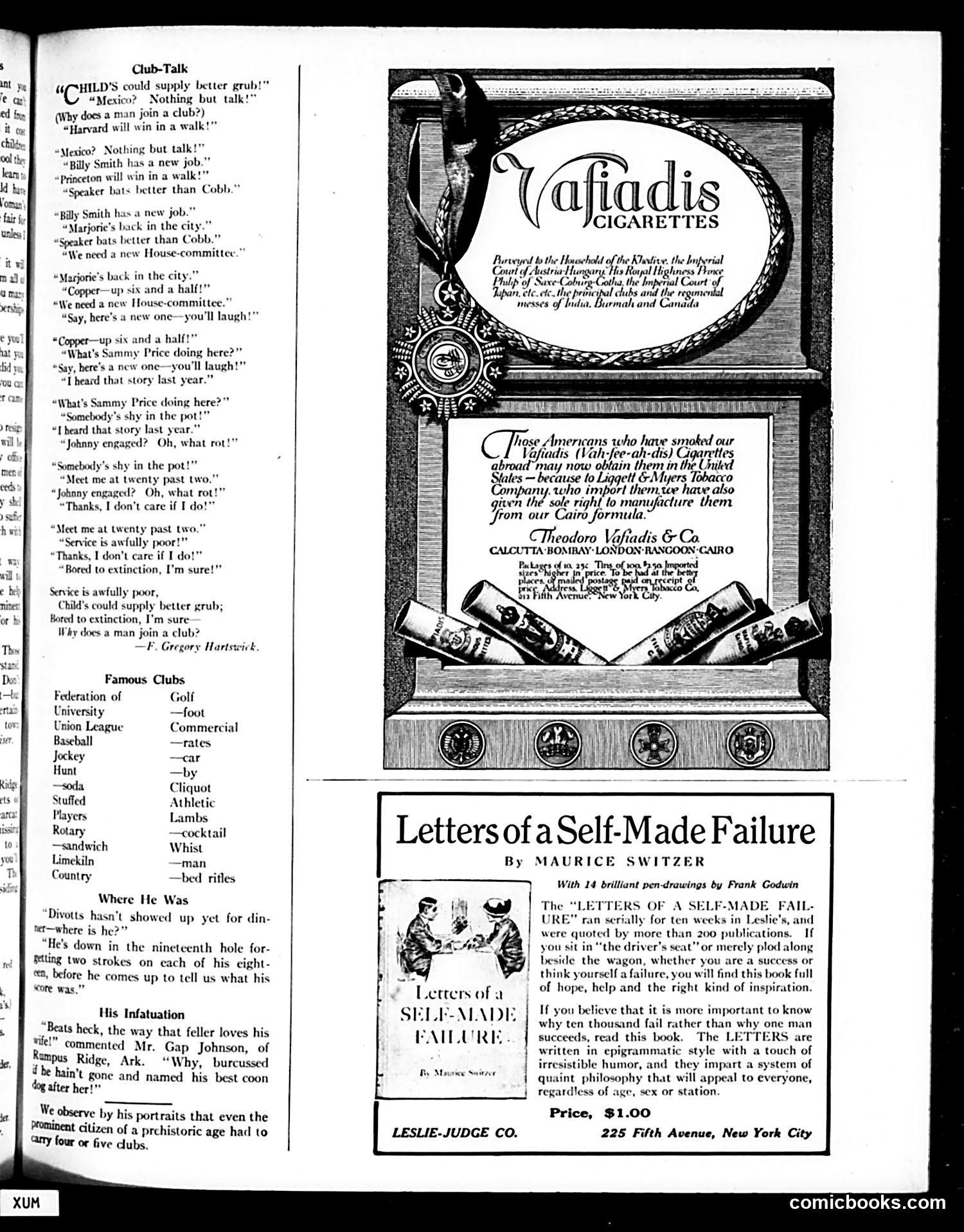
This page is primarily **advertising and book promotion**, with satirical commentary about club life. **The "Club-Talk" section** mocks the repetitive, boring conversation at exclusive clubs—members endlessly repeat the same tired jokes and gossip ("Mexico? Nothing but talk!"; "I heard that story last year"). The satirist F. Gregory Hartswick observes that clubs provide dull company and mediocre food, asking why men join them at all. **The Vafiadis Cigarettes ad** (right) promotes imported Egyptian cigarettes now manufactured in America under license by Liggett & Myers, marketed as prestigious because they're endorsed by foreign royalty and used abroad. **The "Letters of a Self-Made Failure" book promotion** advertises Maurice Switzer's humorous self-help volume, emphasizing that understanding failure is more valuable than studying success. It promises philosophical wit and universal appeal. The page reflects early 20th-century leisure culture: exclusive clubs, imported luxury goods, and popular self-improvement literature.
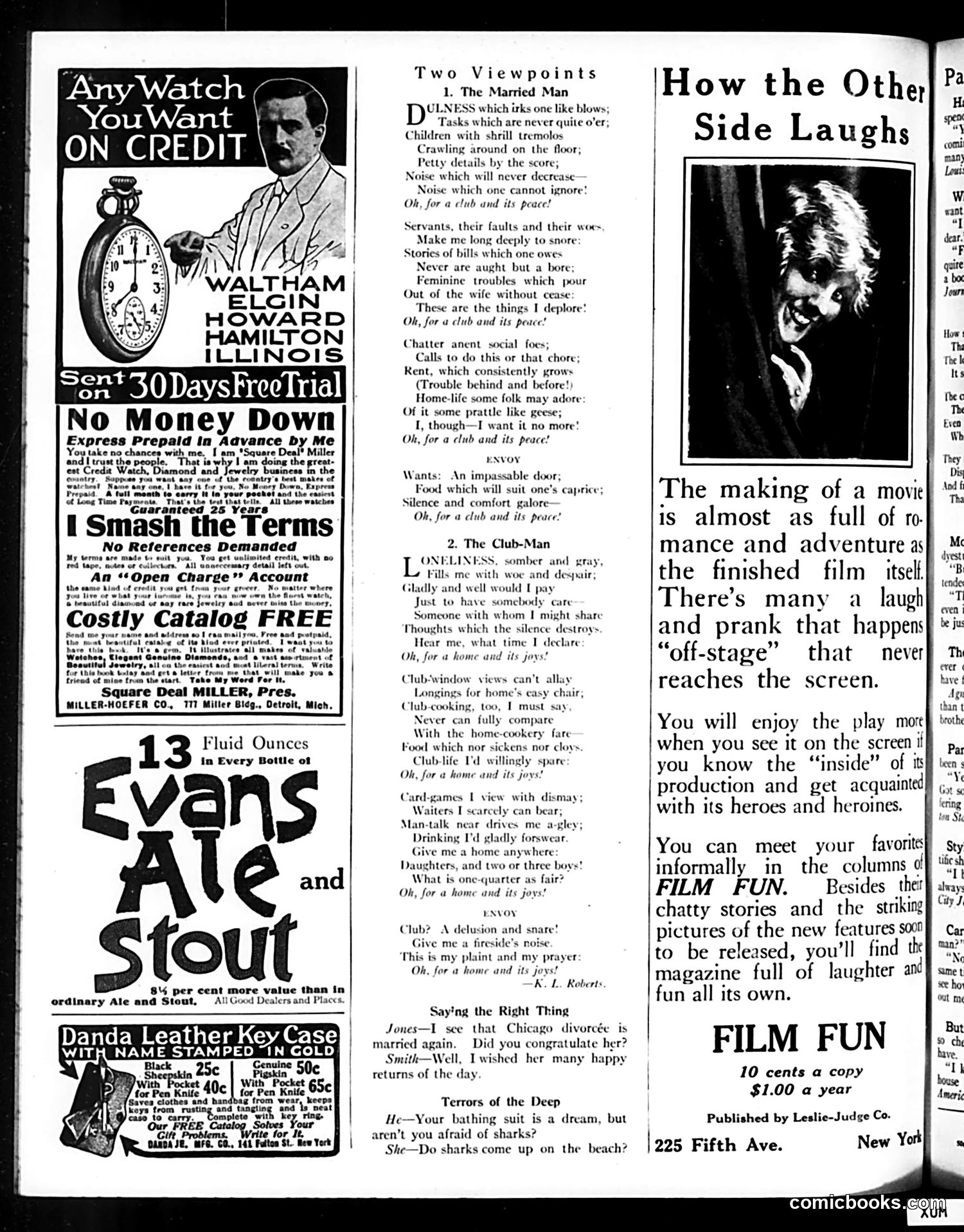
This page presents a satirical **contrast between married and club life** through two competing poetic viewpoints. **"The Married Man"** complains of domestic chaos—noisy children, demanding wives, servants, bills, and endless chores—and longs for the peace and silence of an exclusive club. **"The Club-Man"** paradoxically expresses the opposite: loneliness and despair in club life, yearning for home, family companionship, home-cooked meals, and his children. The satire cuts both ways, suggesting **no escape from discontent**: married men fantasize about club freedom while club members romanticize domestic life. This reflects early-20th-century anxieties about male domesticity versus bachelor independence—a recurring theme in satirical magazines. The page also includes light humor ("Saying the Right Thing" and "Terrors of the Deep") and period advertisements (watches on credit, leather goods, ale). The overall message: **grass is always greener**, and contentment eludes both conditions.
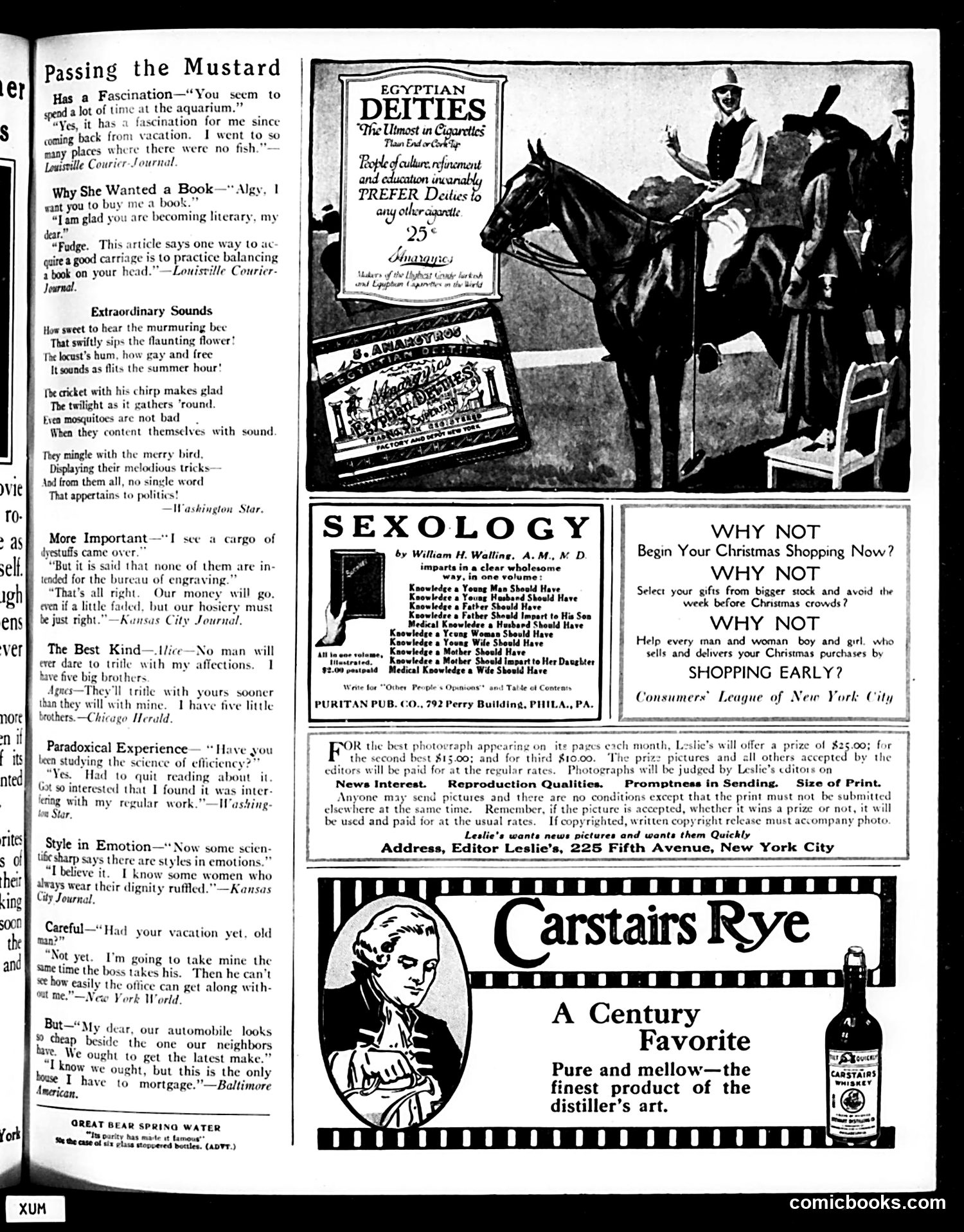
This page is primarily **advertising and reader submissions** rather than political satire. The content consists of: **Humorous Short Items**: Brief jokes and quotes from newspapers (Louisville Courier-Journal, Kansas City Journal, Washington Star, etc.) about everyday life—vacations, automobiles, relationships, office efficiency. These are lighthearted domestic humor with no apparent political content. **Advertisements**: Egyptian Deities cigars, Sexology book, Carstairs Rye whiskey, and a Consumers' League plea for early Christmas shopping to reduce crowding and help retail workers. **Photo Contest**: Leslie's magazine announcing a $25 prize for the best photograph submitted. The page reflects **early 20th-century American consumer culture and social attitudes**—concerns about efficient housekeeping, automobile ownership, gender relations, and holiday shopping. The "Why Not Shop Early?" campaign represents early organized consumer activism by the Consumers' League. There is **no identifiable political cartoon or significant satire** on this page—it's a typical miscellaneous content page from a humor/lifestyle magazine.
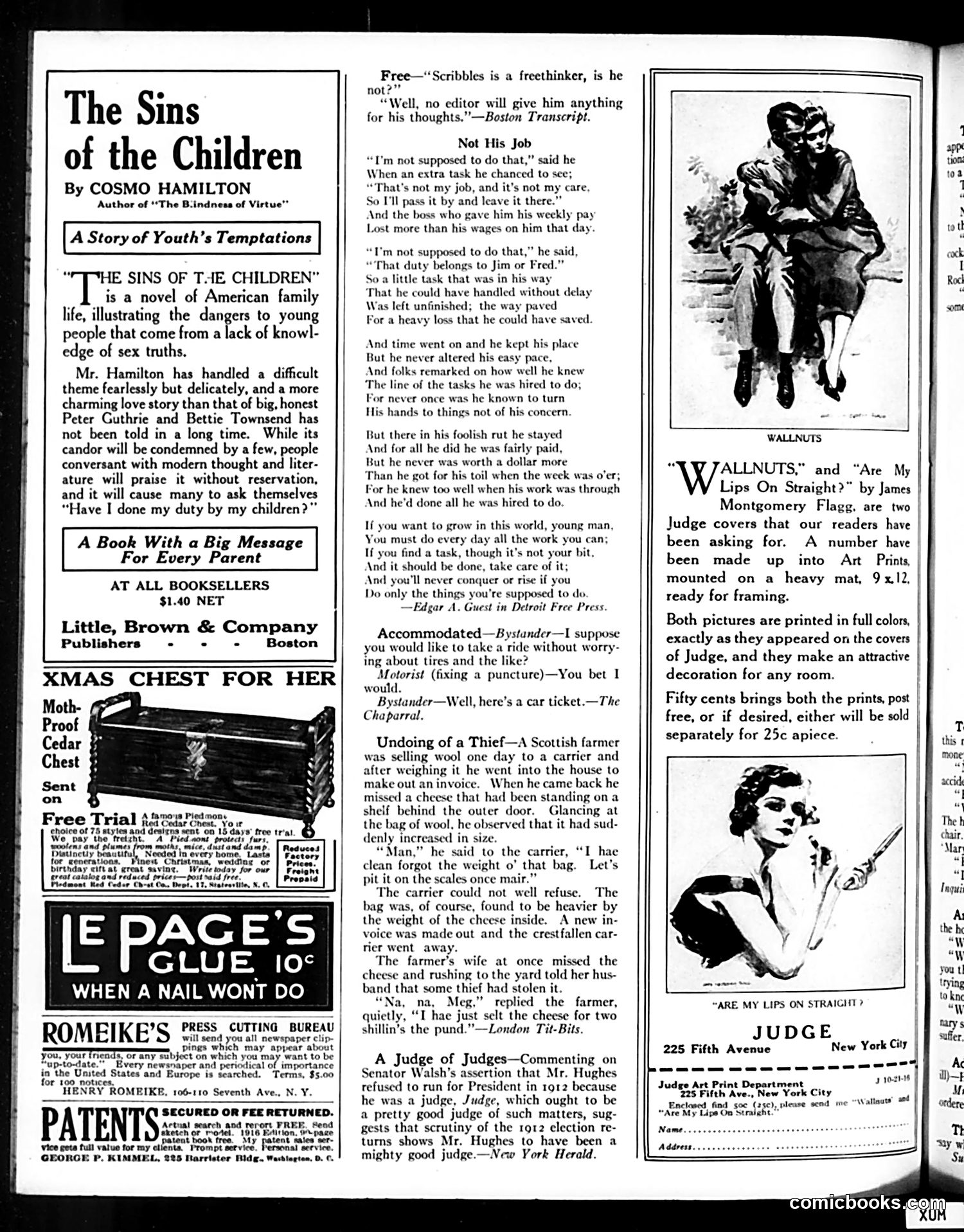
This page is primarily a **book advertisement and satirical humor magazine content**, not a political cartoon. The main feature advertises Cosmo Hamilton's novel *The Sins of the Children*, described as addressing sexual ignorance among youth—a progressive social concern for 1916. The book's frank treatment of sex education was considered bold for the era. The page includes several brief **humorous anecdotes**: 1. "Not His Job"—a cautionary tale criticizing workers who refuse tasks outside their job description, losing employers money through negligence 2. Short jokes about motorists, farmers, and Scottish thieves The humor reflects early-20th-century American values: work ethic, duty beyond one's strict responsibilities, and self-improvement. The remaining content consists of **period advertisements** (book chests, glue, patent searches, press clipping bureaus). There are no identifiable political figures or caricatures. This is a typical *Judge* magazine page mixing progressive literature promotion with moralistic humor and commercial ads.
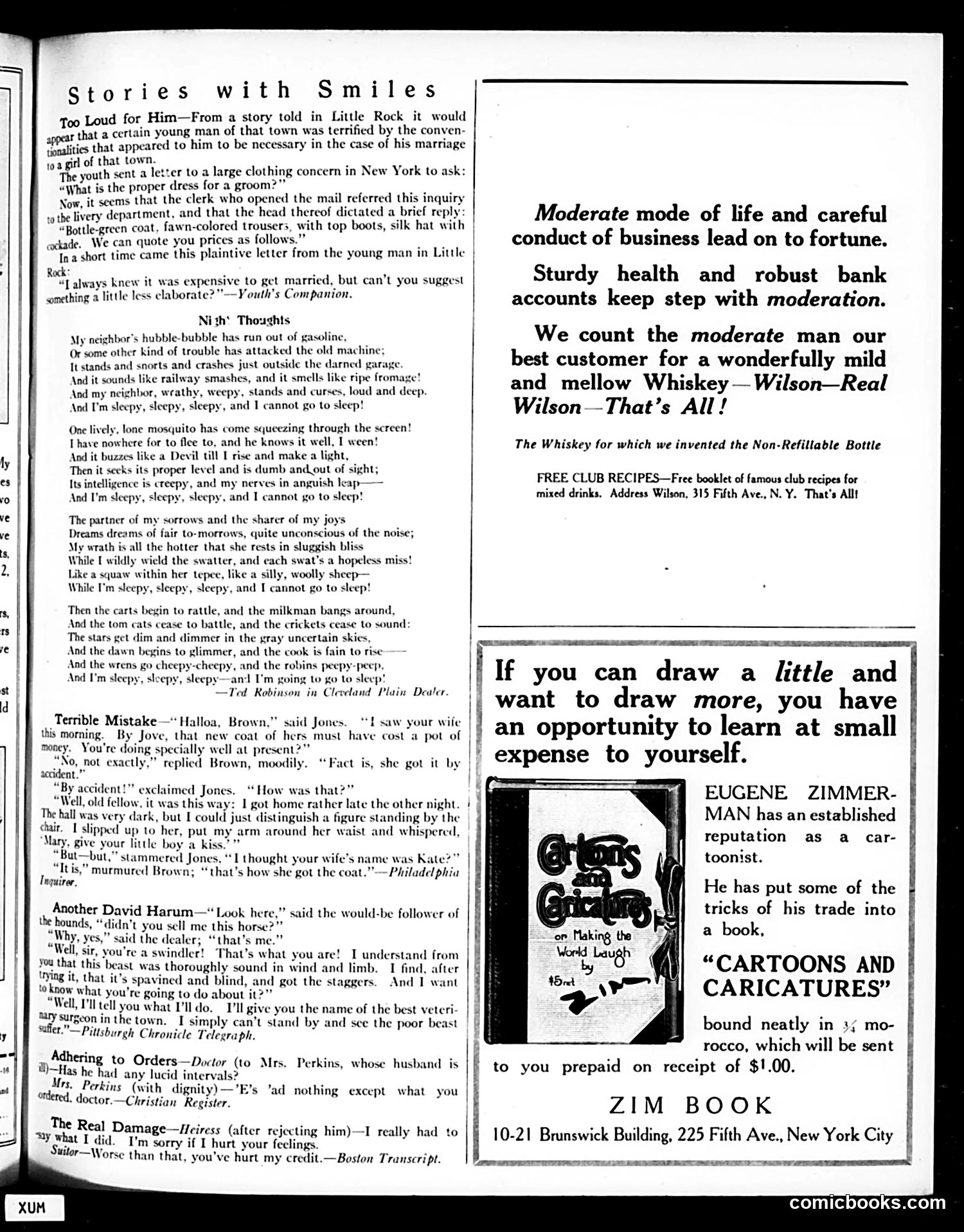
This page from *Judge* magazine contains several brief humorous stories rather than political cartoons. The humor reflects early 20th-century social anxieties: **"Too Loud for Him"** satirizes a young man's anxiety about wedding etiquette—he writes to a NYC clothing store asking proper groom attire, receiving a reply meant for livery (horse) department staff instead. The joke: his terror at social conventions is absurdly misdirected. **"Nith' Thoughts"** is a poem about insomnia caused by neighbors' car troubles, mosquitoes, and wife's poor aim with a fly swatter—capturing early automobile-age complaints. **"Terrible Mistake"** plays on marital miscommunication: a man mistakes his wife for a woman in the dark, kisses her, she assumes it's intentional flattery and buys an expensive coat. The wife's logic is humorously warped. The remaining anecdotes use similar comedic structures: misunderstandings, exaggerated male anxiety, and witty punchlines. The adjacent *Wilson Whiskey* advertisement emphasizes "moderation," reflecting prohibition-era attitudes.
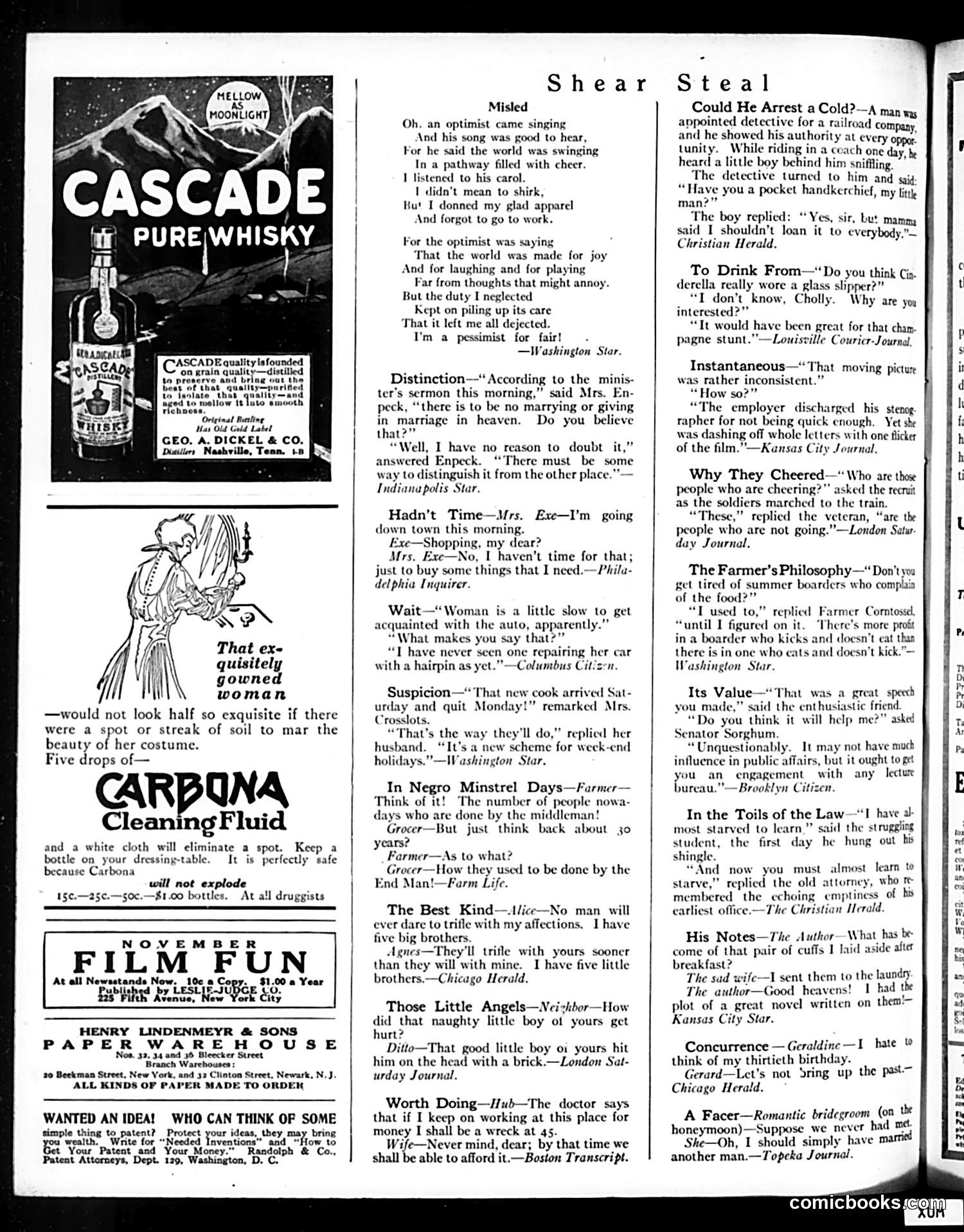
This page is primarily **advertisements and humor columns** rather than political cartoons. The main visual elements are ads for Cascade Whiskey, Carbona Cleaning Fluid, and other products. The humor pieces are brief, joke-format columns typical of early 20th-century magazines. They include: - **"Misled"**: A poem about an optimist whose cheerful outlook distracts him from work—satirizing naive optimism. - **"Distinction"**: A joke implying heaven must be better than hell because they don't marry there (dark humor about marriage). - **"In Negro Minstrel Days"**: References outdated minstrel show humor and compares modern middlemen to historical exploitation. - **"Those Little Angels"**: A joke about boys fighting, playing on the term "angels" ironically. These pieces use gentle satire on everyday situations—work, marriage, commerce, childhood misbehavior—rather than targeting specific political figures or events. The humor reflects period attitudes including casual racial references now considered offensive.
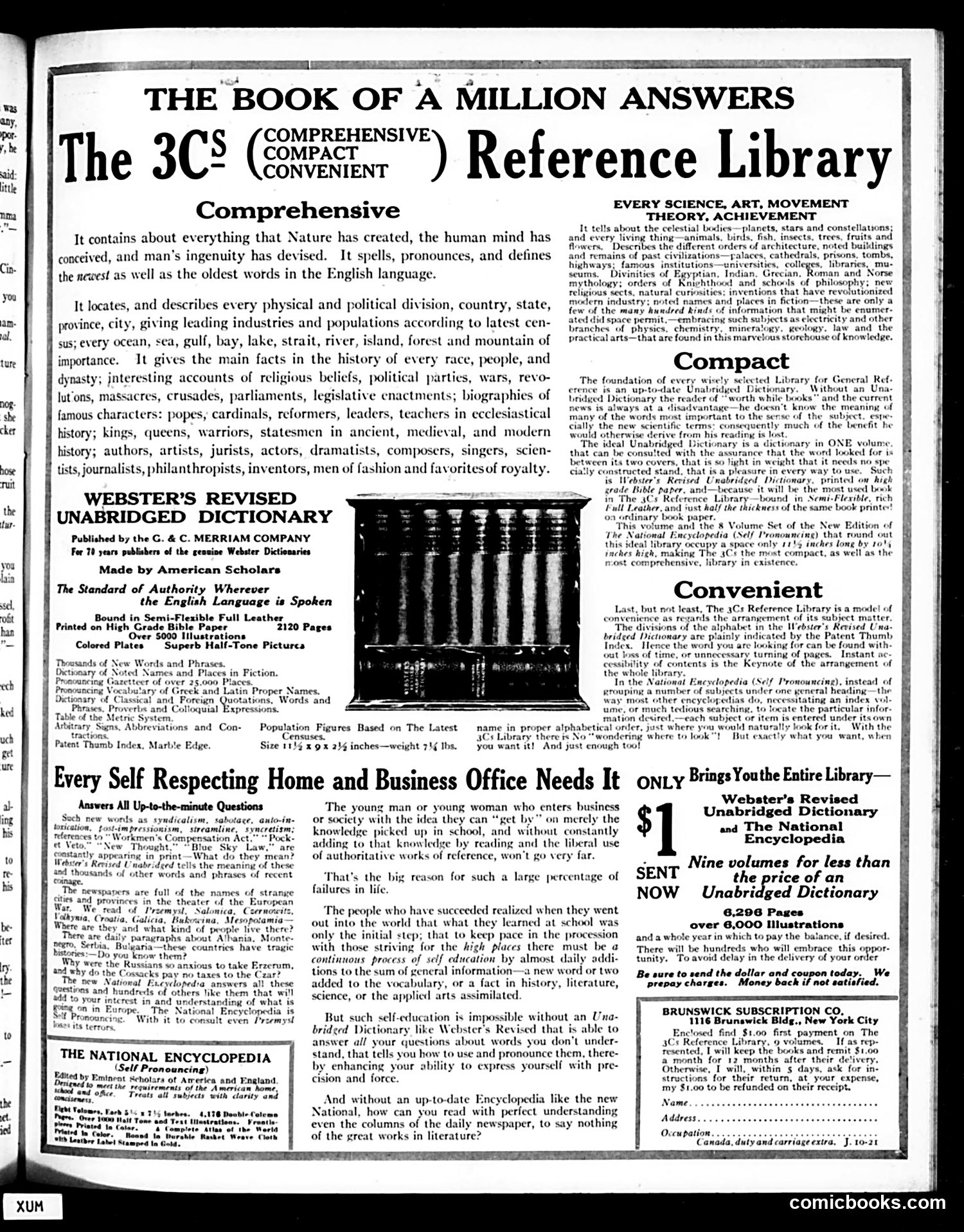
This page is primarily **advertising**, not political satire or cartoon content. It promotes "The 3C's Reference Library"—a comprehensive reference set combining Webster's Revised Unabridged Dictionary, The National Encyclopedia, and other reference materials. The marketing emphasizes three qualities (the "3C's"): **Comprehensive, Compact, and Convenient**. The ad targets self-education, appealing to readers who want authoritative information on "every science, art, movement, theory, achievement" without formal schooling. Notably, the text stresses that self-education is "impossible without an Unabridged Dictionary" and current encyclopedia, positioning these books as essential tools for anyone seeking social or economic advancement—a common early-20th-century sales pitch. The advertisement reflects period values: self-improvement through reading and the democratization of knowledge through affordable reference materials. No political figures or satire are evident on this page.
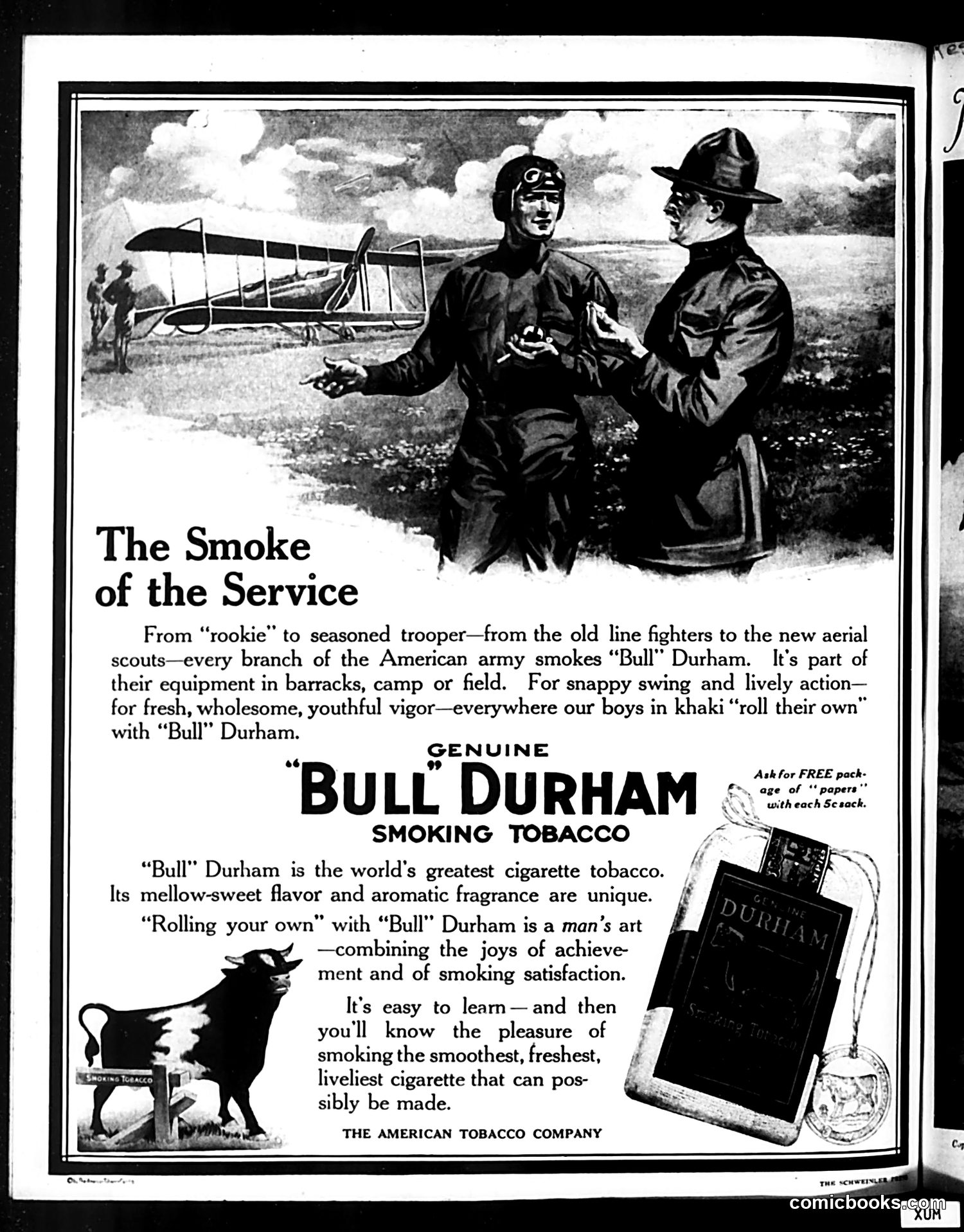
This is primarily a **cigarette advertisement**, not satire or political commentary. The "Judge" magazine page promotes Bull Durham smoking tobacco to American military personnel. The illustration depicts two soldiers (one in flying gear, one in campaign hat) conversing near an early aircraft, establishing a military setting. The ad claims Bull Durham is standard-issue equipment across all army branches—from infantry to "new aerial scouts" (WWI-era pilots). The appeal is patriotic and masculine: smoking Bull Durham is presented as a soldier's right-of-passage and mark of manhood ("rolling your own" is "a man's art"). The accompanying bull mascot reinforces strength and virility. **Modern context**: This reflects pre-health-warning tobacco marketing that openly targeted youth and military audiences, using patriotism and masculinity as selling points. Such ads would be illegal today. This is advertising copy, not editorial satire, though it exemplifies the era's unrestrained tobacco promotion.