
Judge, 1916-10-21 · page 17 of 32
Judge — October 21, 1916 — page 17: what you’re looking at
What you’re looking at
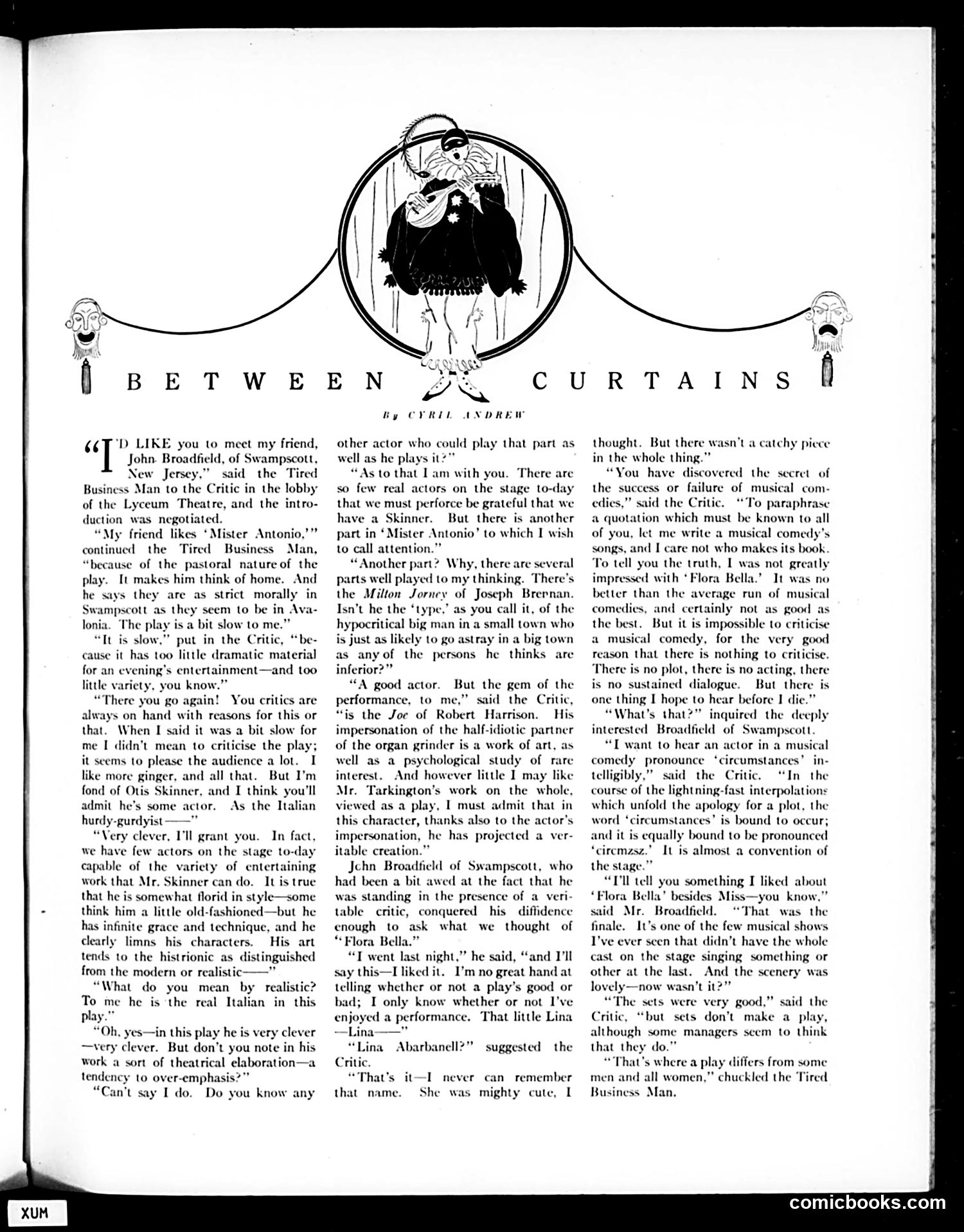
This theatrical dialogue satirizes the tension between professional drama critics and ordinary theatergoers. The "Tired Business Man" represents the average audience member who enjoys entertainment without analytical pretense, while the "Critic" embodies the pretentious, over-analytical theater reviewer. The humor centers on their debate about a play called "Mister Antonio" starring **Otis Skinner**, a famous actor of the period. The Critic dismisses the production as slow and lacking dramatic material, while the Business Man simply enjoyed it and admires Skinner's performance. The Critic accuses Skinner of being "florid" and overly theatrical rather than realistic. The satire mocks critics who prioritize intellectual frameworks over genuine audience enjoyment. The Business Man's pragmatic response—that he only cares whether he enjoyed himself—contrasts with the Critic's elaborate justifications for disliking the show. Judge suggests critics often complicate simple entertainment with unnecessary sophistication.
📄 Transcribed text from this page (OCR, searchable)
Machine-transcribed from the original scan — historical spelling and the odd misread are preserved.
DW sal LIKE you to meet my friend, John. Broadfield, of Swampscott, New Jersey,” said the Tired Business Man to the Critic in the lobby of the Lyceum Theatre, and the intro- duction was negotiated. “My friend 1 Mister Antonio,’” continued the Tired Business Man, “because of the pastoral nature of the play. [1 makes him think of home. And he says they are as strict morally in Swampscott as they seem to be in Ava- lonia. The play is a bit slow to me.” “Tt is slow,” put in the Crit cause it has too little dramatic material for an evening's entertainment—and too little variety, you know.” “There you go again! You critics are always on hand with reasons for this or that. When I said it was a bit slow for me I didn’t mean to criticise the play; it seems to please the audience a lot. I like more ginger, and all that. But I’m fond of Otis Skinner, and I think you'll admit he’s some actor. As the Italian hurdy-gurdyist “Very clever, I'll grant you. In fact, we have few actors on the stage to-day capable of the variety of entertaining work that Mr. Skinner can do. It is true that he is somewhat florid in style—some think him a little old-fashioned—but he has infinite grace and technique, and he clearly limns his characters. tends to the histrionic as from the modern or realistic “What do you mean by realistic To me he is the real Italian in this pla: “Oh, yes—in this play he is very clever —very clever. But don’t you note in work a sort of theatrical elaboration—a tendency to over-emphasis?” “Can't say Ido. Do you know any BETWEEN 2s CURTAINS by CYRIL ANDREW other actor who could play that part as well as he plays it?” As to that Iam with you. There are so few real actors on the stage to-day that we must perforce be grateful that we have a Skinner. But there is another part in ‘Mister Antonio’ to which I wish to call attention.” “Another part? Why, there are several parts well played to my thinking. There’s the Milton Jorney of Joseph Brernan. Isn’t he the ‘type,’ as you call it, of the hypocritical big man in a small town who just as likely to go astray in a big town as anyof the persons he thinks are inferior?” “A good actor. But the gem of the performance, to me,” said the Critic, “is the Joe of Robert Harrison. His impersonation of the half-idiotic partner of the organ grinder is a work of art, as well as a psychological study of rare interest. And however little I may like Mr. Tarkington’s work on the whole, viewed as a play, I must admit that in this character, thanks also to the actor's impersonation, he has projected a ver- itable creation Jchn Broadfield of Swampscott, who had been a bit awed at the fact that he was standing in the presence of a veri- table critic, conquered his diffidence enough to ask what we thought of “Flora Bella.” “T went last night,” he said, “and I'll say this—I liked it. I’m no great hand at telling whether or not a play’s good or bad; I only know whether or not I've j That little Lina ancl?” suggested the it—I never can remember that name. She was mighty cute, 1 But there v thought. in the whole thing. “You have discovered the secret of the success or failure of musical com- edies,” said the Critic. “To paraphra: a quotation which must be known to all of you, let me write a musical comedy’s songs, and I care not who makes its book. To tell you the truth, I was not greatly impressed with ‘Flora Bella.’ It was no better than the average run of musical comedies, and certainly not as good the best. But it is impossible to criticise a musical comedy, for the very good reason that there is nothing to criticis There is no plot, there is no acting, there is no sustained dialogue. But there is one thing I hope to hear before I die.” “What's that?” inquired the deeply interested Broadfield of Swampscott “I t to hear an actor in a mus comedy pronounce ‘circumstances’ in- telligibly,” said the Critic. “In the course of the lightning-fast interpolations which unfold the apology for a plot, the word ‘circumstances’ is bound to occur; and it is equally bound to be pronounced * It is almost a convention of sn’ta catchy piece ‘Flora Bel you know,’ Mr. Broadfield. as the le. It’s one of the few musical shows ¢ ever scen that didn’t have the whole cast on the stage singing something or other at the last. And the scenery was Jy—now wasn’t it re very good,” said the s don’t make a_ pl: although some managers seem to think said The sets v s where a play differs from some men and all women,” chuckled the Tired Business Man, comicbooks.com