
Judge, 1916-10-21 · page 4 of 32
Judge — October 21, 1916 — page 4: what you’re looking at
What you’re looking at
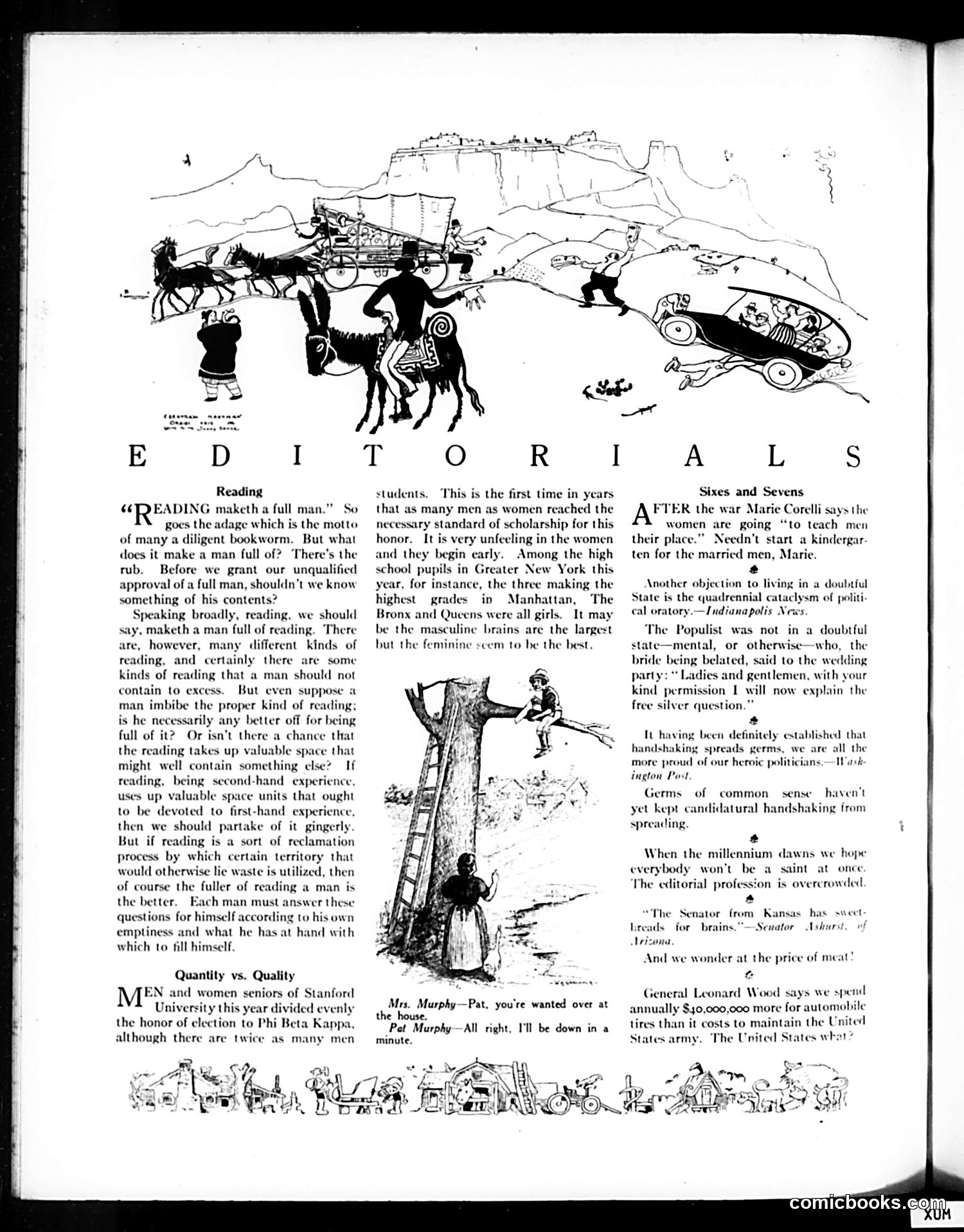
This page contains three distinct sections: **Top illustration ("Editorials")**: A satirical cartoon depicting the collision between old and new—a horse-drawn wagon laden with traditional goods meeting a modern automobile on a road. The imagery critiques the rapid technological disruption of early 20th-century American life. **Left column ("Reading")**: An editorial essay debating what constitutes proper reading material for men, questioning whether men should read "valuable space that might well contain something else." **Right columns**: Brief satirical commentary on post-WWI social issues, including women's suffrage ("the free silver question"), concerns about disease transmission ("handswiping spreads germs"), and military spending on automobiles versus Army maintenance. The overall theme appears to be contemporary anxieties about modernization, changing gender roles, and government priorities during the interwar period.
📄 Transcribed text from this page (OCR, searchable)
Machine-transcribed from the original scan — historical spelling and the odd misread are preserved.
Reading 3 maketh a full mar age which is the motto of many a diligent bookworm. But what does it make a man full of? There's the rub. Before we grant our unqualified approval of a full man, shouldn't we know something of his contents? Speaking broadly, reading, we should say, maketh a man full of reading. There are, however, many different kinds of reading, and certainly there are some kinds of reading that a man should not contain to excess. But even suppose a man imbibe the proper kind of reading; is he necessarily any better off for being full of it? Or isn’t there a chance that the reading takes up valuable space that might well contain something else? If reading, being second-hand ¢ uses up valuable space units t to be devoted to first-hand e: then we should partake of it ging But if reading is a sort of reclamation process by which certain territory that would otherwise lie waste is utilized, then of course the fuller of reading a man is the better. Each man must answer these questions for himself according to his own emptiness and what he has at hand with which to fill himself Quantity vs. Quality EN and women seniors of Stanford University this year divided evenly the honor of election to Phi Beta Kappa, although there are twice as many men students, This is the first time in years that as many men as women reached the necessary standard of scholarship for this honor. It is very unfeeling in the women and they begin early. Among the high school pupils in Greater New York this year, for instance, the three making the highest grades in Manhattan, The Bronx and Queens were all girls. It may be the masculine brains are the largest but the feminine scem to be the best. Mrs. Murphy—Pat, you're wanted over at the house. Pat Murphy—All right. I'll be down in a Sixes and Sevens the war Marie Corelli says the women are going “to teach men their place.” Needn’t start a kindergar ten for the married men, Marie. 2 Another objection to living in a doubtful State is the quadrennial cataclysm of politi- cal oratory.—Indiana polis News The Populist was not in a doubtful state—mental, or otherwise—who, the bride being belated, said to the wedding party: * Ladies and gentlemen, with your kind permission I will now explain the free silver question.” * It having been definitely established that handshaking spreads germs, we are all the more proud of our heroic politicians. — Was ington Post, Germs of common sense haven't yet kept candidatural handshaking from spreading. e When the millennium dawns we hope everybody won't be a saint: at once ‘The editorial profession is overcrowded. @ or from brains.” Kansas has sweet Senator Ashurst “The breads for sIrisona. And we wonder at the price of meat! t General Leonard Wood says we spend annually $40,000,000 more for automobile tires than it costs to maintain the United States army. The United States whet?