
A complete issue · 32 pages · 1916
Judge — September 9, 1916
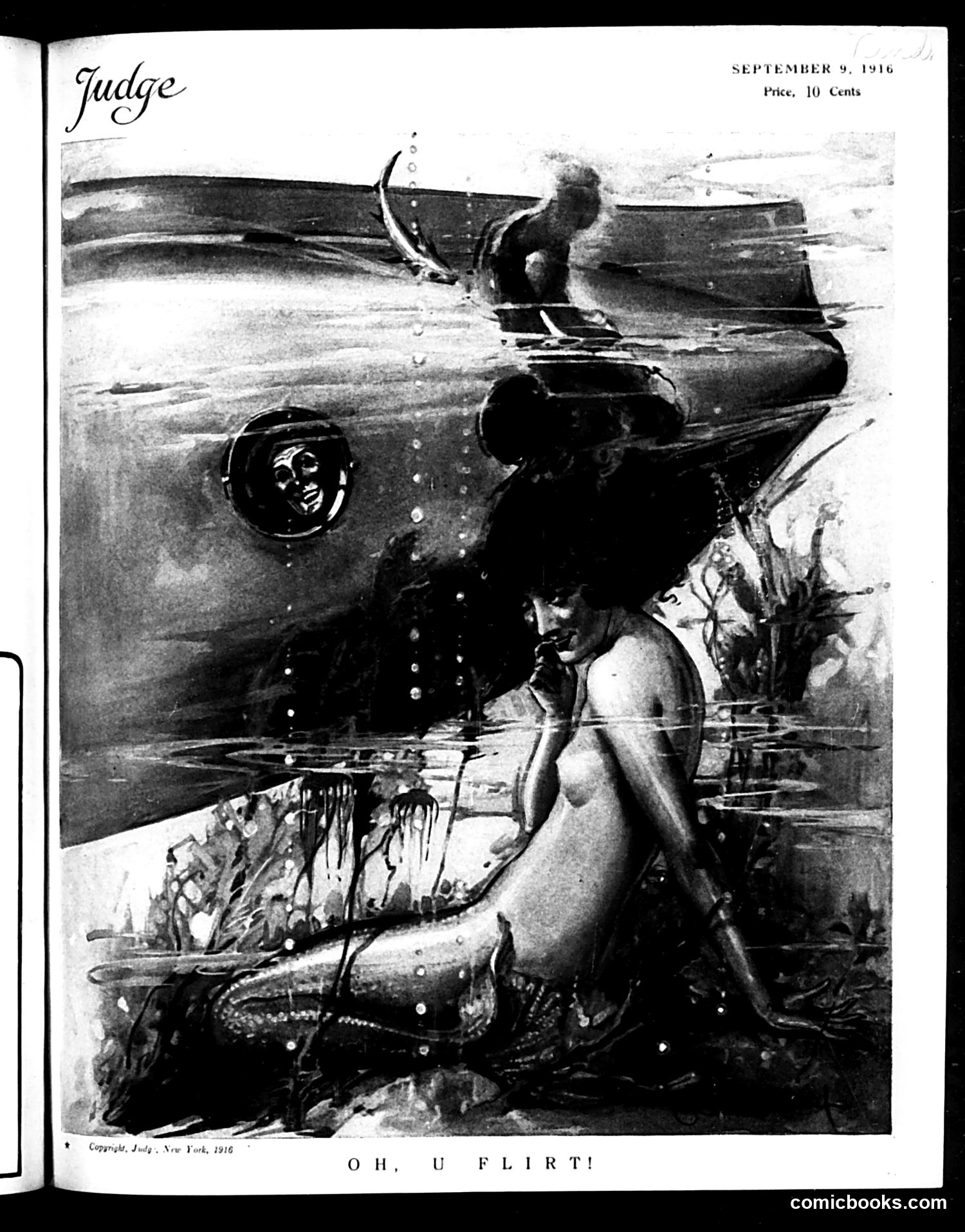
This Judge magazine cover from September 9, 1916 depicts a mythological or allegorical scene featuring a partially nude female figure (likely representing a nation or abstract concept) surrounded by male figures in military dress. The title "Oh, U Flirt!" appears to reference the German submarine campaign ("U-boat" warfare) that was a major controversy in 1916. The satire likely mocks Germany's submarine warfare tactics—presented as aggressive "flirtation" or seduction rather than straightforward military action. The partially clothed female figure may represent America or neutral nations being threatened or tempted by German military power. The composition suggests the unsettling nature of submarine warfare, which killed civilians and challenged American neutrality before the U.S. entered World War I in 1917.
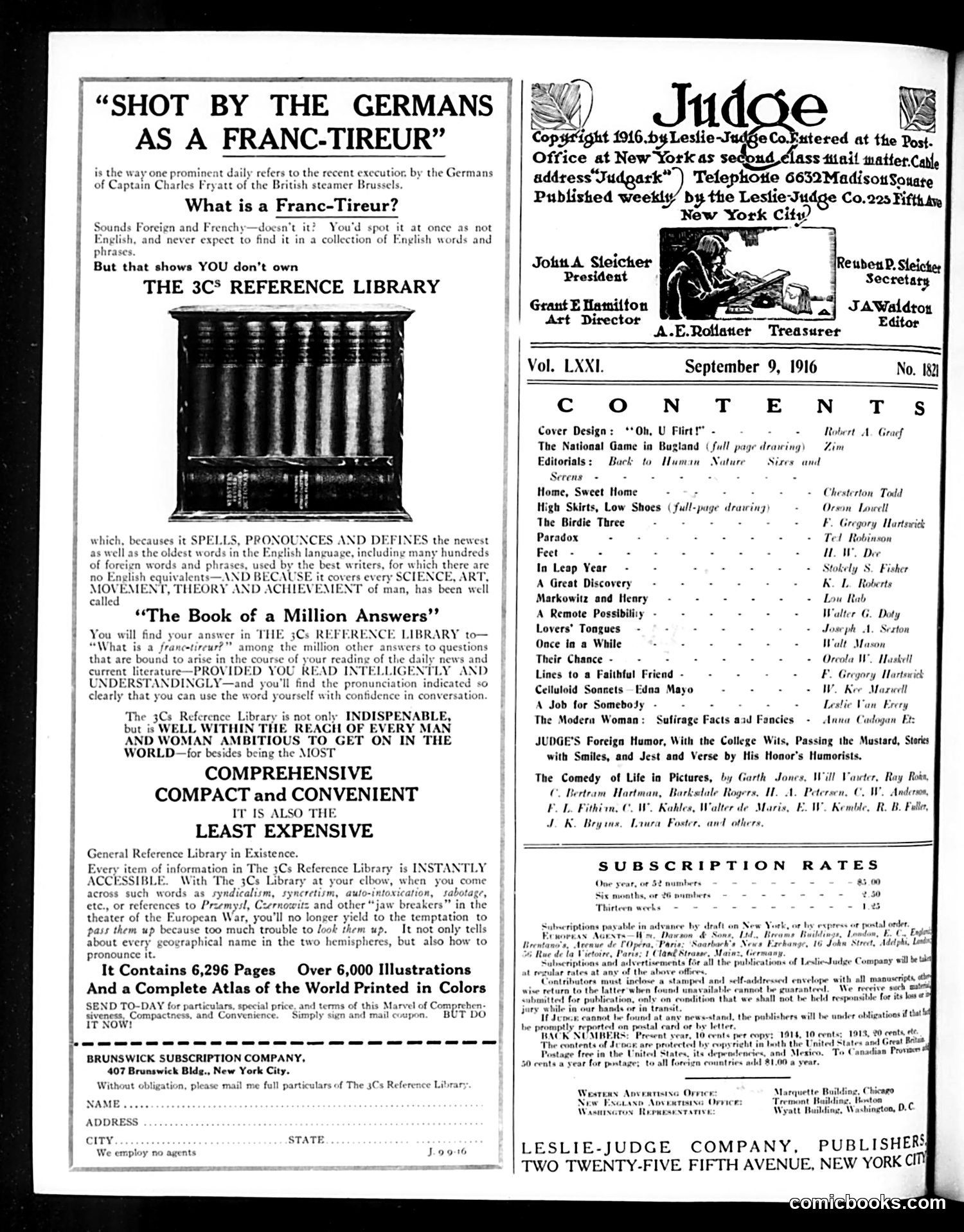
This page is primarily **advertising and masthead information** rather than political cartoon. The left side advertises the 3C's Reference Library—a comprehensive encyclopedia claiming 6,296 pages and 6,000 illustrations. The ad emphasizes the book's utility for understanding unfamiliar terms, including "franc-tireur" (referenced in the header as relating to a German execution of Captain Fryatt). The right side shows the magazine's **contents page** listing various articles and illustrations, including humor pieces, drawings on fashion and social topics, and foreign humor sections. No significant political cartoons are visible on this page. The content reflects typical 1916 magazine layout: advertisements, mastheads, and contents listings rather than editorial commentary or satire.
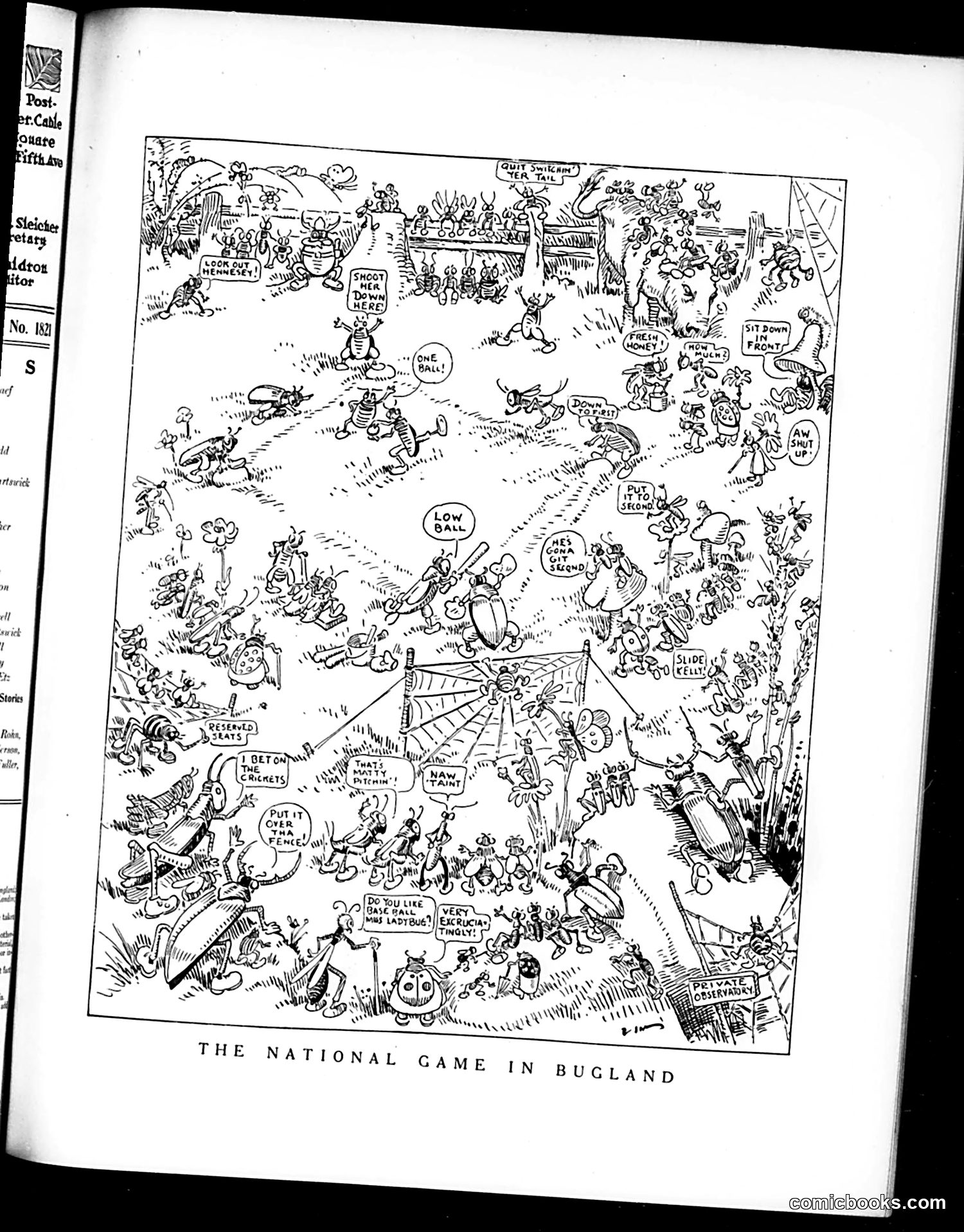
This is a satirical cartoon depicting an insect-themed baseball game. The title plays on baseball as "America's National Game" by reimagining it populated entirely by bugs and creatures in a fantastical landscape. The cartoon is a busy, humorous "spot the detail" style illustration typical of Judge magazine, featuring numerous insects engaged in baseball activities—batting, fielding, running bases. Various speech bubbles contain exclamations and game commentary from the bug players. The satire appears to be gentle humor rather than pointed political commentary; it's visual wordplay where "bugland" becomes a literal world of bugs playing humanity's favorite sport. This type of anthropomorphized animal humor was popular in early 20th-century American comic magazines, appealing to readers' sense of whimsy and detailed observation.
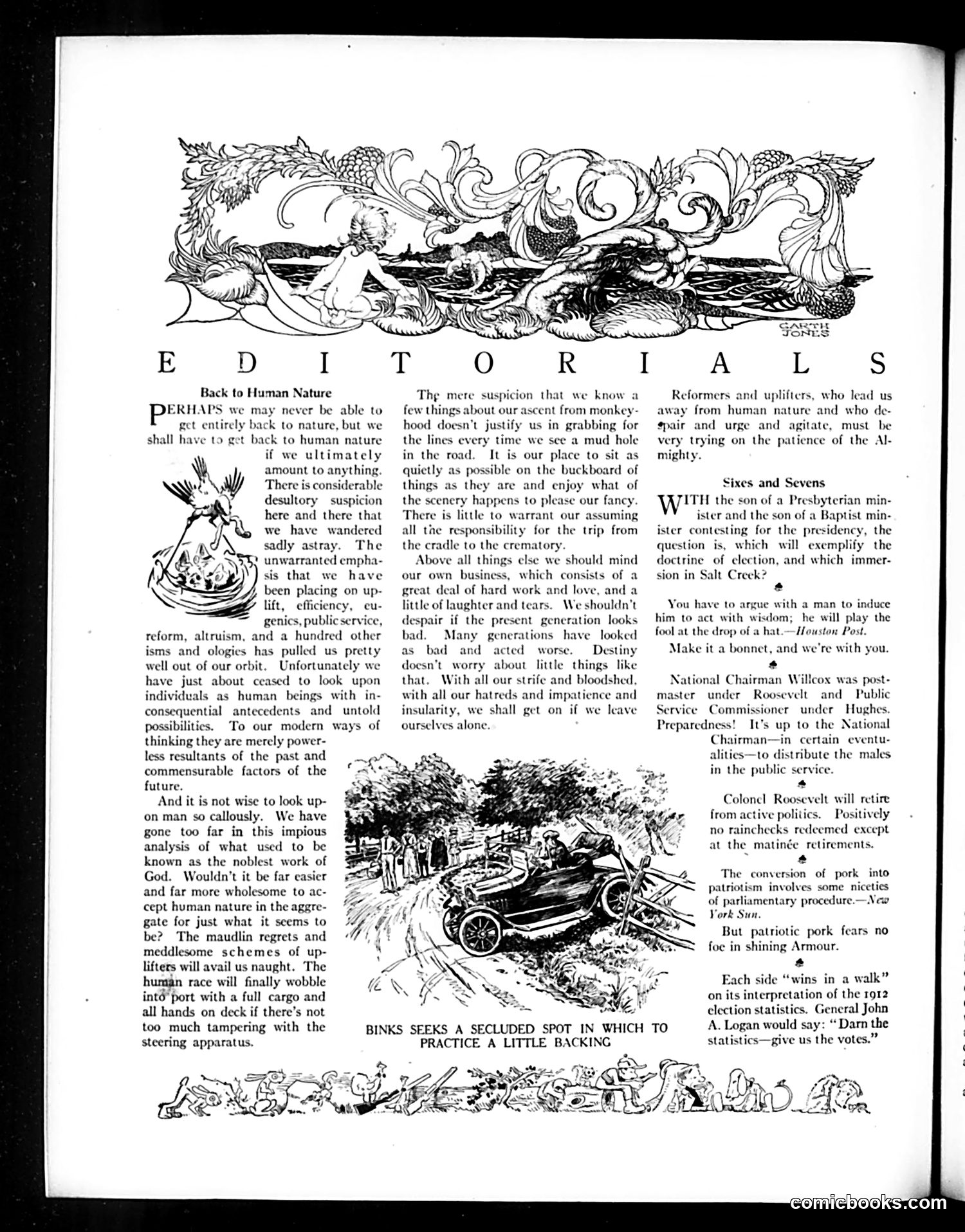
This is a political editorial page from *Judge* magazine featuring commentary on progressive reform movements and contemporary politics. The left column ("Back to Human Nature") criticizes excessive faith in reform ideologies, arguing that human nature—not perfect systems—ultimately determines outcomes. The author warns against naive utopianism. The right column discusses "Sixes and Sevens," referencing a Presbyterian minister and Baptist minister contesting for the presidency. It mentions Chairman Wilcox under Roosevelt and Public Service Commissions, and notes Colonel Roosevelt's retirement from active politics. The central illustration shows a car (labeled "Binks") seeking a secluded spot to practice "backing"—likely a metaphor for political maneuvering or strategic retreat. The satirical tone critiques both reform enthusiasm and political positioning of the era.
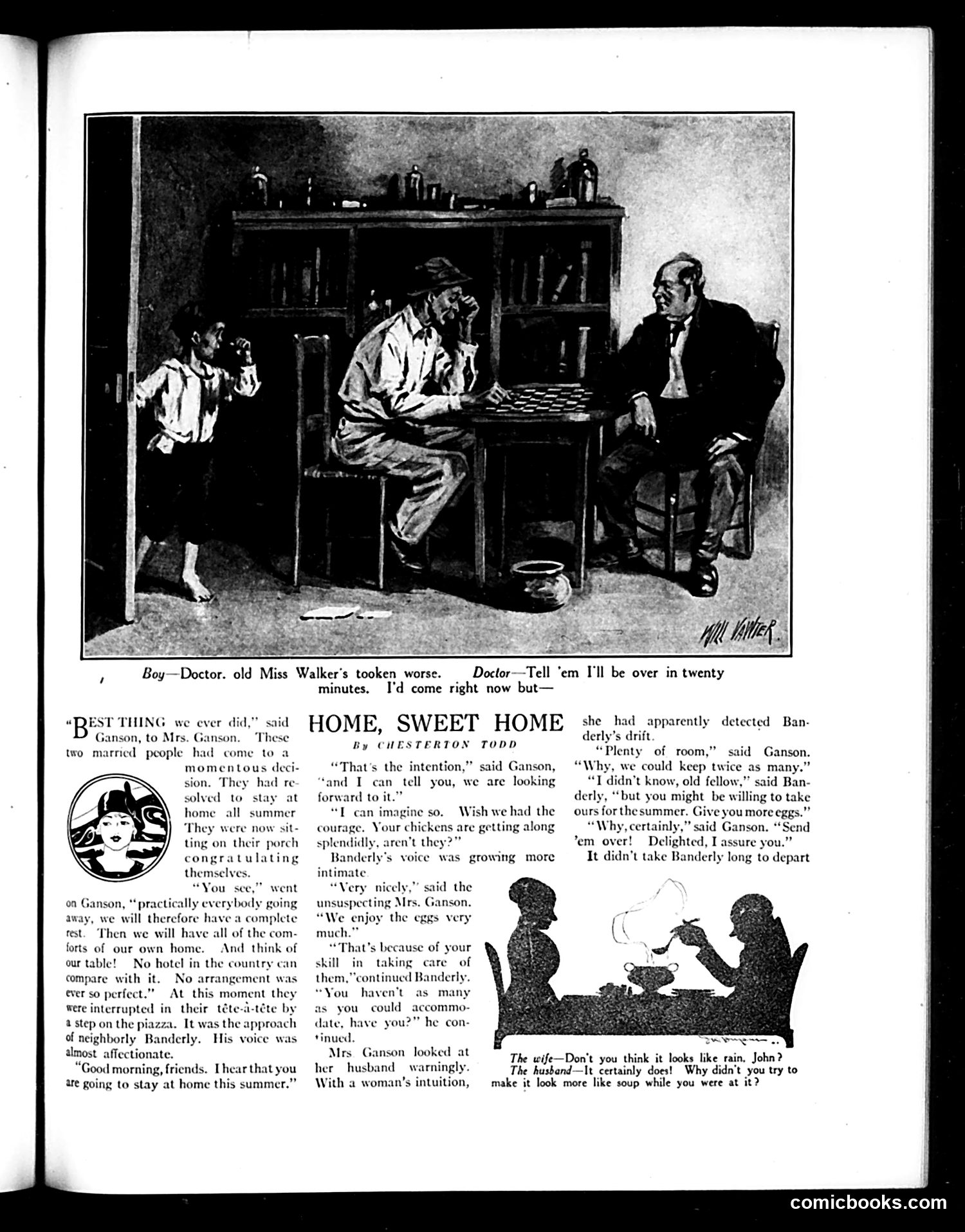
This is a domestic comedy about a married couple, the Gansons, deciding to stay home for summer rather than travel. The humor centers on their neighbor Banderly's attempts to convince them otherwise—he wants them gone so he can use their property or take advantage of their absence. The joke plays on conflicting desires: Banderly tries various persuasive tactics (praising their chickens, offering to take eggs) while the Gansons remain firm about staying put. The cartoon's title ironically emphasizes the comfort of home, while the dialogue reveals Banderly's self-interested motives. The bottom illustration shows a wife criticizing her husband's cooking, suggesting domestic mishaps when wives aren't managing household tasks—a common period stereotype about male incompetence in domestic matters.
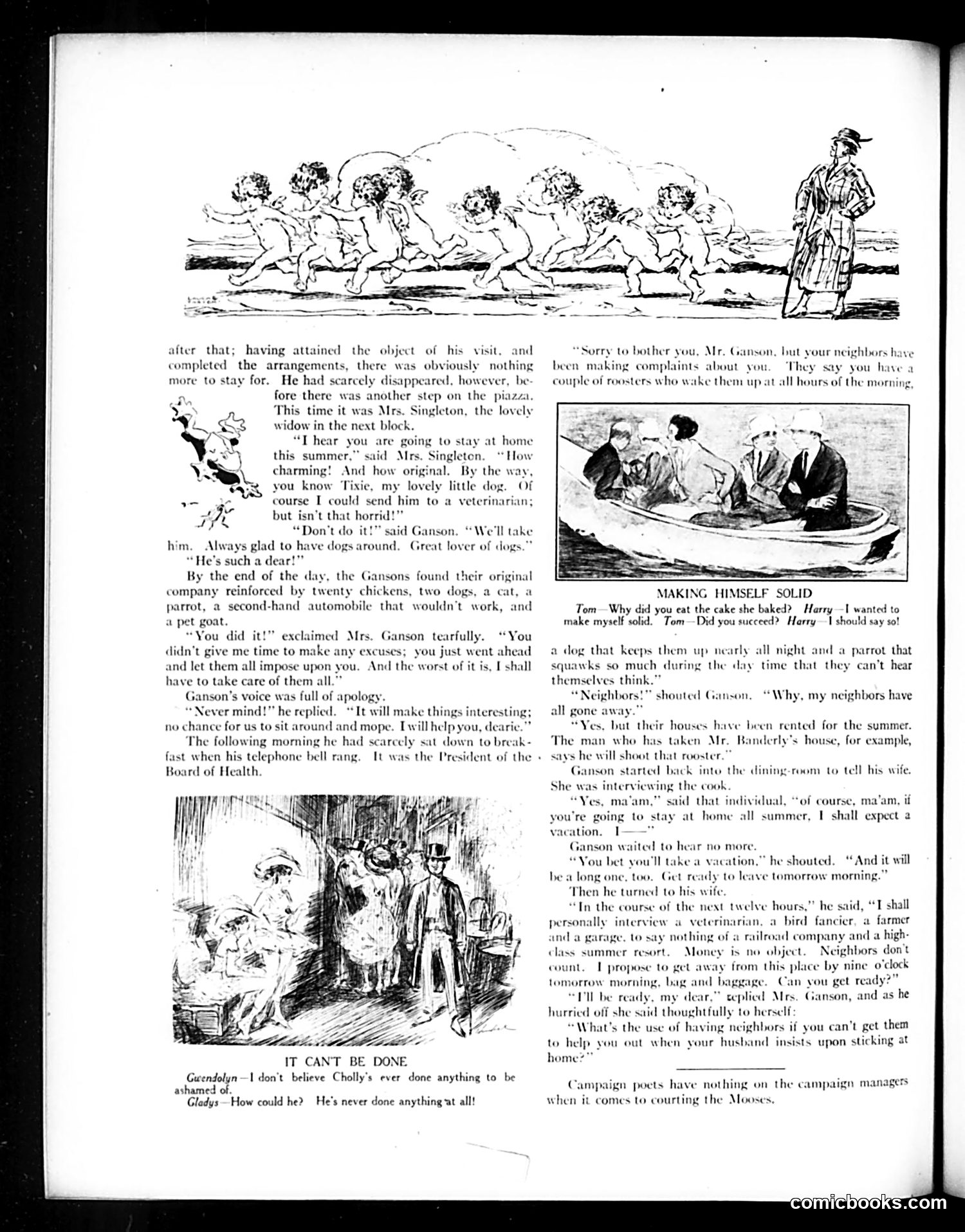
This page satirizes the social burden of neighborly obligation and the dangers of appearing too available during summer vacation. Mr. Ganson decides to stay home rather than vacation, but his apparent availability triggers an invasion: neighbors exploit his presence by dumping their pets and problems on him—twenty chickens, two dogs, a cat, a parrot, a broken automobile, and a goat. The Board of Health receives complaints about noise from these animals. The humor lies in Ganson's predicament: by being helpful and agreeable, he creates endless social obligations. The satire targets middle-class social conventions where refusing requests directly is impossible, forcing people into situations they neither want nor can easily escape. The smaller cartoon "Making Himself Solid" makes a pun about eating cake to "make myself solid" (win favor), suggesting that food is currency in social climbing. The final jab at "campaign poets" and "Mooses" appears unrelated—possibly a separate editorial comment about political campaigning tactics.
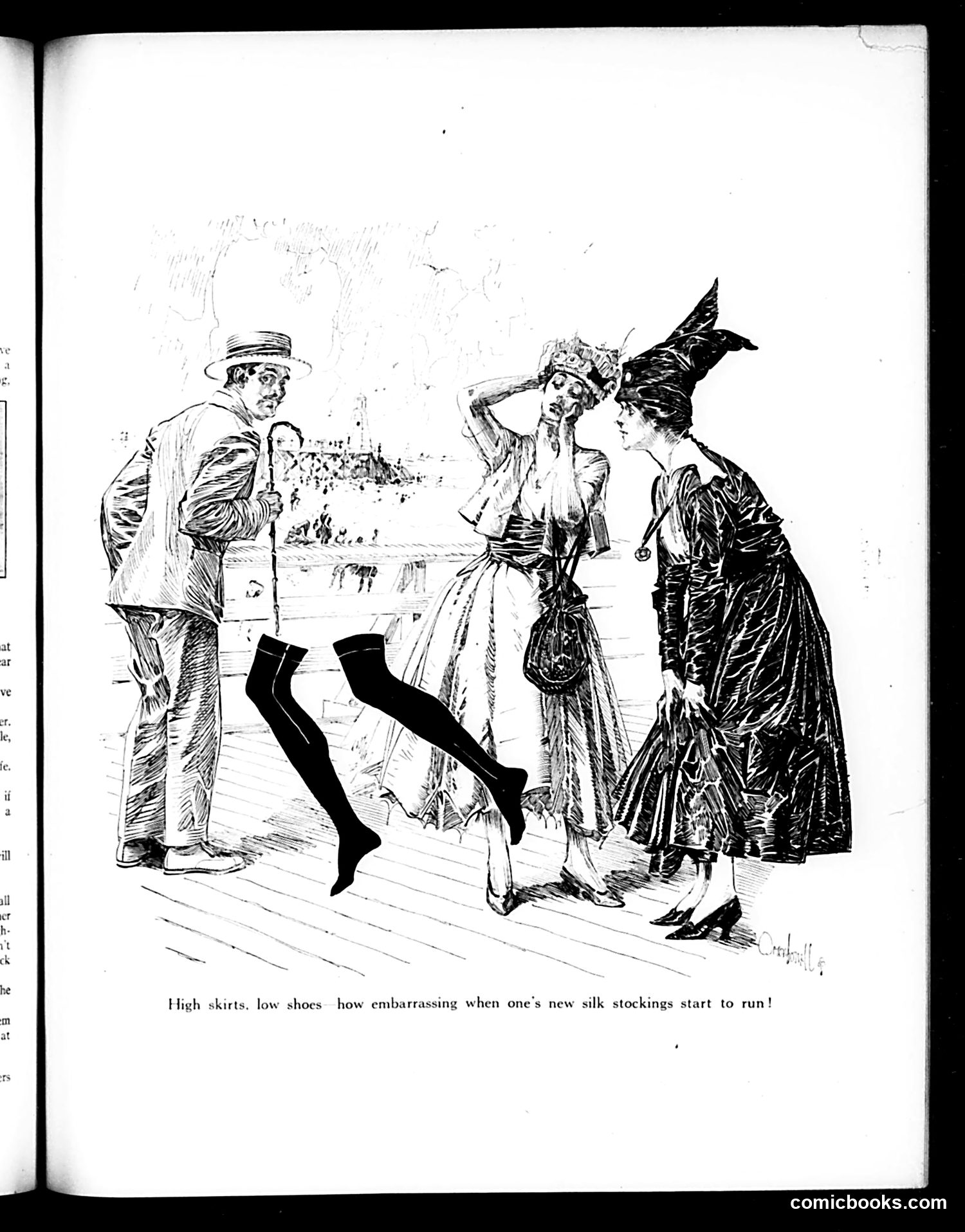
This cartoon satirizes early 20th-century women's fashion anxieties. The joke centers on the contradiction between two competing fashion trends: women wore increasingly high skirts (a relatively daring development for the era) paired with low shoes, which exposed their legs and stockings. The humor targets the embarrassment a fashionable woman experiences when her expensive new silk stockings develop "runs" (tears or snags in the fabric)—a common problem with delicate silk hosiery. The cartoon mocks how visible this fashion mishap becomes precisely because current style dictates exposed legs, making any stocking damage publicly humiliating rather than hidden. The bystanders' shocked reactions emphasize society's ongoing discomfort with women's changing fashion and exposed legwear.
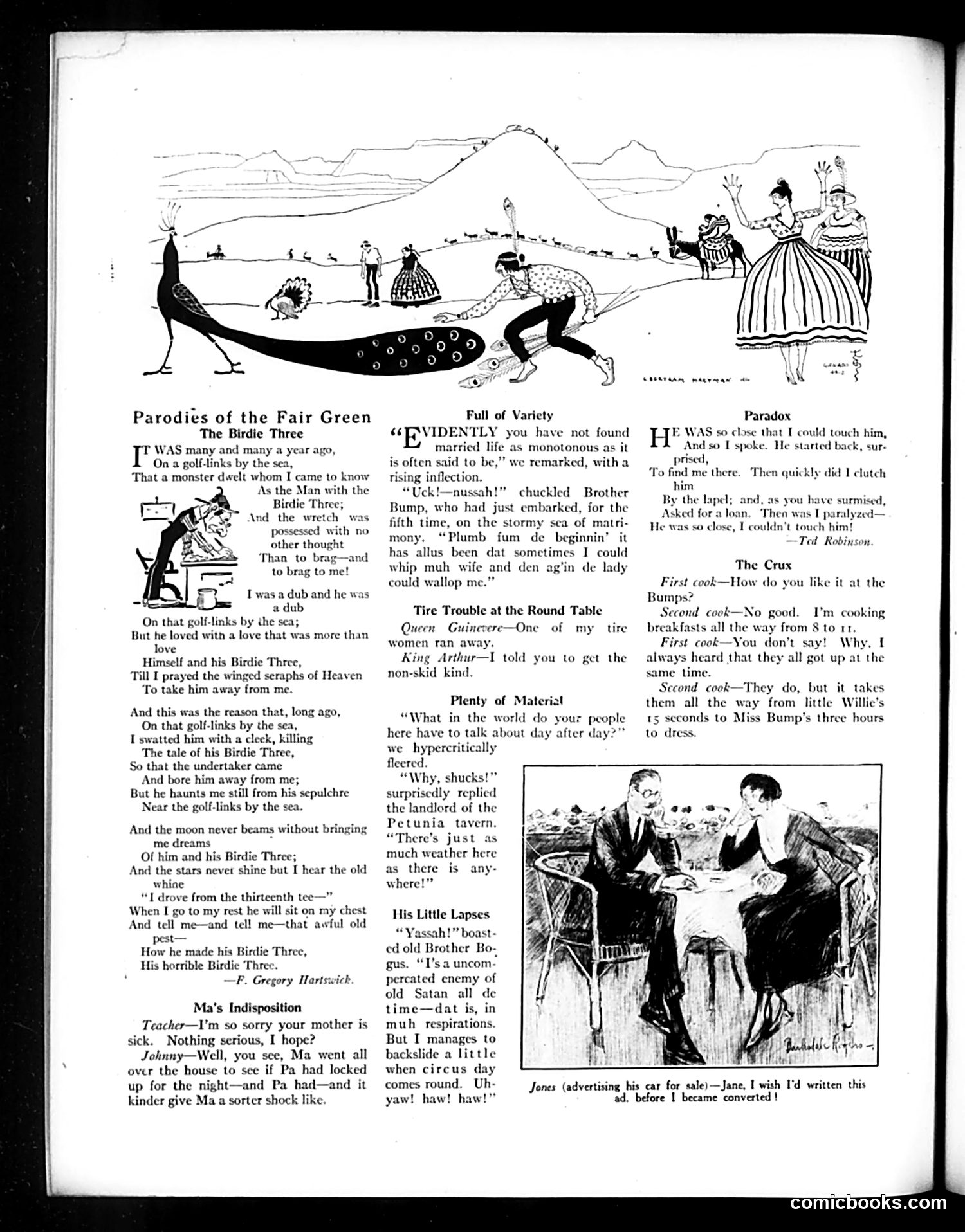
This page contains multiple short humor pieces satirizing early 20th-century American life: **"The Birdie Three"** parodies Edgar Allan Poe's "Annabel Lee," mocking golfers obsessed with bragging about their scores. The joke: a boring golfer's endless recounting of one good shot drives the narrator to murder—reflecting contemporary frustration with golf's growing popularity and golfers' tedious storytelling. **"Ma's Indisposition"** is a domestic joke about a wife checking that her husband locked up at night, then being shocked to discover he *had*—implying marital discord or suspicion. **Other brief pieces** satirize: - Marital monotony (contradicted by lower-class couple who fight) - Tire advertisements (referencing new automobile technology) - Small-town gossip - Racial stereotypes in dialect humor - Gender roles (women's lengthy dressing rituals) The overall tone reflects Judge's satirical approach to modern anxieties: golf culture, automobiles, marriage, and class divisions in rapidly changing America.
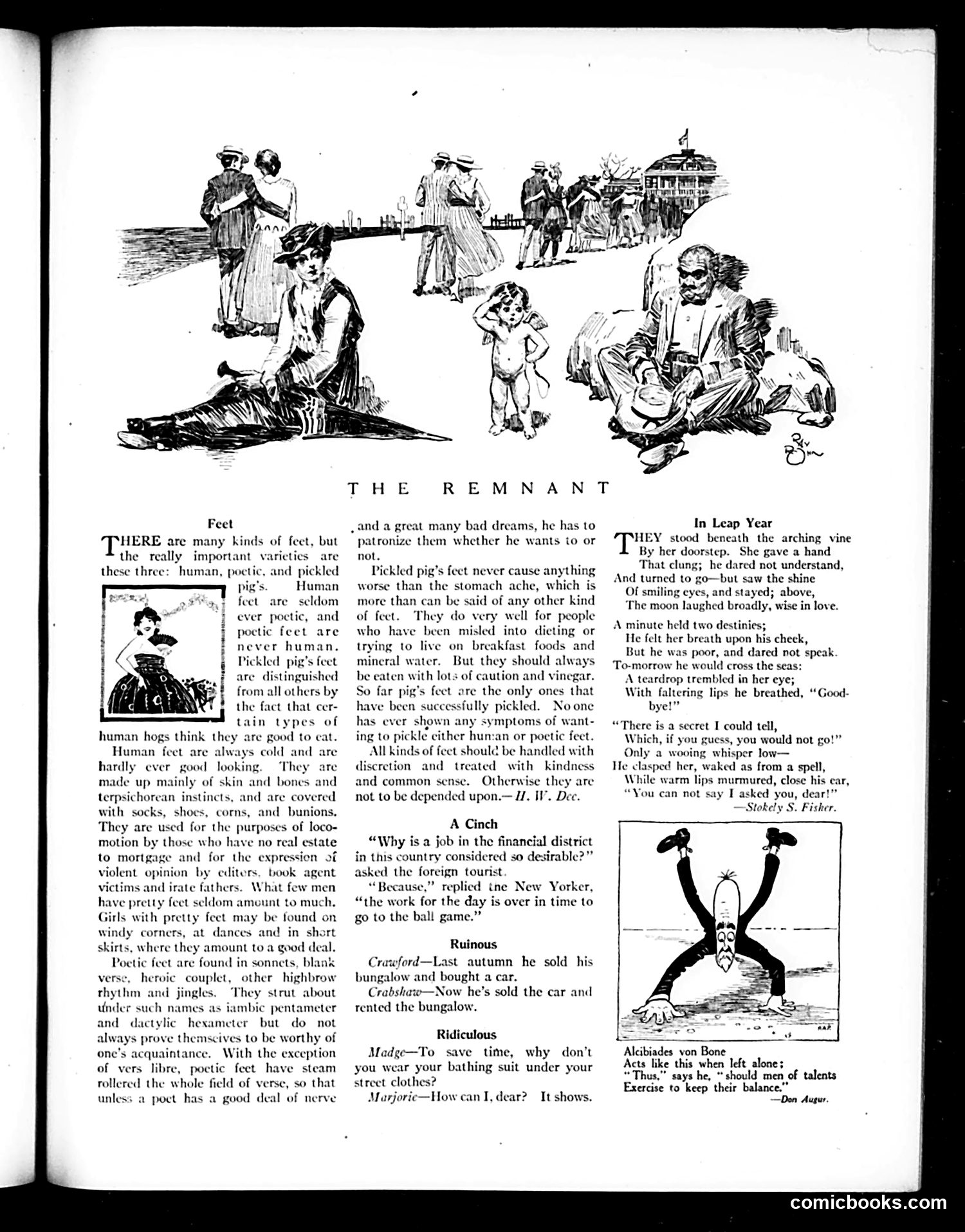
This page from Judge magazine contains several brief satirical pieces typical of early 20th-century American humor: **"The Remnant"** is a tongue-in-cheek essay distinguishing three types of feet: human (covered in practical problems like corns), poetic (used in verse forms like iambic pentameter), and pickled pig's feet (a working-class food). The satire gently mocks both pretentious literary conventions and the absurdity of treating food seriously. **"A Cinch"** jokes that Wall Street financiers consider their jobs desirable only because they finish early enough to attend baseball games—a swipe at both financial workers' priorities and the era's obsession with baseball. **"In Leap Year"** is a sentimental romantic poem where a poor man and woman share a moment under the moon; she hints she could confess love, but he leaves the next day. **"Ridiculous"** is a brief comic exchange about wearing a bathing suit under street clothes. The cartoon showing an acrobat illustrates "Alcibiades von Bone" practicing balance exercises—likely commenting on maintaining composure or dignity in absurd situations.
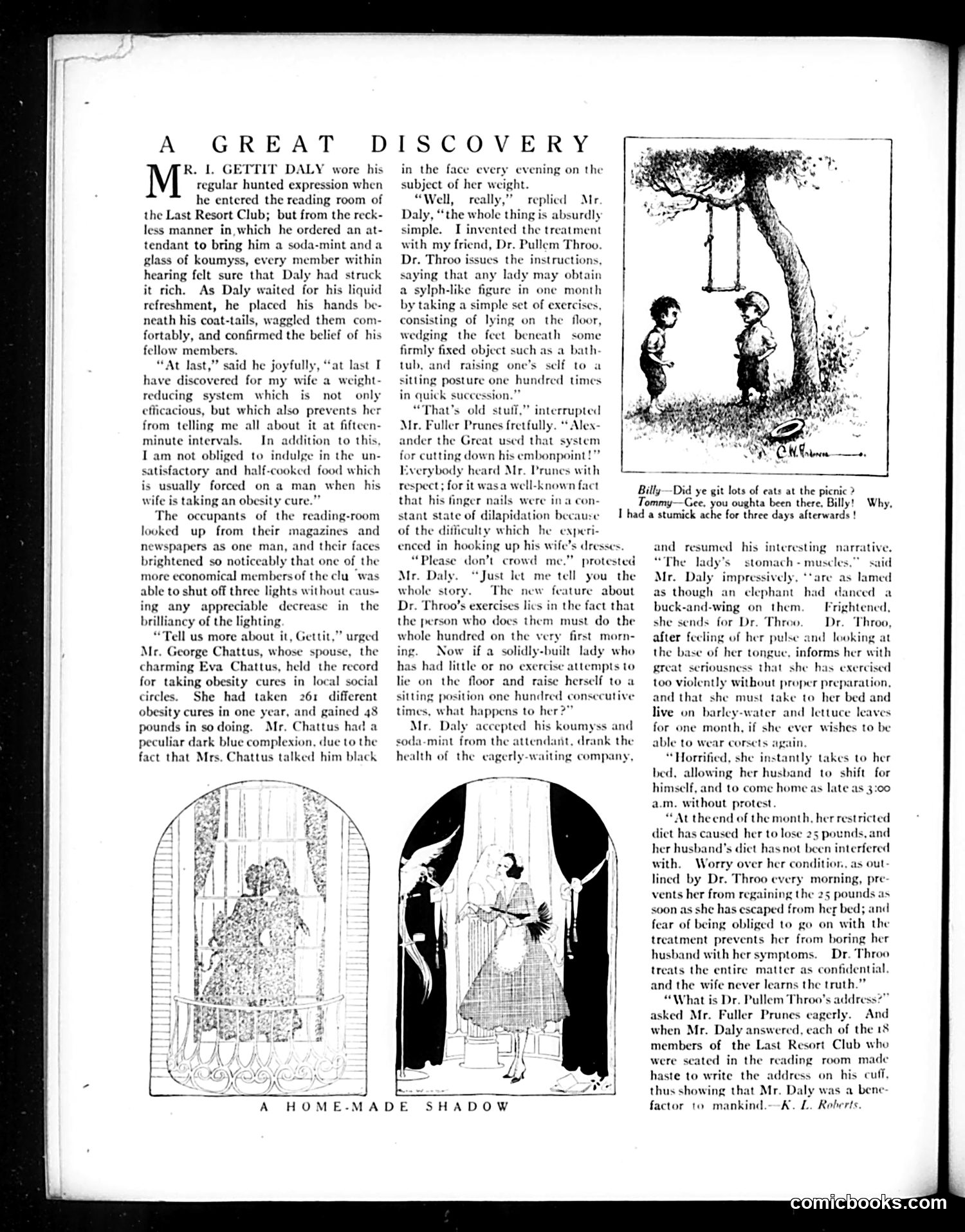
This 1900s satirical story mocks the era's weight-loss obsession and quack medical treatments. Mr. Daly discovers a "miracle cure"—simple sit-ups—that he claims both reduces weight AND prevents wives from complaining about dieting (the real appeal to husbands). The joke escalates through supporting characters: Mr. Chattus, whose wife has tried 261 different obesity cures while gaining 43 pounds, and Mr. Prunes, whose fingernails are damaged from fastening his wife's increasingly tight dresses. The satire reveals the period's absurd diet culture: the "treatment" actually causes stomach damage, requiring doctor visits and restrictive "barley-water" diets—perpetuating the cycle of useless cures. The small cartoon shows children discussing picnic overeating, reinforcing that the period's eating anxieties affected all social classes. The target: predatory "doctors," gullible wealthy men, and the commercial exploitation of women's body image standards.
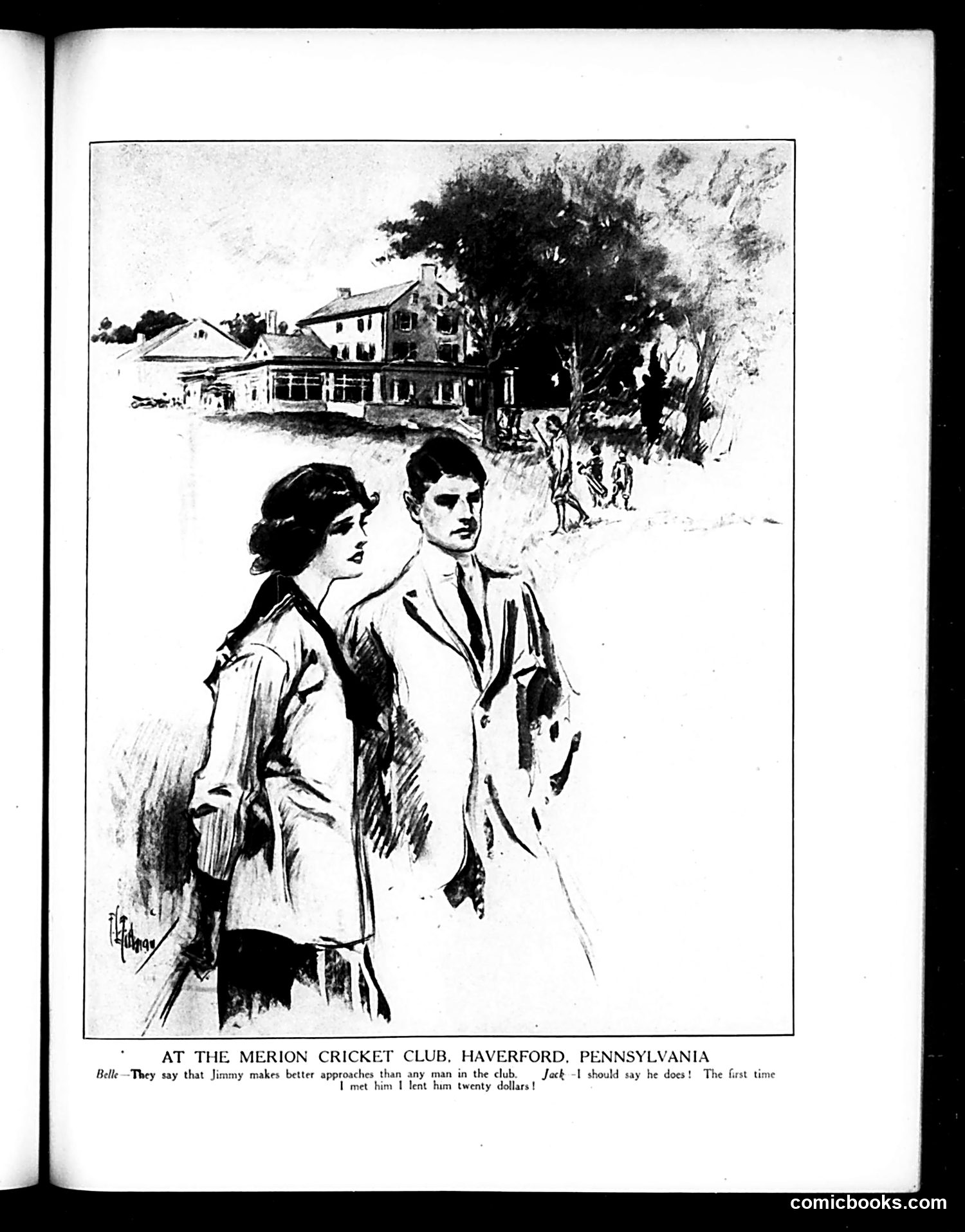
This Judge magazine cartoon satirizes a man named Jimmy who is apparently skilled at "approaches"—likely meaning he's persuasive or charming in social situations. The joke plays on a double meaning: Belle compliments his "approaches" at the cricket club (a prestigious country club), but Jack reinterprets this as Jimmy's approach to borrowing money. Jack reveals he lent Jimmy twenty dollars on their first meeting, suggesting Jimmy uses his charm to extract loans from people. The humor relies on the social embarrassment of discussing debt openly and the implication that Jimmy is a chronic borrower who exploits his likability. The setting at an exclusive Pennsylvania cricket club emphasizes the upper-class context where such financial awkwardness would be particularly mortifying.
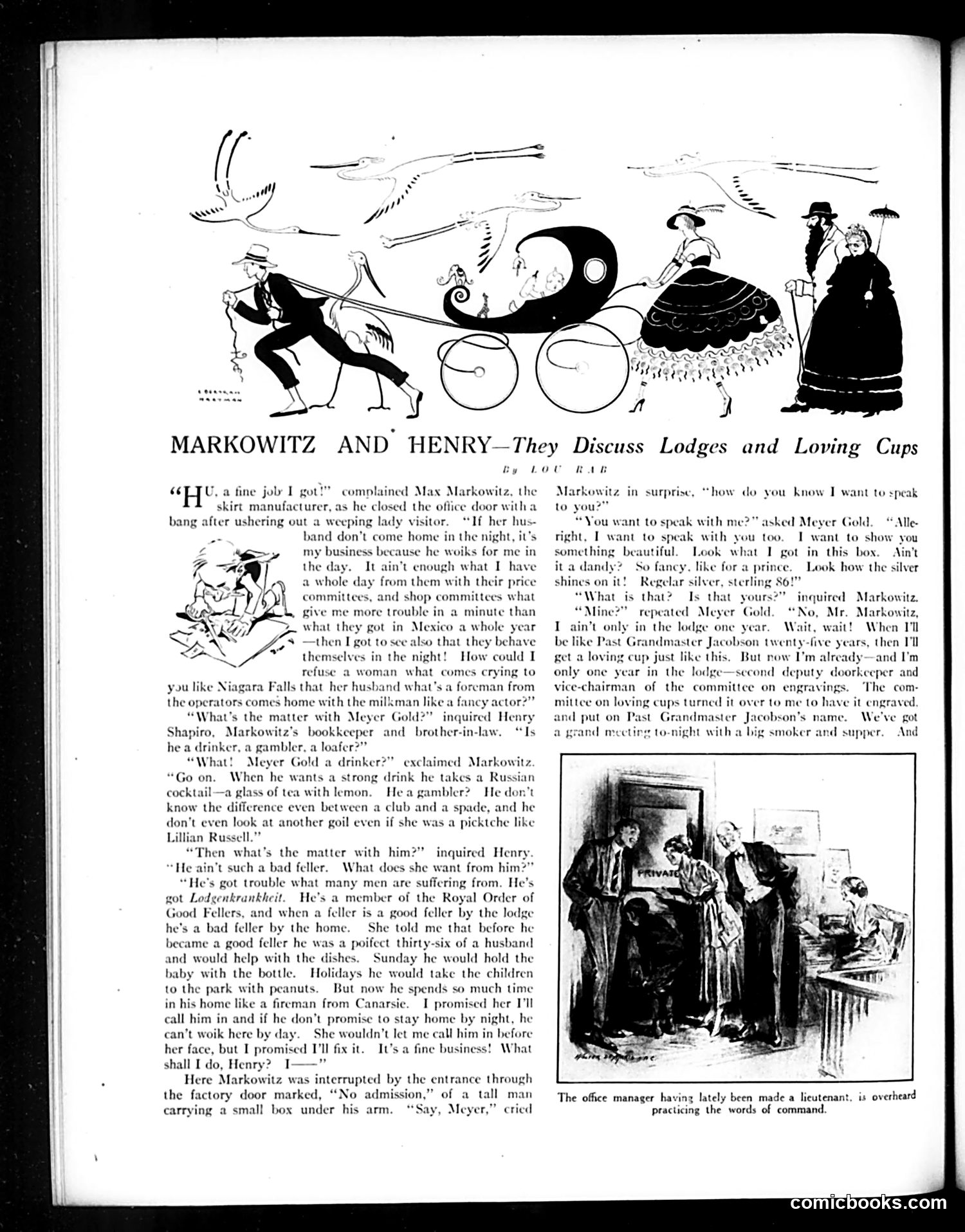
This is a Yiddish-dialect comedy story satirizing Jewish immigrant fraternal organizations and their social impact on family life. Max Markowitz, a skirt manufacturer, complains to his bookkeeper that Meyer Gold—a factory employee—has become obsessed with lodge membership, neglecting his home and wife. The satire targets "Lodgenkrankheit" (lodge sickness): Gold has transformed from a devoted husband who helped with dishes and childcare into an absent lodge officer. He now spends evenings at fraternal meetings and committees, earning status symbols like "loving cups" (engraved trophies). The joke exposes how working-class immigrant men pursued respectability and community status through secret societies and fraternal orders, often at their families' expense. The cartoon and photograph illustrate the pretension and elaborate ceremony surrounding lodge life—the formal dress, ceremonial objects, and hierarchical ranks (Past Grandmaster, Deputy Doorkeeper)—presenting it as comical vanity that disrupts domestic life.
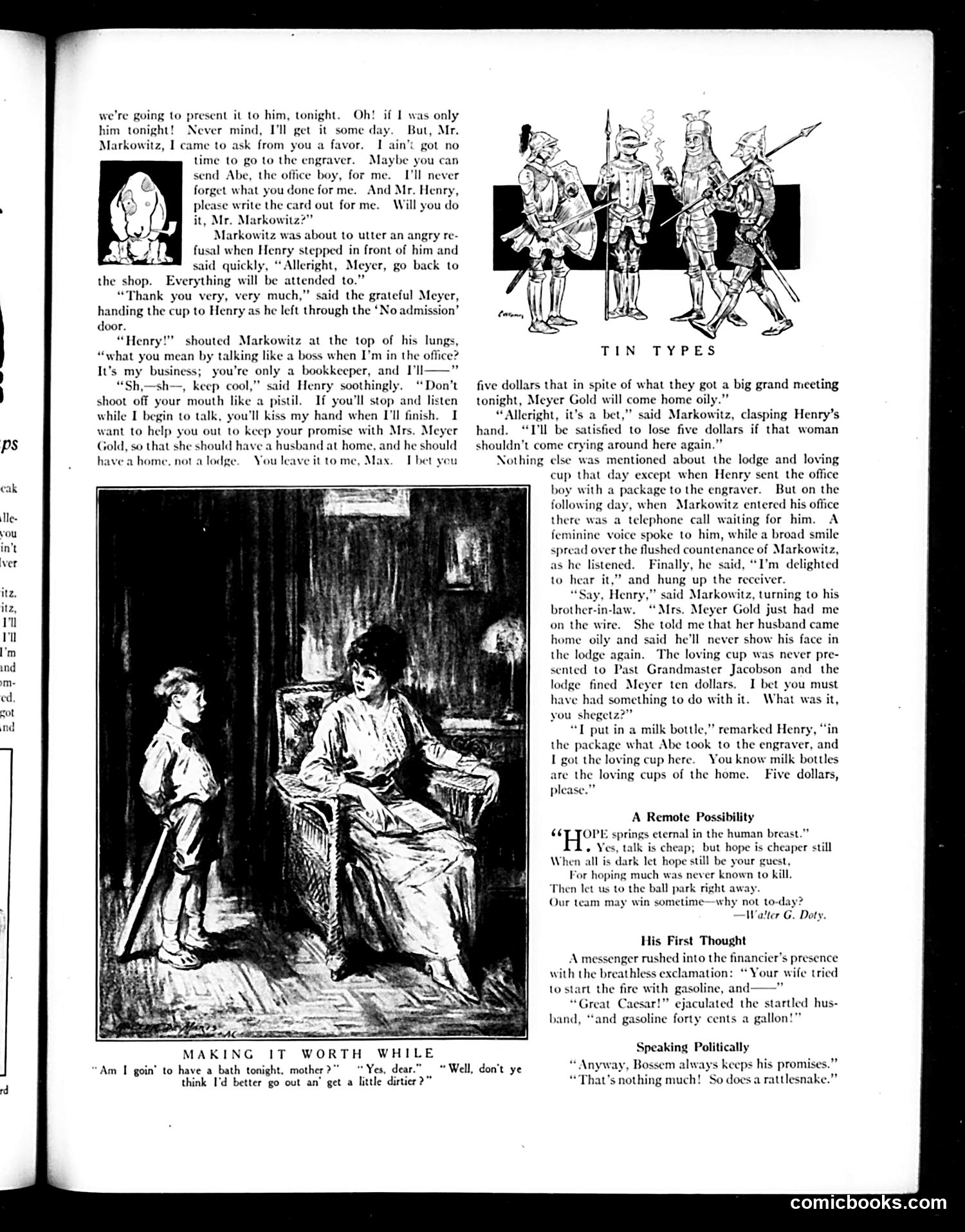
This page contains multiple satirical pieces typical of early 20th-century Judge magazine: **Main Story ("Making It Worth While"):** A narrative about Jewish characters—Markowitz (employer), Henry (bookkeeper), and Meyer Gold—centered on a fraternal lodge's "loving cup" award. Henry manipulates the situation by secretly placing a milk bottle in the engraver's package, causing Meyer to come home drunk and abandon the lodge. The satire mocks fraternal lodge culture and uses ethnic stereotypes common to the era, with the humor depending on Yiddish-inflected speech and working-class immigrant characters. **"Tin Types":** Decorative illustrations of military/historical figures; likely unrelated filler. **Brief Jokes:** "A Remote Possibility" (baseball optimism), "His First Thought" (husband concerned about gasoline prices during wife's accident), and "Speaking Politically" (cynical comparison of politicians to rattlesnakes). The page reflects Judge's typical blend of immigrant humor, social satire, and period-specific references that modern readers would need historical context to fully appreciate.
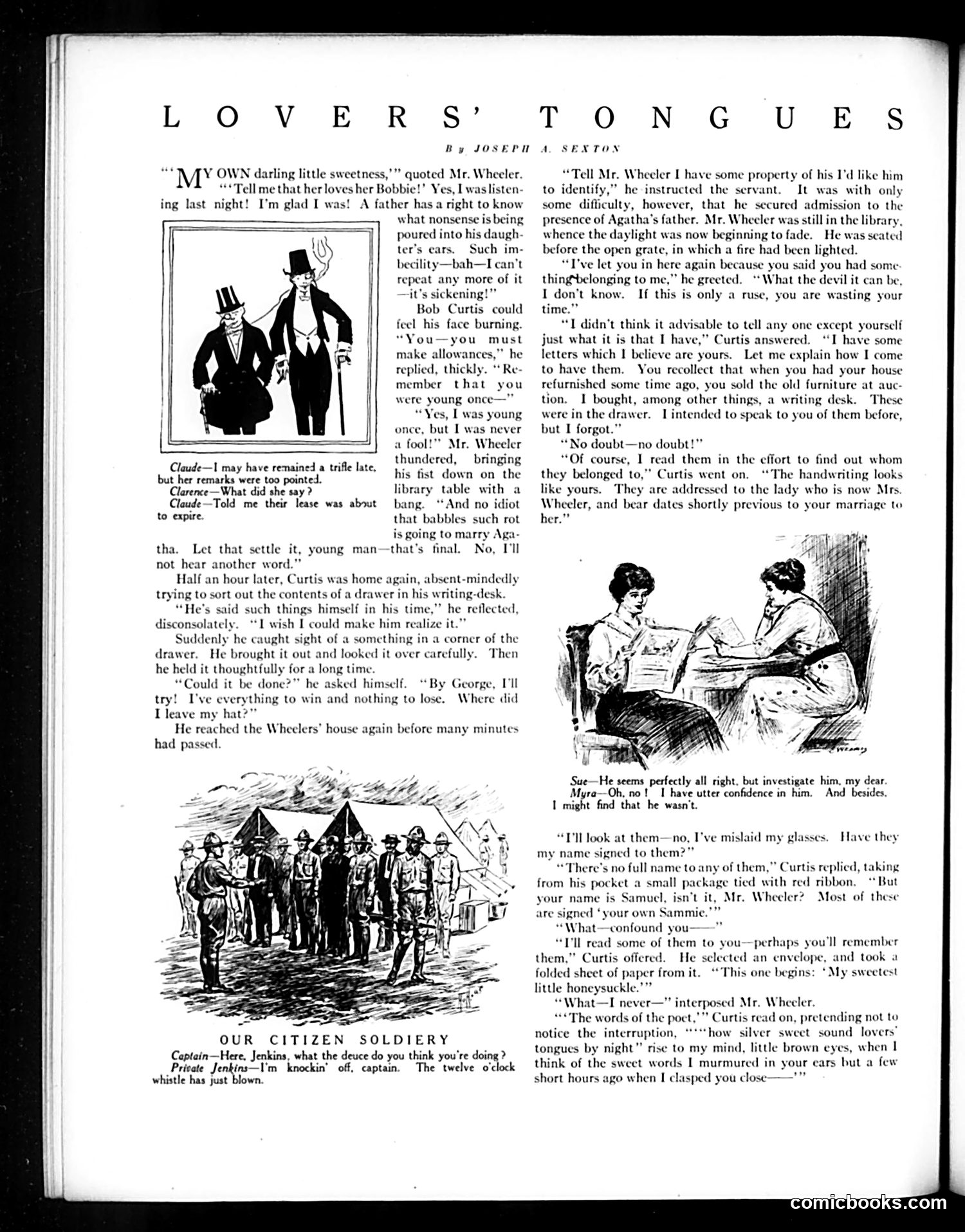
This story satirizes Victorian courtship customs and parental hypocrisy. Mr. Wheeler, Agatha's father, discovers his daughter's suitor (Bob Curtis) reciting romantic poetry to her and furiously forbids the match, thundering that Curtis is an "idiot" spouting "nonsense." Curtis discovers old love letters Wheeler himself wrote to Wheeler's wife (then unmarried) before their marriage—letters equally sentimental and "foolish" by Wheeler's own standards. Curtis retrieves them from an old writing desk purchased at auction. The satire's point: the story exposes Wheeler's double standard. He condemns the young couple's romantic language as sickening drivel, yet he himself wrote identical love letters in his youth. The cartoon implies that parents often demand stricter propriety from their children than they practiced themselves—a timeless complaint about generational hypocrisy. The secondary cartoon ("Our Citizen Soldiery") jokes about a soldier leaving work exactly at noon whistle, mocking military discipline or civilian soldiers' casual attitudes toward duty.
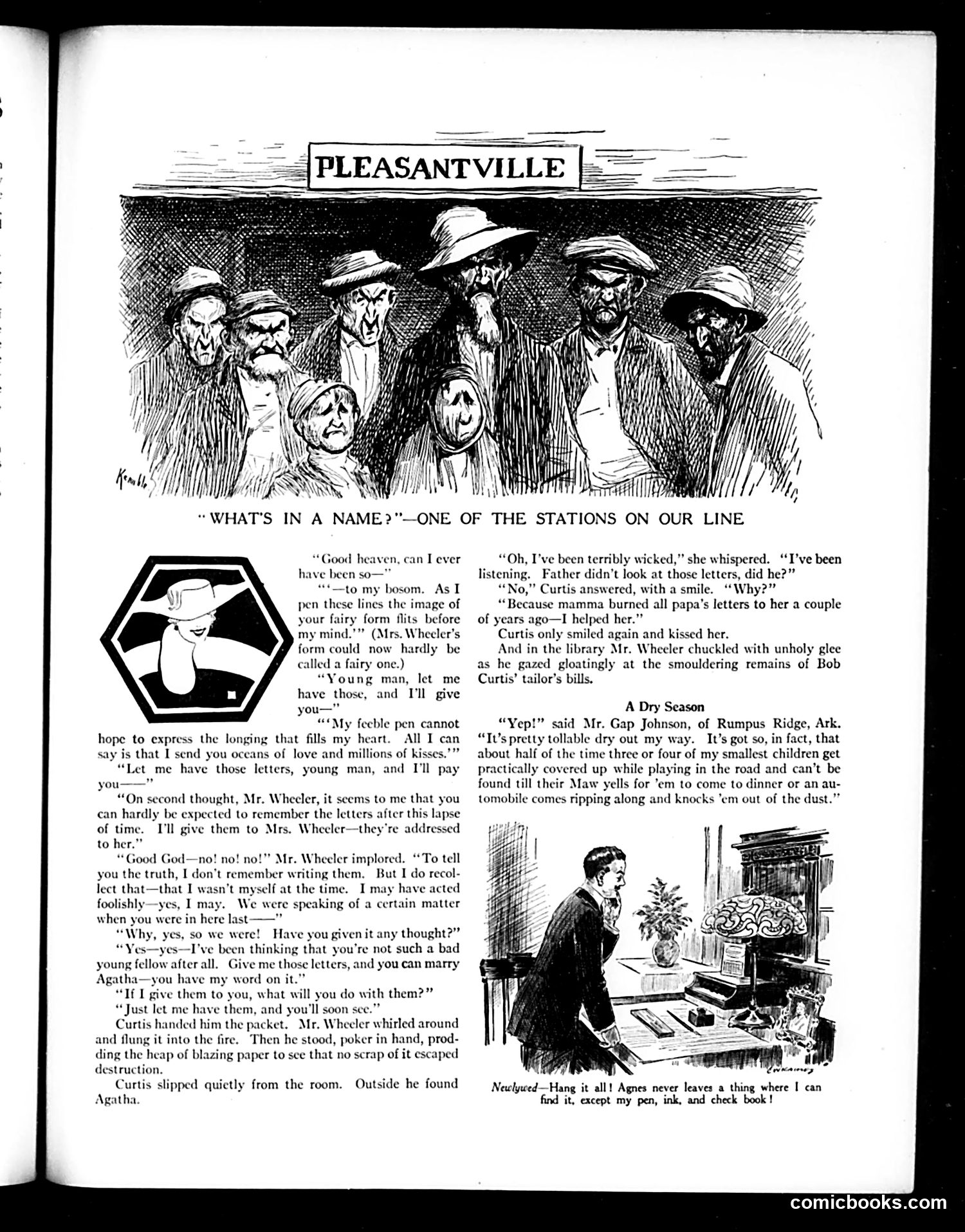
**Main Story**: A young man (Curtis) possesses romantic love letters written by Mr. Wheeler to his wife years earlier. Curtis uses them as leverage to gain Wheeler's permission to marry his daughter Agatha. Wheeler initially tries to buy the letters back, then agrees to let Curtis marry Agatha if he surrenders them. Wheeler burns the letters—but the joke's twist: Curtis discovers Wheeler was actually destroying his own *tailor's bills*, not love letters, while Curtis' true romantic correspondence remains safe. The satire targets male anxiety about preserved evidence of youthful romantic excess and marital compromises. **"A Dry Season"**: Rural humor about severe drought in Arkansas, where dust is so thick children playing outdoors become buried and invisible until called for dinner or hit by passing automobiles. **"Newlywed"**: Brief joke about a new wife's disorganization—she loses everything except her husband's pen, ink, and checkbook (implying she'll drain his finances). The page exemplifies Judge's mix of domestic comedy and rural Americana stereotypes.
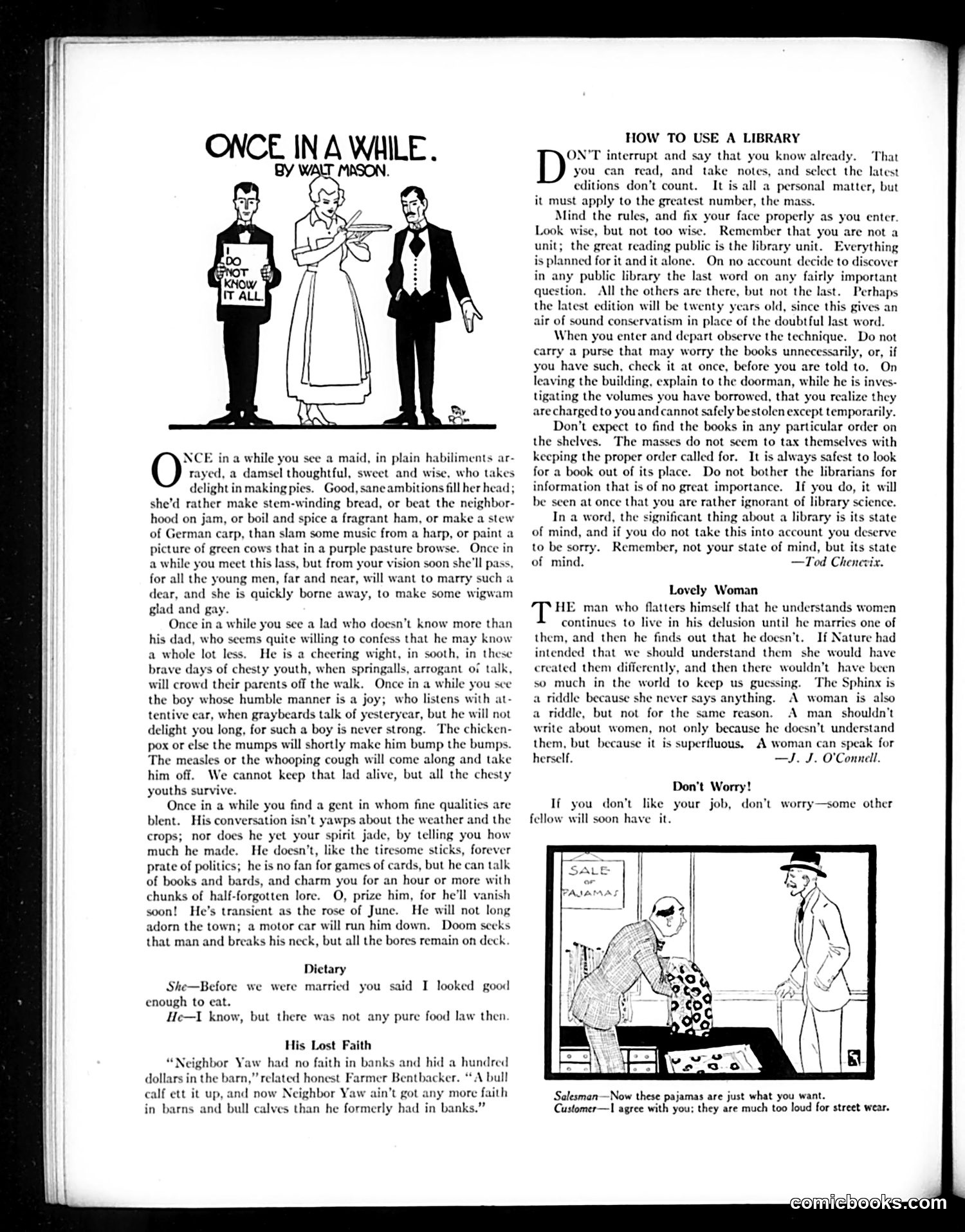
This page from **Judge** (a satirical American magazine) contains three distinct pieces: ## "Once in a While" by Walt Mason A humorous poem celebrating rare virtuous types destined for early death or obscurity: the domestic maid (who'll be quickly married off), the humble, respectful youth (who'll die of childhood illness), and the cultured gentleman (who'll be hit by a car). The satire mocks how society eliminates its best members while mediocrity persists. ## Social Commentary Pieces Brief jokes on contemporary topics: "Lovely Woman" questions men's understanding of women; "Don't Worry" offers workplace humor; "Dietary" jokes about food safety laws (likely referencing early 20th-century Pure Food legislation); "His Lost Faith" satirizes a farmer's loss of trust in institutions (banks/barns). ## "How to Use a Library" Tongue-in-cheek advice mocking snobbish library culture—advising patrons to appear wise, accept outdated books, and maintain proper decorum. It critiques elitist attitudes toward public library systems. The bottom cartoon (salesman/customer) appears cut off but likely addresses consumer behavior or retail fraud.
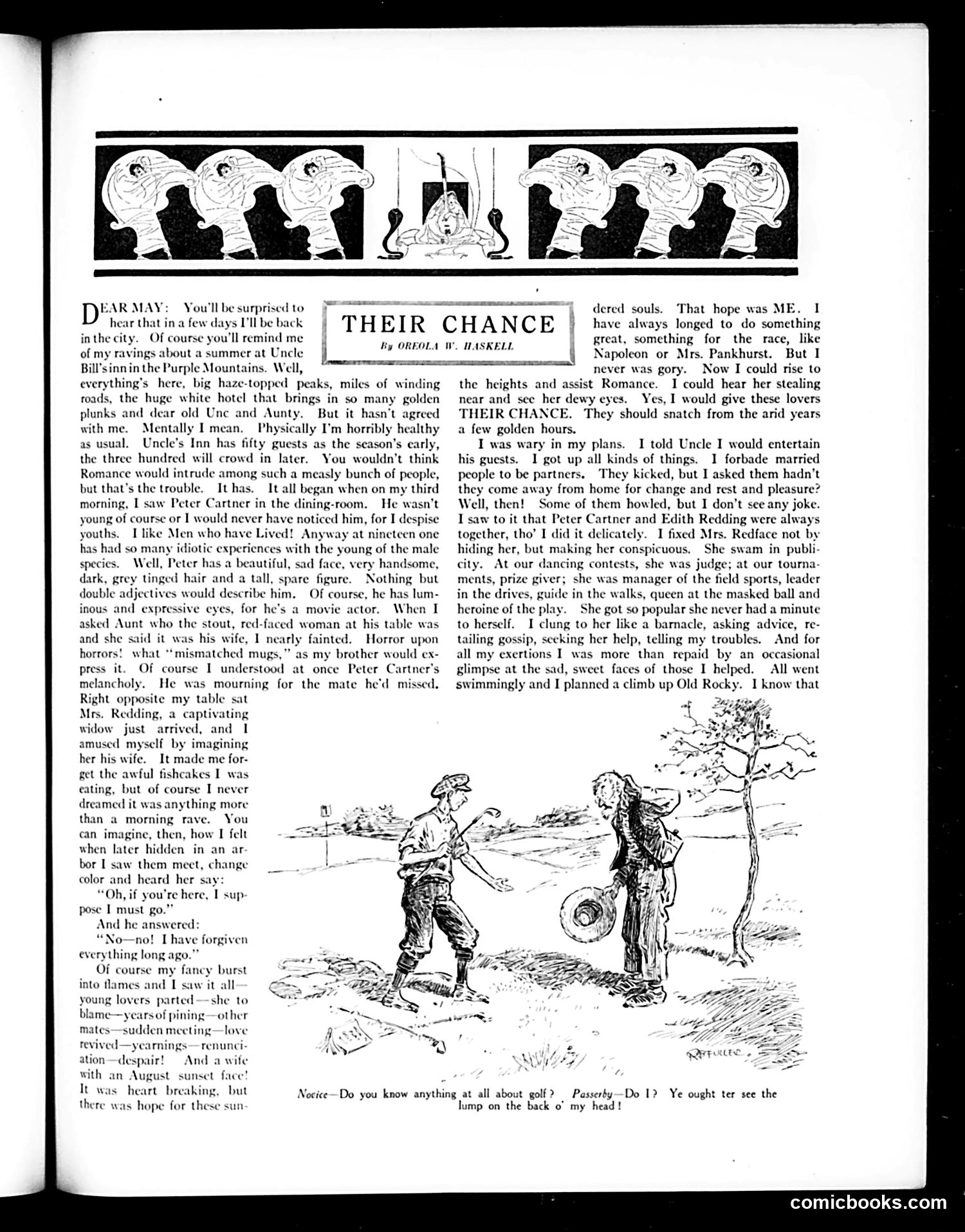
This is a romantic comedy story illustrated with a sketch showing two figures at golf. The narrative voice—a female guest at Uncle Bill's mountain inn—describes her matchmaking efforts. She notices Peter Cartner, a handsome former movie actor, unhappily married to a plain woman. She also meets the attractive widow Mrs. Redding and fantasizes about uniting them as "soulmates." The narrator positions herself as a romantic hero (comparing herself to Napoleon and Mrs. Pankhurst) and orchestrates situations forcing them together while keeping Mrs. Cartner occupied and visible in public activities. The illustration's caption—"Do you know anything at all about golf?"—suggests the golf outing is one of the narrator's orchestrated opportunities. The story satirizes both melodramatic romantic fantasy and the meddlesome "well-meaning" busybody who assumes she knows best for others.
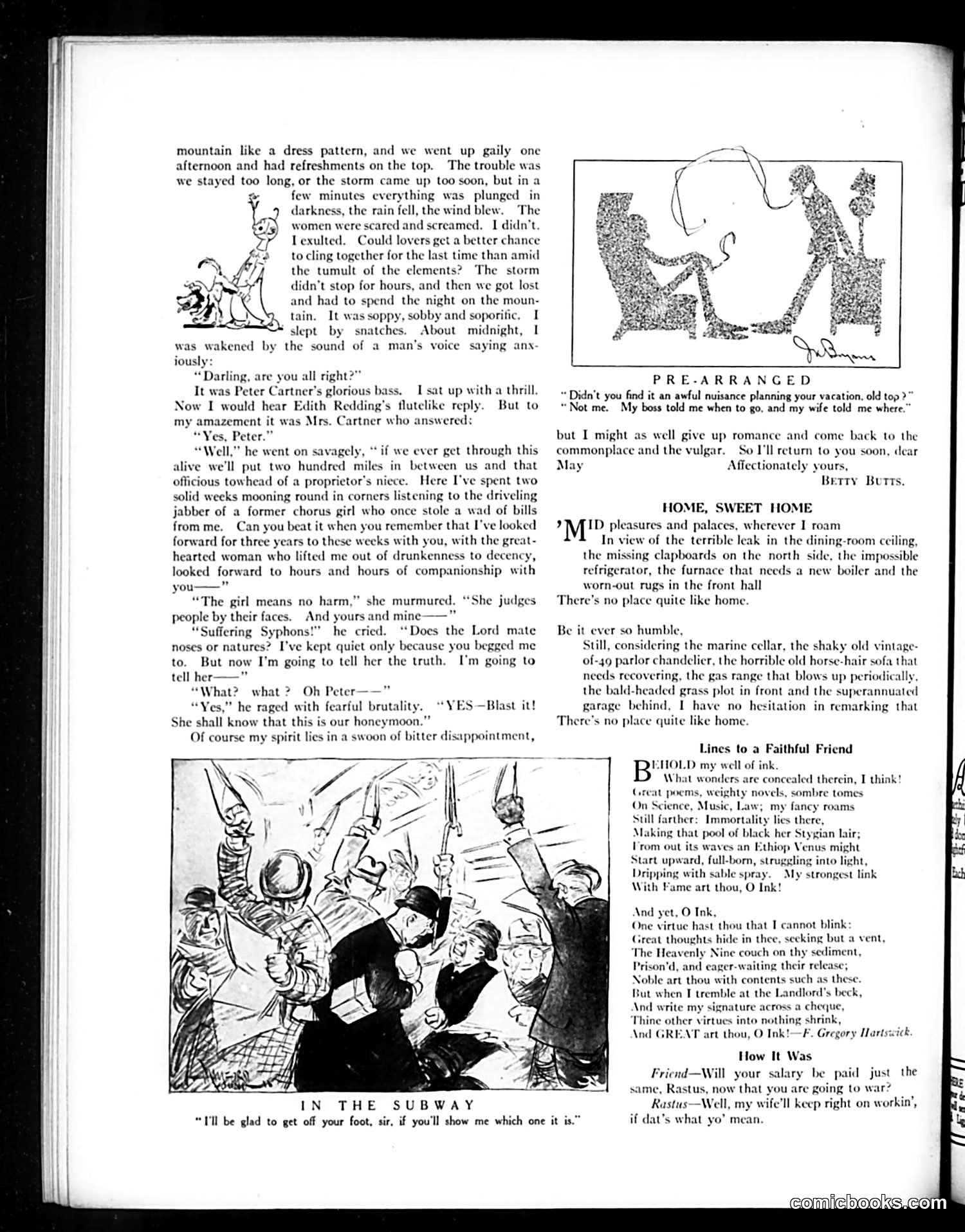
This page contains several distinct pieces of social satire typical of early 20th-century Judge magazine: **"Pre-Arranged" (top right):** A satirical exchange mocking the modern erosion of romance. A woman complains about vacation planning becoming tedious and corporate rather than romantic. The joke targets how workplace demands ("My boss told me when to go") have replaced spontaneity in middle-class life. **"Home, Sweet Home" (center-right):** A parody of the sentimental song, listing domestic horrors—leaking ceilings, broken furnaces, damaged furniture—while ironically maintaining the original's nostalgic refrain. This mocks both the gap between domestic ideals and reality, and perhaps the exhausting maintenance demands of homeownership. **"In the Subway" (bottom left):** A cartoon satirizing crowded urban transit, showing passengers packed together. The caption ("I'll be glad to get off your foot, sir") humorously captures the indignity and discomfort of modern city life. The overall theme: early 20th-century social critique of how modernization—workplace demands, housing deterioration, urban congestion—has undermined traditional romance, domesticity, and comfort.
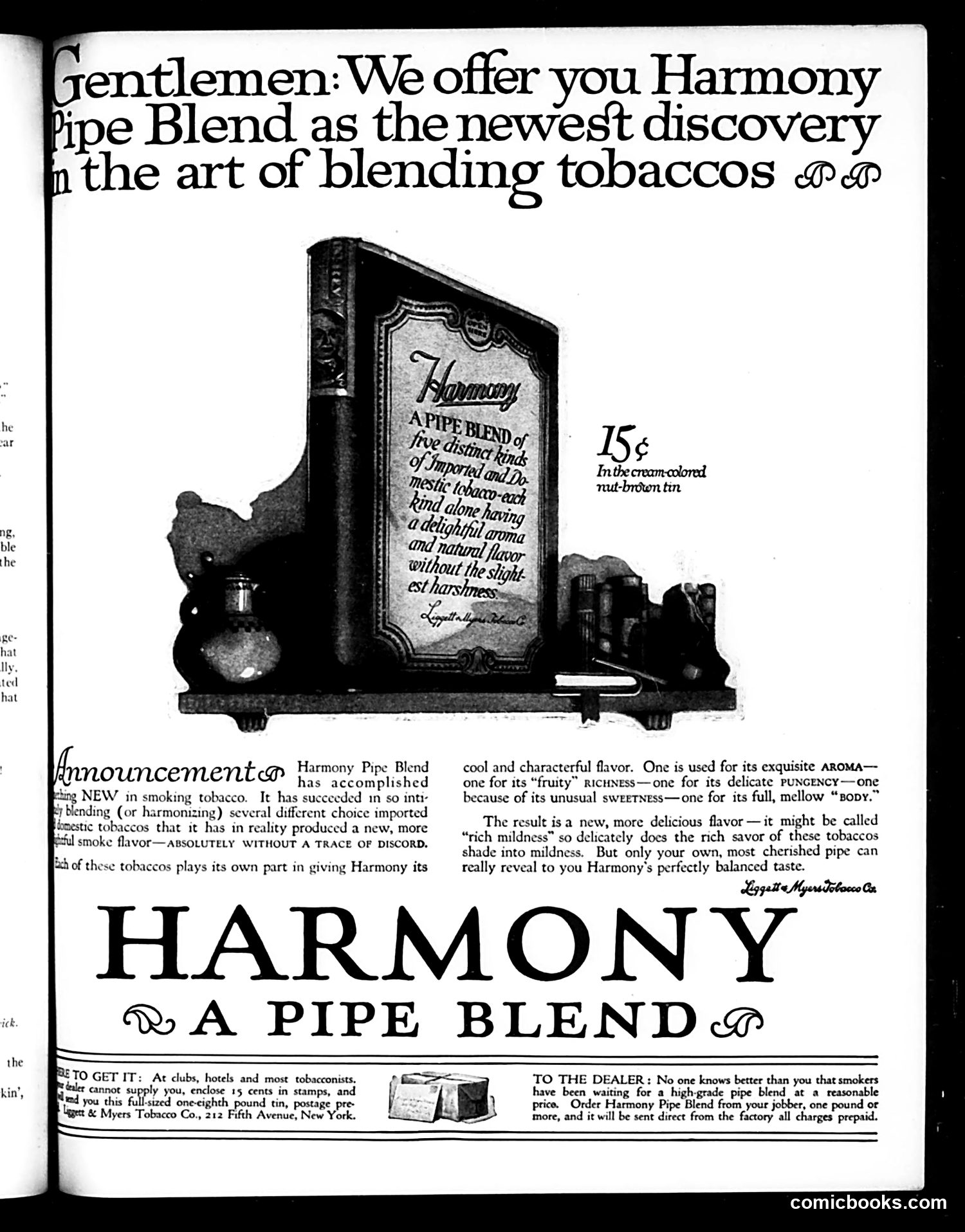
This is not a cartoon or satire—it's a **straight tobacco advertisement** from Judge magazine. The page promotes "Harmony Pipe Blend," a new tobacco product by Liggett & Myers Tobacco Co. The ad uses musical/orchestral language to market the blend: different imported tobaccos are described as instruments in an ensemble, each contributing its own quality (aroma, richness, pungency, mellowness) to create a harmonious whole without "discord." This metaphor—blending disparate elements into unified perfection—was common advertising rhetoric of the early 20th century. The ornate decorative display box and "gentlemen" address reflect the era's marketing toward male smokers. The price of 15 cents and distribution details (clubs, hotels, tobacconists) indicate a mid-range premium product. There is no political satire or social commentary visible on this page.
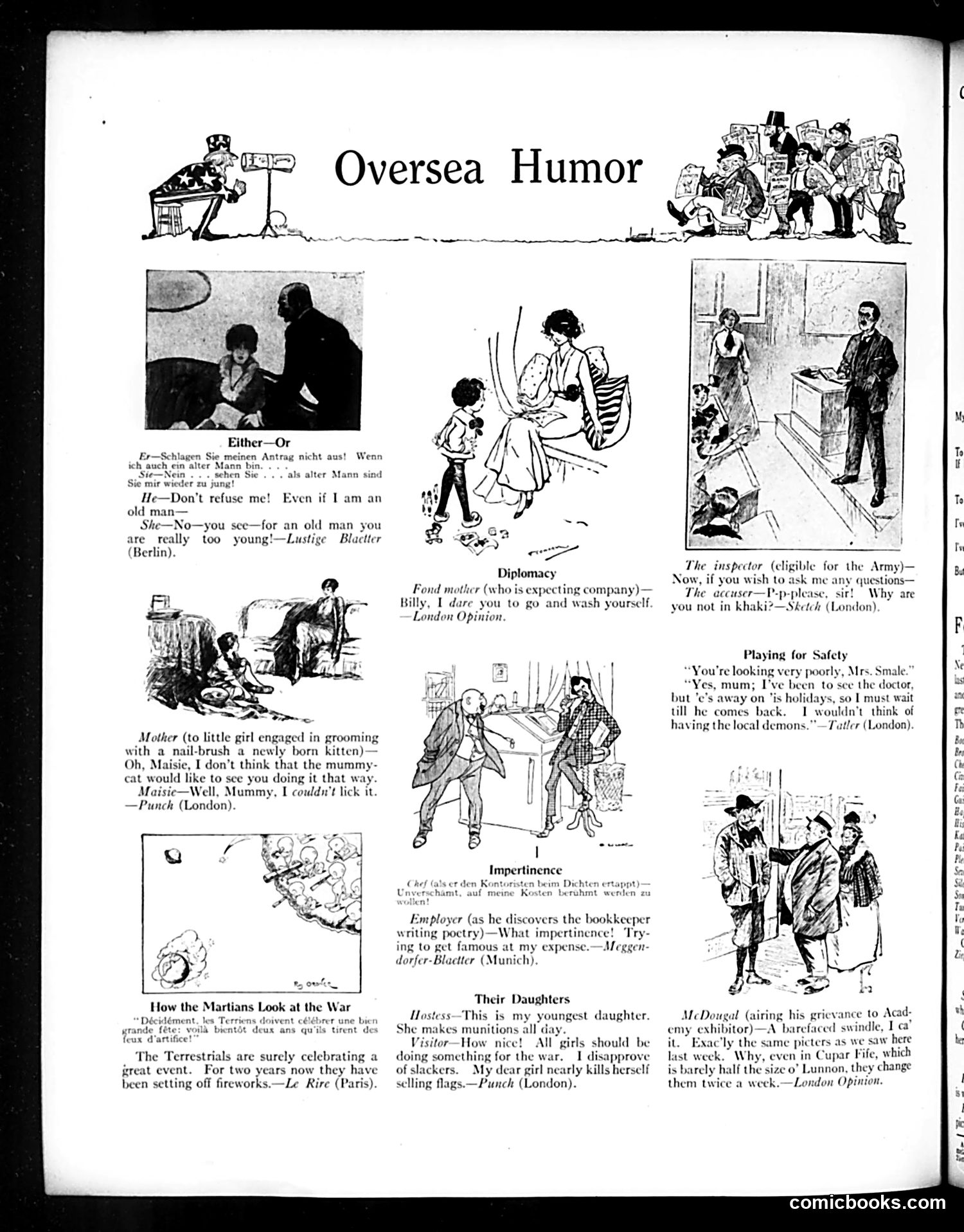
This page compiles humorous cartoons and jokes from European publications, translated for American *Judge* readers. The content reflects World War I anxieties: **"How the Martians Look at the War"** jokes that extraterrestrials would find Earth's two-year celebration of fireworks (artillery bombardment) absurd—dark humor about the war's continuation. **"Their Daughters"** presents a patriotic mother bragging that her daughter works in munitions factories, while disapproving of "slackers." It reflects wartime social pressure on women to contribute to war production. **"The Inspector"** shows a military-eligible man questioned why he's not in khaki (uniform), reflecting conscription concerns. **"Playing for Safety"** depicts someone avoiding local doctors during wartime, possibly fearing conscription or medical examination consequences. The German, French, and British sources indicate this represents international humor shared among Allied nations during WWI, emphasizing shared wartime experiences and social pressures across borders.
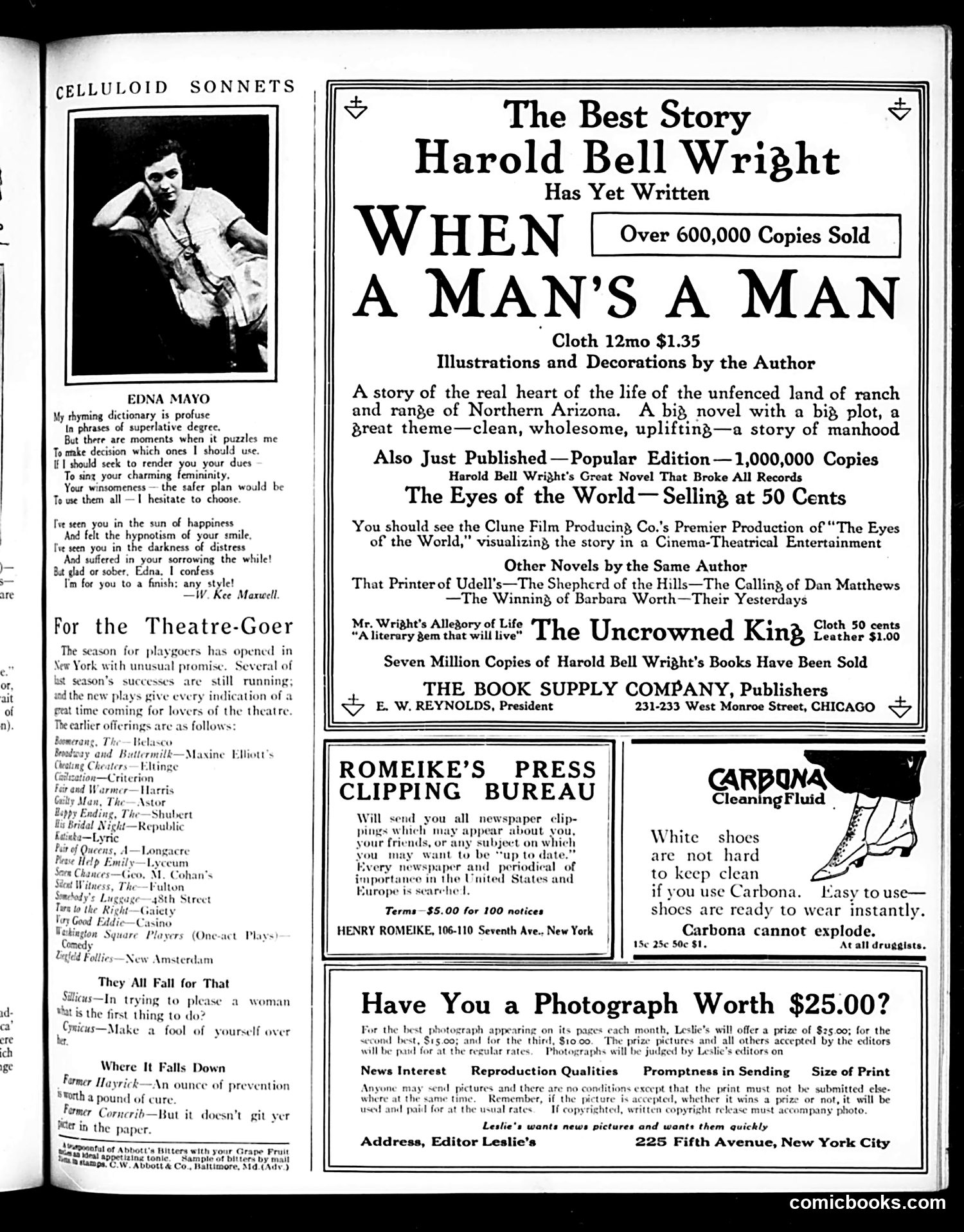
This page is **primarily advertising** with minimal editorial cartoon content. The dominant feature is a large advertisement for Harold Bell Wright's novel *When a Man's a Man*, promoting its commercial success (600,000+ copies sold) and positioning it as wholesome, manly fiction set in Arizona ranch country. The left column contains "Celluloid Sonnets"—light verse about actress Edna Mayo, and theater listings for the New York season. These are not satirical but rather entertainment coverage typical of Judge's format. The remaining advertisements include Romeike's Press Clipping Bureau, Carbona shoe cleaner, and Leslie's magazine's photography contest. These are straightforward commercial pitches with no apparent satirical intent. **There are no identifiable political cartoons or social satire on this page.** The content reflects early 20th-century popular culture: celebrity coverage, theatrical listings, and consumer advertising for books, cleaning products, and magazine services. The page demonstrates Judge's mix of light entertainment and paid advertising rather than pointed social commentary.
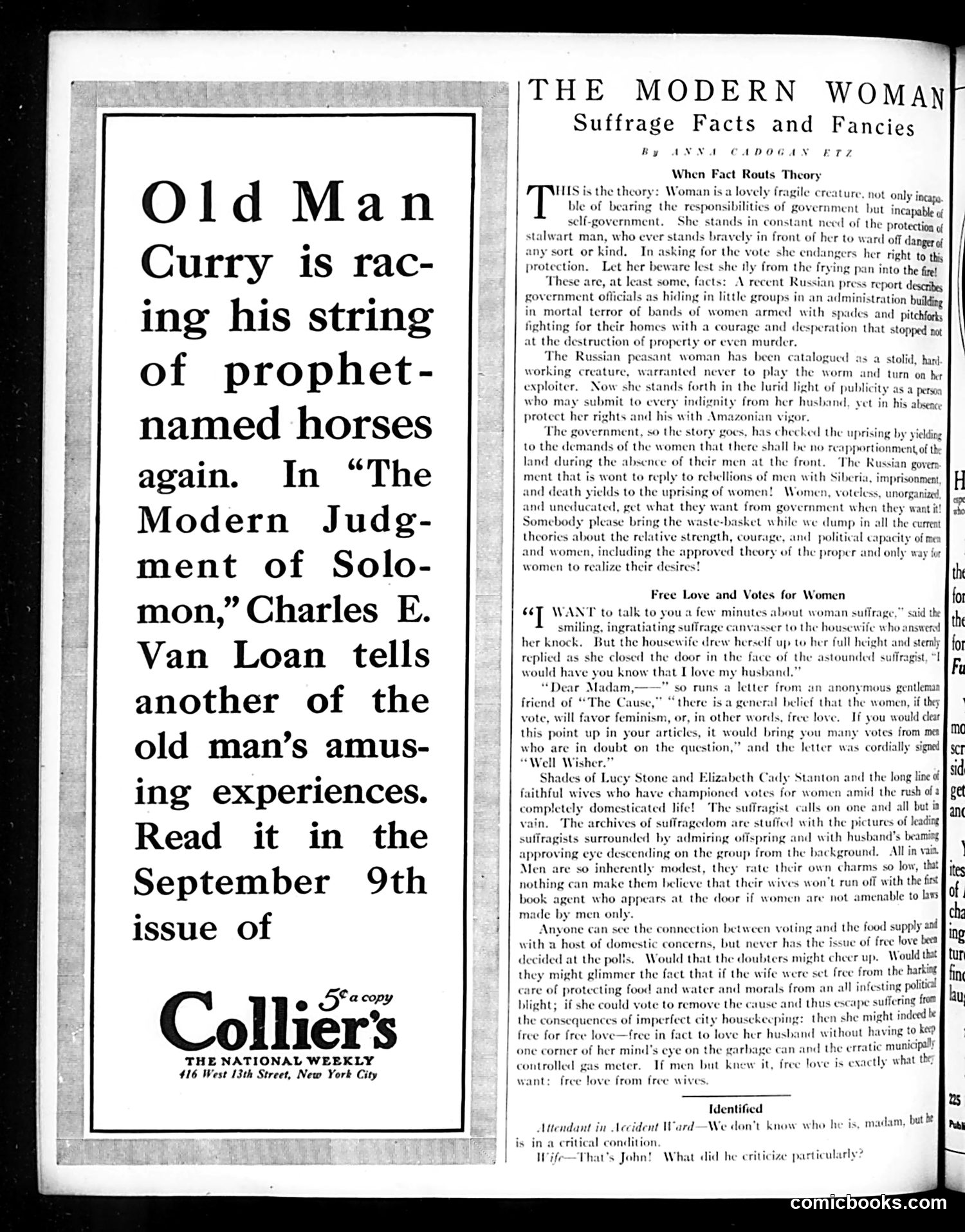
This page contains two distinct pieces: **Left side:** An advertisement for *Collier's* magazine promoting a short story called "The Modern Judgment of Solomon" by Charles E. Van Loan, featuring a character named Old Man Curry and his racing horses with prophetic names. **Right side:** An article by Anna Cadogan Etz titled "The Modern Woman: Suffrage Facts and Fancies." It satirizes anti-suffrage arguments through ironic contrast. The piece presents the claim that women are fragile creatures needing male protection, then demolishes this "theory" with a "fact": Russian peasant women armed with spades and pitchforks successfully fought for land rights during wartime—even persuading the Russian government to yield to their demands where men's rebellions had failed. Etz uses this example to mock the notion that voteless women lack political capacity. The article also ridicules the false equation of women's suffrage with "free love," noting that prominent suffragists were devoted wives and mothers.
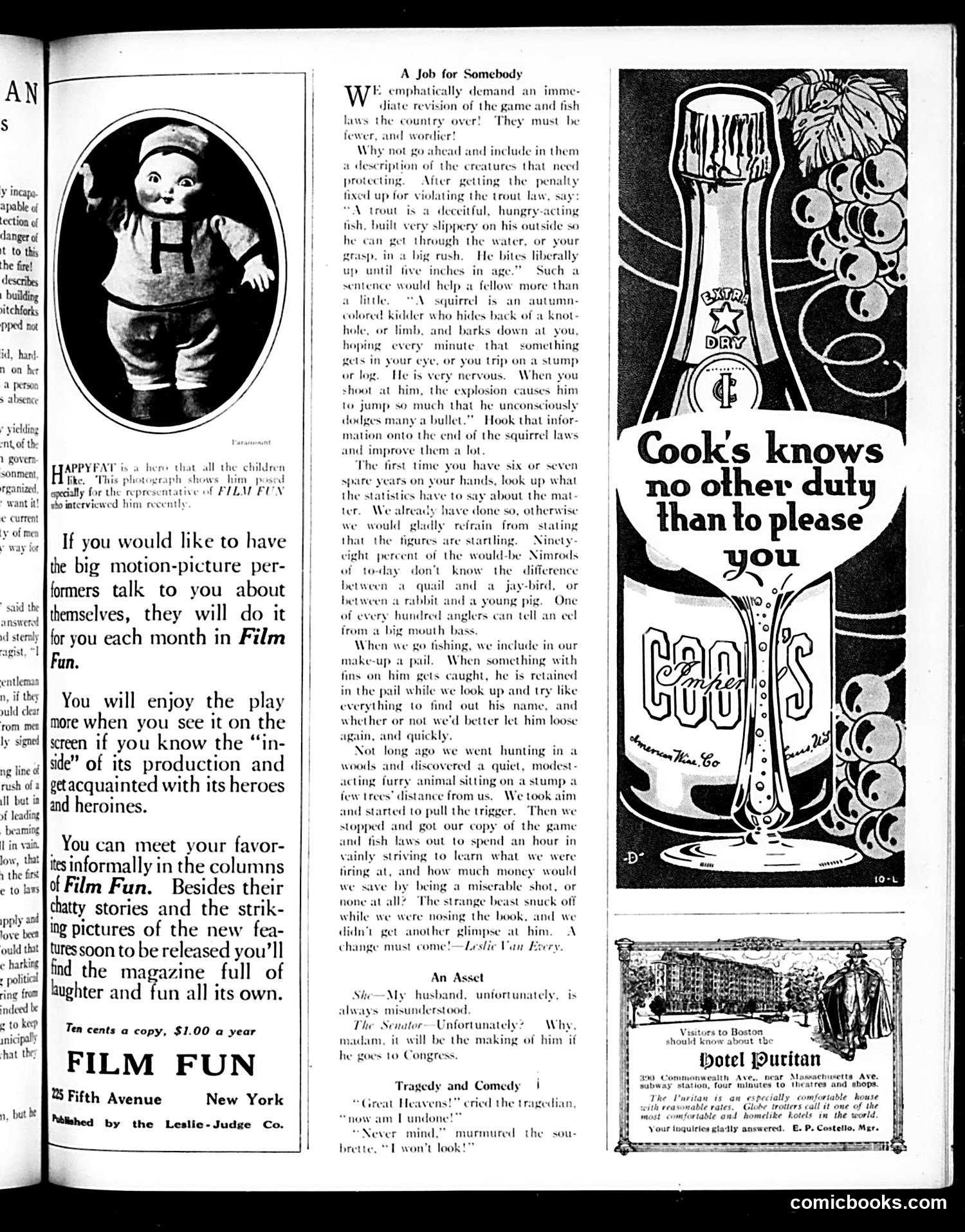
This page contains **satirical editorial content and advertisements** rather than political cartoons. **Main Article: "A Job for Somebody"** Leslie Van Every satirizes the complexity and absurdity of American game and fish laws. The piece argues these regulations are unnecessarily wordy and confusing. Van Every humorously proposes adding detailed, ridiculous descriptions of animals to the laws—describing trout as "deceitful" and "slippery," squirrels as "autumn-colored kidders" that bark at people. The satire targets **unclear, poorly-written legislation** that hunters and fishermen cannot realistically follow. Van Every illustrates the problem through anecdotes: he stopped mid-hunt to consult the law book, couldn't identify which animal he'd shot at, and lost the opportunity entirely. The broader point: lawmakers write overly complex regulations that nobody understands or follows, making enforcement and compliance impossible. It's a critique of **legislative inefficiency and poor draftsmanship**, not partisan politics. The page also includes period advertisements for *Film Fun* magazine and the Hotel Puritan in Boston.
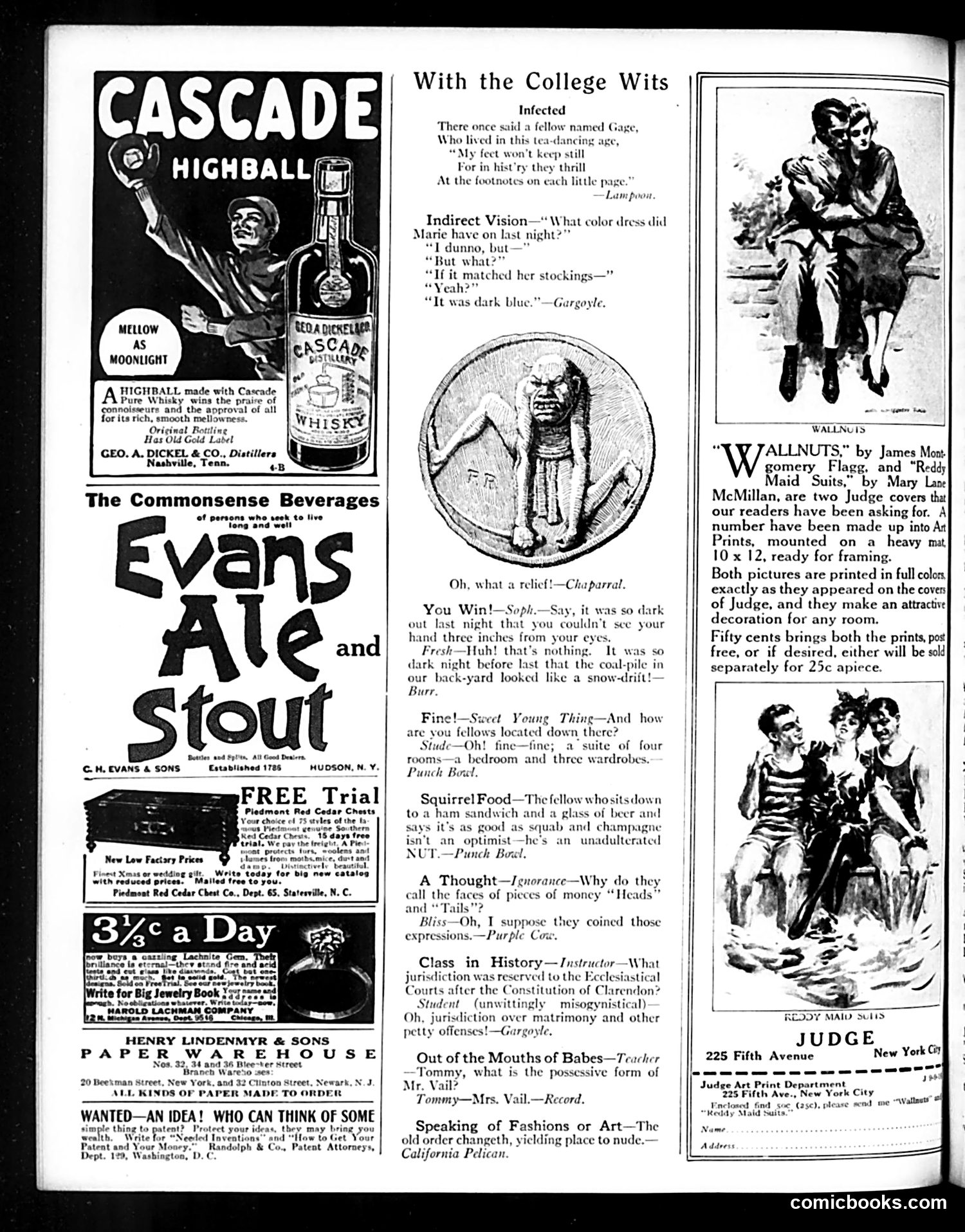
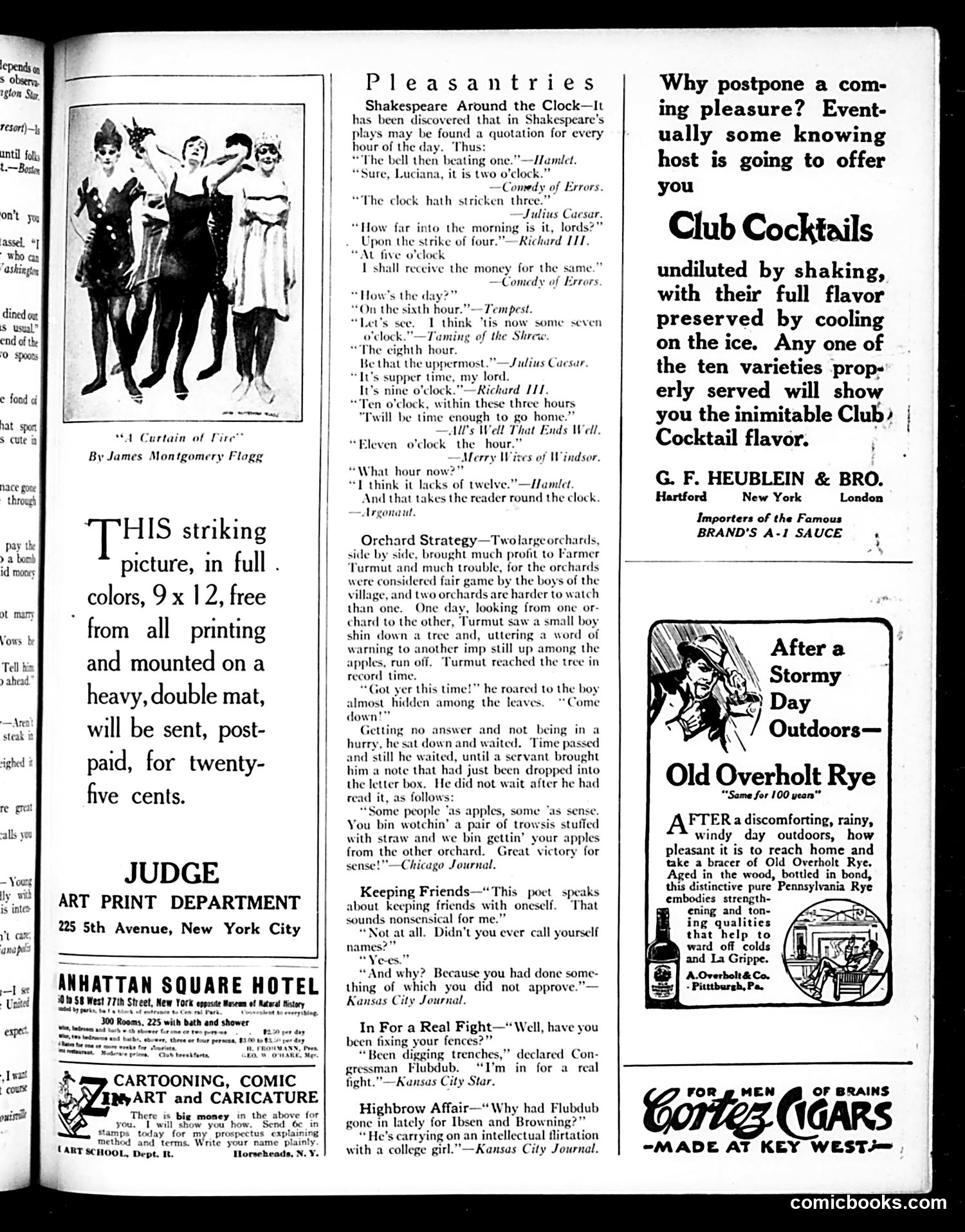
This page is primarily **advertisements and humorous college content**, not political satire. The left side features whiskey and consumer product ads (Cascade Highball, Evans Ale, patent services). The right side showcases "College Wits"—humor pieces from university publications like *Lampoon*, *Gargoyle*, and *Punch Bowl*. These are lightweight jokes about student life: a pedantic student obsessed with footnotes, a drunk unable to see in darkness, and wordplay about "Heads and Tails" (coin terminology). The page also advertises Judge magazine's art prints—illustrations by Montgomery Flagg and Mary Lane McMillan titled "Wallnuts" and "Reddy Maid Suits," available for 50 cents or separate purchase at 25 cents. **No significant political content appears here.** This is a typical Judge page mixing advertisements with reprinted college humor, reflecting early 20th-century magazine publishing practices.
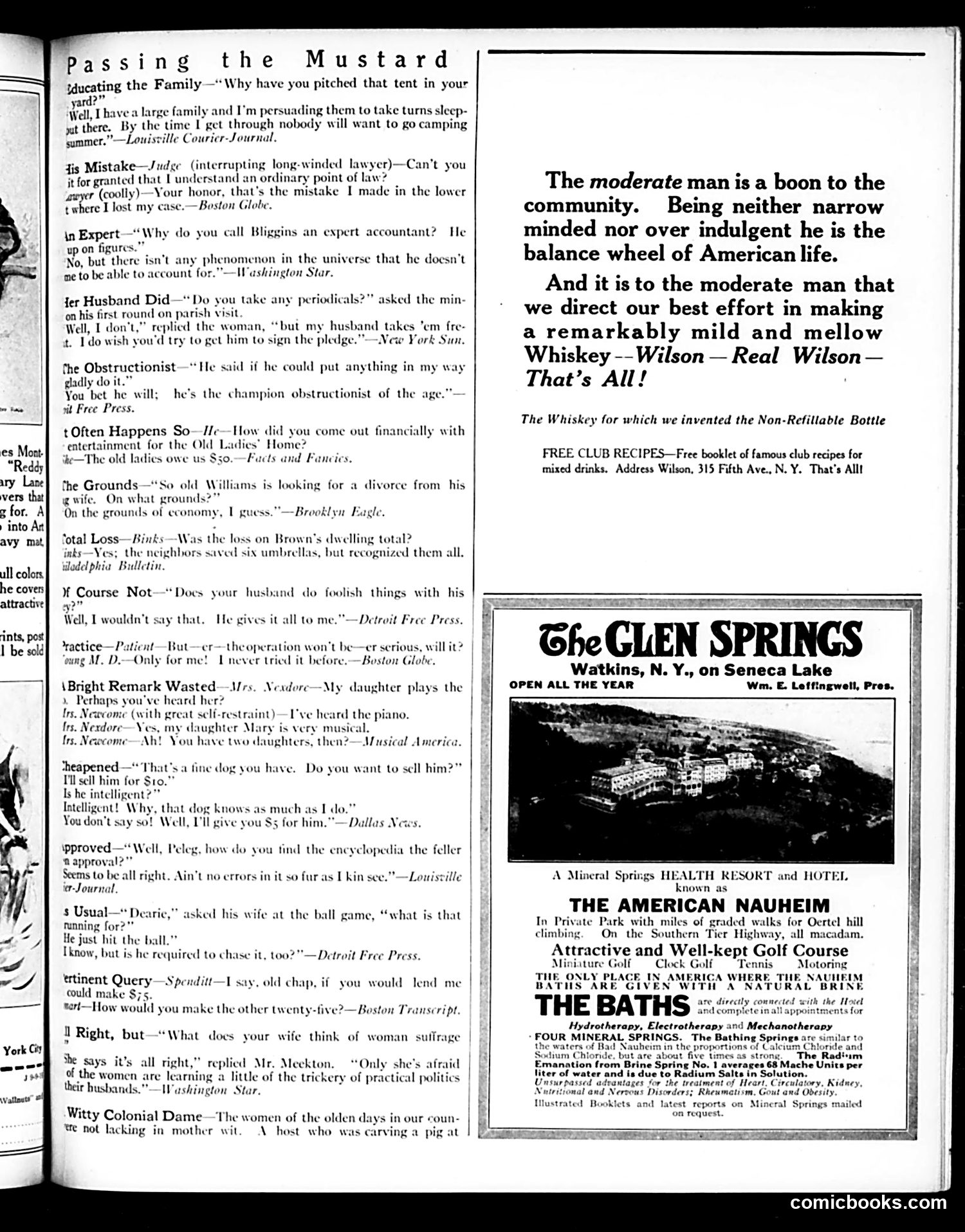
This is primarily a **humor/joke page** from Judge magazine featuring brief anecdotes rather than editorial cartoons. The page collects short, punchy jokes organized under humorous headings, mostly playing on wordplay and domestic situations typical of early 20th-century American humor. The jokes satirize common social types: incompetent professionals (the lawyer who loses cases, the young doctor performing his first operation), marital dynamics (husbands avoiding pledges, wives managing household finances), and gender relations (the woman skeptical about suffrage fearing women will learn "trickery" from men's politics). The dominant advertisement is for **Wilson Whiskey**, marketing itself to "the moderate man" as embodying American balance and virtue—ironic given Prohibition-era concerns about alcohol. The **Glen Springs resort ad** offers a mineral springs health resort, reflecting era-specific wellness trends. Overall, the page reflects early 1900s concerns: temperance debates, women's political participation, class anxiety, and emerging consumer culture.
This page is primarily **advertising**, not political satire. It contains numerous classified ads typical of early 20th-century magazines: diamonds and watches on credit, accountancy courses, piano lessons, patent services, and office supplies (glue, ink pencils). The text content consists of **humor pieces and jokes** rather than cartoons—brief, sentimental or punny anecdotes on topics like rural courtship ("Hillbilly Lyric"), Darwinism, domestic life, and romance. These reflect period attitudes: a condescending tone toward rural speech, simplistic anti-evolution humor, and gender stereotypes about women's materialism ("divorce suit," "superior manner"). There are **no identifiable political figures or sophisticated satire** visible. The humor is generic, family-newspaper fare aimed at mainstream readers. The page demonstrates how Judge balanced satirical editorial content with conventional advertising and light comic filler to fill space and generate revenue.
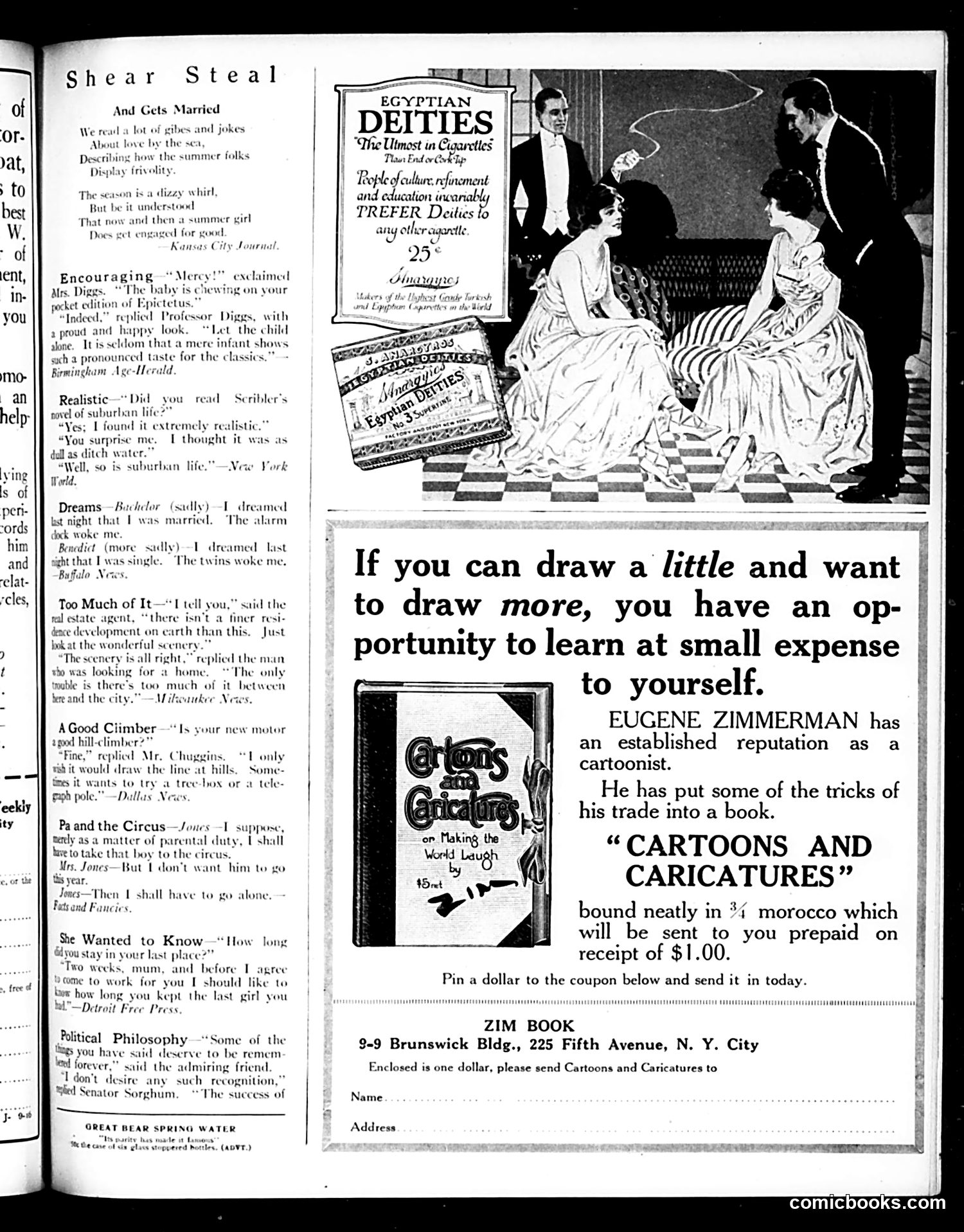
This page contains primarily **humorous anecdotes and advertising** rather than political cartoons. The left column features brief jokes on domestic and social themes typical of early 20th-century humor: a child quoting classics, suburban life realism, newlywed dreams, real estate sales pitches, and marital complaints. These are gentle satirical observations of contemporary American middle-class life—no specific political figures or events are referenced. The top features an **Egyptian Deities cigarette advertisement**, appealing to consumers through claims of "culture, refinement and education"—a common early advertising strategy linking products to sophistication. The dominant content is a **mail-order advertisement** for Eugene Zimmerman's instructional book "Cartoons and Caricatures" (priced at $1.00). Zimmerman was an established cartoonist, and the ad targets readers with drawing interest, offering to teach cartooning techniques affordably. The page is essentially a **mixed-content issue** mixing light humor with commercial promotions rather than focused political or social satire.
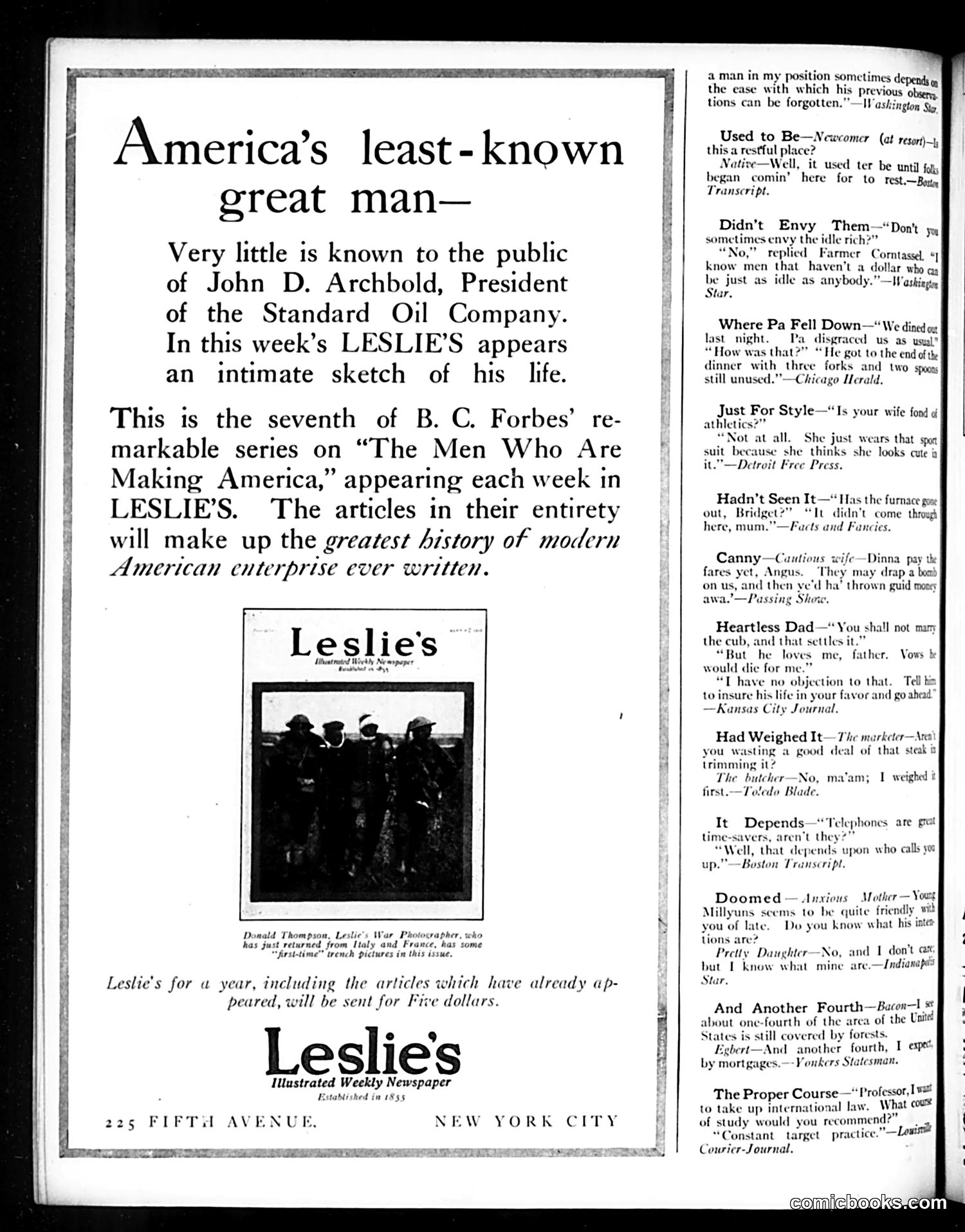
This page is primarily **advertising** for Leslie's Illustrated Weekly Newspaper, promoting a series by B.C. Forbes called "The Men Who Are Making America." The lead article announces coverage of **John D. Archbold, President of Standard Oil**—a prominent but little-known industrialist whom the magazine claims deserves public attention. The left side features a war photograph by Donald Thompson from Italy and France. The right side consists entirely of **brief humorous jokes/anecdotes**, a common feature of satirical magazines. These include domestic humor ("Pa disgraced us"), gender humor ("she wears a sport suit"), and class commentary ("envy the idle rich"). One joke references **forest coverage and mortgages**—likely critiquing rural debt or foreclosure. The overall content reflects early 20th-century American sensibilities: industrial titans, WWI interest, domestic comedy, and economic anxiety.
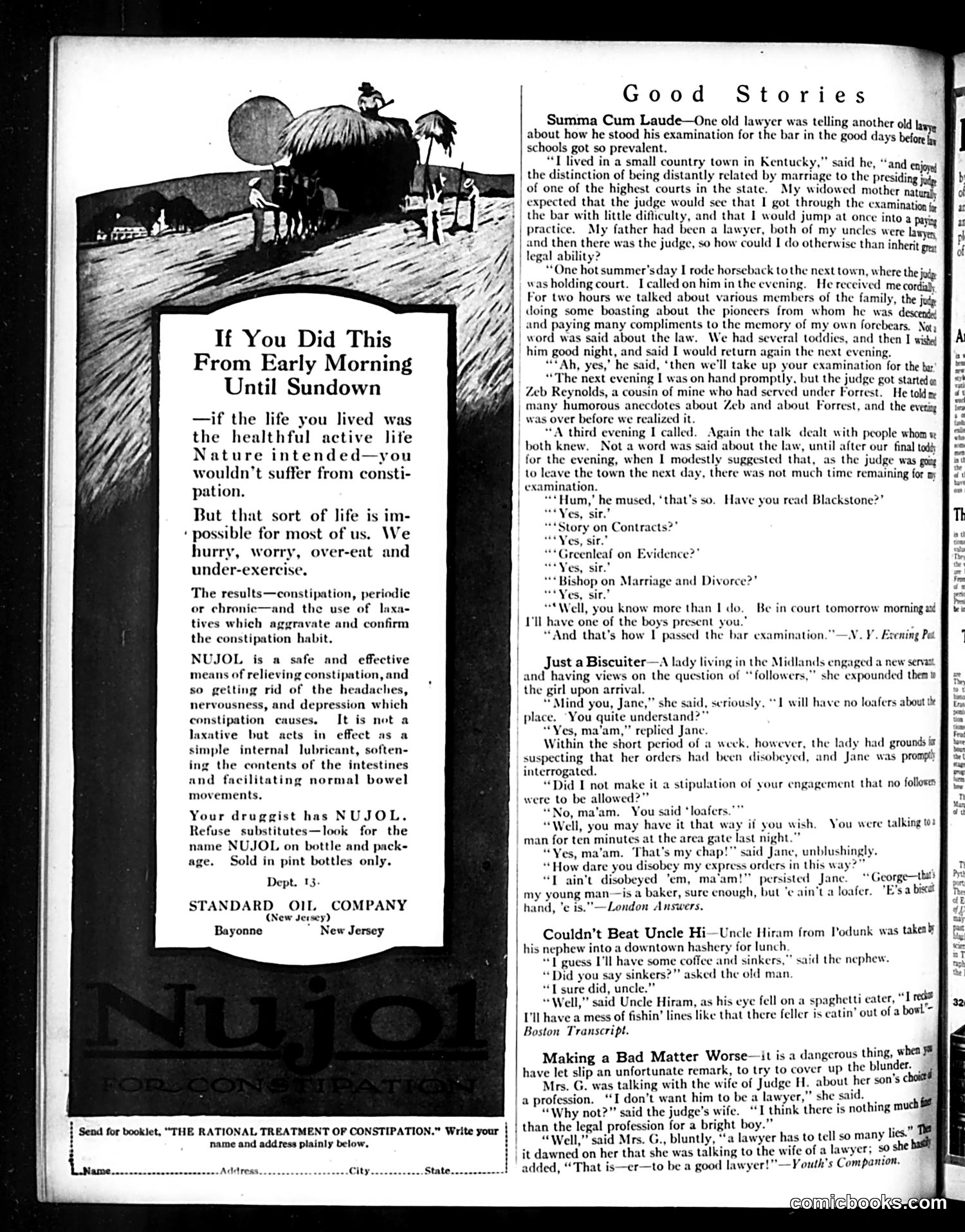
This page is primarily a **pharmaceutical advertisement** for Nujol, a mineral oil laxative made by Standard Oil Company. The ad uses a common early 20th-century health argument: modern urban life—hurrying, worrying, overeating, under-exercising—causes constipation. The accompanying illustration shows idealized rural/outdoor labor from "early morning until sundown," implying such natural activity would prevent digestive problems. The pitch claims Nujol differs from typical harsh laxatives by acting as a "simple internal lubricant" rather than a stimulant, thus avoiding habit-formation. The right column contains unrelated "Good Stories"—brief humorous anecdotes about lawyers and servants—typical filler content for Judge magazine. The ad reflects period anxieties about modern sedentary life and the era's ready marketing of patent medicines as solutions to everyday ailments.
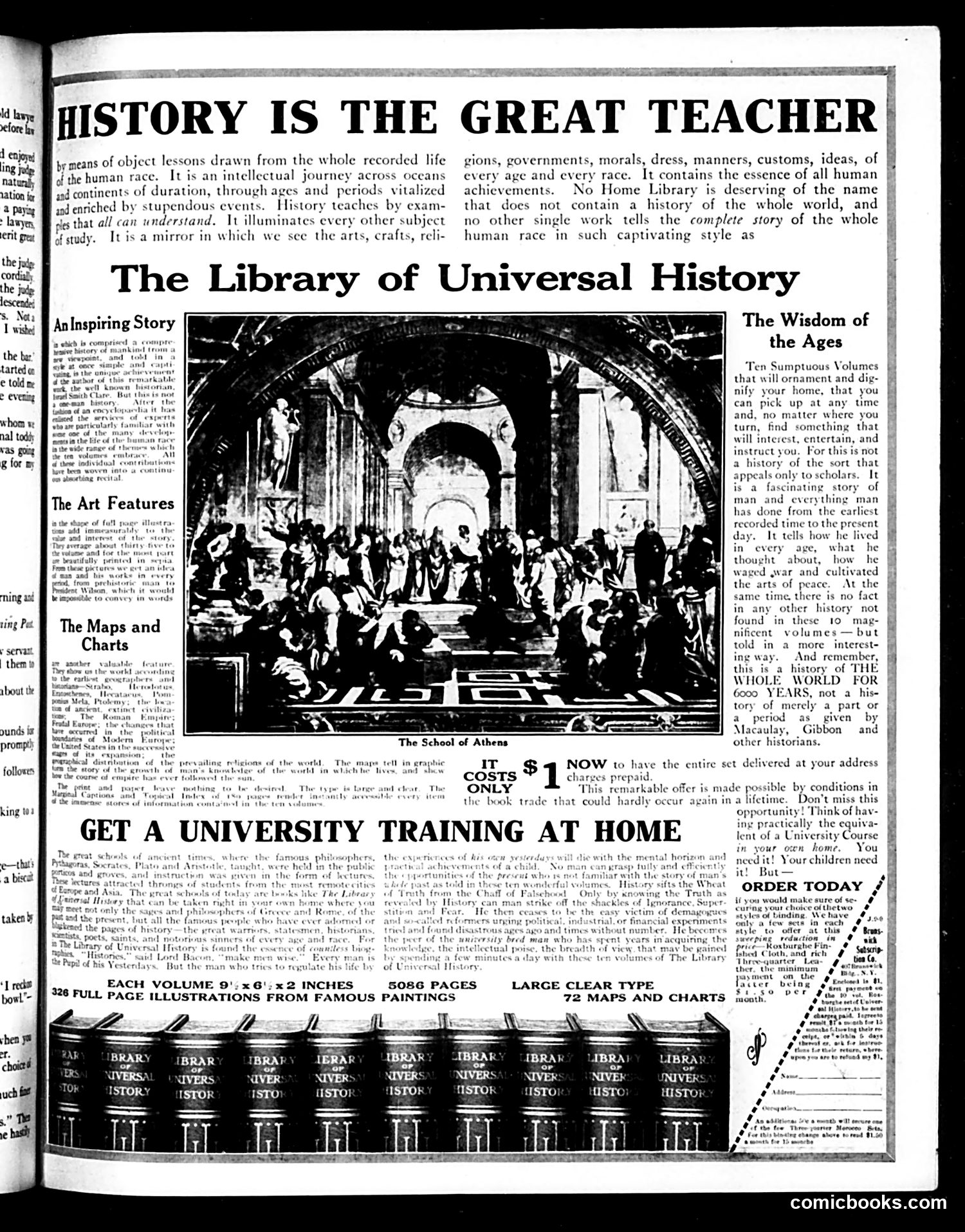
This page is primarily **advertising**, not satire or political commentary. It promotes "The Library of Universal History," a ten-volume encyclopedia set priced at $1 per volume. The content includes: - A philosophical header celebrating history as "the great teacher" - Marketing sections highlighting features: "An Inspiring Story," "The Art Features," "The Maps and Charts," and "The Wisdom of the Ages" - A large central engraving titled "The School of Athens" (depicting classical learning) - An order form emphasizing value: a "university training at home" for working people who cannot afford formal education **Historical context**: This appears to be early 20th-century marketing targeting middle-class Americans. The pitch emphasizes self-improvement and accessible education—selling history as both practical knowledge and cultural refinement for the home. There is **no political satire** on this page. Judge magazine's typical humor is absent here; this is straightforward commercial promotion dressed in educational language.
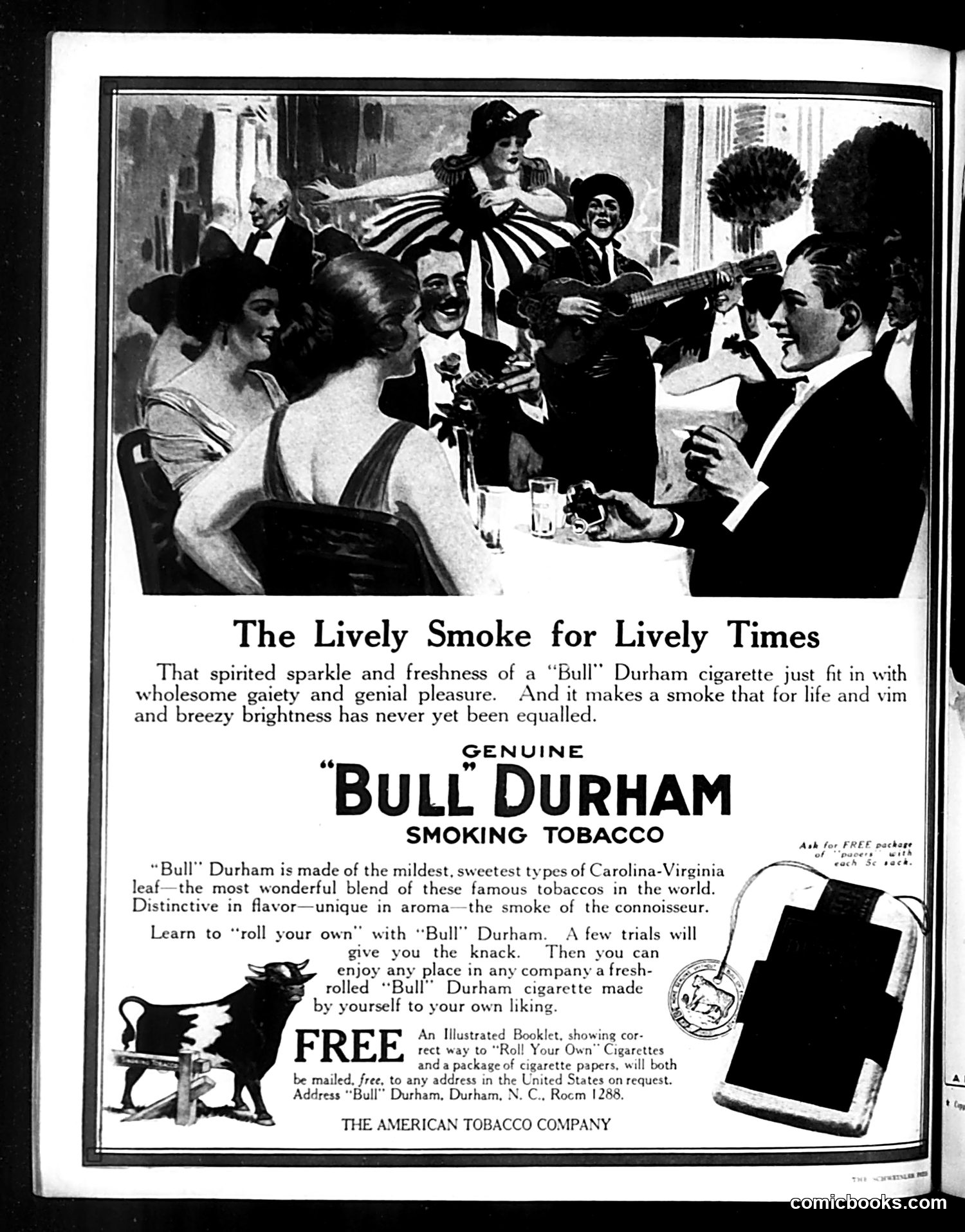
This page is primarily a **tobacco advertisement**, not satire. It's a "Bull Durham" cigarette ad from *Judge* magazine showing an elegant 1910s-era party scene: well-dressed men and women in formal attire, with musicians performing (guitar player visible). The ad's appeal relies on **period class signifiers**—the sophisticated dinner setting suggests that smoking Bull Durham signals refinement and social status. The headline "Lively Smoke for Lively Times" promises the product enhances social pleasure and vitality. The ad emphasizes **"roll your own" cigarettes**, promoting consumer agency and economy. It offers free instructional booklets and cigarette papers to encourage adoption. To modern readers, this is striking primarily for its **casual tobacco marketing to a general audience**—no age restrictions, health warnings, or irony. The aspirational lifestyle branding (gaiety, brightness, connoisseurship) was standard advertising practice before mid-century tobacco regulation.