
Judge, 1916-09-09 · page 16 of 32
Judge — September 9, 1916 — page 16: what you’re looking at
What you’re looking at
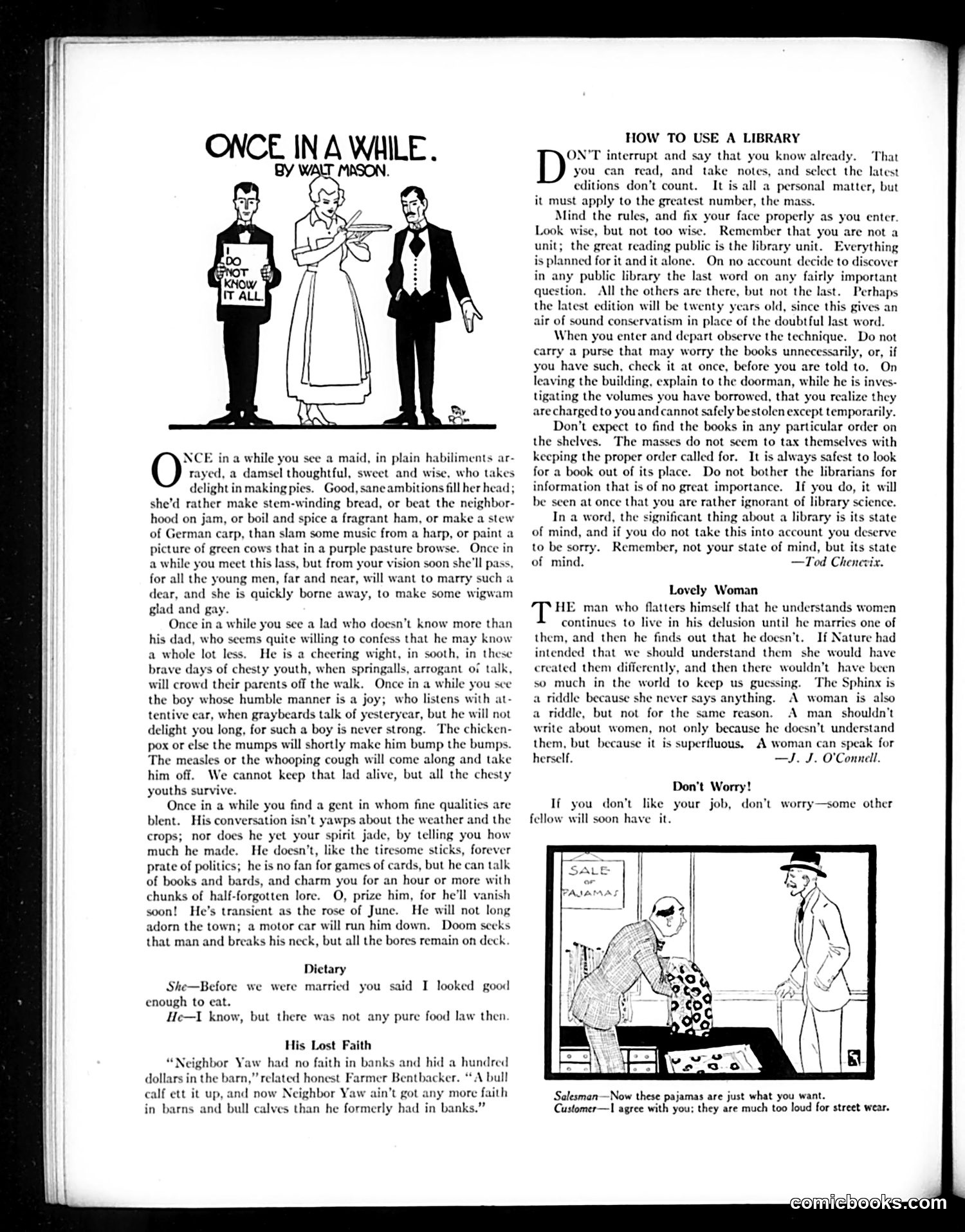
This page from **Judge** (a satirical American magazine) contains three distinct pieces: ## "Once in a While" by Walt Mason A humorous poem celebrating rare virtuous types destined for early death or obscurity: the domestic maid (who'll be quickly married off), the humble, respectful youth (who'll die of childhood illness), and the cultured gentleman (who'll be hit by a car). The satire mocks how society eliminates its best members while mediocrity persists. ## Social Commentary Pieces Brief jokes on contemporary topics: "Lovely Woman" questions men's understanding of women; "Don't Worry" offers workplace humor; "Dietary" jokes about food safety laws (likely referencing early 20th-century Pure Food legislation); "His Lost Faith" satirizes a farmer's loss of trust in institutions (banks/barns). ## "How to Use a Library" Tongue-in-cheek advice mocking snobbish library culture—advising patrons to appear wise, accept outdated books, and maintain proper decorum. It critiques elitist attitudes toward public library systems. The bottom cartoon (salesman/customer) appears cut off but likely addresses consumer behavior or retail fraud.
📄 Transcribed text from this page (OCR, searchable)
Machine-transcribed from the original scan — historical spelling and the odd misread are preserved.
NA WHILE. ALT MASON. C. ii NCE ina while you see a maid, in plain habiliments ar- O rayed, a damsel thoughtful, sweet and wise, who takes delight in making pies. Good, sane ambitions fill her head; she'd rather make stem-winding bread, or beat the neighbor- hood on jam, or boil and spice a fragrant ham, or make a stew of German carp, than slam some music from a harp, or paint a picture of green cows that in a purple pasture browse. Once in a while you meet this lass, but from your vision soon she'll pass, for all the young men, far and near, will want to marry such a dear, and she is quickly borne away, to make some wigwam glad and g Once in a while you see a lad who doesn’t know more than his dad, who seems quite willing to confess that he may know a whole lot less. He is a cheering wight, in sooth, in these brave days of chesty youth, when springalls, arrogant o/ tal will crowd their parents off the walk. Once in a while you sce the boy whose humble manner is a joy; who listens with at- tentive ear, when graybeards talk of yesteryear, but he will not delight you long, for such a boy is never strong. The chicken- pox or else the mumps will shortly make him bump the bumps. The measles or the whooping cough will come along and take him off. We cannot keep that lad alive, but all the chesty youths survi' Once in a while you find a gent in whom fine qualities are blent. His conversation isn’t yawps about the weather and the crops; nor does he yet your spirit jade, by telling you how much he made. He doesn’t, like the tiresome sticks, forever prate of politics; he is no fan for games of cards, but he can talk of books and bards, and charm you for an hour or more with chunks of half-forgotten lore. O, prize him, for he'll vanish soon! He’s transient as the rose of June. He will not long adorn the town; a motor car will run him down. Doom seeks that man and breaks his neck, but all the bores remain on deck. Dietary She—Before we were married you said I looked good enough to eat. He—I know, but there was not any pure food law then His Lost Faith “Neighbor Yaw had no faith in banks and hid a hundred dollars in the barn,” related honest Farmer Bentbacker. “A bull calf ett it up, and now Neighbor Yaw ain’t got any more faith in barns and bull calves than he formerly had in banks.” HOW TO USE A LIBRARY ON’T interrupt and say that you know already. ‘That you can read, and take notes, and select the latest editions don’t count. It is all a personal matter, but it must apply to the greatest number, the mass. Mind the rules, and fix your face properly as you enter. Look wise, but not too w Remember that you are not a unit; the great reading public is the library unit. Everything is planned for it and it alone. On no account decide to discover in any public library the last word on any fairly important question. All the others are there, but not the last. Perhaps the latest edition will be twenty years old, since this gives an air of sound conservatism in place of the doubtful last word. When you enter and depart observe the technique. Do not carry a purse that may worry the books unnecessarily, or, if you have such, check it at once, before you are told to. On leaving the building, explain to the doorman, while he ligating the volumes you have borrowed, that you realize they arecharged to youand cannot safely be stolen except temporarily. Don’t expect to find the books in any particular order on the shelves. The masses do not scem to tax themselves with keeping the proper order called for. It is always safest to look for a book out of its place. Do not bother the librarians for information that is of no great importance. If you do, it will be seen at once that you are rather ignorant of library science. In a word, the significant thing about a library is its state of mind, and if you do not take this into account you deserve to be sorry. Remember, not your state of mind, but its state of mind. ‘od Chener Lovely Woman HE man who flatters himself that he understands women continues to live in his delusion until he marries one of them, and then he finds out that he doesn’t. If Nature had intended that we should understand them she would have created them differently, and then there wouldn’t have been so much in the world to keep us guessing. The Sphinx is a riddle because she never says anything. A woman is also a riddle, but not for the same reason. A man shouldn't write about women, not only because he doesn’t understand them, but because it is superfluous. A woman can speak for herself. —J. J. O'Connell. Don't Worry! If you don't like your job, don’t worry—some other fellow will soon have it. Salesman—Now these pajamas are just what you want. Customer—I agree with you: they are much too loud for street wear.