
Judge, 1916-09-09 · page 9 of 32
Judge — September 9, 1916 — page 9: what you’re looking at
What you’re looking at
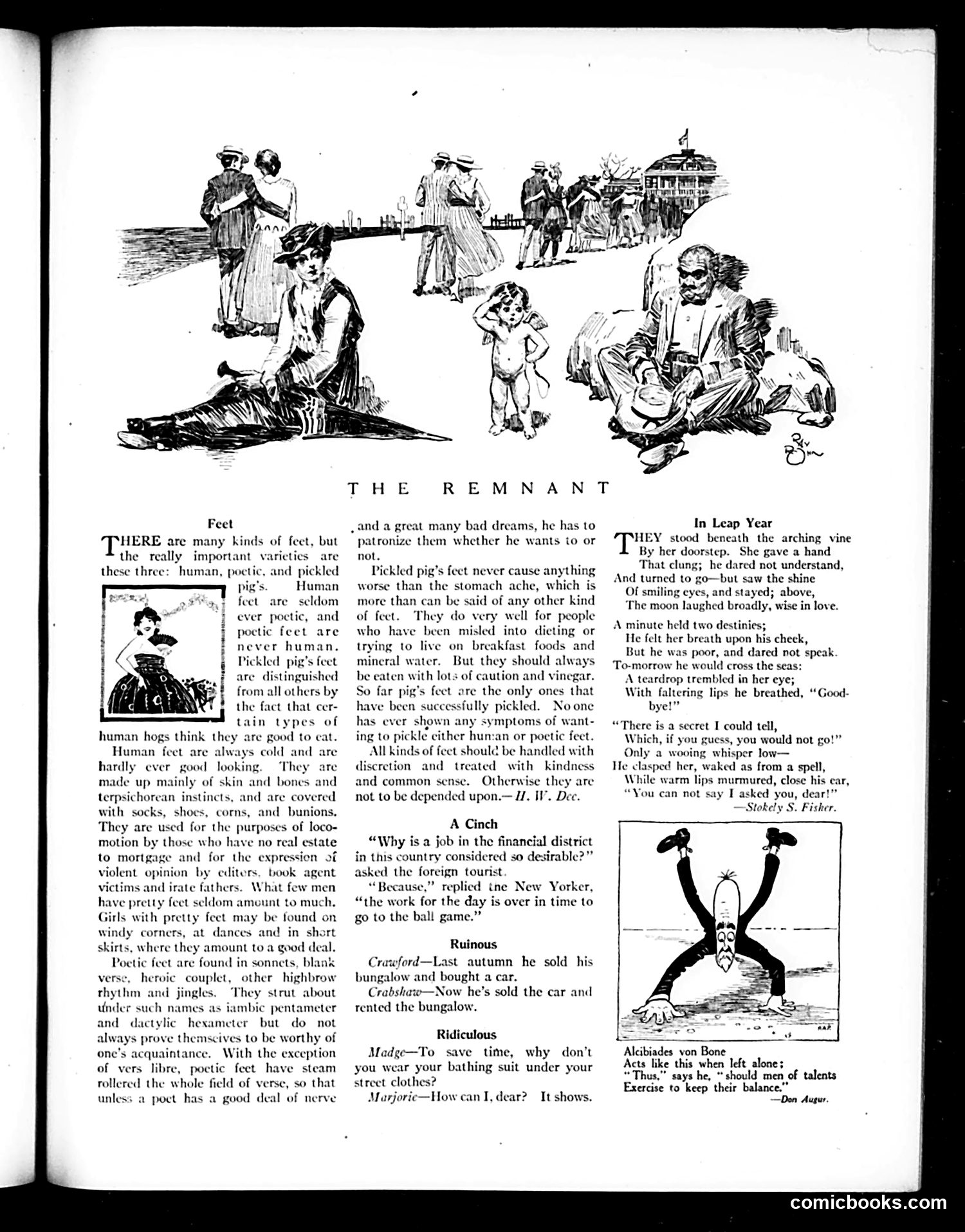
This page from Judge magazine contains several brief satirical pieces typical of early 20th-century American humor: **"The Remnant"** is a tongue-in-cheek essay distinguishing three types of feet: human (covered in practical problems like corns), poetic (used in verse forms like iambic pentameter), and pickled pig's feet (a working-class food). The satire gently mocks both pretentious literary conventions and the absurdity of treating food seriously. **"A Cinch"** jokes that Wall Street financiers consider their jobs desirable only because they finish early enough to attend baseball games—a swipe at both financial workers' priorities and the era's obsession with baseball. **"In Leap Year"** is a sentimental romantic poem where a poor man and woman share a moment under the moon; she hints she could confess love, but he leaves the next day. **"Ridiculous"** is a brief comic exchange about wearing a bathing suit under street clothes. The cartoon showing an acrobat illustrates "Alcibiades von Bone" practicing balance exercises—likely commenting on maintaining composure or dignity in absurd situations.
📄 Transcribed text from this page (OCR, searchable)
Machine-transcribed from the original scan — historical spelling and the odd misread are preserved.
Feet HERE are many kinds of feet, but the really important varieties are these three: human, poctic, and pickled pig’s. Human feet seldom ever pocti nd poctic feet are never human, Pickled pig's feet are distinguished from all others by the fact that cer- tain types of human hogs think they are good to cat. Human feet are always cold and hardly ever good looking. ‘They are made up mainly of skin and bones and terpsichorean instincts, and are covered with socks, shoes, corns, and bunions, They are used for the purposes of loco- motion by those who have no real estate to mort and for the expression of violent opinion by editers, book agent victims and irate fathers. What few men have pretty feet seldom amount to much. Girls with pretty feet may be found on windy corners, at dances and in short skirts, where they amount to a good deal. Poetic fect are found in sonnets, blank verse, heroic couplet, other highbrow rhythm and jingles. They strut about under such names as iambic pentameter and dactylic hexameter but do not always prove themscives to be worthy of one’s acquaintance. With the exception of vers libre, poctic fect have steam rollered the whole field of verse, so that unless a poct has a good deal of nerve are THE REMNANT and a great many bad dreams, he to patronize them whether he wants to or not. Pickled pig’s feet never cause anything worse than the stomach ache, which is more than can be said of any other kind of fect. They do very well for people who have been misled into dieting or trying to live on breakfast foods and mineral water. But they should always be eaten with lots of caution and vinegar. So far pig's fect are the only ones that have been successfully pickled. Noone has ever shown any symptoms of want- ing to pickle cither hun:an or poctic feet. All kinds of feet should be handled with discretion and treated with kindness and common sense. Otherwise they are not to be depended upon.— 11. W. Dee. A Cinch “Why is a job in the financial district in this country considered so desirable?” asked the foreign tourist “Because,” replied tne New Yorker, “the work for the day is over in time to go to the ball game.” Ruinous Crawford—Last autumn he sold his bungalow and bought a car. Crabshaw—Now he’s sold the car and rented the bungalow. Ridiculous Madge—To save time, why don’t you wear your bathing suit under your street clothes? Marjoric—How can I, dear? It shows. In Leap Year HEY stood beneath the arching vine By her doorstep. She gave a hand That clung; he dared not understand, And turned to go—but saw the shine Of smiling d stayed; above, The moon laughed broadly, wise in love. A minute held two destinies; He felt her breath upon his check, But he was poor, and dared not speak To-morrow he would cross the sea! A teardrop trembled in her eye; With faltering lips he breathed, ‘‘Good- bye “There is a secret I could tell, Which, if you guess, you would not go!” Only a wooing whisper low— He clasped her, waked as from a spell, While warm lips murmured, close his car, “You can not say I asked you, dear!” —Stokely S. Fisker. Alcibiades von Bone Acts like this when left alone; “Thus,” says he, “should men Exercise to keep their balance.” Den Augur. of talents comicbooks.com