
Judge, 1916-09-09 · page 15 of 32
Judge — September 9, 1916 — page 15: what you’re looking at
What you’re looking at
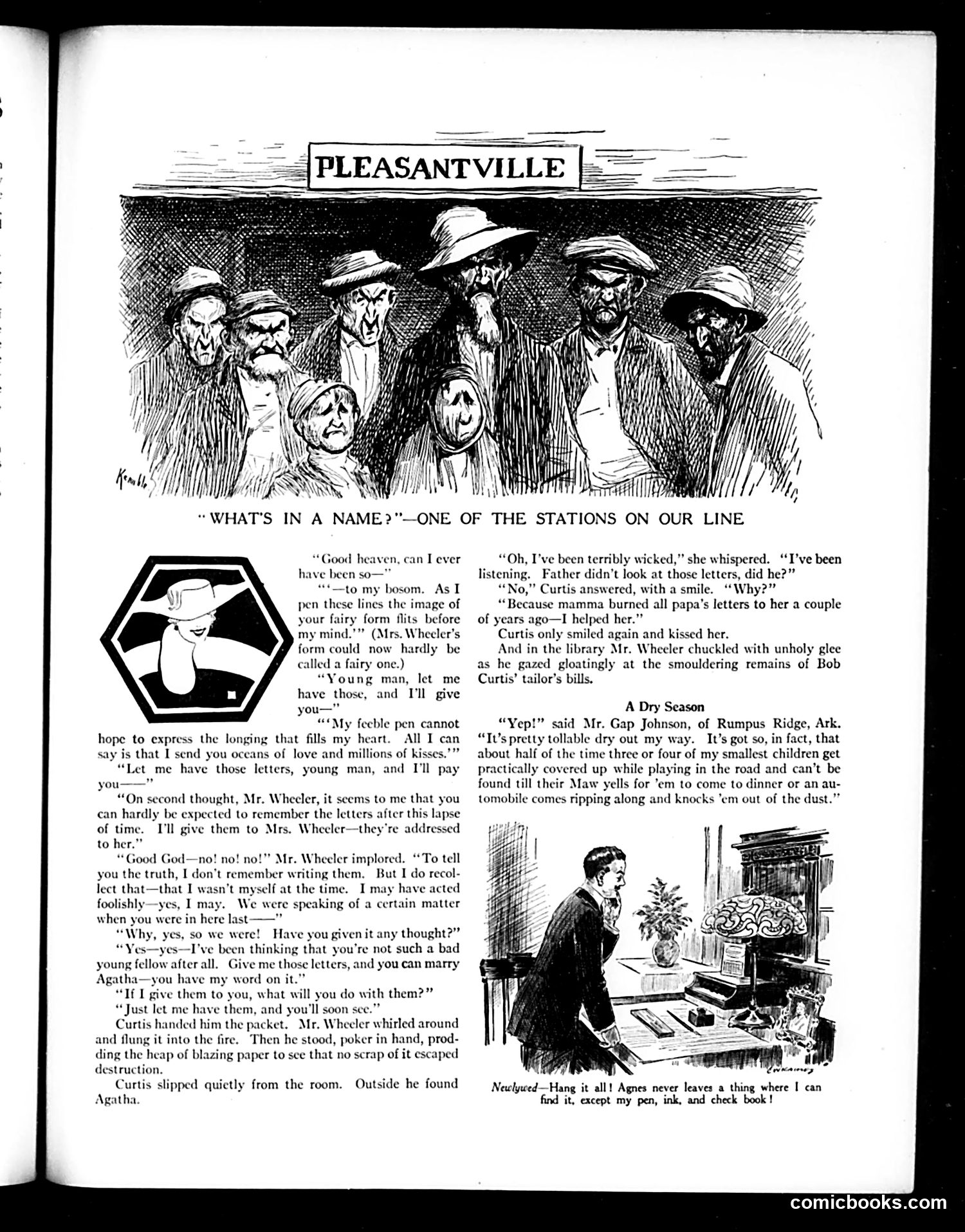
**Main Story**: A young man (Curtis) possesses romantic love letters written by Mr. Wheeler to his wife years earlier. Curtis uses them as leverage to gain Wheeler's permission to marry his daughter Agatha. Wheeler initially tries to buy the letters back, then agrees to let Curtis marry Agatha if he surrenders them. Wheeler burns the letters—but the joke's twist: Curtis discovers Wheeler was actually destroying his own *tailor's bills*, not love letters, while Curtis' true romantic correspondence remains safe. The satire targets male anxiety about preserved evidence of youthful romantic excess and marital compromises. **"A Dry Season"**: Rural humor about severe drought in Arkansas, where dust is so thick children playing outdoors become buried and invisible until called for dinner or hit by passing automobiles. **"Newlywed"**: Brief joke about a new wife's disorganization—she loses everything except her husband's pen, ink, and checkbook (implying she'll drain his finances). The page exemplifies Judge's mix of domestic comedy and rural Americana stereotypes.
📄 Transcribed text from this page (OCR, searchable)
Machine-transcribed from the original scan — historical spelling and the odd misread are preserved.
“Good heaven, can I ever have been so—" “*—to my bosom. As I pen these lines the image of your fairy form flits before my mind.’” (Mrs. Wheeler's form could now hardly be called a fairy one.) “Young man, let me have those, and I'll give you—" “My feeble pen cannot hope to express the longing that fills my heart. All I can say is that I send you oceans of love and millions of kisses.’”” “Let me have those letters, young man, and I'll pay you——" “On second thought, Mr. Wheeler, it seems to me that you can hardly be expected to remember the letter er this lapse of time. I'll give them to Mrs. Wheeler—they're addressed to her.” “Good God—no! no! no!” Mr. Wheeler implored. “To tell you the truth, I don't remember writing them, But I do recol- lect that—that I wasn’t myself at the time. I may have acted foolishly speaking of a certain matter when you were in here last yes, so we were! Have you given it any thought?” s—I’ve been thinking t you're not such a bad young fellow after all. Give me those letters, and you can marry Agatha—you have my word on it.” “If 1 give them to you, what will you do with them?” “Just let me have them, and you'll soon see. Curtis handed him the packet. Mr. Wheeler whirled around and flung it into the fire. Then he stood, poker in hand, prod- ding the heap of blazing paper to sce that no scrap of it escaped destruction. Curtis slipped quictly from the room. Agatha. Outside he found “Oh, I've been terribly wicked,” she whispered. ‘I’ve been listening. Father didn’t look at those letters, did he?” “No,” Curtis answered, with a smile. ‘‘ Why?” “Because mamma burned all papa’s letters to her a couple of years ago—I helped her.” Curtis only smiled again and kissed her. And in the library Mr. Wheeler chuckled with unholy glee as he gazed gloatingly at the smouldering remains of Bob Curtis’ tailor’s bills. A Dry Season “Yep!” said Mr. Gap Johnson, of Rumpus Ridge, Ark. “It’s pretty tollable dry out my way. It’s got so, in fact, that about half of the time three or four of my smallest children get practically covered up while playing in the road and can’t be found till their Maw yells for ’em to come to dinner or an au- tomobile comes ripping along and knocks ‘em out of the dust.”” Newlywed—Hang it all! Agnes never leaves a thing where I can find it, except my pen, ink, and check book ! comicbooks.com