
Judge, 1916-09-09 · page 14 of 32
Judge — September 9, 1916 — page 14: what you’re looking at
What you’re looking at
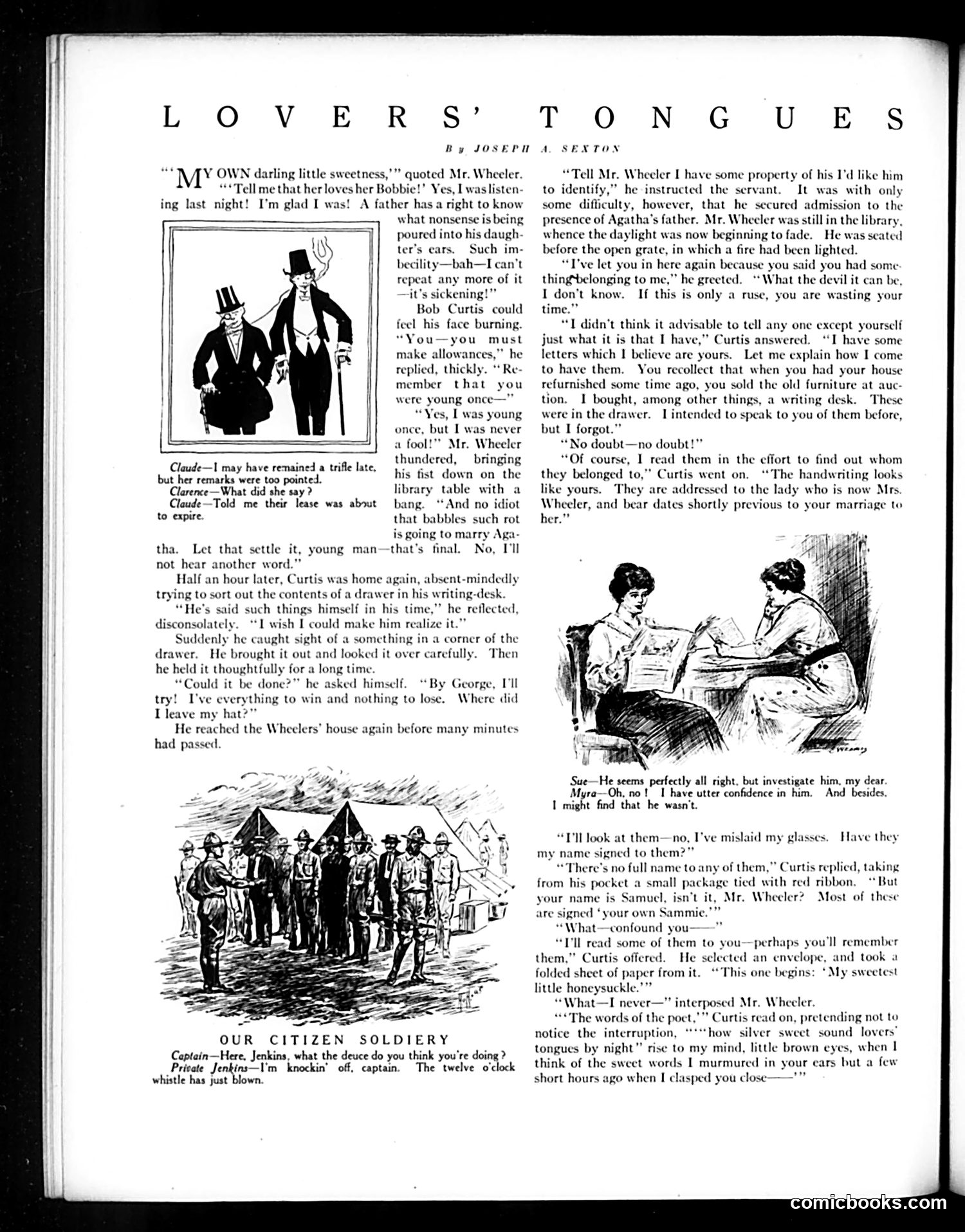
This story satirizes Victorian courtship customs and parental hypocrisy. Mr. Wheeler, Agatha's father, discovers his daughter's suitor (Bob Curtis) reciting romantic poetry to her and furiously forbids the match, thundering that Curtis is an "idiot" spouting "nonsense." Curtis discovers old love letters Wheeler himself wrote to Wheeler's wife (then unmarried) before their marriage—letters equally sentimental and "foolish" by Wheeler's own standards. Curtis retrieves them from an old writing desk purchased at auction. The satire's point: the story exposes Wheeler's double standard. He condemns the young couple's romantic language as sickening drivel, yet he himself wrote identical love letters in his youth. The cartoon implies that parents often demand stricter propriety from their children than they practiced themselves—a timeless complaint about generational hypocrisy. The secondary cartoon ("Our Citizen Soldiery") jokes about a soldier leaving work exactly at noon whistle, mocking military discipline or civilian soldiers' casual attitudes toward duty.
📄 Transcribed text from this page (OCR, searchable)
Machine-transcribed from the original scan — historical spelling and the odd misread are preserved.
LO V E R §S’ By JOSEPH Y OWN darling little sweetness,’ quoted Mr. Wheeler. ell me that her loves her Bobbie!’ Yes, I waslisten- ing last night! I’m glad I was! A father has a right to know what nonsense is being poured into his daugh- ter’s Such im- becility—bah—I can’t repeat any more of it —it’s sickening! Bob Curtis could feel his face burning. “You—you must make allowances,” he replied, thickly. ** Re- member that you were young on ad Yes, I was young once, but I was never a fool!” Mr. Wheeler thundered, _ bringing his fist down on the library table with a bang. ‘And no idiot that babbles such rot is going to marry Aga- that’s final. No, I'll Claude—I may have remained a triffe late, but her remarks were too pointed. Clarence—What did she say ? Claude—Told me their lease was about to expire. tha. Let that settle it, young man not hear another word.” Half an hour later, Curtis was home again, absent-mindedly trying to sort out the contents of a drawer in his writing-desk. “He's said such things himself in his time,”’ he reflected, disconsolately. “1 wish I could make him realize it.” Suddenly he caught sight of a something in a corner of the drawer. He brought it out and looked it over carefully. Then he held it thoughtfully for a long time. “Could it be done?” he asked himself.“ E try! I've everything to win and nothing to lose. I leave my hat?” He reached the Wheelers’ house again before many minutes had passed. y George, [ll Where did OUR CITIZEN SOLDIERY Captain—Here, Jenkins, what the deuce do you think you're doing ? Private Jenkins—\'m knockin’ off, captain. The twelve o'clock whistle has just blown. T ON G UE § 1. SEXTON “Tell Mr. Wheeler I have some property of his I'd like him to identify,” he instructed the servant. It was with only some difficulty, however, that he secured admission to the presence of Agatha’s father. Mr. Wheeler was still in the library, whence the daylight was now beginning to fade. He was seated before the open grate, in which a fire had been lighted. “T've let you in here again because you said you had some: thingbelonging to me,” he greeted.“ What the devil it can be, I don’t know. If this is only a ruse, you are wasting your time.” “T didn’t think it advisable to tell any one except yourself just what it is that I have,” Curtis answered. “I have some letters which I believe are yours. Let me explain how I come to have them. You recollect that when you had your house refurnished some time ago, you sold the old furniture at auc tion. I bought, among other things, a writing des These were in the drawer. intended to speak to you of them before, but I forgot.” “No doubt—no doubt!” “Of course, I read them in the effort to find out whom they belonged to,’ Curtis went on. he handwriting looks like yours. They are addressed to the lady who is now Mrs. Wheeler, and bear dates shortly previous to your marriage to her. He seems perfectly all right. but investigate him, my dear. Sue Myra—Oh, no! I have utter confidence in him. I might find that he wasn’t. And besides, “Took at them—no, I've mislaid my glasses. Have they ame signed to them?” “There's no full name to any of them,” Curtis replied, taking from his pocket a small package tied with red ribbon, ** But your name is Samuel, isn’t it, Mr. Wheeler? Most of these my are signed ‘your own Sammie.’ “What—confound you— “Tl read some of them to you—perhaps you'll remember them,” Curtis offered. He selected an envelope, and took a folded sheet of paper from it. “This one begins: *My sweetest little honeysuckle.’ “What—I never—" interposed Mr. Wheeler. “*The words of the poct,’” Curtis read on, pretending not to notice the interruption, “***how silver sweet sound lovers’ tongues by night” rise to my mind, little brown eyes, when 1 think of the sweet words | murmured in your ears but a few short hours ago when I clasped you close——'””