
A complete issue · 28 pages · 1916
Judge — July 1, 1916
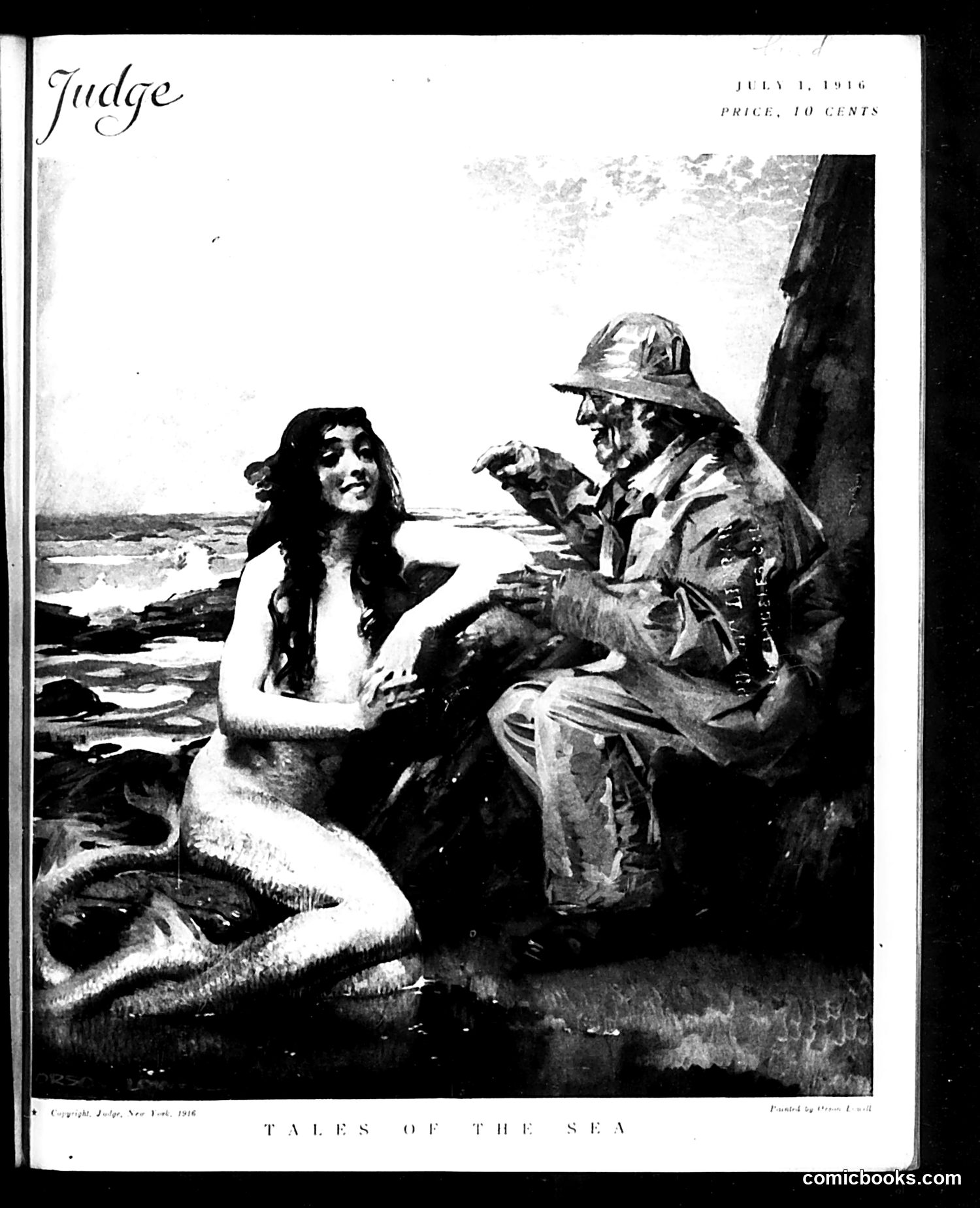
This illustration depicts a mermaid and two sailors in what appears to be a humorous maritime encounter. The caption "Tales of the Sea" suggests this is satirizing the classic folklore trope of mermaids luring sailors. Given Judge magazine's satirical nature and the 1916 date during World War I, this likely contains social commentary about sailors, naval affairs, or wartime behavior. However, without additional context or identifying captions for the specific figures, the exact political or social targets of the satire remain unclear. It may be simply a lighthearted joke about nautical mythology rather than pointed political commentary. The image quality and lack of specific identifying labels make definitive interpretation difficult.
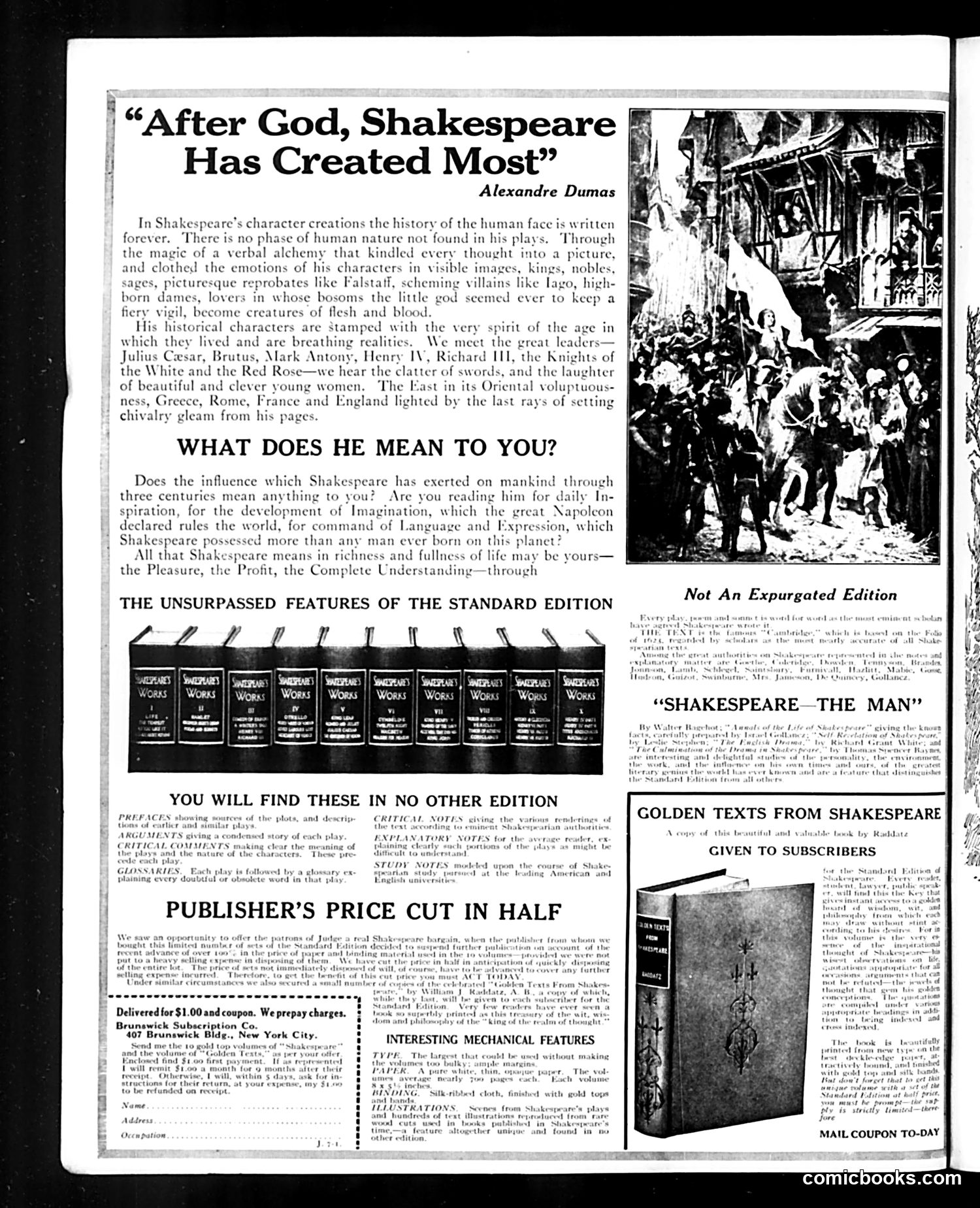
This page is primarily **advertising**, not satire or political commentary. It promotes a Standard Edition of Shakespeare's complete works published by the Brederloh Subscription Co. The marketing copy quotes Alexandre Dumas praising Shakespeare's character creation ("After God, Shakespeare has created most"). The ad emphasizes the edition's exclusive features—prefaces, critical notes, glossaries, and illustrations—unavailable in competing editions. A key selling point is the "Publisher's Price Cut in Half," suggesting competitive pricing advantages. The page includes images of the book volumes and a coupon for mail subscription. The only potentially humorous element is the caption "Not An Exaggerated Edition" accompanying an illustration, likely a lighthearted assurance of authenticity. This represents straightforward product promotion rather than political or social satire typical of Judge magazine.
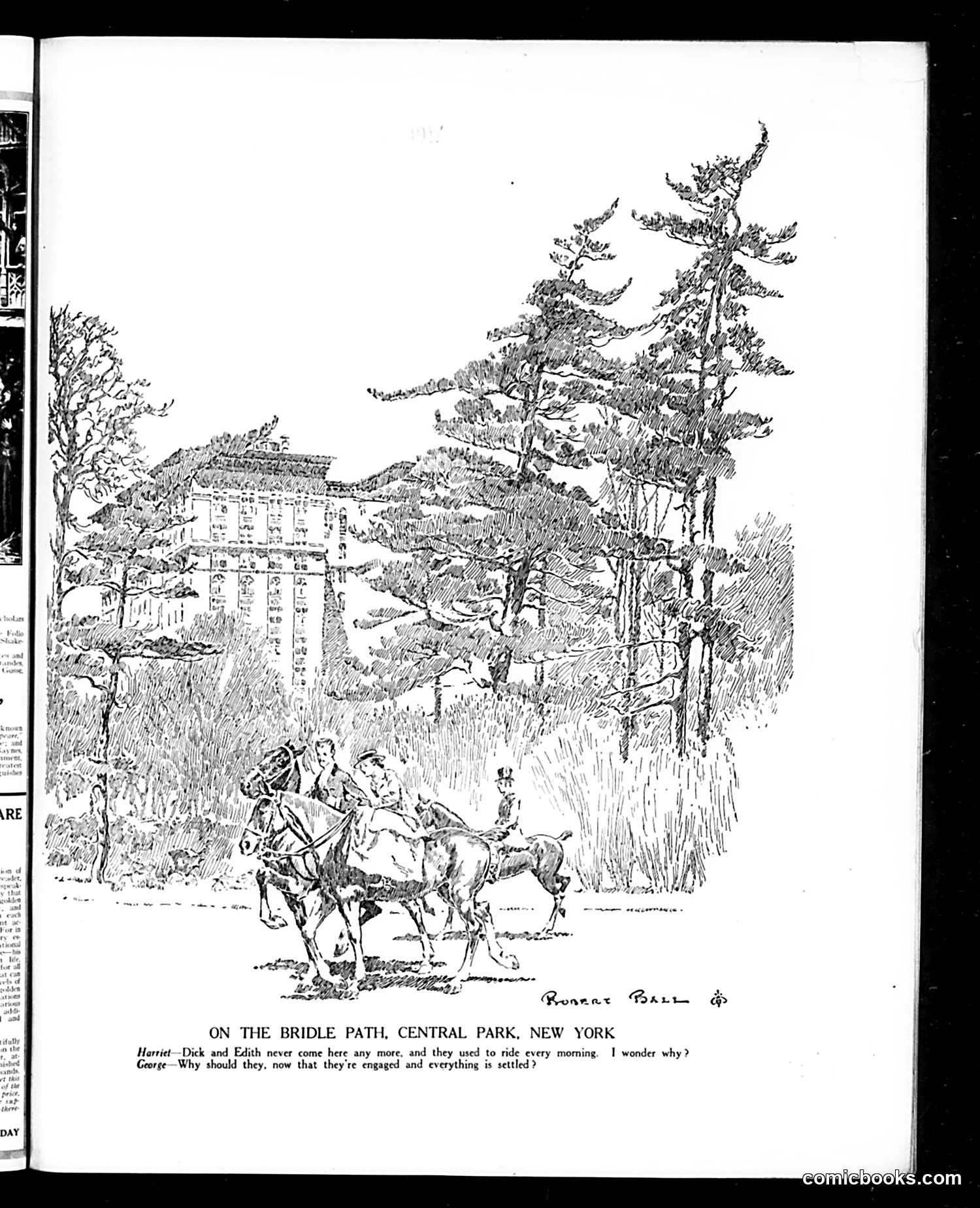
This sketch illustrates a social commentary about engagement and courtship customs. The caption shows dialogue between characters named Harriet, Dick, George, and Edith discussing riding habits. The joke appears to hinge on the contrast between pre-engagement and post-engagement behavior: Dick and Edith "never come here any more" now that "they're engaged," prompting speculation about why they've abandoned their previous social routine of morning rides. The satire mocks how engagement changes couples' public social activities—suggesting that betrothed couples withdraw from communal social spaces like Central Park's bridle path, possibly to spend time alone together instead. It's a gentle jab at how romantic commitment alters social conventions and visibility among Manhattan's upper classes.
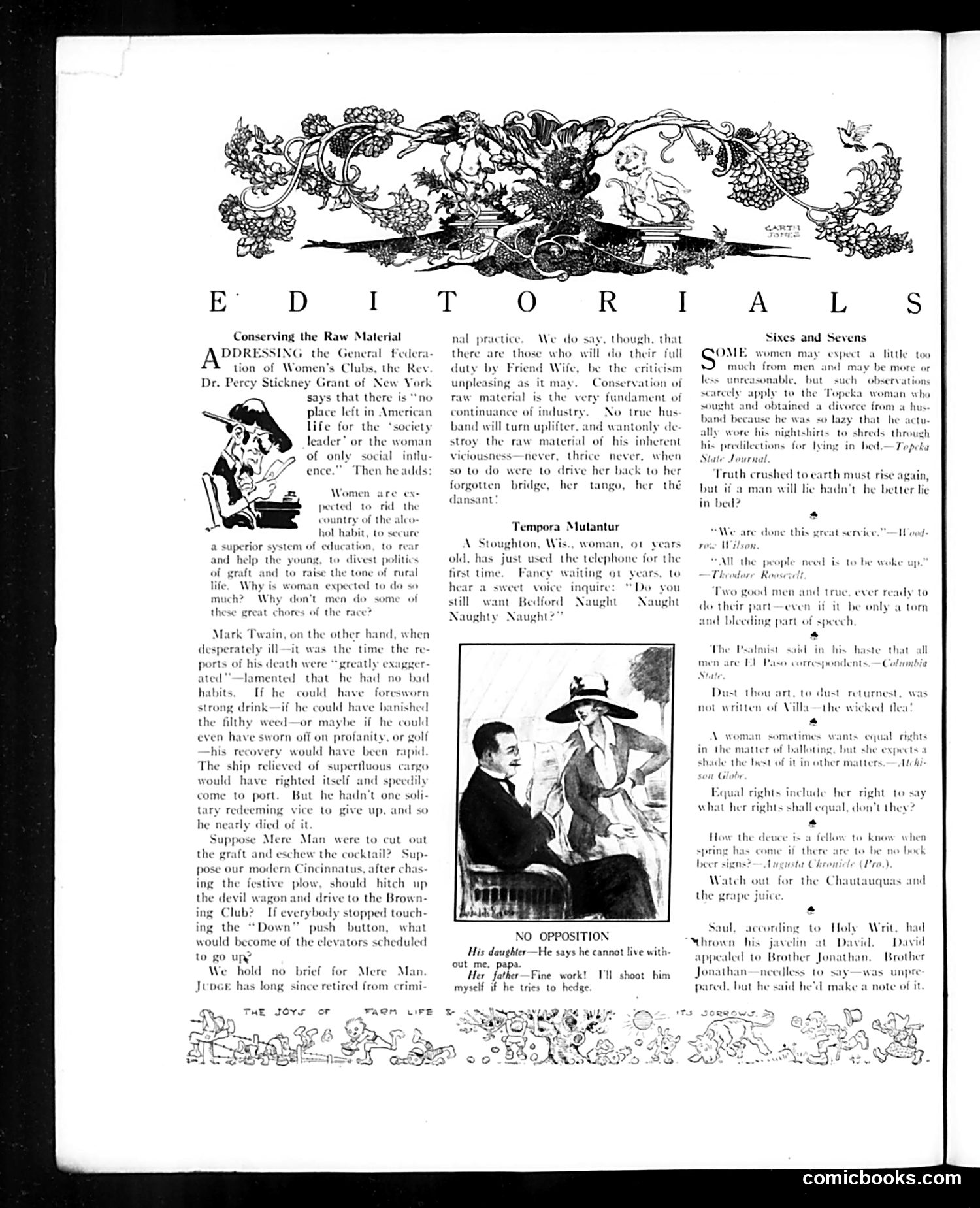
This page combines several editorial pieces critiquing social issues of the era. The main cartoon titled "NO OPPOSITION" depicts a domestic scene where a daughter tells her father she cannot live with her papa, claiming "Fine work! I'll shoot him myself if he tries to hedge." The editorials address women's clubs and their social influence, labor conditions, and marriage/domestic relations—topics of contemporary debate. One section mentions "Sixes and Sevens," discussing women's rights and equality in marriage. The humor relies on period anxieties about changing gender roles and women's increasing social activism. The cartoon suggests tension between generations regarding authority and women's autonomy—likely reflecting early 20th-century concerns about women's suffrage and independence movements.
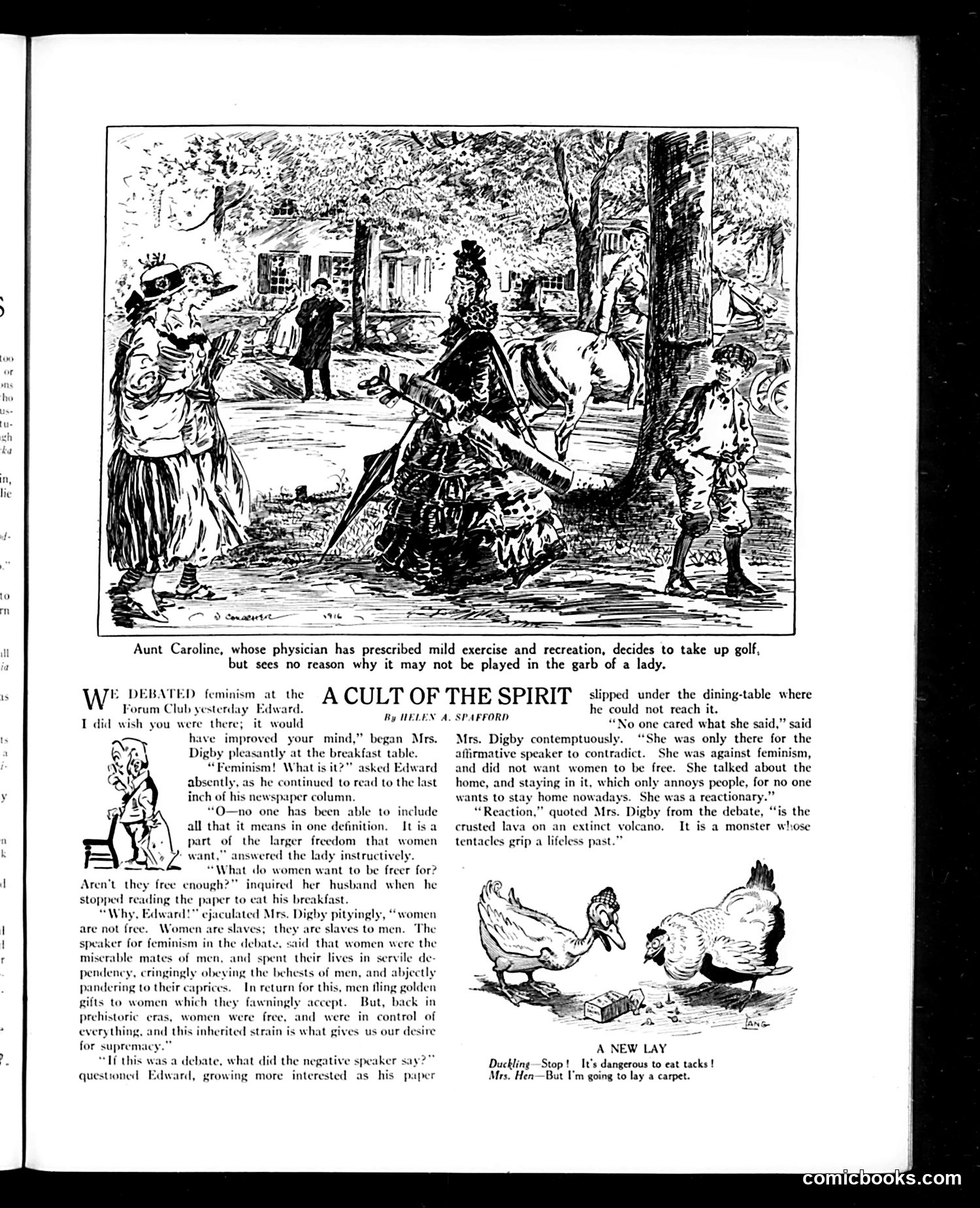
This page satirizes early 20th-century feminist debates through two pieces: **"A Cult of the Spirit"** depicts a Forum Club discussion where Mrs. Digby argues women are "slaves to men" and should have complete freedom. Her husband Edward, reading the newspaper at breakfast, responds that women already possess freedom and control—their "inherited strain" gives them supremacy over men through manipulation. The satire mocks both feminists and anti-feminists: it suggests feminists exaggerate women's oppression while implying women already wield power through influence. **"A New Lay"** (bottom right) shows a hen refusing to lay eggs, planning to "lay a carpet" instead—a crude visual pun equating women's liberation with domestic rebellion. The overall message critiques feminist activism as hypocritical and socially disruptive.
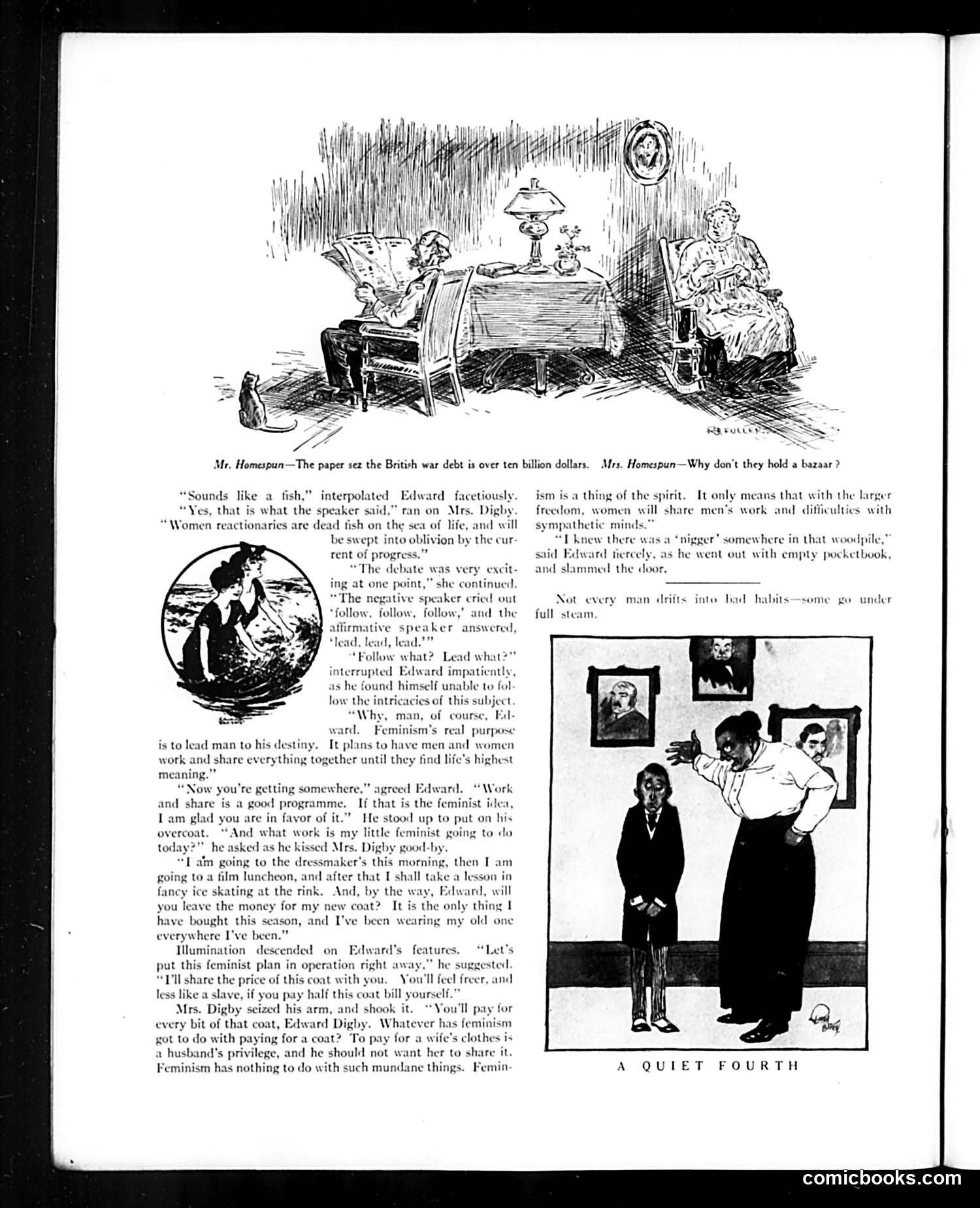
This Judge satire mocks 1920s feminism through a domestic argument between Edward and Mrs. Digby. The joke exposes feminist hypocrisy: Mrs. Digby enthusiastically champions women sharing men's work and "life's difficulties" in principle, yet immediately demands Edward pay for her dressmaker, film lunch, ice-skating lessons, and new coat—claiming such expenses are "a husband's privilege," not shared responsibility. Edward's realization ("I knew there was a 'nigger' somewhere in that woodpile") reveals the contradiction: feminism, as she practices it, means women gain freedom while keeping traditional male financial obligations. The cartoon attacks progressive gender ideology as self-serving rhetoric masking unchanged material expectations. The opening reference to British war debt ($10 billion) frames this as national concern—the implication being that wasteful feminism compounds America's problems. The "Quiet Fourth" illustration below appears unrelated visual filler.
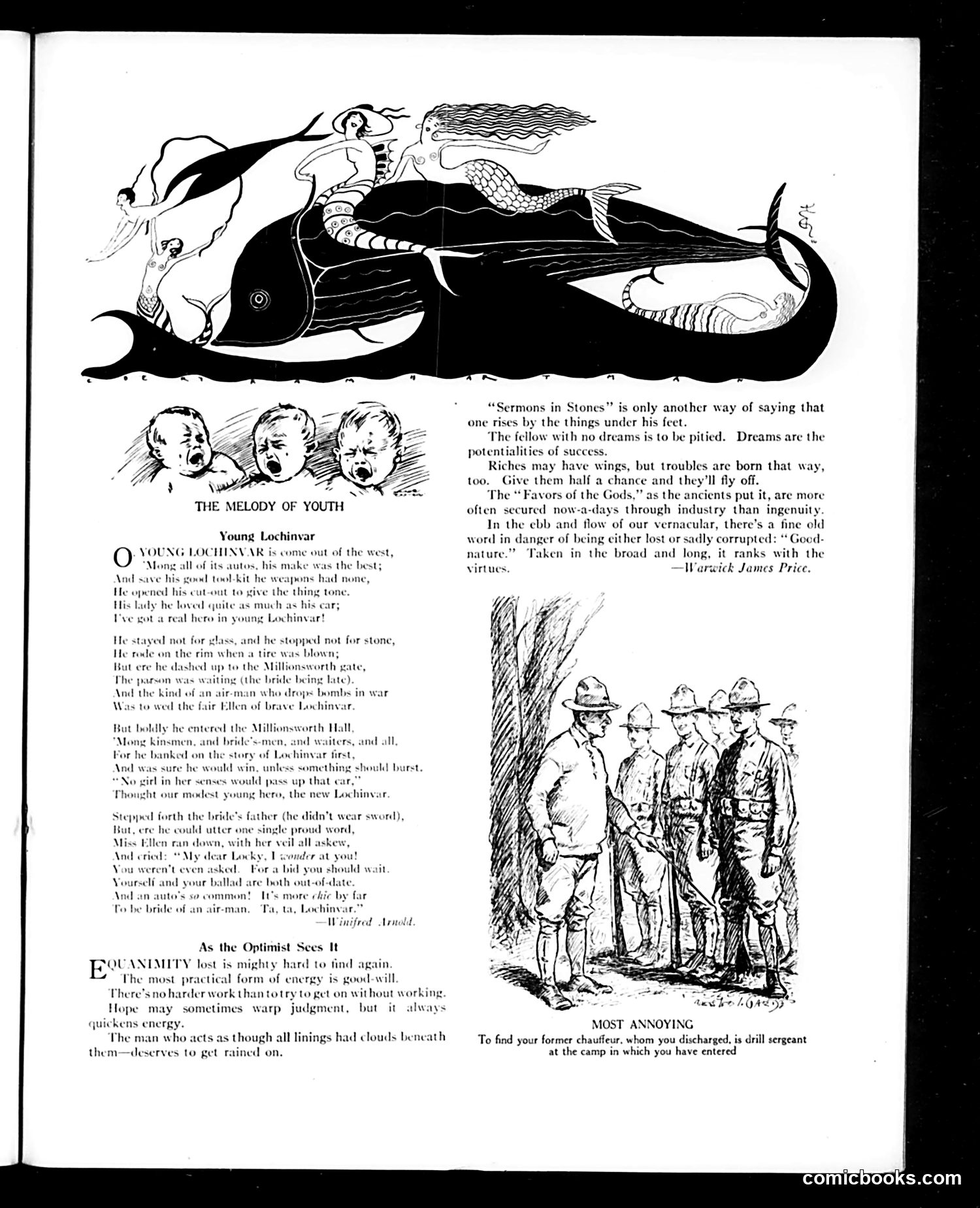
This page satirizes modern courtship and values through a parody of the classic Scottish ballad "Young Lochinvar." The original poem depicts a romantic hero who boldly wins his bride through daring and devotion. The satire inverts this: the modern "Lochinvar" arrives by automobile rather than horseback, but discovers that the bride prefers marrying an **airman (pilot)** instead—not for romance, but because an airplane is more fashionable and prestigious than a car. The bride's father's traditional objections are dismissed as outdated. The joke targets **1920s-era materialism and status-seeking**: young women supposedly value modern technology and social standing over genuine heroism or character. The accompanying text emphasizes "good-nature" and integrity as undervalued virtues, suggesting society has abandoned them for superficial glamour and industrial progress. The smaller cartoon below jokes about military hierarchy—an annoying aspect of camp life is encountering a former superior officer.
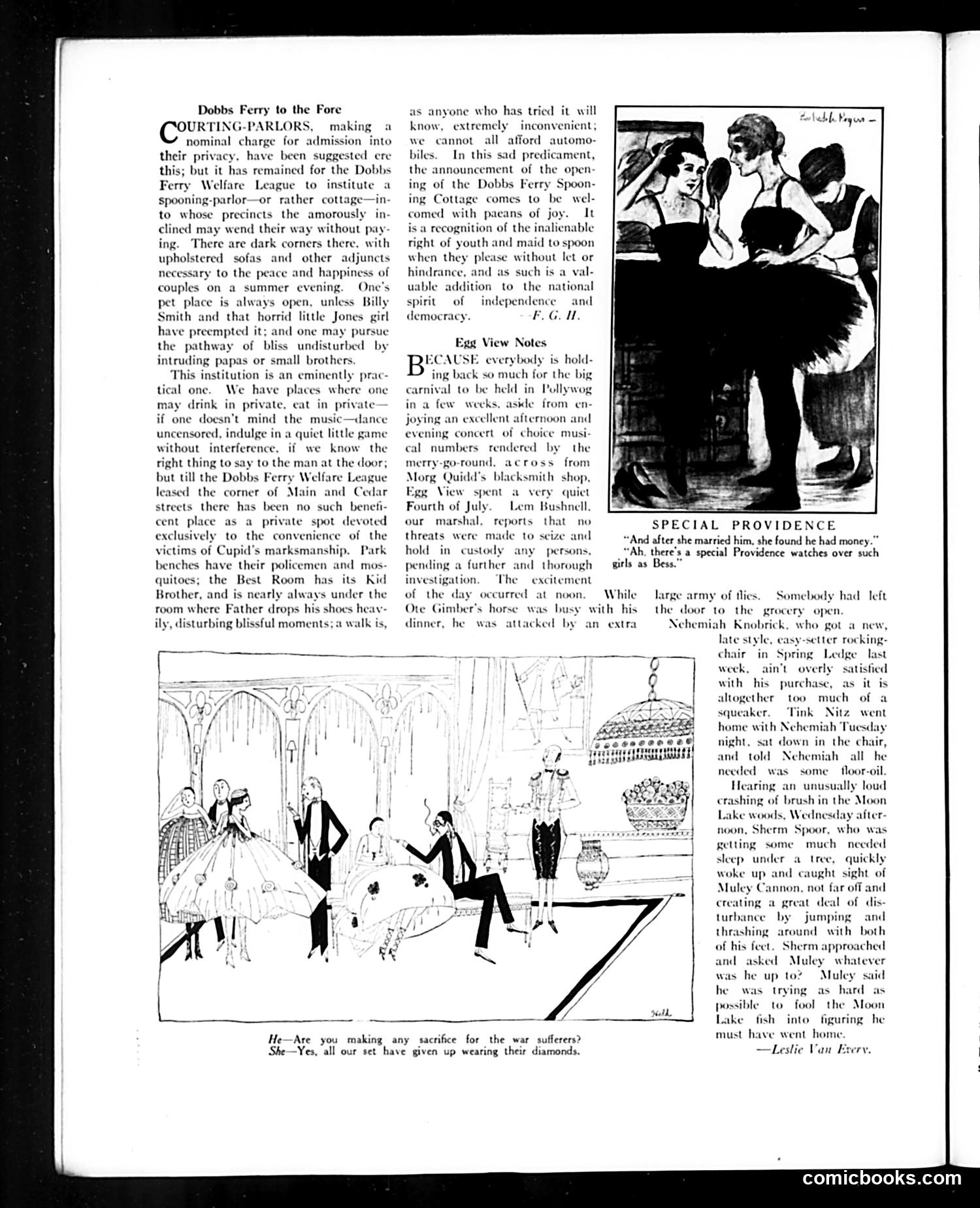
This Judge magazine page satirizes early-20th-century American courtship customs and social propriety. **Main Cartoon (bottom):** The illustration depicts a formal indoor venue where couples "spoon" (court romantically). The satire targets the Dobbs Ferry Welfare League's creation of a designated "spooning cottage"—a private space where young couples could romance without parental or public interference. The joke's premise: society has places for drinking, dining, and dancing "with permission," so why not officially provide spaces for courting youth? **The Point:** Judge mocks both the League's progressive initiative and society's hypocrisy about young romance. The caption joke between the couple reinforces this—she mentions "war sufferers" sacrifices; he responds they've given up wearing diamonds. This contrasts trivial social concerns with actual wartime hardship. **Secondary Content:** "Egg View Notes" and "Special Providence" are humorous rural vignettes about small-town life, including a joke about a woman marrying for love who unexpectedly finds her husband wealthy. The overall tone gently ridicules propriety while supporting youth's "inalienable right" to romance.
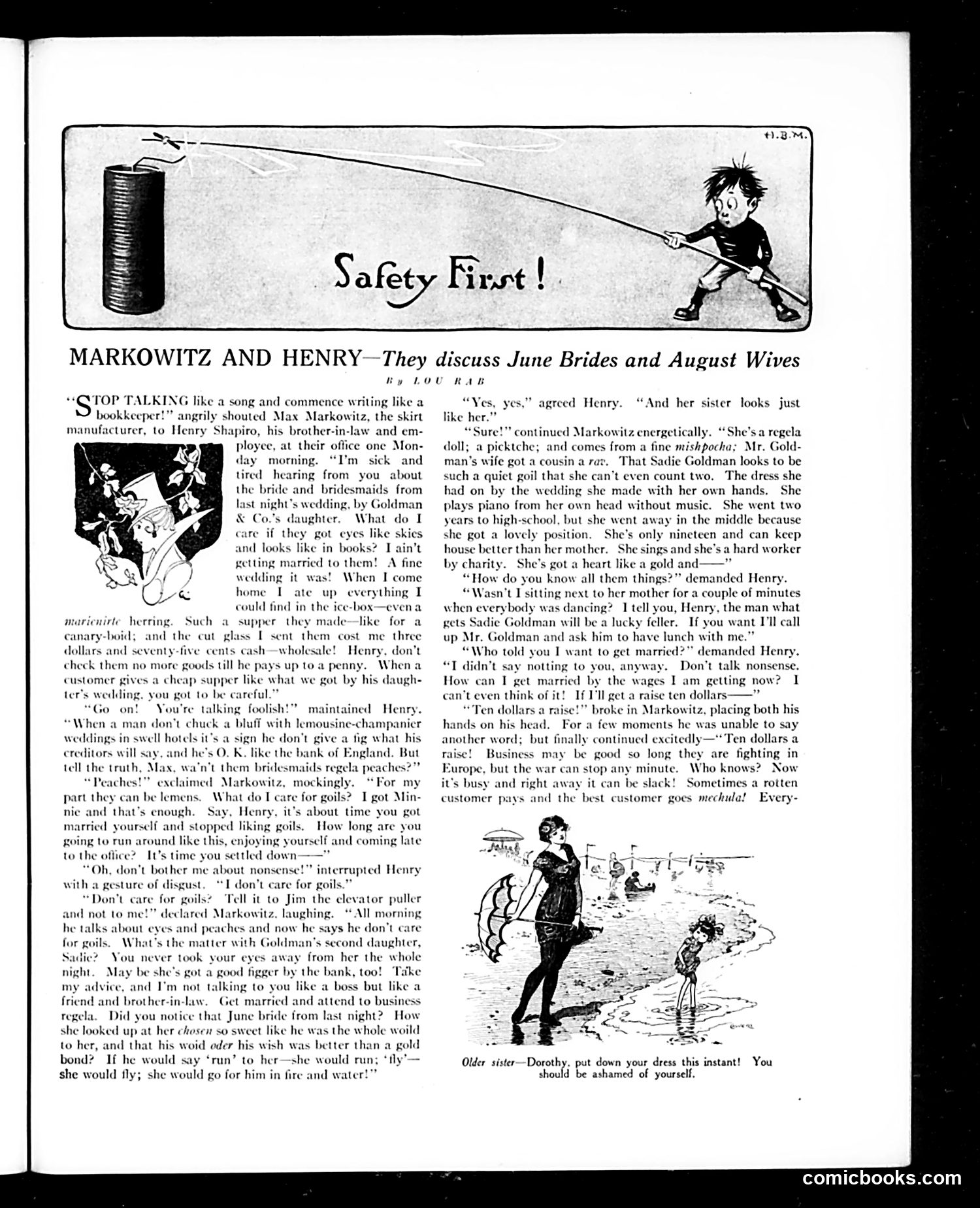
This is a humorous dialogue between two Jewish businessmen—Max Markowitz (a skirt/dress manufacturer) and his brother-in-law Henry Shapiro—debating marriage and courtship after attending a wedding. **The satire**: Markowitz lectures Henry about settling down, while Henry protests he doesn't care about women. However, Markowitz catches him in an obvious lie—he noticed Henry couldn't take his eyes off Sadie Goldman all evening. Markowitz then launches into praise of Sadie: she's beautiful, modest, domestic, musical, charitable, and from a good family ("mishpocha"—Yiddish for extended family). **The joke**: The contrast between Henry's denials and his obvious attraction, plus Markowitz's comic enthusiasm for matchmaking and his mercenary observations (he resents wedding expenses while simultaneously calculating Sadie's value as a wife). **Context**: This reflects early-20th-century immigrant Jewish-American humor, using Yiddish expressions and stereotypes about shrewd businessmen and arranged marriages within community circles. The "Safety First" banner at top appears unrelated—likely a standard Judge magazine header.
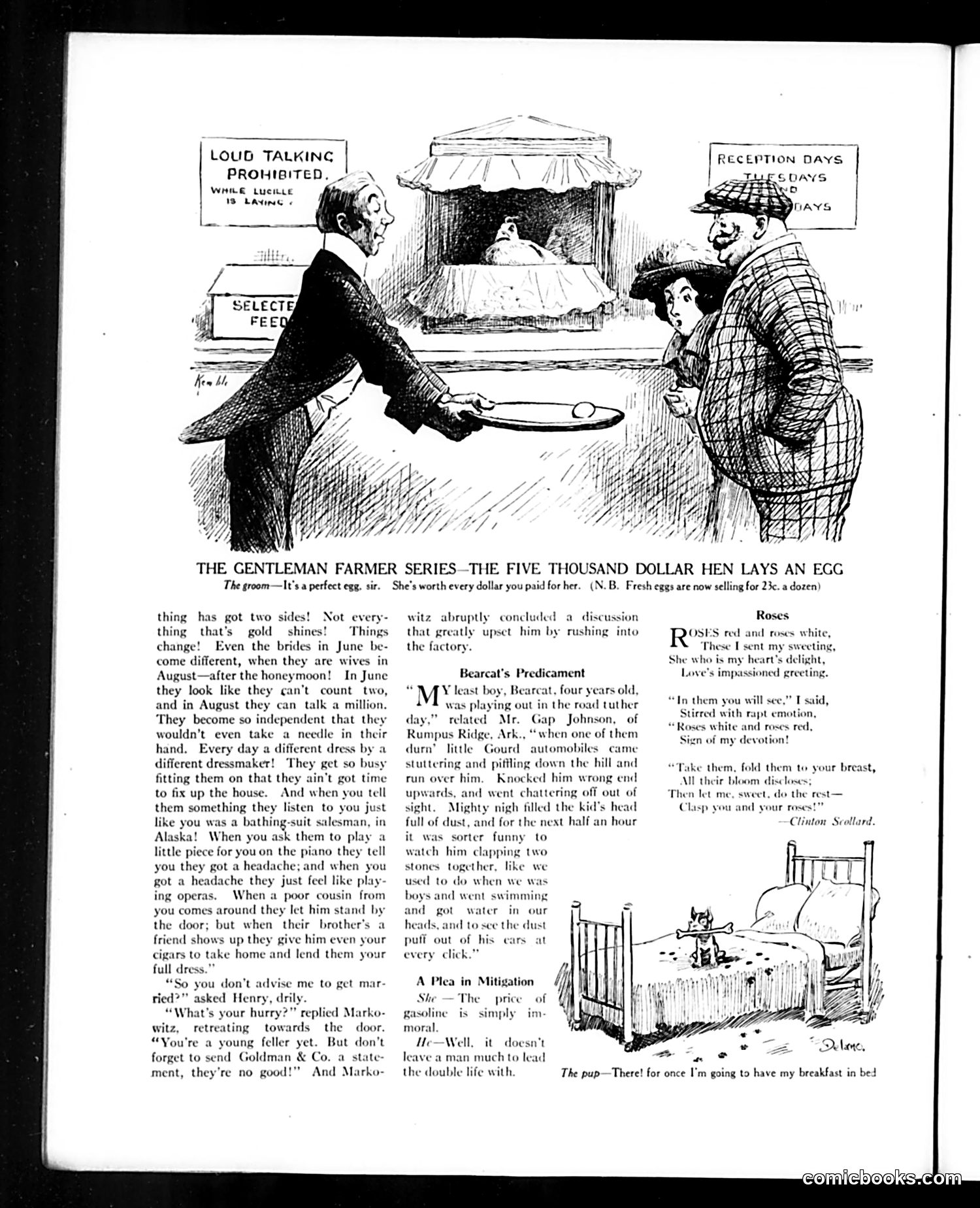
This Judge magazine page contains three distinct pieces of humor reflecting early 20th-century American social anxieties: **Main Cartoon:** "The Gentleman Farmer Series" satirizes wealthy urbanites purchasing expensive purebred chickens. The joke is that a "$5,000 hen" produces an ordinary egg worth roughly a penny (eggs sold at 23¢ per dozen). This mocks nouveau-riche farmers wasting money on impractical agricultural ventures—a common target of Judge's satire. **"Bearcat's Predicament":** A humorous anecdote about a child nearly hit by an automobile, then comically shaking dust from his ears by clapping stones. This reflects early-1900s anxiety about automobiles as dangerous novelties. **Minor Content:** Includes romantic verse by Clinton Scollard and a joke about infidelity disguised as discussing gasoline prices—typical of the magazine's somewhat risqué humor for the era. The page also shows office rules (no loud talking during laying season, reception days listed) that reinforce the farming satire.
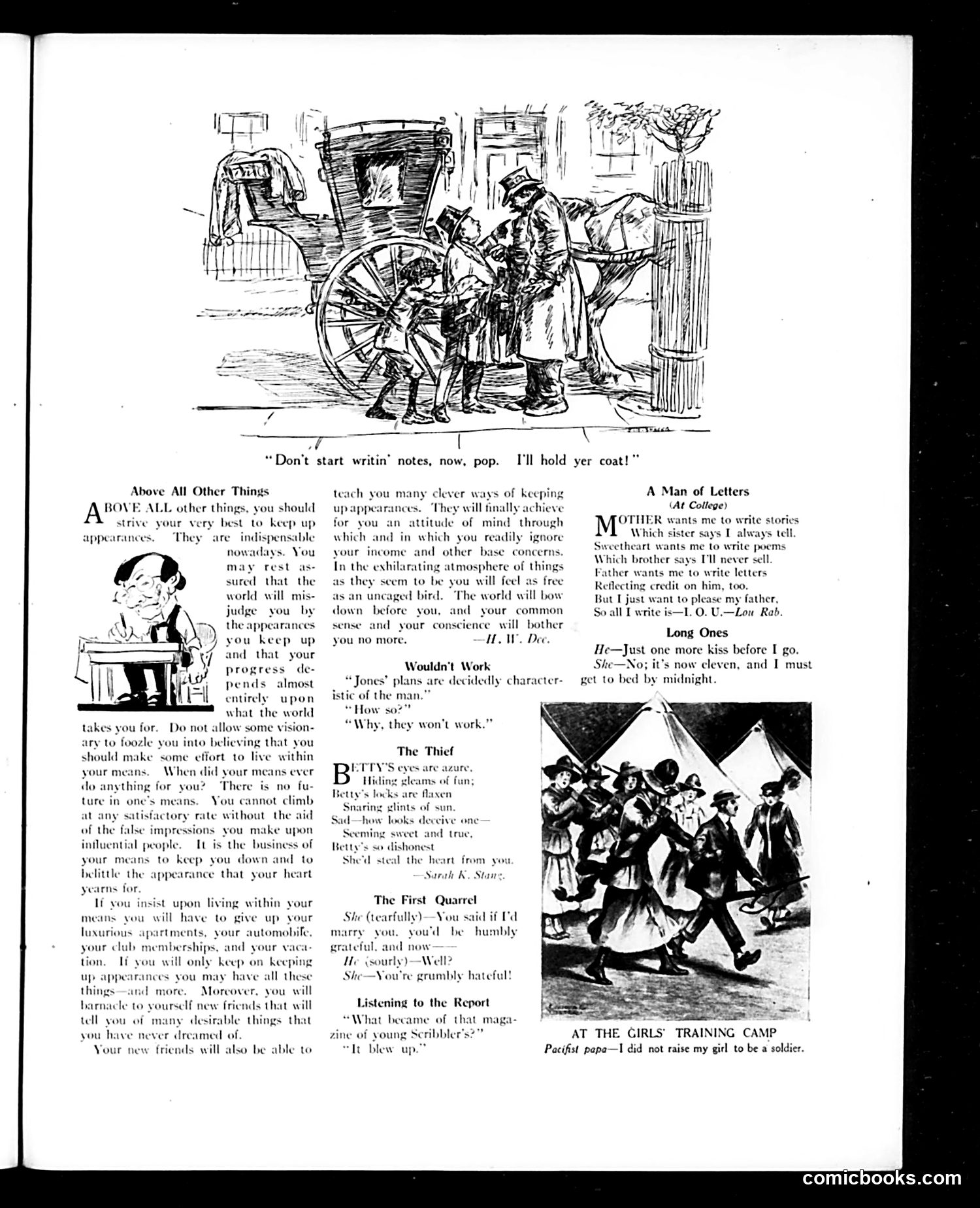
The top cartoon depicts a street scene where a young boy offers to "hold yer coat" while his father (labeled "pop") appears ready for a physical fight—a common working-class scenario of the era. The humor lies in the child's eager, naive participation in adult male violence. The main essay "Above All Other Things" is satirical social commentary attacking American materialism and status anxiety. It sarcastically argues that maintaining false appearances through luxury spending—apartments, automobiles, club memberships—matters more than living within one's means. The piece mocks how people prioritize impressing others over financial reality, claiming this dishonesty brings social advancement and freedom from conscience. The scattered short pieces below (poems, brief dialogues) are typical Judge humor: "Wouldn't Work" mocks a man whose plans fail; "The Thief" discusses deception; "The First Quarrel" shows newlywed conflict. The photograph captioned "At the Girls' Training Camp" shows a pacifist father lamenting his daughter's military training—likely referencing WWI-era women's military service preparation, contrasting parental pacifism with nationalist duty.
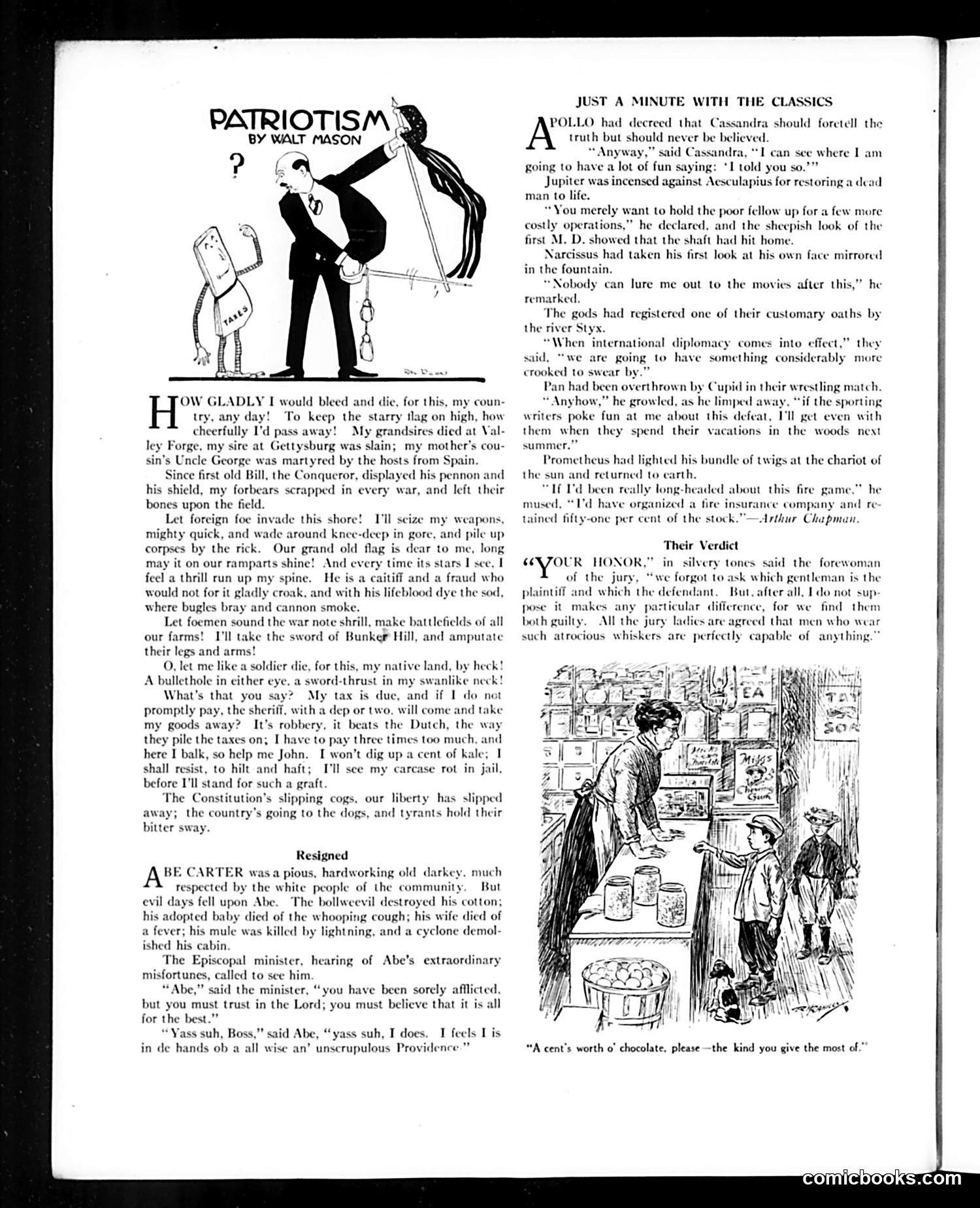
This poem satirizes American patriotic rhetoric by exposing hypocrisy. The speaker delivers grandiose declarations about dying for his country—willing to "wade around knee-deep in gore" and "amputate their legs and arms" of enemies. However, the moment he's asked to pay his taxes, he abruptly reverses course, refusing to "dig up a cent of kale" and complaining about government "robbery." Mason's point: Americans mouth patriotic platitudes about ultimate sacrifice but resist minor civic obligations like taxes. The satire suggests patriotic fervor is performative—easily abandoned when actual personal cost arrives. The final lines about the Constitution "slipping" and "tyrants" holding sway reinforce the irony: those claiming to defend liberty actively undermine it through selfish resistance to public responsibility.
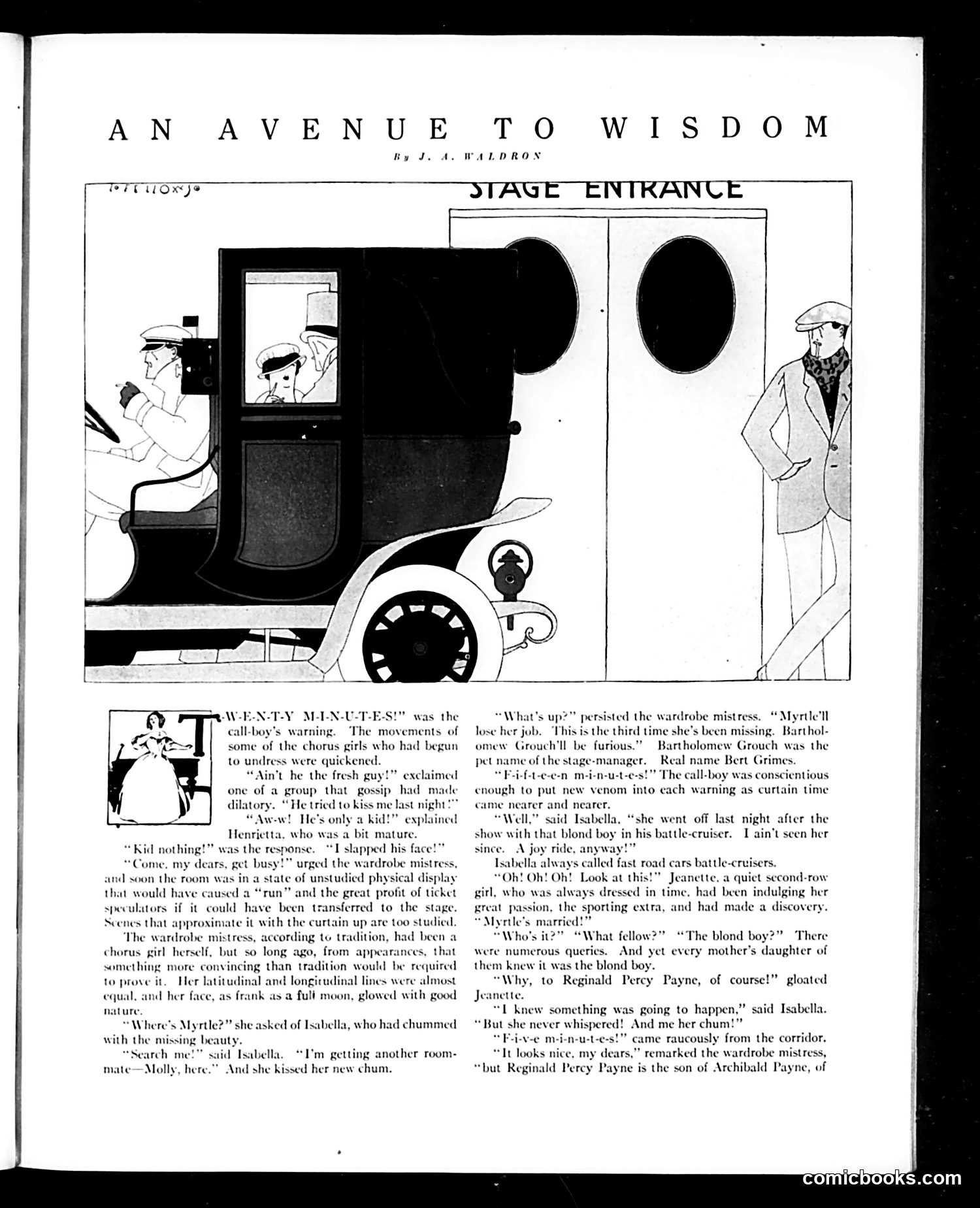
This is a backstage comedy set in a theater dressing room during the early 20th century. The narrative concerns chorus girls preparing for a show when one performer, Myrtle, goes missing—for the third time, risking her job. The joke unfolds when Jeanette discovers in a newspaper ("sporting extra") that Myrtle has eloped with "the blond boy"—a wealthy young man identified as Reginald Percy Payne, son of the prominent Archibald Payne. The wardrobe mistress's final remark suggests social irony: despite Myrtle's humble theater work, she's married into an aristocratic family. The cartoon satirizes the common theatrical plot device of chorus girls seeking wealthy husbands as social advancement. The "battle-cruisers" reference (fast cars) hints at modern courtship customs. The title "Avenue to Wisdom" appears ironic—suggesting marriage to wealth represents the ultimate female aspiration and social lesson.
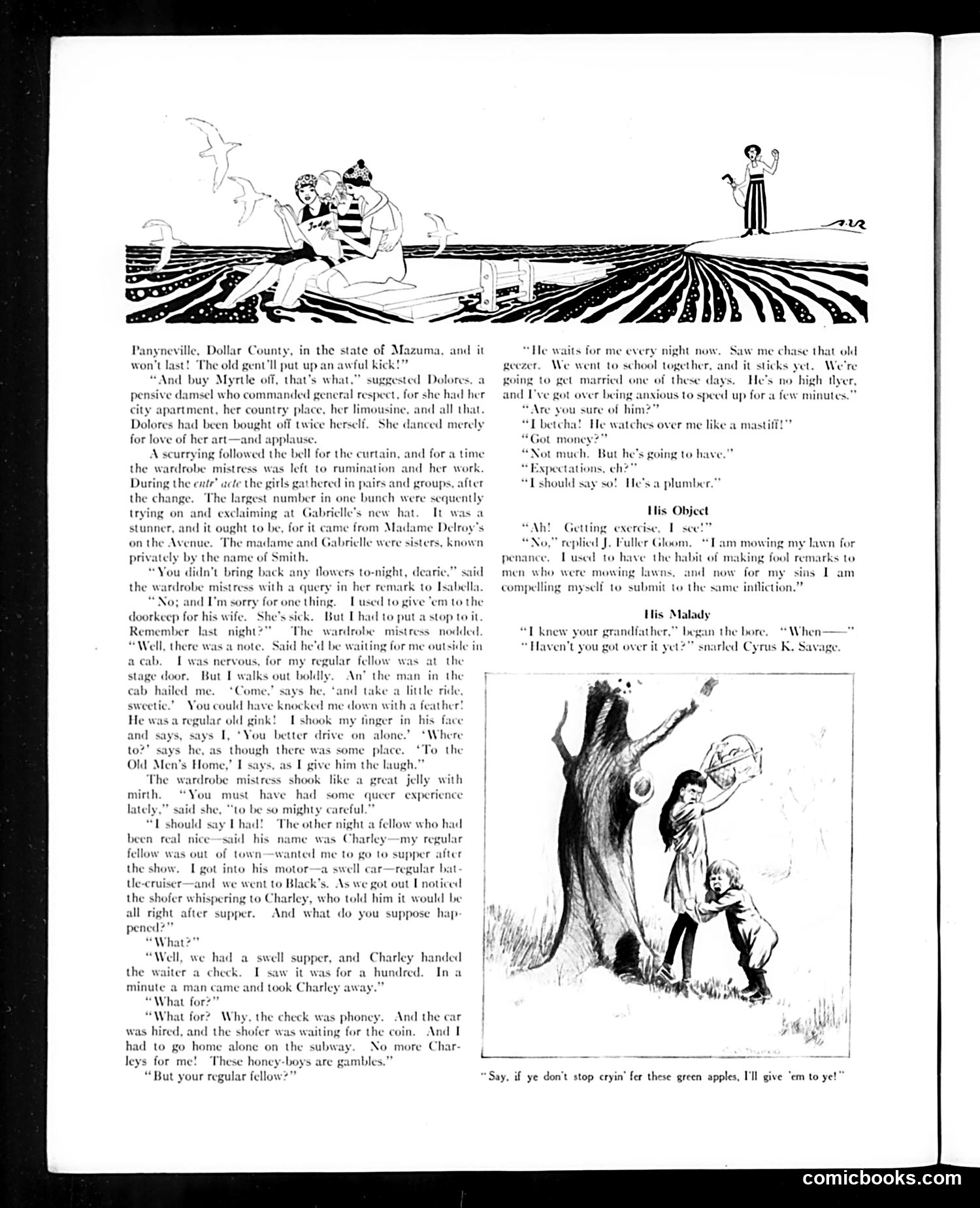
This page contains two distinct pieces of social satire typical of early 20th-century Judge magazine. **Main Story**: A backstage conversation between show-girls and a wardrobe mistress reveals anxieties about male deception and financial insecurity among working women. The narrative satirizes dating culture where men ("honey-boys") use schemes—phoney checks, hired cars, false identities—to seduce actresses and dancers. The protagonist's resolution to marry her steady, honest plumber boyfriend mocks both the pretensions of flashy suitors and working-class marriage as a supposed "safe" alternative. **Sidebar Jokes**: Two brief gags mock male behavior: one about a man using lawn-mowing as exercise (to avoid his wife's nagging remarks), and another about someone unable to escape an acquaintance's boring storytelling. The satire targets masculine dishonesty, class anxiety among working women, and the economic vulnerability of performers in the theatrical world—reflecting concerns about urban dating and economic mobility in the pre-WWI era.
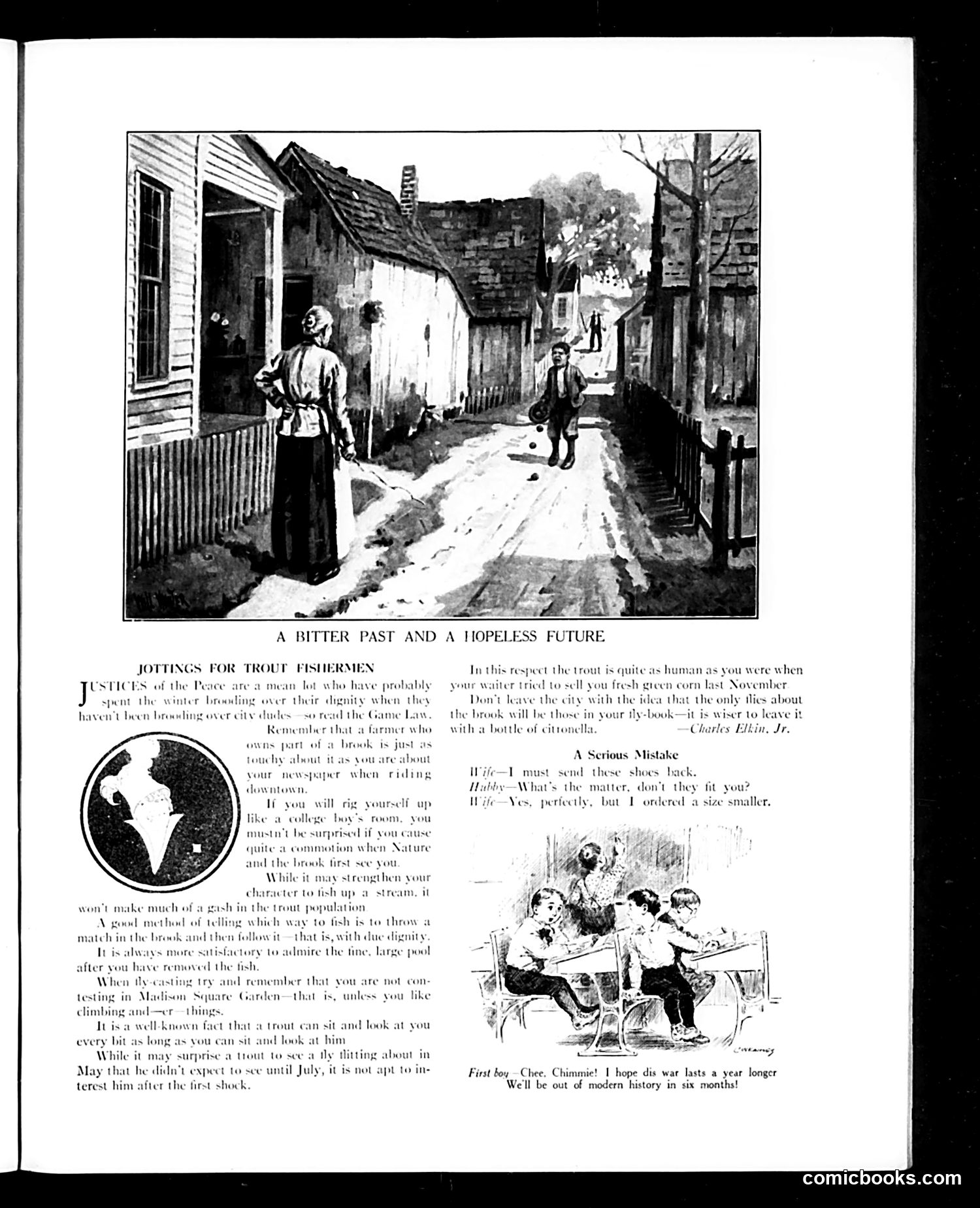
This page contains two separate pieces from *Judge* magazine: **"Jottings for Trout Fishermen"** is humorous advice about fly-fishing etiquette and technique. The satire mocks city dwellers ("city dudes") who invade rural areas for recreation, treating farming communities disrespectfully. It pokes fun at overly formal fishermen and their pretensions, while gently ribbing the fish themselves for their predictable behavior. **"A Serious Mistake"** is a domestic humor comic strip about a wife who ordered shoes in a smaller size than she needs—a joke about female vanity and shopping habits common to early-20th-century humor. **The bottom caption** appears to reference World War I ("dis war"), with a boy hoping the conflict lasts longer so his class can avoid studying modern history—dark humor about how students might benefit from educational disruption. The top illustration titled "A Bitter Past and Hopeless Future" depicts a rural village scene but its specific satirical target remains unclear from the visible text.
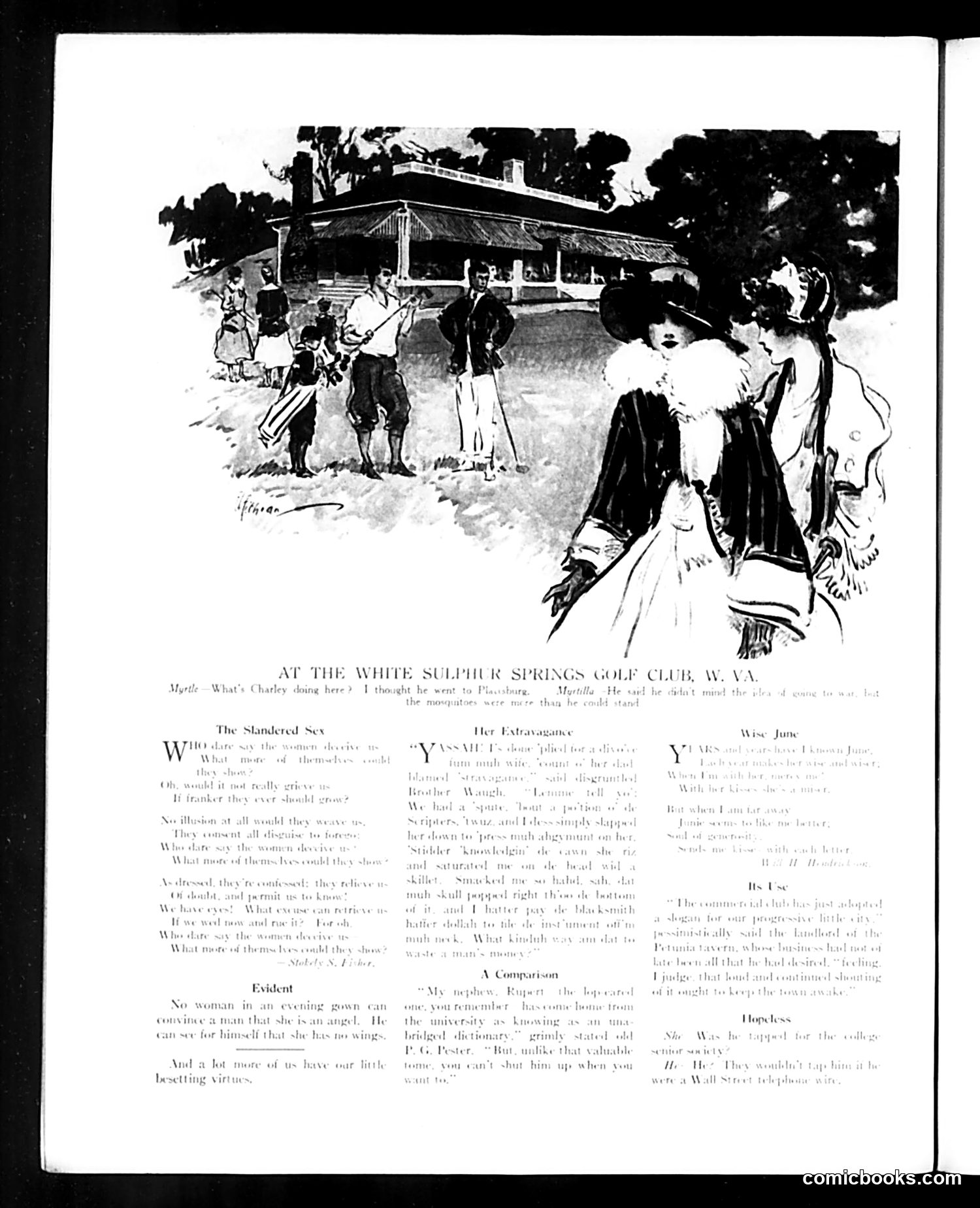
This page from *Judge* presents a satirical illustration titled "At the White Sulphur Springs Golf Club, W.Va." showing well-dressed figures at an elite golf club. The accompanying text columns—"The Slandered Sex," "Her Extravagance," "Wise June," "A Comparison," "His Use," and "Hopeless"—appear to be humorous dialogues about gender relations and social behavior among the wealthy. The satire targets fashionable society's attitudes toward women, particularly regarding accusations of extravagance and poor judgment. The illustration shows both men and women in formal attire at a leisure venue, suggesting commentary on courtship, marriage expectations, and class pretensions among the upper class. The tone is gently mocking of both genders' stereotypical behaviors and the artificial social conventions governing their interactions at such exclusive resorts.
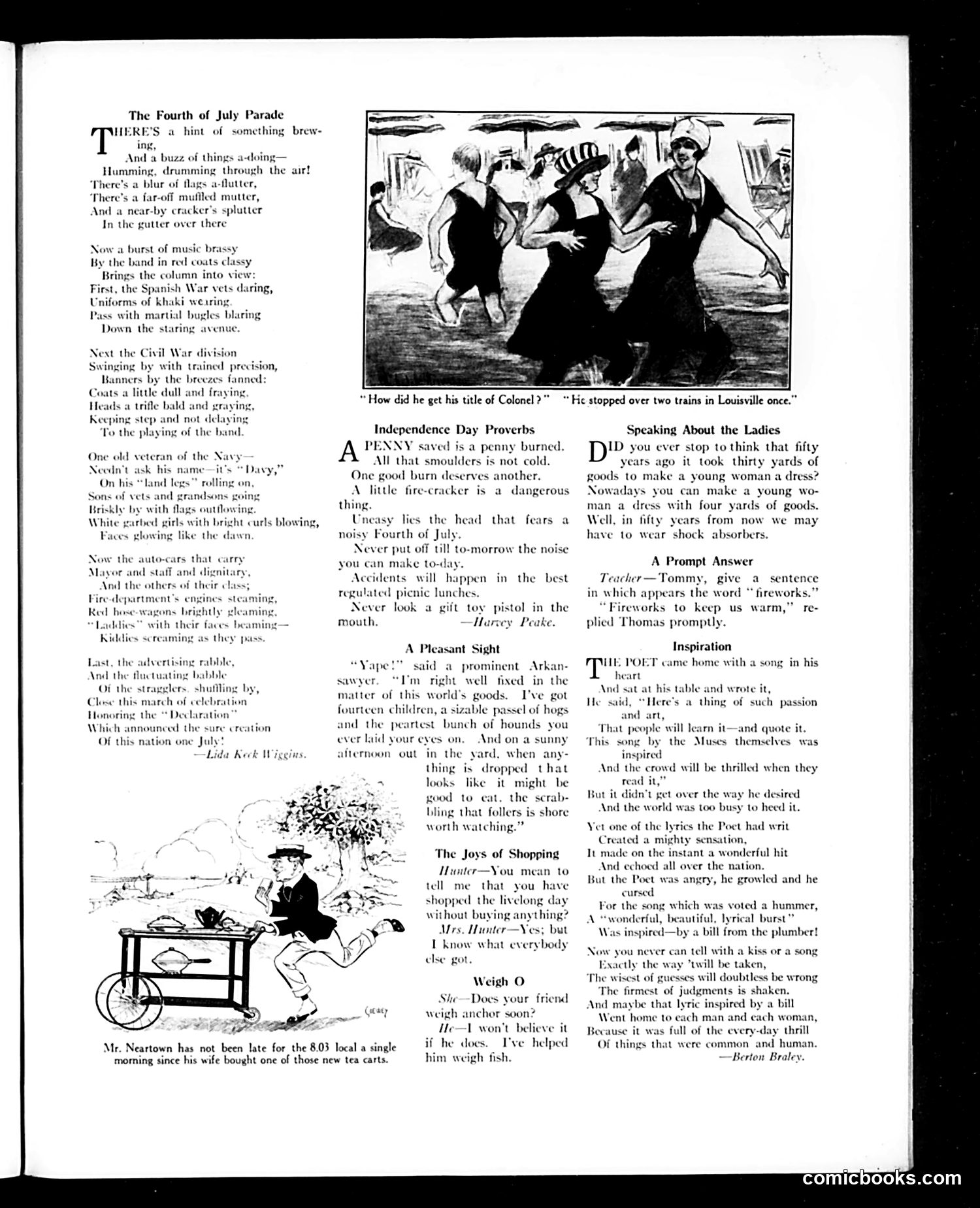
This page contains satirical commentary on Fourth of July celebrations and American life circa early 1900s. **"The Fourth of July Parade"** poem humorously describes a typical Independence Day procession, moving from Spanish-American War veterans in fresh uniforms, through aging Civil War soldiers in deteriorating dress, to naval veterans, and finally concluding with "advertising rabble"—a satirical jab at commercialization creeping into patriotic observance. **The sidebar content** offers light social satire: Independence Day proverbs mock holiday noise and dangers (fireworks injuries); the "Ladies" section jokes about women's fashion changing dramatically (fifty yards of fabric becoming four); and small anecdotes poke fun at consumer culture and human foibles. **The cartoons** appear to illustrate these themes—one showing people at a parade, another depicting domestic shopping habits. The overall message: Judge satirizes how American patriotic celebration had become commercialized and somewhat chaotic by this era, while also mocking contemporary social customs around gender and consumerism.
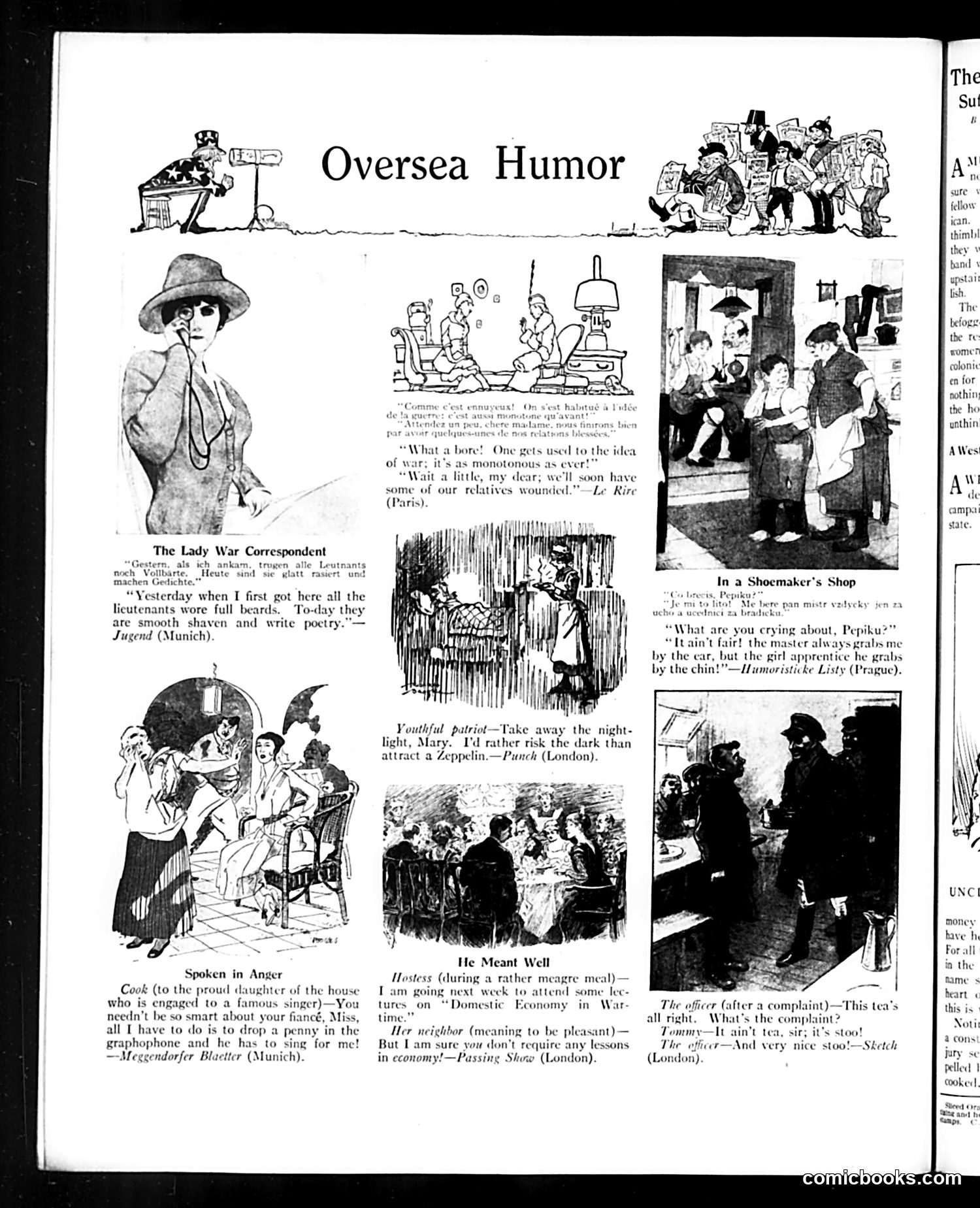
This page collects humorous quips from European publications during World War I, mocking war-related absurdities and social pretension. **"The Lady War Correspondent"** mocks a female war reporter, suggesting she's adopted masculine affectations (smooth-shaven, writes poetry) to fit in with rough military men. **"Spoken in Anger"** satirizes a cook's contempt for his employer's daughter's fiancé—a famous opera singer whom the cook reduces to a mere mechanical performer (graphophone = phonograph). The remaining jokes target wartime anxieties: people becoming numb to war's horrors, civilians fearing Zeppelin attacks, wives' supposed incompetence at domestic economy, and military food quality. One sketch depicts a shoemaker's apprentice being physically mistreated, another shows an officer dismissing complaints about substandard tea. The humor is broadly European—sourced from Munich, Paris, London, and Prague publications—reflecting shared WWI experiences and dark comedy about civilian life during conflict.
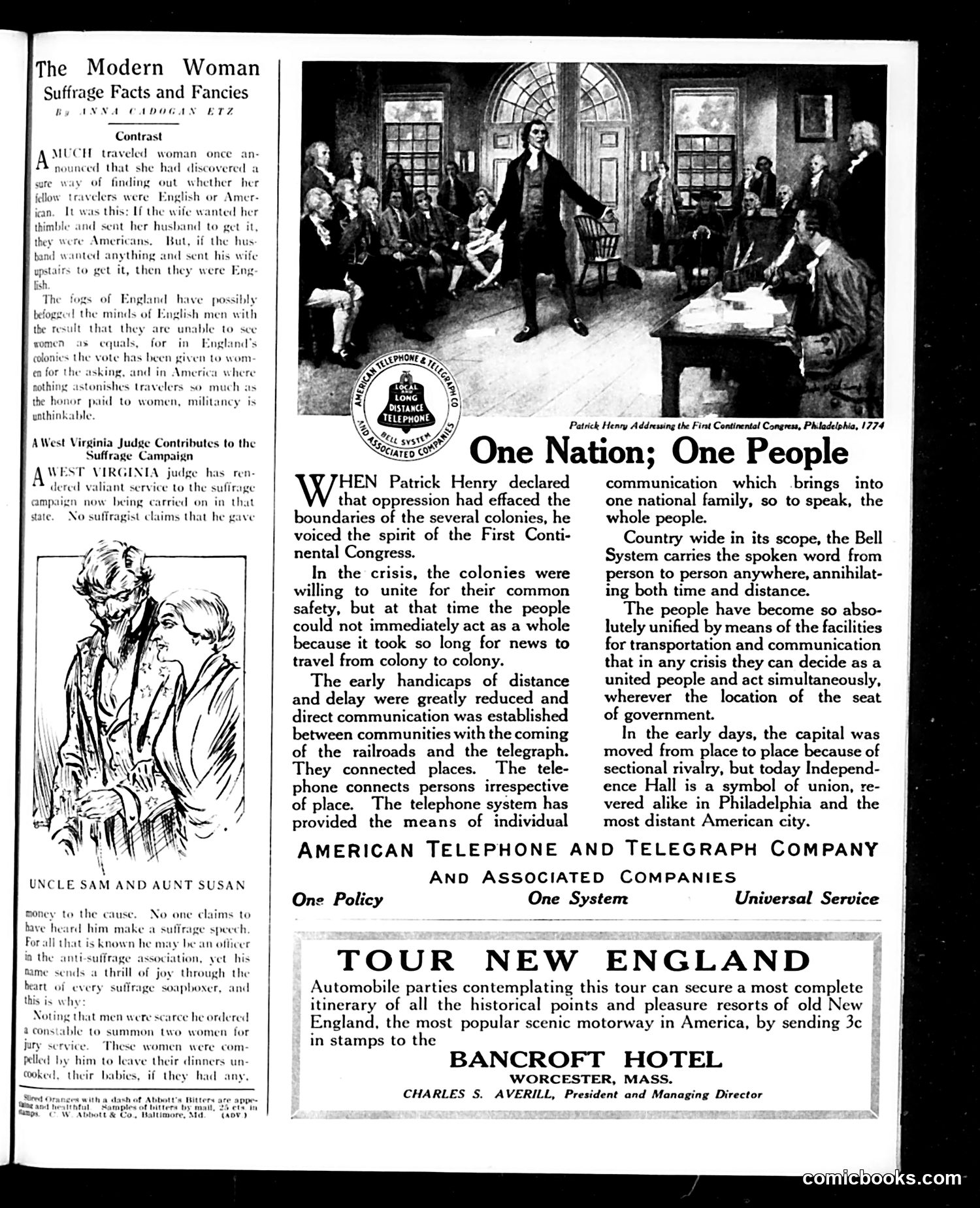
This page combines satirical commentary on women's suffrage with corporate advertising. **"The Modern Woman" Section:** The column by Anna Cadogan Etz presents contrasting gender dynamics between American and English couples through anecdotes. It humorously suggests American wives are more assertive (sending husbands on errands), while English wives remain subservient. The piece argues that England's fog has "befogged" English men's minds, making them unable to see women as equals—contrasting with America's more progressive (if imperfect) treatment of women. **The West Virginia Judge Cartoon:** The illustration of "Uncle Sam and Aunt Susan" appears to satirize a West Virginia judge who, facing a jury shortage, compelled women to serve. The piece notes he gave no money to suffrage causes yet becomes celebrated by suffragists simply for treating women as equal citizens capable of jury duty. **"One Nation; One People":** This is primarily AT&T corporate propaganda equating telephone technology with national unity, using Revolutionary War imagery (Patrick Henry) to suggest communication infrastructure creates democratic cohesion. The page juxtaposes feminist commentary with advertising, reflecting how suffrage debates permeated mainstream publications.
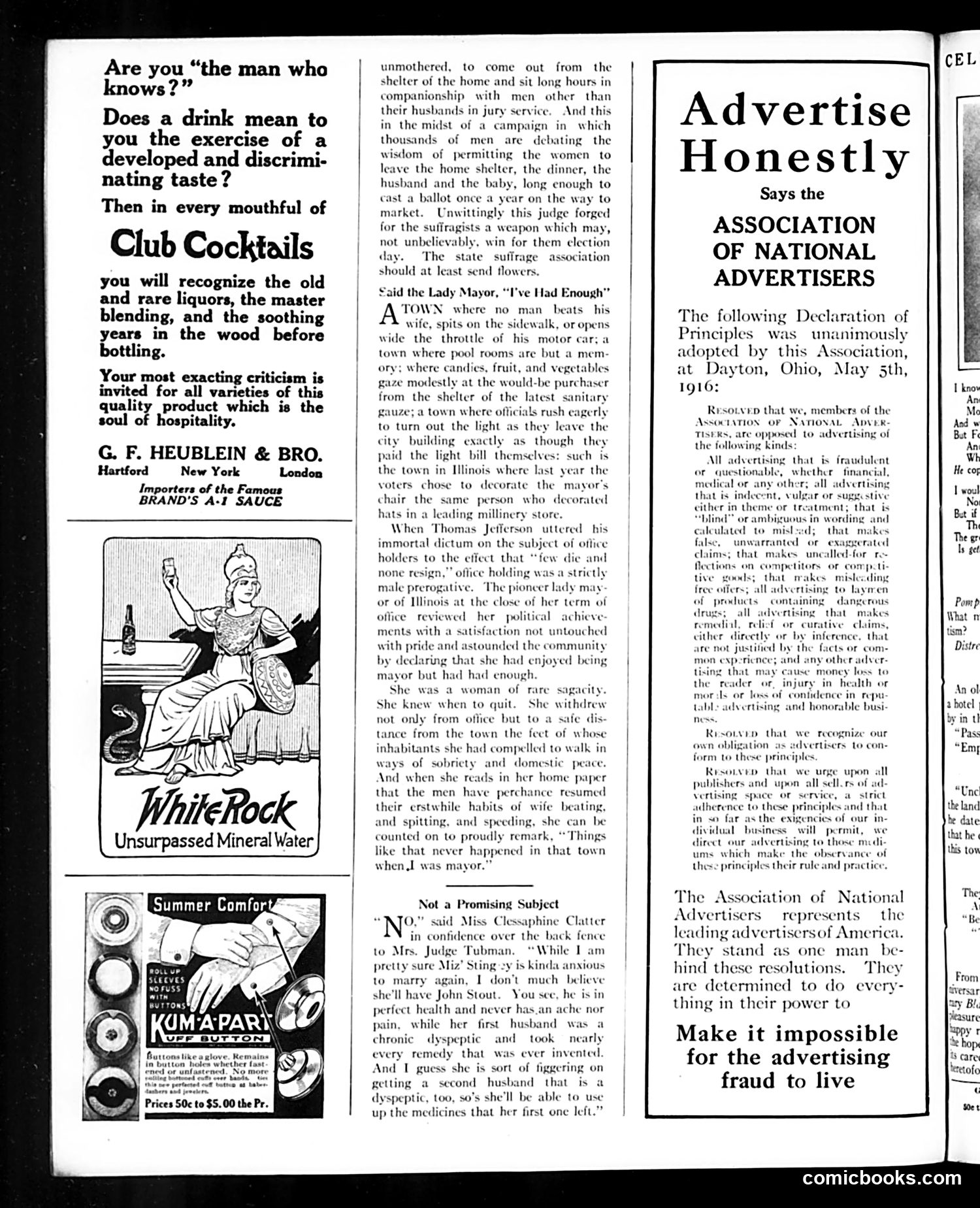
This Judge magazine page contains three distinct satirical pieces: 1. **"Said the Lady Mayor, I've Had Enough"** - Satirizes a female mayor in Illinois who implemented strict moral reforms (no wife-beating, spitting, speeding). The joke: she succeeded so thoroughly that she quit, satisfied with her work. The satire cuts both ways—mocking both those who doubted women's capability in office AND those (like suffrage opponents) who feared women leaving home would cause moral collapse. Ironically, her success proved women *could* govern effectively. 2. **"Not a Promising Subject"** - Two gossips discuss a widow reluctant to remarry because her first husband was a chronic dyspeptic (having digestive problems). The dark humor: she valued him primarily because his ailments justified consuming patent medicines. This satirizes both patent medicine culture and marriage dynamics. 3. **Advertisements** - The page also promotes Club Cocktails, Brand's A-1 Sauce, White Rock mineral water, and Kum-A-Part button fasteners—typical period advertising. The Association of National Advertisers declaration advocates honest advertising, positioning itself against fraudulent claims common in 1916.
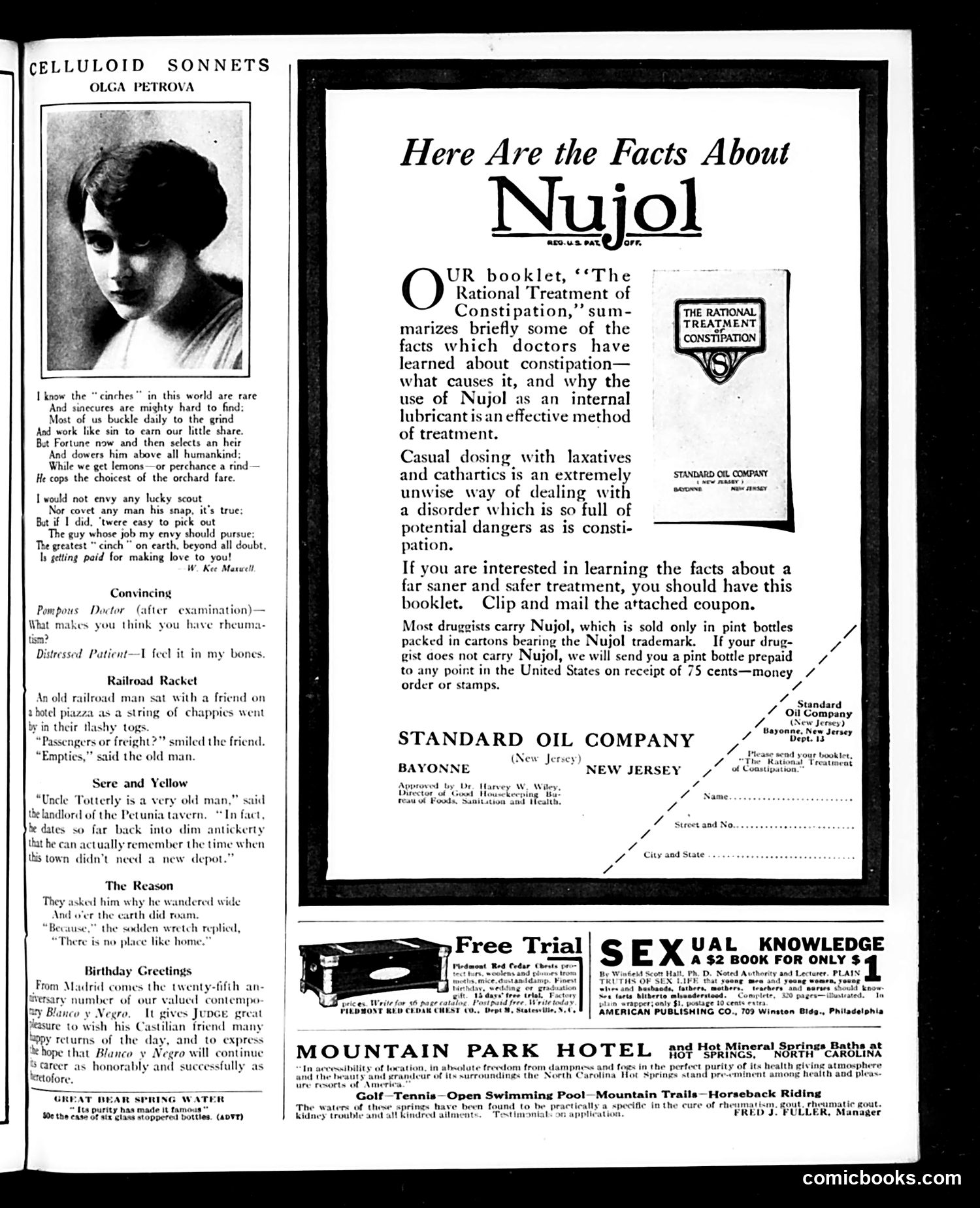
This page is primarily **advertising**, not editorial content. The main feature is a full-page Nujol advertisement promoting an internal lubricant as a constipation treatment—Standard Oil Company's medical product. The left side contains "Celluloid Sonnets" by Olga Petrova, a silent-film actress of the era. The poem playfully celebrates her desirability, with the joke that the "greatest cinch" (easiest job) would be "getting paid for making love to you"—referring to her film work and public appeal. Below are brief humorous filler items typical of *Judge* magazine: puns about doctors, railroads, and old age that require no special historical knowledge. The remaining advertisements (Piedmont Red Cedar Chests, a "Sexual Knowledge" book, Mountain Park Hotel) represent typical early 20th-century magazine advertising. **The satire here is minimal**—this is primarily a commercial vehicle showcasing ads and light entertainment rather than political commentary.
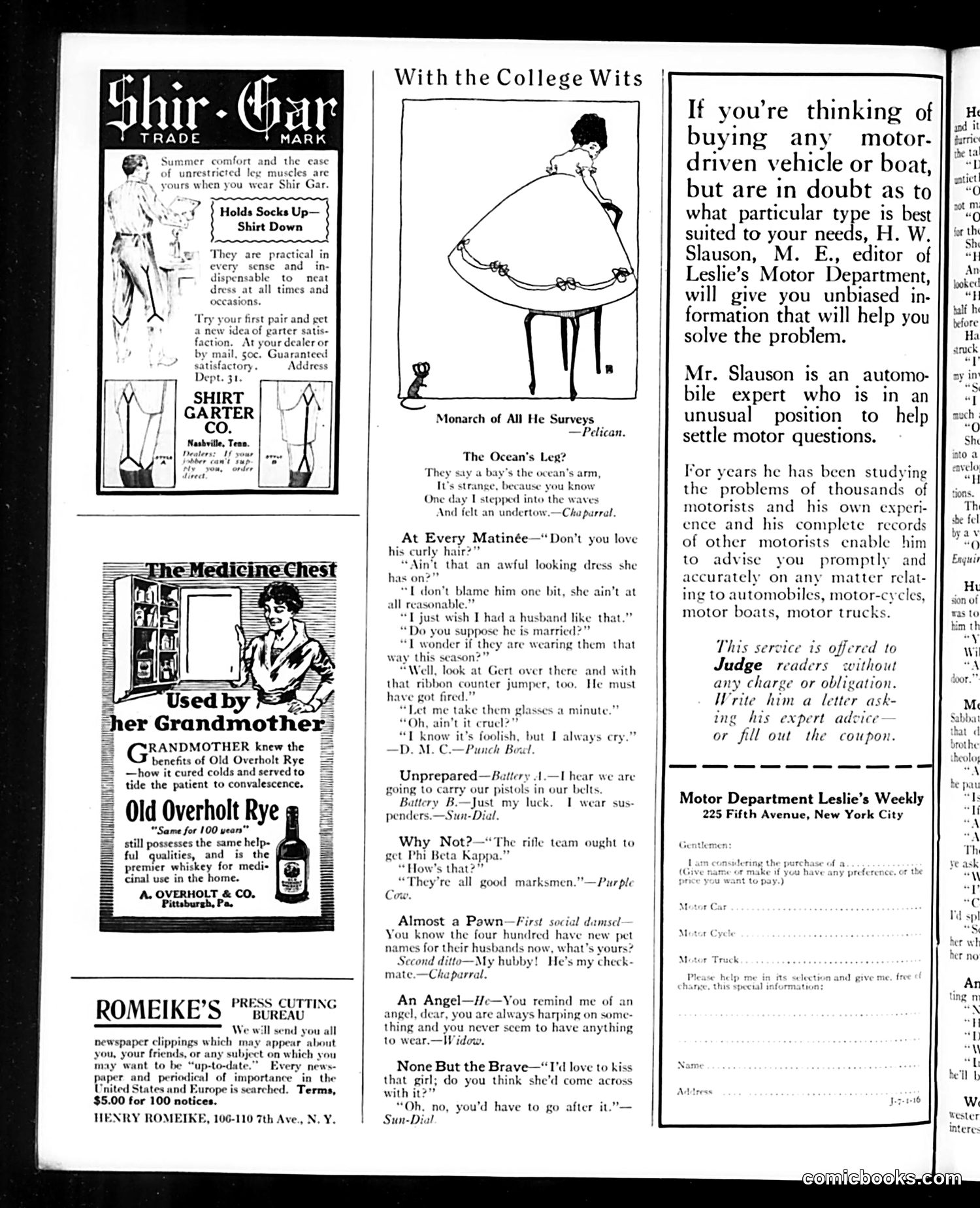
This page is primarily **advertising and service features** rather than political satire. The main content includes: **Advertisements**: A shirt garter ("Shir-Gar"), Old Overholt Rye whiskey (marketed as medicinal), and Romeike's press-clipping bureau. **"With the College Wits"**: A section featuring humorous one-liners and jokes submitted by college readers—typical banter about romance, fashion, and student life. The cartoon shows a woman in a voluminous skirt, captioned "Monarch of All He Surveys," a gentle jab at 1920s women's fashion. **Motor Department Feature**: H.W. Slauson offers free automotive advice to Judge readers, reflecting the era's fascination with automobiles. The humor is **light and domestic**—no political content. It captures period attitudes: casual sexism in jokes about wives and marriage, whiskey marketed as health tonic (pre-Prohibition), and the novelty of motorcar ownership. This reflects Judge's shift toward lifestyle content and advertising rather than sharp political commentary.
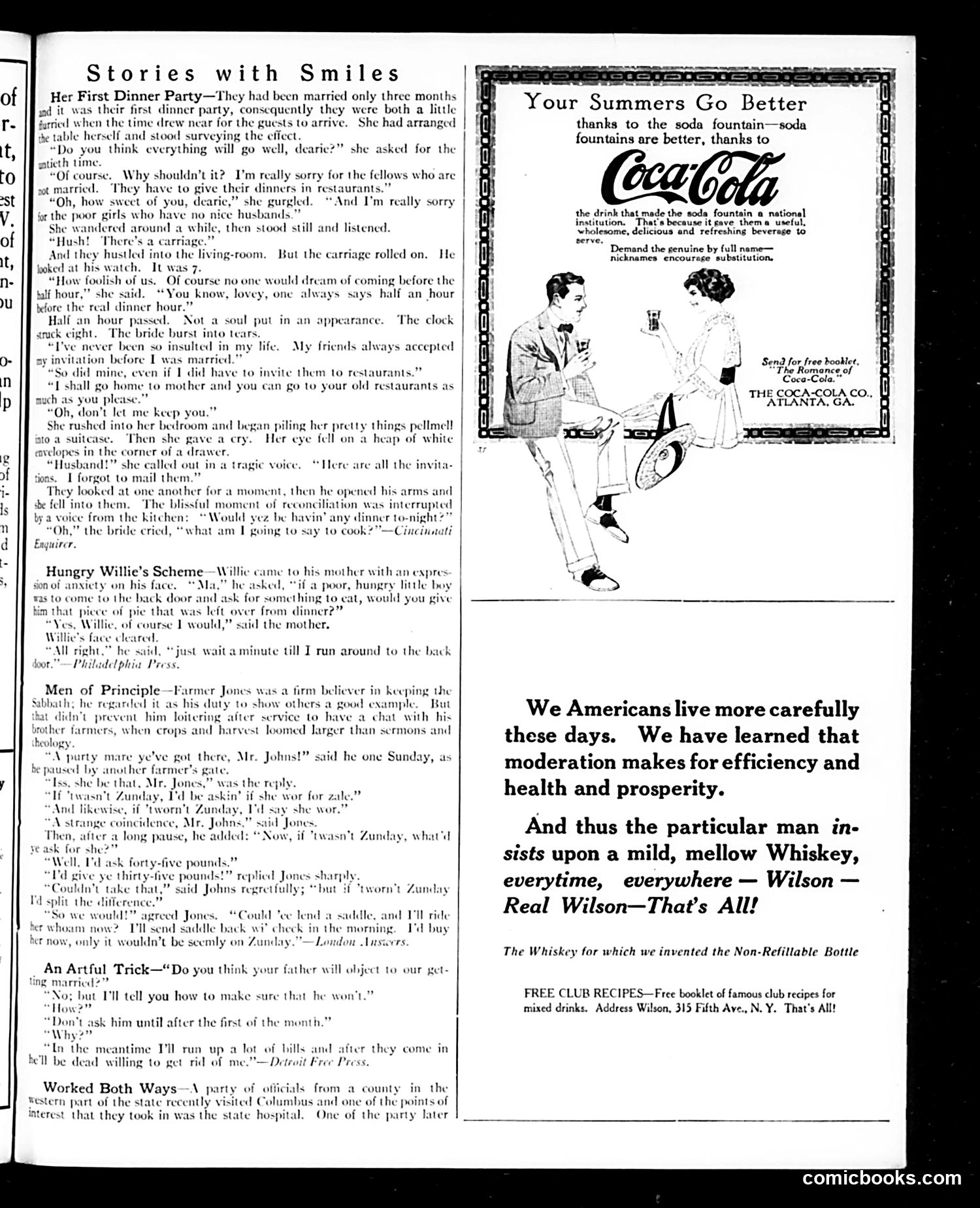
This page from *Judge* magazine contains three humorous short stories typical of early 20th-century American comedy: **"Her First Dinner Party"** satirizes newlyweds' social anxiety. A bride forgets to mail dinner invitations, then assumes her friends have deliberately snubbed her—a commentary on emerging middle-class social pretensions and the importance placed on formal entertaining. **"Hungry Willie's Scheme"** depicts a child's clever deception: he asks his mother if she'd feed a "poor, hungry boy," gets permission, then plans to be that boy himself to secure leftover pie—gentle satire on childhood cunning. **"Men of Principle"** mocks religious hypocrisy: Farmer Jones publicly upholds Sabbath observance but privately negotiates buying a mare on Sunday through verbal loopholes ("if 'twasn't Zunday"), circumventing his stated principles. The page also contains vintage advertisements for Coca-Cola and Wilson Whiskey, emphasizing "moderation" and "efficiency"—ironic given Prohibition-era messaging.
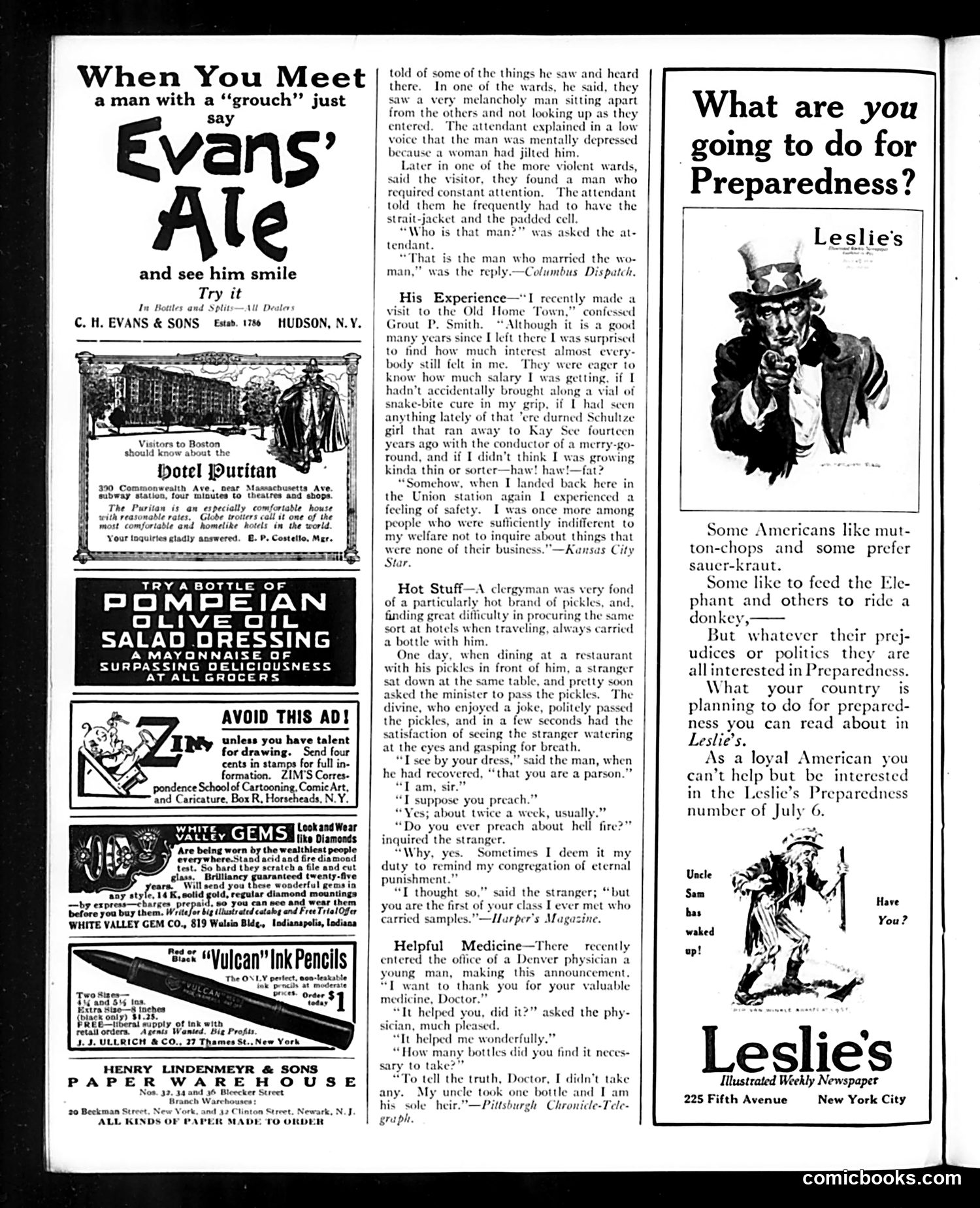
This page is primarily **advertisements** interspersed with humorous anecdotes—typical Judge magazine content from the early 20th century. The main joke pieces include: **"The Melancholy Man" anecdote**: A dark humor tale contrasting a mentally depressed man at an asylum (jilted by a woman) with a violent patient (who married her). The joke: marriage is worse than heartbreak. **"His Experience"**: Satirizes small-town nosiness—a traveler notes townspeople obsessively ask personal questions about his salary and romantic history, but upon returning to the city, he appreciates urban indifference to others' affairs. **"Hot Stuff"**: A minister enjoys spicy pickles; a stranger at his table steals one, experiences painful heat, and assumes the minister is cruel—a simple punchline about miscommunication. **Evans' Ale advertisement** features the only visual element suggesting satire: a "grouch" (grumpy person) who smiles upon tasting the product—typical early advertising humor claiming miraculous mood improvement. The page reflects pre-modern American humor: domestic situations, mild cruelty, and straightforward punchlines rather than sophisticated satire.
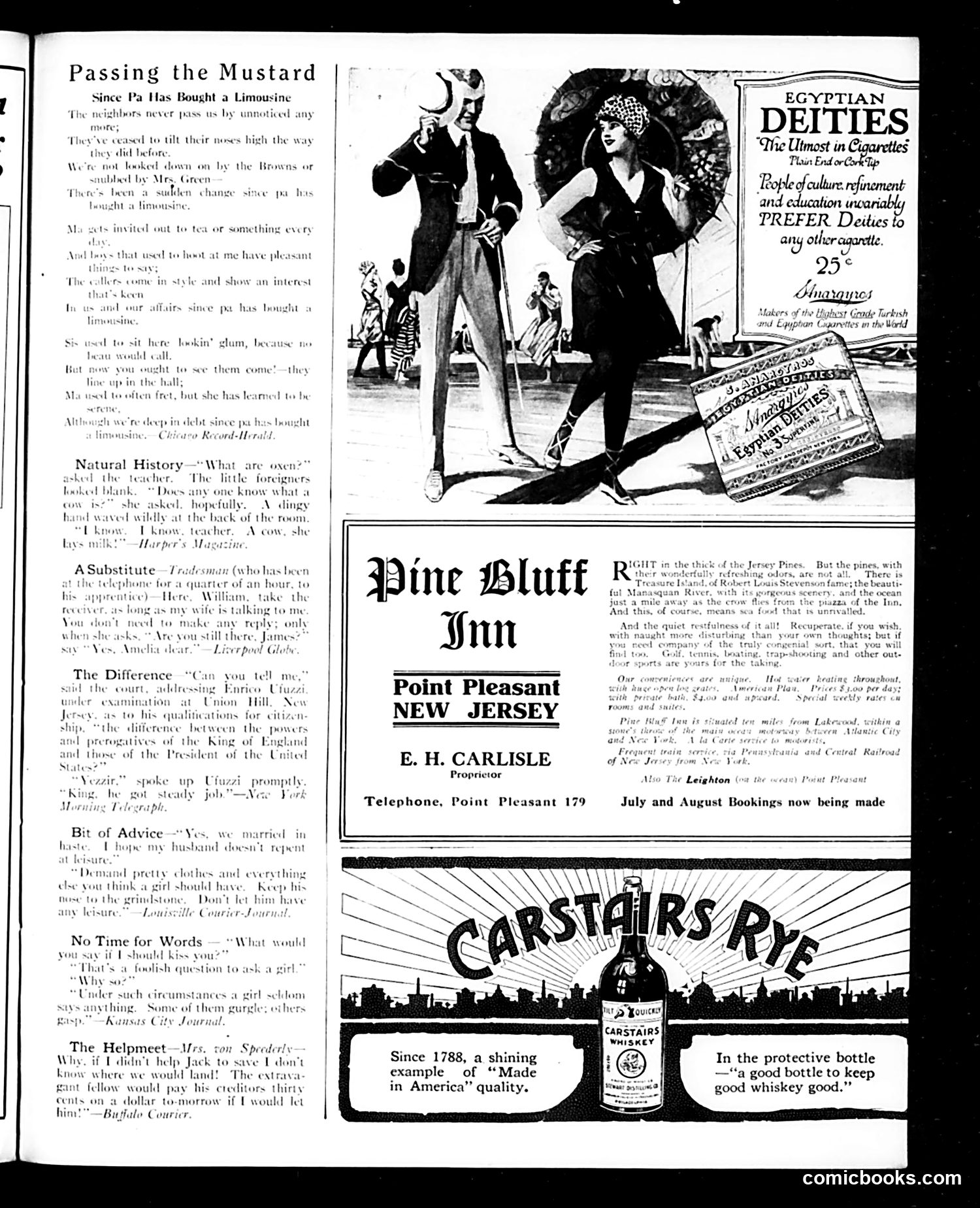
This page contains multiple short humorous pieces typical of Judge magazine's satirical format. **Main cartoon/story "Passing the Mustard"**: Social satire about a family's changed status after the father buys a limousine. Previously snubbed by neighbors like "the Browns" and "Mrs. Green," they now receive tea invitations and social attention. The joke satirizes American class consciousness and materialism—social acceptance tied entirely to visible wealth rather than character. The title suggests superficial politeness ("passing the mustard" = polite social exchanges). **Surrounding anecdotes** mock various social types: a teacher's student who doesn't know what oxen are; a substitute tradesman; marital advice columns; and a wife claiming credit for her husband's financial responsibility. **Bottom advertisements** for Egyptian Deities cigarettes and Carstairs Rye whiskey anchor the page's commercial content. The overall tone targets nouveau riche pretension and shallow social hierarchies of early 20th-century American society.
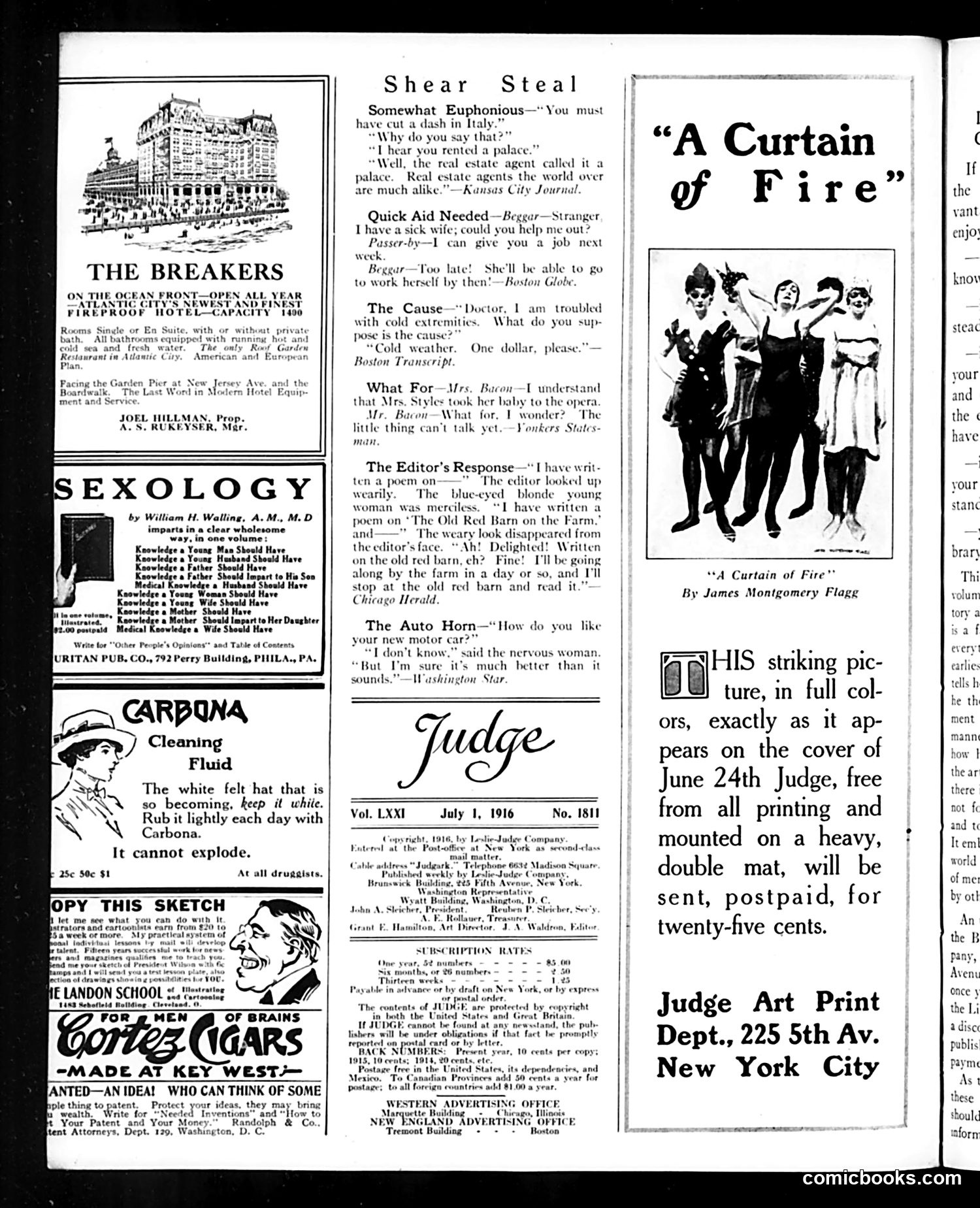
This page primarily advertises a color art print by James Montgomery Flagg accompanying Judge's June 24th issue. The image shows five figures with raised arms in dramatic poses against what appears to be fire or explosions—likely depicting wartime heroism or sacrifice. The context: 1916 was pivotal—America was edging toward entering World War I (officially joined in 1917). Flagg, famous for patriotic imagery including the later "I Want YOU" poster, created emotionally charged war-related art. This "Curtain of Fire" appears designed to stir patriotic sentiment during a period of growing American involvement in the conflict. The page also contains typical Judge humor snippets mocking everyday situations—marital life, poverty, pretension—alongside period advertisements (Carbona cleaning fluid, patent services). The contrast between light social satire and patriotic war imagery reflects how magazines balanced entertainment with propaganda during this transitional moment.
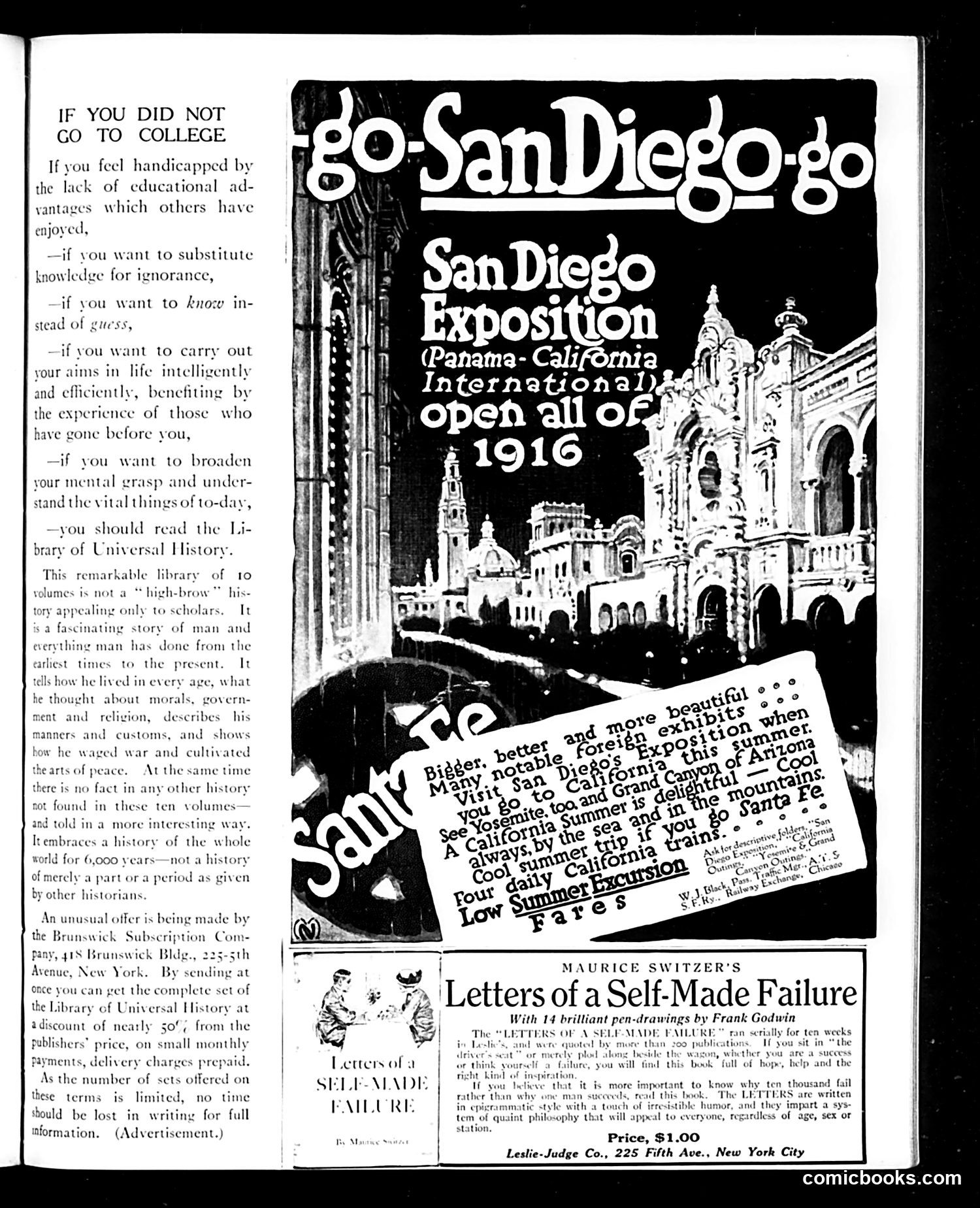
This page is primarily **advertising**, not satire or political commentary. The main advertisements promote: 1. **San Diego Exposition (1916)** — A large illustrated ad encouraging tourism to California's Panama-California Exposition, highlighting attractions like Yosemite and the Grand Canyon with "low summer fares." 2. **Library of Universal History** — A self-improvement pitch targeting people without college education, offering a 10-volume history set at discount prices through the Brunswick Subscription Company. The copy uses aspirational language about gaining knowledge to compensate for lack of formal education. 3. **Letters of a Self-Made Failure** — A humorous book by Maurice Switzer with pen-drawings, serialized in Judge magazine. The page reflects early-20th-century American consumer culture, emphasizing self-improvement through purchasing (education, travel, books) and appealing to working-class readers who feel socially disadvantaged by lacking college credentials.
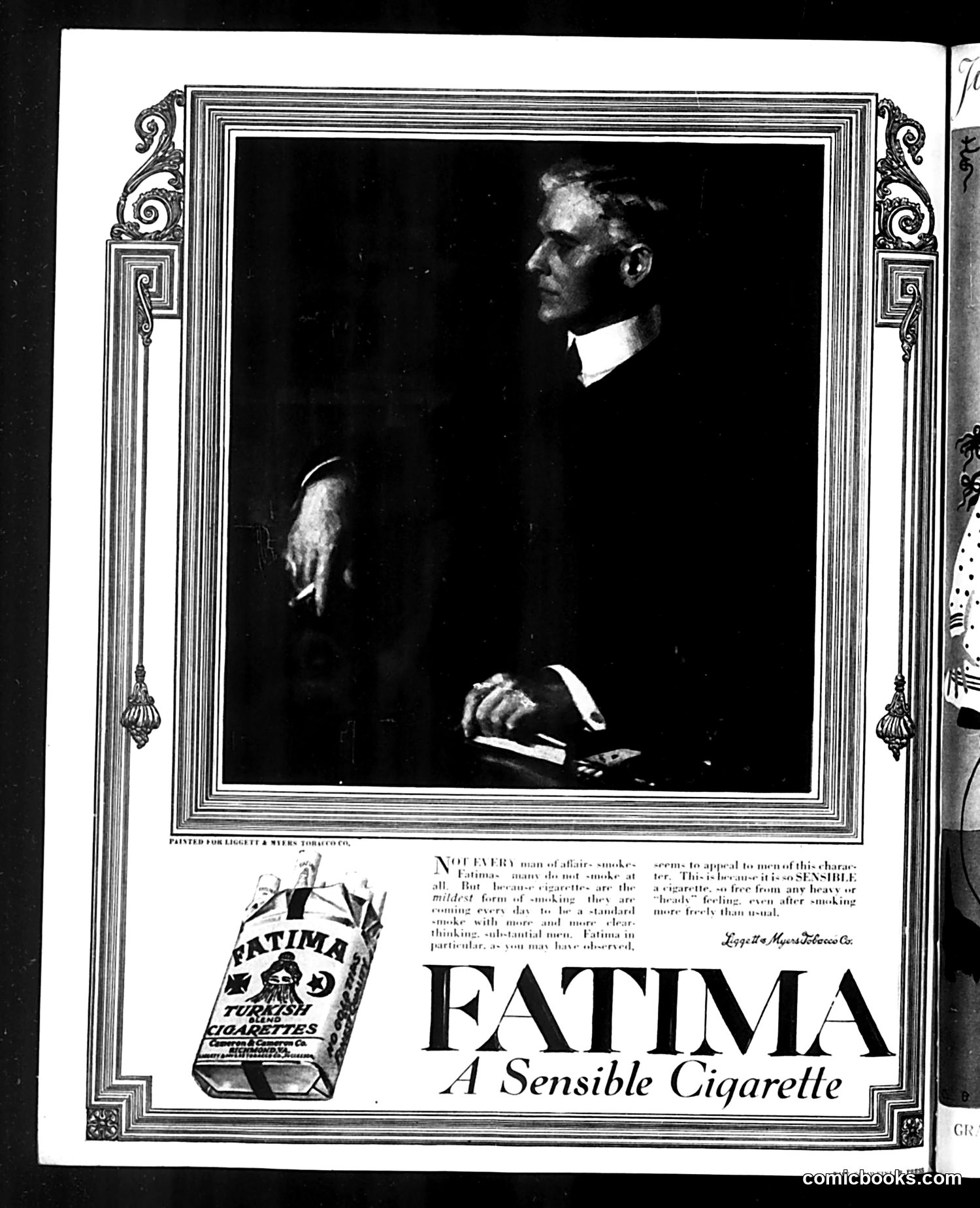
This page is primarily **advertising**, not political satire. It advertises Fatima Turkish cigarettes as "A Sensible Cigarette." The advertisement features a formal portrait of a well-dressed man in profile, likely meant to represent a distinguished gentleman or man of affairs. The accompanying text argues that Fatima cigarettes are the "sensible" choice because, unlike most cigarettes, they don't produce the "heavy" feeling smokers experience—even after smoking more than usual. The ad emphasizes that substantial men and thinking individuals prefer Fatima, positioning the brand as rational and sophisticated. The ornate framing suggests prestige and respectability. This reflects early 20th-century cigarette marketing that emphasized health and gentility rather than the explicit health warnings that would become standard decades later.