
Judge, 1916-07-01 · page 7 of 28
Judge — July 1, 1916 — page 7: what you’re looking at
What you’re looking at
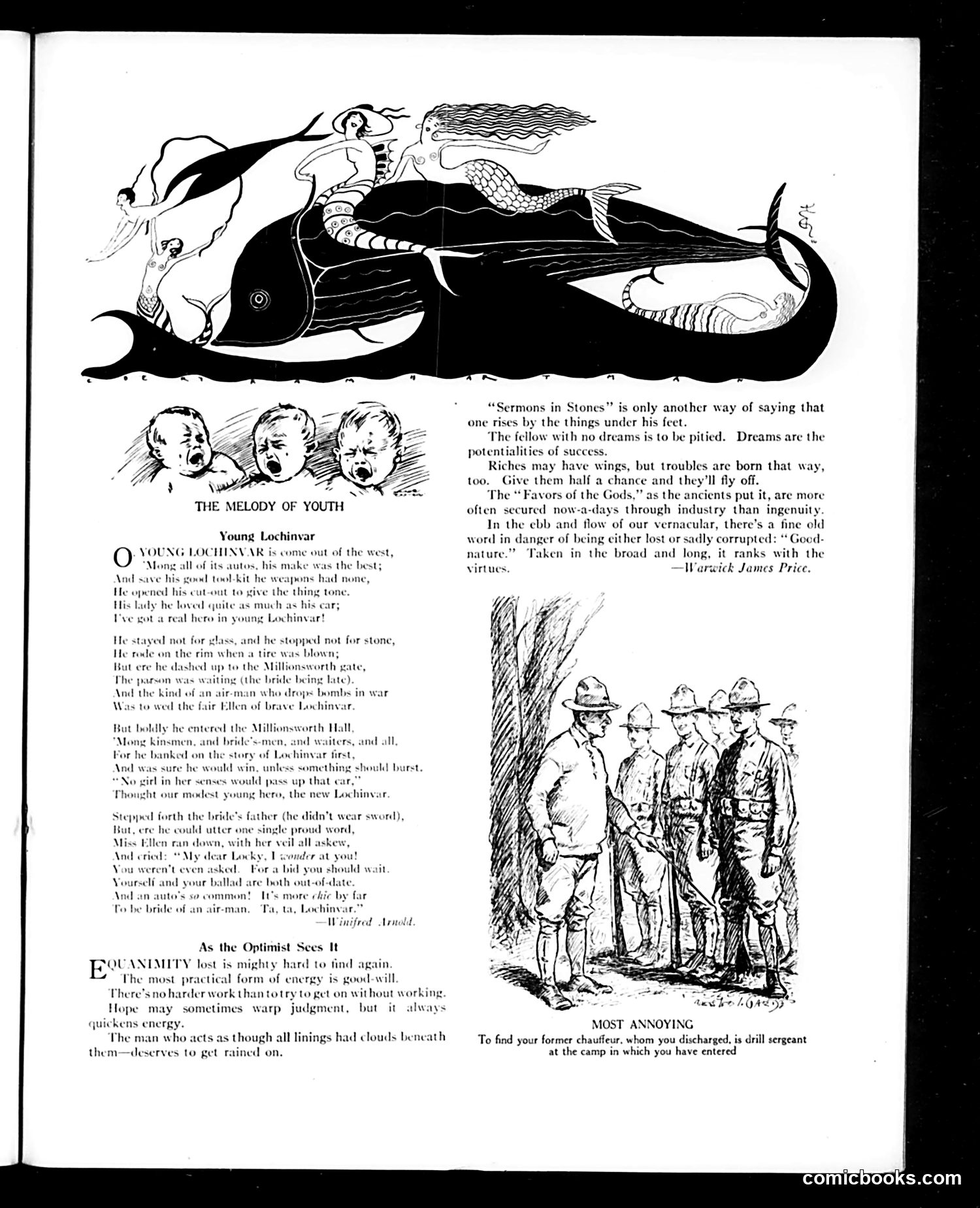
This page satirizes modern courtship and values through a parody of the classic Scottish ballad "Young Lochinvar." The original poem depicts a romantic hero who boldly wins his bride through daring and devotion. The satire inverts this: the modern "Lochinvar" arrives by automobile rather than horseback, but discovers that the bride prefers marrying an **airman (pilot)** instead—not for romance, but because an airplane is more fashionable and prestigious than a car. The bride's father's traditional objections are dismissed as outdated. The joke targets **1920s-era materialism and status-seeking**: young women supposedly value modern technology and social standing over genuine heroism or character. The accompanying text emphasizes "good-nature" and integrity as undervalued virtues, suggesting society has abandoned them for superficial glamour and industrial progress. The smaller cartoon below jokes about military hierarchy—an annoying aspect of camp life is encountering a former superior officer.
📄 Transcribed text from this page (OCR, searchable)
Machine-transcribed from the original scan — historical spelling and the odd misread are preserved.
i “Sermons in Stones” is only another way of saying that one rises by the things under his feet. The fellow with no dreams is to be pitied. Dreams are the potentialities of success. Riches may have wings, but troubles are born that way, \ pwr = too. Give them half a chance and they'll fly off. s The “Favors of the Gods,” as the ancients put it, are more THE MELODY OF YOUTH often secured now-a-days through industry than ingenuity. In the ebb and flow of our vernacular, there’s a fine old Young Lochinvar word in danger of being either lost or sadly corrupted: “ Good- YOUNG LOCHINVAR is come out of the west, nature.” Taken in the broad and long, it ranks with the Mong all of its autos, his make was the best; virtues. Warwick James Price. And save his good tool-kit he weapons had none, cut-out to give the thing tone. His lady he loved quite as much as his car; Ive got a real hero in young Lochinvar! He stayed not for glass, and he stopped not for stone, He rode on the rim when a tire was blown; But ere he dashed up to the Millionsworth gate, Phe parson was waiting (the bride being late). And the kind of an air-man who drops bombs in war Was to wed the fair Ellen of brave Lochinvar But boldly he entered the Millionsworth Hall and bride dl waiters, and all ory of Lochinvar firs sure he would win, unless something should burst irl in her senses would pass up that ear, ing hero, the new Lochinvar Stepped forth the bride’s father (he didn’t wear sword), But, ere he could utter one single proud word, with her veil weren't even asked. For a bid you should wait rscli and your ballad are both out-of-date And an auto's so common! [t's more chic by far To be bride of an air-man, Ta, ta, Lochinvar.” Winifred Arnold. As the Optimist Sces It QUANIMITY lost is mighty hard to find again The most practical form of energy is good-will Vhere’sno harder work than totry to get on without working Hope may sometimes warp judgment, but it always 5 quickens energy. MOST ANNOYING lhe man who acts as though all linings had clouds beneath Ta ted sinus torener chucdeas whee sou diachacyed. wall wexeant them—deserves to get rained on. at the camp in which you have entered comicbooks.com