
Judge, 1916-07-01 · page 23 of 28
Judge — July 1, 1916 — page 23: what you’re looking at
What you’re looking at
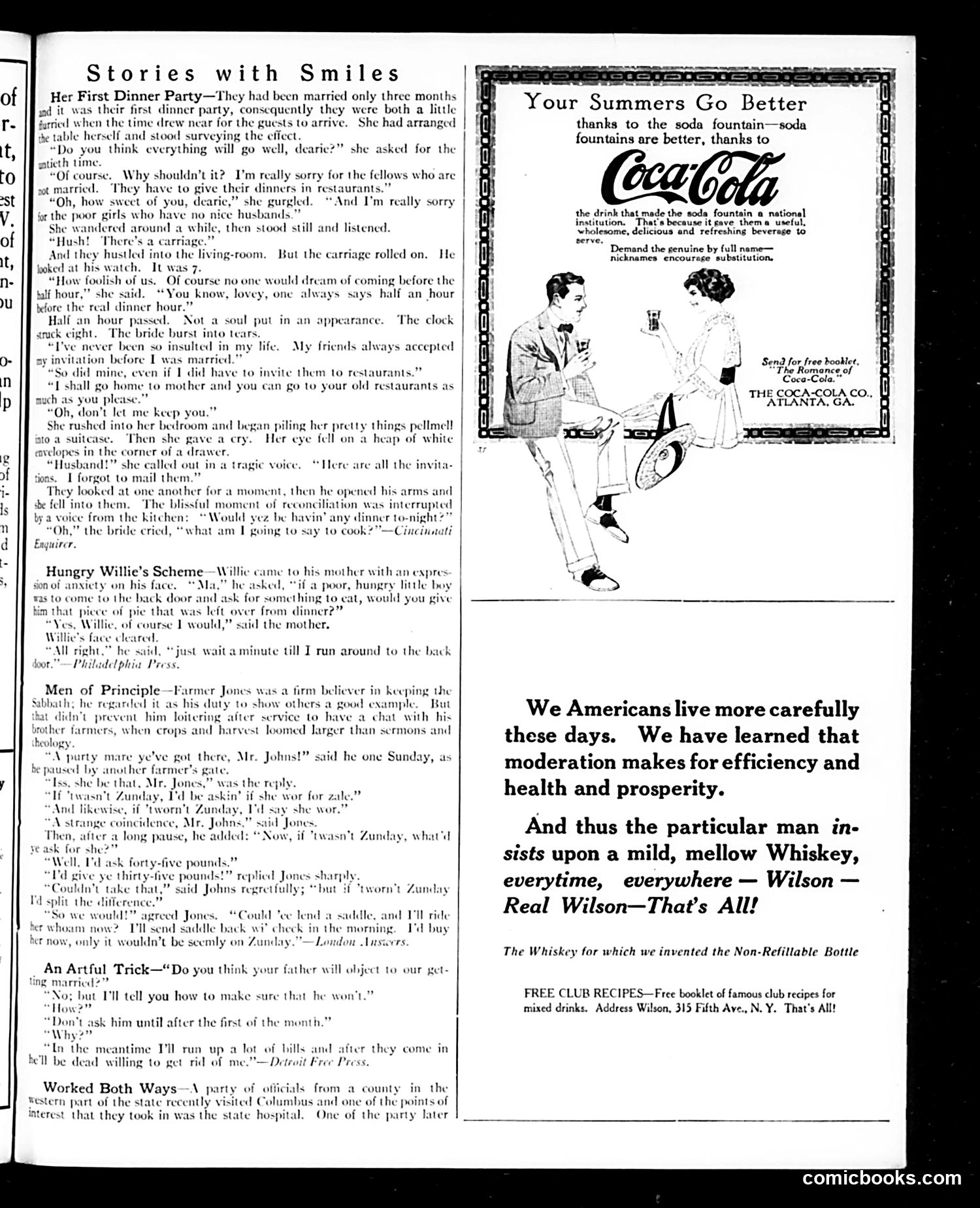
This page from *Judge* magazine contains three humorous short stories typical of early 20th-century American comedy: **"Her First Dinner Party"** satirizes newlyweds' social anxiety. A bride forgets to mail dinner invitations, then assumes her friends have deliberately snubbed her—a commentary on emerging middle-class social pretensions and the importance placed on formal entertaining. **"Hungry Willie's Scheme"** depicts a child's clever deception: he asks his mother if she'd feed a "poor, hungry boy," gets permission, then plans to be that boy himself to secure leftover pie—gentle satire on childhood cunning. **"Men of Principle"** mocks religious hypocrisy: Farmer Jones publicly upholds Sabbath observance but privately negotiates buying a mare on Sunday through verbal loopholes ("if 'twasn't Zunday"), circumventing his stated principles. The page also contains vintage advertisements for Coca-Cola and Wilson Whiskey, emphasizing "moderation" and "efficiency"—ironic given Prohibition-era messaging.
📄 Transcribed text from this page (OCR, searchable)
Machine-transcribed from the original scan — historical spelling and the odd misread are preserved.
Stories with Smiles Her First Dinner Party—They had been married only three months it was their first dinner party, consequently they were both a little ried when the time drew near for the guests to arrive. She had arranged table herself and stood surveying the effect. Jo you think everything will go well, dearie?” she asked for the eth time. “Of course. Why shouldn’t it? I’m really sorry for the fellows who are sot married. They have to give their dinners in restaurants.” “Oh, how sweet of you, dearic,” she gurgled. “And I’m really sorry at the poor girls who have no nice husbands.” She wandered around a while, then stood still and listened. “Hush! There's a earriag And they hustled into the living-room. But the carriage rolled on. He boked at his watch. It was 7. “How foolish of us. Of course no one would dream of coming before the talf hour,” she said. “You know, lovey, one always says half an hour before the real dinner hour.” Half an hour passed. Not a soul put in an appearance. ‘The clock anck eight. The bride burst into tears. ve never been so insulted in my life. My friends always accepted ay invitation before Twas marri ‘So did mine, even if 1 did have to invite them to restaurants.” “I shall go home to mother and you can go to your old restaurants as such as you please.” Oh, don’t let me keep you.” She rushed into her bedroom and began piling her pretty things pellmel! ato a suitease. Then she gave a cry. Her eye fell on a heap of white lopes in the corner of a drawer. Husband!” she called out in a tragic voice. “Here are all the invita- | I forgot to mail them.” They looked at one another for a moment, then he opened his arms and se fell into them. The blissful moment of reconciliation was interrupted bya voice from the kitchen: Would yez be havin’ ner to-night?” “Oh,” the bride cried, “what am I going to say to cook?” —Cincinnati incr. Hungry Willie’s Scheme Willie came to his mother with an expres onof anxiety on his face. “Ma,” he asked, “if. a poor, hungry little boy come to the back door and ask for something to eat, would you give that picee of pie that was left over from dinner?” Yes, Willie, of course 1 would,” said the mother, Willie’s face cleared. “AM right said, “just waita minute till I run around to the back Philadelphia Press. Men of Principle Farmer Jones was a firm believer in keeping the he regarded it as his duty to show others a good example. But t prevent him loitering after service to have a chat with his vother farmers, when crops and harvest loomed larger than sermons and heology “N purty mare ye've got there, Mr. Johns!” said he one Sunday, as tused by another farmer's gute. “Iss, she be that, Mr. Jones,” was the reply. If “twasn't Zunday, Pd be askin’ if she wor for zale.”” And likewise, if "tworn't Zunday, Vd say she wor.” “A strange coincidence, Mr. Johns,” said Jones Then, after a long pause, he addec ‘ow, if "twasn’t Zunday, what ye ask for she?" Well, 1'd ask forty-five pound “I'd give ye thirty-five pounds!” replied Jones sharply. “Couldn't take that,” said Johns regretfull tif ‘tworn't Zunday ld split the ditferenc So we would!” i Jones. “Could "ce lend a saddle, and VI ric whoam now? [ll send saddle back wi? cheek in the morning. Id buy her now, only it wouldn’t be seemly on Zunday.”—London .Lasiers An Artful Trick—“Do you think your father will object to our get- ting married?” 0; but [ll tell you how to make sure that he won't.” How?” “Don’t ask him until after the first of the month.” Why?” “In the meantime Tl run up a lot of bills and after they come in be'll be dead willing to get rid of me.”—Detroit Free Press. Worked Both Ways—A\ party of officials from a county in the Bester part of the state recently visited Columbus and one of the points of interest: that they took in was the state hospital. One of the party later Veer conneen Go Better thanks to the soda fountain—soda fountains are better, thanks to Od the drink that made the soda fountain a national institution, That's because it gave thema useful, wholesome, delicious and refreshing beverage to Demand the genuine by full name— nicknames encourege substitution, a | Send for free booklet ‘he Romance of "Coco Cola” ane SOCASCOLA, co., TLANTA, GA. We Americans live more carefully these days. We have learned that moderation makes for efficiency and health and prosperity. And thus the particular man in- sists upon a mild, mellow Whiskey, everytime, everywhere — Wilson — Real Wilson—That’s All! The Whiskey for which we invented the Non-Refillable Bottle FREE CLUB RECIPES—Free booklet of famous club recipes for mixed drinks. Address Wilson, 315 Fifth Ave., N.Y. That's All! comicbooks.com