
A complete issue · 28 pages · 1916
Judge — May 27, 1916
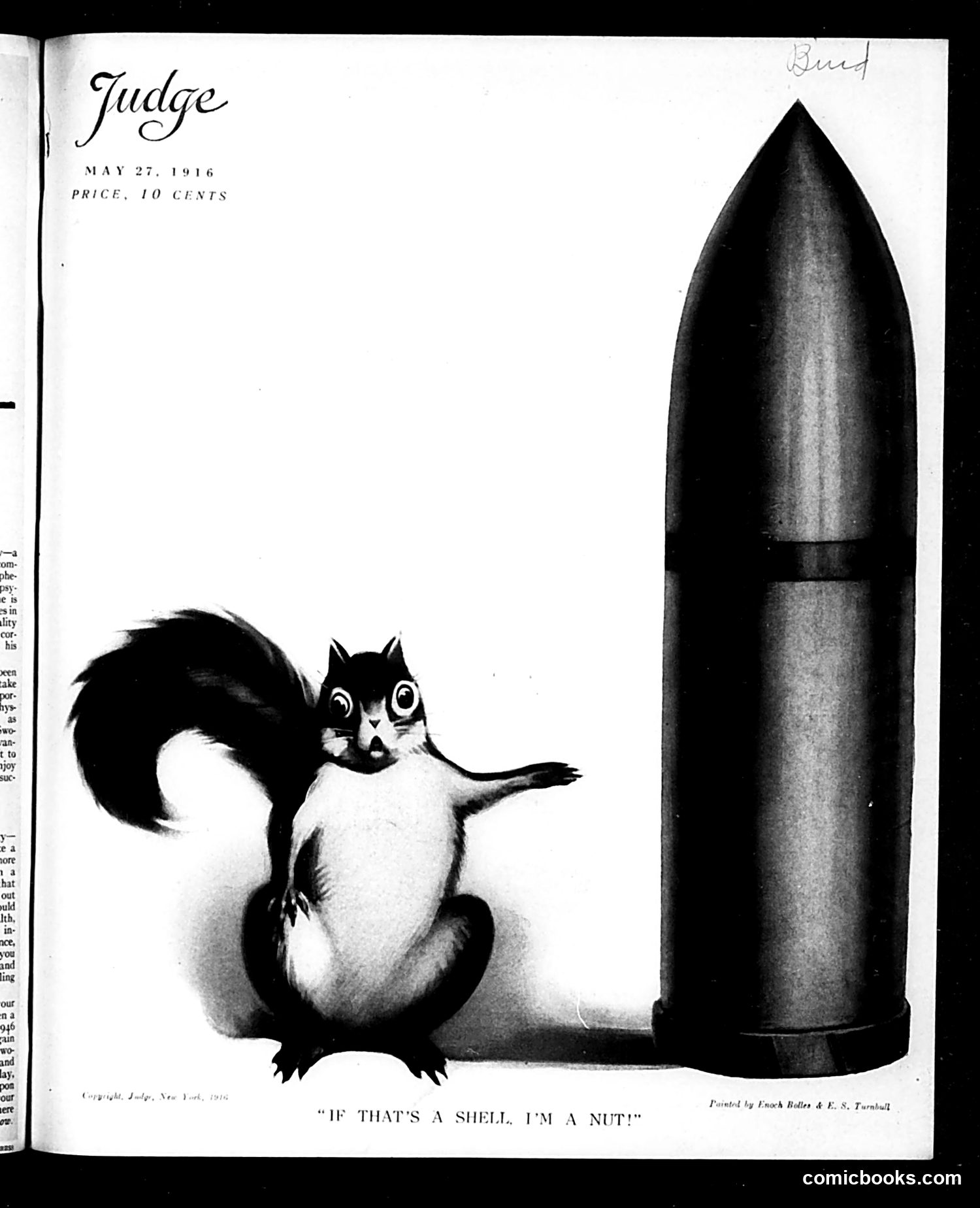
This cartoon depicts a squirrel confronting a large artillery shell, with the caption "If That's a Shell, I'm a Nut!" **Context:** Published in 1916, during World War I, this is a visual pun playing on double meaning. The squirrel—a nut-gatherer—makes a joke equating the military shell to its natural food. The cartoon likely comments on the massive scale and destructiveness of modern warfare, using the squirrel's bewilderment to express American civilian shock or skepticism about the enormous weapons being deployed in the European conflict. The satire suggests either amazement at military technology or, possibly, skepticism about war claims circulating at the time. The juxtaposition of small animal to weaponry emphasizes the absurd gulf between civilian life and industrial-scale warfare.
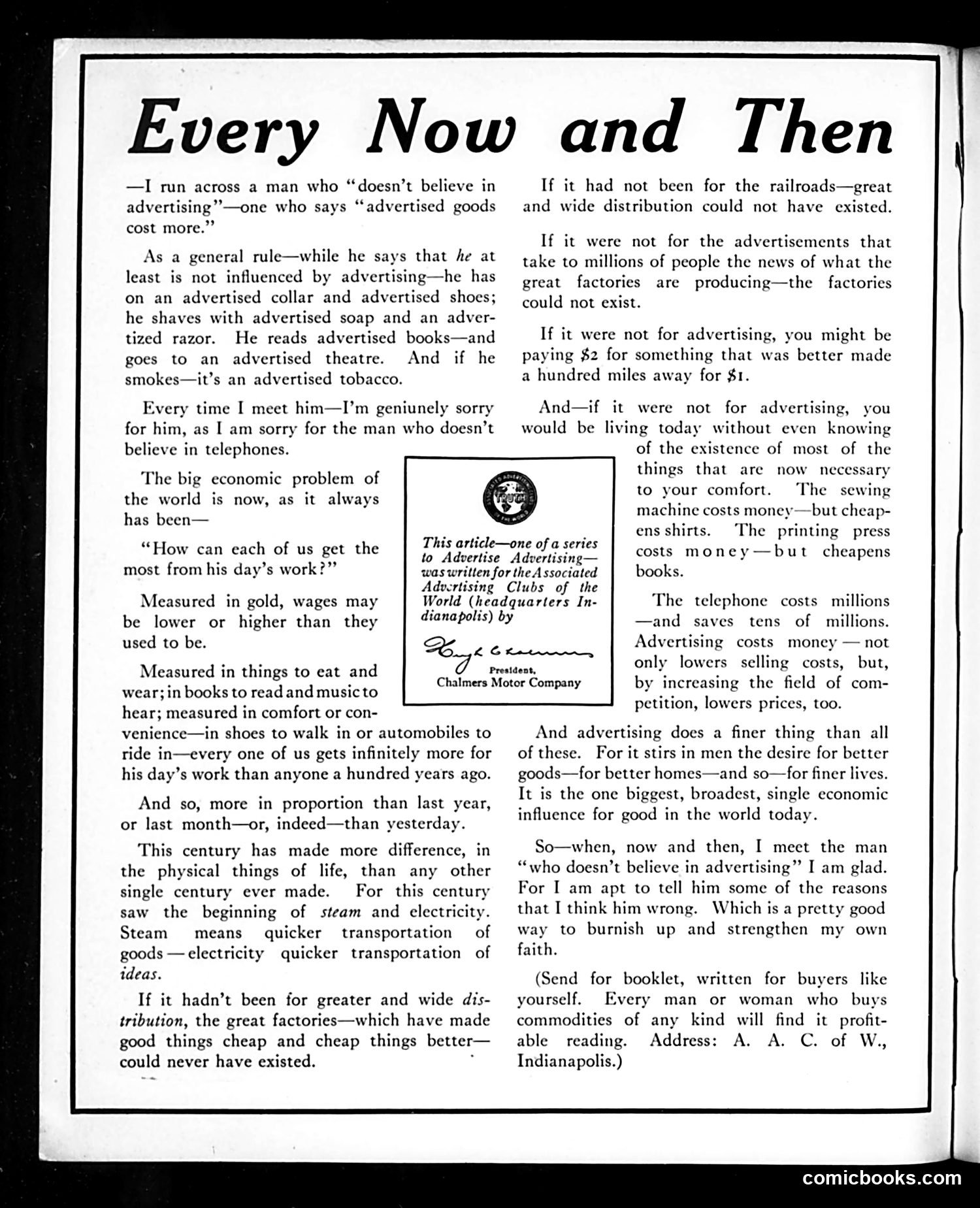
This appears to be a pro-advertising editorial essay from *Judge* magazine, not a cartoon. The piece argues that skeptics of advertising are mistaken about its economic value. The author contends that advertising: - Enables mass distribution, making goods cheaper - Spreads information about factory innovations - Reduces costs through competition - Improves living standards by creating desire for better products The "man who doesn't believe in advertising" is a rhetorical figure representing common skepticism. The author dismisses this skeptic as illogical—comparing him to someone who "doesn't believe in telephones." The text emphasizes advertising as a fundamental economic force of the modern century, alongside steam and electricity, essential for industrial progress and consumer welfare.
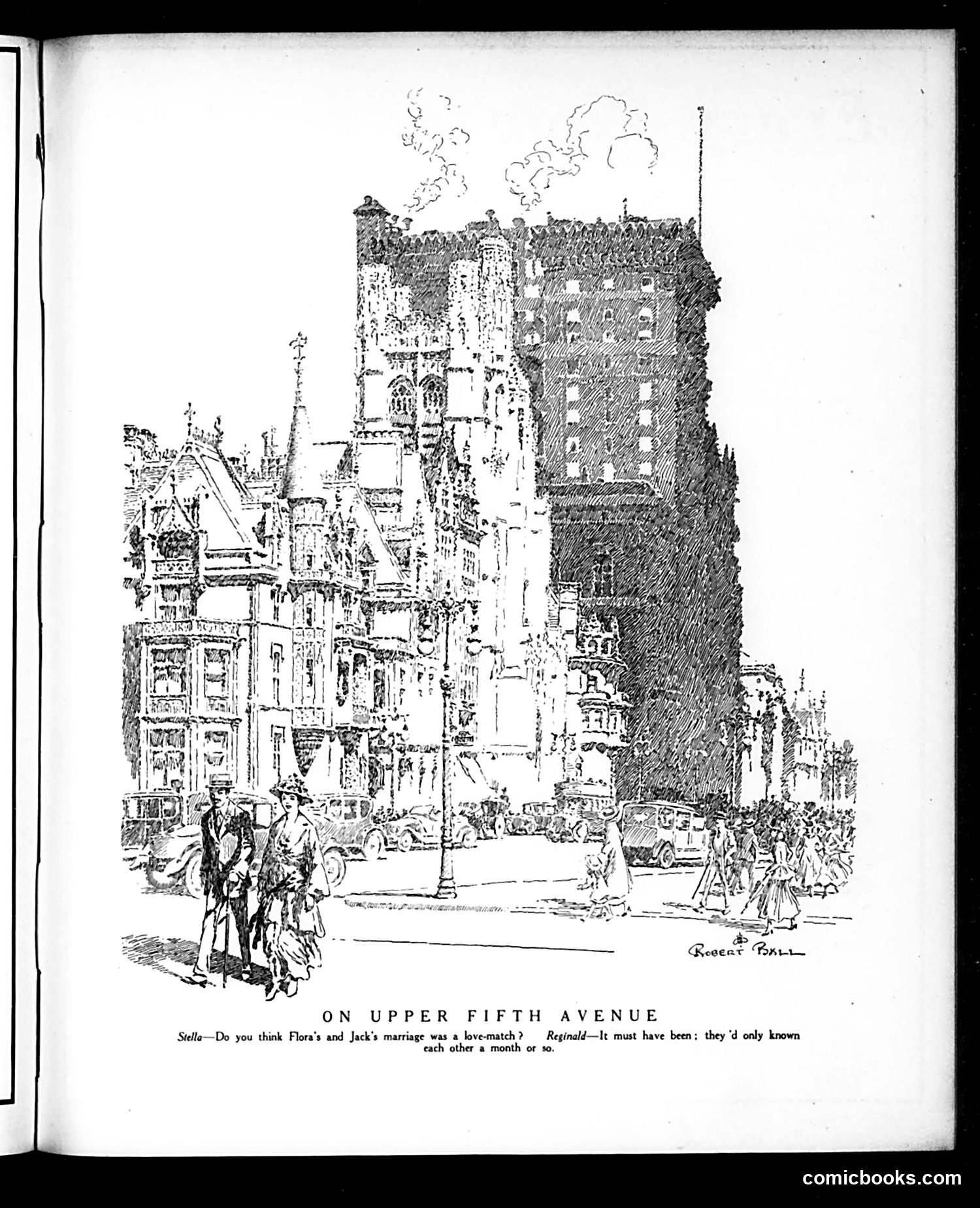
This illustration by Robert Ball depicts a street scene on Manhattan's prestigious Fifth Avenue. The cartoon caption presents a brief domestic dialogue: "Stella" asks whether "Flora's and Jack's marriage was a love-match," to which "Reginald" responds skeptically that it must have been—"they'd only known each other a month or so." The satire targets wealthy New York society's hasty marriages among the upper classes. The joke implies that among the affluent, marrying someone after minimal acquaintance was commonplace enough to be unremarkable. The detailed architectural sketch of elegant buildings and well-dressed pedestrians establishes the setting as a place where such frivolous romantic decisions among the privileged would be entirely expected and unsurprising.
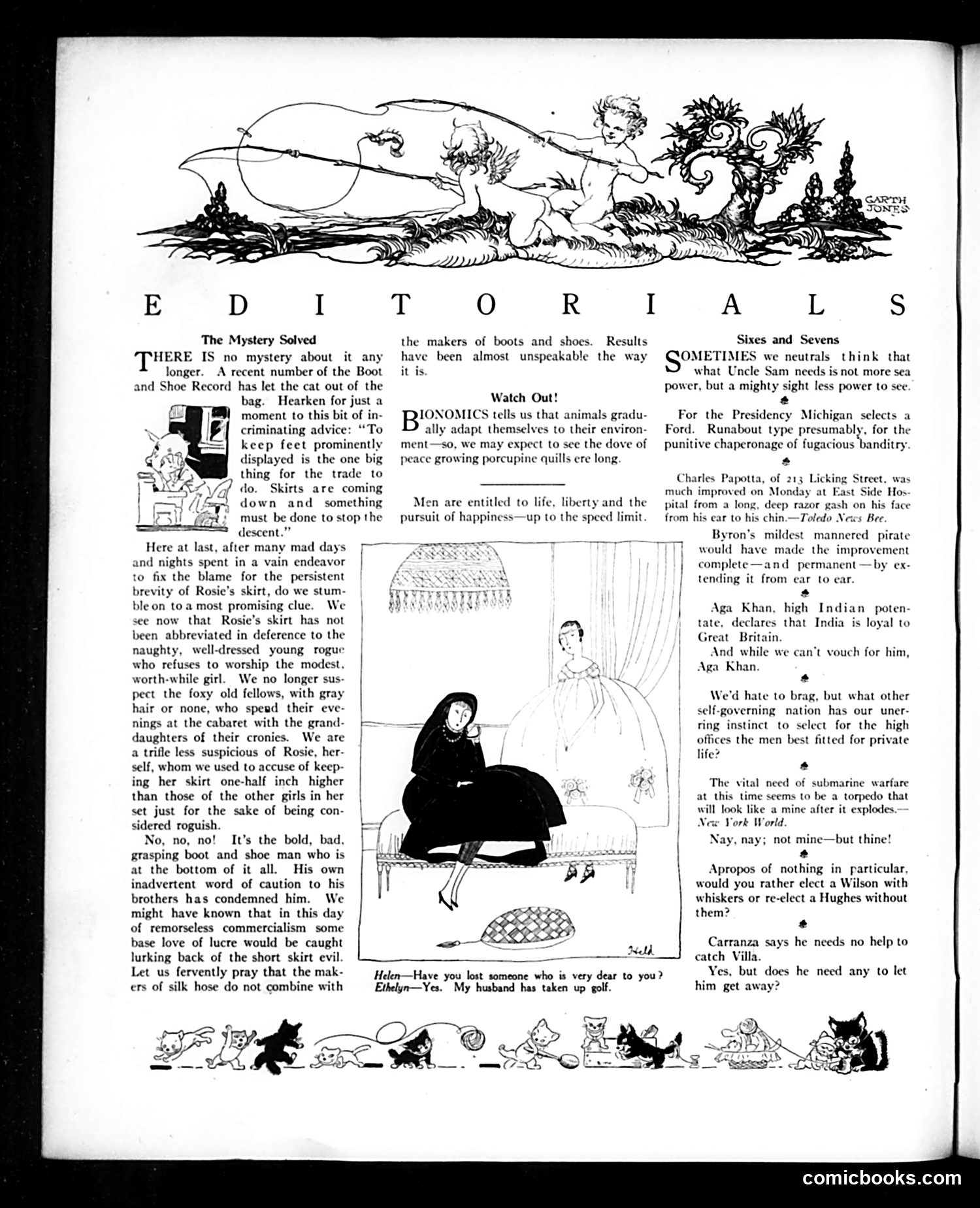
This page contains satirical commentary on contemporary issues rather than a single cartoon. The main article "The Mystery Solved" defends women's fashion, specifically shorter skirts, against critics who claim the style is immodest. The author argues that skirt length has nothing to do with morality—the real issue is commercialism and manufacturers seeking profits. The accompanying illustration shows two women in conversation about lost acquaintances, with one mentioning her husband taking up golf. The right column includes brief satirical items on various topics: presidential selection, a man's facial injury, India's loyalty to Britain, warfare, and political elections. The overall tone mocks social pretension and conservative moral panic about women's changing fashion.
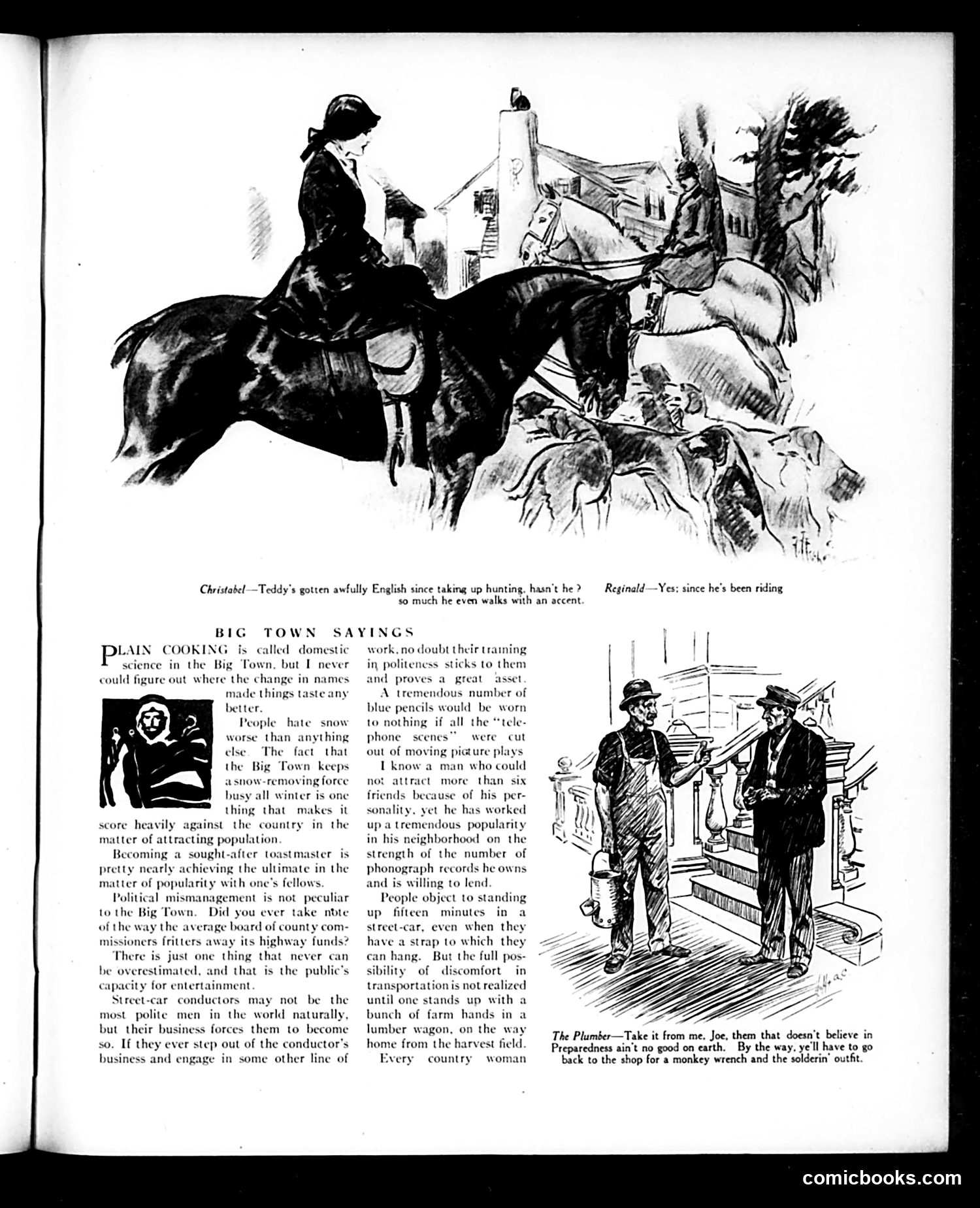
**Top Cartoon:** Shows a woman on horseback hunting, with dialogue between "Christabel" and "Reginald" discussing how a man named Teddy has become "awfully English" since taking up hunting and now "walks with an accent." This appears to be satirizing affectation—someone adopting exaggerated English mannerisms upon engaging in upper-class pursuits like fox hunting. **"Big Town Savings" Article:** Discusses urban society observations, including street-car conductors' behavior, political mismanagement in cities, and transportation complaints. The accompanying sketch shows two men in conversation, with dialogue about plumbing repairs and shop recommendations. The page blends social satire about class pretension with urban commentary typical of Judge's editorial stance on early 20th-century American society.
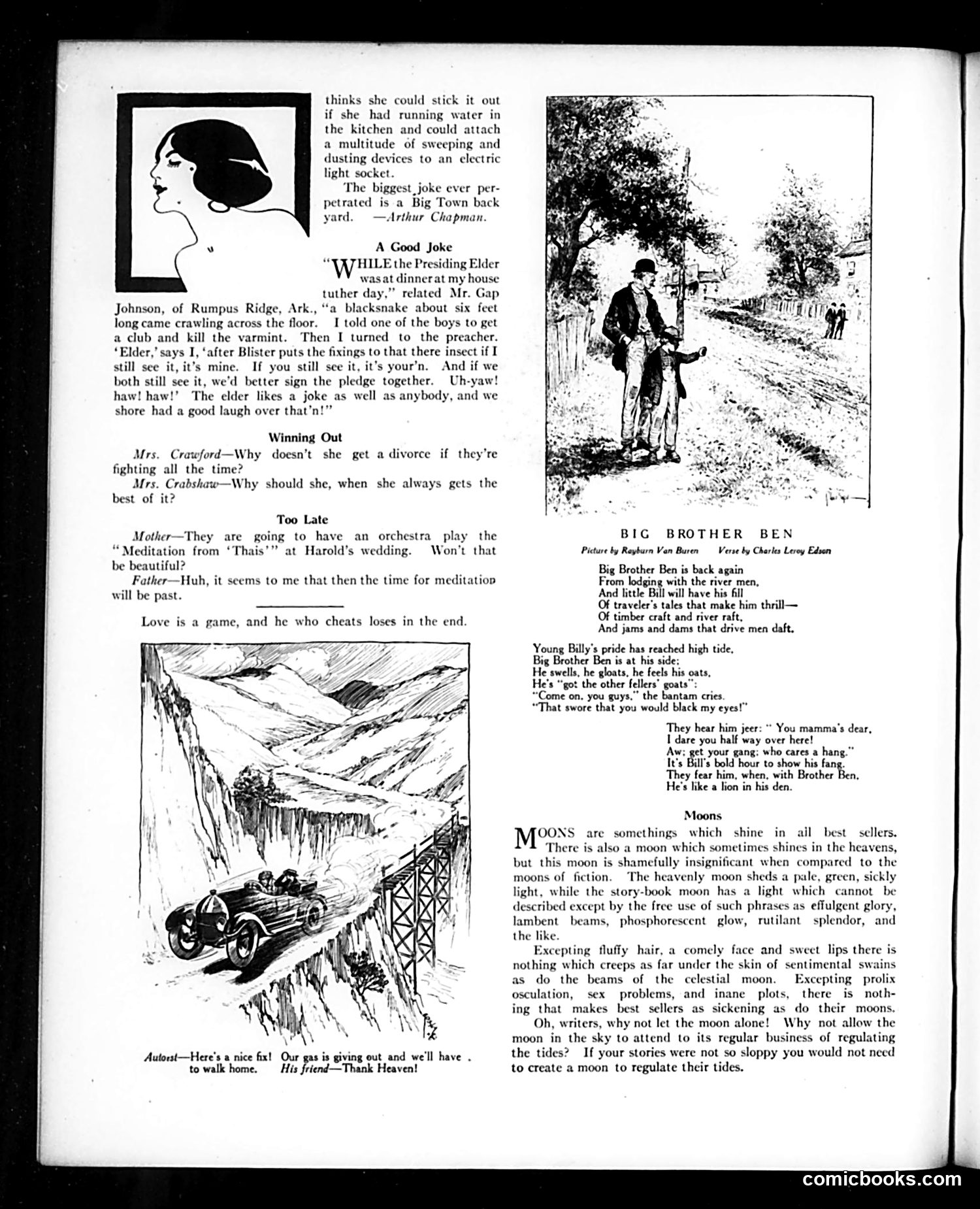
This page contains several humor items typical of early 20th-century American magazines: **"A Good Joke"** features a rural Arkansas anecdote about a preacher and a blacksnake, playing on frontier dialect and the elder's good nature—the humor relies on the supposed contrast between clerical dignity and participation in rustic pranks. **"Winning Out"** is a brief domestic joke where a wife "wins" marital arguments, reflecting early satire on marriage dynamics. **"Too Late"** satirizes the bride's character through her mother's dismissal of wedding music—implying the marriage itself doesn't warrant celebration. **"Big Brother Ben"** is a serialized illustrated poem about an older brother returning to river work and becoming a local hero to his younger sibling, representing working-class adventure narratives popular in the era. **"Moons"** is editorial commentary mocking overly romanticized moon imagery in popular fiction—criticizing sentimental writing conventions where celestial moonlight is described with purple prose ("effulgent glory," "rutilant splendor") rather than realistic observation. The page reflects Judge's mix of domestic humor, rustic folksiness, and literary criticism aimed at middle-class readers.
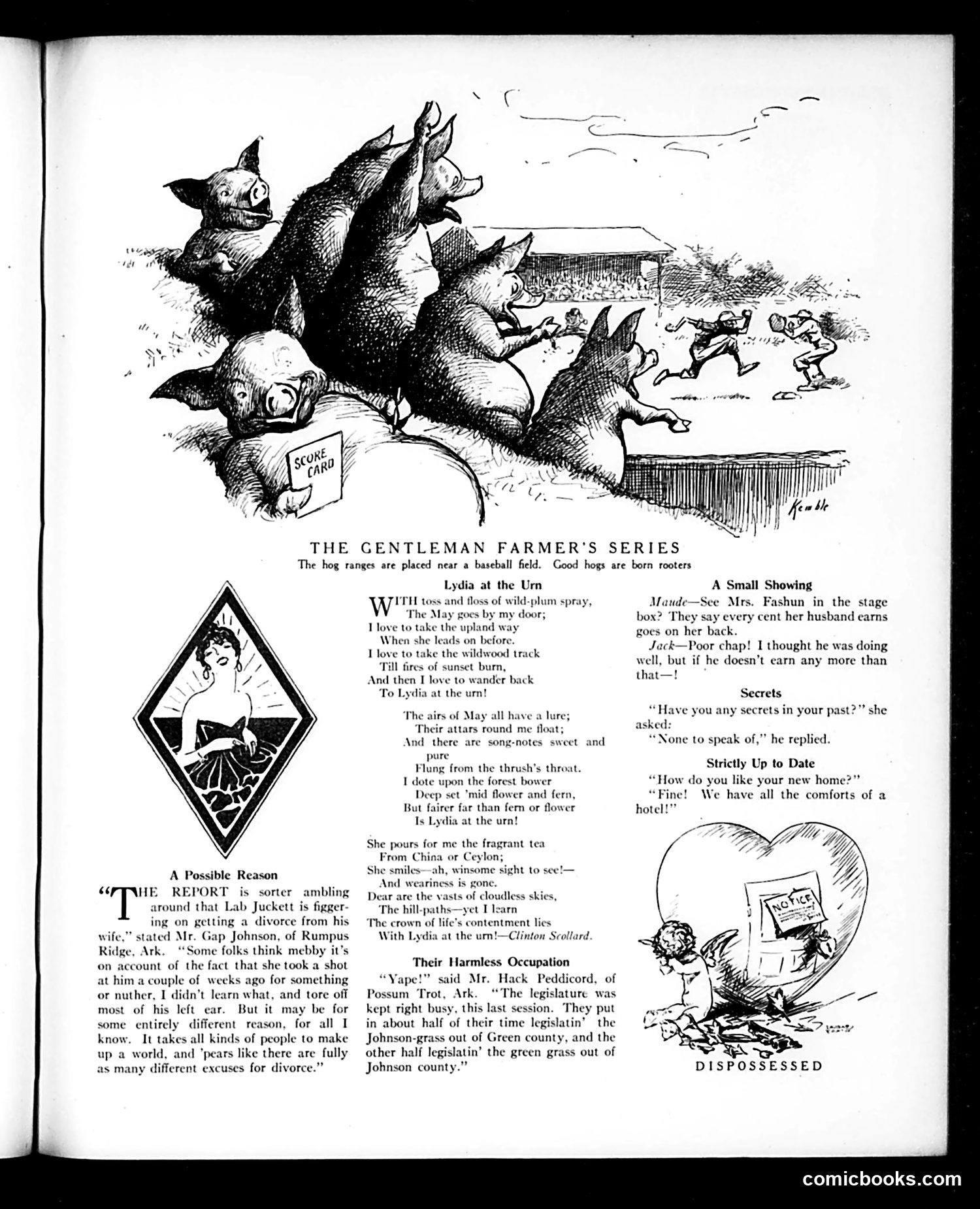
This page satirizes rural Arkansas life through dialect humor and gentle mockery. The main cartoon shows hogs rooting near a baseball field, captioned as "born rooters"—a pun on baseball terminology applied to actual pig behavior. The surrounding rustic anecdotes mock backwoods characters: Lab Juckett considering divorce after his wife shoots off his ear; Mr. Hack Peddicord describing legislators alternately removing invasive Johnson-grass and local marijuana ("green grass") from competing counties—satirizing rural legislative absurdity and implied drug cultivation. Additional brief jokes mock urban social pretension: Mrs. Fashun's husband earning barely enough for her wardrobe, and a newlywed couple whose "hotel comforts" suggest they can't afford actual housing. The romantic poem "Lydia at the Urn" provides literary counterpoint, romanticizing rural domestic life. Overall, the page presents condescending humor targeting rural Arkansans as simultaneously simple, corrupt, and quaint.
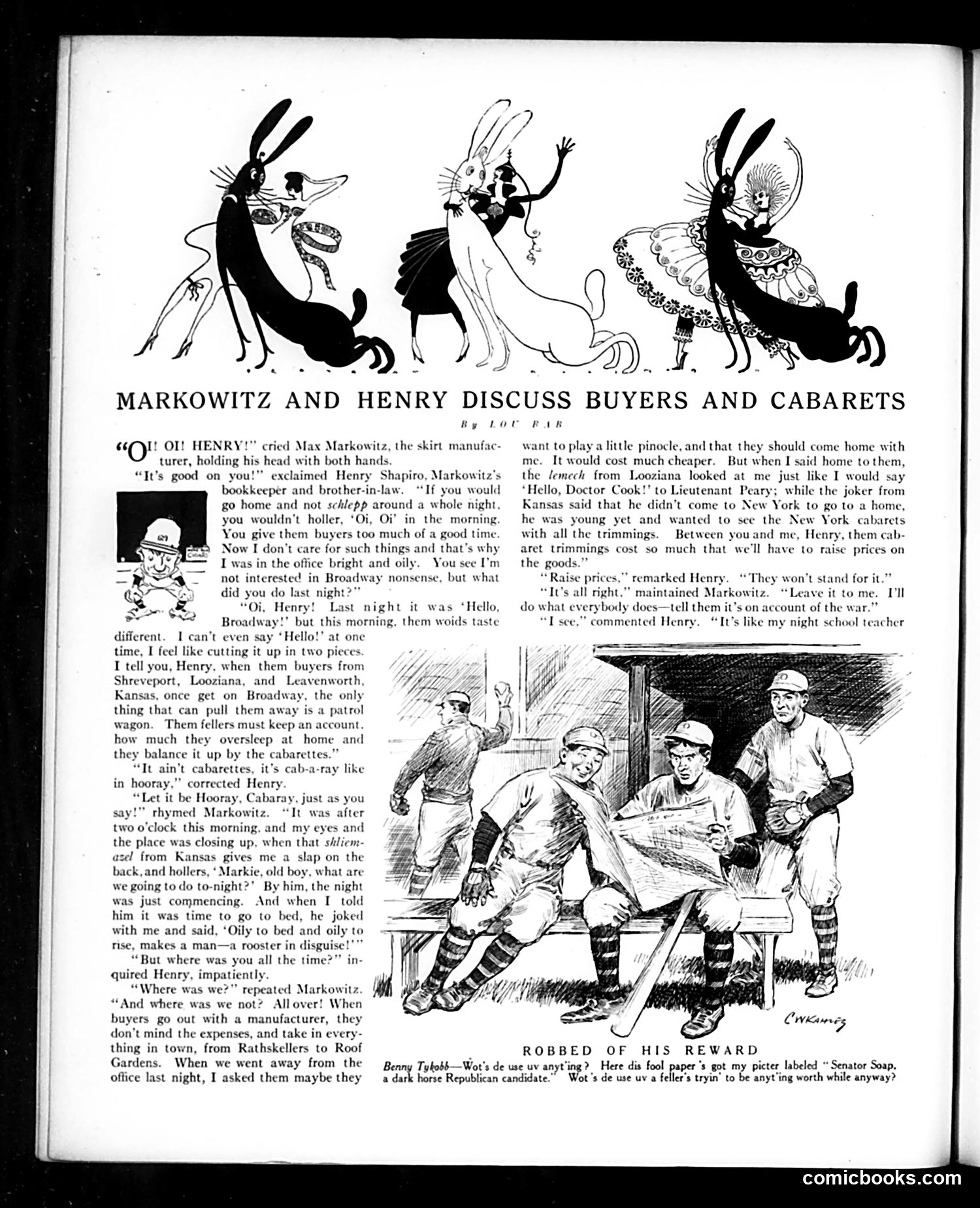
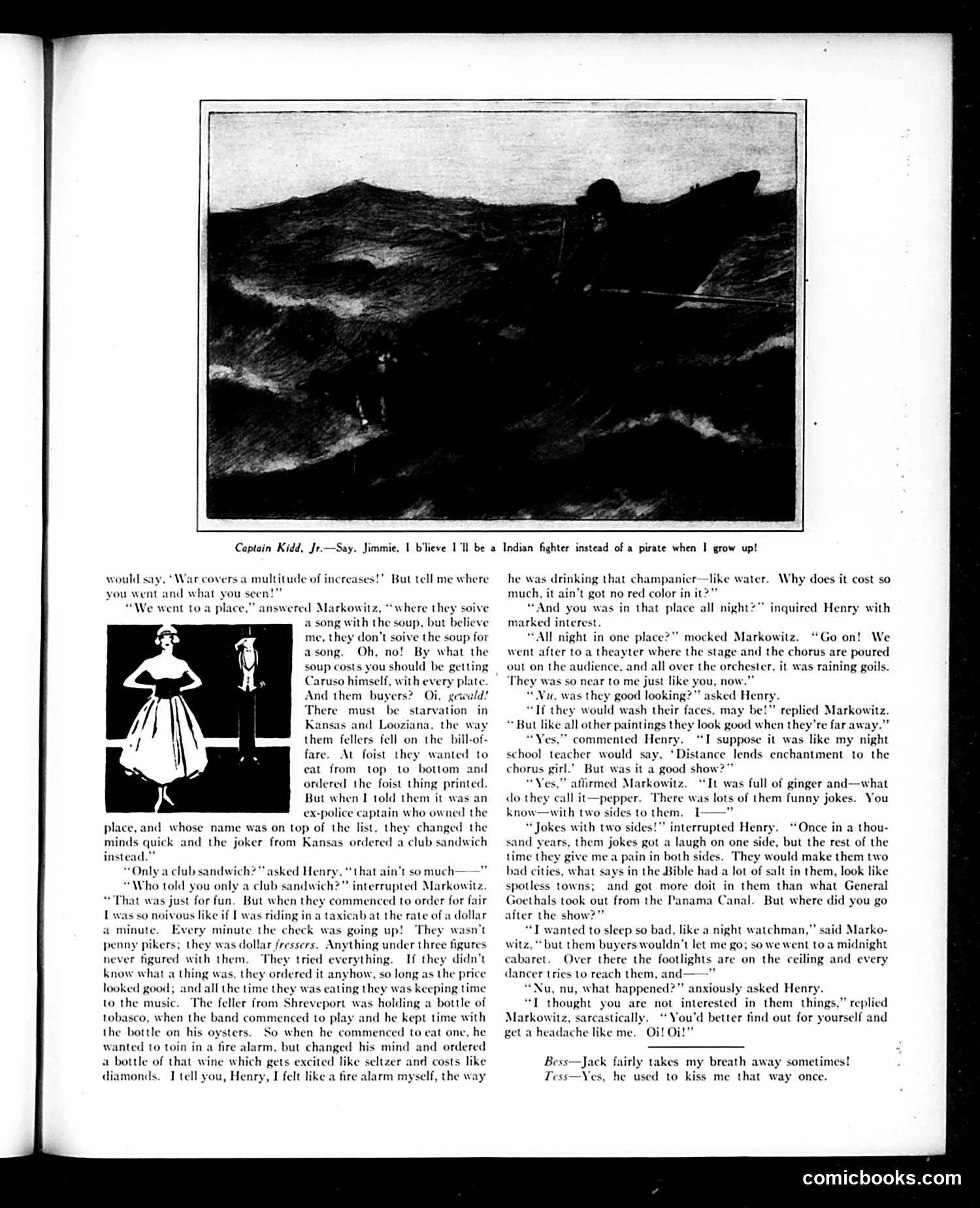
This page satirizes wealthy but unsophisticated newcomers on a spending spree. The conversation between Markowitz and Henry describes out-of-town visitors (from Kansas, Louisiana, and Shreveport) who arrive in the city and recklessly overspend on dining and entertainment—ordering expensive dishes they can't identify, buying champagne carelessly, and patronizing theaters and cabarets. The humor targets the **Yiddish-speaking immigrant perspective** (evident in Markowitz's dialect and expressions like "Oi" and "Nu"), presenting these rural visitors as comically naive about urban luxury. Their indifference to cost, combined with their inability to appreciate or understand what they're consuming, becomes the joke: they equate high prices with quality and status-seeking, wastefully ordering anything expensive without discrimination. The small illustration shows "Captain Kidd, Jr."—a child aspiring to be an "Indian fighter" rather than a pirate—likely a period reference to contemporary anxieties about violence or colonial conquest, though context is unclear. The satire reflects early 20th-century American class tensions and attitudes toward both immigrant sophistication and rural wealth.
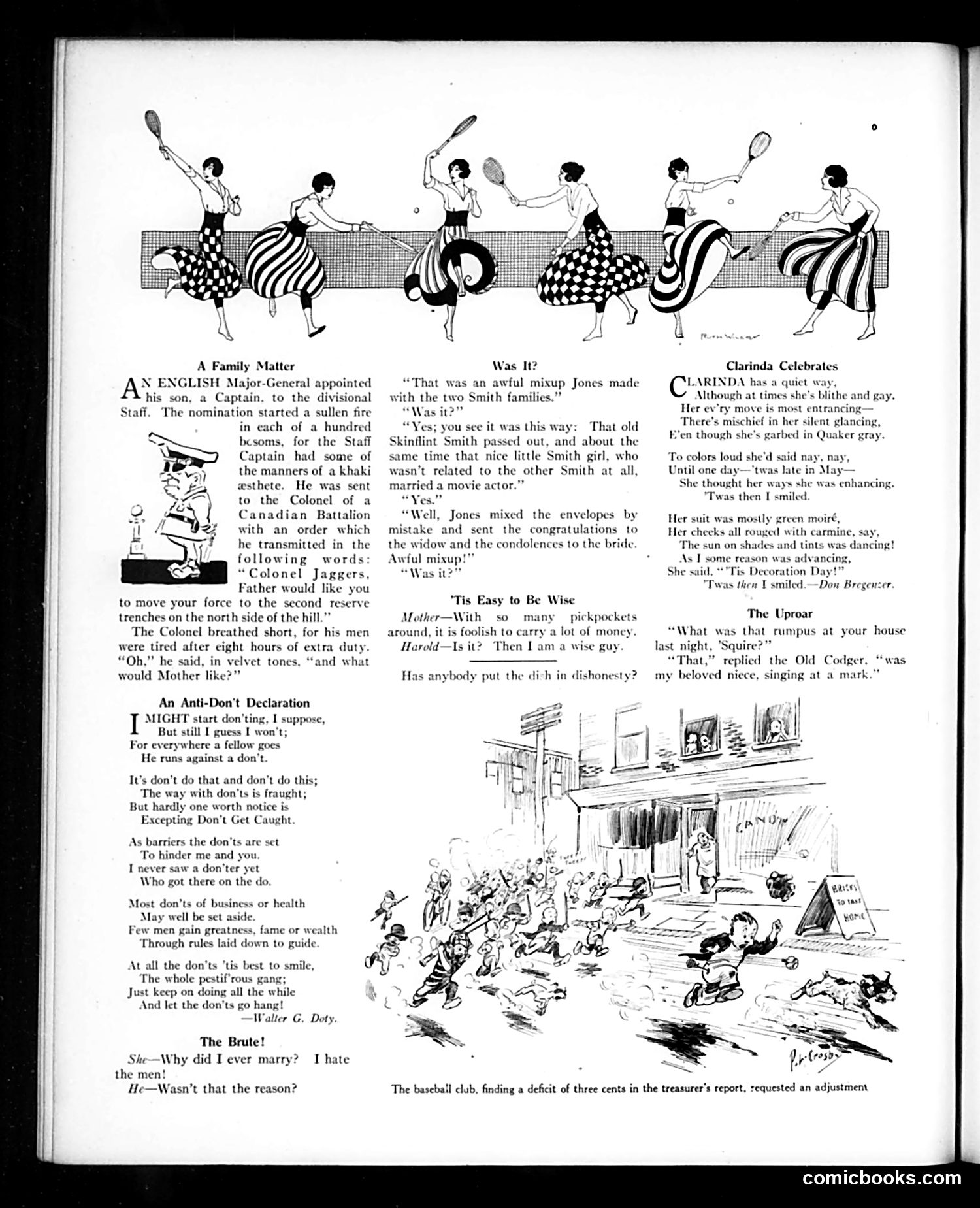
This page contains several humorous short pieces typical of early 20th-century American satirical magazines: **"A Family Matter"** mocks nepotism in the military—a General appoints his aesthete son as Captain, offending experienced soldiers. The joke: when the son delivers orders in affected language, a Colonel sarcastically asks what "Mother" would like, insulting the young officer's perceived weakness and dependence on his father's influence. **"The Anti-Don't Declaration"** is a poem celebrating rule-breaking. It ironically argues against warnings and restrictions, with the punchline that the only "don't" that matters is "Don't Get Caught"—satirizing widespread disregard for social rules and authority. **Other brief jokes** include wordplay about envelopes mixed between condolences and congratulations, a mother's warning about pickpockets, and a pun on "dich in dishonesty." **The bottom cartoon** shows children playing near storefronts, humorously captioning that a baseball club needs to adjust their treasurer's report—missing three cents, presumably due to children's mischief. The overall tone reflects wartime-era skepticism toward authority and institutions.
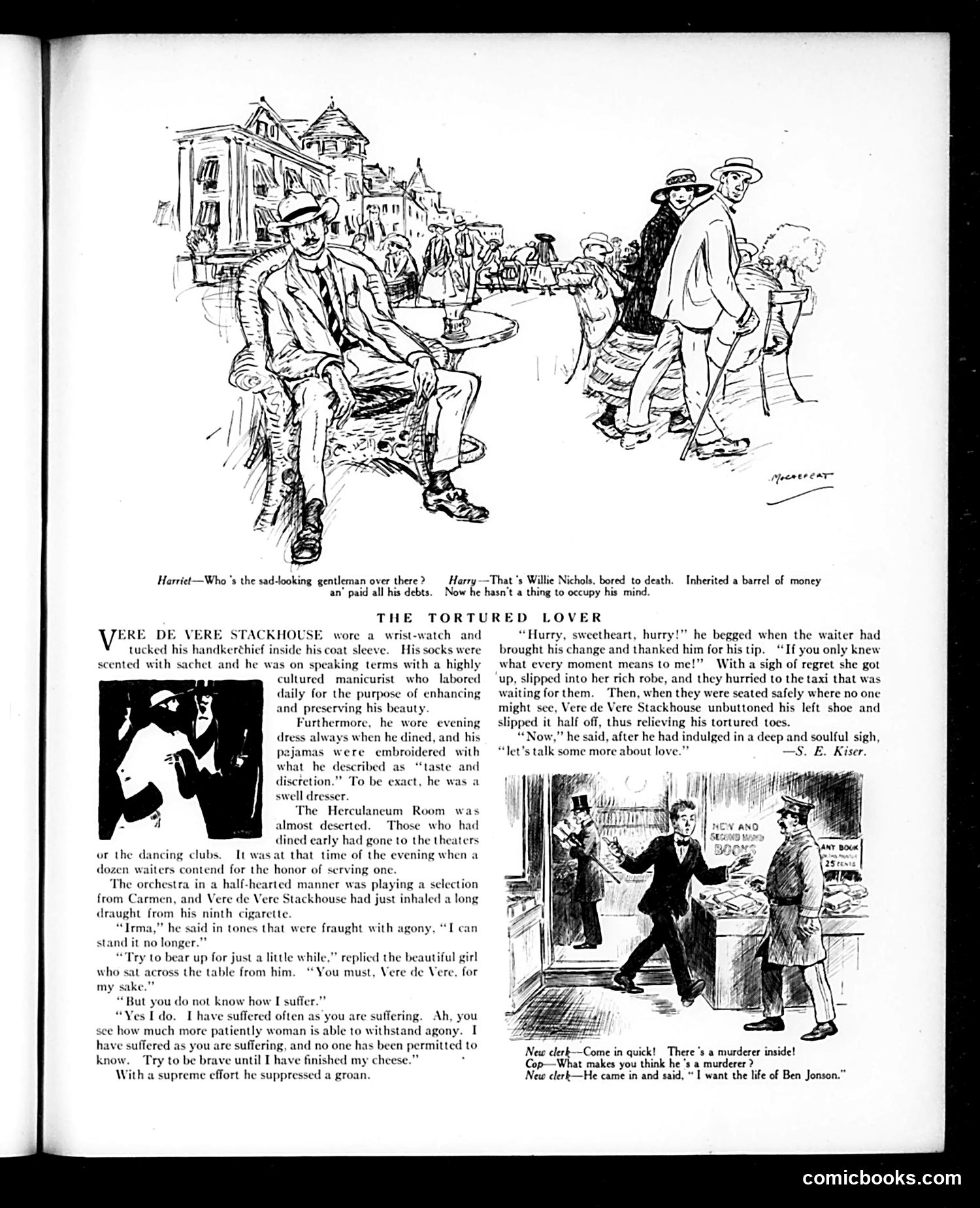
This page contains two separate satirical pieces from *Judge* magazine: **Top Cartoon**: A man inherits wealth but becomes bored because paying his debts eliminates his purpose. The joke mocks idle rich people—their suffering stems from *lack* of problems, not genuine hardship. **"The Tortured Lover" Story**: A dandy named Vere de Vere Stackhouse obsesses over fashion and appearance while on a date. His dramatic suffering—complaining he "cannot bear it"—is revealed as trivial: his tight shoe causes him discomfort. The satire targets affected, vain men who perform exaggerated emotional anguish over minor physical discomforts while their patient female companion listens sympathetically about "love." **Bottom Cartoon**: A clerk misunderstands a customer asking for "the life of Ben Jonson" (a biography of the famous playwright) as a request to kill someone, calling police. The joke plays on homophone confusion and the clerk's panic. Both pieces mock male vanity, pretension, and overblown emotional displays—typical *Judge* targets of the era.
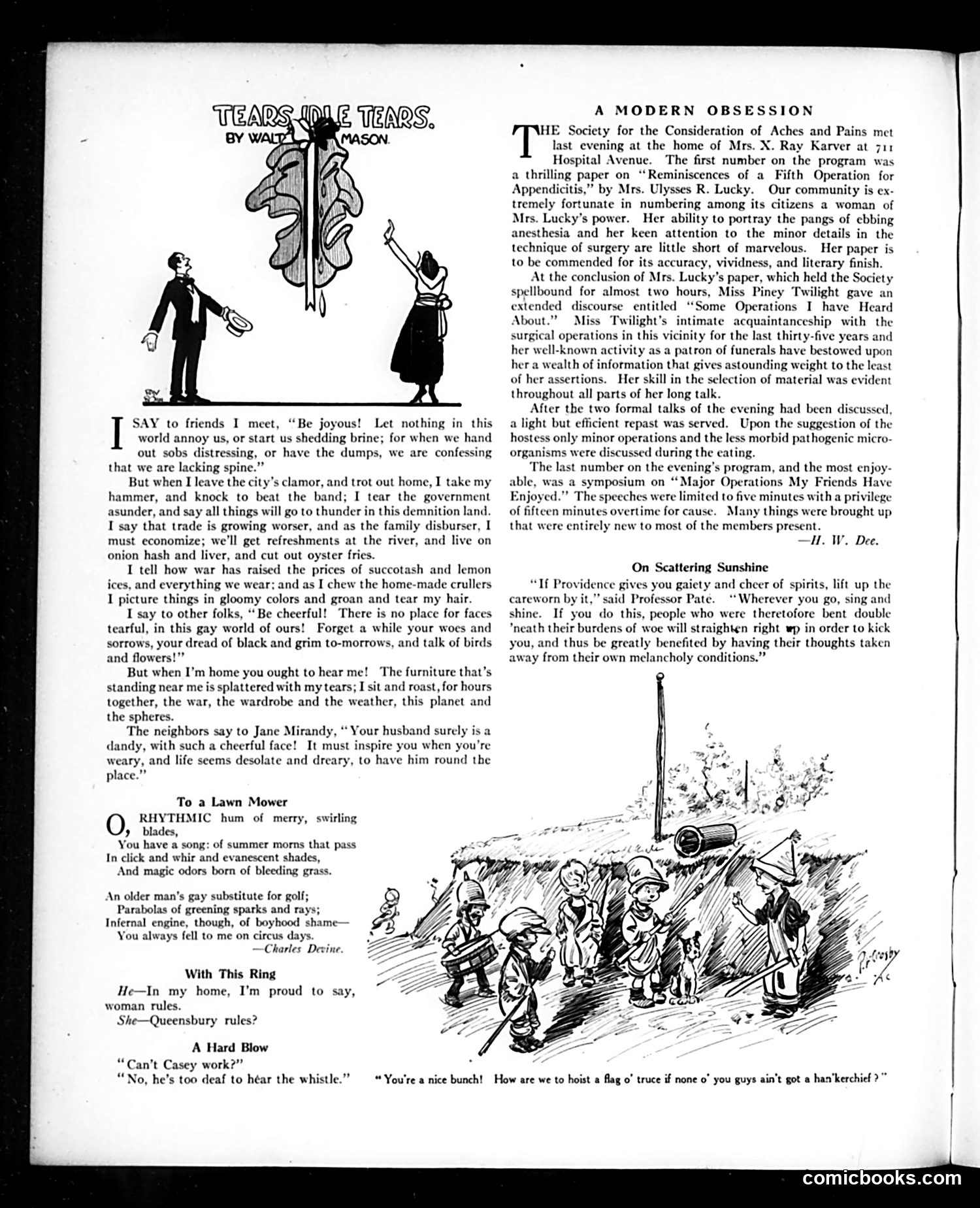
This page combines several satirical pieces mocking early 20th-century American social anxieties and affectations. **"Tears of Tears"** (top left cartoon): A man complains publicly about cheerfulness while privately wallowing in despair at home—satirizing hypocritical social performance and the gap between public persona and private behavior. **"A Modern Obsession"** (main article): Mocks upper-middle-class women's obsessive discussion of medical procedures and ailments. The Society meeting features Mrs. "X. Ray Karver" and Miss "Piney Twilight" discussing appendix operations and surgical gossip with exaggerated solemnity. The satire targets both medical narcissism and women's tendency to bond through discussing health complaints—a common period stereotype. **Minor poems**: "To a Lawn Mower" romanticizes yard work; "With This Ring" jokes about marital power dynamics (Queensbury Rules being boxing regulations); "A Hard Blow" references someone named Casey being deaf. The overall theme: mocking self-indulgent middle-class preoccupations—false cheerfulness, medical obsession, and domestic drama.
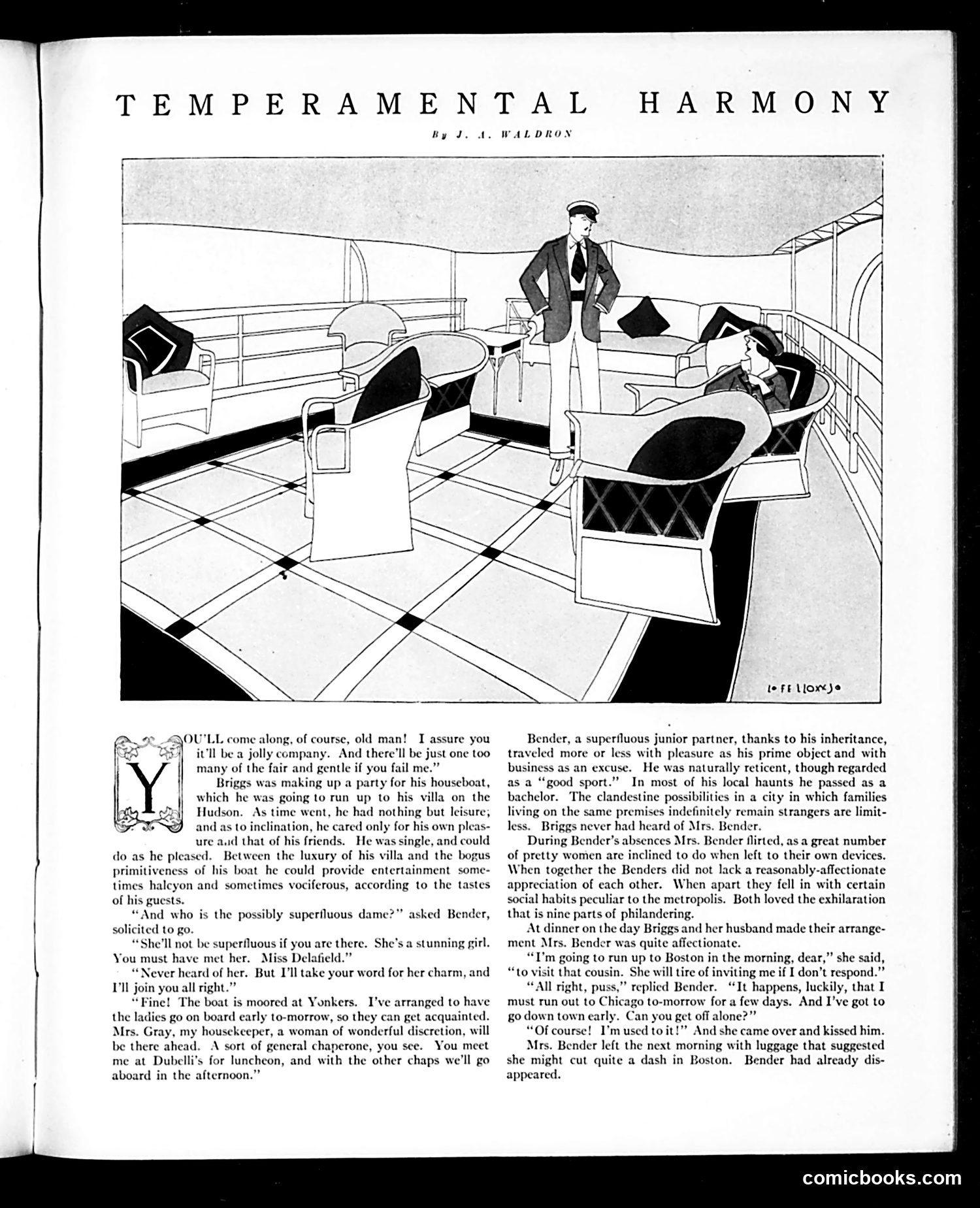
This is a domestic comedy story illustrated with a modernist interior design aesthetic. The narrative concerns Bender, a wealthy but unfaithful married man whose wife is equally inclined to infidelity. When Bender invites a mysterious woman (Miss Delafield) on a houseboat party up the Hudson River, he tells his friend he's arranged for Mrs. Gray (a housekeeper) to serve as "chaperone"—a thin cover for impropriety. The satire targets the hypocrisy and compartmentalization of upper-class urban life circa 1920s: the Benders maintain a facade of respectability and affection while openly pursuing separate pleasures. The "temperamental harmony" of the title is ironic—their marriage functions through mutual, unspoken tolerance of infidelity rather than genuine devotion. Both conveniently disappear on the same day under false pretenses (Boston, Chicago), suggesting they're equally unfaithful. The story mocks the era's wealthy leisure class and their elaborate social deceptions.
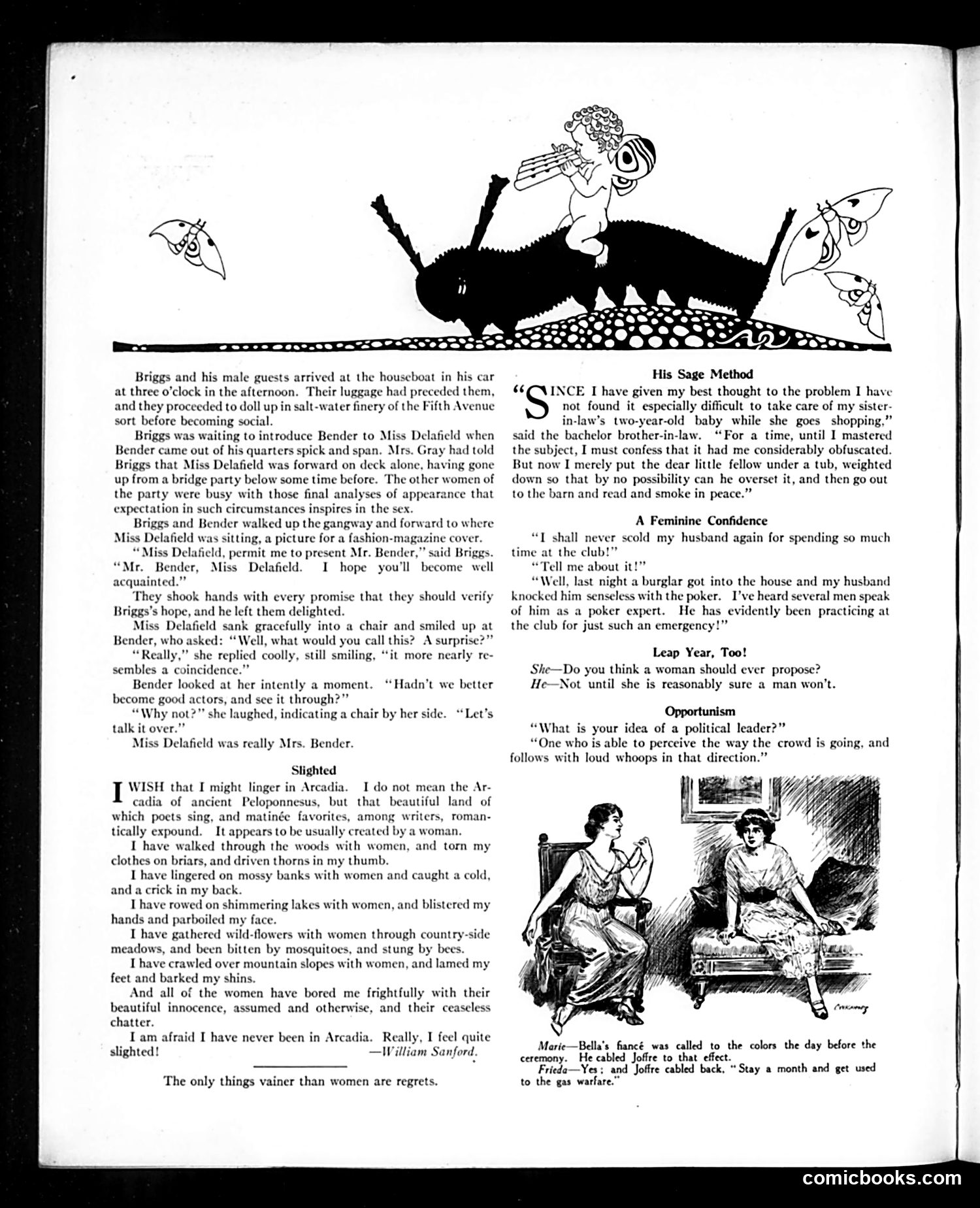
This page contains multiple satirical pieces targeting early 20th-century gender dynamics and social attitudes: **Main narrative** ("His Sage Method"): A bachelor describes childcare as simply placing a toddler under a weighted tub while he relaxes—absurd and negligent by design, satirizing men's casual incompetence with domestic responsibilities. **"Slighted"** (left column): A monologue by William Sanford complaining that pastoral romance (Arcadia) created by women always bores him, despite women's efforts to create "beautiful" outdoor experiences. The satire targets male ingratitude and dismissiveness toward women's attempts at romance. **Other shorts** mock female behavior: women's vanity, the propriety debate over women proposing ("Leap Year"), and a wife praising her husband's "poker practice" at the club—when he actually knocked out a burglar. This likely satirizes wives' naive acceptance of husbands' excuses. **Political joke**: A leader simply follows crowd direction loudly—mocking populist politicians lacking principles. The overall tone is cynical about both genders, though primarily satirizing male selfishness and female naiveté.
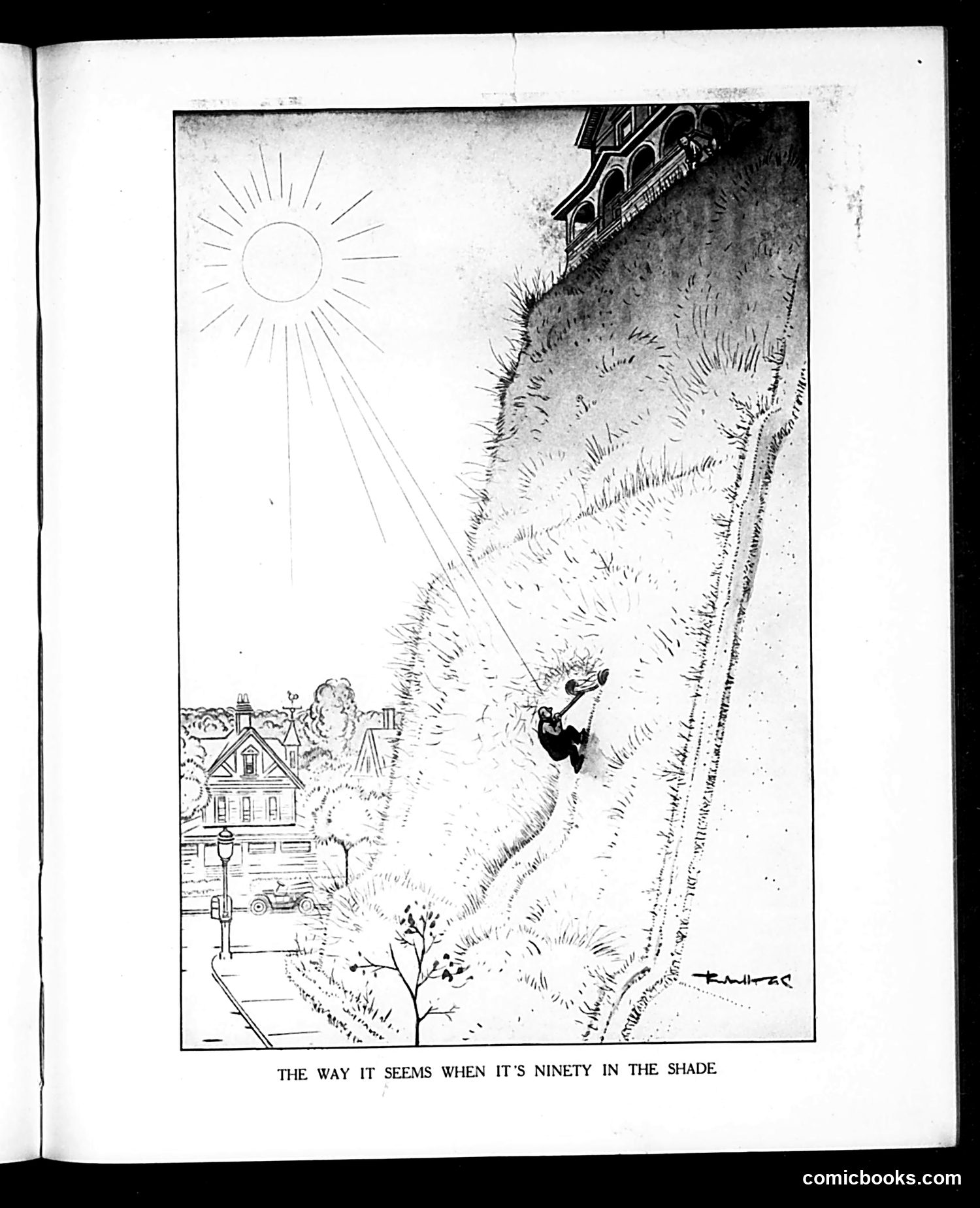
This cartoon illustrates the subjective experience of extreme heat. On the left, a modest suburban scene shows a house, car, and street lamp in normal proportions. On the right, the same landscape appears dramatically distorted—a steep hillside looms impossibly large, and a small figure struggles to climb it, appearing tiny against the exaggerated terrain. The joke plays on how unbearable heat warps perception: ordinary surroundings feel monumental and exhausting when it's extremely hot. What's normally manageable becomes an arduous mountain to climb. The "ninety degrees" (Fahrenheit) reference dates this to early-to-mid 20th century America, when such temperatures were considered dangerously hot. The cartoon humorously captures the universal experience of heat-induced fatigue and despair.
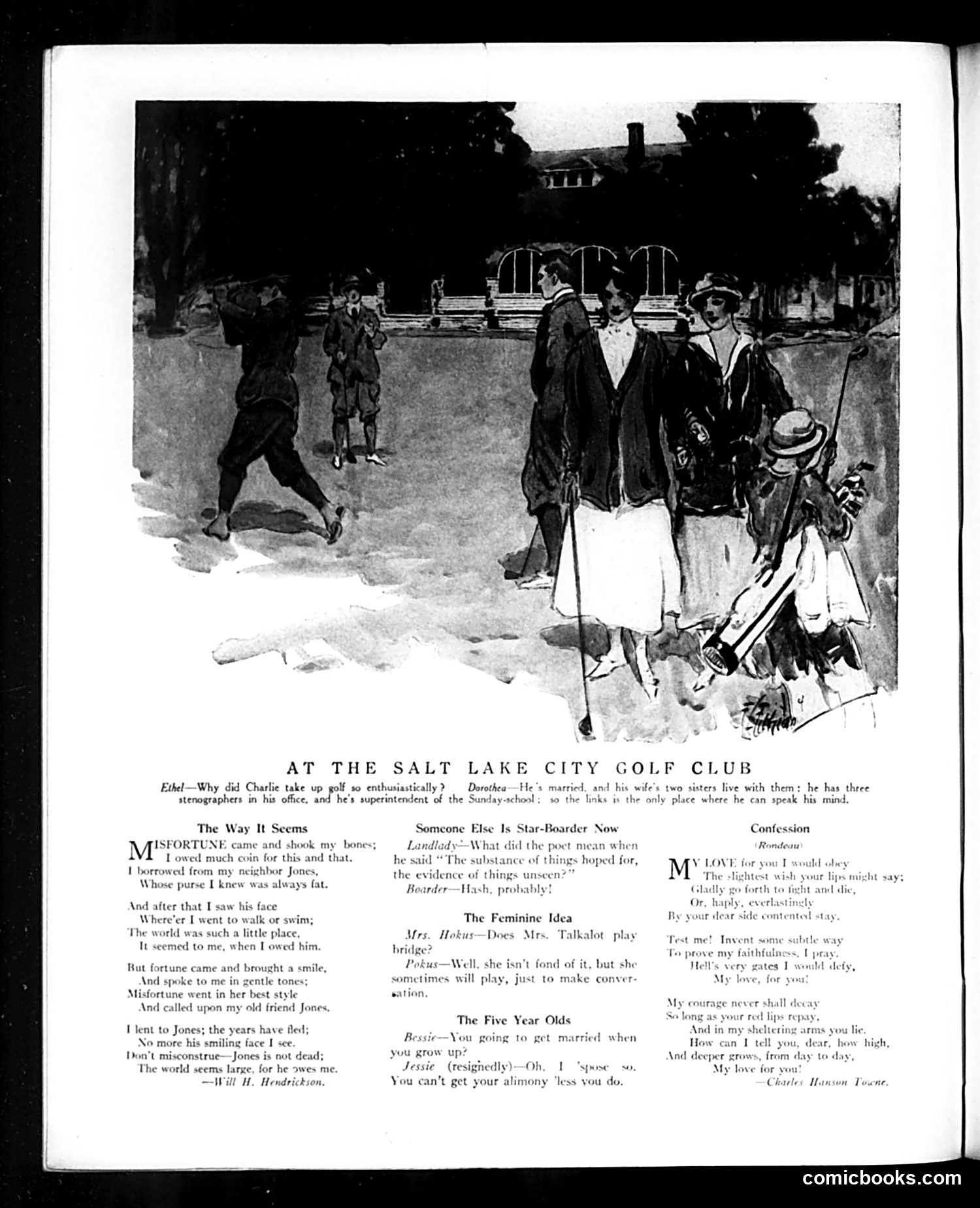
This page from *Judge* magazine contains several short humorous pieces satirizing early 20th-century American domestic and social life. The top illustration shows golfers at Salt Lake City's golf club. The accompanying caption jokes that a man named Charlie took up golf enthusiastically because it's the only place he can "speak his mind"—his home is crowded with his wife's two sisters, three stenographers from his office, and Sunday school responsibilities. The satire targets the loss of male domestic authority and privacy in modern life. The text pieces below mock various social pretenses: a man avoiding a creditor he owes money to; a woman who plays bridge only for conversation; and children discussing marriage and alimony. The overall theme suggests anxiety about changing gender roles, financial obligations, and the erosion of male independence—common satirical targets in early 20th-century American humor magazines aimed at middle-class readers.
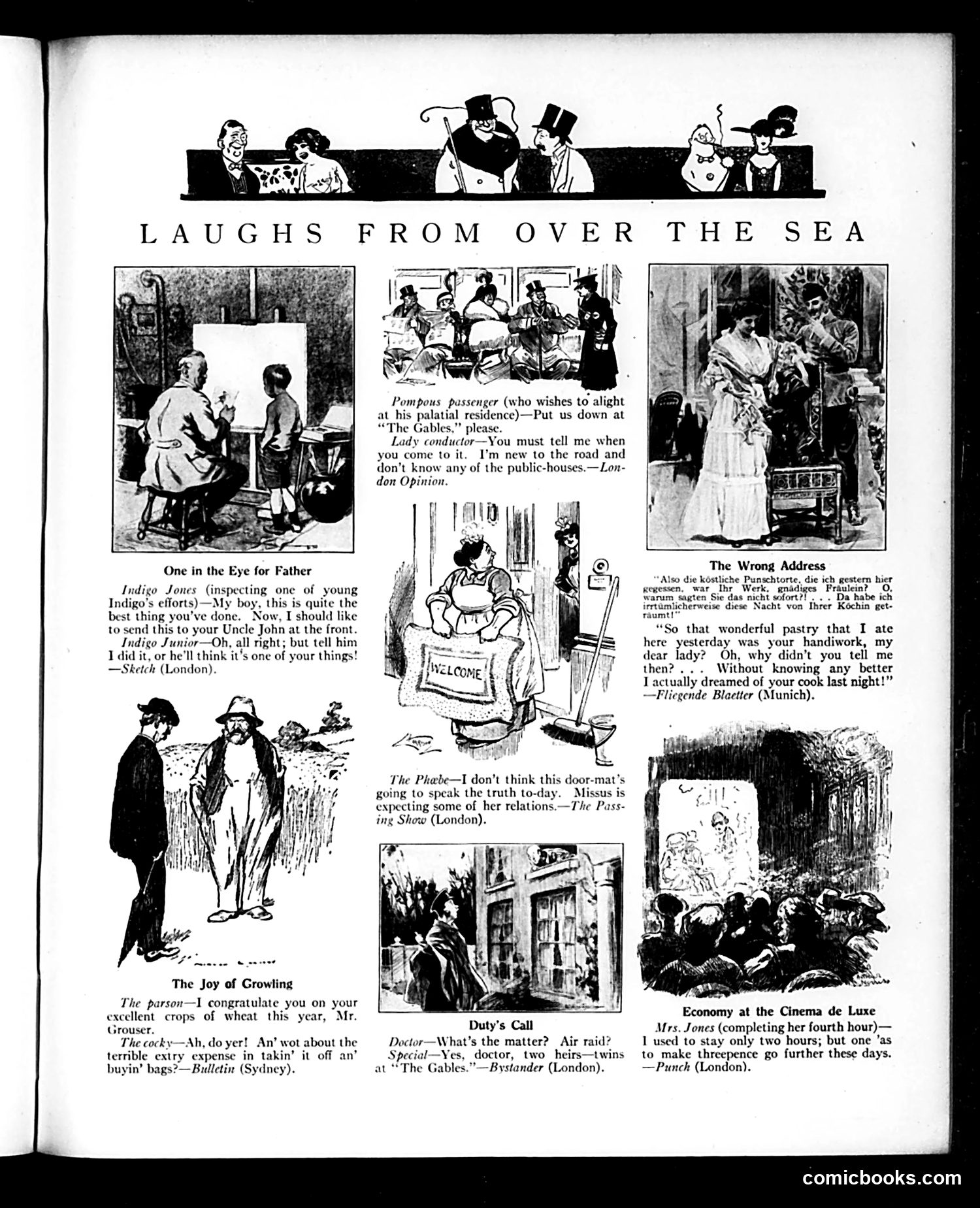
This page collects humorous anecdotes from international publications (London, Sydney, Munich, etc.), each illustrating social absurdities of the era. **Notable cartoons:** - "One in the Eye for Father": A boy takes credit for artwork to mock his father's inferior work, with a jab at absent WWI soldiers. - "The Joy of Growling": A clergyman congratulates a farmer on wheat crops while the farmer complains about expenses—satirizing perpetual grouchiness. - "The Wrong Address": A German gentleman dreams of a servant after complimenting her pastry—the humor lies in misplaced romantic thoughts. - "Economy at the Cinema de Luxe": A woman stretches cinema visits to four hours to maximize value during post-war economic hardship. The unifying theme is wartime and post-war economic strain, social pretension, and human folly across different countries—typical Judge magazine fare of the 1920s era.
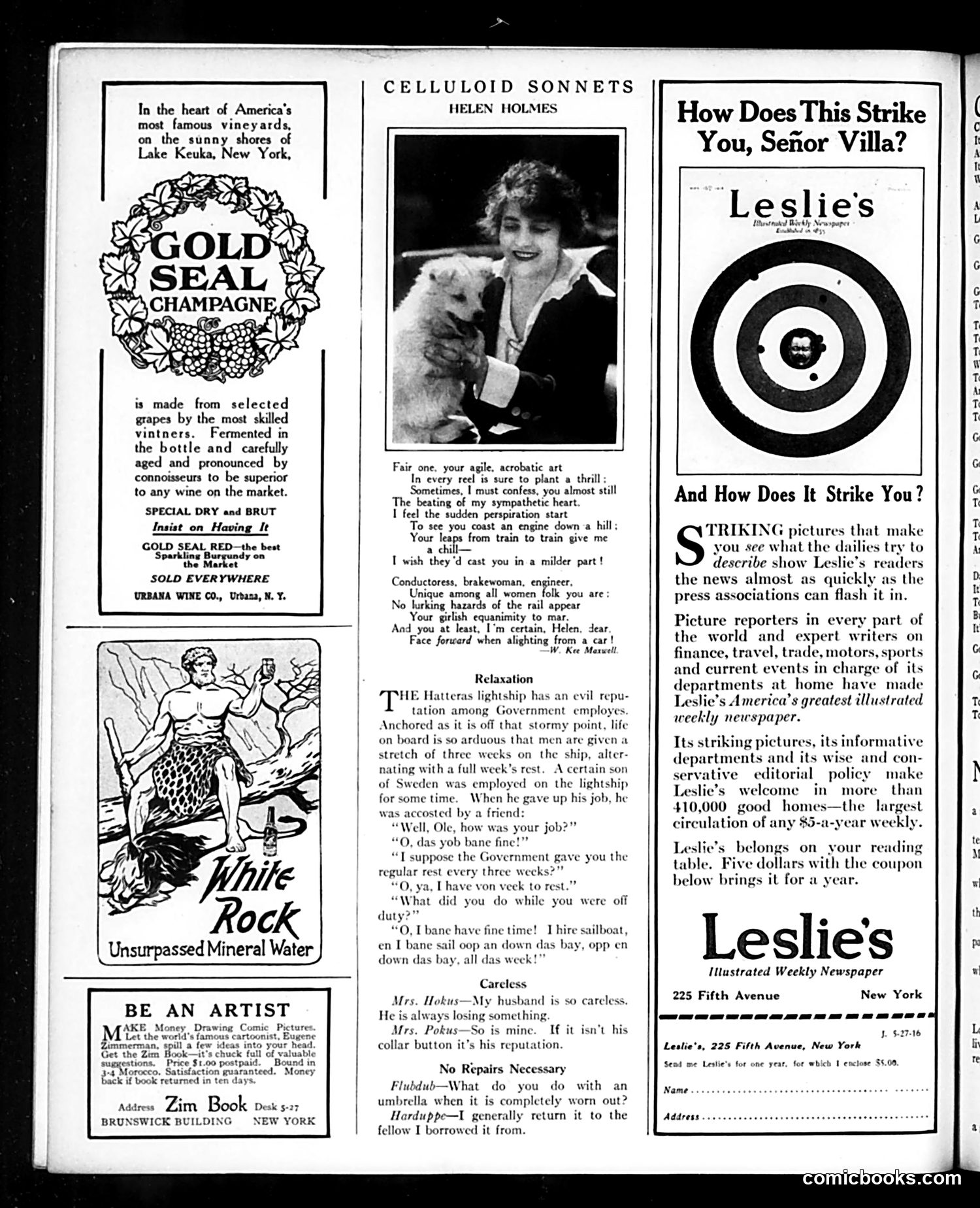
This page is primarily **advertising and light humor**, not political satire. The main content includes: **"Celluloid Sonnets"** by Helen Holmes: A romantic poem praising actress Helen Holmes for her daring film stunts (train scenes, etc.). This references the silent film era when stunt work by actresses was genuinely dangerous and noteworthy. **Three brief jokes**: "Relaxation" features a Swedish immigrant (indicated by dialect) working on a lighthouse ship who enjoys his shore leave sailing. "Careless" and "No Repairs Necessary" are standard domestic humor about husbands losing things and borrowing umbrellas—timeless jokes. **The "Senor Villa" headline** appears disconnected from the Leslie's magazine advertisement below it, possibly referencing Pancho Villa (Mexican revolutionary), though its relevance here is unclear. The page is dominated by **product advertisements** (Gold Seal Champagne, White Rock water, Leslie's Weekly magazine, and art instruction) typical of Judge magazine's revenue model. The humor is gentle, not satirical.
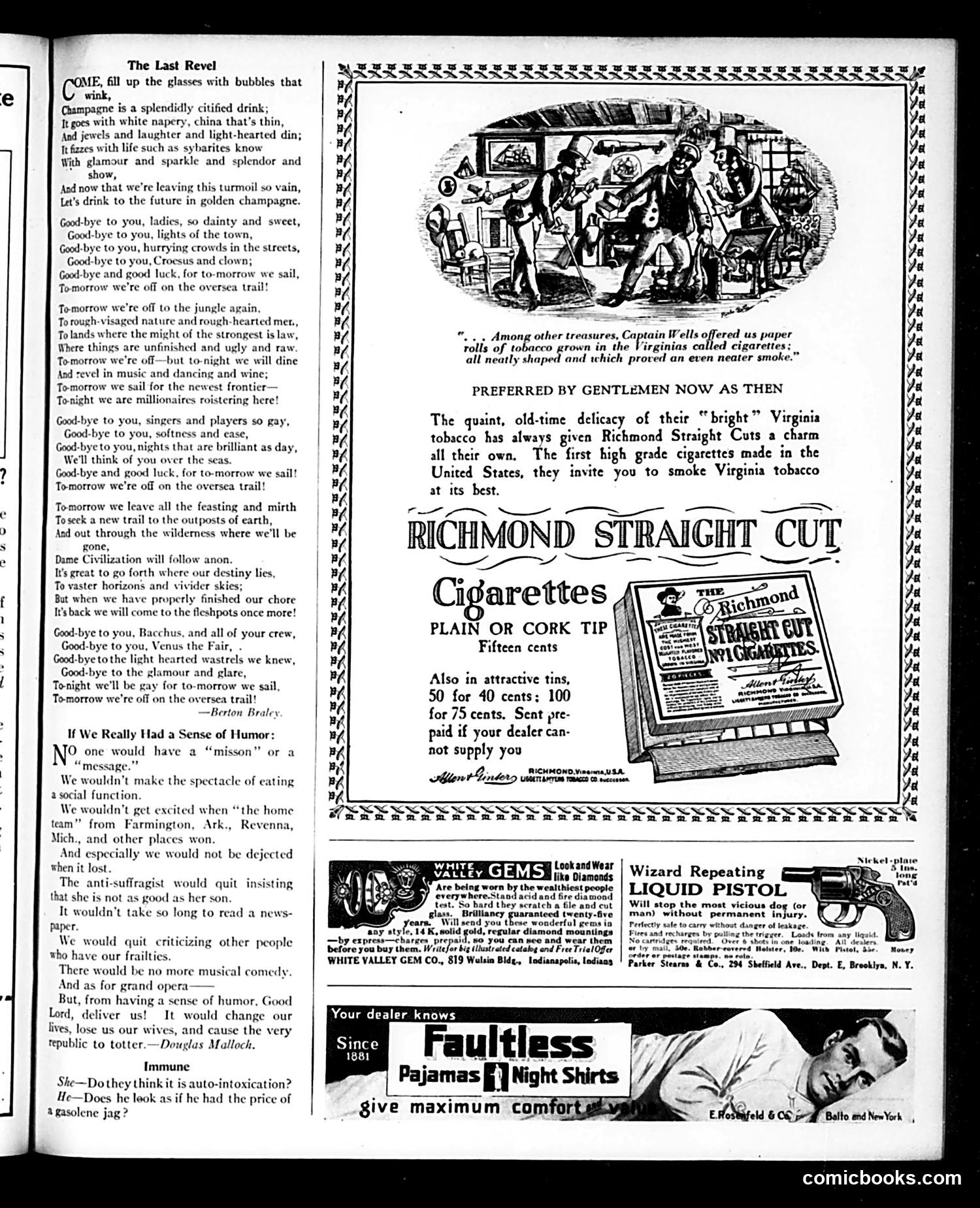
This page contains **poetry and advertisements** rather than political cartoons. **"The Last Revel"** (by Berton Braley) is a poem celebrating the departure of civilization-builders—likely soldiers, colonists, or explorers—who toast their final night of luxury before heading to frontier/colonial outposts. The satire lies in the contrast: they bid farewell to champagne, music, and urban refinement while ironically calling themselves "millionaires" for one night, knowing they'll return to "fleshpots" (pleasures) once their work is done. It's romanticizing imperial/colonial expansion as noble sacrifice. **"If We Really Had a Sense of Humor"** mocks American society's lack of humor about class divisions (suffrage debates), sports loyalty, and pretentious dining customs. The advertisements showcase **Richmond Straight Cut Cigarettes**, **White Valley Gem diamonds** (synthetic), a **Wizard Repeating Liquid Pistol**, and **Faultless Pajamas**—typical early 20th-century luxury goods marketed to affluent readers. The Colonial-era tobacco advertisement (top right) appears to reference Sir Walter Raleigh introducing Virginia tobacco to England.
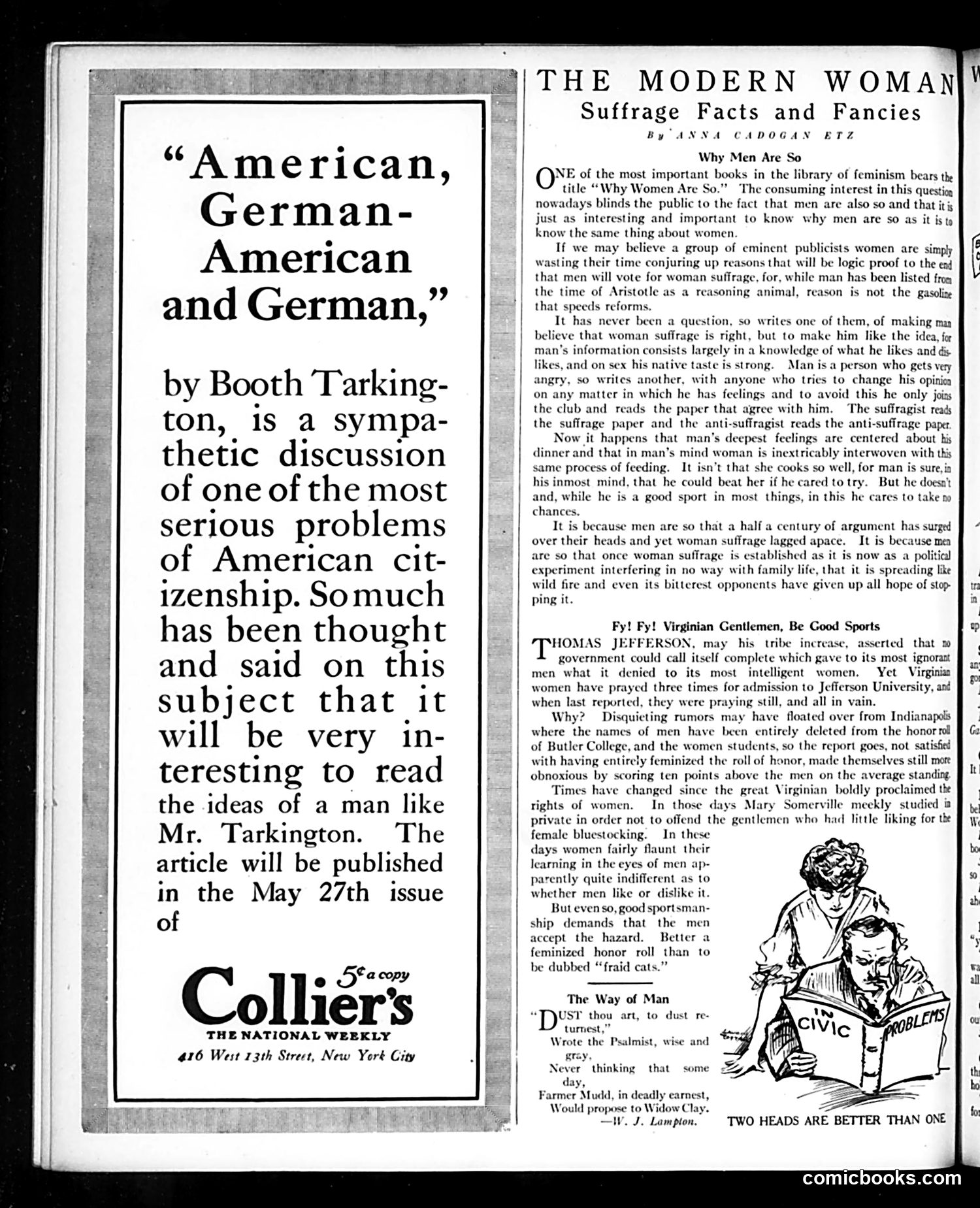
This page from Judge satirizes the women's suffrage debate through an anti-suffrage lens. The main article, "The Modern Woman: Suffrage Facts and Fancies" by Anna Cadogan Ettz, argues that women waste effort on logical arguments for voting rights because men are fundamentally irrational creatures—driven by emotion, habit, and particularly their attachment to food and dining. The piece mocks suffragists' expectations that reason will persuade men, claiming men's "native taste is strong" and they resist changing opinions on matters involving feelings. It sarcastically notes that women's educational achievements (mentioned: women at Butler College outscoring men academically) prove futile—men simply won't care. The accompanying cartoon ("Two Heads Are Better Than One") depicts a man reading a newspaper labeled "CIVIC PROBLEMS," appearing overwhelmed or befuddled, reinforcing the article's satirical portrayal of male incompetence in addressing social issues. The overall satire appears to be *anti-suffrage* propaganda disguised as sympathetic analysis—suggesting women's efforts are doomed because men are too stubborn and irrational to recognize women's equality.
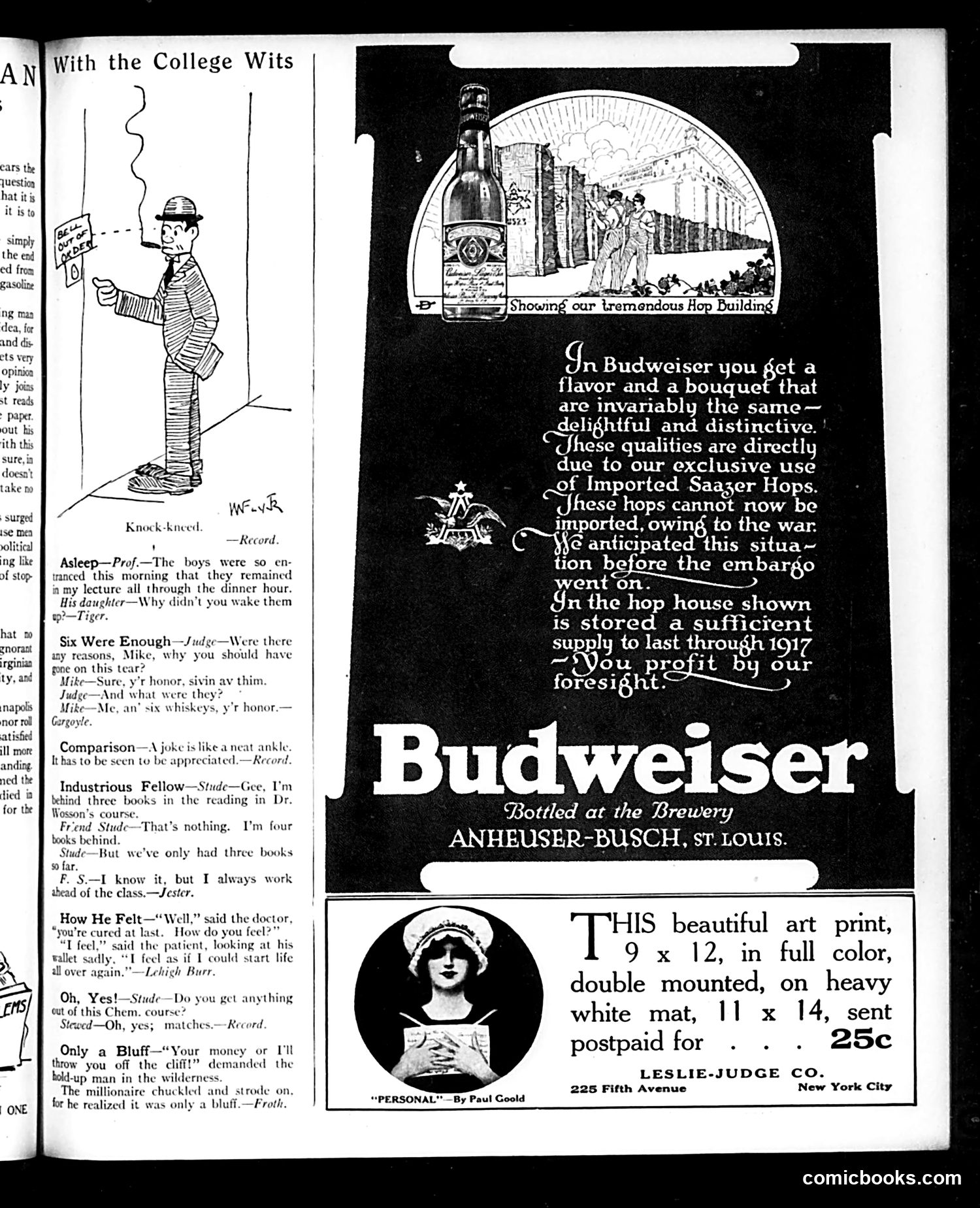
This page contains primarily **college humor jokes** ("With the College Wits") and a **Budweiser advertisement**. The left column features brief comedic exchanges between professors and students about classroom behavior, academic performance, and a mugging scenario—typical lighthearted college humor of the era. The dominant right side is a **WWI-era beer advertisement** addressing a serious economic concern. Budweiser explains that imported Saaz hops—essential to their product's quality—can no longer be imported due to the war embargo (likely WWI). The ad claims the brewery wisely stockpiled sufficient hops "before the embargo went on" to supply through 1917, positioning foresight as a selling point. This advertisement reflects genuine wartime anxiety about supply chains and shortages, while attempting to reassure consumers that Budweiser remains available. The patriotic framing of "foresight" subtly connects brand loyalty to preparedness during national crisis.
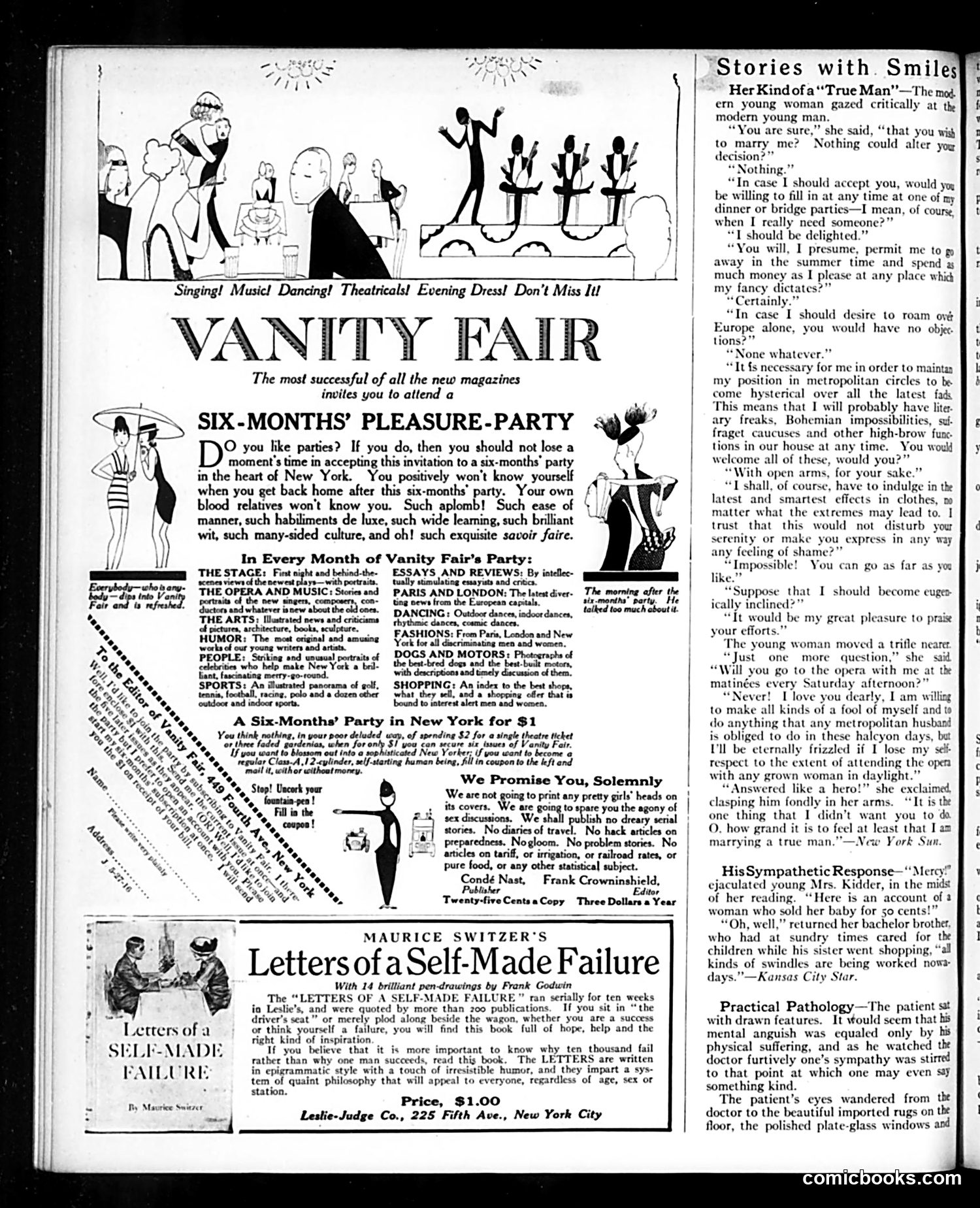
This page is primarily **advertising for Vanity Fair magazine**, using satirical humor typical of Judge's style. **The Main Content:** The top cartoon mocks high-society pretension—showing people singing, dancing, and dressing formally with exaggerated poses, captioned "Singing! Music! Dancing! Theatrical! Evening Dress! Don't Miss It!" **The Vanity Fair Advertisement:** Vanity Fair pitches a "six-months' pleasure-party in the heart of New York," promising readers will acquire such sophistication ("savoir faire," impeccable manners, culture) that even their own relatives won't recognize them. The satire lies in selling *cultural aspiration*—the implicit joke being that people will pay for the *illusion* of sophistication. **The Promise:** Each issue covers theater, opera, fashion, society gossip, sports, and humor—all markers of upper-class leisure and taste. The price ($1 for six months) is positioned as a bargain compared to theater tickets. **Bottom Section:** Advertisement for "Letters of a Self-Made Failure" by Maurice Switzer—a book of humorous essays promising inspiration to both failures and successes. The satire targets early-20th-century aspirational consumption and the magazine industry's marketing of social status.
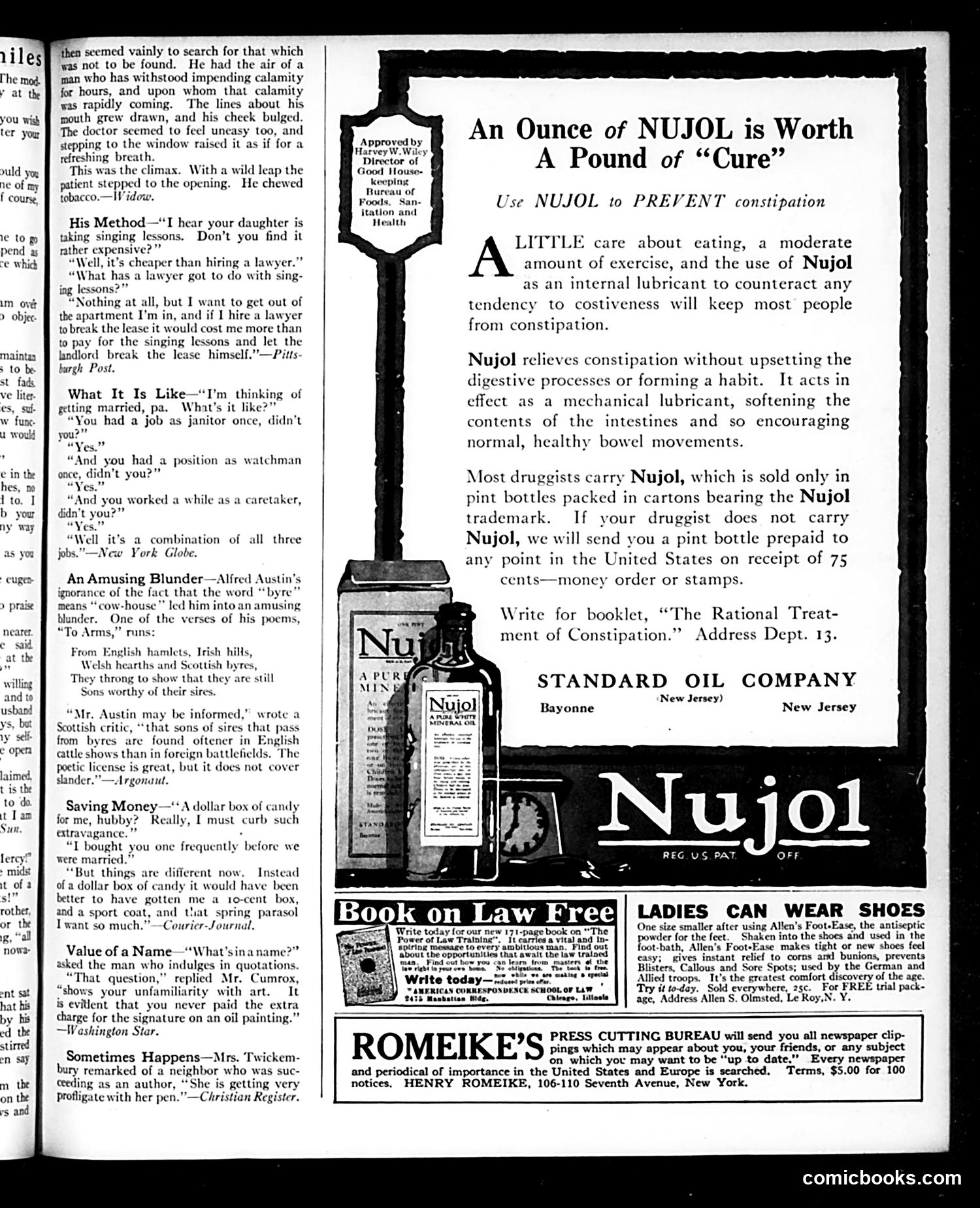
This is primarily a **magazine page mixing humor and advertising**—typical of early 20th-century Judge magazine. The left side contains humorous anecdotes: one describes a doctor's shock when a patient chewing tobacco spits from a window; another mocks expensive singing lessons as a cheaper alternative to hiring a lawyer to break a lease; a third plays on the word "byre" (cattle shed), where Scottish critic Alfred Austin mistakenly used it in patriotic war poetry, earning ridicule. The right side is dominated by a **Nujol advertisement**—a laxative product marketed as constipation prevention. The ad promises it acts as a mechanical intestinal lubricant without forming a habit, positioning it as preventative health care rather than emergency medicine. Below appear smaller ads for a law school book, Allen's Foot-Ease (foot powder), and a newspaper clipping service. The satire and advertising coexist without irony—both common editorial content then.
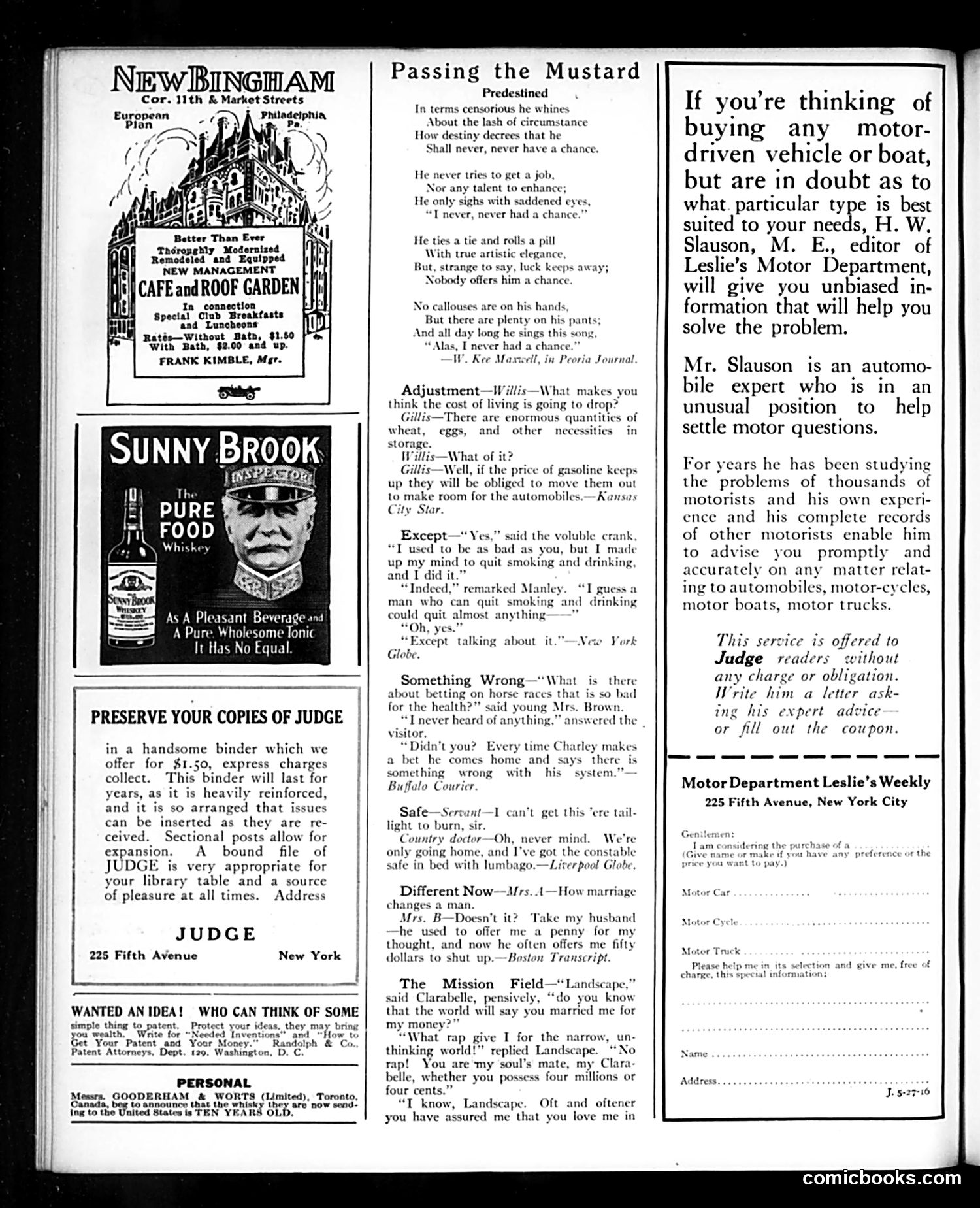
This page is primarily **advertisements and filler content** rather than political satire. The main elements include: **Advertisements**: Hotel (New Bingham), whiskey (Sunny Brook), Judge magazine binders, patent services, and motor vehicle advice. **"Passing the Mustard" section**: Contains several short humorous anecdotes and jokes typical of early 20th-century magazines: - A poem about a pessimistic man who blames "destiny" rather than trying - Brief jokes about rising gasoline prices, quitting smoking, horse racing, and marriage **Motor Department**: Leslie's Weekly offers H.W. Slausen's free expert advice on purchasing vehicles/boats without bias—positioning him as an authority for motorist readers. **No major political cartoons or caricatures appear here.** The content reflects early automotive-age concerns (fuel costs, vehicle choice) and period humor conventions (domestic comedy, character types). This is essentially a **magazine filler page** mixing advertising with lightweight entertainment.
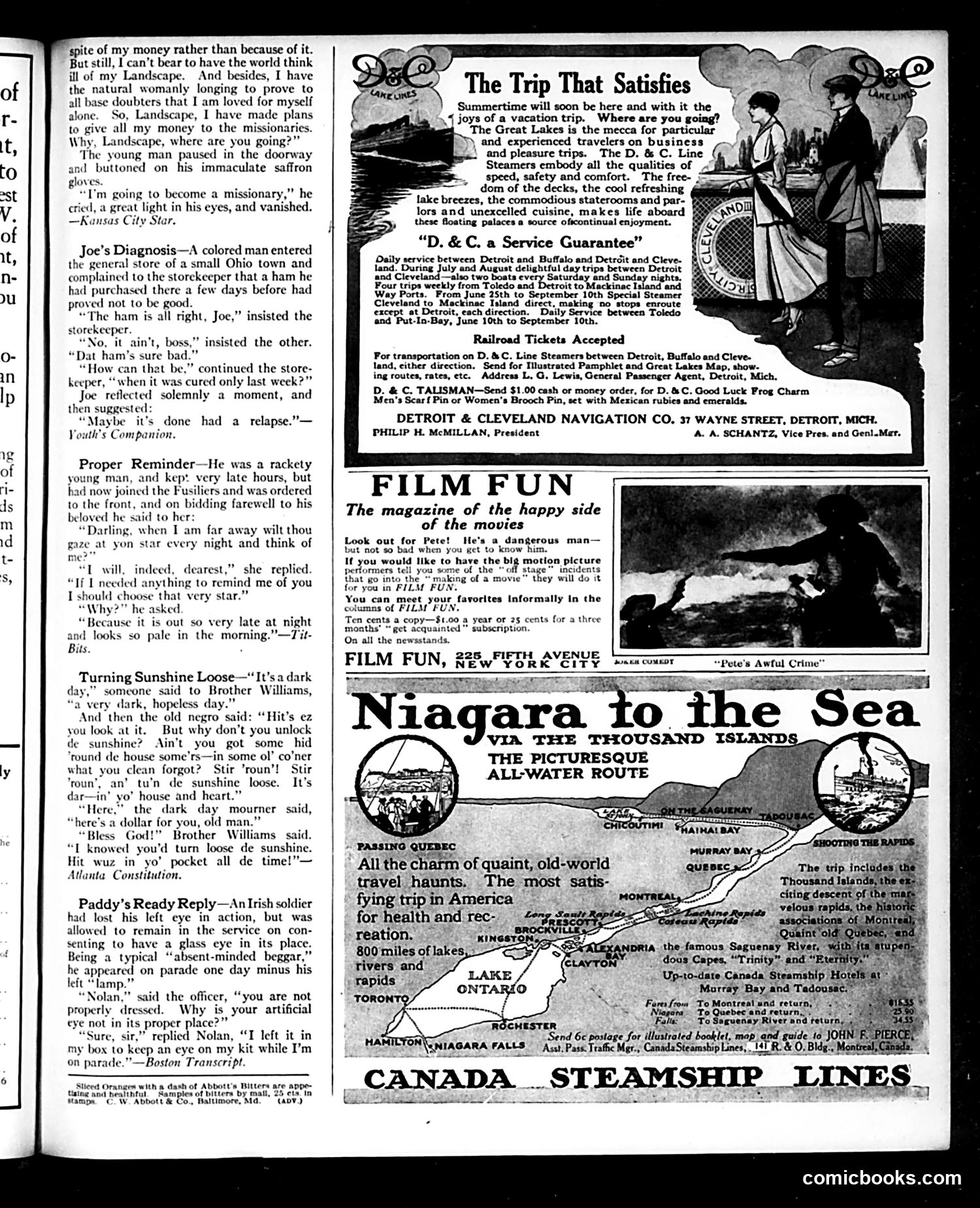
This page is primarily **advertising and light humor**, not political satire. The content includes: **Short Humorous Anecdotes:** - "Joe's Diagnosis": A racial stereotype joke where a Black man suggests a ham has had a "relapse" after being cured - "Proper Reminder": A joke about a soldier's fiancée choosing to remember him by a star because it's "out so very late" and "looks so pale" - "Turning Sunshine Loose": Features "Brother Williams," an elderly Black man offering wisdom about finding joy despite hardship - "Paddy's Ready Reply": An Irish soldier explains leaving his glass eye behind to "keep an eye on my kit" **Commercial Content:** The page is dominated by tourism advertising—steamship lines promoting Great Lakes vacations and a Niagara Falls/Thousand Islands route. These represent the era's leisure travel marketing. **Historical Context:** The racial humor reflects early 20th-century Judge magazine's casual, now-offensive ethnic stereotyping. The travel ads target middle-class Americans with discretionary income for vacation.
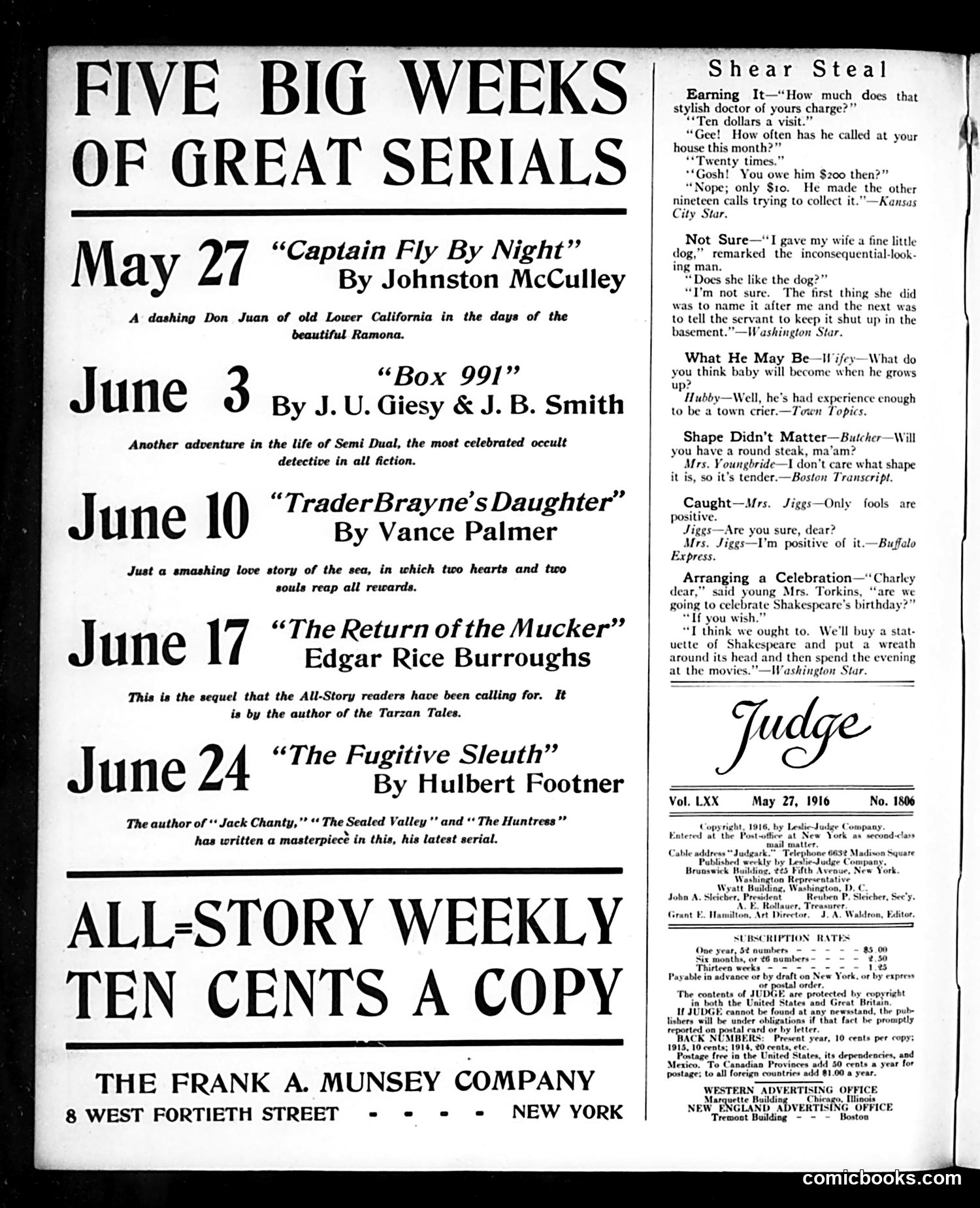
This is primarily an **advertising/content page** for Judge's companion publication, *All-Story Weekly*, rather than a satirical cartoon page. The left side promotes five serialized fiction stories running that May-June, featuring popular adventure and detective narratives of the era—including Edgar Rice Burroughs' "The Return of the Mucker" (sequel to Tarzan tales). The right side contains **brief humor anecdotes** typical of early-20th-century magazine filler: - "Shear Steal": A doctor joke about inflated medical bills - "Not Sure": A husband's joke about naming a dog after himself - Marriage/domestic humor involving the Jiggs family (references to a popular contemporary comic strip) - Gentle spousal disagreements and wordplay These short jokes trade in common period stereotypes: doctors as money-grabbers, wives as difficult, and husbands as long-suffering. The humor is mild and domestic rather than political. The page essentially functions as a promotional/miscellaneous content section rather than editorial satire.
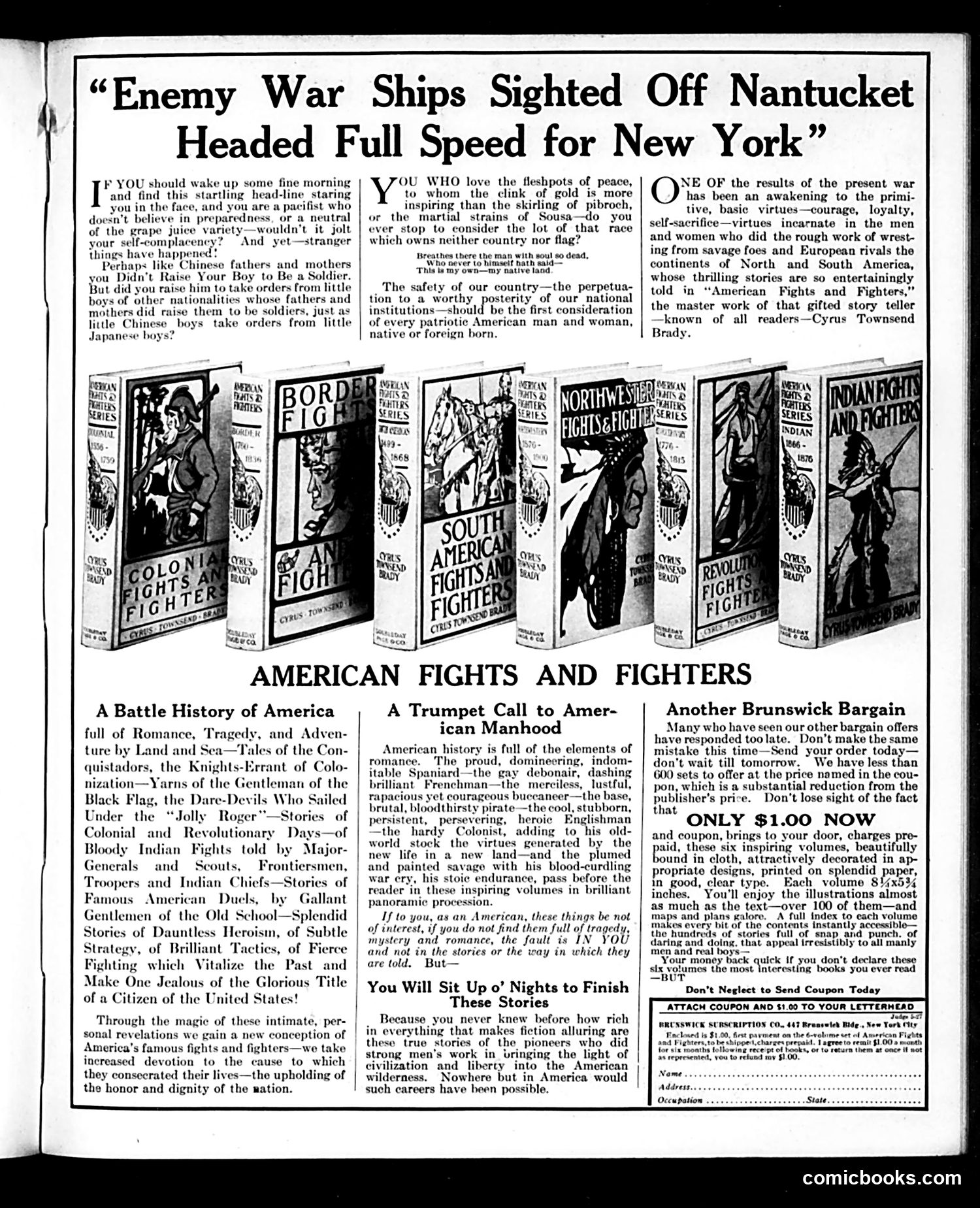
This page is primarily **advertising** for a book series called "American Fights and Fighters" by Cyrus Townsend Brady, disguised as editorial content. The header references a WWI-era war scare (enemy ships near Nantucket headed toward New York), which sets up the advertising pitch: Americans should read these patriotic histories to understand their nation's martial heritage and strengthen their commitment to national defense. The satirical opening mocks pacifists and anti-war sentiment ("you are a pacifist who doesn't believe in preparedness"), sarcastically asking whether they'd raise their sons to be soldiers. This reflects **real WWI-era debates** over American military preparedness and intervention. The lengthy marketing copy romanticizes American history—colonial conquest, naval battles, Indian wars—as noble adventures worth emulating. The repeated emphasis on "courage, loyalty, self-sacrifice" appeals to contemporary anxieties about national strength during wartime. Essentially: **propaganda advertising disguised as patriotic editorializing**, using current events anxiety to sell historical narratives.
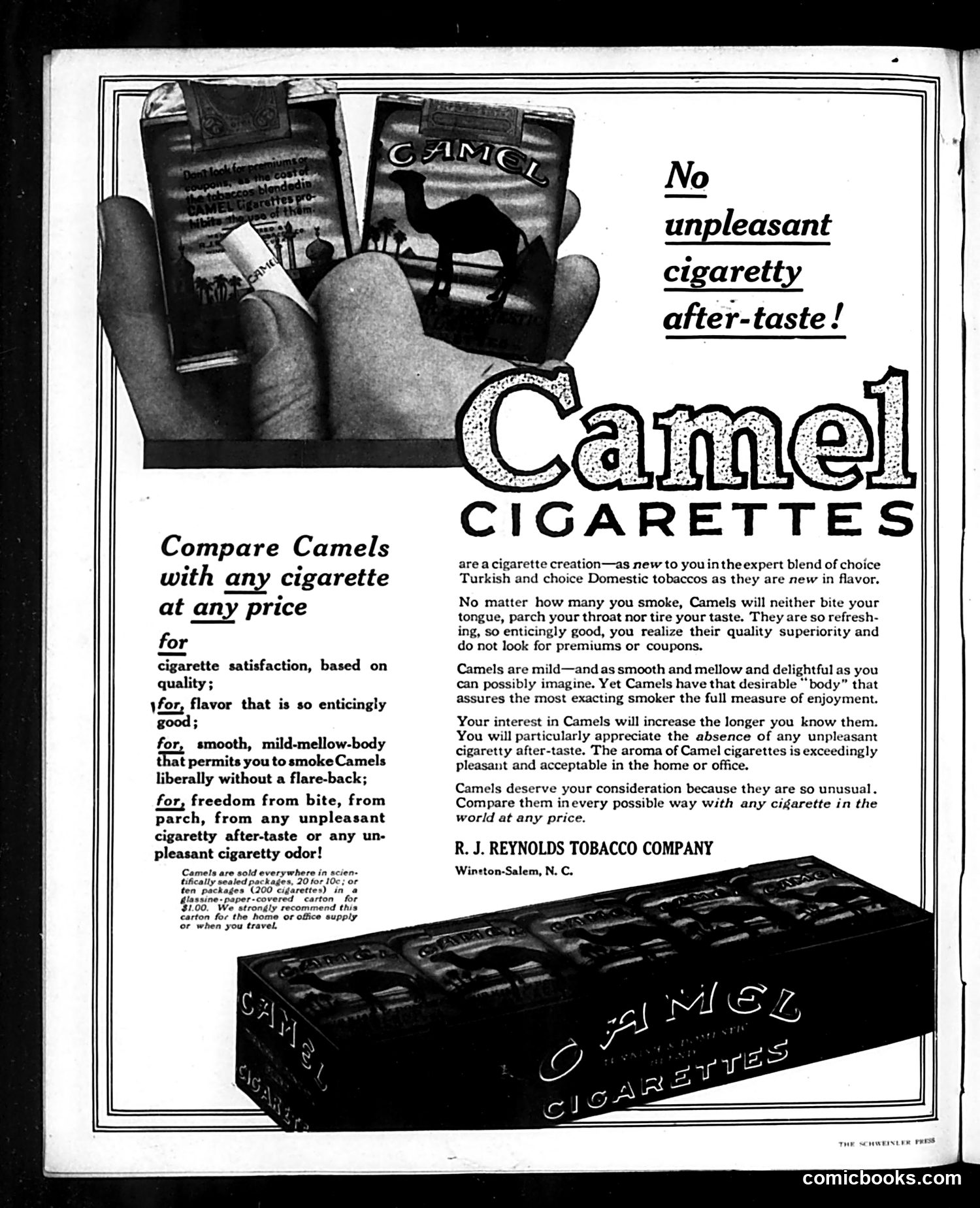
This is primarily a **Camel cigarette advertisement**, not political satire. Appearing in *Judge* magazine (a satirical publication), the ad uses the magazine's space for commercial promotion rather than editorial content. The ad features hands holding two Camel cigarette packs and emphasizes the product's purported benefits: no unpleasant aftertaste, smooth flavor, and mild body. The copy repeatedly contrasts Camels favorably against unnamed competitors "at any price." **For modern readers**: This illustrates how differently cigarettes were marketed in the early-to-mid 20th century. Health claims ("won't bite your tongue," "won't parch your throat") were standard advertising language—claims that would be illegal today. The emphasis on quality and absence of negative effects reflects an era when tobacco companies could make broad health-adjacent assertions without scientific evidence or regulatory restriction. The ad's placement in a humor magazine shows cigarette advertising's ubiquity across all media types.