
Judge, 1916-05-27 · page 2 of 28
Judge — May 27, 1916 — page 2: what you’re looking at
What you’re looking at
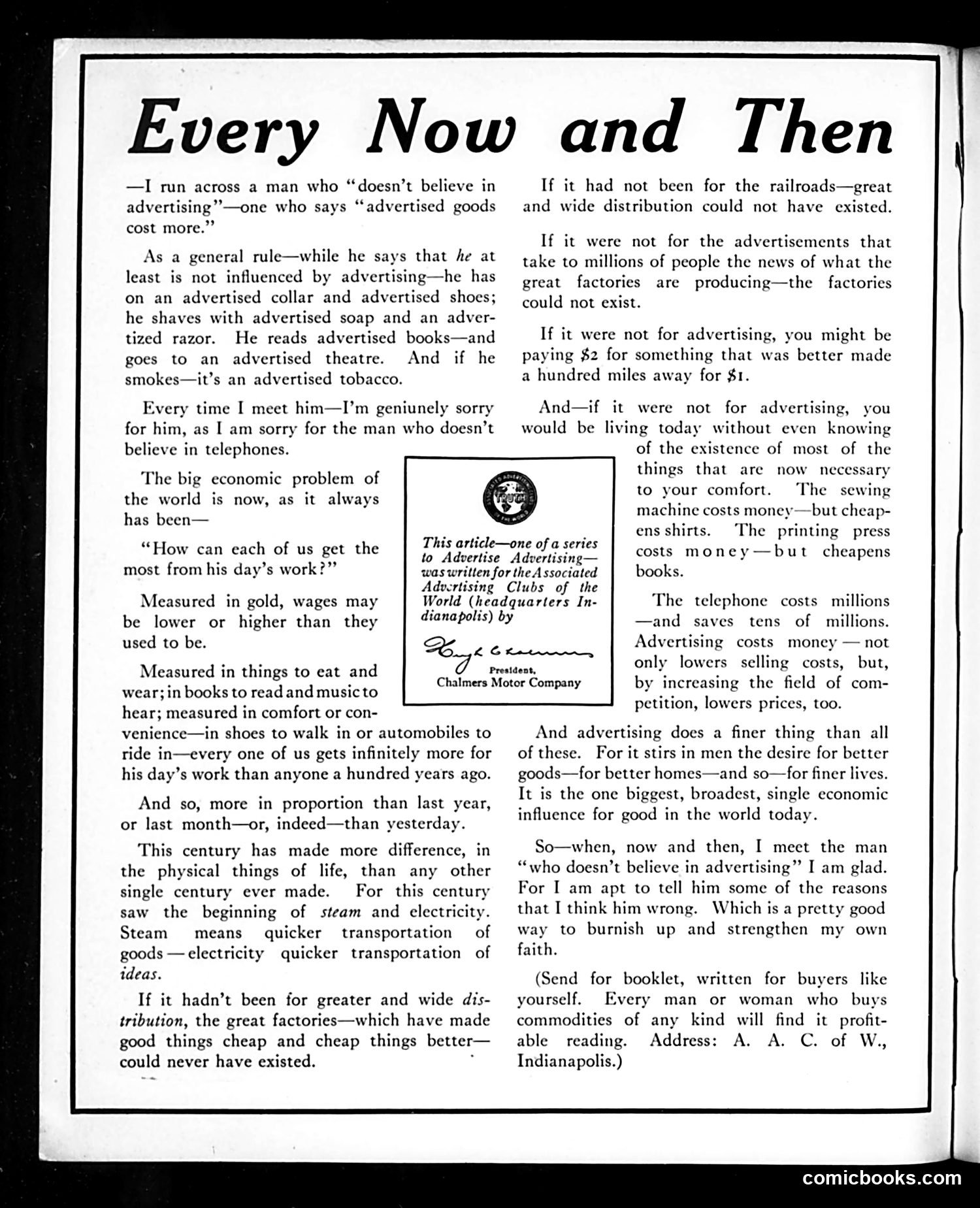
This appears to be a pro-advertising editorial essay from *Judge* magazine, not a cartoon. The piece argues that skeptics of advertising are mistaken about its economic value. The author contends that advertising: - Enables mass distribution, making goods cheaper - Spreads information about factory innovations - Reduces costs through competition - Improves living standards by creating desire for better products The "man who doesn't believe in advertising" is a rhetorical figure representing common skepticism. The author dismisses this skeptic as illogical—comparing him to someone who "doesn't believe in telephones." The text emphasizes advertising as a fundamental economic force of the modern century, alongside steam and electricity, essential for industrial progress and consumer welfare.
📄 Transcribed text from this page (OCR, searchable)
Machine-transcribed from the original scan — historical spelling and the odd misread are preserved.
Every Now and Then —I run across a man who “doesn’t believe in advertising’”-—one who says “‘advertised goods cost more.” As a general rule—while he says that he at least is not influenced by advertising—he has on an advertised collar and advertised shoes; he shaves with advertised soap and an adver- tized razor. He reads advertised books—and goes to an advertised theatre. And if he smokes—it’s an advertised tobacco. Every time I meet him—I’m geniunely sorry for him, as I am sorry for the man who doesn’t believe in telephones. The big economic problem of the world is now, as it always has been— “How can each of us get the most from his day’s work?” Measured in gold, wages may be lower or higher than they used to be. Measured in things to eat and wear; in books to read and music to hear; measured in comfort or con- venience—in shoes to walk in or automobiles to ride in—every one of us gets infinitely more for his day’s work than anyone a hundred years ago. And so, more in proportion than last year, or last month—or, indeed—than yesterday. This century has made more difference, in the physical things of life, than any other single century ever made. For this century saw the beginning of steam and electricity. Steam means quicker transportation of goods —electricity quicker transportation of ideas. If it hadn’t been for greater and wide dis- tribution, the great factories—which have made good things cheap and cheap things better— could never have existed. . This article—one of a series to Advertise Advertising— was written for the Associated Advertising Clubs of the World (headquarters In- dianapolis) by a President, Chalmers Motor Company If it had not been for the railroads—great and wide distribution could not have existed. If it were not for the advertisements that take to millions of people the news of what the great factories are producing—the factories could not exist. If it were not for advertising, you might be paying $2 for something that was better made a hundred miles away for $1. And—if it were not for advertising, you would be living today without even knowing of the existence of most of the things that are now necessary to your comfort. The sewing machine costs money—but cheap- ens shirts. The printing press costs money—but cheapens books. The telephone costs millions —and saves tens of millions. Advertising costs money — not only lowers selling costs, but, by increasing the field of com- petition, lowers prices, too. And advertising does a finer thing than all of these. For it stirs in men the desire for better goods—for better homes—and so—for finer lives. It is the one biggest, broadest, single economic influence for good in the world today. So—when, now and then, I meet the man “who doesn’t believe in advertising” I am glad. For I am apt to tell him some of the reasons that I think him wrong. Which is a pretty good way to burnish up and strengthen my own faith. (Send for booklet, written for buyers like yourself. Every man or woman who buys commodities of any kind will find it profit- able reading. Address: A. A. C. of W., Indianapolis.) comicbooks.com