
Judge, 1916-05-27 · page 13 of 28
Judge — May 27, 1916 — page 13: what you’re looking at
What you’re looking at
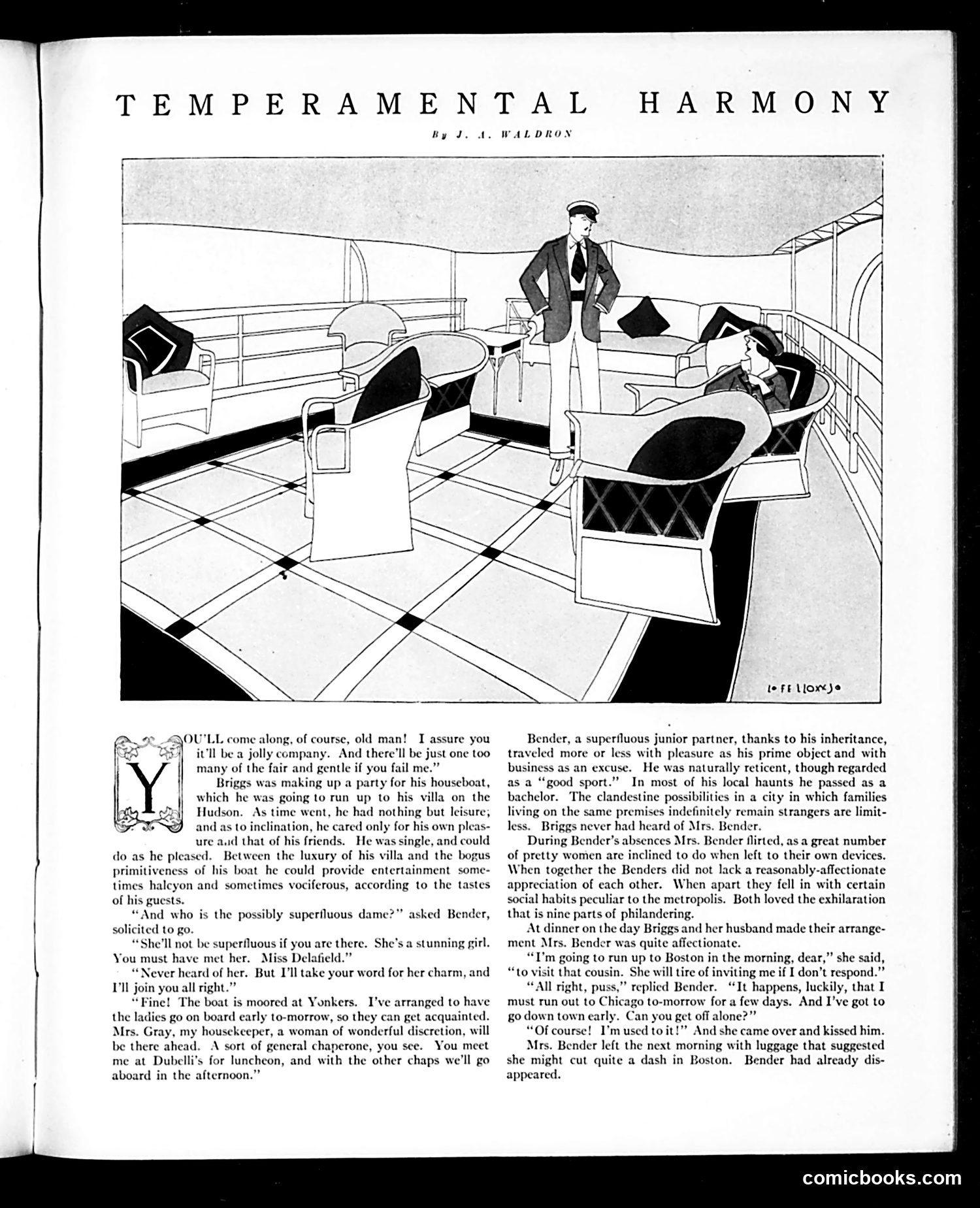
This is a domestic comedy story illustrated with a modernist interior design aesthetic. The narrative concerns Bender, a wealthy but unfaithful married man whose wife is equally inclined to infidelity. When Bender invites a mysterious woman (Miss Delafield) on a houseboat party up the Hudson River, he tells his friend he's arranged for Mrs. Gray (a housekeeper) to serve as "chaperone"—a thin cover for impropriety. The satire targets the hypocrisy and compartmentalization of upper-class urban life circa 1920s: the Benders maintain a facade of respectability and affection while openly pursuing separate pleasures. The "temperamental harmony" of the title is ironic—their marriage functions through mutual, unspoken tolerance of infidelity rather than genuine devotion. Both conveniently disappear on the same day under false pretenses (Boston, Chicago), suggesting they're equally unfaithful. The story mocks the era's wealthy leisure class and their elaborate social deceptions.
📄 Transcribed text from this page (OCR, searchable)
Machine-transcribed from the original scan — historical spelling and the odd misread are preserved.
TEMPERAMENTAL By J. A. HARMONY WALDRON le FE Lloxje IU'LL come along, of course, old man! I assure you it'll be a jolly company. And there'll be just one too many of the fair and gentle if you fail me.” Briggs was making up a party for his houseboat, which he was going to run up to his villa on the Hudson. time went, he had nothing but leisure; and as to inclination, he cared only for his own pleas- ure aud that of his friends. He was single, and could ‘ased. Between the luxury of his villa and the bogus of his boat he could provide entertainment some- yon and sometimes vociferous, according to the tastes “And who is the possibly superfluous dame?” asked Bender, solicited to go. “She'll not be superfluous if you are there. You must have met her. Miss Delafield.” “Never heard of her. But I’ll take your word for her charm, and you all right.” is moored at Yonkers. I've arranged to have rly to-morrow, so they can get acquainted. Mrs. Gray, my housekeeper, a woman of wonderful discretion, will be there ahead. A sort of general chaperone, you see. You meet me at Dubelli’s for luncheon, and with the other chaps we'll go aboard in the afternoon.” stunning girl. Bender, a superfluous junior partner, thanks to his inheritance, traveled more or less with pleasure as his prime object and with business as an excuse. He was naturally reticent, though regarded as a “‘good sport.”” In most of his local haunts he passed as a bachelor. The clandestine possibilities in a city in which families living on the same premises indefinitely remain strangers are limit- less. Briggs never had heard of Mrs. Bender. During Bender’s absences Mrs. Bender flirted, as a great number of pretty women are inclined to do when left to their own devices. When together the Benders did not lack a reasonably-affectionate appreciation of each other. When apart they fell in with certain social habits peculiar to the metropolis. Both loved the exhilaration that is nine parts of philandering. At dinner on the day Briggs and her husband made their arrange- ment Mrs. Bender was quite affectionate. “I’m going to run up to Boston in the morning, dear,” she said, “to visit that cousin. She will tire of inviting me if I don’t respond.” “All right, puss,” replied Bender. “It happens, luckily, that I must run out to Chicago to-morrow for a few days. And I’ve got to go down town early. Can you get off alone?” “Of course! I’m used to it!” And she came over and kissed him. Mrs. Bender left the next morning with luggage that suggested she might cut quite a dash in Boston. Bender had already dis- appeared. comicbooks.com