
A complete issue · 28 pages · 1916
Judge — May 20, 1916
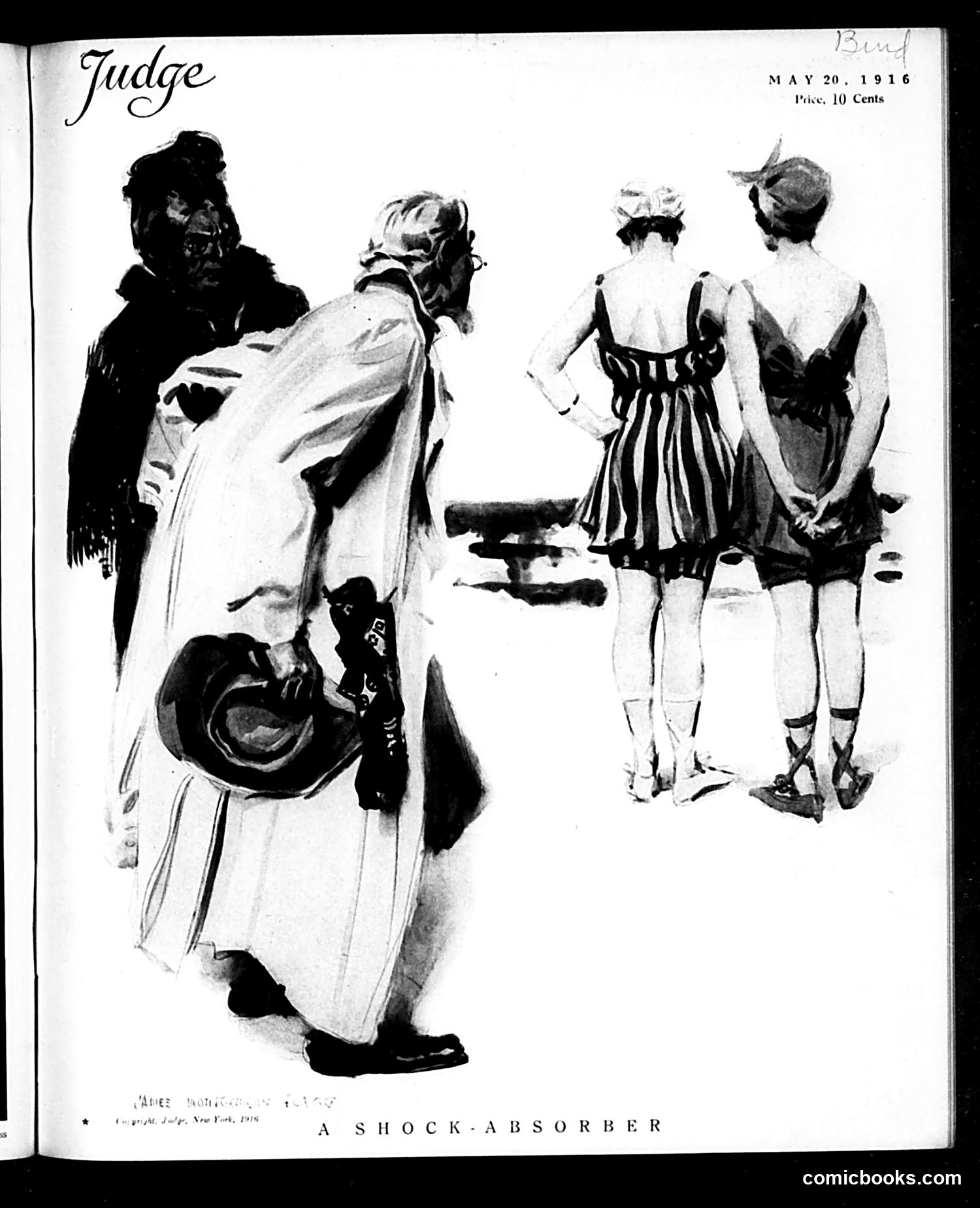
This cartoon satirizes women's fashion and social behavior. On the left, a shocked elderly woman (drawn with exaggerated features suggesting she's meant to represent conservative attitudes) reacts in horror to two young women on the right wearing short, striped bathing suits—scandalous attire for 1916. The title "A Shock-Absorber" is a pun: the young women's casual acceptance of revealing swimwear "absorbs" or neutralizes the elderly woman's scandalized reaction. The cartoon mocks generational conflict over changing fashion standards, particularly women's increasing willingness to expose legs and arms in public. It captures early-20th-century anxiety about shifting social morality and female liberation from Victorian dress codes.
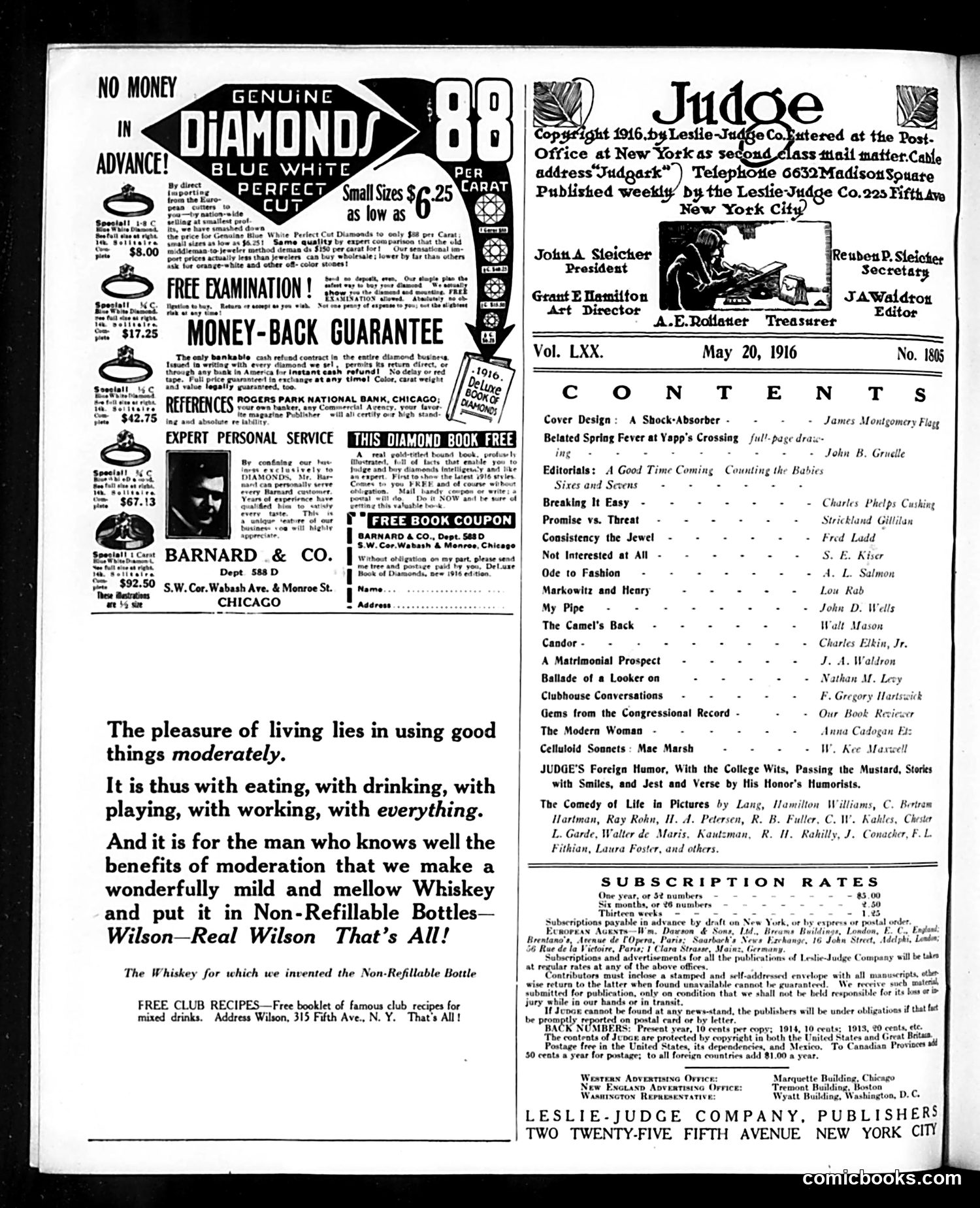
This page is primarily **advertising and editorial masthead** rather than political cartoon content. The left side features a lengthy advertisement for "Genuine Diamonds" by Barnard & Co., emphasizing their "money-back guarantee" and competitive pricing ($6.25 per carat for small sizes). Below is a Wilson whiskey advertisement promoting "moderation" and "Non-Refillable Bottles." The right side displays the magazine's masthead and table of contents for Vol. LXX, No. 1885. Notable articles include pieces on fashion, women's issues, and humor columns. The subscription rates and advertising office information appear at the bottom. The content reflects 1916 American commercial culture and Judge's satirical focus on contemporary social topics.
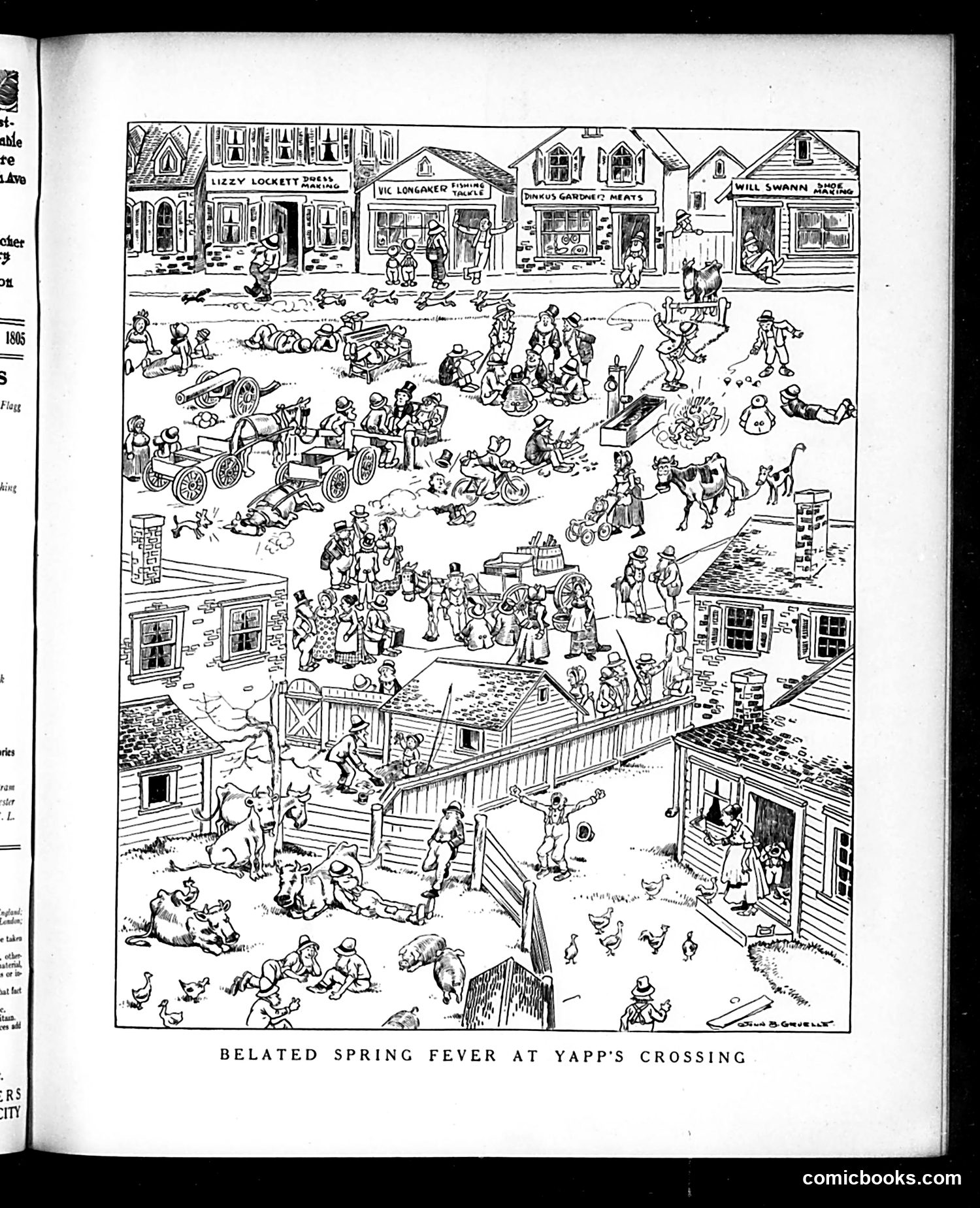
This satirical illustration depicts a chaotic rural or small-town scene titled "Belated Spring Fever at Yapp's Crossing." The cartoon shows numerous townspeople engaged in various recreational activities—playing, socializing, and generally causing disorder in the streets. Visible storefronts include "Lizzy Lockett Dress," "Vic Loncaker's," "Darius Gardener's Meats," and "Will Swann's Shoe" shop. The satire appears to mock the sudden arrival of spring weather causing townspeople to abandon their usual routines and decorum, creating general pandemonium. "Spring fever"—the traditional restlessness associated with warmer weather—is presented as an affliction that causes widespread social disruption at this particular crossing, suggesting both the irrepressible human impulse toward leisure and the comic disorder it creates in an orderly community.
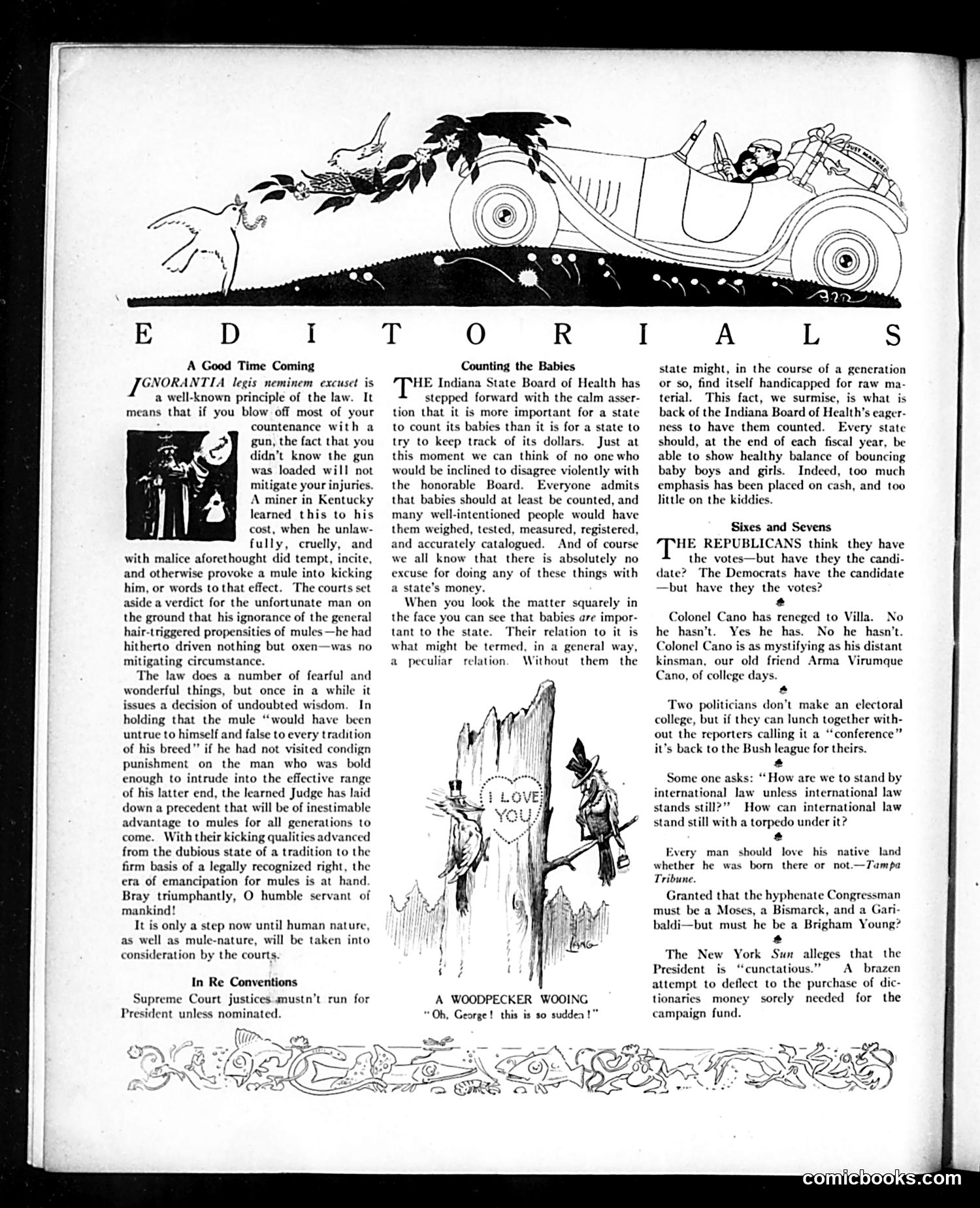
**Top Cartoon:** Shows a car careening wildly with occupants flying about, pulled by what appears to be a donkey or mule. This satirizes reckless driving or poor automotive control—likely commentary on inexperienced or irresponsible drivers of the era. **"A Woodpecker Wooing":** A small cartoon showing a woodpecker with a heart, captioned "Oh, George! this is so sudden!" This is a gentle romantic joke playing on the double meaning of "pecking." **Editorial Section:** Discusses the Indiana Board of Health counting babies as economic assets, Republican vs. Democratic electoral strategy, and references to Colonel Cano (appears to involve Latin American politics) and Congressional figures. The tone is satirically skeptical of political claims and bureaucratic initiatives. The page reflects early-20th-century political and social commentary typical of Judge magazine's satirical approach.
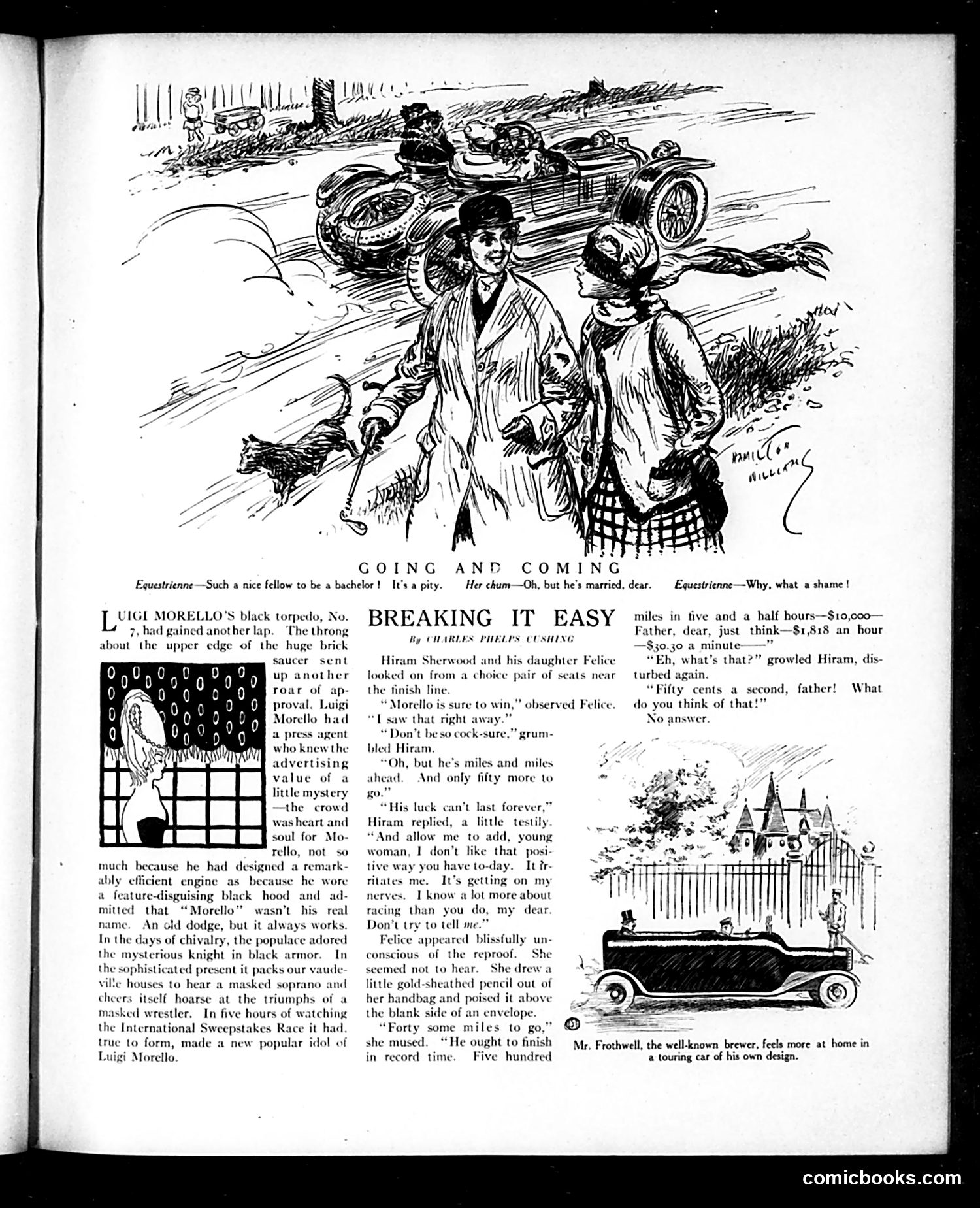
This page contains two satirical stories about automobile racing. The top cartoon depicts spectators at what appears to be the International Sweepstakes Race, with dialogue mocking both racing enthusiasts and bachelors. The "Breaking It Easy" story below focuses on Luigi Morello's black torpedo car in a racing competition, satirizing the vehicle's distinctive hood design that became famous for its association with the International Sweepstakes Race. The humor centers on early 20th-century automobile culture—the excitement around racing, the peculiar engineering of racing cars, and social commentary about wealthy men like "Mr. Frothwell, the well-known brewer" who participate in motorsports. The satire gently mocks racing's dangers and the spectacle surrounding these events, which were major public attractions of the era.
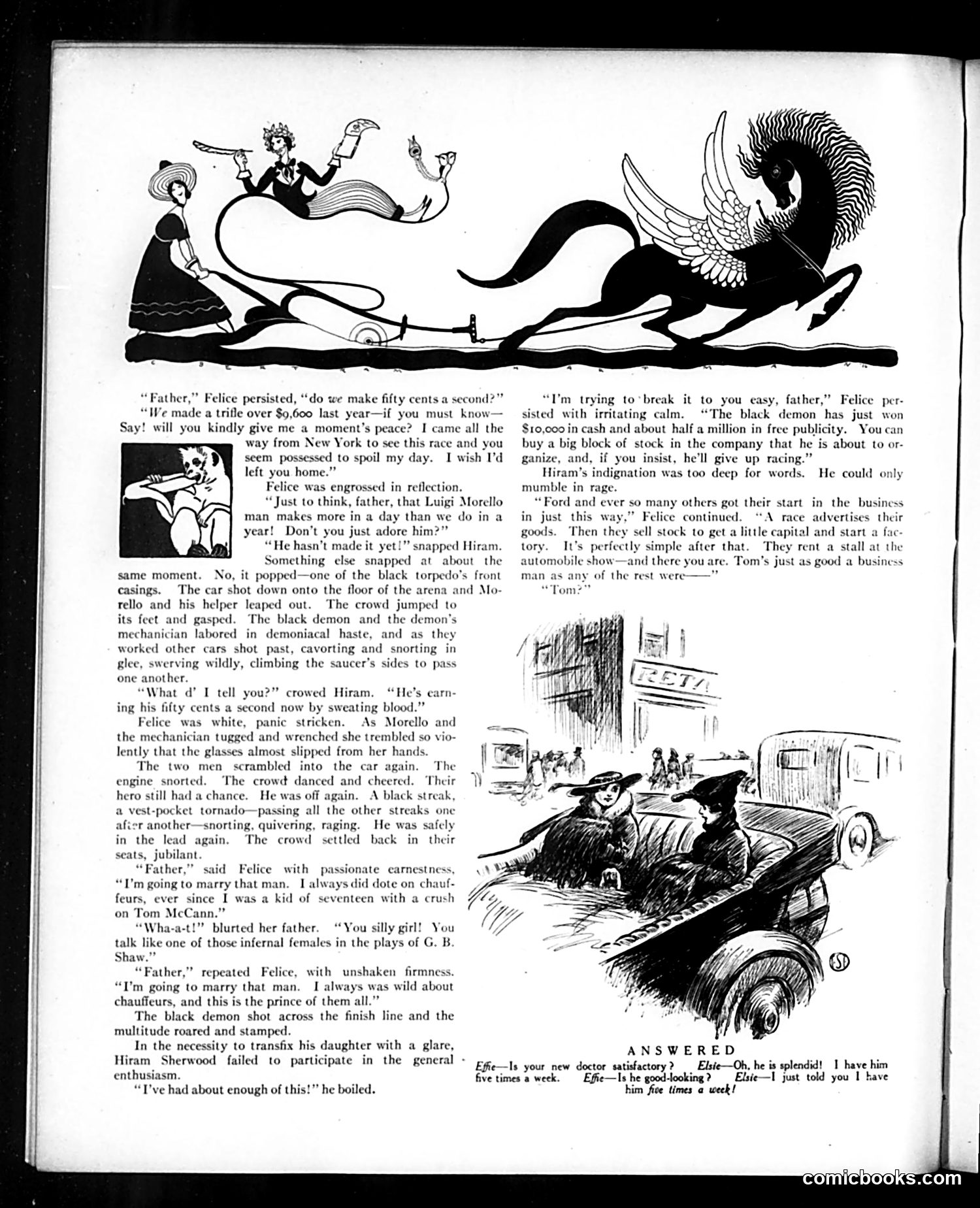
This page satirizes the clash between old-money conservatism and new automotive-age entrepreneurship. Hiram Sherwood, a wealthy but traditional businessman, attends a car race with his daughter Felice, who becomes infatuated with Luigi Morello, a racing driver. The satire targets Hiram's dismissive attitude toward Morello's earning potential ("fifty cents a second") and unconventional path to wealth. When Morello's car breaks down mid-race but he recovers to win, Felice sees opportunity in his publicity value and business potential. She argues that racing drivers like Morello—and by extension, Ford and others—build fortunes through publicity, stock offerings, and factory ventures. Hiram's outrage represents older patriarchal anxieties about ambitious newcomers and changing social mobility. The joke is that Felice has grasped modern marketing and capitalism better than her father: appearances and publicity matter as much as actual achievement. The small "Answered" joke about a doctor is unrelated filler.
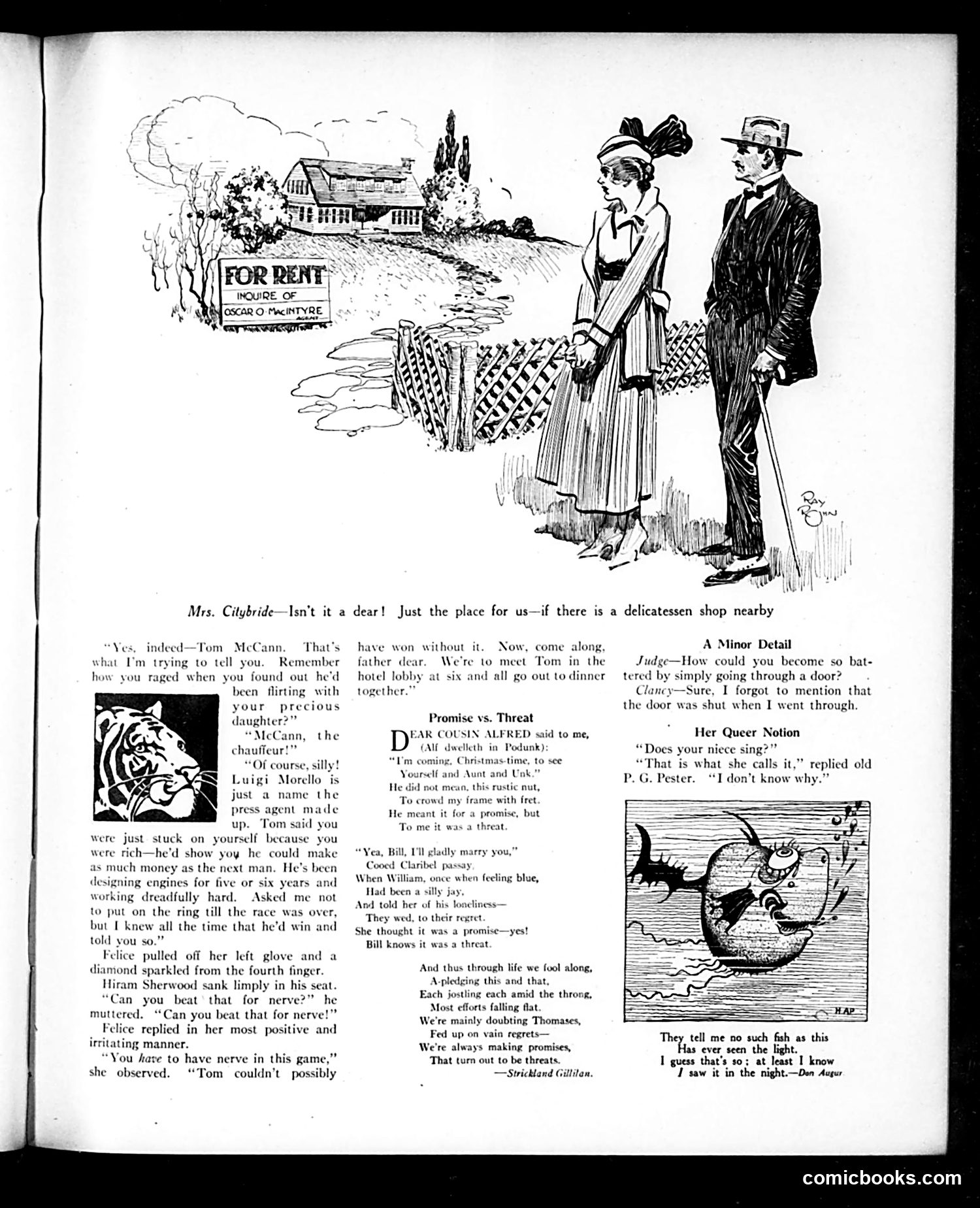
This page contains multiple short humorous pieces typical of early 20th-century satirical magazines: **"Mrs. Citybride"** (top cartoon): A social satire about class mobility. A wealthy father initially objected to his daughter Felice dating "Luigi Morello," believing him beneath their station. He's now learning the man is actually Tom McCann, a chauffeur-turned-engineer who deliberately hid his identity to prove he could succeed through merit alone. The joke targets both snobbish class consciousness and the American self-made man narrative—McCann's deliberate deception undermines the sincerity of his achievement. **"Promise vs. Threat"** (poem): A lighthearted meditation on how people mistake casual utterances for binding commitments, using marriage proposals as the central example. It's social commentary on miscommunication and regret. The remaining pieces are brief gag comics exploiting wordplay and literal misunderstandings ("A Minor Detail," "Her Queer Notion"), typical filler content for such magazines.
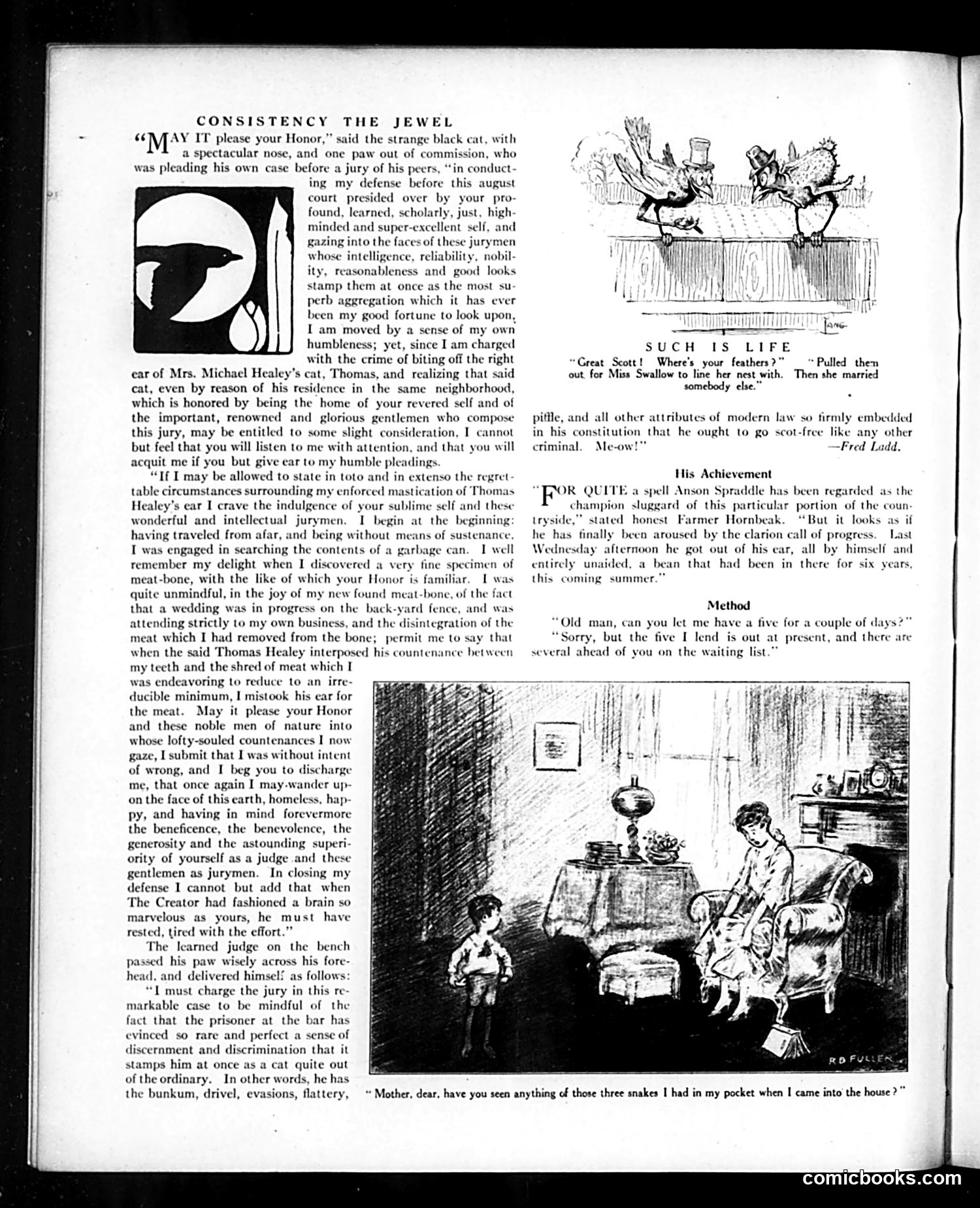
This satirical piece mocks courtroom flattery and legal absurdity. A black cat accused of biting off another cat's ear delivers an elaborate defense filled with excessive praise for the judge and jury—calling them "profound," "scholarly," "superb," etc. The satire targets how defendants and lawyers abuse flowery language and obsequious compliments to manipulate courts, hoping judges will overlook obvious guilt through shameless flattery. The cat's defense is deliberately ridiculous: he admits the crime but argues his brain (like the judge's) is so superior he deserves leniency. The title "Consistency the Jewel" implies judges often contradict themselves, being swayed by flattery rather than principle. The accompanying illustrations mock daily life's absurdities—a woman asking about missing snakes, a man unable to lend money despite claiming to have it available. The broader message critiques how formal institutions rely on performative language rather than justice.
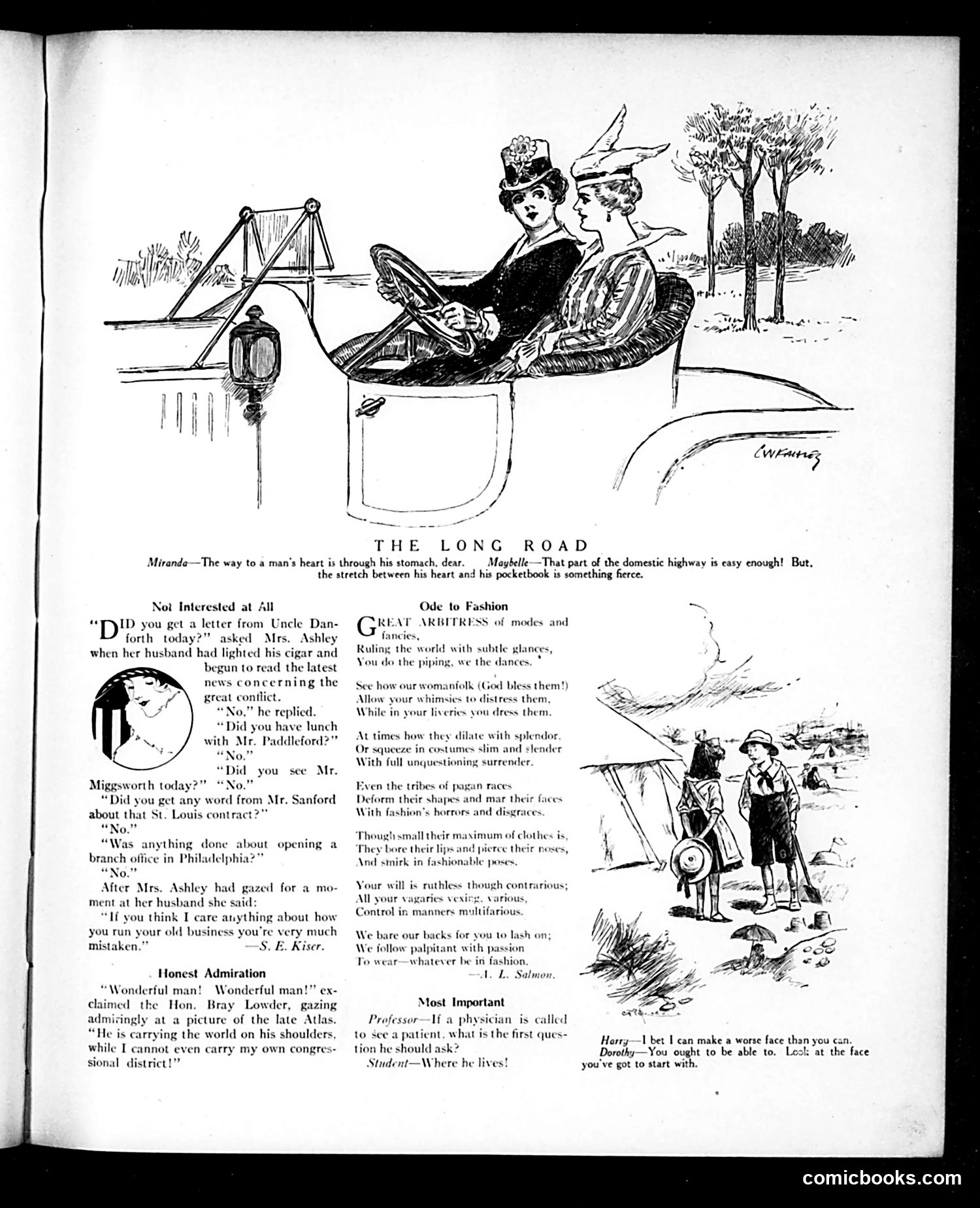
This Judge magazine page contains three distinct humor pieces satirizing early 20th-century American life: **"The Long Road"** (top cartoon): Two fashionable women in an automobile joke about winning a man's heart through his stomach being easy—the real challenge is accessing his wallet ("the stretch between his heart and his pocketbook"). **"Not Interested at All"**: A husband ignores his wife's questions about business matters (Uncle Danforth's letter, lunch plans, contracts, branch offices), then she sarcastically announces she doesn't care about his business anyway. The satire targets marital dynamics and female disinterest in male financial affairs. **"Ode to Fashion"**: A poem mocking women's servitude to fashion trends, depicting them as mindlessly following arbitrary whims—from bare backs to pierced noses. It portrays Fashion as a tyrannical "Arbitress" controlling women's bodies and behavior. **"Honest Admiration"**: A brief joke about a man admiring Atlas's strength while unable to manage his own congressional district—likely political self-deprecation. These pieces reflect period anxieties about gender roles, consumerism, and women's fashion obsession.
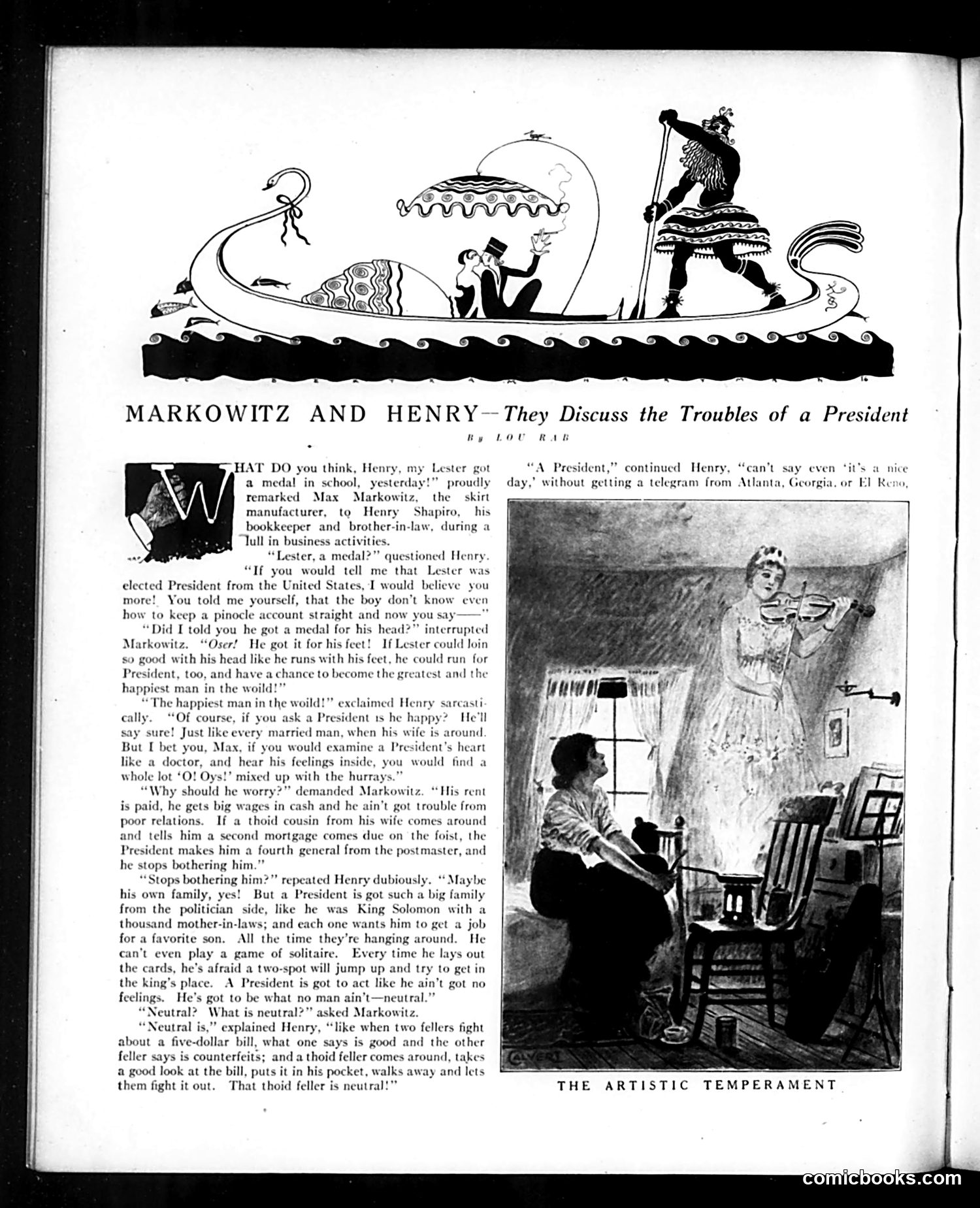
This is a Yiddish-inflected humor piece featuring two Jewish businessmen (a shirt manufacturer and his bookkeeper brother-in-law) debating the burdens of the U.S. presidency through working-class perspective. **The Setup:** Max's son Lester earned a school medal, prompting Max to jest that Lester could run for President. Henry responds seriously, exploring why being President is actually miserable despite apparent advantages. **The Satire:** Henry catalogs presidential troubles: constant demands from politicians' relatives seeking patronage jobs, inability to make private decisions without political telegrams arriving from various states, and the impossible demand for "neutrality"—acting without personal feelings while managing endless competing interests. **The Point:** The humor inverts typical reverence for high office. Using immigrant vernacular and working-class logic, it depicts the presidency as an exhausting popularity contest where the President serves everyone else's interests while suppressing his own humanity. The final "neutral" explanation—a bystander pocketing disputed money while others fight—satirizes how politicians claim neutrality while actually serving their own interests. The cartoon's ship imagery above reinforces presidential navigation through turbulent political waters.
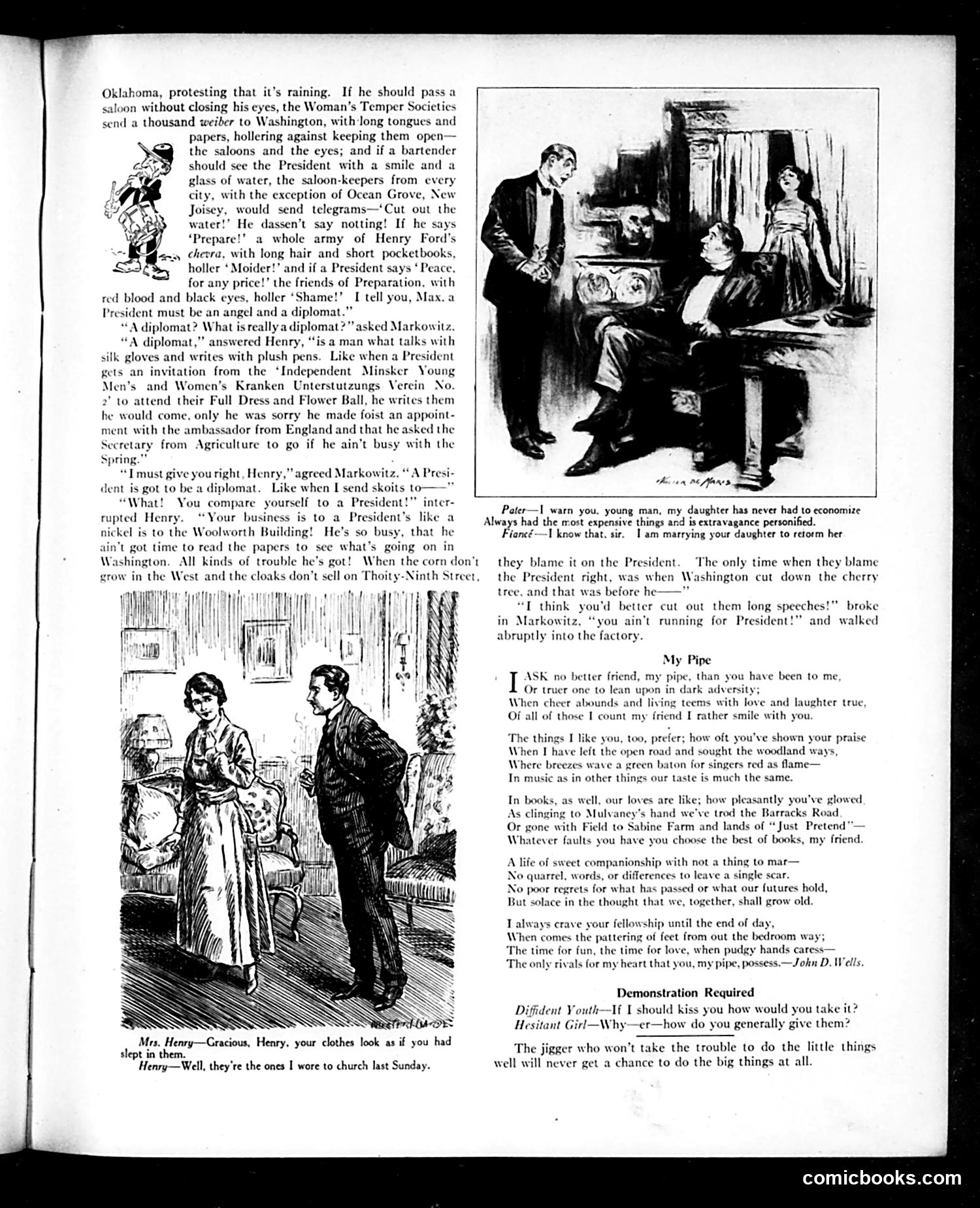
This page contains satirical dialogue mocking Presidential constraints and public expectations. **Henry** (appearing to be a Jewish immigrant character, indicated by Yiddish phrases and accent) lectures **Markowitz** about how a President must navigate impossible contradictions: temperance advocates demand he close saloons, while saloon-keepers demand he keep them open; pacifists condemn militarism while "Preparedness" advocates demand armament. The satire targets how Presidents receive blame regardless of decisions made. Henry illustrates with absurd examples: even reading newspapers risks offending someone. The comparison to Markowitz's own business struggles emphasizes the President's impossible diplomatic position. The lower sections contain unrelated content: a domestic joke about Henry's rumpled clothes, a father warning his daughter's fiancé about her extravagance, a sentimental poem about a pipe, and brief quips about decisiveness. The cartoons (two visible illustrations) depict middle-class domestic and business scenes supporting the dialogue's themes.
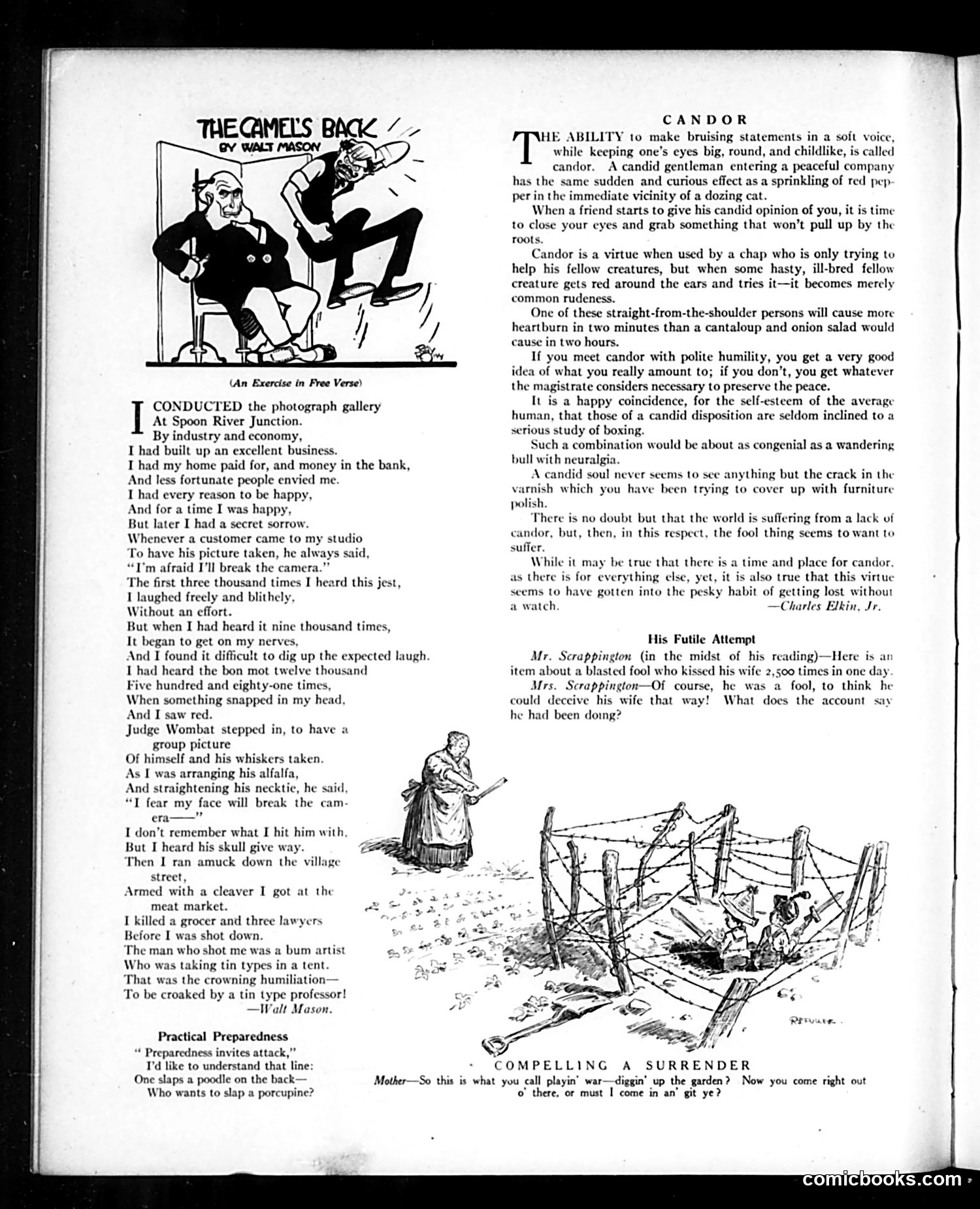
This page contains satirical essays and verse mocking social types and human nature. **"The Camel's Back" (top left):** A cartoon showing someone being kicked by another, illustrating Walt Mason's free-verse poem below about a photographer's breakdown. Mason describes a studio operator who heard the same camera-breaking joke thousands of times until snapping—he violently assaults a judge and goes on a killing spree before being shot by a "tin type professor" (early photographer). The satire targets both the joke-teller's obliviousness and the photographer's violent overreaction. **"Candor" (right column):** An essay defining candor as blunt honesty. It argues candor is virtuous when genuinely helpful but becomes mere rudeness when delivered by ill-mannered people. The piece satirizes overly frank individuals who cause social disruption while ironically noting that truly candid people rarely study boxing—implying they'd face physical retaliation. **"His Futile Attempt":** A brief humorous domestic scene where a husband reads about another man kissing his wife 2,500 times daily. His wife dismissively calls him a fool, implying no deception would work on her.
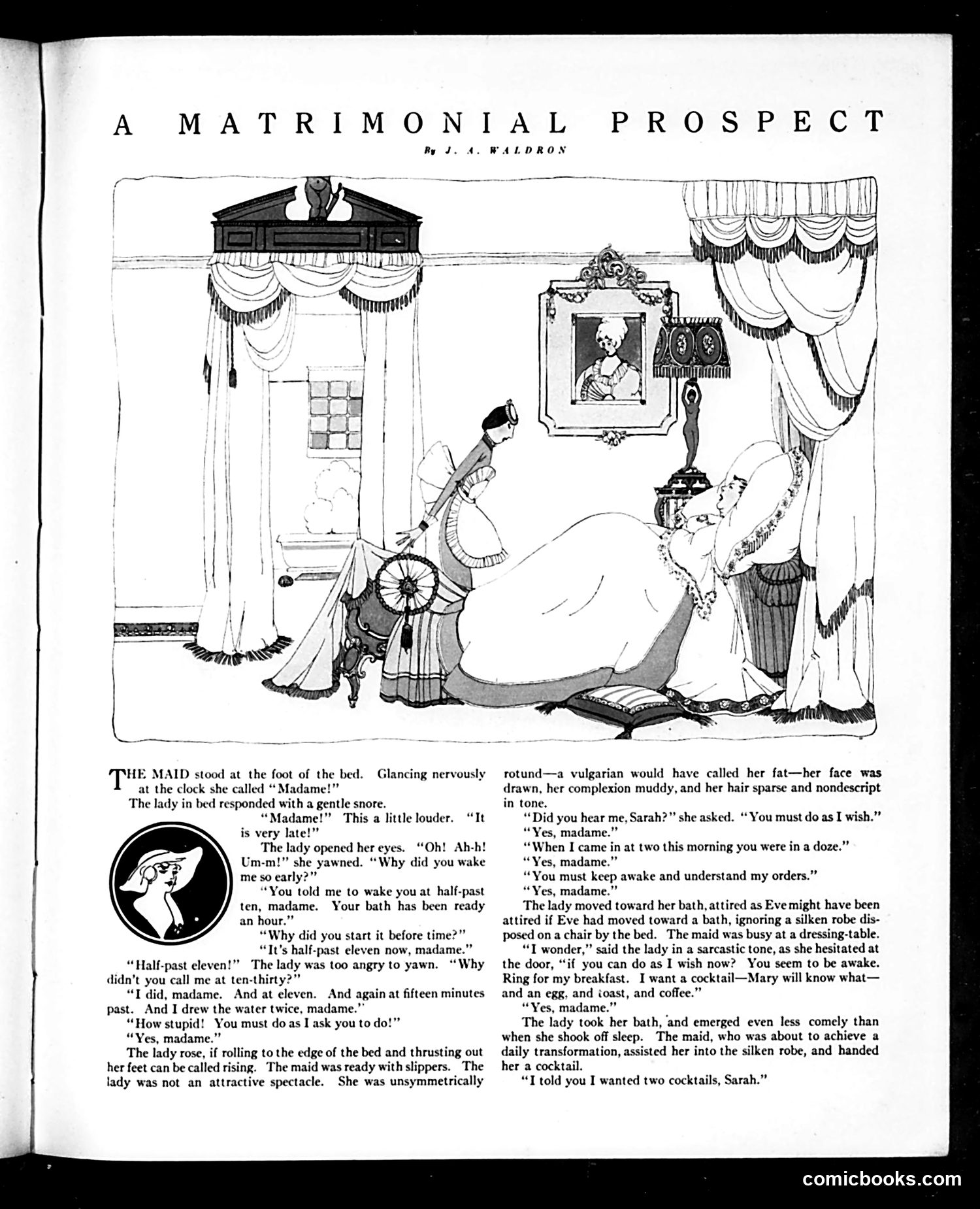
This satirical story depicts the morning routine between a wealthy, idle woman and her maid Sarah. The satire targets the laziness and unreasonable demands of the upper-class lady—she sleeps late, ignores the maid's repeated wake-up calls, complains about her bath being prepared too early, then demands breakfast cocktails before noon. The illustration shows the lady's physical unattractiveness: "unsymmetrically rotund" (fat), with poor complexion and sparse hair. This visual satire emphasizes the disconnect between her privileged status and her actual worth. The title's irony becomes clear: despite her wealth and leisure time, this woman makes for an unappealing matrimonial prospect—her character is as unattractive as her appearance. The joke critiques both idle wealth and domestic service dynamics of the era, mocking the arbitrary cruelty of employers toward servants.
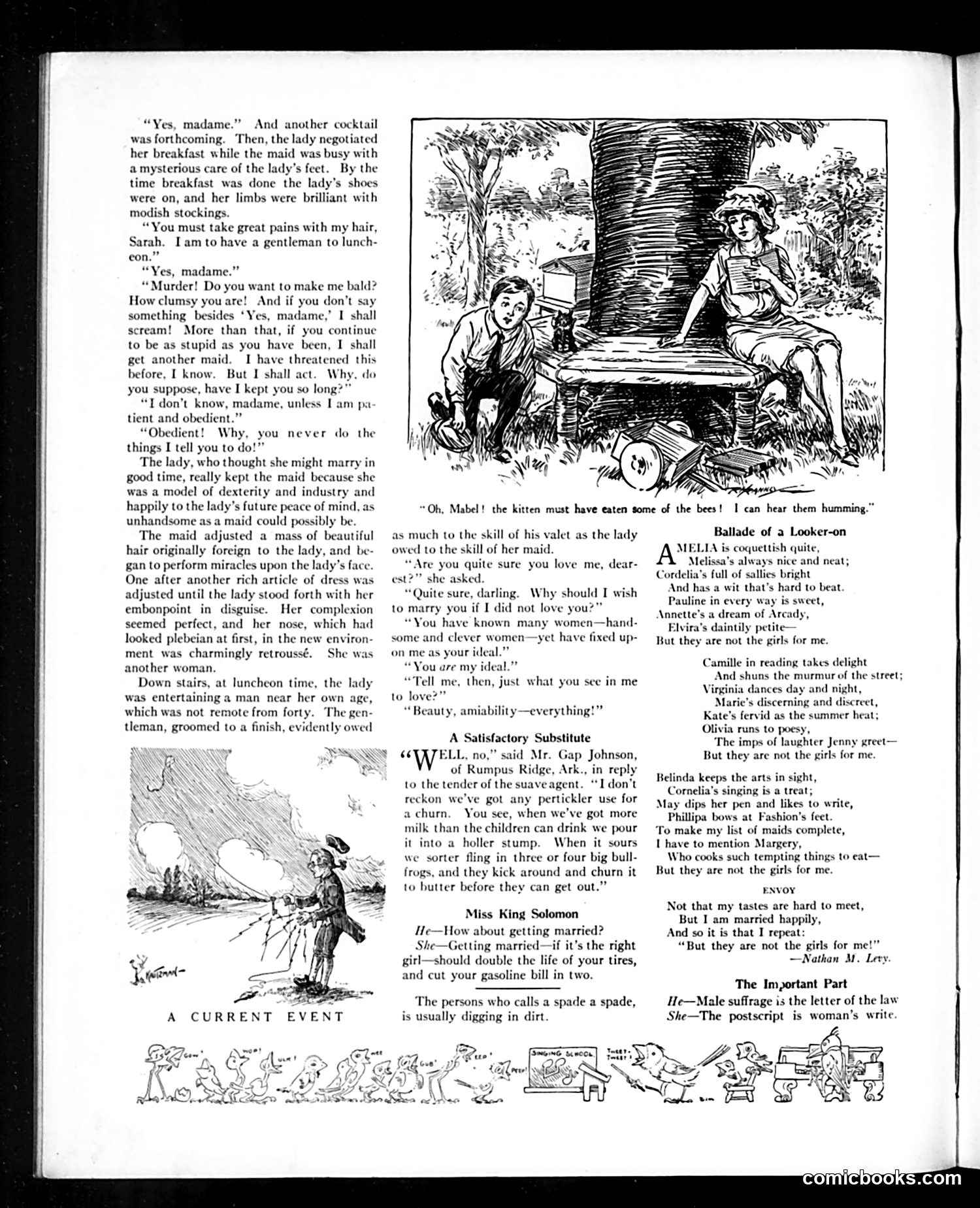
This page satirizes **women's superficiality and vanity** through multiple sketches and verses. The main narrative depicts a wealthy woman verbally abusing her maid while preparing for a lunch date with a gentleman suitor. The satire's point: the woman's entire identity is artificial—her hair is a hairpiece, her complexion requires cosmetic "miracles," her figure needs corseting. Yet she demands the man love her for "beauty, amiability—everything," oblivious to her own deception. The secondary pieces reinforce this theme: "A Current Event" jokes about male gullibility in romance; "A Satisfactory Substitute" humorously contrasts rustic simplicity with urban consumerism; "Miss King Solomon" satirizes women's materialistic marriage calculations; and the "Ballade" depicts a married man admiring various women while contentedly committed. The cartoons ridicule **early-20th-century gender dynamics**—women's economic dependence on marriage and men's willingness to be deceived by artifice.
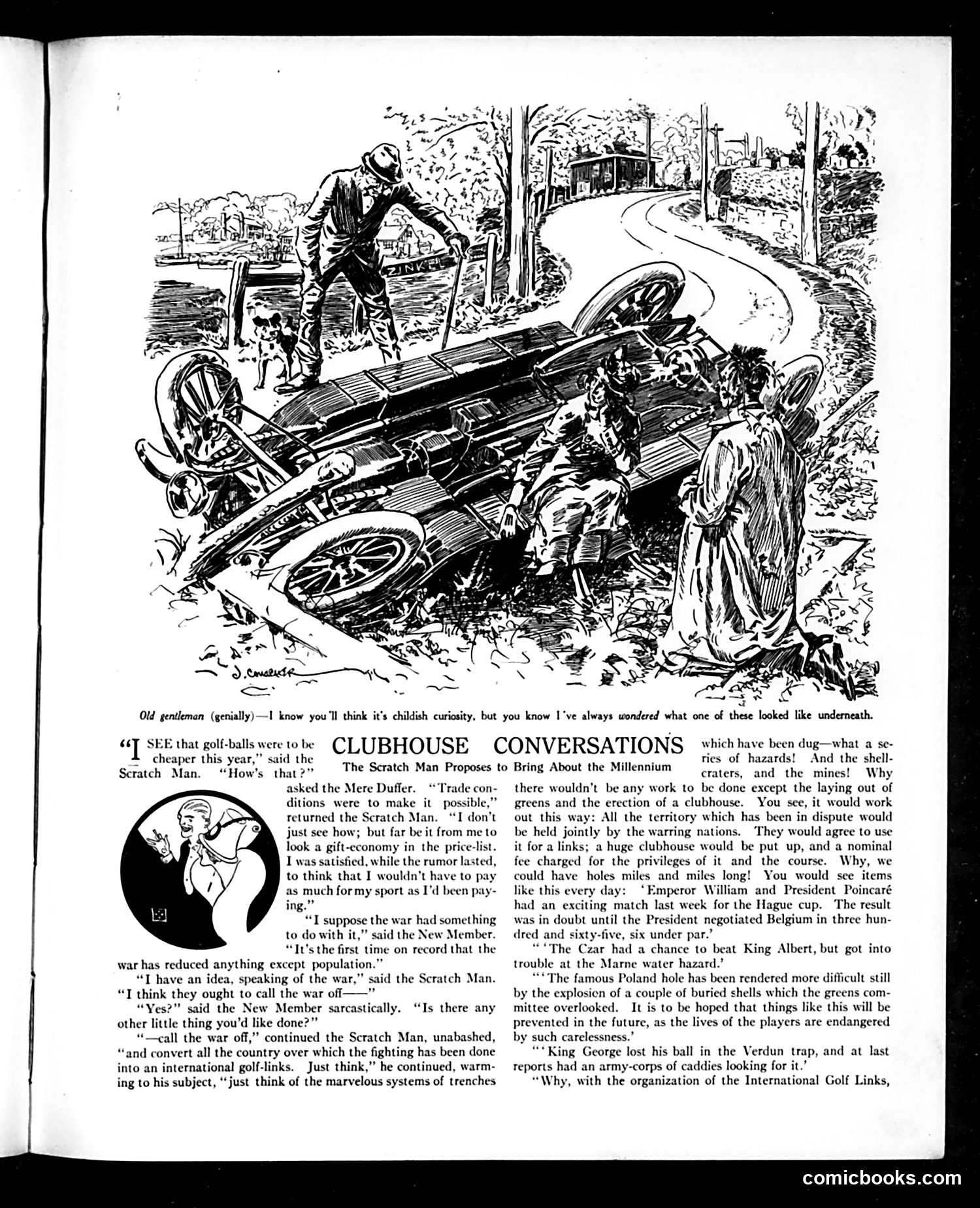
This is satirical commentary on World War I, published while the war was still ongoing. The "Scratch Man" character proposes converting all the war-devastated European battlefields into an international golf course—a absurdist idea meant to ridicule both the senselessness of the war and the obsessive, self-absorbed priorities of wealthy golfers. The satire works on multiple levels: it mocks how the upper classes trivialize a catastrophic conflict; it critiques the notion that warring nations could cooperate on anything; and it darkly jokes about real hazards (trenches, shell craters, mines) becoming golf obstacles. The fictional match results naming real leaders (Kaiser, Czar, King George) and actual battle locations (Verdun, Marne, Poland, Belgium) emphasize the grotesque contrast between devastating human conflict and leisure sports. The cartoon above illustrates an old gentleman examining the underside of a golf ball—a visual pun supporting the page's golf-obsessed theme.
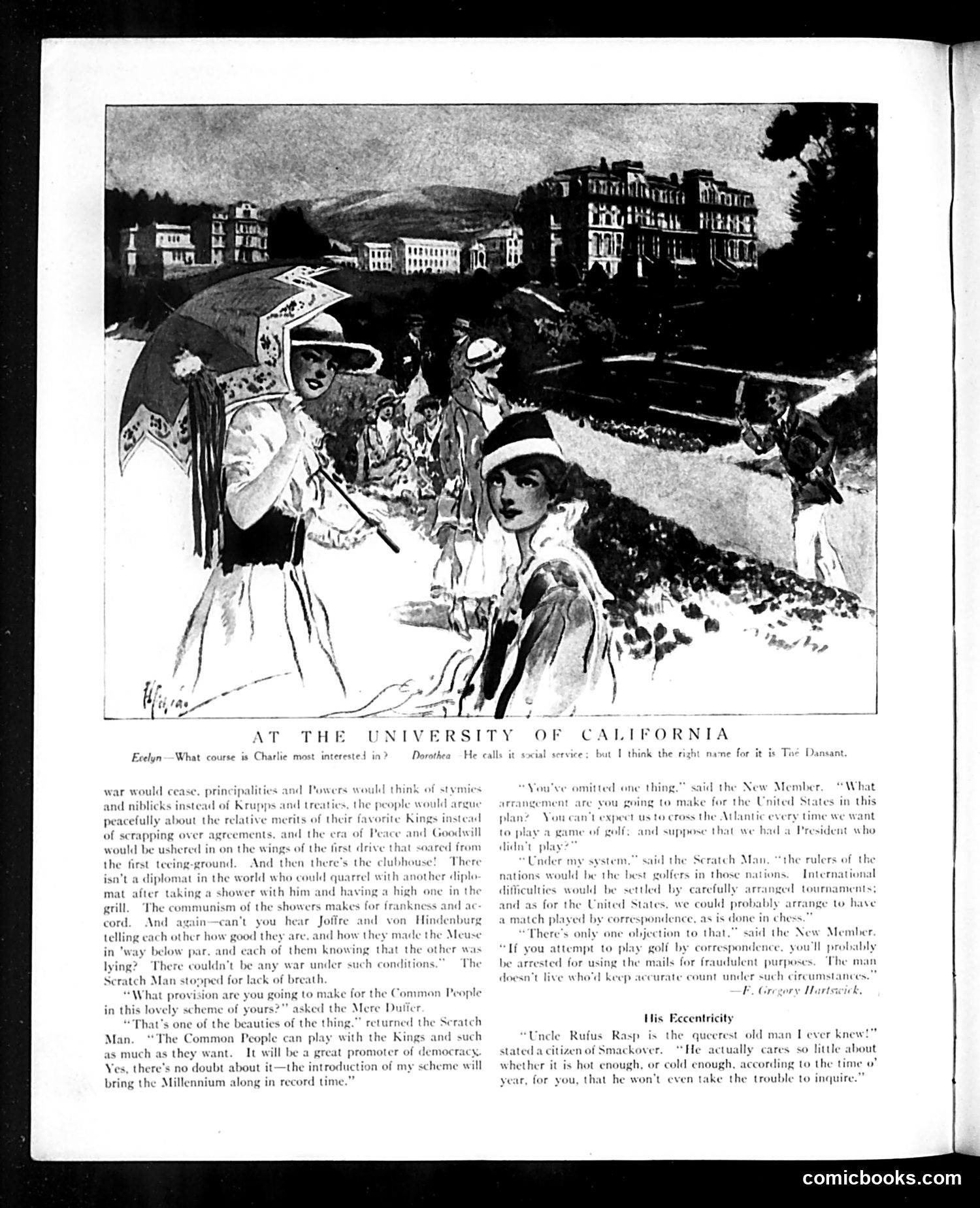
This illustrated dialogue satirizes early 20th-century idealistic proposals to prevent war through international sports competition. The cartoon depicts fashionably dressed characters debating a scheme where nations would settle disputes through golf and other games rather than military conflict. The satire targets the naïveté of such utopian thinking: a character proposes that "Common People can play with the Kings" and that international tournaments would replace warfare and diplomacy. Others point out practical flaws—including that correspondence golf matches could involve mail fraud. The humor lies in mocking both the grandiose optimism of peace activists and the absurdity of believing sport could replace geopolitics. References to "the Common People," "the Millennium," and "democracy" suggest this targets progressive-era reformers and their faith in democratic solutions to international conflict—a belief Judge's satirists found comically naive.
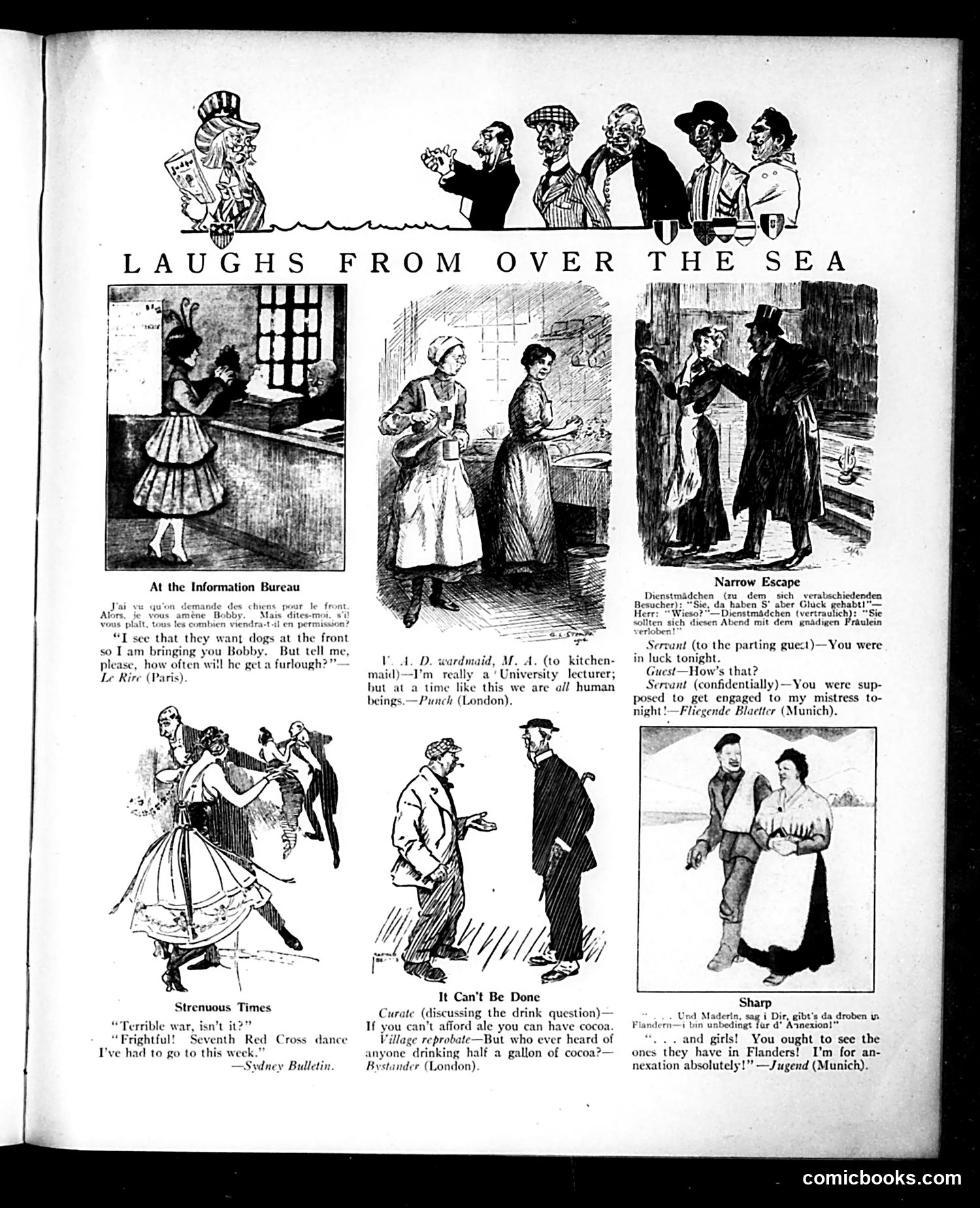
This page collects humorous cartoons and jokes from European publications, reprinted in the American *Judge* magazine during World War I. The content mocks various wartime absurdities: **Key themes:** - **Military service disruptions**: References to soldiers getting furloughs and civilians drafted into war work - **Class anxiety**: A university lecturer forced to work as a kitchen maid; servants' gossip about their employers - **Wartime shortages and rationing**: Jokes about cocoa substitutes and drink restrictions - **Romance and marriage disrupted by war**: A servant nearly tricked into an unwanted engagement; soldiers flirting with girls in Flanders - **Annexation politics**: Dark humor about soldiers preferring to annex French/Belgian territory (and girls) The cartoons satirize how total war upended normal social hierarchies and domestic life across Europe. The international sourcing (*Punch*, *Bystander*, *Jugend*, *Fliegende Blätter*) shows war humor transcended borders.
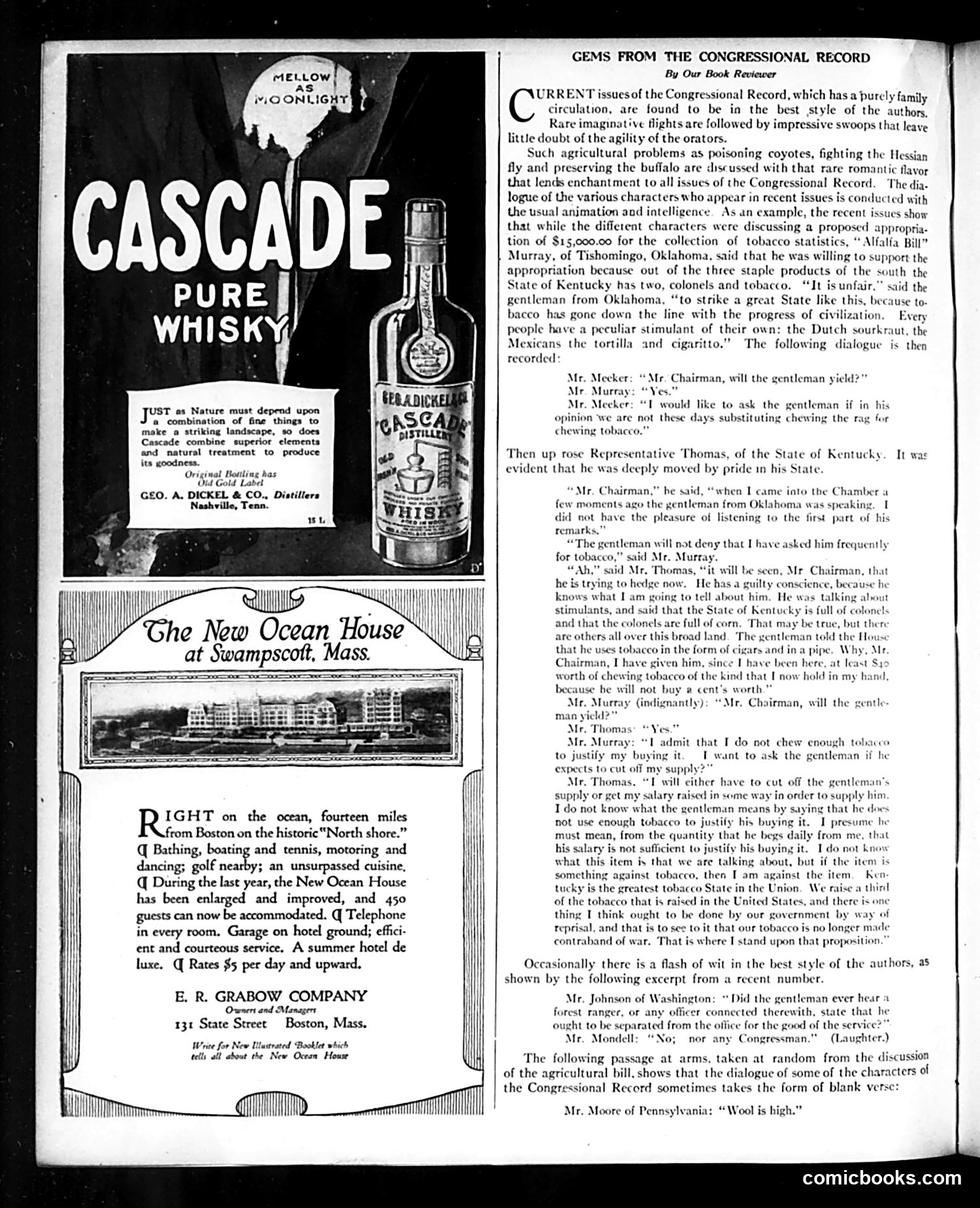
This satirical article mocks the *Congressional Record*'s publication of Congressional debates, presenting them as entertainment with literary pretension. Judge's reviewer highlights the absurdity of representatives debating trivial agricultural matters (coyote poisoning, tobacco statistics) in grandiose language. The central joke involves a heated exchange between Representative "Alfalfa Bill" Murray of Oklahoma and Representative Thomas of Kentucky over tobacco use and state pride. Thomas accuses Murray of accepting expensive chewing tobacco as gifts while claiming poverty. The dialogue deliberately captures the legislators as vain and petty—arguing over tobacco and insults rather than substantive policy. The satire suggests that the Congressional Record, despite its "purely family circulation," contains undignified bickering dressed up in flowery oratory. By reproducing this exchange verbatim, Judge exposes the gap between Congress's self-serious debates and their actually trivial, personal nature.
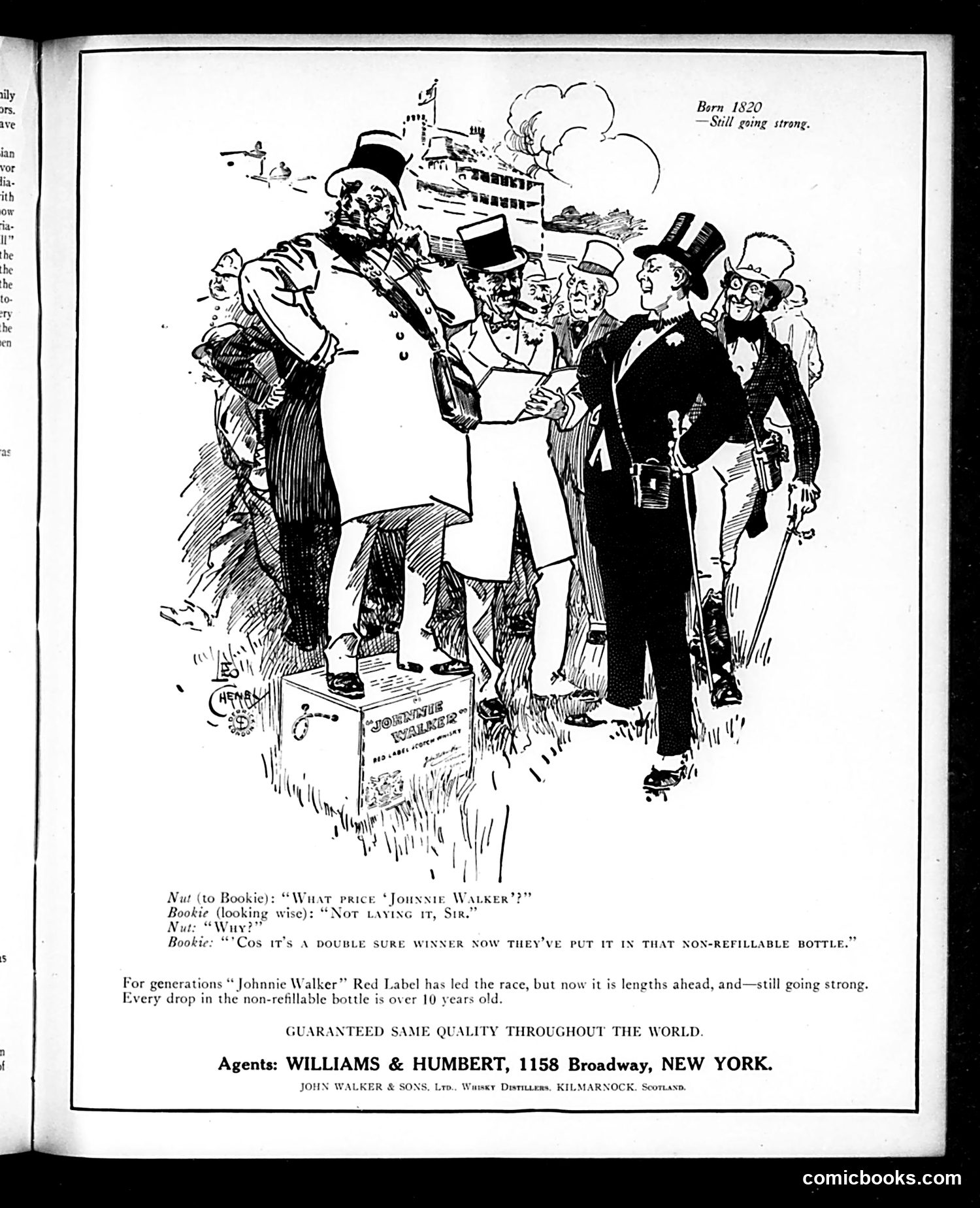
This is primarily a **Johnnie Walker whisky advertisement**, not political satire. The cartoon uses humor to promote their "non-refillable bottle" innovation. The joke: A bettor ("Nut") asks a bookie the odds on "Johnnie Walker," treating the whisky brand as a racehorse. The bookie refuses to bet because it's now a "double sure winner"—the new non-refillable bottle guarantees quality consistency since every drop is over 10 years old, making it an unbeatable product. The visual depicts well-dressed gentlemen and a bookie in period dress, with a horse race implied through the betting terminology. The "Born 1820—Still going strong" caption emphasizes the brand's longevity and reliability. This represents early **brand advertising disguised as editorial humor** in Judge magazine, targeting wealthy male readers familiar with horse racing and scotch consumption.
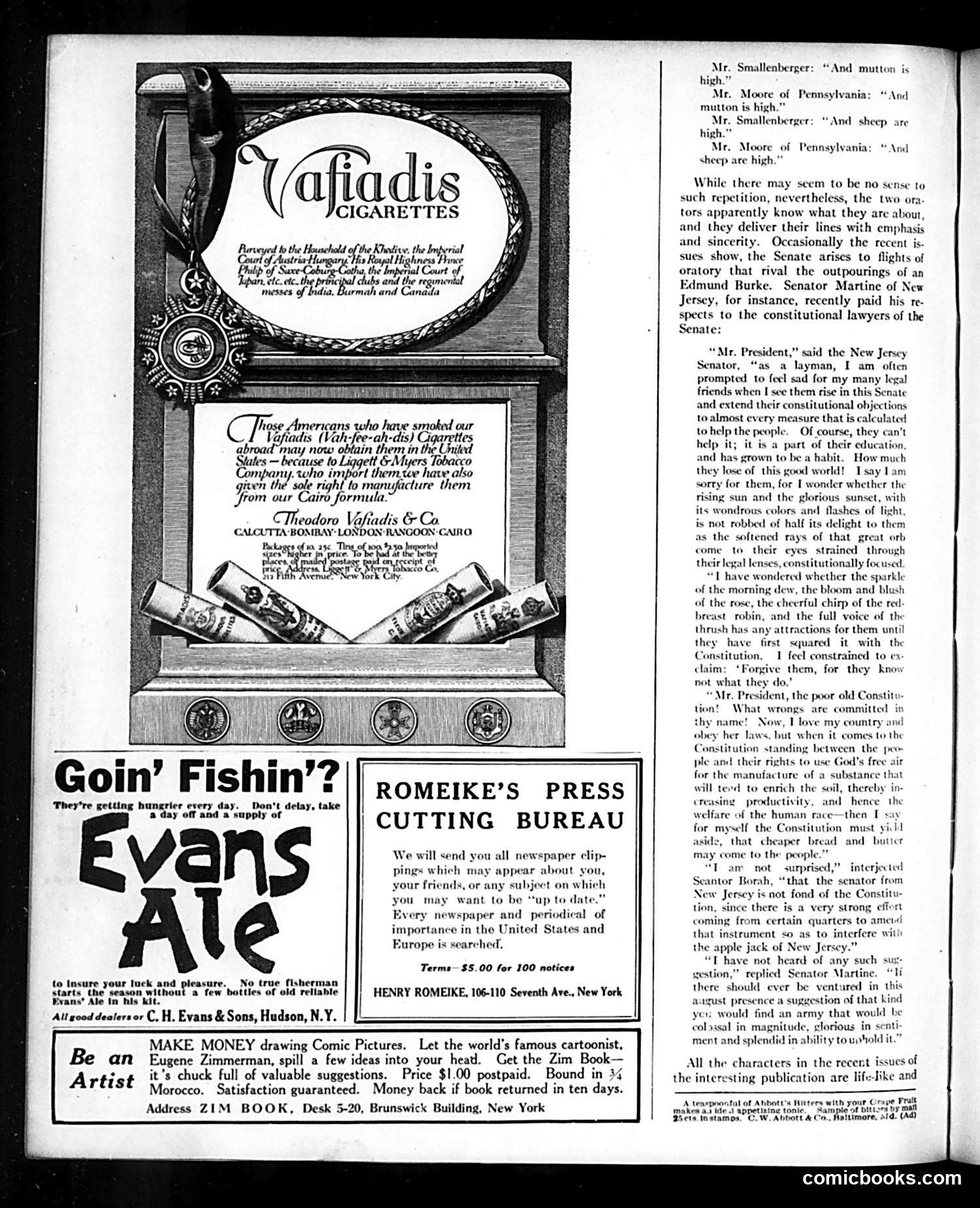
This page primarily contains **advertisements and Senate debate commentary** rather than a cartoon. The main satirical content mocks repetitive Senate oratory—specifically Senators Smallenberger and Moore of Pennsylvania mechanically repeating "mutton is high" and "sheep are high" with false emphasis, despite the apparent nonsense. The accompanying text celebrates Senator Martine of New Jersey's flowery speech attacking constitutional lawyers who block populist measures. Martine poetically laments that these legalistic minds cannot appreciate nature's beauty until they've "squared it with the Constitution." **The satire's point**: Judge ridicules both extremes—mindless Senate repetition AND verbose constitutional obstruction—suggesting lawmakers were equally detached from practical concerns affecting ordinary people (food prices, economic welfare). The heavy-handed rhetoric of both speakers is presented as absurdly disconnected from reality. The Vafiadis Cigarettes advertisement occupies the upper portion; other ads fill remaining space.
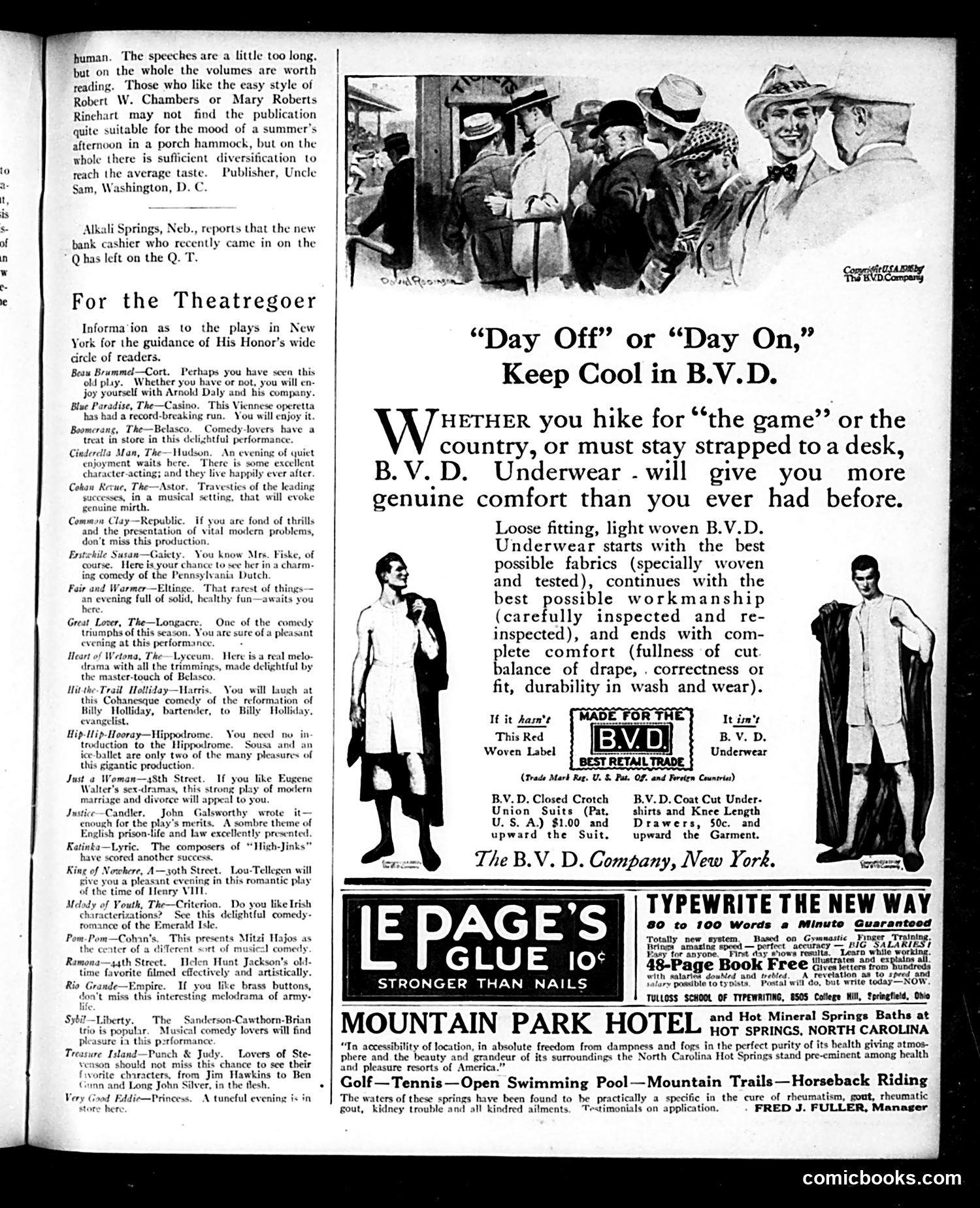
This page is primarily **advertising and entertainment listings**, not political satire. The top section contains theatre reviews for Broadway productions, listing plays like "Beau Brummel," "The Boomerang," and "Common Clay" with brief critical commentary—typical entertainment journalism. The dominant feature is a **B.V.D. Underwear advertisement** showing two men in undergarments. The ad's tagline "Day Off" or "Day On, Keep Cool in B.V.D." targets male consumers with promises of comfort whether relaxing or working. This reflects early 20th-century advertising's direct appeal to masculine practicality. Below are additional ads for **LePage's Glue, typewriter services, and Mountain Park Hotel**—standard commercial content for the era. The page's only potentially satirical element is a brief news item about an Alkali Springs banker who "left on the Q.T." (quietly)—likely mocking small-town banking scandals, though details are minimal. **Overall**: This is a standard magazine page mixing theatre criticism with period advertisements, not primarily satirical content.
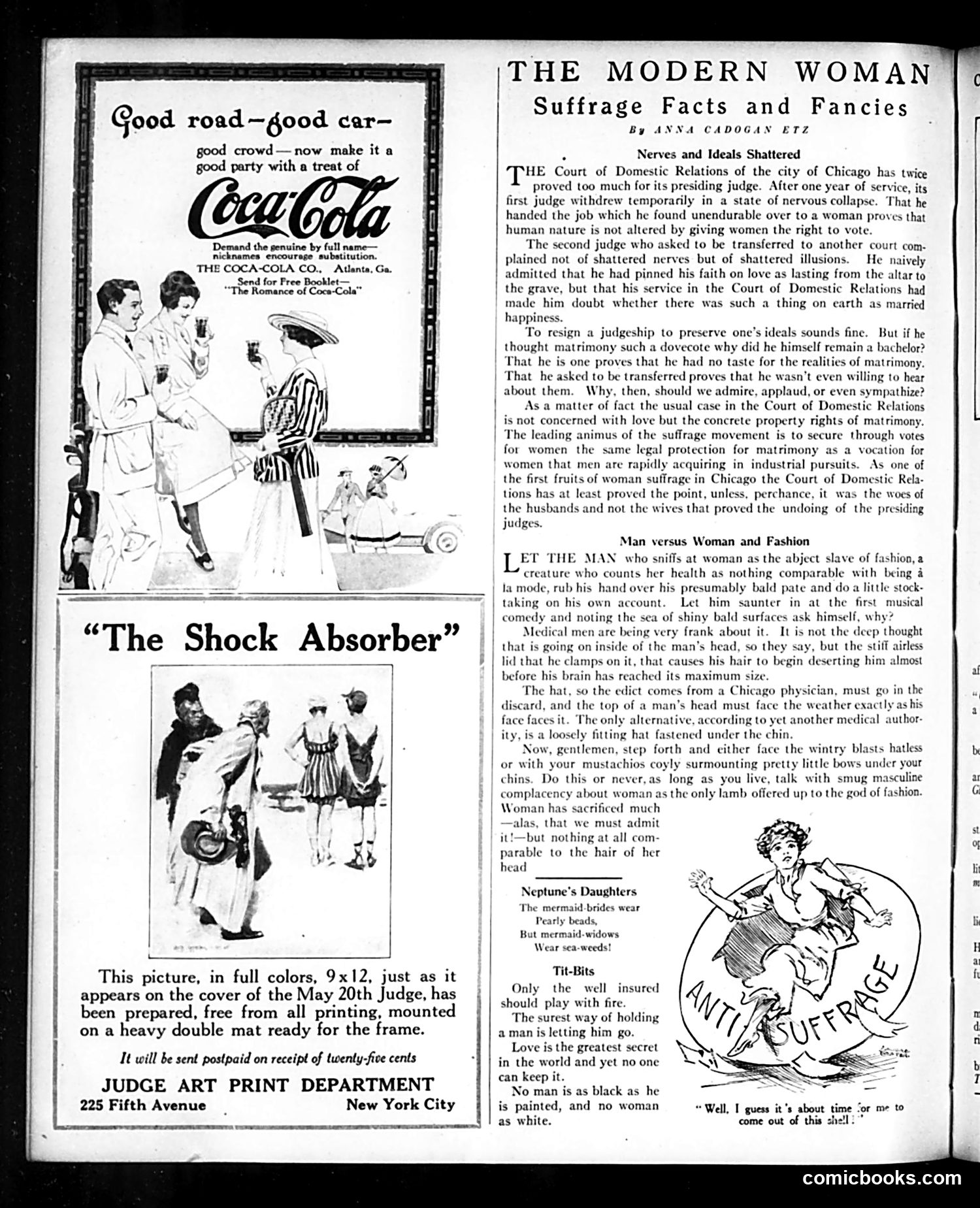
This page satirizes women's suffrage and changing gender roles circa 1920. The main article mocks female judges in Chicago's Court of Domestic Relations, claiming their nervous breakdowns prove women unfit for serious responsibility—despite noting the court actually addresses property rights, not romance. The "Man versus Woman and Fashion" section inverts the suffrage debate: it ridicules men's vanity about hats and baldness while claiming moral superiority over fashion-conscious women. The author argues men obsess equally over appearance (via tight hats causing hair loss) yet condemn women's fashion focus as frivolous slavery. The cartoons appear to illustrate these gender contradictions, though "The Shock Absorber" specific meaning is unclear from the image alone. The Coca-Cola advertisement represents typical contemporary commercial placement. Overall, the page presents anti-suffrage arguments while inadvertently exposing their hypocrisy.
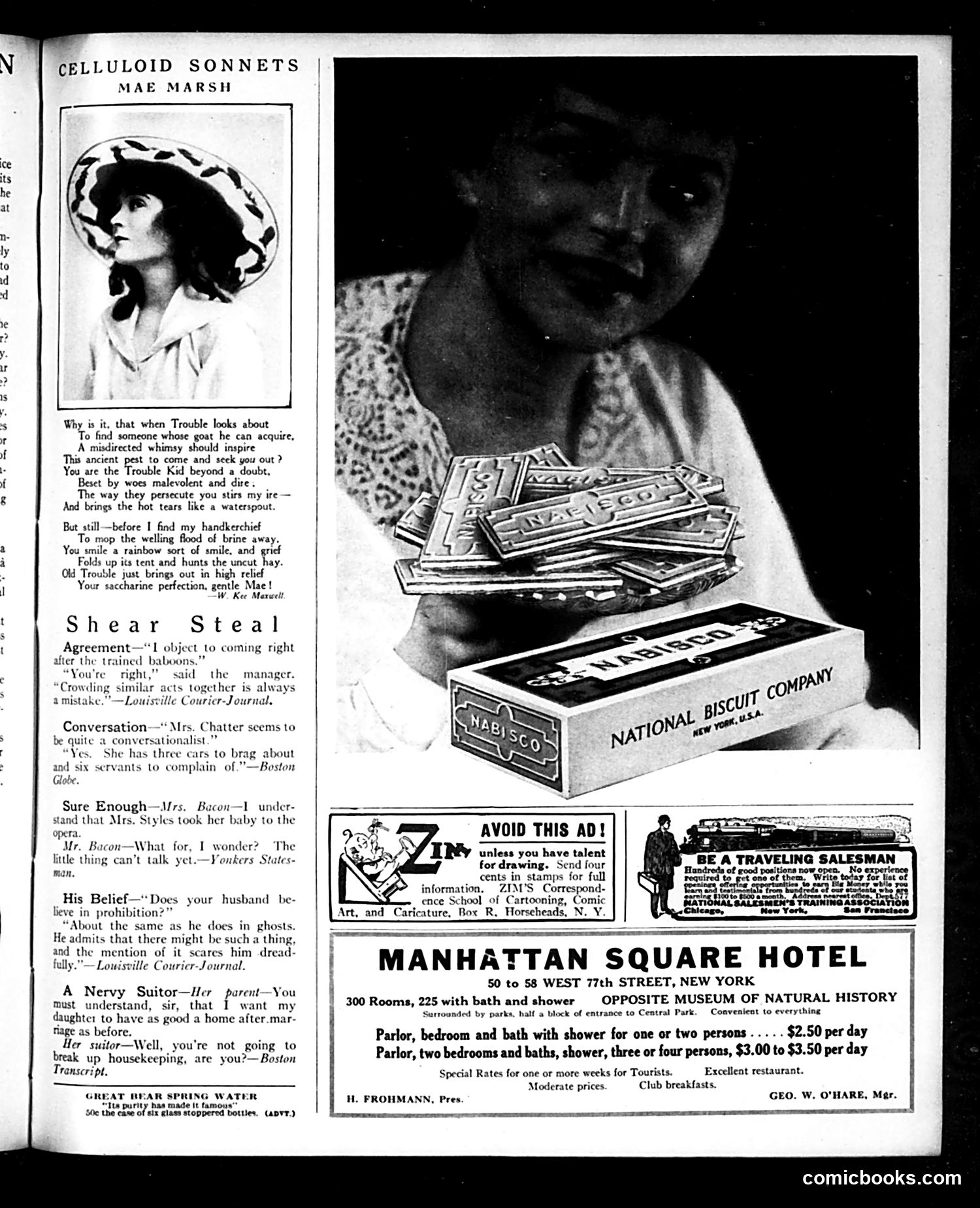
This page features **"Celluloid Sonnets," a section celebrating Mae Marsh**, a silent film actress. The romantic poem praises her as "the Trouble Kid" whose optimistic smile transforms hardship into joy—typical fan-magazine verse of the 1920s era. The page's other content includes brief satirical **humor snippets** mocking everyday social pretensions: someone objecting to sharing stage billing with trained baboons; a woman bragging about servants; a husband's hypocrisy about prohibition; a suitor unwilling to maintain his fiancée's lifestyle. A **National Biscuit Company advertisement** dominates the right side, showing Nabisco products, alongside hotel and cartooning school ads—typical magazine filler. The satire is gentle—poking fun at social climbers, phoniness, and marital dynamics rather than addressing serious political issues. The Mae Marsh tribute reflects Hollywood's growing cultural prominence in American popular media during this period.
This page is primarily **advertisements and humor columns**, typical of Judge magazine's format. The main content includes: **"With the College Wits"** — A humor section featuring short jokes from college publications, mostly playing on wordplay and student life situations (noisy roommates, compromising on fare-splitting, love letters as cushions). These are lighthearted, apolitical observations about college culture and courtship customs of the era. **Advertisements** dominate: Club Cocktails, King George IV Whisky, Kum-A-Part cuff buttons, Old Overholt Rye, White's Rock mineral water, and novelty items. The Prohibition-era context is notable—alcohol ads still appeared in magazines, though Prohibition was enacted in 1920. **No political satire appears here.** The page reflects early 20th-century consumer culture and collegiate humor conventions—there are no caricatured political figures or social commentary beyond gentle campus observations. It's essentially a commercial/entertainment page showcasing period advertising and college-newspaper-style jokes.
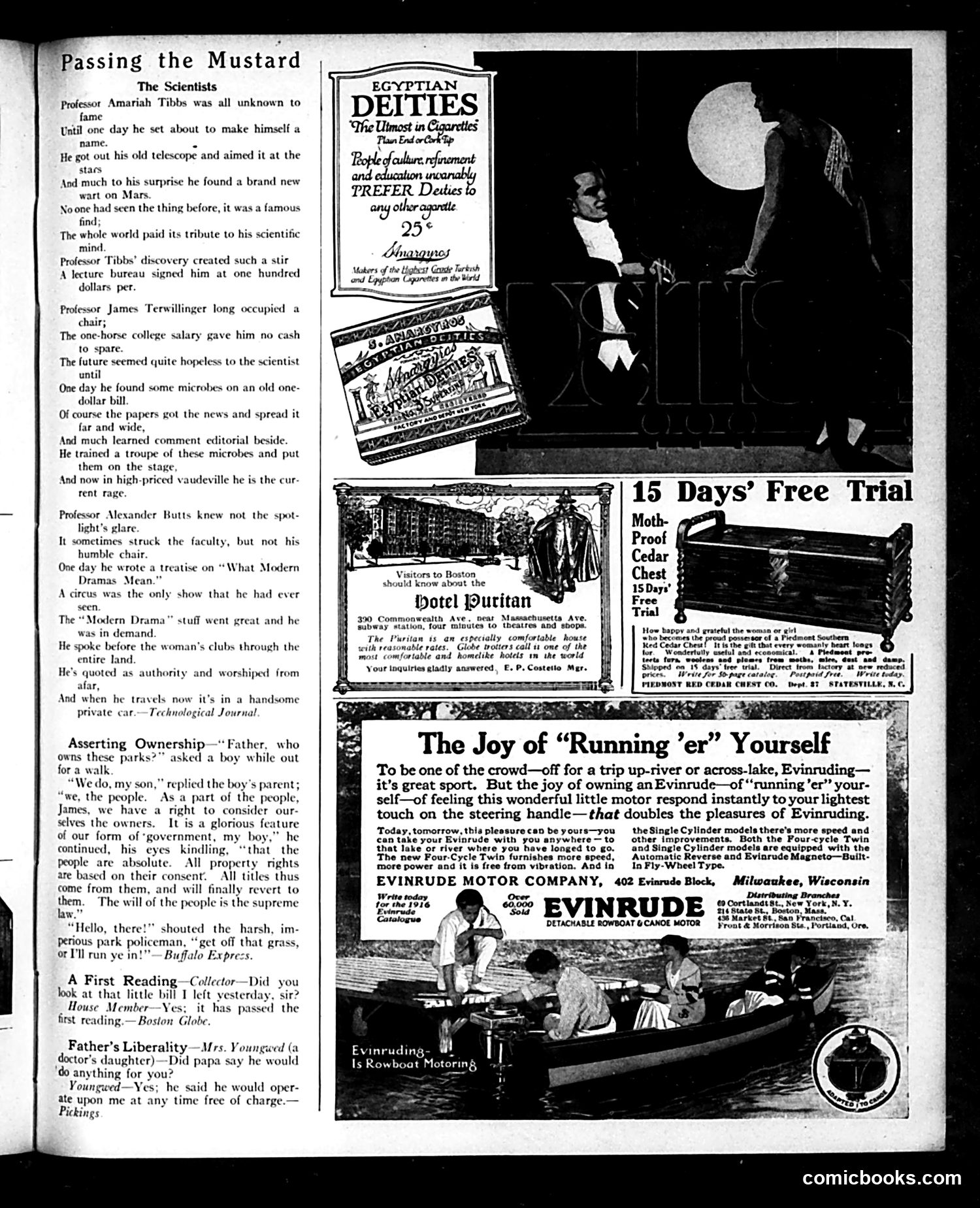
This satirical piece mocks academic careerism and the commodification of scientific discovery. Three professors—Tibbs, Terwillinger, and Butts—are portrayed as initially obscure academics who achieve fame and fortune through dubious means: discovering a "wart on Mars," exhibiting microbes in vaudeville, and lecturing on modern drama despite having seen only a circus. The satire suggests that in the early 20th century, scientists could manufacture celebrity and profit regardless of genuine achievement. The title "Passing the Mustard" implies they're passing off fraudulent or trivial claims as significant. A secondary piece mocks the contradiction between democratic park ownership and actual police enforcement, highlighting the gap between idealistic civic theory and authoritarian practice.
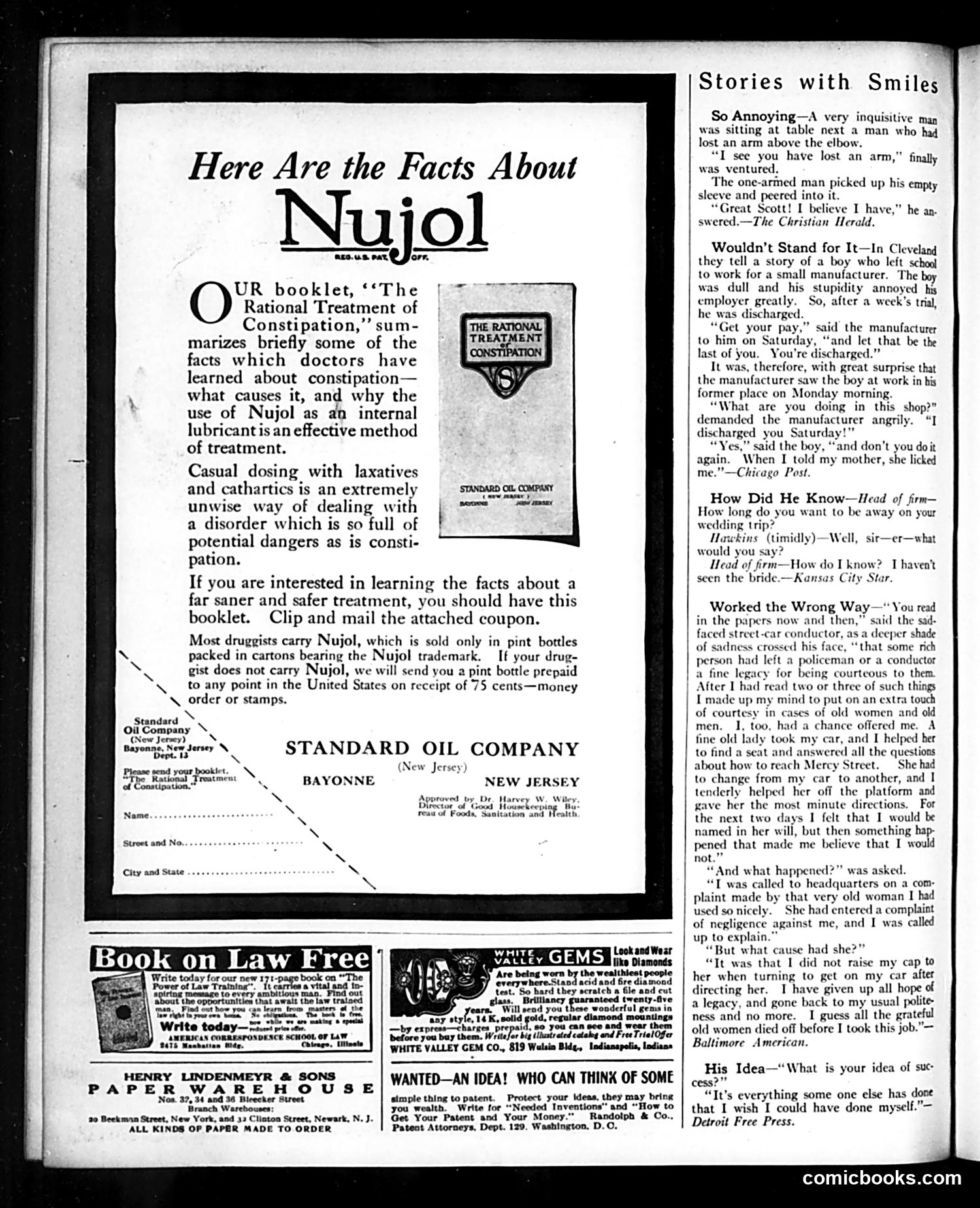
This page is primarily **advertising and humor filler**, not political satire. The main content promotes Nujol, a mineral oil laxative, through an informational booklet offer from Standard Oil Company. The "Stories with Smiles" section contains three brief jokes: 1. A one-armed man's witty response to an intrusive question 2. A discharged boy rehired by his employer (who learns the boy quit to work for a competitor) 3. A streetcar conductor's failed attempt to earn a legacy through kindness—he helped an elderly woman, who repaid him by *complaining about him* These are gentle, workplace-focused humor reflecting early 20th-century concerns: employment instability, courtesy versus pragmatism, and the unpredictability of human gratitude. The remaining ads (law book, gems, paper house) are standard period advertisements with no satirical content. **Bottom line**: This page contains no political cartoons or significant social commentary—it's routine magazine filler combining light humor with commercial promotion.
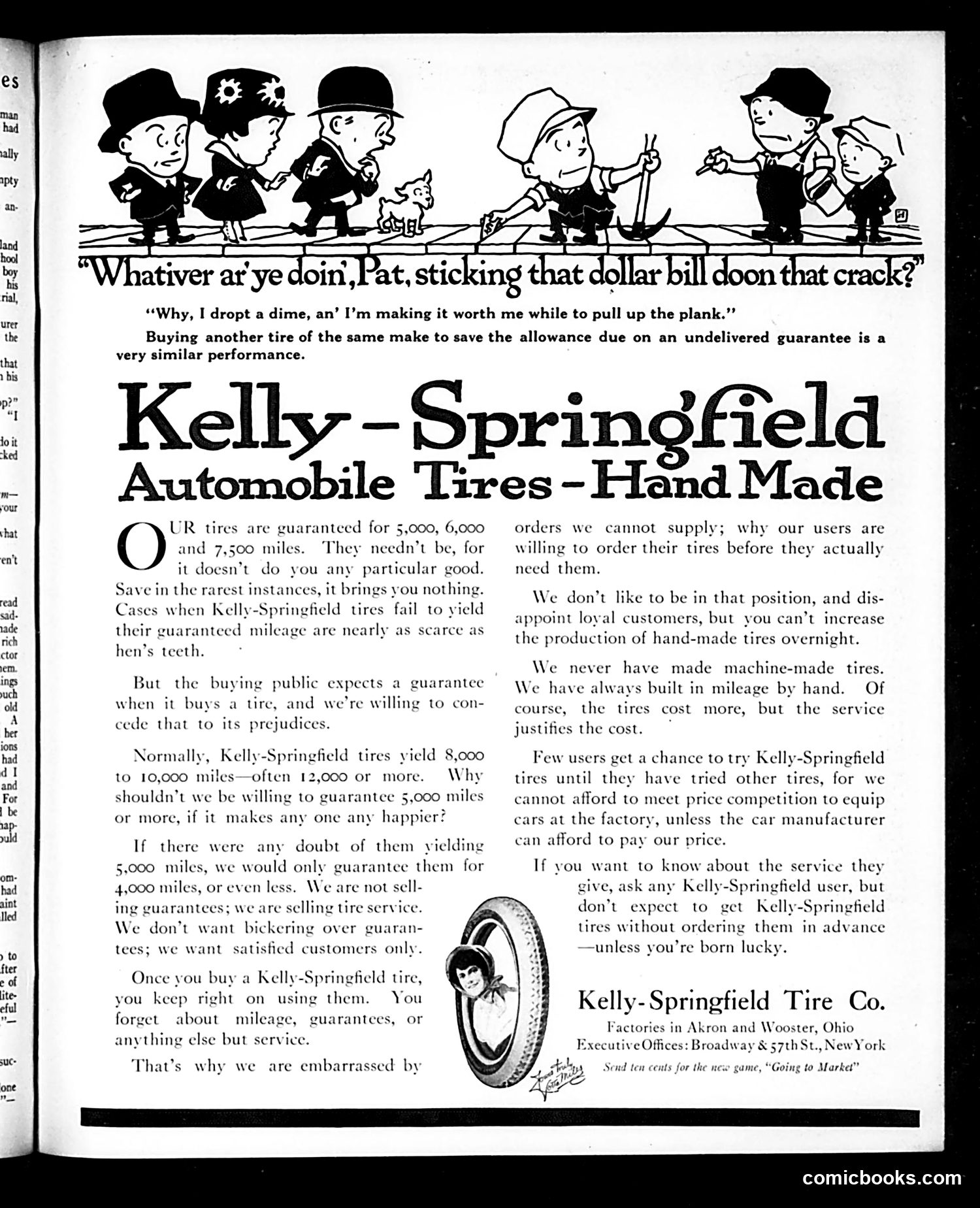
This is primarily a **tire company advertisement**, not political satire. The cartoon at top illustrates the advertisement's argument through analogy. The cartoon shows a child who dropped a dime into a plank and is now deliberately trying to extract it—working hard to recover a small amount of money. The caption notes this mirrors a consumer practice: buying replacement tires of the same brand to claim warranty allowances before delivery, essentially gaming the guarantee system. **The advertisement's core message**: Kelly-Springfield tires are so reliably durable (yielding 8,000-12,000 miles) that their 5,000-7,500 mile guarantees are nearly meaningless. Rather than compete on price with mass-produced competitors, the company emphasizes hand-crafted quality and customer satisfaction over warranty claims. The ad also references supply shortages—customers must order tires in advance because hand-made production cannot meet demand. This reflects post-WWI economic conditions when manufacturing capacity was limited.
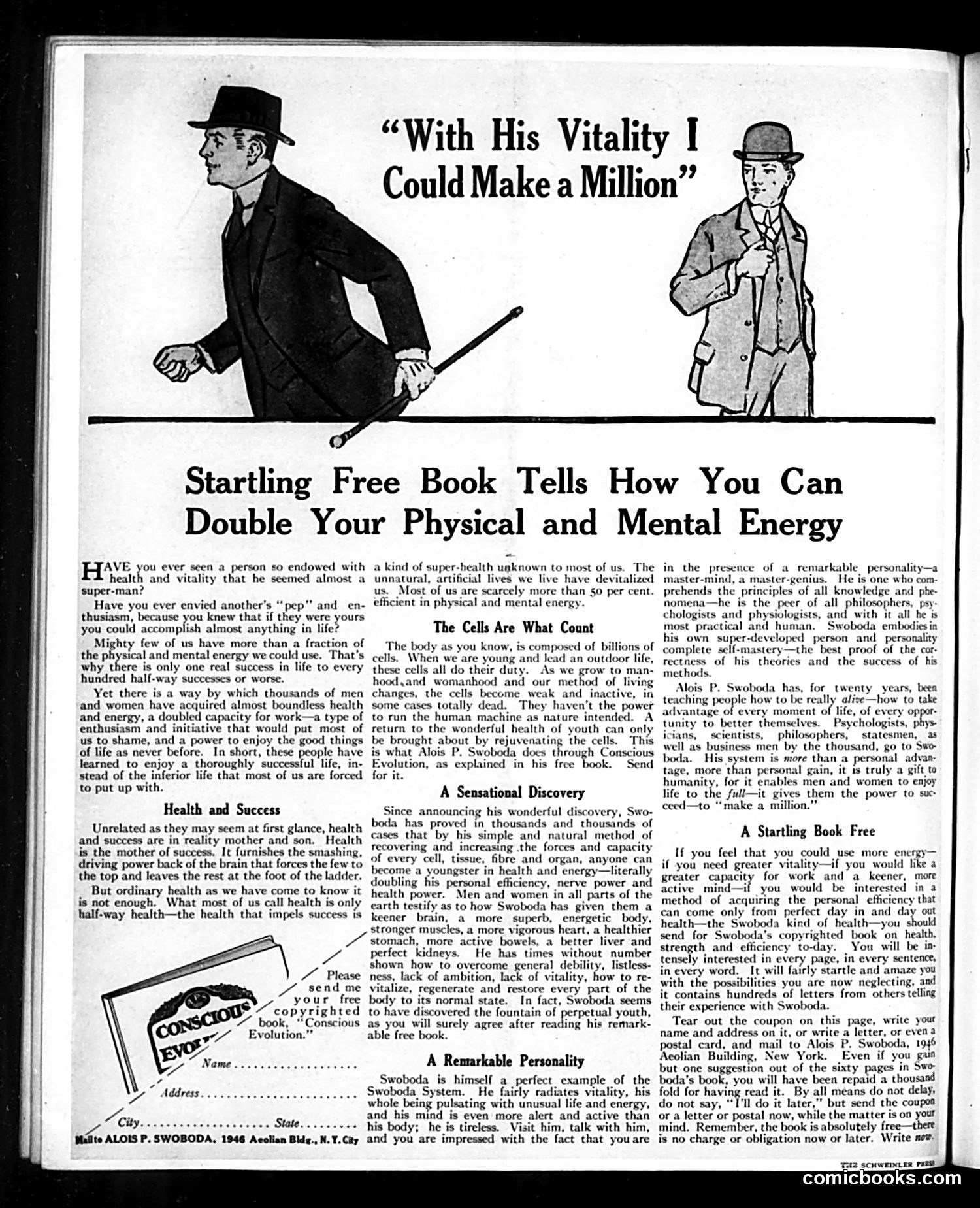
This page is primarily **advertising**, not satire. It promotes Alois P. Swoboda's "Conscious Evolution" system—a self-help program claiming to double physical and mental energy by "rejuvenating cells." The cartoon illustrates the sales pitch: a man on the left, appearing vital and energetic, says he could "make a million" with such vitality; the smaller man on the right represents the target customer—someone lacking this energy. **Historical context**: This reflects early 20th-century pseudoscientific "vitalism"—the belief that special life-force could be harnessed through specific methods. The ad promises fountain-of-youth results through mysterious cell-rejuvenation techniques. **For modern readers**: This is a classic example of dubious health marketing that exploited people's anxieties about aging and productivity. The vague promises ("rejuvenate cells," restore "youth") and celebrity-endorsement approach (Swoboda himself as proof) are recognizable modern advertising tactics, though the pseudoscience is now laughable.