
Judge, 1916-05-20 · page 18 of 28
Judge — May 20, 1916 — page 18: what you’re looking at
What you’re looking at
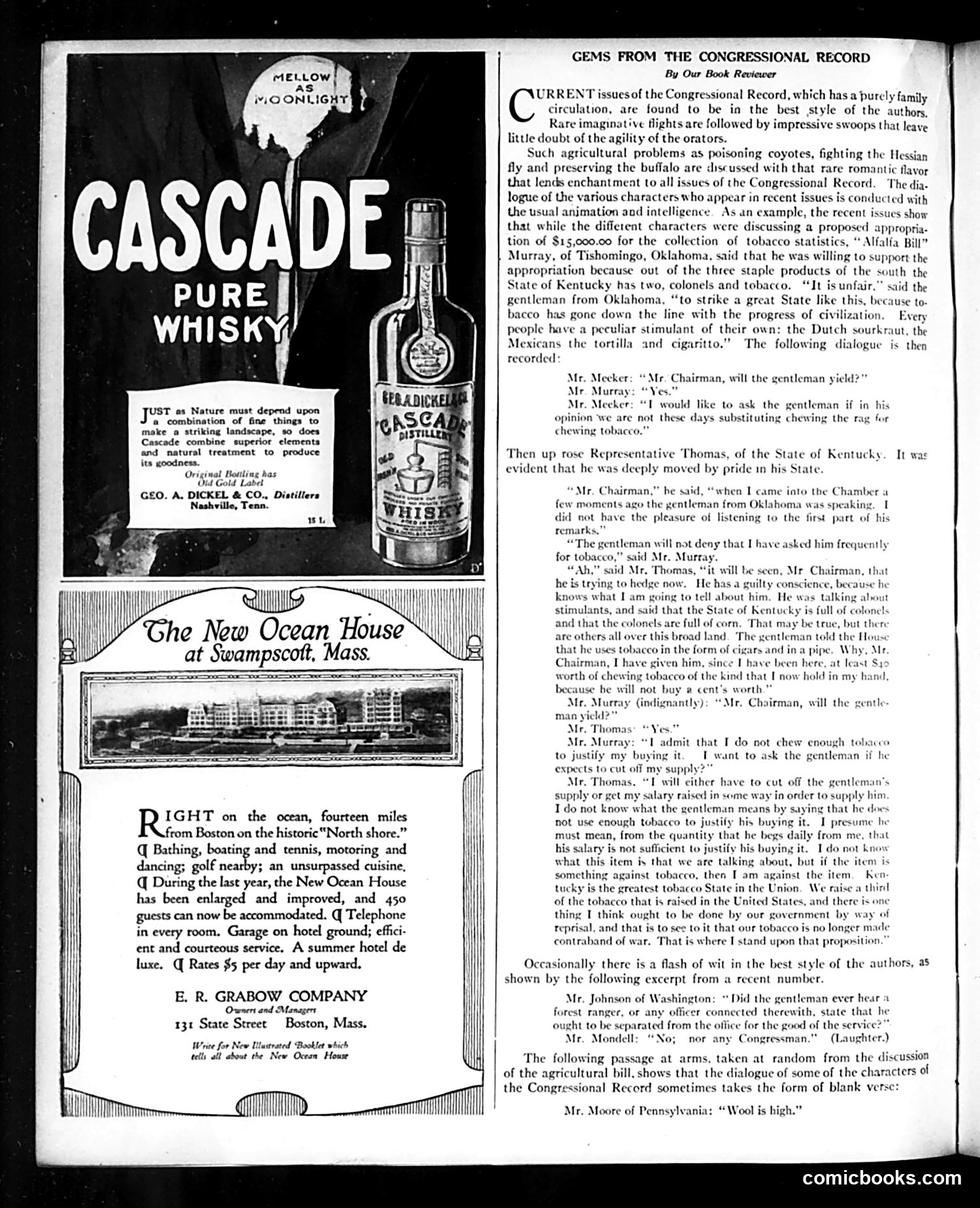
This satirical article mocks the *Congressional Record*'s publication of Congressional debates, presenting them as entertainment with literary pretension. Judge's reviewer highlights the absurdity of representatives debating trivial agricultural matters (coyote poisoning, tobacco statistics) in grandiose language. The central joke involves a heated exchange between Representative "Alfalfa Bill" Murray of Oklahoma and Representative Thomas of Kentucky over tobacco use and state pride. Thomas accuses Murray of accepting expensive chewing tobacco as gifts while claiming poverty. The dialogue deliberately captures the legislators as vain and petty—arguing over tobacco and insults rather than substantive policy. The satire suggests that the Congressional Record, despite its "purely family circulation," contains undignified bickering dressed up in flowery oratory. By reproducing this exchange verbatim, Judge exposes the gap between Congress's self-serious debates and their actually trivial, personal nature.
📄 Transcribed text from this page (OCR, searchable)
Machine-transcribed from the original scan — historical spelling and the odd misread are preserved.
MOONLIGHT CASCA PURE) WHISKY, JeST 2s Nature muse depend upon bination of fine things to make a striking landscape, so does Cascade combine superior elements and natural treatment to produce its goodness. Original Bottling has Old Gold Label GEO. A. DICKEL & CO., Distillers Nashville, Tenn. BL IGHT on the ocean, fourteen miles ‘rom Boston on the historic“North shore.” { Bathing, boating and tennis, motoring and dancing; golf nearby: an unsurpassed cuisine, {During the last year, the New Ocean House has been enlarged and improved, and 450 guests can now be accommodated. (J Telephone in every room. Garage on hotel ground; effici- ent and courteous service. A summer hotel de luxe. ({ Rates $5 per day and upward. E, R. GRABOW COMPANY Owners and Managers 131 State Street Boston, Mass. Write for New Utustrated Booklet which tells all about the New Ocesn Howse GEMS FROM THE CONGRESSIONAL RECORD By Our Book Reviewer URRENT issues of the Congressional Record, which has a purely family circulation, are found to be in the best style of the authors, Rare imaginative flights are followed by impressive swoops that leave litue doubt of the agility of the orators. Such agricultural problems as poisoning coyotes, fighting the Hessian fly and preserving the buffalo are discussed with that rare romantic flavor that lends enchantment to all issues of the Congressional Record. The dia- logue of the various characters who appear in recent issues is conducted with the usual anjmation and intelligence. As an example, the recent issues show that while the different characters were discussing a proposed appropria- tion of $15,000.00 for the collection of tobacco statistics, “Alfalfa Bill” Murray, of Tishomingo, Oklahoma, said that he was willing to support the appropriation because out of the three staple products of the south the State of Kentucky has two, colonels and tobacco. “It is unfair.” said the gentleman from Oklahoma, ‘‘to strike a great State like this, because to- bacco has gone down the line with the progress of civilization. Every people have a peculiar stimulant of their own: the Dutch sourkraut, the Mexicans the tortilla and cigaritto.” The following dialogue is then recorded Mr. Mecker: “Mr. Chairman, will the gentleman yield?” Mr. Murray 4 Mr. Meeker: “I would like to ask the gentleman if in his opinion Wwe are not these days substituting chewing the rag for chewing tobacco.” Then up rose Representative Thomas, of the State of Kentucky. It was evident that he was deeply moved by pride in his State. “Mr. Chairman,” be said, “when I came into the Chamber a few moments ago the gentleman from Oklahoma was speaking. I did not have the pleasure of listening to the first part of his remarks,” “The gentleman will not deny that I have asked him frequer for tobacco,” said Mr. Murray. “Ah,” said Mr, Thomas, “it will be seen, Mr Chairman, that he is trying to hedge now. He has a guilty conscience, because he knows what Iam going to tell about him. He was talking about stimulants, and said that the State of Kentucky is full of colonels and that the colonels are full of corn. That may be true, but there are others all over this broad land. ‘The gentleman told the Hous he uses tobacco in the form of cigars and in a pipe. Why, Mr Chairman, I have given him, T have been here, at least worth of chewing tobacco of the kind that I now hold in my hand. because he will not buy a cent’s worth.” (indignantly): “Mr. Choirman, will the gentle- admit that I do not chew enough tobacco my y buying it T want to ask the gentleman expects to cut off my supply?” Mr. Thomas. “I will either have to cut off the gentlem: supply or get my salary raised in some way in order to supply him I do not know what the gentleman means by saying that he does not use enough tobacco to justify his buying it. I presume he must mean, from the quantity that he begs daily from me, that his salary is not sufficient to justify his buying it. I do not know what this item is that we are talking about, but if the item is something against tobacco, then Tam against the item. Keo the greatest tobacco State in the Union. We raise a third of the tobacco that is raised in the United States, and there thing T think ought to be done by our government by way of reprisal, and that is to se it that our tobacco is no longer made contraband of war, That is where I stand upon that proposition. Occasionally there is a flash of wit in the best style of the authors, as shown by the following excerpt from a recent number. Mr. Johnson of Washington: * Did the gentleman ever hear 4 forest ranger, or any officer connected therewith, state that he t to be separated from the office for the good of the service?” Mr. Mondell: “No; nor any Congressman.” (Laughter.) The following passage at arms, taken at random from the discussion of the agricultural bill, shows that the dialogue of some of the characters of the Congressional Record sometimes takes the form of blank verse Mr. Moore of Pennsylvania: “Wool is high comicbooks.com