
Judge, 1916-05-20 · page 11 of 28
Judge — May 20, 1916 — page 11: what you’re looking at
What you’re looking at
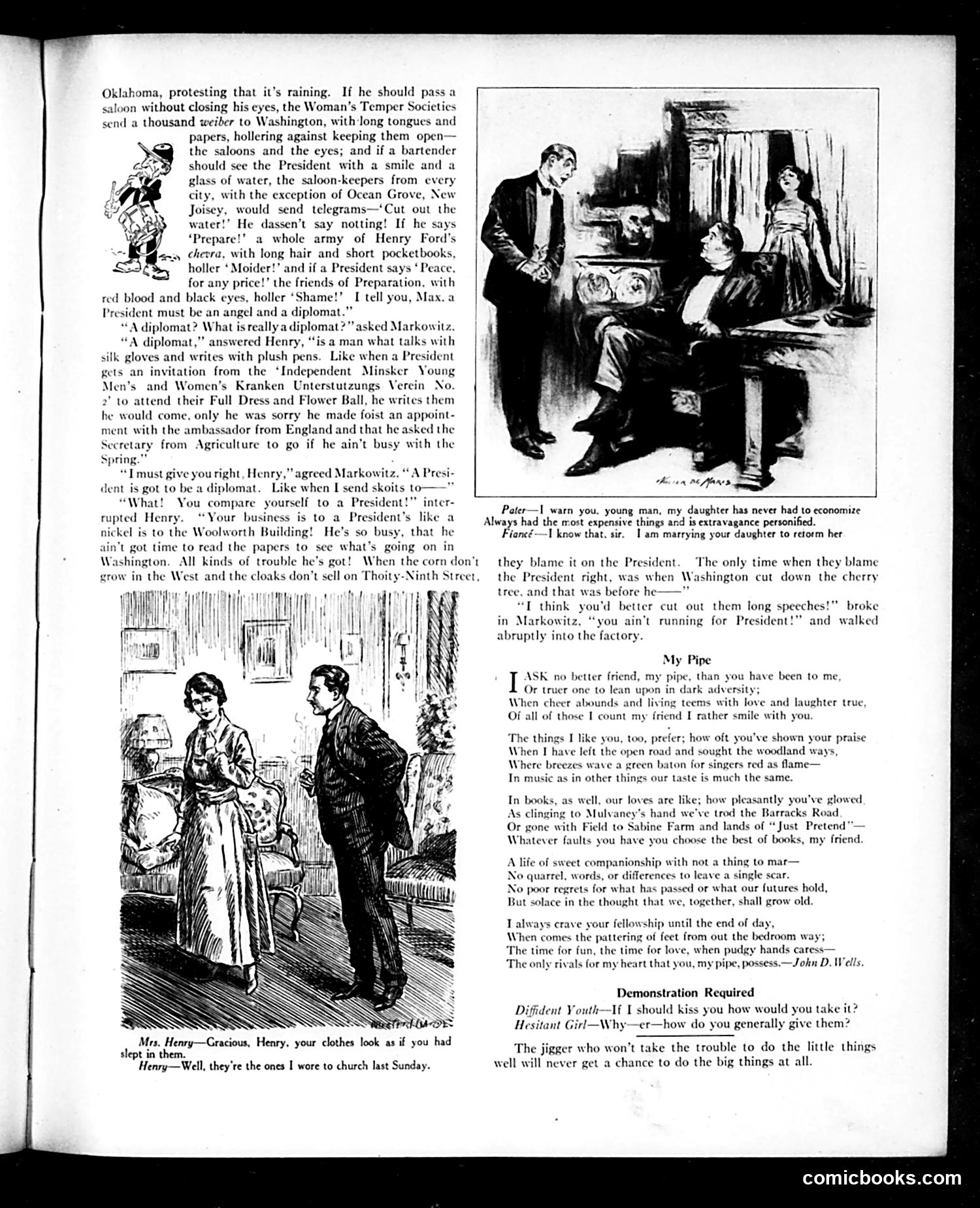
This page contains satirical dialogue mocking Presidential constraints and public expectations. **Henry** (appearing to be a Jewish immigrant character, indicated by Yiddish phrases and accent) lectures **Markowitz** about how a President must navigate impossible contradictions: temperance advocates demand he close saloons, while saloon-keepers demand he keep them open; pacifists condemn militarism while "Preparedness" advocates demand armament. The satire targets how Presidents receive blame regardless of decisions made. Henry illustrates with absurd examples: even reading newspapers risks offending someone. The comparison to Markowitz's own business struggles emphasizes the President's impossible diplomatic position. The lower sections contain unrelated content: a domestic joke about Henry's rumpled clothes, a father warning his daughter's fiancé about her extravagance, a sentimental poem about a pipe, and brief quips about decisiveness. The cartoons (two visible illustrations) depict middle-class domestic and business scenes supporting the dialogue's themes.
📄 Transcribed text from this page (OCR, searchable)
Machine-transcribed from the original scan — historical spelling and the odd misread are preserved.
Oklahoma, protesting that it’s raining. If he should pass a saloon without closing his eyes, the Woman’s Temper Societ send a thousand weiber to Washington, with long tongues and papers, hollering against keeping them open— the saloons and the eyes; and if a bartender should see the President with a smile and a glass of water, the saloon-keepers from every with the exception of Ocean Grove, . would send telegrams—‘Cut out the ’ He dassen’t say notting! If he says ‘Prepare!’ a whole army of Henry Ford’s chevra, with long hair and short pocketbooks, holler ‘ Moider!’ and if a President says ‘ Peace, for any price!’ the friends of Preparation, with red blood and black eyes, holler ‘Shame!’ I tell you, Max. a President must be an angel and a diplomat “A diplomat? What is really a diplomat?” asked Markowitz. A diplomat,” answered Henry, “is a man what talks with silk gloves and writes with plush pens. Like when a President gets an invitation from the ‘Independent Minsker Young Men’s and Women’s Kranken Unterstutzungs Verein No. to attend their Full Dress and Flower Ball, he writes them he would come, only he was sorry he made foist an appoint- ment with the ambassador from England and that he asked the ury from Agriculture to go if he ain't busy with the Secre Spring. “Tmust give you right, Henry,” dent is got to be a diplomat. Like when I send skoits to— Bian Manes “What! You compare yourself to a President!” inter- rupted Henry. “Your business is to a President’s like a nickel is to the Woolworth Building! He’s so busy, that he ain't got time to read the papers to sce what’s going on in Washington. All kinds of trouble he’s got! When the corn don’t grow in the West and the cloaks don’t sell on Thoity aye rin uw pu I im i wttyr! Mrs, Henry—Gracious, Henry. your clothes look as if you had slept in them. Henry—Well, they're the ones I wore to church last Sunday. Pater—I warn you, young man, my daughter has never had to economize Always had the most expensive things and is extravagance personified. Fianeé—I know that. sir. [am marrying your daughter to retotm her they blame it on the President. The only time when they blame the President right, was when Washington cut down the cherry and that was before he-—’ think you'd better cut out them long speeches!” tr in Markowitz, “you ain't abruptly into the factory. ASK no better friend, my pipe, than you have been to me er one to lean upon in dark adv When cheer abounds and living teems with love and laughter true, OF all of those I count my friend I rather smile with you Where breezes wav In musi gr In books, as well, our loves are like; how pleasantly y to Mulvaney’s hand w As cling Or gone with Field to Sabine Whatever faults you have you choose the best of books, my friend. A T always crave your fellowship until the end of day, When comes the pattering of feet from out the bedroom way; the time for love, when pudgy hands caress— ‘The only rivals for my heart that you, my pipe, possess.—John D. Wells. The time for f Di The jigger who won't t well will never get a chance The things I like you, too, pre! When I have left the open road and sought the woodland ways, ‘n baton for singers red as flame— in other things our taste is much the same. > of sweet companionship with not a thing to mar— No quarrel, words, or differences to leave a single scar. No poor regrets for what has passed or what our futures hold, But solace in the thought that we, together, shall grow old. Demonstration Required fident Youth—If I should ki Hesitant Girl—Why—er—how do broke running for President!” and walked My Pipe sity; how oft you've shown your praise u've glowed “ve trod the Barracks Road arm and lands of “Just Pretend’”— s you how would you take it? vou generally give them? the trouble to do the little things to do the big things at all. comicbooks.com