
A complete issue · 28 pages · 1915
Judge — October 9, 1915
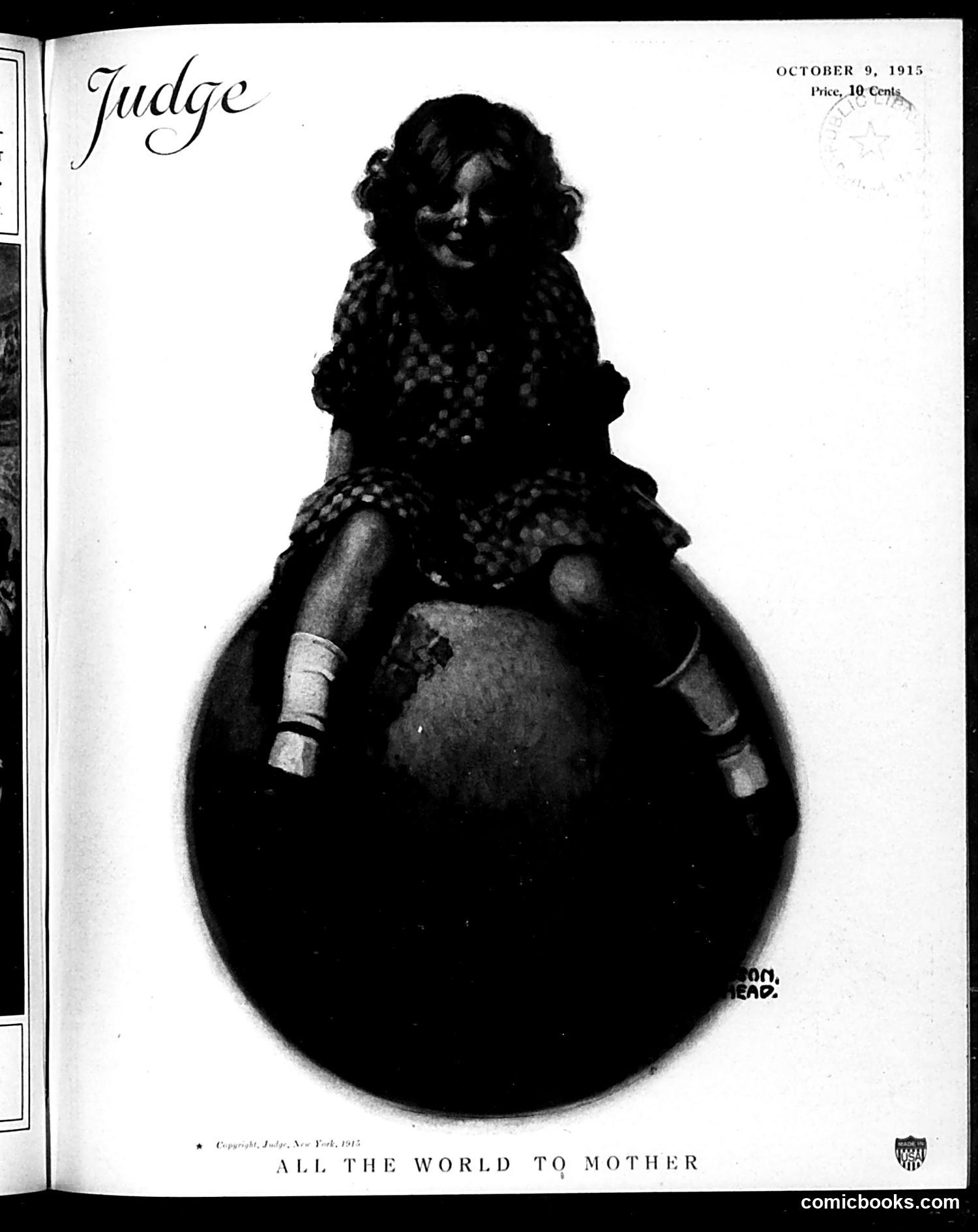
This cover illustration depicts a large globe being cradled by a woman's arms and held against her body, with a small child sitting atop it. The title "All the World to Mother" uses maternal imagery as metaphor. Published during World War I (while America remained officially neutral), this likely celebrates motherhood and protective femininity as universal values. The globe-as-child suggests either: idealization of mothers as nurturers of civilization, or commentary on maternal sacrifice during wartime when children were being sent to fight. The specific satirical intent—whether celebratory or critical of mothers' roles in war—remains unclear without additional context from Judge's editorial position in 1915.
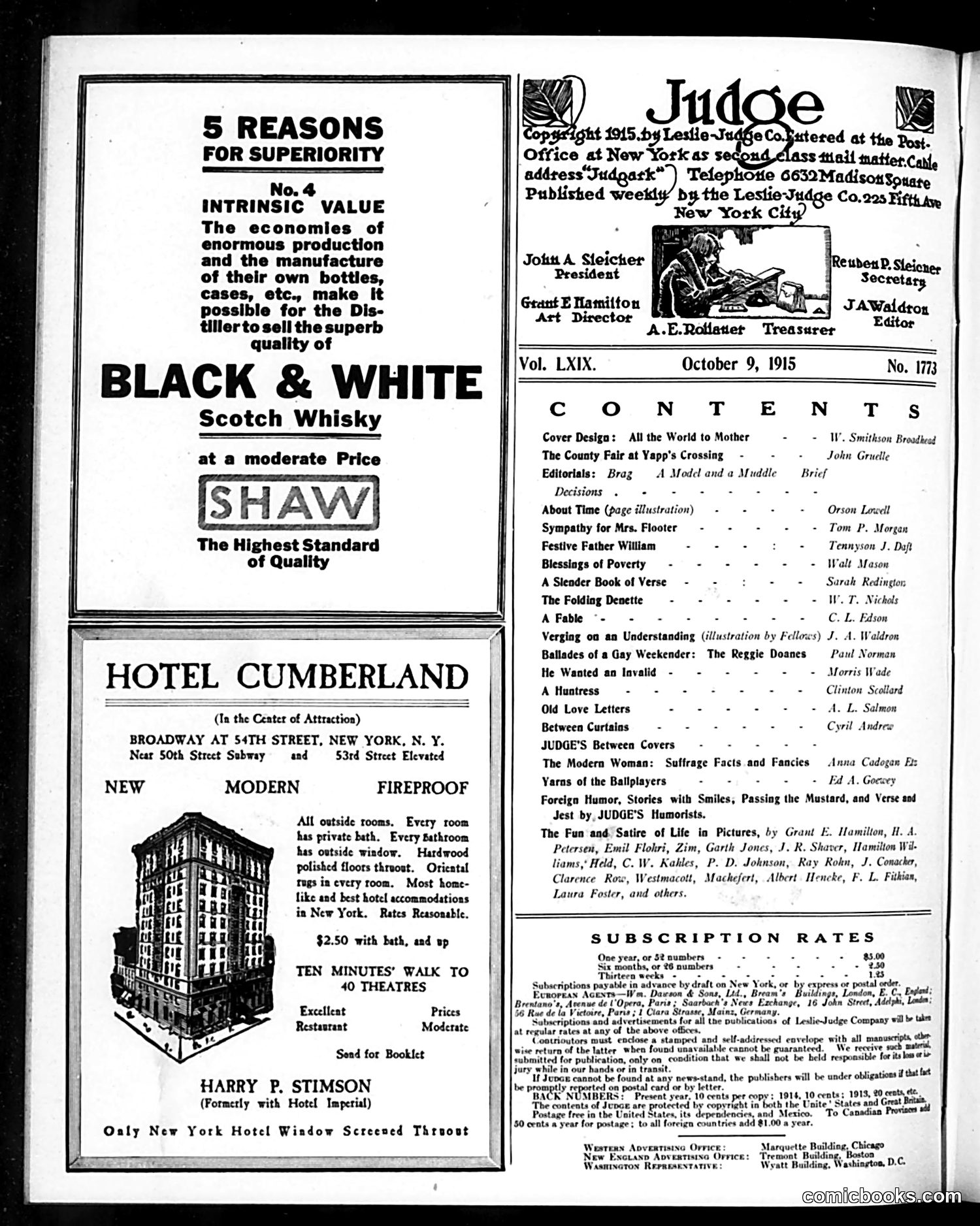
This page is primarily **advertising and magazine masthead** rather than editorial content or satire. The left column contains ads for Black & White Scotch Whisky and the Hotel Cumberland in New York. The right side shows the magazine's table of contents and subscription information. The visible content lists articles and illustrations by various authors and artists, though no specific political cartoons are evident on this particular page. Judge was known for satirical commentary on contemporary issues, but this appears to be a transitional or filler page dominated by commercial advertisements typical of early 20th-century magazines, where ads subsidized publication costs.
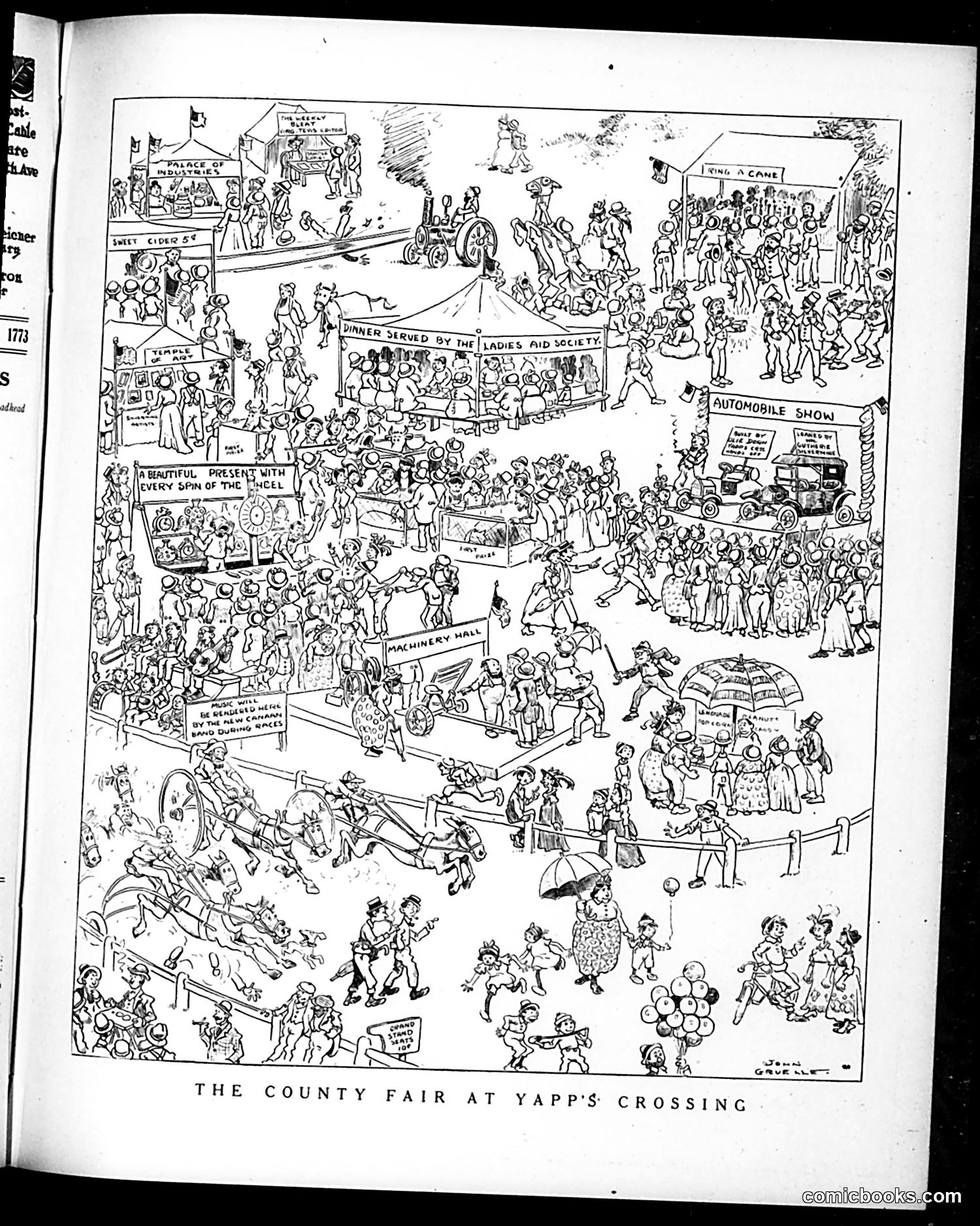
This is a dense, humorous illustration of a small-town county fair circa early 20th century. The cartoon depicts dozens of activities and attractions typical of rural American fairs: an automobile show (featuring early motorcars), a machinery hall, a dinner served by the Ladies Aid Society, various games and entertainment booths, livestock displays, and recreational activities like tug-of-war. The satire lies in the chaotic abundance—the sheer proliferation of attractions, crowds, and simultaneous activities competing for attention. The drawing style emphasizes the carnival atmosphere and social mingling across class lines. This appears to be gentle, observational humor about small-town American life rather than political satire, celebrating the earnest, bustling nature of rural community gatherings during the pre-WWI era.
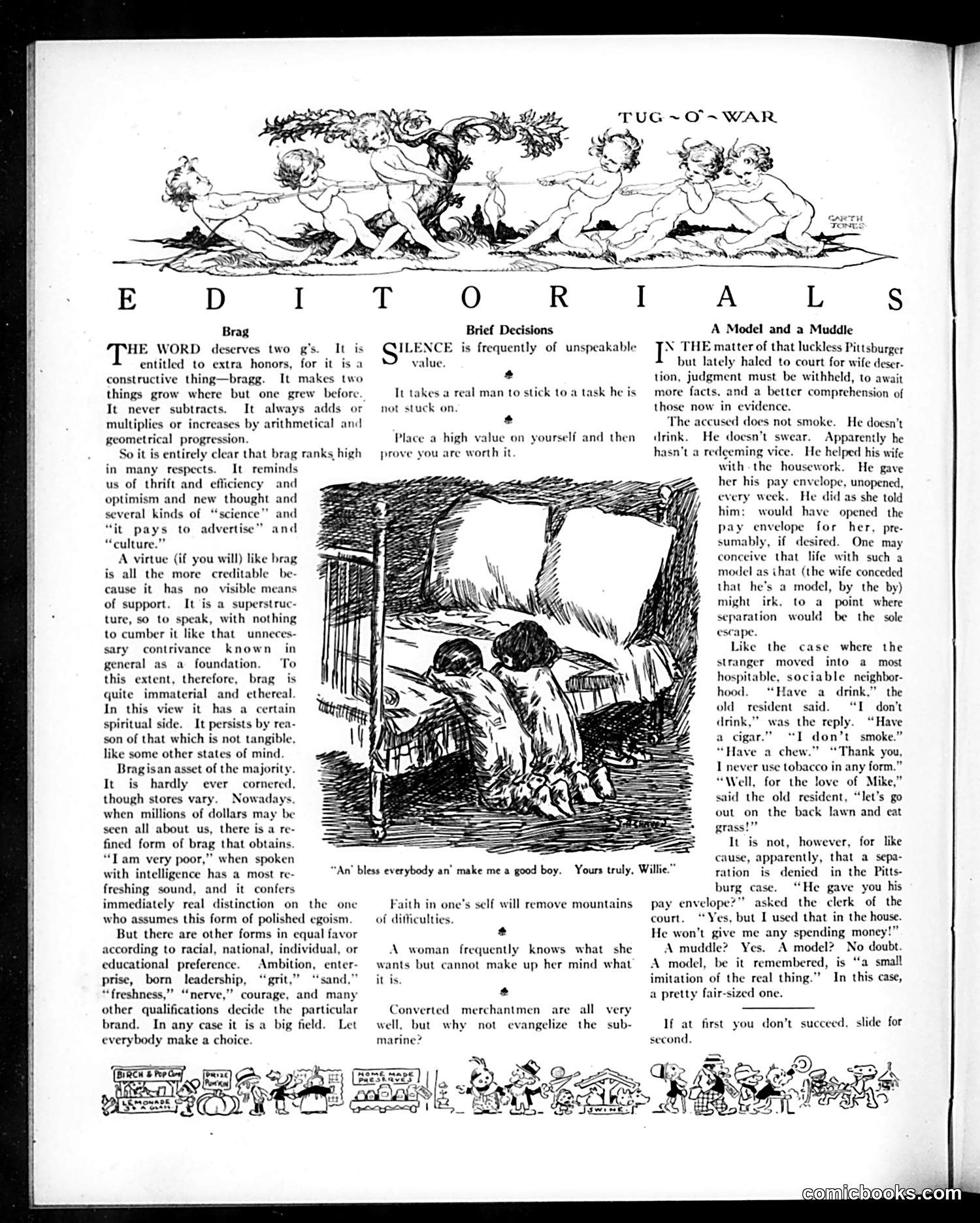
This Judge magazine page presents satirical "editorials" addressing social behavior and morality. The header illustration shows cherubs engaged in a tug-of-war, symbolizing competing moral forces. The main cartoon depicts a domestic scene: a man in bed with a woman, captioned "An' bless everybody an' make me a good boy. Yours truly, Willie." This appears to satirize hypocritical piety—a man praying to be good while engaged in infidelity or moral transgression. The surrounding text essays discuss virtues like silence, self-confidence, and faith, with particular focus on a Pittsburgh court case involving marital infidelity and a disputed pay envelope. The satire targets moral inconsistency: people who publicly espouse virtue while privately behaving unethically. The overall message critiques American hypocrisy regarding personal conduct.
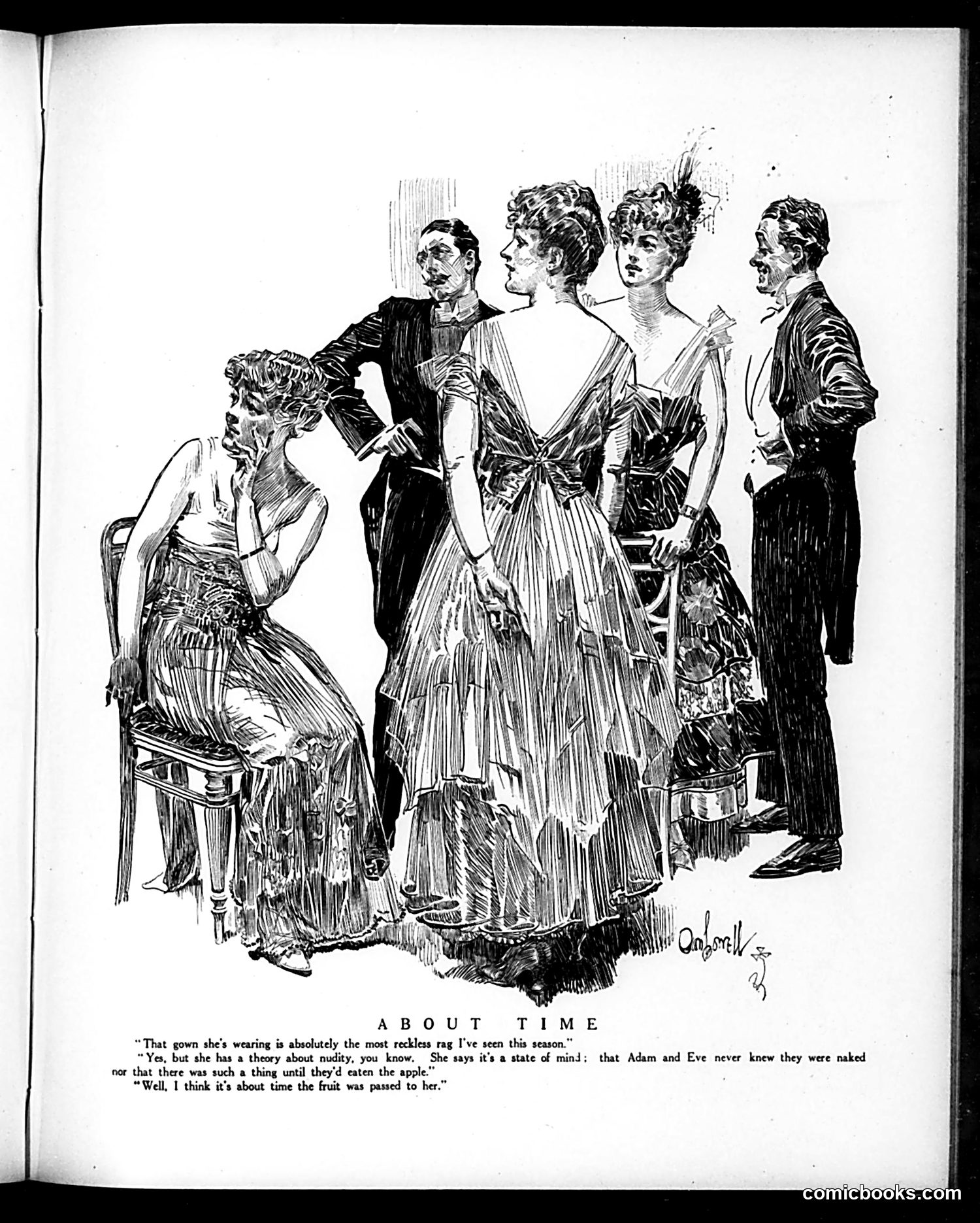
This cartoon satirizes debates over women's fashion and propriety in the early 20th century. The title "About Time" suggests an overdue conversation. A woman sitting (possibly representing "Fashion" or modern woman) is criticized for wearing what one observer calls "absolutely the most reckless rag" of the season. Another character defends her with a provocative joke: the gown represents "a state of mind" — that Adam and Eve were naked and didn't know it was wrong until eating the apple. His punchline: "Well, I think it's about time the fruit was passed to her." The cartoon mocks both prudish critics of revealing fashions and the philosophical arguments defenders used to justify them, using biblical references for satirical effect.
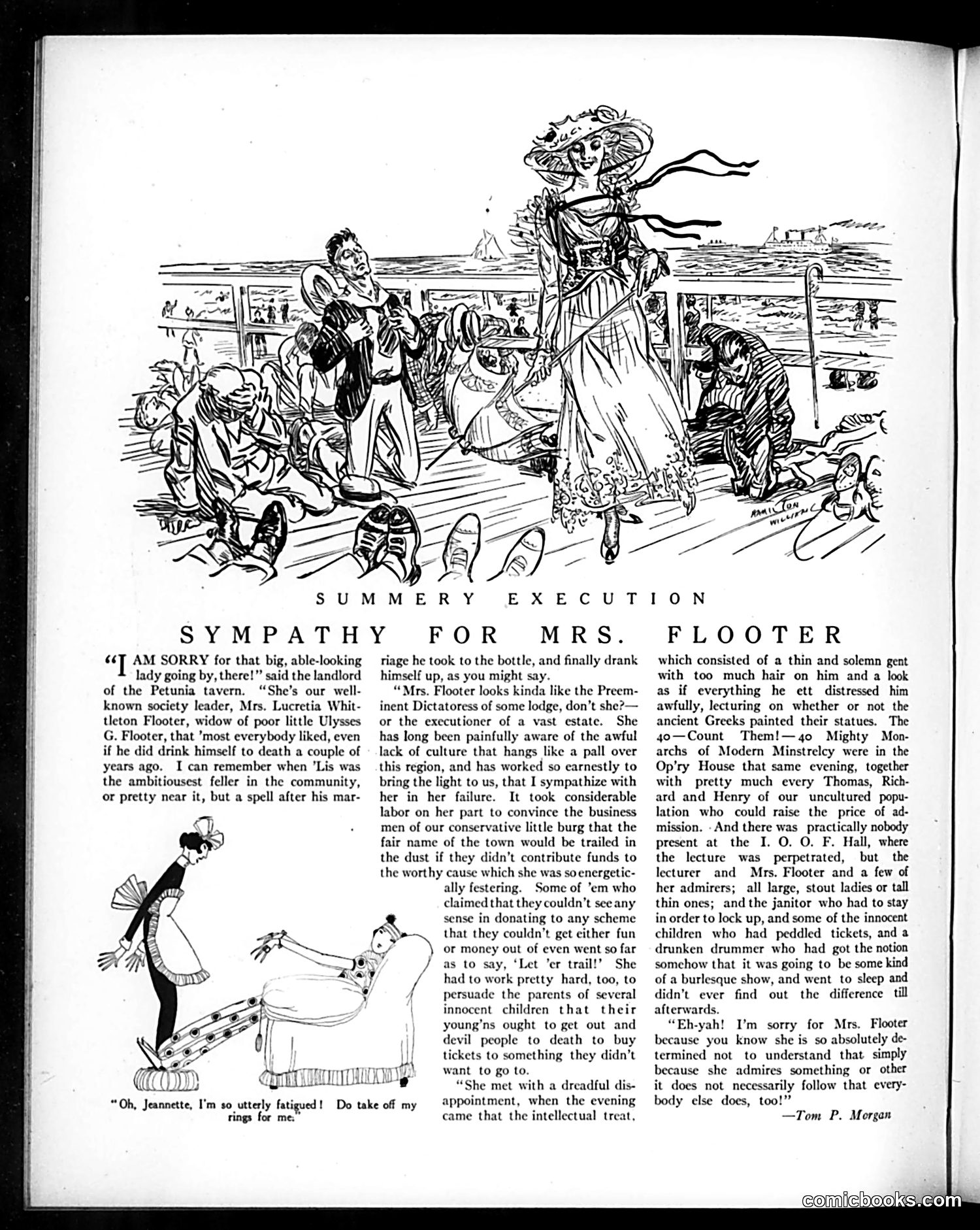
This satirical piece mocks Mrs. Lucretia Whitleton Flooter, a wealthy widow and self-appointed cultural arbiter in a small town. The joke centers on her failed attempt to elevate the community's "culture" by organizing a lecture on ancient Greek statuary. Despite her considerable effort pressuring townspeople and businesses to attend and support the event, the lecture was a humiliating flop. The speaker was described as off-putting, and the venue sat nearly empty—only her devoted admirers and a few others showed up. Meanwhile, a minstrelsy show (the "40 Mighty Monarchs") drew the actual crowds the same evening. The satire targets her arrogant assumption that her personal tastes and values automatically matter to everyone else. She cannot comprehend that ordinary people simply don't share her intellectual pretensions or desire to be "cultured" on her terms. The cartoon ridicules both her snobbish condescension and her obliviousness to her own failure.
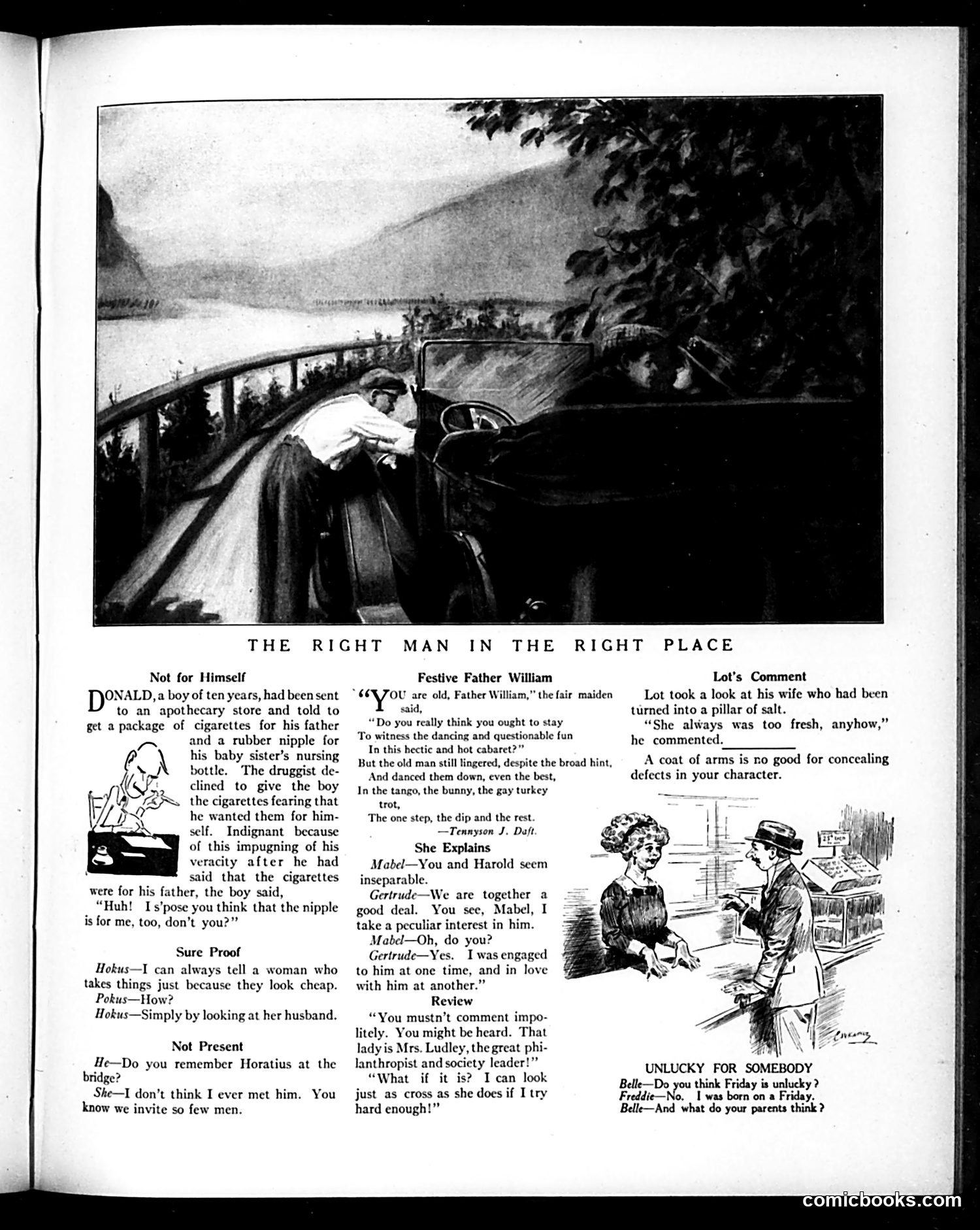
This page contains multiple brief satirical humor pieces typical of early 20th-century Judge magazine: **Main cartoon (top):** Shows a boy at an overlook with a car, illustrating the lead story about a ten-year-old sent to buy cigarettes for his father. The druggist refused, suspecting the boy wanted them for himself—the boy's indignant response mocks this assumption. **Other jokes** target social pretensions and gender dynamics: - A man judges women as cheap by observing their husbands - A woman feigns ignorance of "Horatius at the bridge" (classical reference) because her social circle is exclusive - "Festive Father William" parodies Tennyson, mocking elderly men chasing youth in cabarets - A woman admits maintaining an ex-fiancé as a romantic interest - A man comments his wife "was too fresh" after she becomes a pillar of salt (biblical Lot's wife reference) - A joke about Friday the 13th superstitions The humor relies on class consciousness, marital discord, and mocking both pretension and moral hypocrisy typical of Edwardian-era satire.
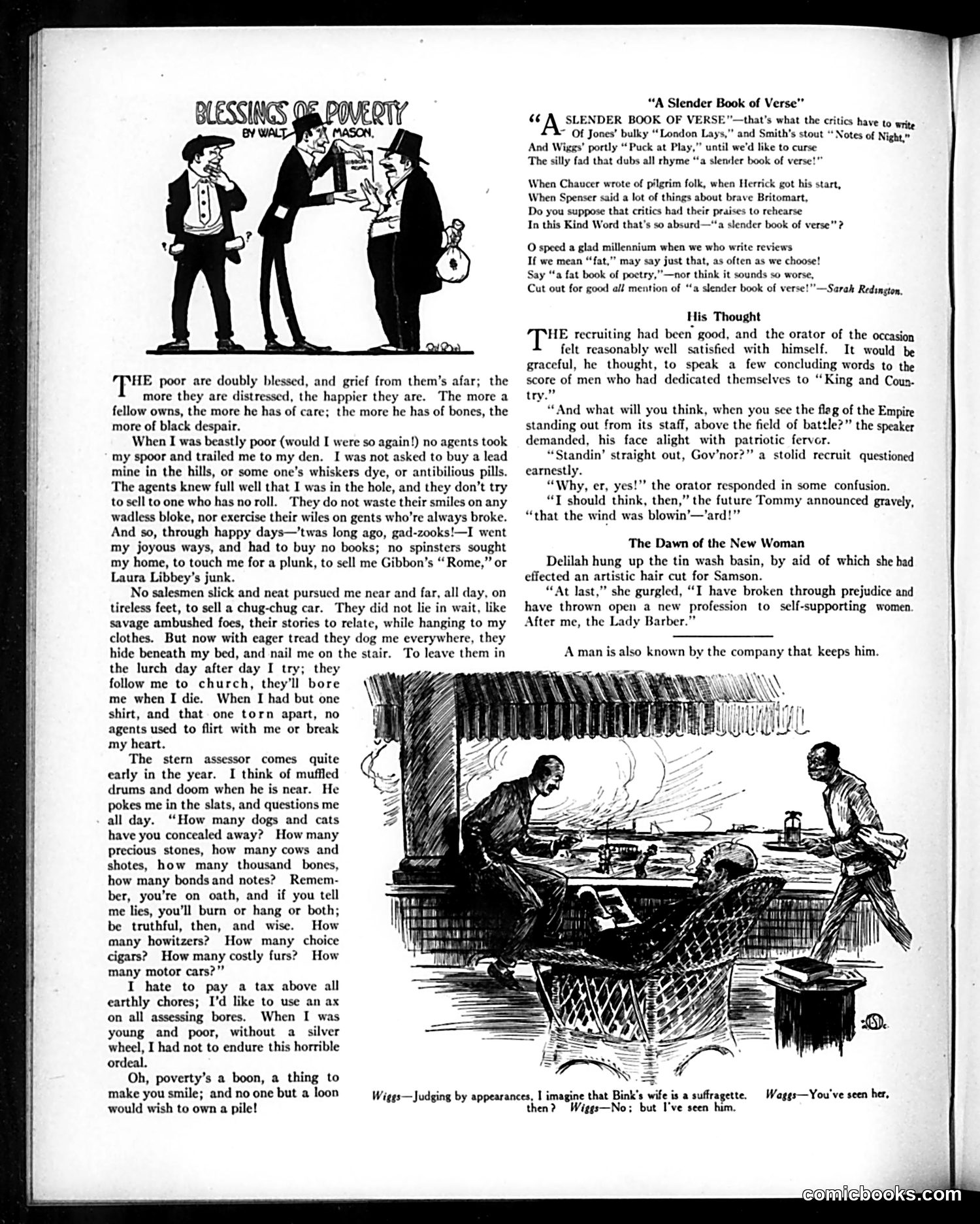
This Judge magazine page contains three satirical pieces: **"Blessings of Poverty"** (left cartoon and main text): A wealthy man's ironic lament that poverty was preferable to riches. The joke is that as a poor man, he avoided salesmen, tax assessors, and social climbers. Now wealthy, he's constantly pestered by agents selling everything from automobiles to literature, and harassed by tax collectors. The satire mocks both wealth's burdens and the aggressive sales culture of early 20th-century America. **"A Slender Book of Verse"** (top right): Critics' overuse of the phrase "slender book of verse" to describe poetry collections is ridiculed. The author argues that if a book is actually *fat*, critics should say so frankly instead of using euphemistic language. **"His Thought"** (bottom): A military recruiter delivers patriotic rhetoric about the Empire's flag during battle. A recruit's deadpan question—whether the flag will be standing straight out—deflates the emotional appeal with literal-minded practicality, mocking both recruitment propaganda and working-class soldiers' indifference to jingoistic speeches.
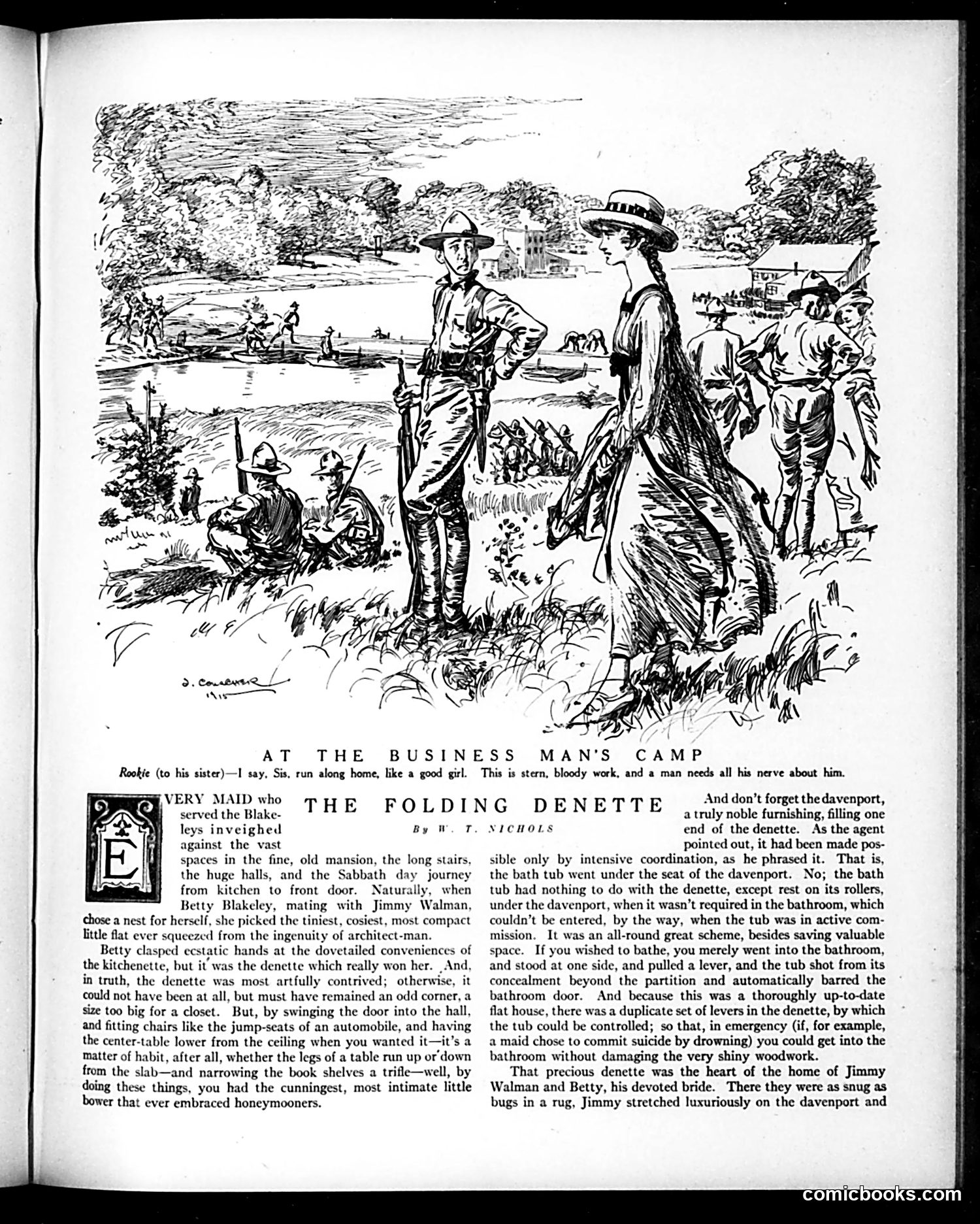
This is a humorous short story (not a political cartoon) satirizing early 20th-century apartment living and newlywed domestic life. The illustration shows a soldier ("Rookie") visiting his sister, with a military camp in background. The narrative mocks the fashionable "efficiency apartment" trend—specifically a tiny "denette" (dining-nette) designed with absurdly clever contraptions: a davenport that conceals a bathtub underneath, fold-down tables, murphy-bed style mechanics, and nested furniture. The satire peaks in dark comedy: the author notes that because of these engineering tricks, if a maid wanted to commit suicide by drowning, she'd have to do so without "damaging the very shiny woodwork." The piece pokes fun at architect-designed space-saving gimmicks marketed to newlyweds and the era's obsession with "modern" compact living, suggesting these innovations are clever but ultimately absurd and potentially dangerous.
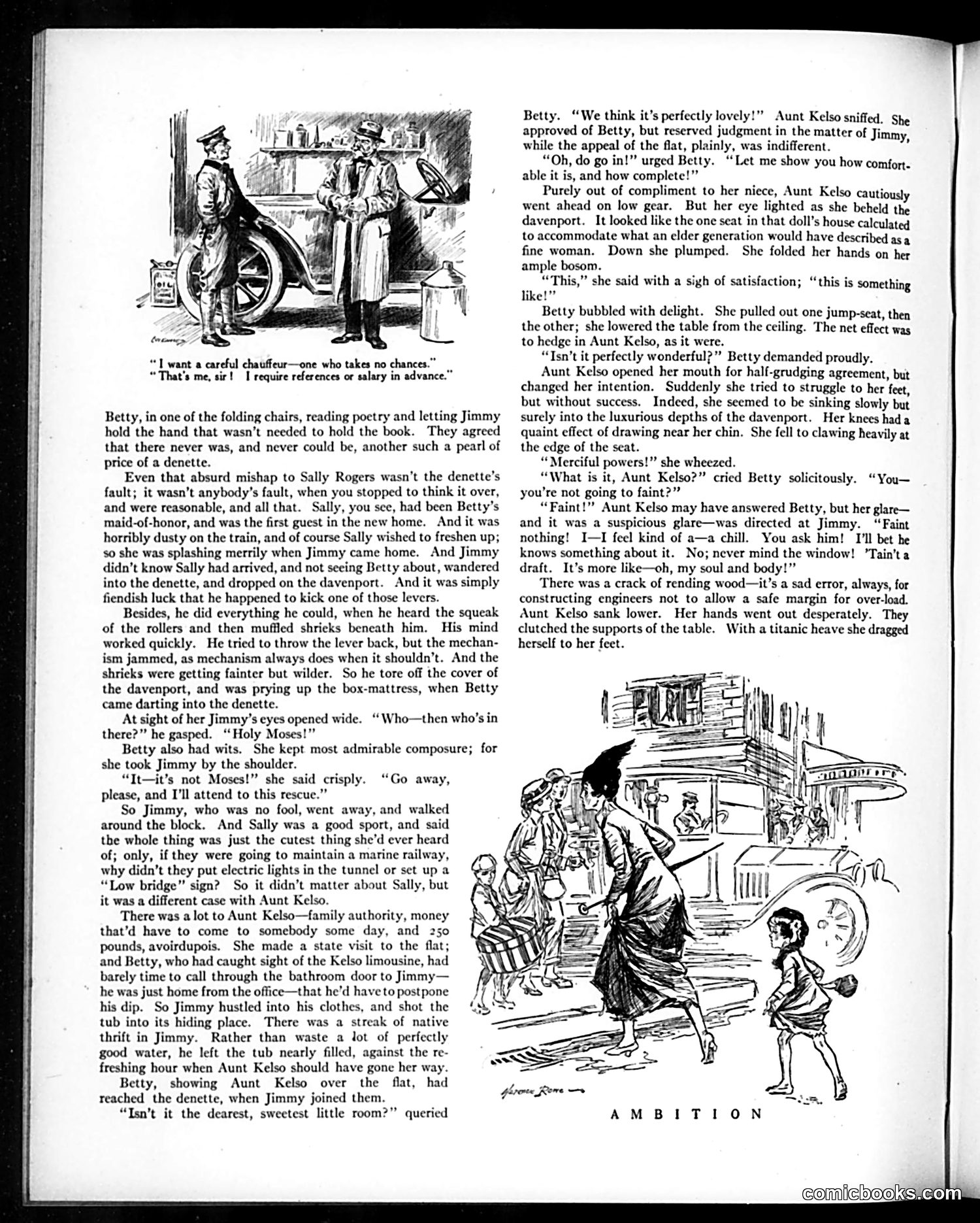
This is a humorous domestic story about a newlywed couple and their prized convertible davenport (sofa bed). The narrative describes two mishaps involving the furniture's mechanical complexity. **The Setup:** Betty and Jimmy are proud of their new apartment's clever davenport, which apparently has hidden mechanisms and folding components. A guest (Sally Rogers) accidentally gets trapped inside it when Jimmy kicks a lever, requiring rescue. **The Main Satire:** The story mocks early 20th-century "labor-saving" furniture—increasingly complex mechanical innovations marketed to homeowners. The davenport malfunctions repeatedly, trapping people and creating embarrassment rather than convenience. **The Social Commentary:** The visit from Aunt Kelso (a wealthy relative controlling family money) represents anxieties about appearing respectable to authority figures. The couple must hide evidence of the problematic furniture while maintaining appearances. **The Joke:** Modern "ingenious" design often fails spectacularly. The cartoon illustrates how newfangled contraptions intended to impress actually create disaster—a timeless domestic comedy theme.
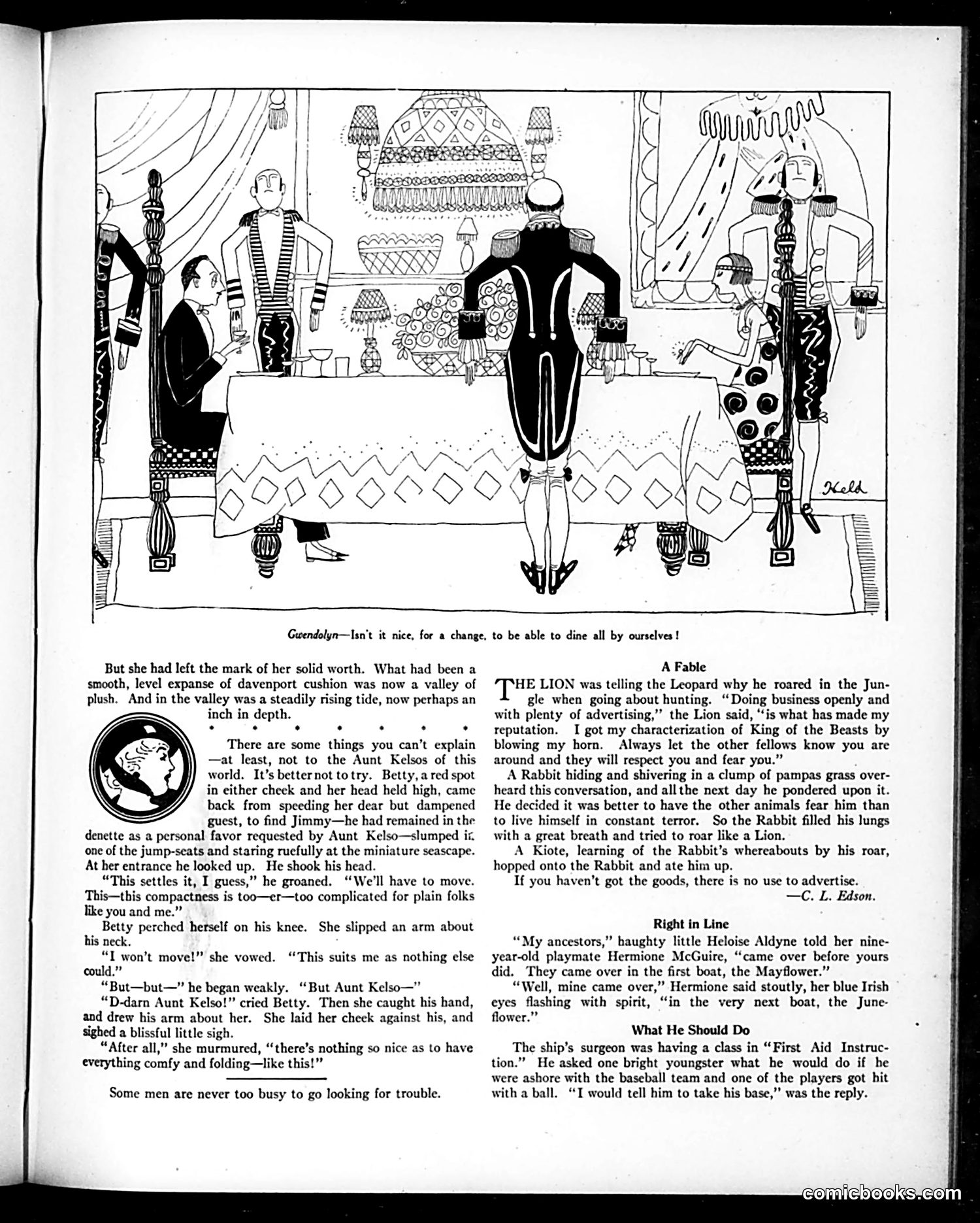
**Top Cartoon**: Depicts a couple (Jimmy and Betty) in a cramped apartment, with Aunt Kelso departing. The joke centers on apartment living's constraints—Betty has sat on a davenport so hard she's created a permanent depression in the cushion. Jimmy despairs they must move, but Betty romantically refuses, declaring "there's nothing so nice as to have everything comfy and folding." The satire targets post-WWI urban housing density and newlyweds' naive romanticism about cramped "modern" living spaces. **"A Fable"**: A moral tale about false advertising. The Lion succeeds through honest self-promotion; the Rabbit attempts deceptive boasting and gets killed by a Coyote. The lesson: "If you haven't got the goods, there is no use to advertise"—satirizing empty commercial claims. **Lower items**: Brief humor pieces mocking social pretension (ancestry snobbery) and a pun on baseball terminology ("take his base").
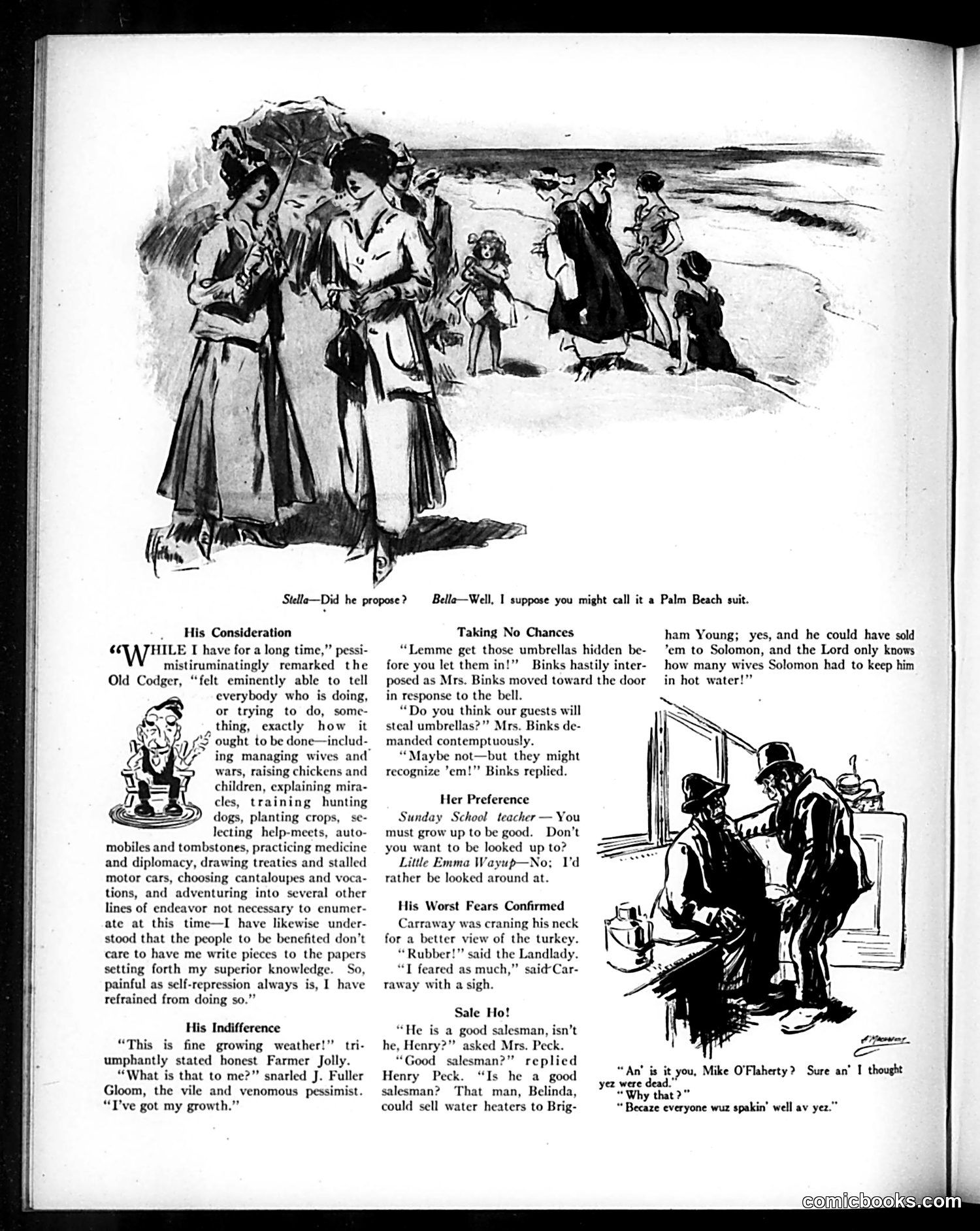
This page contains multiple unrelated comic vignettes typical of Judge's format. The top illustration shows a beach scene with the caption about a marriage proposal and "Palm Beach suit"—likely referencing the fashionable Florida destination. The text sections are brief satirical sketches mocking character types: an old codger who dispenses unsolicited advice; a pessimist indifferent to good weather; a host hiding umbrellas from guests (suggesting social class anxieties about theft); a vain Sunday school girl; a man disappointed by turkey size; and a salesman so talented he could have sold water heaters to polygamist Brigham Young and Mormon leader Solomon. The final dialogue appears to mock Irish dialect, with someone expressing surprise that another is alive because "everyone wuz spakin' well av yez"—implying the person had a terrible reputation. These are gentle, character-based humor pieces typical of early 20th-century American magazine satire, relying on social observation and period attitudes rather than topical politics.
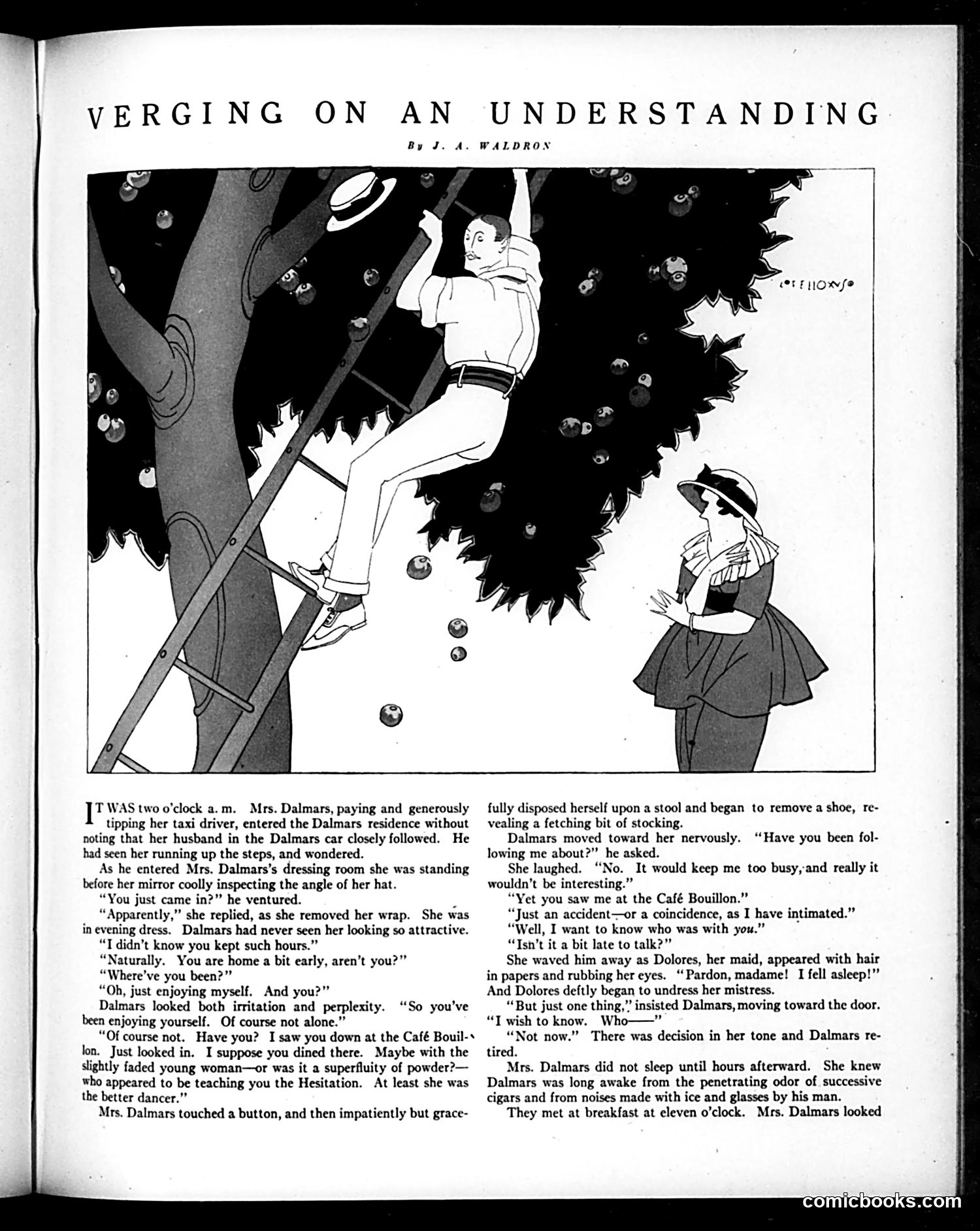
This satirical story by J.A. Waldron depicts a marital confrontation exposing mutual infidelity. Mr. and Mrs. Dalmars return home at 2 a.m. from separate outings in evening dress. When confronted, Mrs. Dalmars coolly deflects her husband's accusations by revealing he was seen at the Café Bouillon with another woman, apparently teaching her "the Hesitation" (a contemporary dance). The satire targets early 20th-century marriage dynamics: both spouses engage in suspected affairs but maintain social pretense. Mrs. Dalmars's calm evasion and refusal to answer questions—dismissing his concerns as "late to talk"—demonstrates her strategic use of indifference as power. The cartoon above shows her climbing a tree while a woman below watches, likely illustrating the absurd chaos of their entanglement. The story suggests modern marriages operated on mutual suspicion and deliberate ignorance rather than honesty.
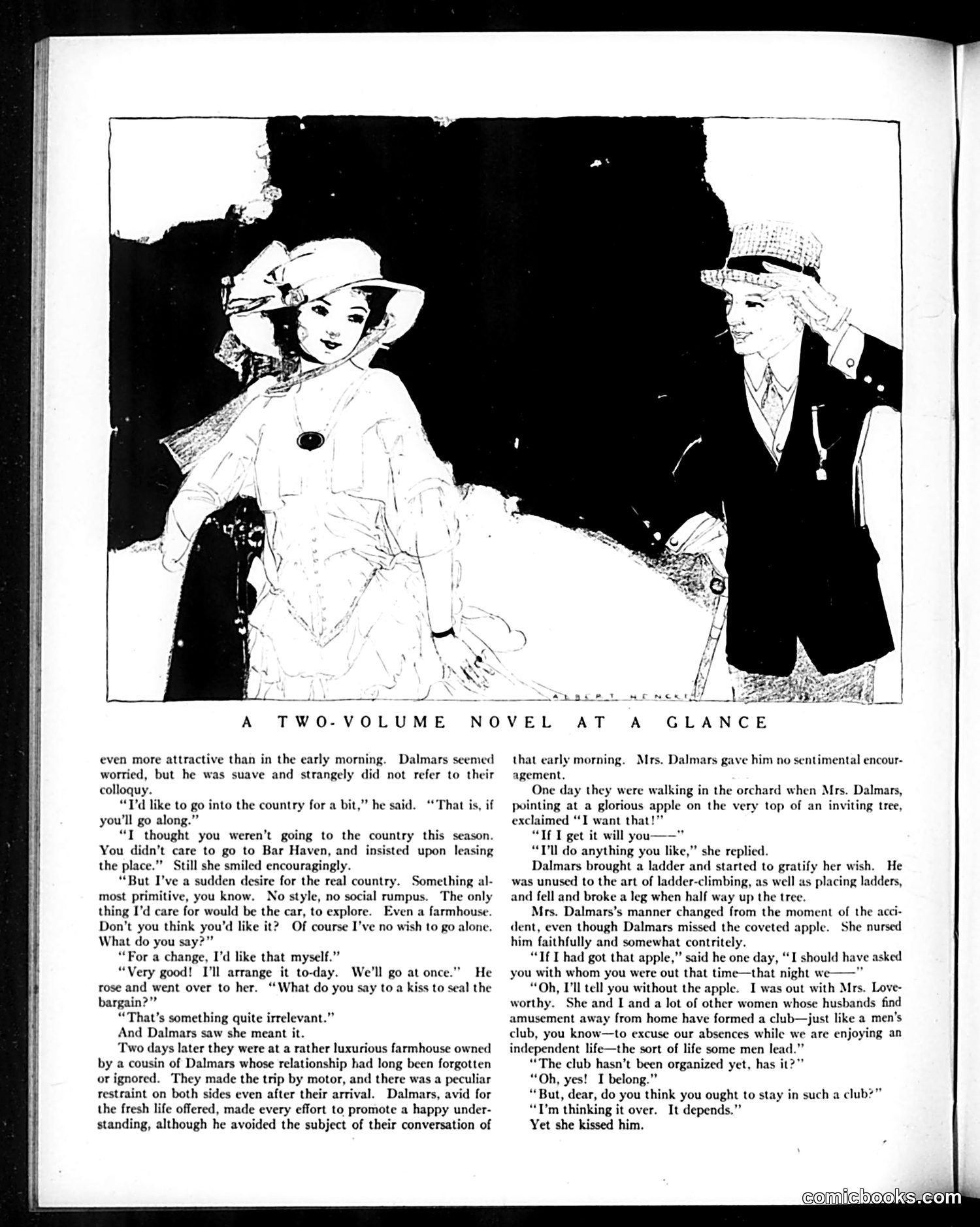
This page illustrates a "two-volume novel" serialized in Judge magazine—a domestic drama addressing early 20th-century gender relations and marital tension. **The Setup:** Mr. Dalmars attempts reconciliation with his wife after a marital argument about her mysterious evening out. He proposes a romantic country retreat, but she remains emotionally distant. **The Conflict:** Mrs. Dalmars reveals she belongs to a women's club—explicitly modeled on men's clubs—that serves as cover for independent social activities away from home and husbands. This was satirical commentary on emerging women's autonomy and the "New Woman" movement of the 1920s-30s. **The Resolution:** When Dalmars injures himself trying to retrieve an apple to win her favor, her maternal instincts surface. She confesses about the club, but remains ambivalent about leaving it. **The Satire:** Judge mocks both marital discord and women's increasing independence from domestic constraints—presenting the wife's autonomy as simultaneously sympathetic and troubling to contemporary (male) readers.
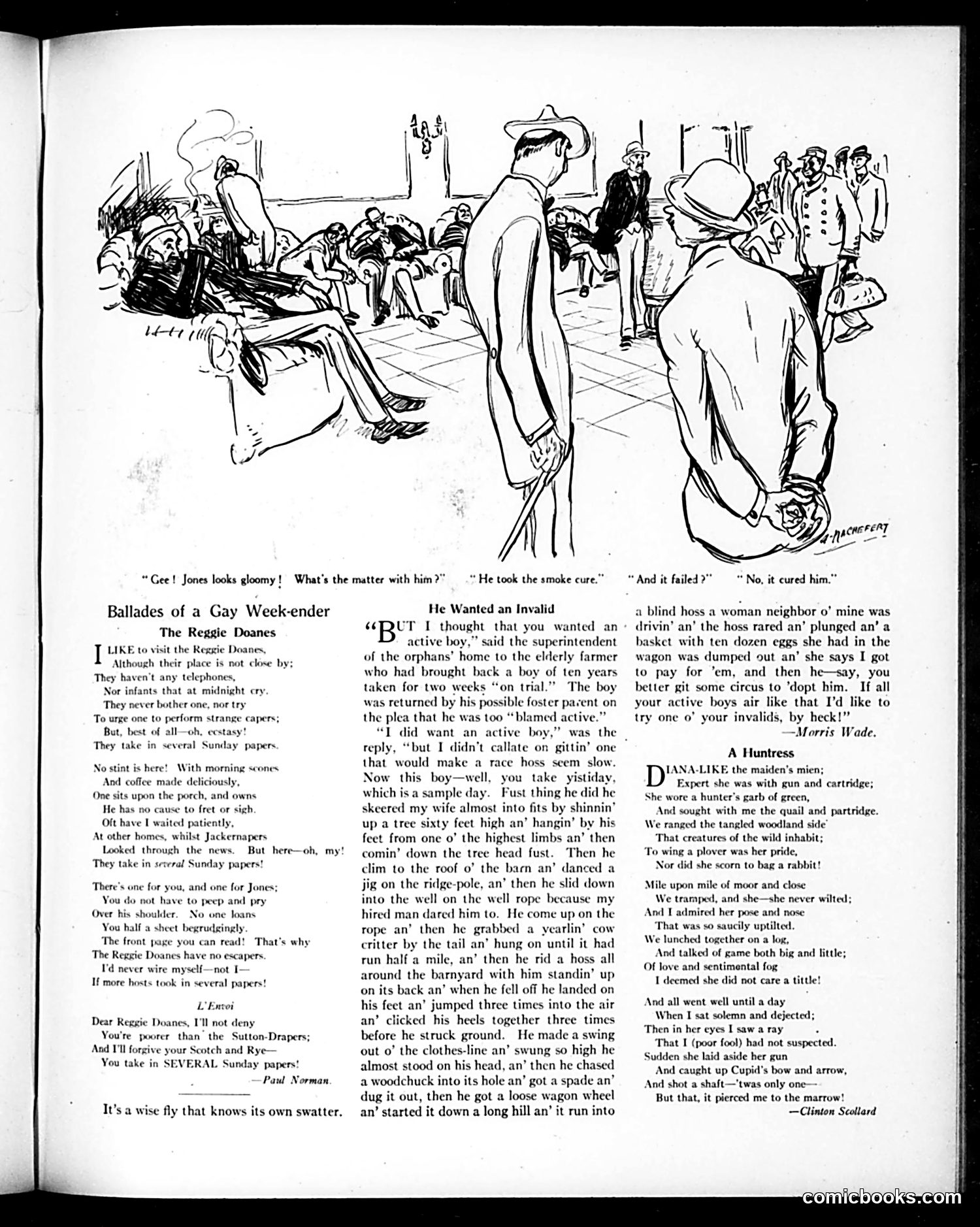
This page contains three humorous pieces satirizing upper-middle-class American social life, likely from the early 20th century. **Top cartoon:** A brief joke about "Jones" appearing gloomy after receiving "the smoke cure"—apparently a medical treatment involving smoke inhalation, presented as ineffective. **"Ballades of a Gay Week-ender":** A poem praising hosts (the "Reggie Doanes") who subscribe to multiple Sunday newspapers, allowing guests their own paper without sharing. This satirizes the status-consciousness of leisure-class visiting and the petty annoyances of shared newspaper reading—a luxury problem for affluent households. **"He Wanted an Invalid":** A humorous rural dialect story where a farmer returns an orphan boy deemed "too active," describing absurdly dangerous stunts (tree-climbing, roof-dancing, well-rope-swinging). The irony: the "active boy" cure worked by exhausting the farmer into preferring invalids. It mocks both orphan-placement practices and rural attitudes. **"A Huntress":** A romantic poem about a woman hunter, incomplete on this page. All reflect Judge's satirical focus on American leisure-class pretensions and domestic comedy.
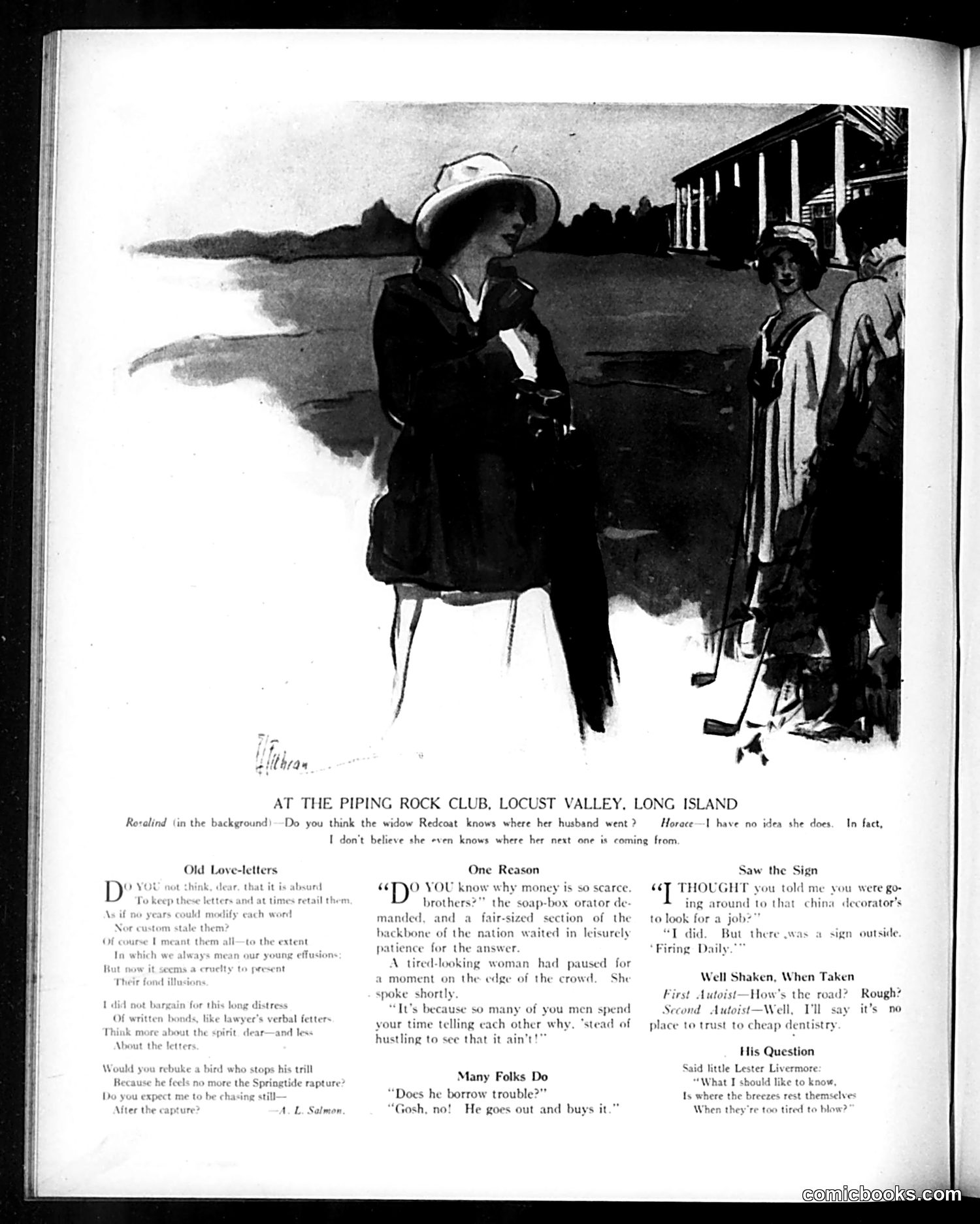
This page presents multiple short satirical vignettes about 1920s-era social and economic issues. The main illustration depicts a scene at an exclusive country club (Piping Rock Club, Long Island), where wealthy people gossip about a widow's marital infidelity—suggesting casual dissolution of marriages among the elite. The text pieces below mock various social failings: men exchanging complaints instead of working ("One Reason" for scarce money), employment desperation during what appears to be an economic downturn ("Saw the Sign"—jobs advertised as "Firing Daily"), automobile road conditions, dental care quality, and financial irresponsibility ("Many Folks Do"—a man who "buys" trouble rather than borrowing it, suggesting excessive spending). The satire targets both wealthy frivolousness and working-class economic struggles of the period, using humor to critique laziness, unemployment, and poor judgment across social classes.
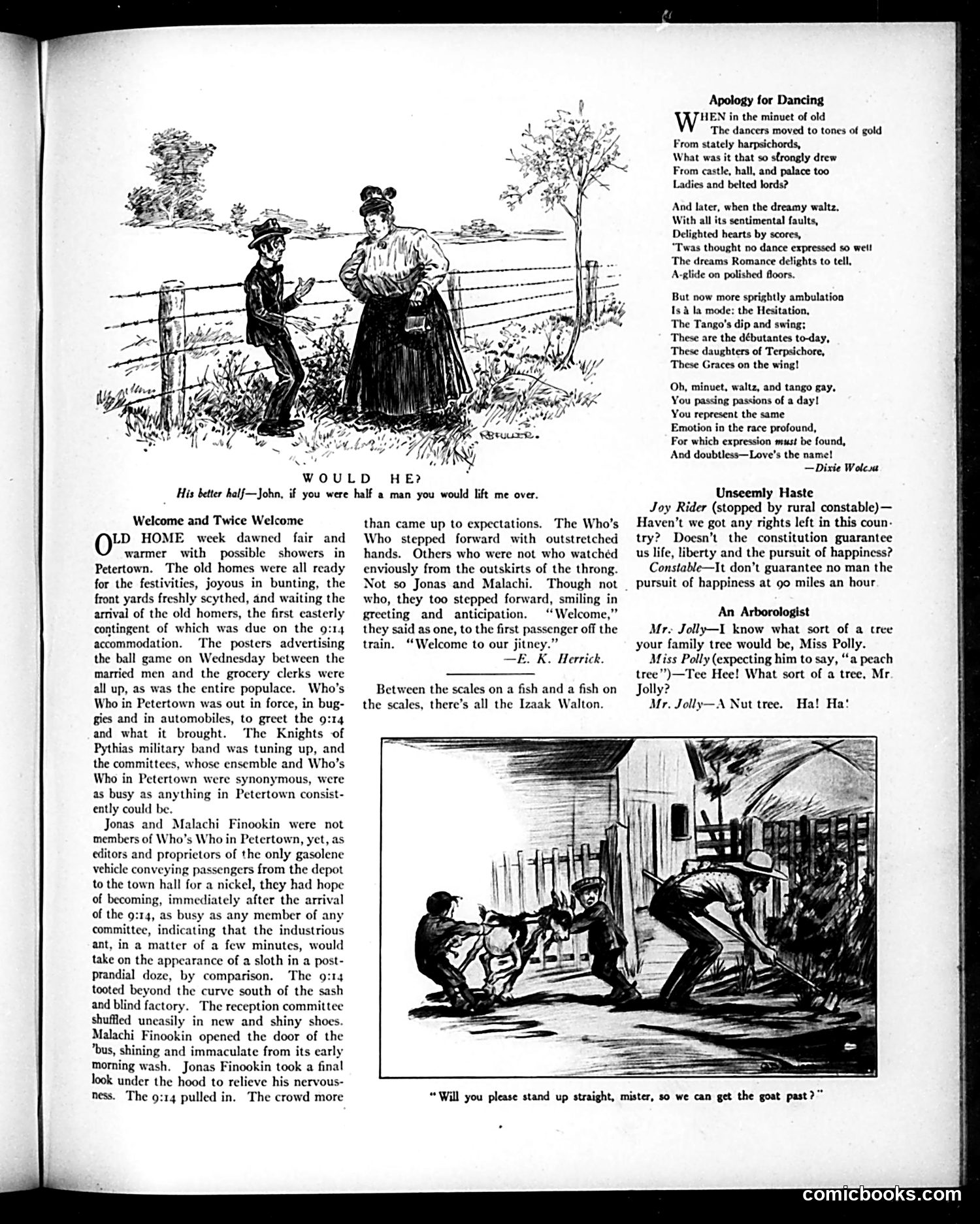
This page contains humorous fiction and poetry satirizing early 1900s American social life. **Main Story ("Welcome and Twice Welcome")**: A comedic narrative about "Old Home Week" in a small town called Petertown. Jonas and Malachi Finookin, working-class operators of a "jitney" (early motorized taxi), hope to gain social status by transporting arriving train passengers. The satire targets small-town social hierarchy—the exclusivity of "Who's Who in Petertown" and the aspiration of ordinary people to climb social ranks. **Other Content**: - "Apology for Dancing": A nostalgic poem lamenting modern dance crazes (Hesitation, Tango) replacing classical dances (minuet, waltz), reflecting generational anxiety about changing morals. - Brief comic exchanges mocking a "Joy Rider" speeding at 90 mph and a pun about family trees ("Nut tree"). The cartoons illustrate rural/small-town life with gentle mockery of social pretension and modernization anxieties typical of early-20th-century American satire.
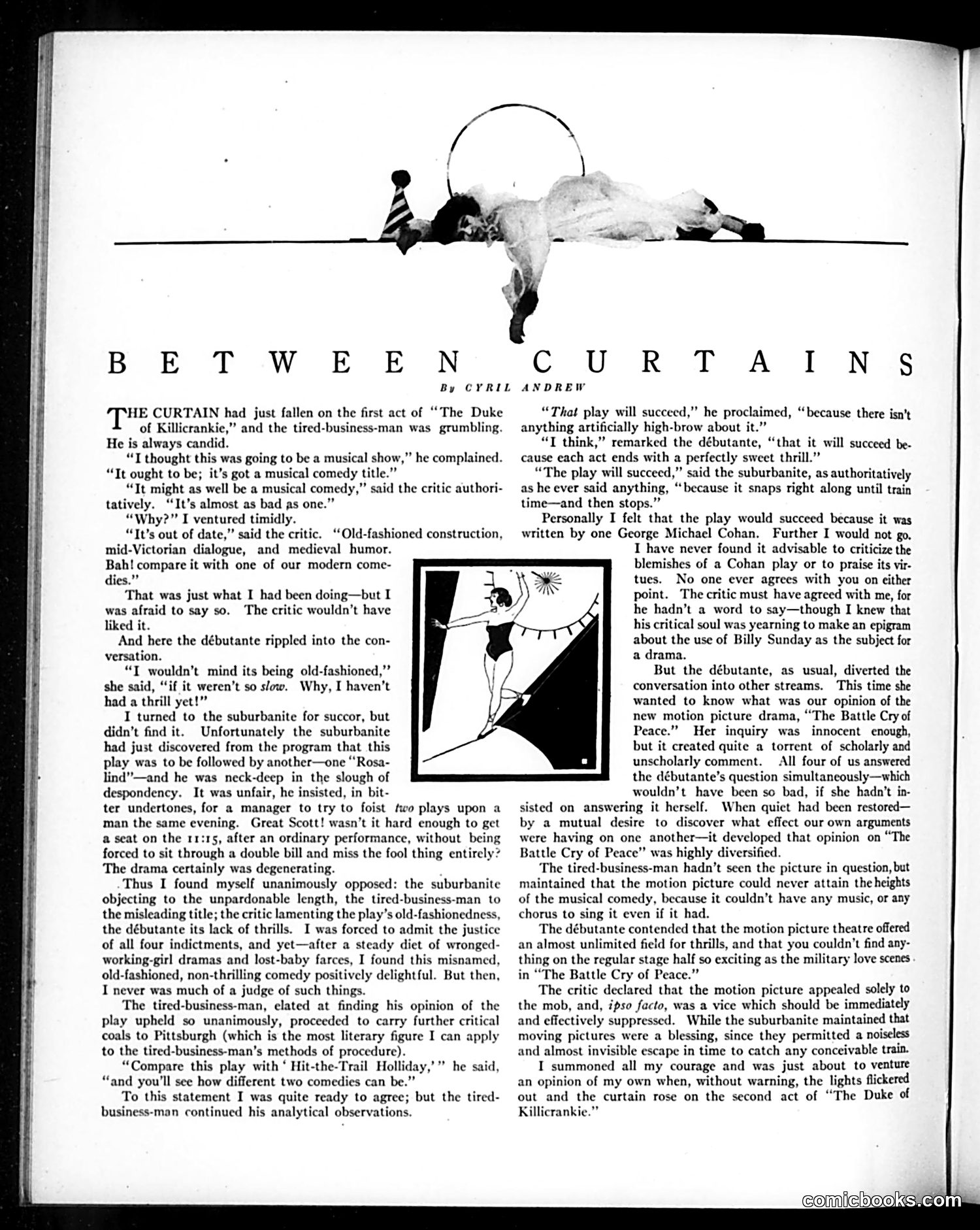
This satirical piece by Cyril Andrew mocks theater-goers' predictable complaints and contradictory opinions. The illustration shows a figure suspended above a horizontal line—suggesting the precarious position of plays caught between audience expectations. The article presents stock characters—a tired businessman, a critic, a debutante, and a suburbanite—each dismissing a play ("The Duke of Killicrankie") for different reasons: old-fashioned construction, lack of thrills, inconvenient length, and misleading marketing. The satire's point: these audiences judge plays through narrow, self-interested lenses rather than artistic merit. The author's punchline—that he enjoyed the "misnamed, old-fashioned" comedy while everyone else complained—undercuts their authority. By invoking George Michael Cohan (a major contemporary playwright/composer) as beyond critical analysis, Andrew further satirizes how audiences defer to celebrity rather than forming independent judgments. The piece critiques shallow theatergoing culture and the impossibility of pleasing arbitrary audiences.
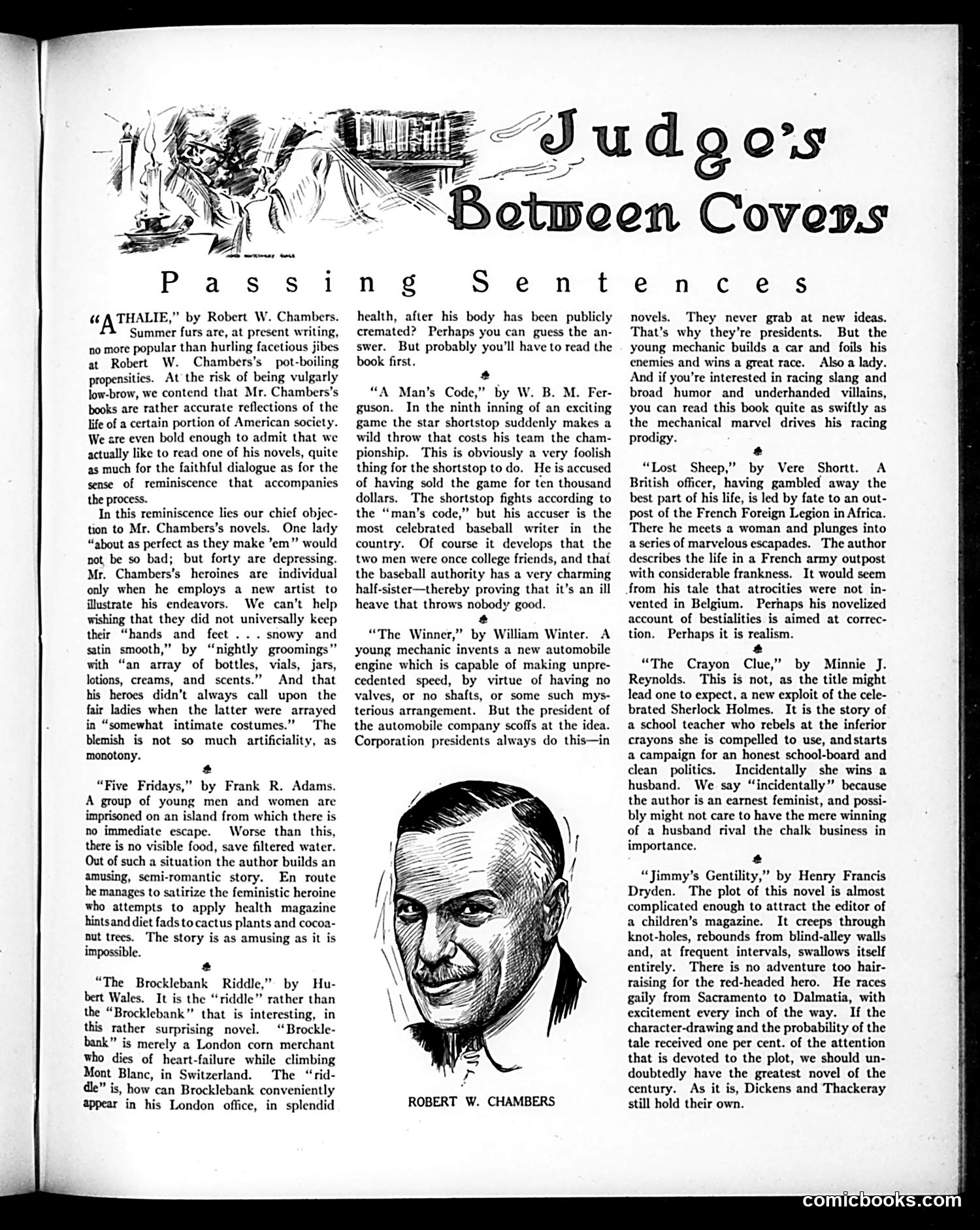
This page from Judge magazine contains book reviews rather than political cartoons. The single illustration is a portrait of author Robert W. Chambers, whose prolific output is the primary target of satire. The reviews mock popular fiction conventions of the era through gentle ridicule. Chambers is criticized for repetitive heroines who are artificially "perfect"—repeatedly described with identical grooming rituals and intimate costumes. The reviewer admits actually enjoying Chambers's work but finds the monotony tedious. Other reviewed novels follow predictable plot formulas: stranded lovers without food, impossible mysteries explained through cremation tricks, sports scandals resolved by revealing past friendships and convenient half-sisters, and young inventors whose corporations foolishly reject their innovations before ultimately vindication. The satire targets both the authors' formulaic storytelling and readers' predictable tastes—suggesting that popular fiction of this period relied heavily on recognizable tropes rather than originality or serious ideas.
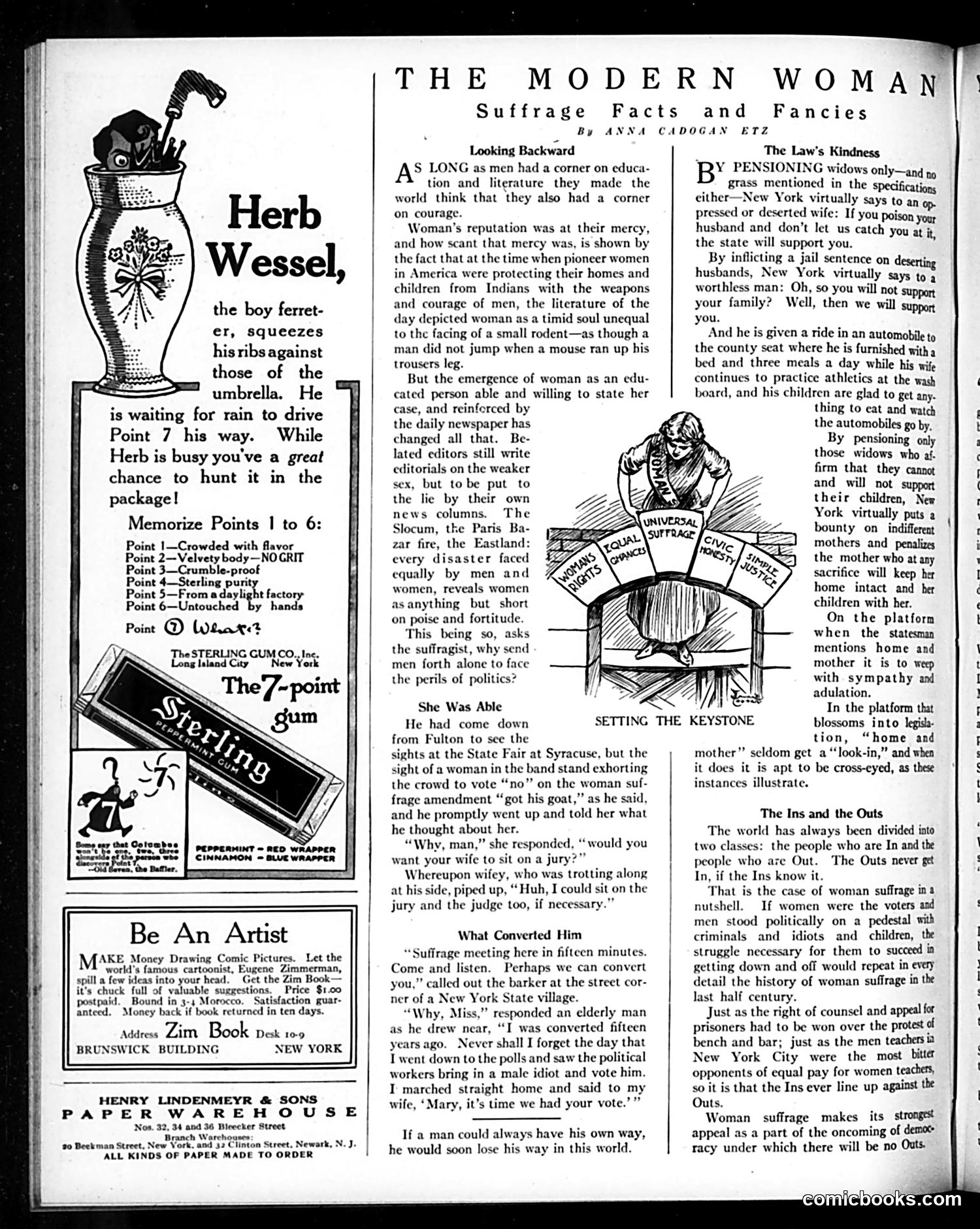
This page presents pro-suffrage arguments through anecdotes and satire, countering anti-woman claims. The main cartoon depicts a woman seated as "SETTING THE KEYSTONE" of a suffrage arch, symbolizing women as foundational to democracy. The text uses three brief narratives to argue women deserve voting rights: 1. **"She Was Able"**: A woman at a fair confidently debates suffrage, with his wife claiming she could serve on a jury better than a judge—demonstrating female competence. 2. **"What Converted Him"**: An older man recalls witnessing an "idiot" male voter at the polls, leading him to demand his wife's voting rights—the joke being that if incompetent men vote, why not women? The broader satire attacks the contradiction between praising pioneer women's courage against Indians while depicting them as timid. The suffragist position: if women prove equally capable in crises (citing disasters like the Slocum and Eastland), why exclude them from politics? The piece is fundamentally an argument for women's suffrage through humorous reductio ad absurdum.
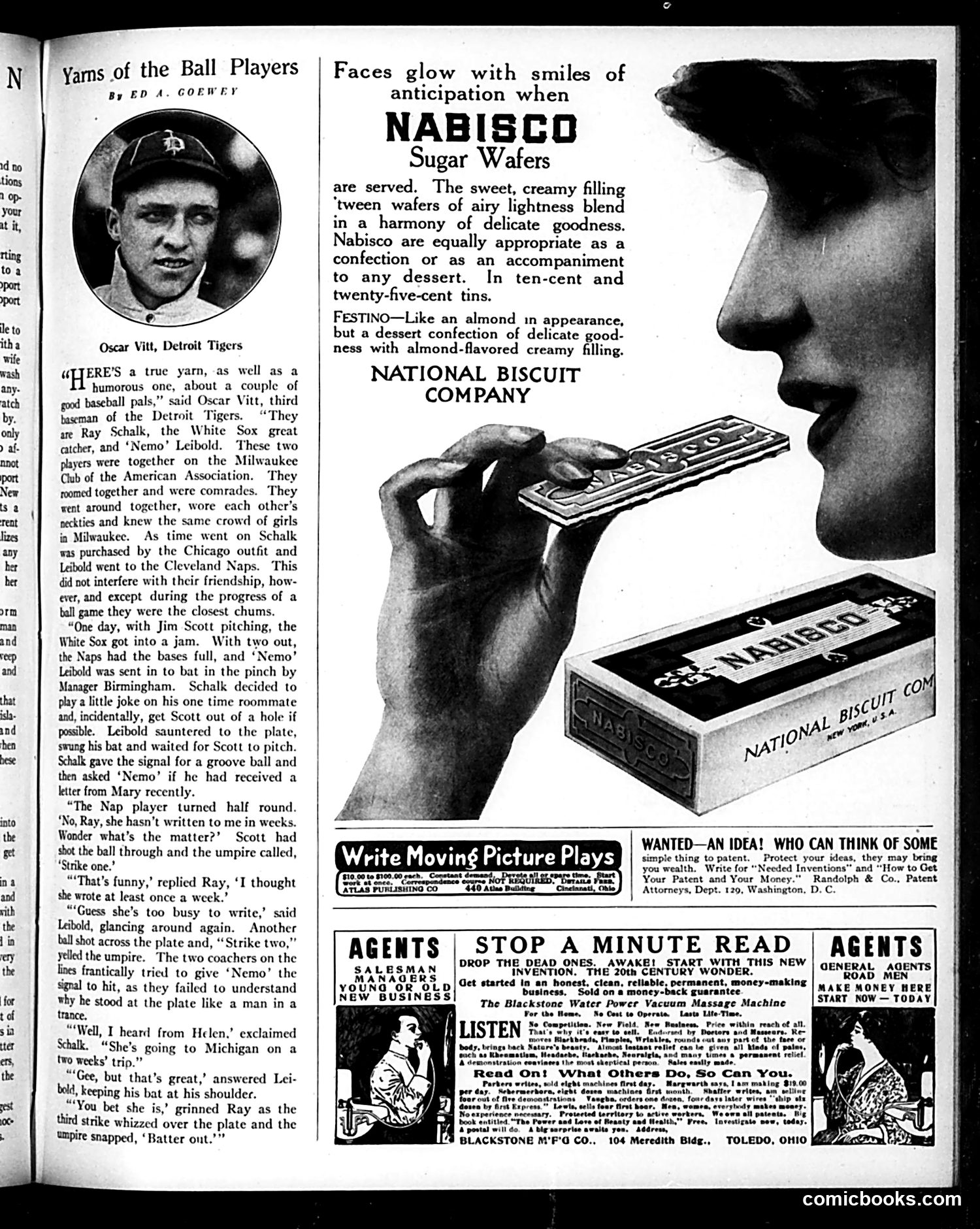
This page mixes editorial content with advertising. The main feature is "Yarns of the Ball Players" by Ed A. Gorwey, profiling Detroit Tigers player Oscar Vitt. The yarn describes a practical joke between two former teammates—Ray Schalk (White Sox catcher) and "Nemo" Leibold (Cleveland Naps outfielder)—who played together in Milwaukee. During a game, Schalk distracts the batting Leibold by asking about his girlfriend Mary's letters, causing him to lose focus and strike out. The joke's appeal lies in the camaraderie between players and the clever manipulation of friendship dynamics during competition. The page also contains multiple advertisements (Nabisco, patent services, business opportunities) typical of Judge magazine's commercial content. These ads are unrelated to the baseball story's satire or humor.
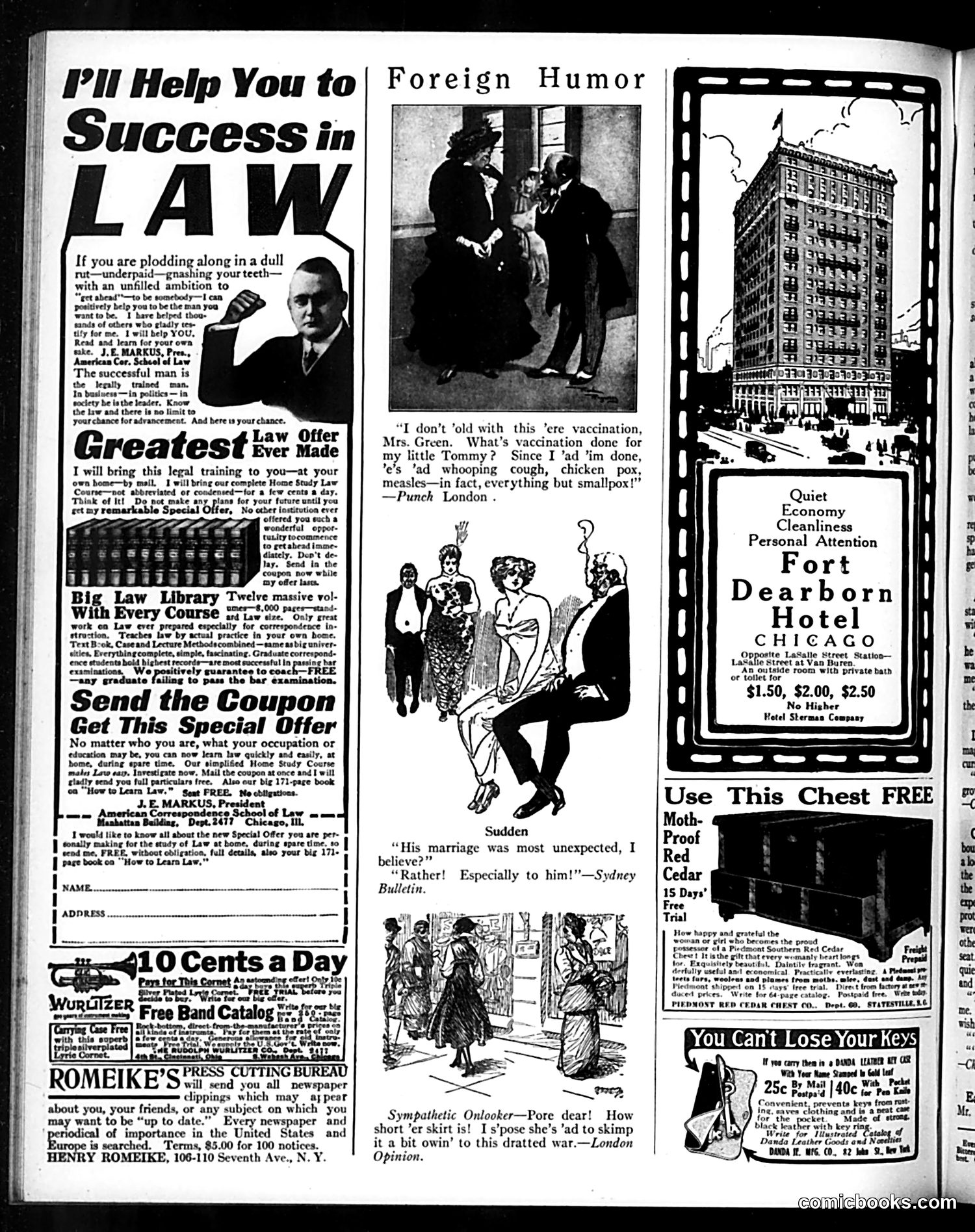
This page mixes advertising with **"Foreign Humor"**—reprinted jokes from British and Australian publications (Punch, Sydney Bulletin, London Opinion). ## The Cartoons/Jokes: The three humor pieces mock working-class attitudes: 1. **Vaccination skeptic**: A British working-class parent complains that vaccination hasn't prevented her son from getting whooping cough, measles, etc.—missing the point that vaccination prevents *smallpox* specifically. 2. **Unexpected marriage**: A brief joke about a man's surprising marriage proposal. 3. **War-era clothing**: A observer sympathizes with a woman's short skirt, assuming wartime poverty forced her to economize on fabric—she responds sarcastically that economic hardship explains it (the joke implies vanity, not necessity). These represent typical early-20th-century British/Commonwealth working-class humor: gentle mockery of logical confusion, marital complications, and wartime penny-pinching. The page is primarily **advertising** (law school courses, hotels, press clipping services) with humor filling remaining space.
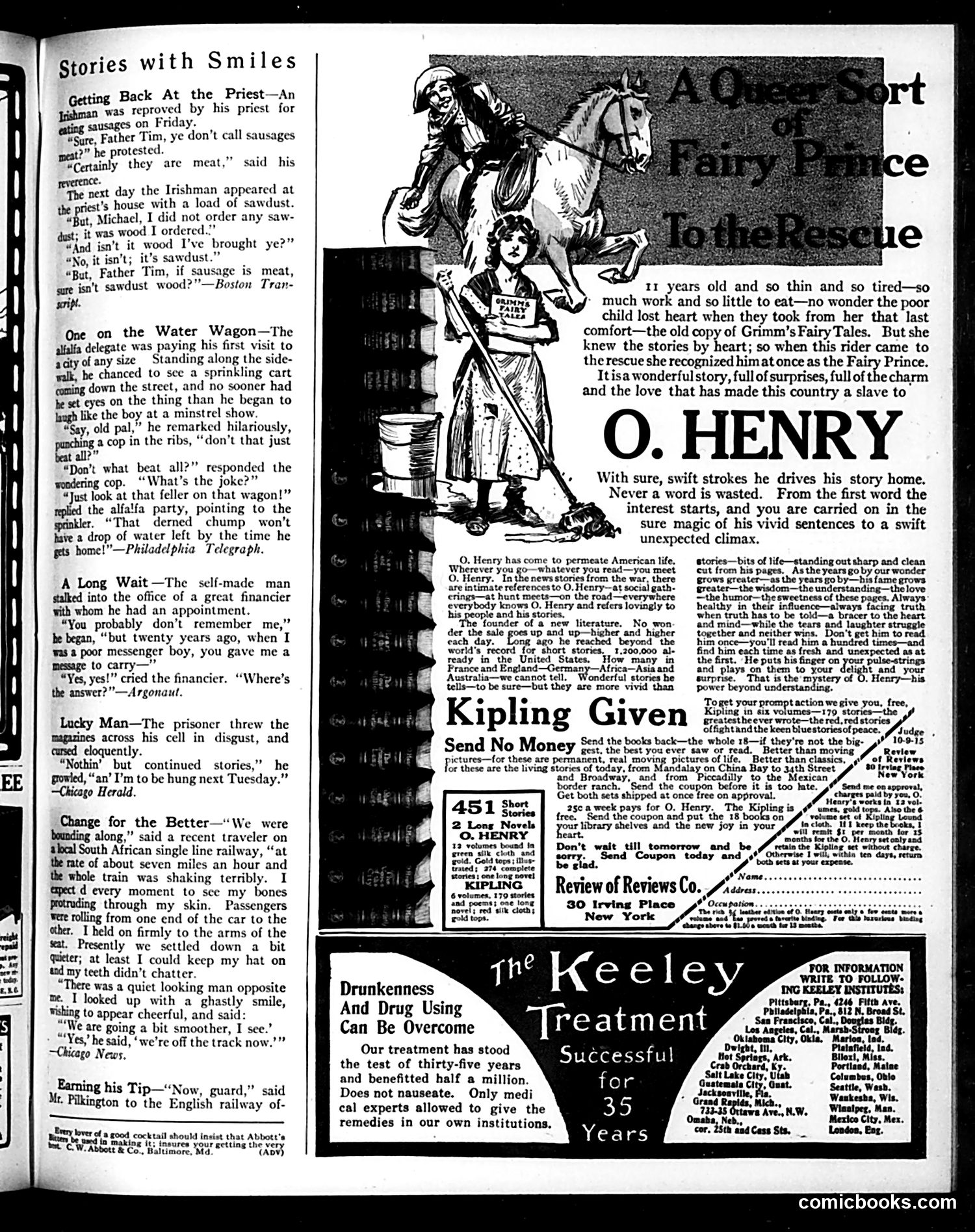
This page contains several humor anecdotes ("Stories with Smiles") and advertising. The cartoons/jokes are brief, traditional humor pieces: 1. **Irish priest joke**: A priest and parishioner argue sophistically about whether sausages are meat. The humor relies on Irish dialect humor and wordplay—the parishioner brings sawdust, claiming if sausages aren't meat, then sawdust isn't wood. 2. **Water wagon joke**: A rural visitor sees a street-sprinkling cart and laughs that the operator will have "no water left" by the time he gets home—misunderstanding the cart's purpose. 3. **Other brief jokes** follow similar patterns: wordplay and mistaken assumptions. The page's main feature is an **advertisement for O. Henry stories**, featuring an illustration of a poor girl and a mounted rider (representing Henry's romanticized fiction). The ad emphasizes Henry's popularity and narrative skill. Below is an advertisement for **Keeley Treatment** for alcoholism and drug addiction, claiming thirty-five years of success. The content reflects early 20th-century magazine humor: dialect jokes, rural/urban misunderstandings, and sentimental literary promotion.
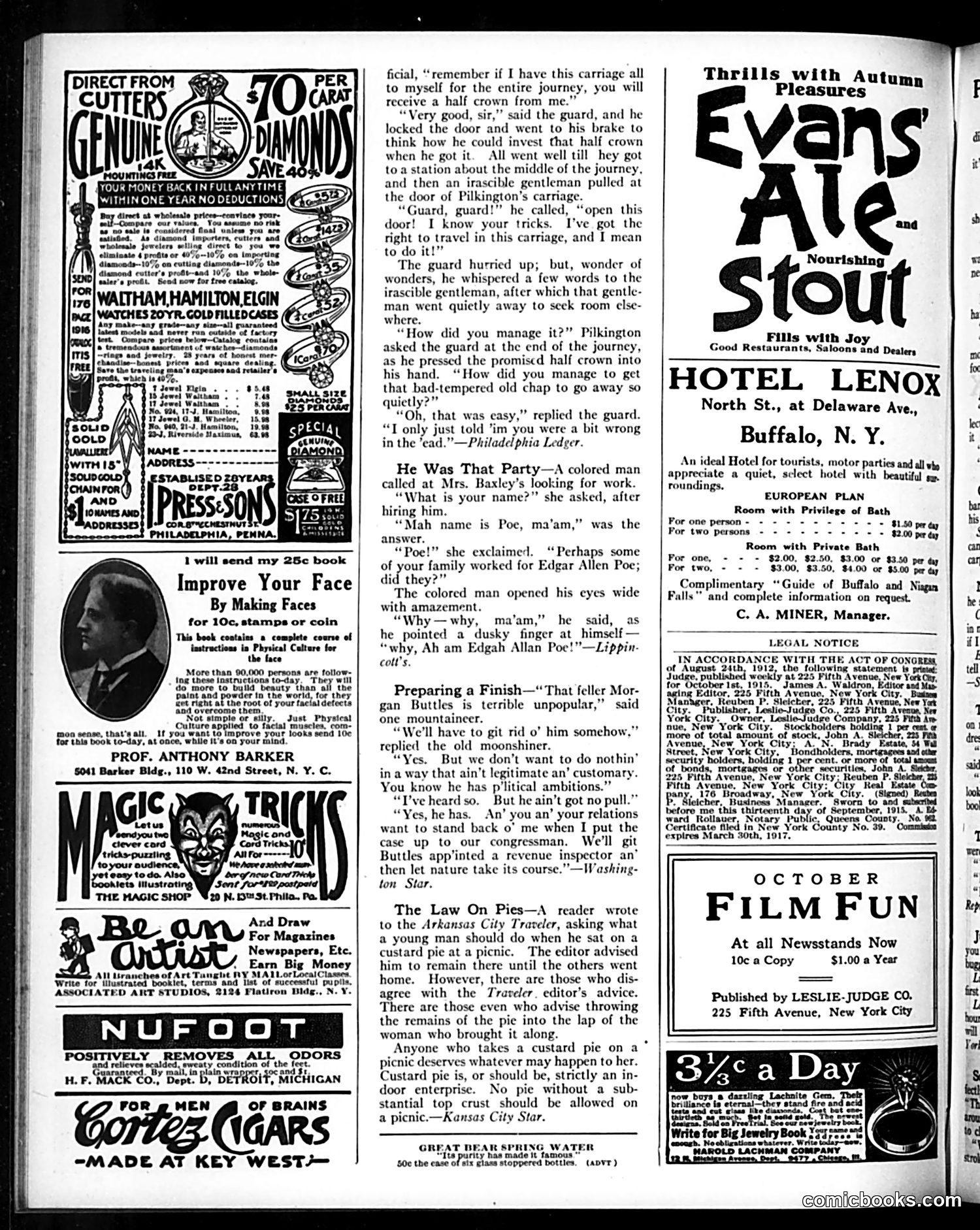
This page is primarily **advertisements and light humor pieces** rather than political satire. The main content includes: **Humor Stories:** Three brief anecdotes—one about a railway guard bribed with a half-crown to tell a passenger someone is mentally unwell; another about a newly hired Black worker named Poe being confused with Edgar Allan Poe; and a fragment about unpopular "Morgan Buttles" and moonshine makers. **Advertisements:** Dominant on the page are ads for diamonds (direct importation claims), "Improve Your Face" beauty advice, magic tricks, cigars, and a hotel in Buffalo. **Social Context:** The "Poe" story relies on period racial stereotypes and dialect humor common in early 20th-century American magazines. The other stories use mild class humor (working-class guards, mountaineers). The page reflects Judge's mixed editorial approach: satirical commentary alongside conventional advertisements and genteel humor targeting middle-class readers.
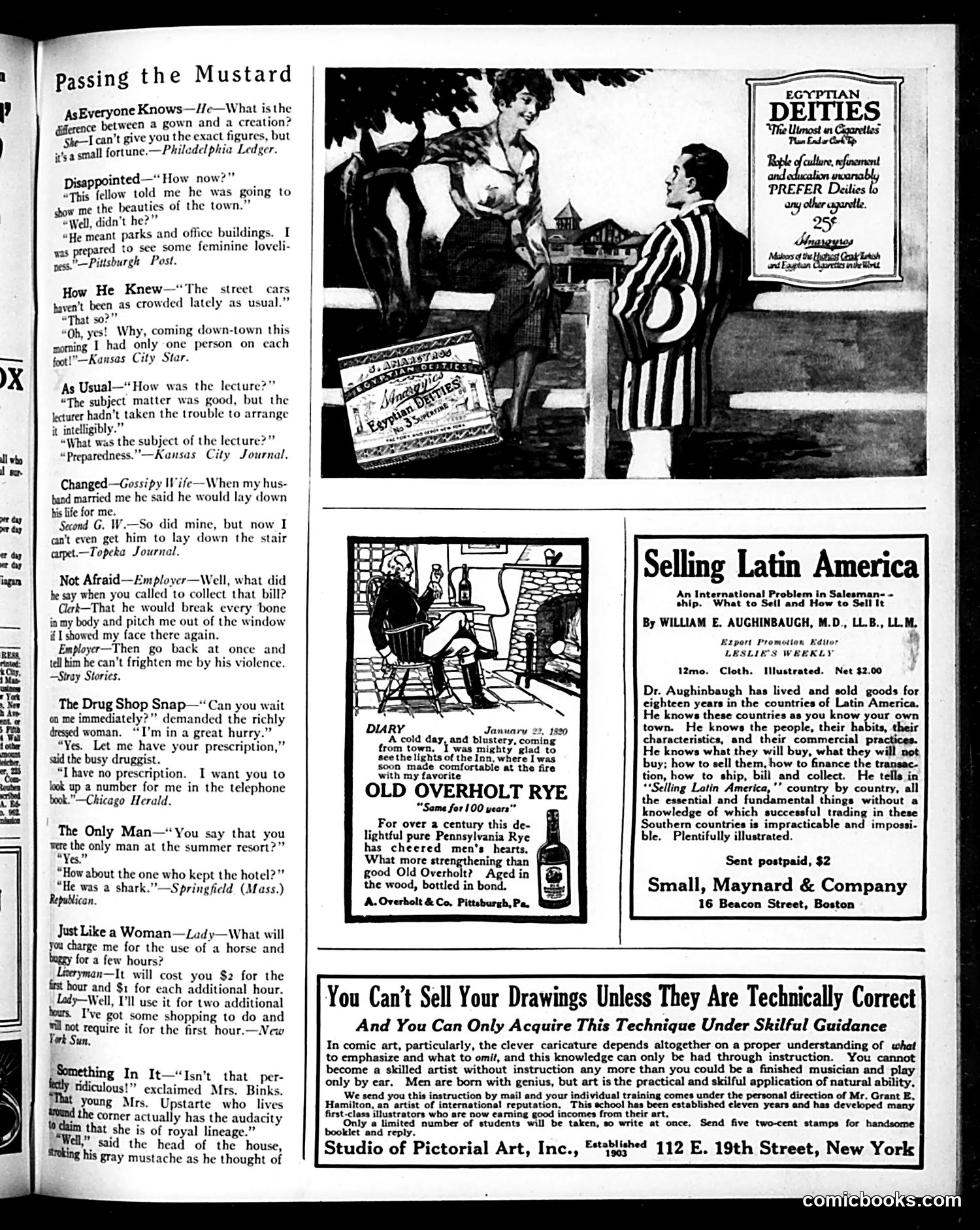
This page consists primarily of **short humor pieces and advertisements**, not political cartoons. The main content is "Passing the Mustard," a humor column featuring brief jokes sourced from newspapers. The central cartoon depicts a man in striped clothing confronting a woman with what appears to be **Egyptian Deities cigarettes**—likely a product advertisement disguised as editorial content. The joke's meaning is unclear without additional context. The humor pieces satirize **early 20th-century American domestic and social life**: absent-minded lectures, wives complaining about husbands' changed behavior, business inefficiency, gender stereotypes (a woman prioritizing shopping over using rental time), and class pretension (a woman claiming royal lineage). The advertisements include books on salesmanship and technical drawing instruction—typical period commercial content. **No clear political satire is present.** This appears to be a standard entertainment/advertising magazine page from approximately the 1910s-1920s.
This page contains **advertising content** alongside humorous vignettes typical of Judge magazine. The main advertisement promotes **national advertising and trademarks** (featuring Firestone and Armour's Quality Products) as economic drivers that reduce costs through efficient distribution and standardization. The argument: branded, advertised goods move faster, reducing warehousing costs and ultimately benefiting consumers despite seemingly higher prices. The right column contains **short joke-vignettes** on courtship, marriage, and everyday life—common Judge fare. These include: a woman discussing her suitor with her father; a farmer noting that scientific knowledge doesn't make nature more cooperative; commentary on fishermen's tall tales; observations about romantic expectations versus reality; and a widow's deadpan comment about her deceased husband's happiness. These jokes reflect early-20th-century social attitudes about gender roles, rural life, and domestic relationships. **No political cartoons are present**—this is primarily a commercial and entertainment page, with advertising and light humor rather than satire on current events.
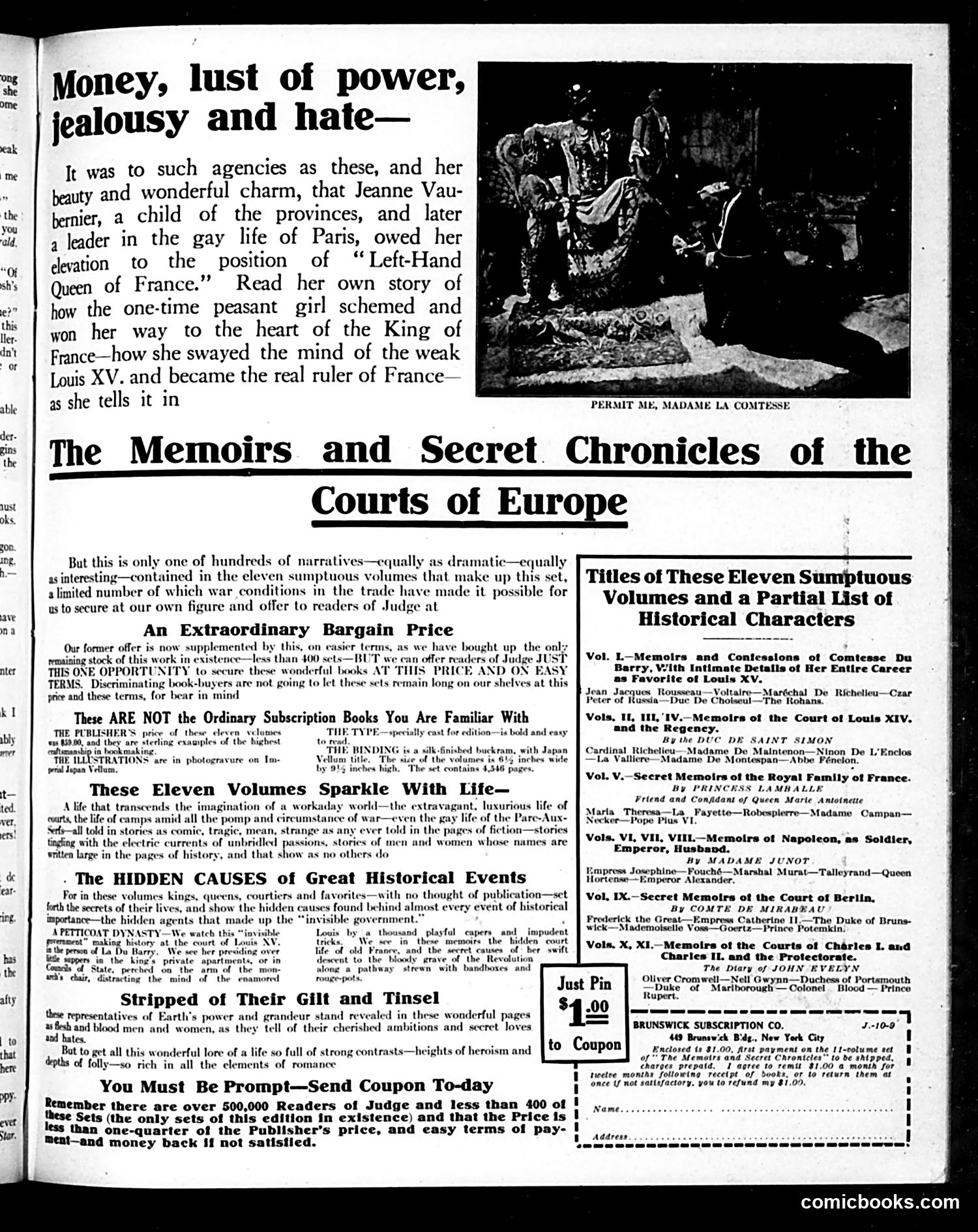
This is primarily a **book advertisement**, not a political cartoon. The page promotes "The Memoirs and Secret Chronicles of the Courts of Europe"—a eleven-volume set of historical narratives about European royal courts. The featured illustration shows a scene labeled "PERMIT ME, MADAME LA COMTESSE," depicting the court of Louis XV. The accompanying text highlights the memoir of **Jeanne Vaubernier (Madame du Barry)**, a peasant-born woman who became the king's mistress and reportedly wielded significant political influence—earning her the satirical title "Left-Hand Queen of France." The advertisement emphasizes sensational content: court intrigues, hidden causes of historical events, and secret romances among royalty. It appeals to readers' fascination with behind-the-scenes palace drama and "hidden" historical truths. The sales pitch stresses scarcity (fewer than 400 sets available) and bargain pricing. This reflects Judge's typical advertising strategy: mixing editorial content with sophisticated marketing appeals to an educated, leisure-class readership interested in European history and scandal.
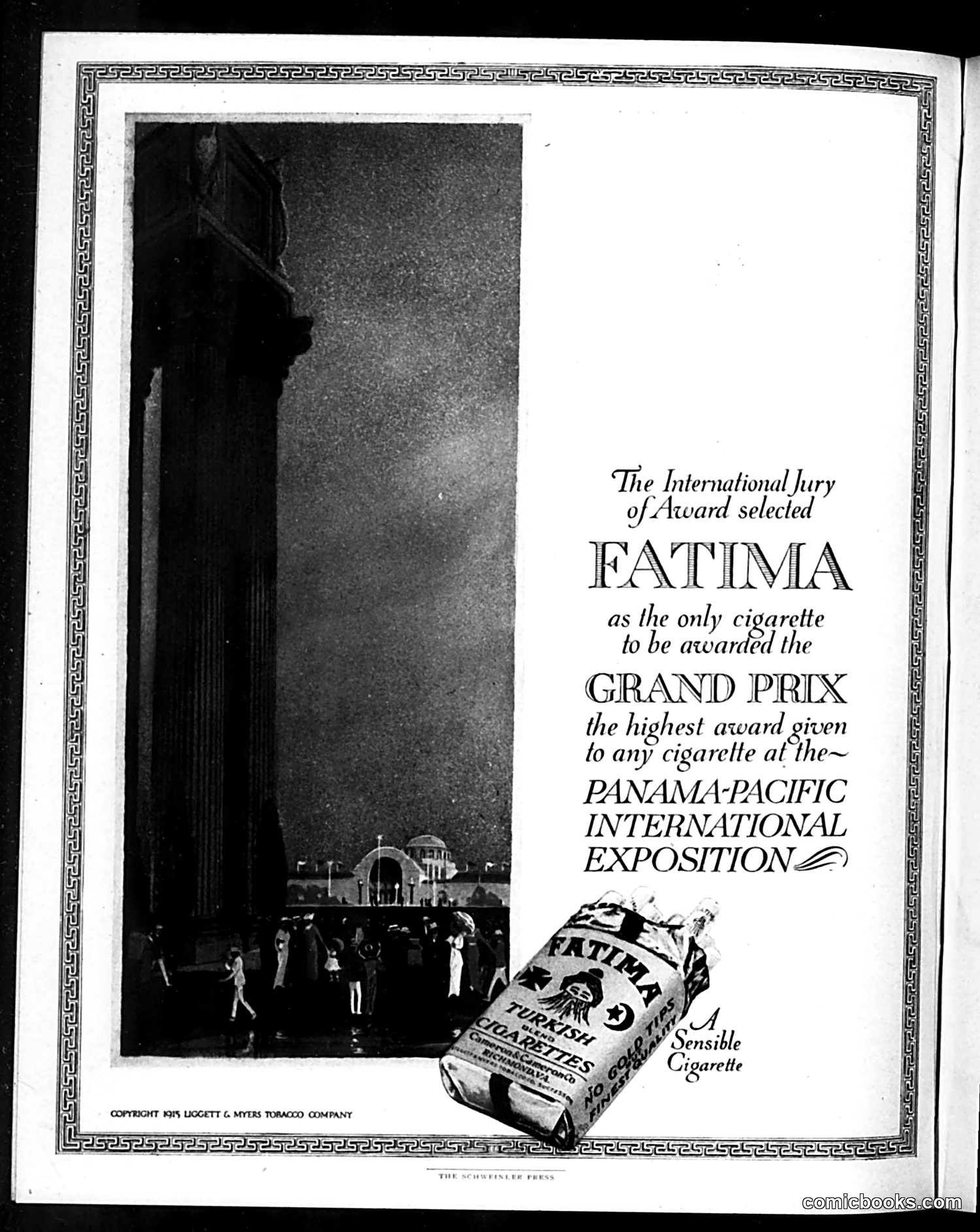
This is a cigarette advertisement, not satire or political commentary. It promotes Fatima cigarettes, claiming an "International Jury of Award" granted it the "Grand Prix" — the highest award — at the Panama-Pacific International Exposition (a 1915 world's fair in San Francisco). The ad features a photograph of the exposition's grounds with its distinctive tower, and displays a Fatima cigarette package labeled "A Sensible Cigarette." This appears designed to leverage the exposition's prestige to market the product as superior to competitors. The copyright indicates it's from Liggett & Myers Tobacco Company. No satire or caricature is present on this page — it functions as straightforward promotional material.