
Judge, 1915-10-09 · page 14 of 28
Judge — October 9, 1915 — page 14: what you’re looking at
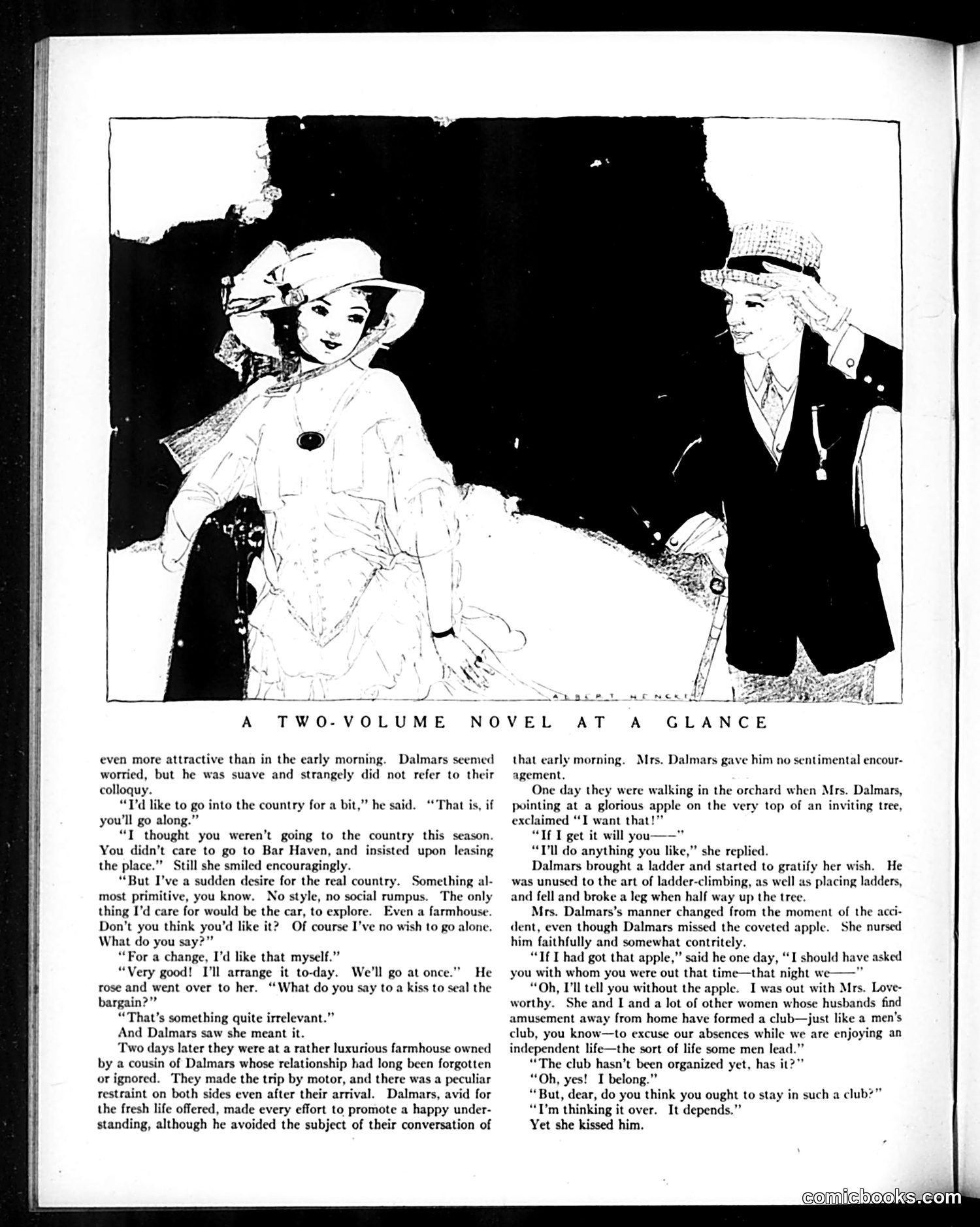
What you’re looking at
This page illustrates a "two-volume novel" serialized in Judge magazine—a domestic drama addressing early 20th-century gender relations and marital tension. **The Setup:** Mr. Dalmars attempts reconciliation with his wife after a marital argument about her mysterious evening out. He proposes a romantic country retreat, but she remains emotionally distant. **The Conflict:** Mrs. Dalmars reveals she belongs to a women's club—explicitly modeled on men's clubs—that serves as cover for independent social activities away from home and husbands. This was satirical commentary on emerging women's autonomy and the "New Woman" movement of the 1920s-30s. **The Resolution:** When Dalmars injures himself trying to retrieve an apple to win her favor, her maternal instincts surface. She confesses about the club, but remains ambivalent about leaving it. **The Satire:** Judge mocks both marital discord and women's increasing independence from domestic constraints—presenting the wife's autonomy as simultaneously sympathetic and troubling to contemporary (male) readers.
📄 Transcribed text from this page (OCR, searchable)
Machine-transcribed from the original scan — historical spelling and the odd misread are preserved.
7 even more attractive than in the early morning. Dalmars seemed worried, but he was suave and strangely did not refer to their colloquy. “T’d like to go into the country for a bit,” he said. ‘That is, if you'll go along.” “T thought you weren’t going to the country this season. You didn’t care to go to Bar Haven, and insisted upon leasing the place.” Still she smiled encouragingly. “But I’ve a sudden desire for the real country. Something al- most primitive, you know. No style, no social rumpus. The only thing I’d care for would be the car, to explore. Even a farmhouse. Don't you think you'd like it? Of course I've no wish to go alone. What do you say?” “For a change, I'd like that myself.” “Very good! I'll arrange it to-day. We'll go at once.” He rose and went over to her. “What do you say to a kiss to seal the bargain?” “That’s something quite irrelevant.” And Dalmars saw she meant it. Two days later they were at a rather luxurious farmhouse owned by a cousin of Dalmars whose relationship had long been forgotten or ignored. They made the trip by motor, and there was a peculiar restraint on both sides even after their arrival. Dalmars, avid for the fresh life offered, made every effort to promote a happy under- standing, although he avoided the subject of their conversation of Ce Se TWO-VOLUME NOVEL AT A that early morning. Mrs. Dalmars gave him no sentimental encour- agement. One day they were walking in the orchard when Mrs. Dalmars, pointing at a glorious apple on the very top of an inviting tree, exclaimed “I want that!” “Tf T get it will you——" “T'll do anything you like,” she replied. Dalmars brought a ladder and started to gratify her wish. He was unused to the art of ladder-climbing, as well as placing ladders, and fell and broke a leg when half way up the tree. Mrs. Dalmars’s manner changed from the moment of the acci- dent, even though Dalmars missed the coveted apple. She nursed him faithfully and somewhat contritely. “If I had got that apple,” said he one day, “I should have asked you with whom you were out that time—that night we— “Oh, I'll tell you without the apple. I was out with Mrs. Love- worthy. She and I and a lot of other women whose husbands find amusement away from home have formed a club—just like a men’s club, you know—to excuse our absences while we are enjoying an independent life—the sort of life some men lead.” “The club hasn’t been organized yet, has it?” “Oh, yes! I belong.” “But, dear, do you think you ought to stay in such a club?” “I’m thinking it over. It depends.” Yet she kissed him.