
Judge, 1915-10-09 · page 11 of 28
Judge — October 9, 1915 — page 11: what you’re looking at
What you’re looking at
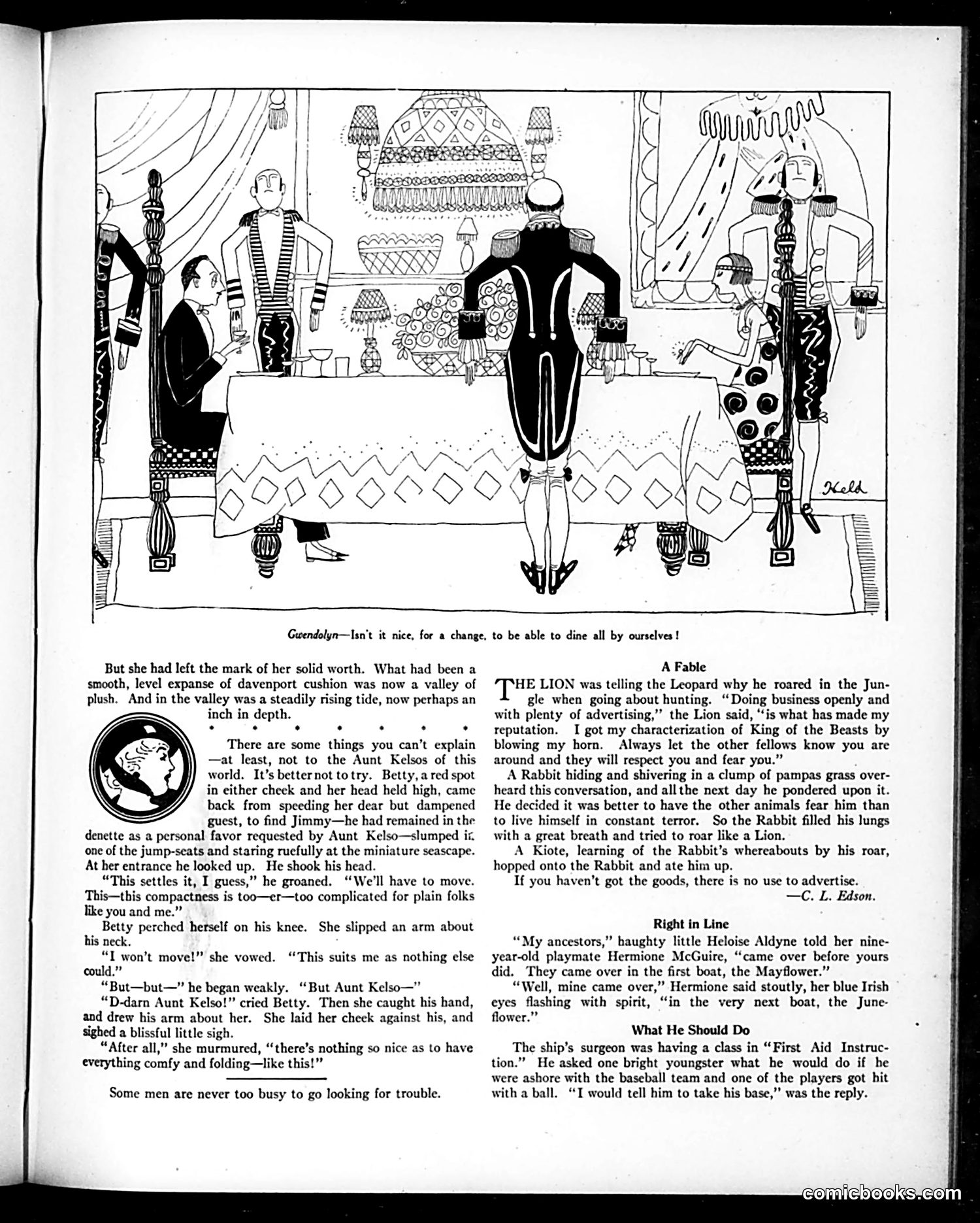
**Top Cartoon**: Depicts a couple (Jimmy and Betty) in a cramped apartment, with Aunt Kelso departing. The joke centers on apartment living's constraints—Betty has sat on a davenport so hard she's created a permanent depression in the cushion. Jimmy despairs they must move, but Betty romantically refuses, declaring "there's nothing so nice as to have everything comfy and folding." The satire targets post-WWI urban housing density and newlyweds' naive romanticism about cramped "modern" living spaces. **"A Fable"**: A moral tale about false advertising. The Lion succeeds through honest self-promotion; the Rabbit attempts deceptive boasting and gets killed by a Coyote. The lesson: "If you haven't got the goods, there is no use to advertise"—satirizing empty commercial claims. **Lower items**: Brief humor pieces mocking social pretension (ancestry snobbery) and a pun on baseball terminology ("take his base").
📄 Transcribed text from this page (OCR, searchable)
Machine-transcribed from the original scan — historical spelling and the odd misread are preserved.
Gwendolyn—Isn't it nice, for a change, But she had left the mark of her solid worth. What had been a smooth, level expanse of davenport cushion was now a valley of plush. And in the valley was a steadily rising tide, now perhaps an inch in depth. . . . . . . . There are some things you can’t explain —at least, not to the Aunt Kelsos of this world. It’s betternot totry. Betty, a red spot in either check and her head held high, came back from speeding her dear but dampened guest, to find Jimmy—he had remained in the denette as a personal favor requested by Aunt Kelso—slumped it. one of the jump-seats and staring ruefully at the miniature seascape. At her entrance he looked up. He shook his head. “This settles it, I guess,” he groaned. ‘We'll have to move. This—this compactness is too—er—too complicated for plain folks like you and me.” Betty perched herself on his knee. She slipped an arm about his neck. “T won’t move!” she vowed. could.” “But—but—” he began weakly. “But Aunt Kelso—” “D-darn Aunt Kelso!” cried Betty. Then she caught his hand, and drew his arm about her. She laid her cheek against his, and sighed a blissful little sigh. “After all,” she murmured, ‘“‘there’s nothing so nice as to have everything comfy and folding—like this!” “This suits me as nothing else Some men are never too busy to go looking for trouble. to be able to dine all by ourselves! A Fable T= LION was telling the Leopard why he roared in the Jun- gle when going about hunting. “Doing business openly and with plenty of advertising,” the Lion said, “is what has made my reputation. I got my characterization of King of the Beasts by blowing my horn. Always let the other fellows know you are around and they will respect you and fear you.” A Rabbit hiding and shivering in a clump of pampas grass over- heard this conversation, and allthe next day he pondered upon it. He decided it was better to have the other animals fear him than to live himself in constant terror. So the Rabbit filled his lungs with a great breath and tried to roar like a Lion. A Kiote, learning of the Rabbit’s whereabouts by his roar, hopped onto the Rabbit and ate him up. If you haven't got the goods, there is no use to advertise. —C. L. Edson. Right in Line “My ancestors,” haughty little Heloise Aldyne told her nine- year-old playmate Hermione McGuire, “came over before yours did. They came over in the first boat, the Mayflower.” “Well, mine came over,” Hermione said stoutly, her blue Irish eyes flashing with spirit, “in the very next boat, the June- flower.” What He Should Do The ship’s surgeon was having a class in “First Aid Instruc- tion.” He asked one bright youngster what he would do if he were ashore with the baseball team and one of the players got hit with a ball. “I would tell him to take his base,” was the reply.