
Judge, 1915-10-09 · page 19 of 28
Judge — October 9, 1915 — page 19: what you’re looking at
What you’re looking at
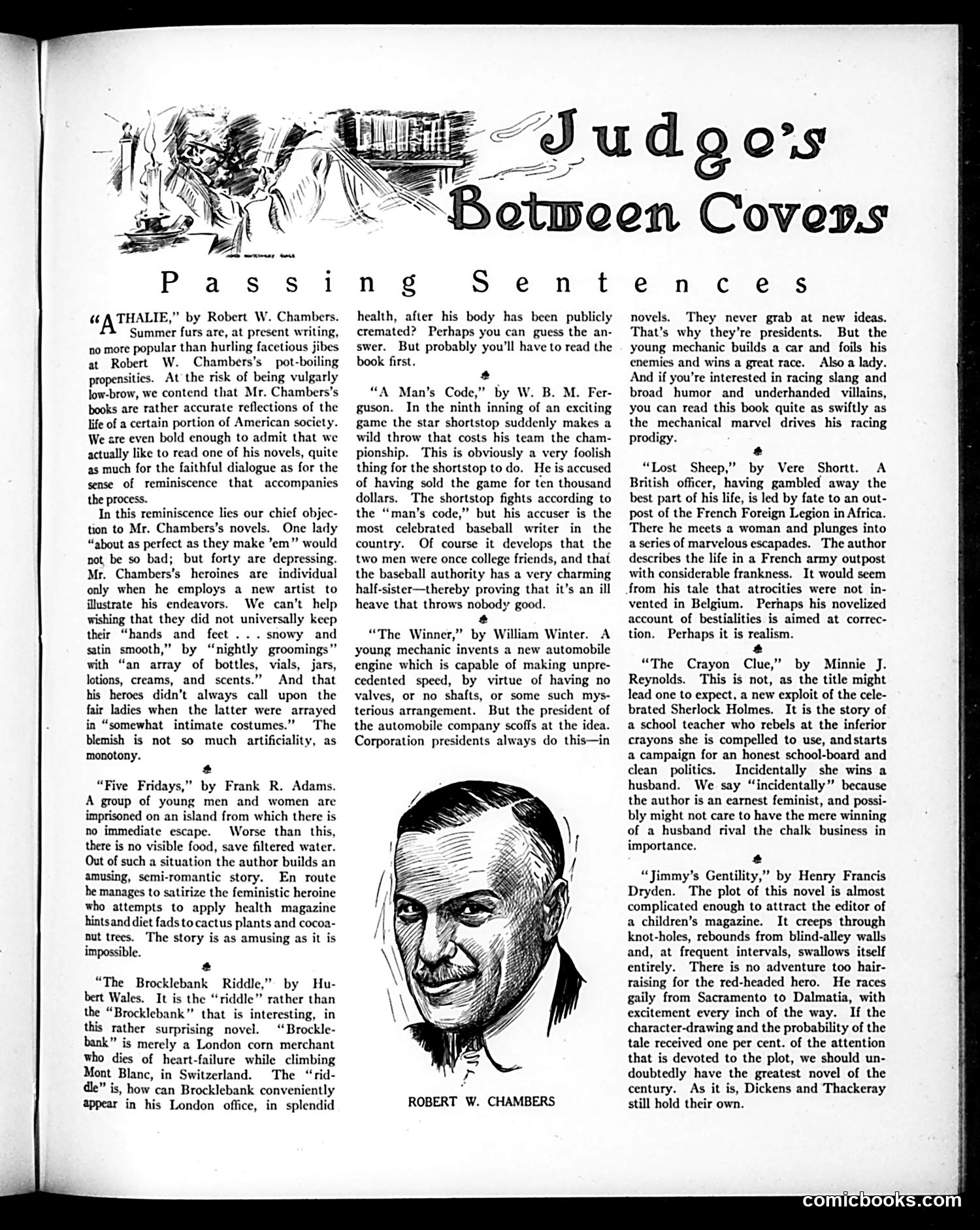
This page from Judge magazine contains book reviews rather than political cartoons. The single illustration is a portrait of author Robert W. Chambers, whose prolific output is the primary target of satire. The reviews mock popular fiction conventions of the era through gentle ridicule. Chambers is criticized for repetitive heroines who are artificially "perfect"—repeatedly described with identical grooming rituals and intimate costumes. The reviewer admits actually enjoying Chambers's work but finds the monotony tedious. Other reviewed novels follow predictable plot formulas: stranded lovers without food, impossible mysteries explained through cremation tricks, sports scandals resolved by revealing past friendships and convenient half-sisters, and young inventors whose corporations foolishly reject their innovations before ultimately vindication. The satire targets both the authors' formulaic storytelling and readers' predictable tastes—suggesting that popular fiction of this period relied heavily on recognizable tropes rather than originality or serious ideas.
📄 Transcribed text from this page (OCR, searchable)
Machine-transcribed from the original scan — historical spelling and the odd misread are preserved.
66 A THALIE,” by Robert W. Chambers. Summer furs are, at present writing, no more popular than hurling facetious jibes at Robert W. Chambers’s _ pot-boiling propensities. At the risk of being vulgarly low-brow, we contend that Mr. Chambers’s books are rather accurate reflections of the life of a certain portion of American socicty. We are even bold enough to admit that we actually like to read one of his novels, quite as much for the faithful dialogue as for the sense of reminiscence that accompanies the process. In this reminiscence lies our chief objec- tion to Mr. Chambers’s novels. One lady “about as perfect as they make ’em” would not be so bad; but forty are depressing. Mr. Chambers’s heroines are individual only when he employs a new artist to illustrate his endeavors. We can’t help wishing that they did not universally keep their “hands and feet ... snowy and satin smooth,” by “nightly groomings” with “an array of bottles, vials, jars, lotions, creams, and scents.” And that his heroes didn’t always call upon the fair ladies when the latter were arrayed in “somewhat intimate costumes.” The blemish is not so much artificiality, as monotony. 2 “Five Fridays,” by Frank R. Adams. A group of young men and women are imprisoned on an island from which there is no immediate escape. Worse than this, there is no visible food, save filtered water. Out of such a situation the author builds an amusing, semi-romantic story. En route he manages to satirize the feministic heroine who attempts to apply health magazine hintsand diet fads to cactus plants and cocoa- nut trees. The story is as amusing as it is impossible. @ “The Brocklebank Riddle,” by Hu- bert Wales. It is the “riddle” rather than the “Brocklebank” that is interesting, in this rather surprising novel. “Brockle- bank” is merely a London corn merchant who dies of heart-failure while climbing Mont Blanc, in Switzerland. The “rid- dle” is, how can Brocklebank conveniently appear in his London office, in splendid n g Sent health, after his body has been publicly cremated? Perhaps you can guess the an- swer. But probably you'll have to read the book first. + “A Man’s Code,” by W. B. M. Fer- guson. In the ninth inning of an exciting game the star shortstop suddenly makes a wild throw that costs his team the cham- pionship, This is obviously a very foolish thing for the shortstop to do. He is accused of having sold the game for ten thousand dollars. The shortstop fights according to the “man’s code,” but his accuser is the most celebrated baseball writer in the country. Of course it develops that the two men were once college friends, and that the baseball authority has a very charming half-sister—thereby proving that it’s an ill heave that throws nobody good. 2 “The Winner,” by William Winter. A young mechanic invents a new automobile engine which is capable of making unpre- cedented speed, by virtue of having no valves, or no shafts, or some such mys- terious arrangement. But the president of the automobile company scoffs at the idea. Corporation presidents always do this—in ROBERT W. CHAMBERS teen Coven.s ences novels. They never grab at new ideas. That’s why they’re presidents. But the young mechanic builds a car and foils his enemies and wins a great race. Also a lady. And if you're interested in racing slang and broad humor and underhanded villains, you can read this book quite as swiftly as the mechanical marvel drives his racing prodigy. e “Lost Sheep,” by Vere Shortt. A British officer, having gambled away the best part of his life, is led by fate to an out- post of the French Foreign Legion in Africa. There he meets a woman and plunges into a series of marvelous escapades. The author describes the life in a French army outpost with considerable frankness. It would seem from his tale that atrocities were not in- vented in Belgium. Perhaps his novelized account of bestialities is aimed at correc- tion. Perhaps it is realism. 2 “The Crayon Clue,” by Minnie J. Reynolds. This is not, as the title might lead one to expect, a new exploit of the cele- brated Sherlock Holmes. It is the story of a school teacher who rebels at the inferior crayons she is compelled to use, and starts a campaign for an honest school-board and clean politics. Incidentally she wins a husband. We say “incidentally” because the author is an earnest feminist, and possi- bly might not care to have the mcre winning of a husband rival the chalk business in importance. 2 “Jimmy’s Gentility,” by Henry Francis Dryden. The plot of this novel is almost complicated enough to attract the editor of a children’s magazine. It creeps through knot-holes, rebounds from blind-alley walls and, at frequent intervals, swallows itself entirely. There is no adventure too hair- raising for the red-headed hero. He races gaily from Sacramento to Dalmatia, with excitement every inch of the way. If the character-drawing and the probability of the tale received one per cent. of the attention that is devoted to the plot, we should un- doubtedly have the greatest novel of the century. As it is, Dickens and Thackeray still hold their own.