
Judge, 1915-10-09 · page 26 of 28
Judge — October 9, 1915 — page 26: what you’re looking at
What you’re looking at
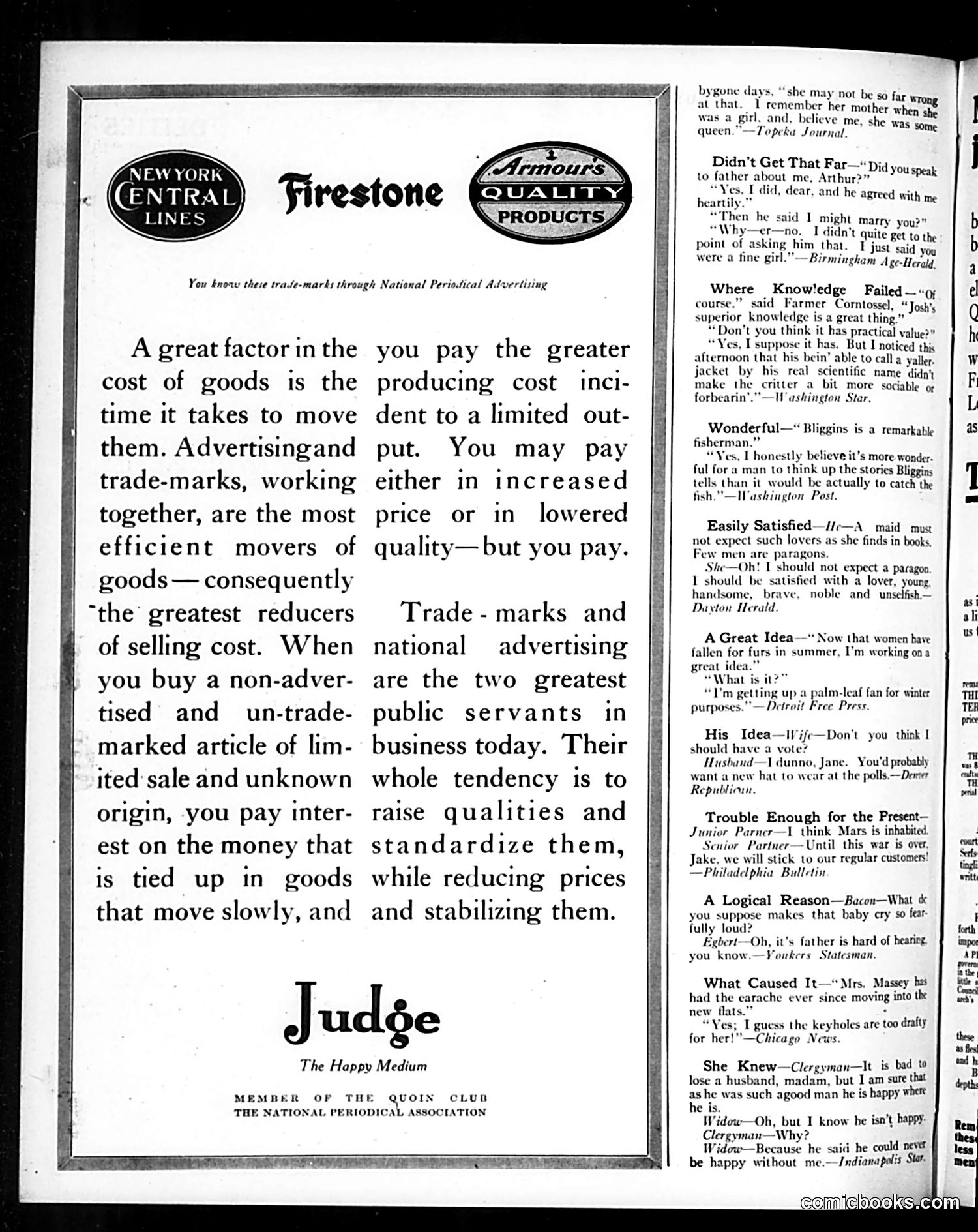
This page contains **advertising content** alongside humorous vignettes typical of Judge magazine. The main advertisement promotes **national advertising and trademarks** (featuring Firestone and Armour's Quality Products) as economic drivers that reduce costs through efficient distribution and standardization. The argument: branded, advertised goods move faster, reducing warehousing costs and ultimately benefiting consumers despite seemingly higher prices. The right column contains **short joke-vignettes** on courtship, marriage, and everyday life—common Judge fare. These include: a woman discussing her suitor with her father; a farmer noting that scientific knowledge doesn't make nature more cooperative; commentary on fishermen's tall tales; observations about romantic expectations versus reality; and a widow's deadpan comment about her deceased husband's happiness. These jokes reflect early-20th-century social attitudes about gender roles, rural life, and domestic relationships. **No political cartoons are present**—this is primarily a commercial and entertainment page, with advertising and light humor rather than satire on current events.
📄 Transcribed text from this page (OCR, searchable)
Machine-transcribed from the original scan — historical spelling and the odd misread are preserved.
A great factor in the cost of goods is the time it takes to move them. Advertisingand trade-marks, working together, are the most efficient movers of goods— consequently “the greatest reducers of selling cost. When you buy a non-adver- tised and un-trade- marked article of lim- ited: sale and unknown origin, you pay inter- est on the money that is tied up in goods that move slowly, and MEMBER OP Firestone You know these trate-marks through National Periotical Advertising J udge The Happy Medium THE THE NATIONAL PERIODICAL ASSOCIATION QUALITY \ PRODUCTS, you pay the greater producing cost inci- dent to a limited out- put. You may pay either in increased price or in lowered quality— but you pay. Trade - marks and | national advertising are the two greatest public servants in business today. Their whole tendency is to raise qualities and standardize them, while reducing prices and stabilizing them. vOIN CLUB a, bygone days, “she may not be so far at that. 1 remember her mother er! was a girl. and, believe me, she was Les queen." —Topeka Journal. — Didn’t Get That Far—« to father about me, Arthur?” Ye Did you speak I did, dear, and he agreed with me aid i aight marry you?” no. I didn’t quite get to point of asking him that. 1 just aid were a fine girl.” —Birmingham Age-Herald Where Knowledge Failed —«¢ course,” said Farmer Corntossel, “Josh's erior knowledge is a great thing.” Don’t you think it has practical value?” “Yes, [suppose it has. But I noticed this afternoon that his bein’ able to call a yaller. jacket by his real scientific name ‘didn't make the critter a bit more sociable of forbearin’.”"—Washington Star, — i ap hs ee ee | ania >i} Wonderful—“ Bliggins is a remarkable fisherman.” “Yes, [ honestly believe it’s more wonder. ful fora man to think up the stories Bliggins tells than it would be actually to catch the fish."—IWashington Post. | Easily Satisfied—He—A_ maid mus not expect such lovers as she finds in books, Few men are pi She—Oh! I should not expect a paragon I should be satisfied with a lover, young, handsome, brave, noble and unselfish— Dayton Herald. A Great Idea—* Now that women have fallen for furs in summer, I’m working ona great idea.” “Wh. a “['m getting up a palm-leaf fan for winter purposes." —Detroit Free Press. His Idea—iVife—Don't you think I should have a vote? Husband—I\ dunno, Jane. You'd probably fy want a new hat to wear at the polls. —Derer ans Republionn. a Trouble Enough for the Present— Junior Parner—\ think Mars is inhabited. . Senior Partner—Until this war is over, bark Jake, we will stick to our regular customers! tag —Philadelphia Bulletin wit A Logical Reason—Bacon—What & : you suppose makes that baby cry so fear- | fully loud? 5 forth Egbert—Oh, it’s father is hard of hearing. ‘impor you know.—Voukers Statesman. ap ts What Caused It—* Mrs. Massey bes L—* had the earache ever since moving into the wat ew flats.” . ony guess the keyholes are too drafty for her!" —Chicago Nei these a fs She Knew—Clergyman—It is bad to oE lose a husband, madam, but I am sure that depth as he was such agood man he is happy where he is. Widow—Oh, but I know he isn’t happy: Clergyman—Why? Widow—Because he said he could nevet be happy without me.—J/ndianapolis Siar oe