
Judge, 1915-10-09 · page 6 of 28
Judge — October 9, 1915 — page 6: what you’re looking at
What you’re looking at
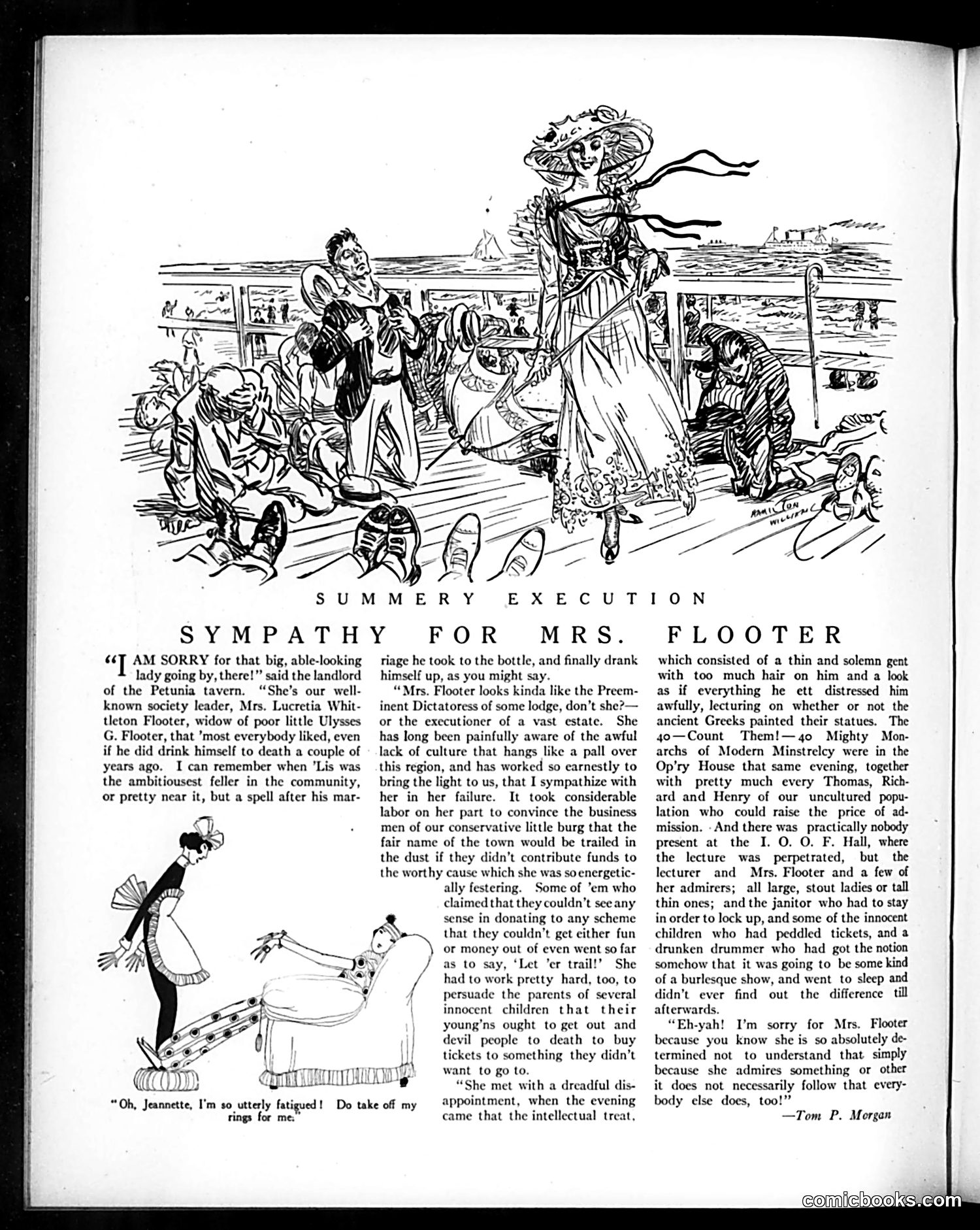
This satirical piece mocks Mrs. Lucretia Whitleton Flooter, a wealthy widow and self-appointed cultural arbiter in a small town. The joke centers on her failed attempt to elevate the community's "culture" by organizing a lecture on ancient Greek statuary. Despite her considerable effort pressuring townspeople and businesses to attend and support the event, the lecture was a humiliating flop. The speaker was described as off-putting, and the venue sat nearly empty—only her devoted admirers and a few others showed up. Meanwhile, a minstrelsy show (the "40 Mighty Monarchs") drew the actual crowds the same evening. The satire targets her arrogant assumption that her personal tastes and values automatically matter to everyone else. She cannot comprehend that ordinary people simply don't share her intellectual pretensions or desire to be "cultured" on her terms. The cartoon ridicules both her snobbish condescension and her obliviousness to her own failure.
📄 Transcribed text from this page (OCR, searchable)
Machine-transcribed from the original scan — historical spelling and the odd misread are preserved.
SUMMERY EX SYMPATHY eT AM SORRY for that big, able-looking lady going by, there!” said the landlord of the Petunia tavern. “She's our well- known society leader, Mrs. Lucretia Whit- tleton Flooter, widow of poor little Ulysses G. Flooter, that 'most everybody liked, even if he did drink himself to death a couple of years ago. I can remember when 'Lis was the ambitiousest feller in the community, or pretty near it, but a spell after his mar- “Oh, Jeannette, I'm so utterly fatigued! Do take off my rings for me: FOR MRS. riage he took to the bottle, and finally drank himself up, as you might say. “Mrs. Flooter looks kinda like the Preem- inent Dictatoress of some lodge, don’t she?— or the executioner of a vast estate. She has long been painfully aware of the awful lack of culture that hangs like a pall over this region, and has worked so earnestly to bring the light to us, that I sympathize with her in her failure. It took considerable labor on her part to convince the business men of our conservative little burg that the fair name of the town would be trailed in the dust if they didn’t contribute funds to the worthy cause which she was so energetic- ally festering. Some of ’em who claimed that they couldn’t see any sense in donating to any scheme that they couldn’t get either fun or money out of even went so far as to say, ‘Let ’er trail!’ She had to work pretty hard, too, to persuade the parents of several innocent children that their young’ns ought to get out and devil people to death to buy tickets to something they didn’t want to go to. “She met with a dreadful dis- appointment, when the evening came that the intellectual treat, ECUTION FLOOTER which consisted of a thin and solemn gent with too much hair on him and a look as if everything he ett distressed him awfully, lecturing on whether or not the ancient Greeks painted their statues. The 4o—Count Them!—4o Mighty Mon- archs of Modern Minstrelcy were in the Op’ry House that same evening, together with pretty much every Thomas, Rich- ard and Henry of our uncultured popu- lation who could raise the price of ad- mission. - And there was practically nobody present at the I. O. O. F. Hall, where the lecture was perpetrated, but the lecturer and Mrs. Flooter and a few of her admirers; all large, stout ladies or tall thin ones; and the janitor who had to stay in order to lock up, and some of the innocent children who had peddled tickets, and a drunken drummer who had got the notion somehow that it was going to be some kind of a burlesque show, and went to sleep and didn’t ever find out the difference till afterwards. “Eh-yah! I’m sorry for Mrs. Flooter because you know she is so absolutely de- termined not to understand that simply because she admires something or other it does not necessarily follow that every- body else does, too!” —Tom P. Morgan