
Judge, 1915-10-09 · page 8 of 28
Judge — October 9, 1915 — page 8: what you’re looking at
What you’re looking at
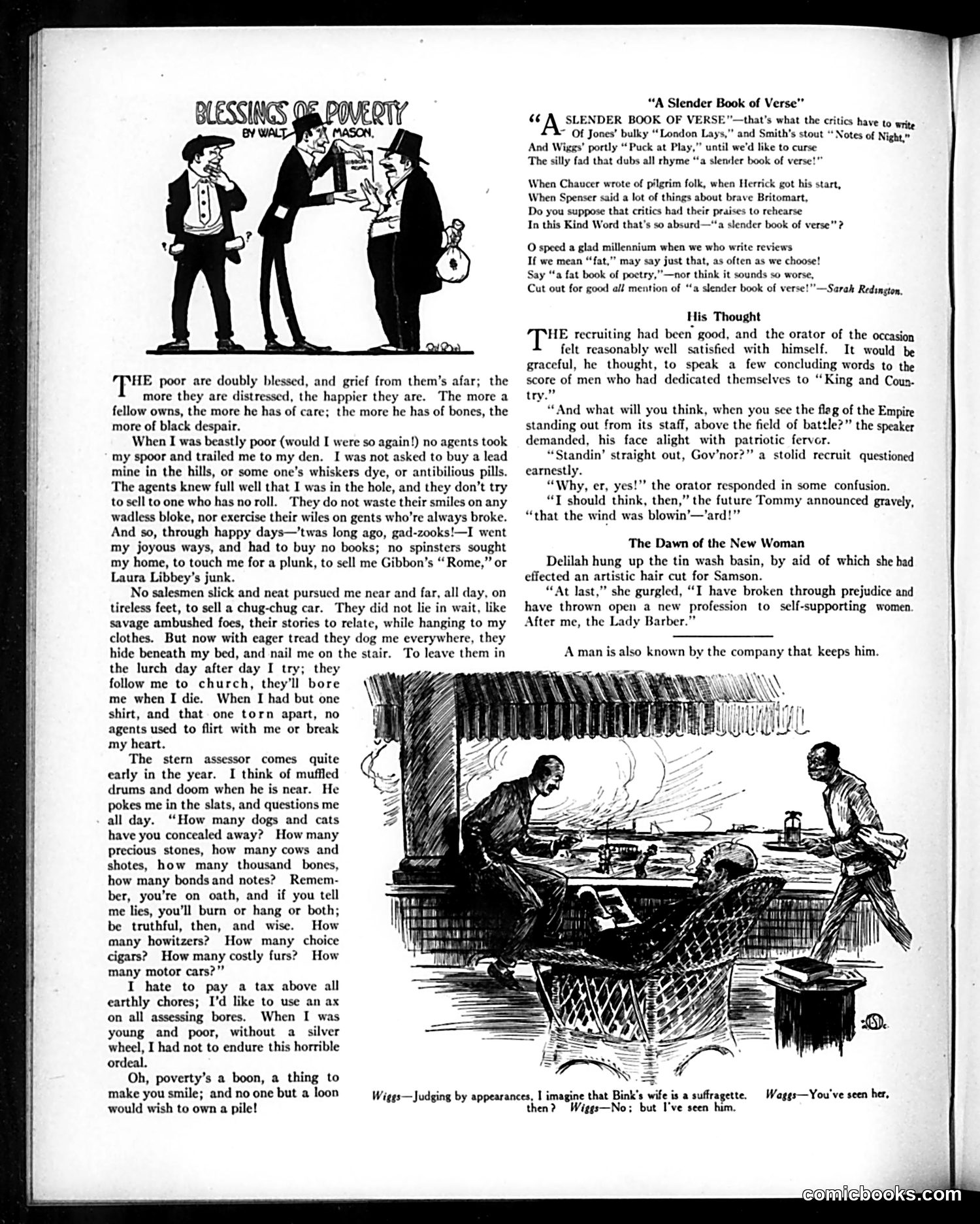
This Judge magazine page contains three satirical pieces: **"Blessings of Poverty"** (left cartoon and main text): A wealthy man's ironic lament that poverty was preferable to riches. The joke is that as a poor man, he avoided salesmen, tax assessors, and social climbers. Now wealthy, he's constantly pestered by agents selling everything from automobiles to literature, and harassed by tax collectors. The satire mocks both wealth's burdens and the aggressive sales culture of early 20th-century America. **"A Slender Book of Verse"** (top right): Critics' overuse of the phrase "slender book of verse" to describe poetry collections is ridiculed. The author argues that if a book is actually *fat*, critics should say so frankly instead of using euphemistic language. **"His Thought"** (bottom): A military recruiter delivers patriotic rhetoric about the Empire's flag during battle. A recruit's deadpan question—whether the flag will be standing straight out—deflates the emotional appeal with literal-minded practicality, mocking both recruitment propaganda and working-class soldiers' indifference to jingoistic speeches.
📄 Transcribed text from this page (OCR, searchable)
Machine-transcribed from the original scan — historical spelling and the odd misread are preserved.
PRE poor are doubly blessed, and grief from them’s afar; the more they are distressed, the happier they are. The more a fellow owns, the more he has of care; the more he has of bones, the more of black despair. When I was beastly poor (would I were so again!) no agents took my spoor and trailed me to my den. I was not asked to buy a lead mine in the hills, or some one’s whiskers dye, or antibilious pills. The agents knew full well that I was in the hole, and they don’t try to sell to one who has no roll. They do not waste their smiles on any wadless bloke, nor exercise their wiles on gents who're always broke. And so, through happy days—’twas long ago, gad-zooks!—I went my joyous ways, and had to buy no books; no spinsters sought my home, to touch me for a plunk, to sell me Gibbon’s “Rome,” or Laura Libbey’s junk. No salesmen slick and neat pursucd me near and far, all day, on tireless feet, to sell a chug-chug car. They did not lie in wait, like savage ambushed foes, their stories to relate, while hanging to my clothes. But now with eager tread they dog me everywhere, they hide beneath my bed, and nail me on the stair. To leave them in the lurch day after day I try; they follow me to church, they'll bore me when I die. When I had but one shirt, and that one torn apart, no agents used to flirt with me or break my heart. The stern assessor comes quite early in the year. I think of muffled drums and doom when he is near. He pokes me in the slats, and questions me all day. “How many dogs and cats have you concealed away? How many precious stones, how many cows and shotes, how many thousand bones, how many bonds and notes? Remem- ber, you're on oath, and if you tell me lies, you'll burn or hang or both; be truthful, then, and wise. How many howitzers? How many choice cigars? How many costly furs? How many motor cars?” I hate to pay a tax above all earthly chores; I'd like to use an ax on all assessing bores. When I was young and poor, without a silver wheel, I had not to endure this horrible ordeal. Oh, poverty’s a boon, a thing to make you smile; and no one but a loon would wish to own a pile! Wiggs—Judging by appearances, I imagine that Bink’s wife is a subregette “A Slender Book of Verse” 66 AQ SLENDER BOOK OF VERSE"—that's what the critics have to write Of Jones’ bulky “London Lays,” and Smith's stout “Notes of Night,” ‘And Wiggs’ portly “Puck at Play,” until we'd like to curse The silly fad that dubs all rhyme “a slender book of verse!" When Chaucer wrote of pilgrim folk, when Herrick got his start, When Spenser said a lot of things about brave Britomart, Do you suppose that critics had their praises to rehearse In this Kind Word that's so absurd—'‘a slender book of verse"? O speed a glad millennium when we who write reviews If we mean “fat,” may say just that, as often as we choose! Say “‘a fat book of poctry,”—nor think it sounds so worse, Cut out for good aif mention of “‘a slender book of verse!”—Sarah Redington. His Thought “HE recruiting had been good, and the orator of the occasion felt reasonably well satisfied with himself. It would be graceful, he thought, to speak a few concluding words to the score of men who had dedicated themselves to “King and Coun- try.” “And what will you think, when you see the flag of the Empire standing out from its staff, above the field of battle?” the speaker demanded, his face alight with patriotic fervor. “Standin’ straight out, Gov’nor?” a stolid recruit questioned earnestly. “Why, er, yes!”’ the orator responded in some confusion. “T should think, then,” the future Tommy announced gravely, “that the wind was blowin’—‘ard!” The Dawn of the New Woman Delilah hung up the tin wash basin, by aid of which she had effected an artistic hair cut for Samson. “At last,” she gurgled, “I have broken through prejudice and have thrown open a new profession to self-supporting women. After me, the Lady Barber.” Aman is also known by the company that keeps him. Waggs—You've seen her, then? Wiggs—No; but I've seen