
A complete issue · 30 pages · 1915
Judge — October 2, 1915
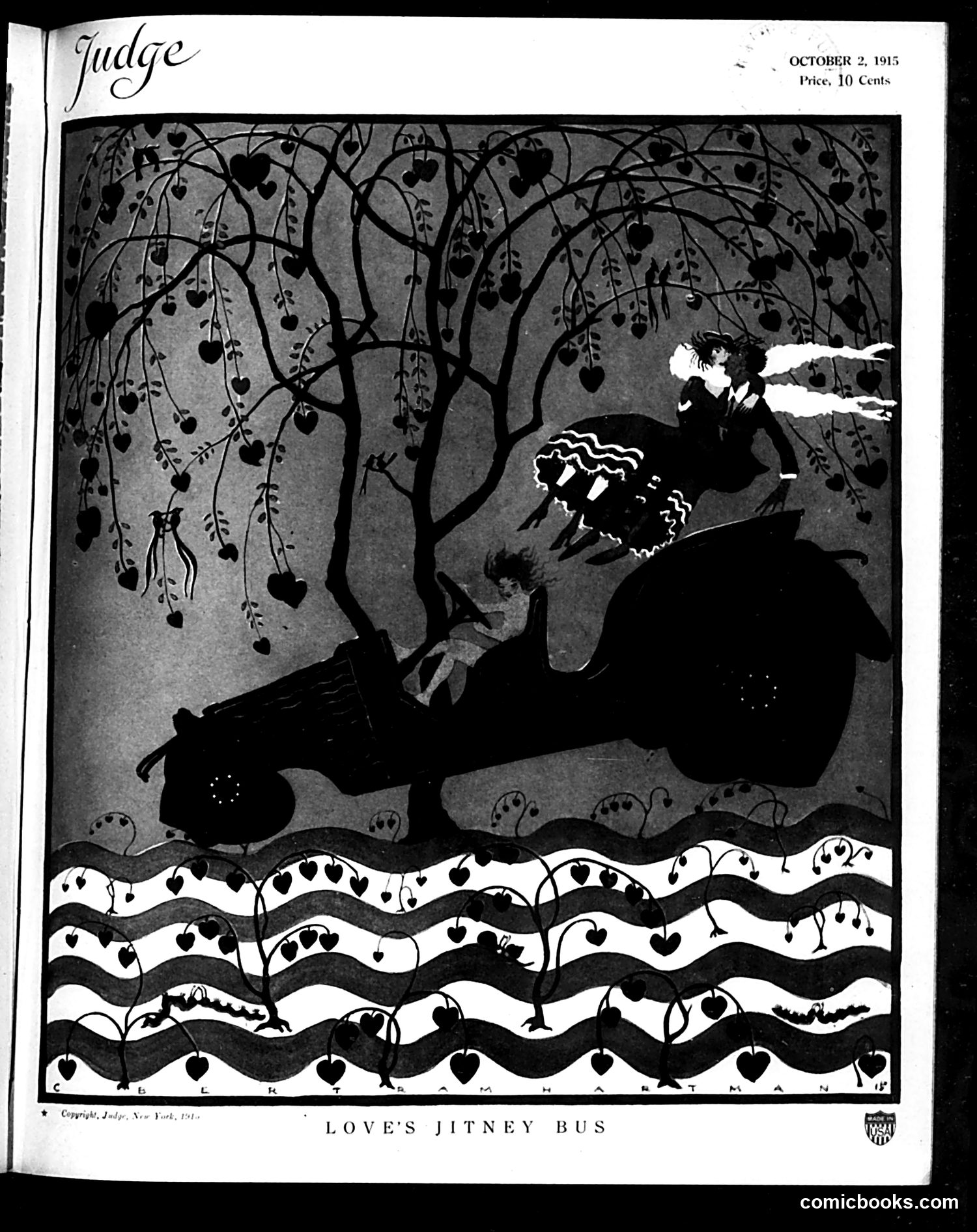
This illustration satirizes romantic courtship as a "jitney bus" ride—likely referencing the popular low-cost jitney buses that were common urban transportation circa 1915. The silhouetted couple appears to be courting beneath drooping fruit trees (suggesting fertility or natural romance), while the landscape below is rendered as rolling waves decorated with heart motifs. The joke plays on the metaphor of love as a journey or ride. The "jitney" reference suggests romance has become cheap, quick, and standardized—mass-produced rather than special. The pastoral, dreamy art style contrasts with this mundane modern transportation reference, creating satirical commentary on how mechanized modern life was transforming intimate human experiences like courtship into commodified, impersonal transactions.
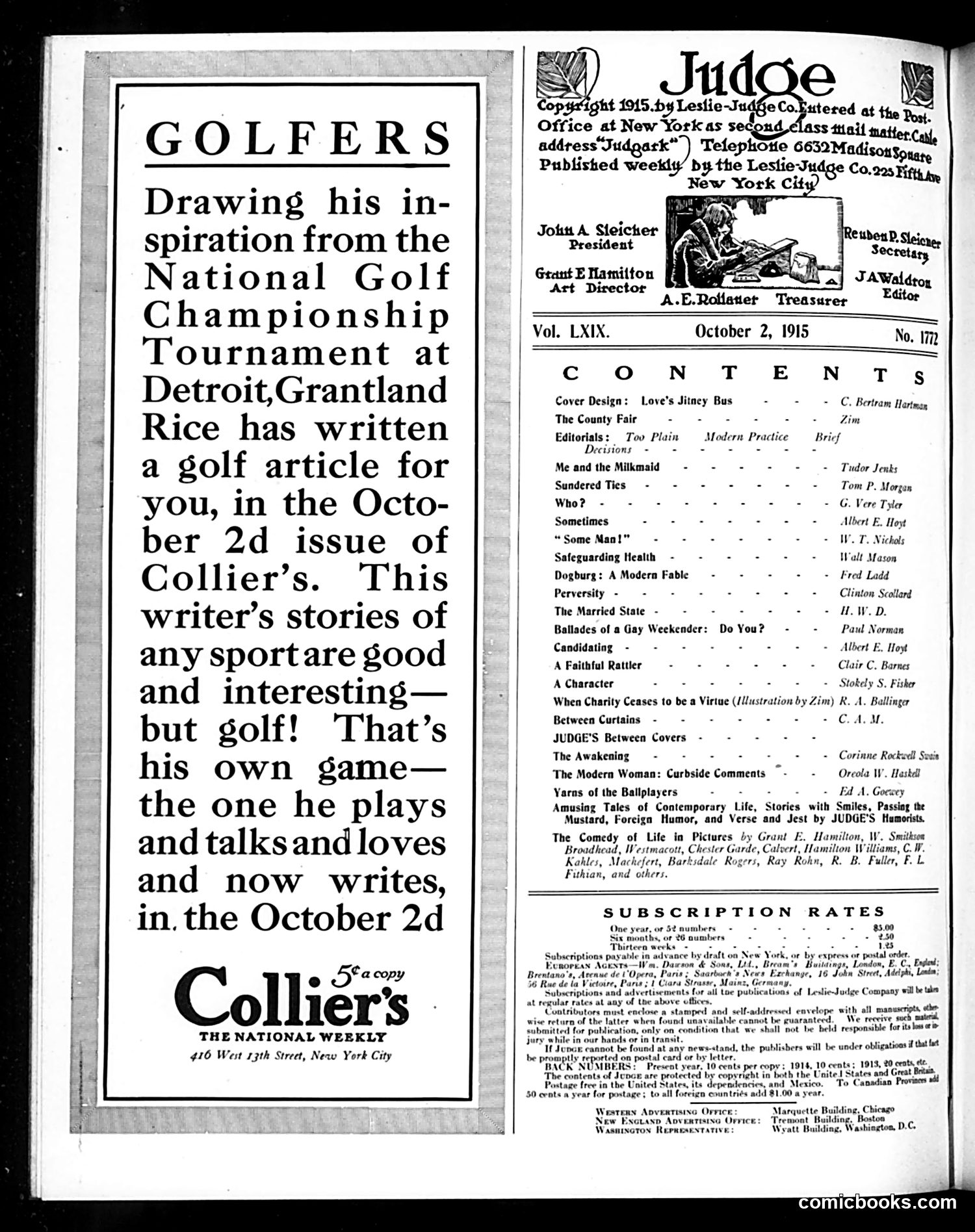
This page is primarily **advertising** for Collier's magazine, promoting a golf article by Grantland Rice about the National Golf Championship Tournament at Detroit. The ad uses humor to appeal to golf enthusiasts, noting that Rice's sports writing focuses on golf—"his own game—the one he plays and talks and loves." The right side shows Judge's masthead, contents page, and subscription information. The magazine featured satirical commentary, editorials, and humor pieces typical of the era. While specific cartoon subjects aren't clearly visible in this image, Judge generally offered political satire and social commentary on contemporary American issues. The 1915 date places this during World War I's early years in Europe, though this particular page doesn't address that conflict.
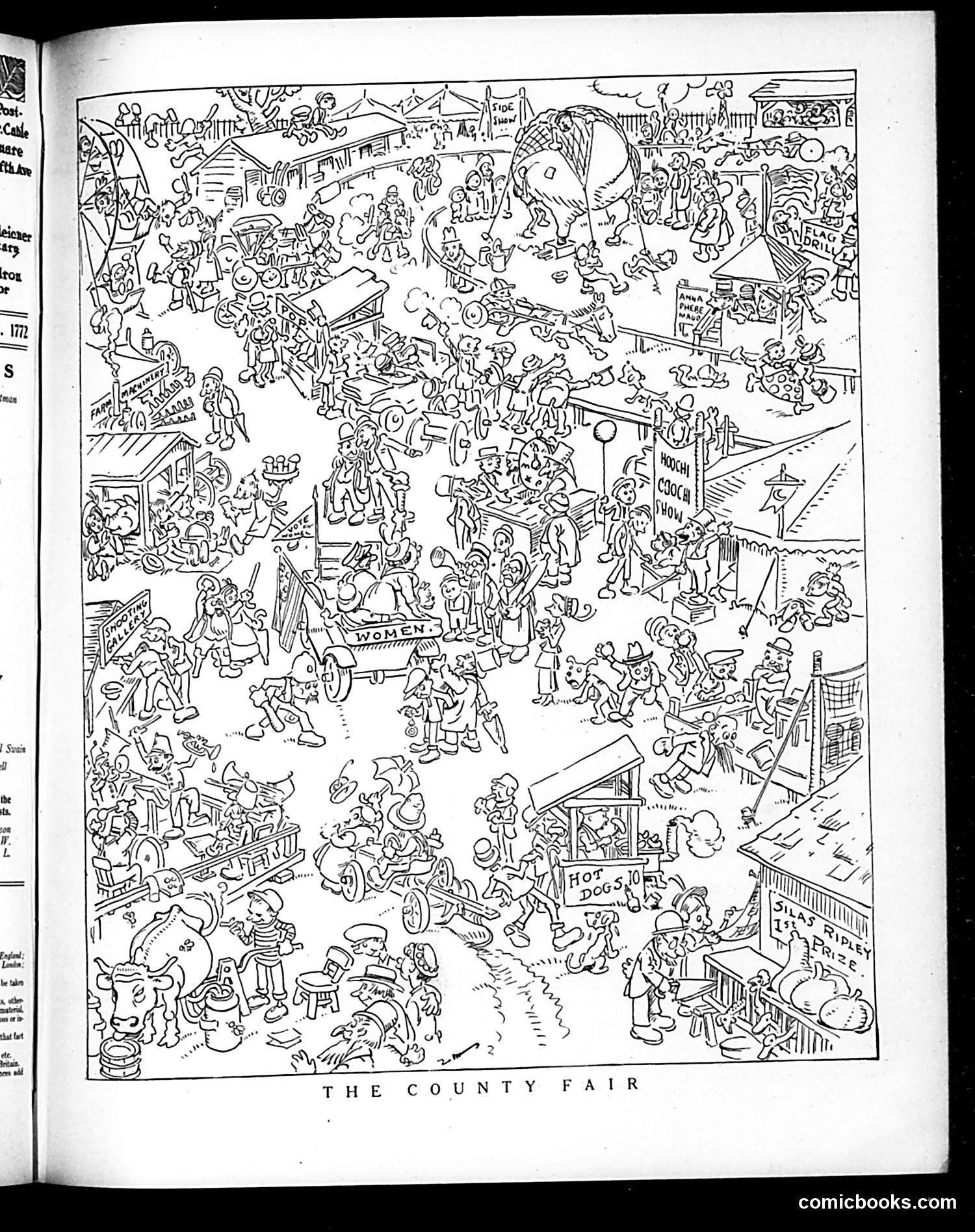
This is a crowded, bustling scene depicting a typical American county fair, rendered in the classic early-20th-century Judge magazine style. The cartoon shows numerous fair-goers enjoying various attractions: a hot air balloon, food vendors (including "Hot Dogs"), games, rides, and entertainment booths. Visible signs include "Women," "Hot Dogs," and "Silver Ride Prize." Rather than political satire, this appears to be **social humor** celebrating American rural/small-town leisure culture. The comedy derives from the chaotic density of activities and people—the cartoonist captures the sensory overload and frivolous amusements of fair-going. This reflects Judge's typical approach of gently mocking American social customs and public gatherings through detailed, densely-packed comic illustration.
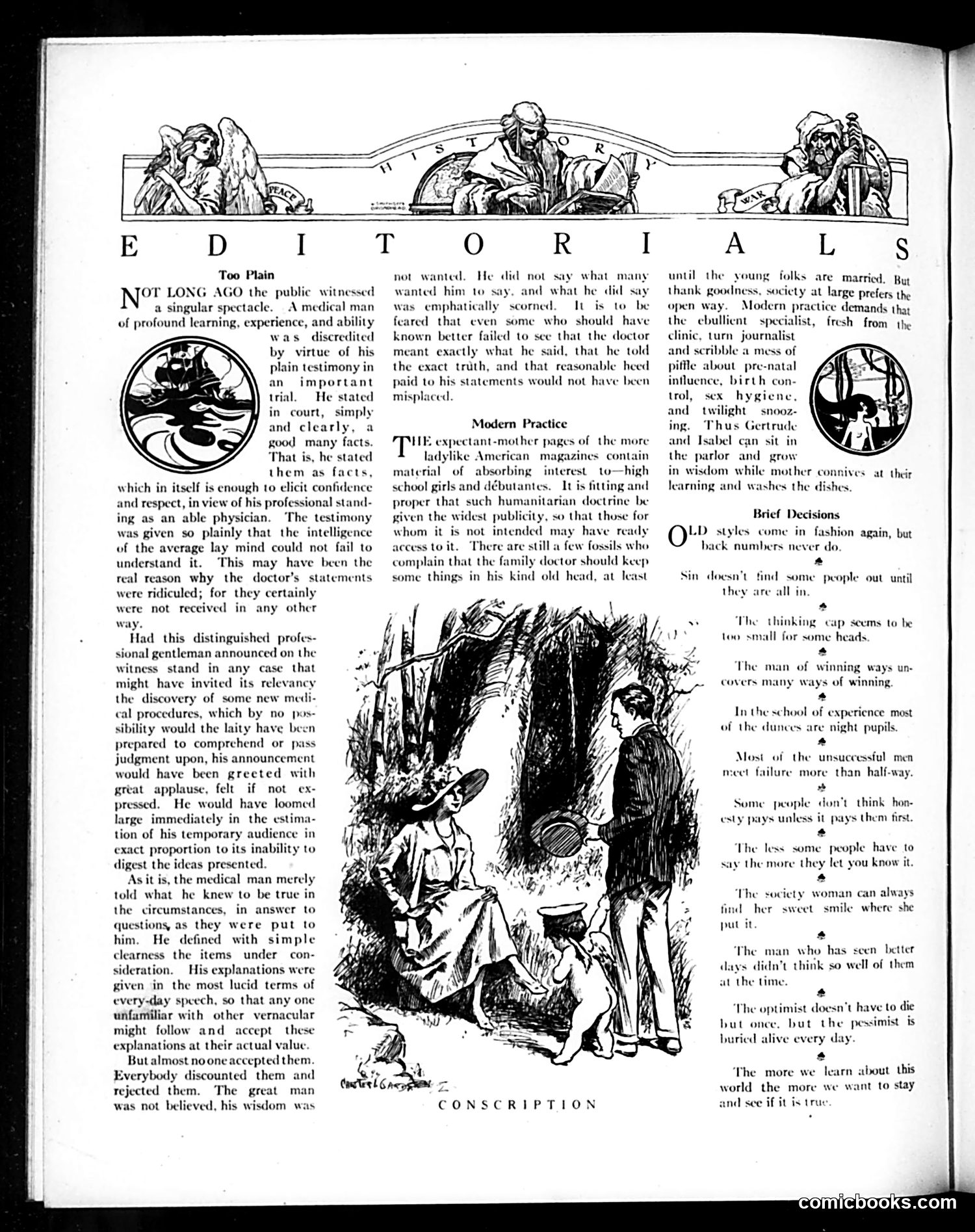
The large central illustration depicts a figure (appearing to be Uncle Sam or a military recruiter) forcibly conscripting a reluctant young man into military service. The man is being pulled or dragged into what appears to be a military structure or tunnel. The accompanying editorial text criticizes a doctor's courtroom testimony about medical matters, discussing how his statements were received skeptically by the public. The juxtaposition suggests Judge is satirizing both military conscription practices and institutional authority figures who lack public credibility. The "Brief Decisions" section contains cynical aphorisms about human nature and society. Without specific dating context, the conscription reference likely alludes to either WWI-era draft debates or general anti-conscription sentiment prevalent in American satirical magazines of that era.
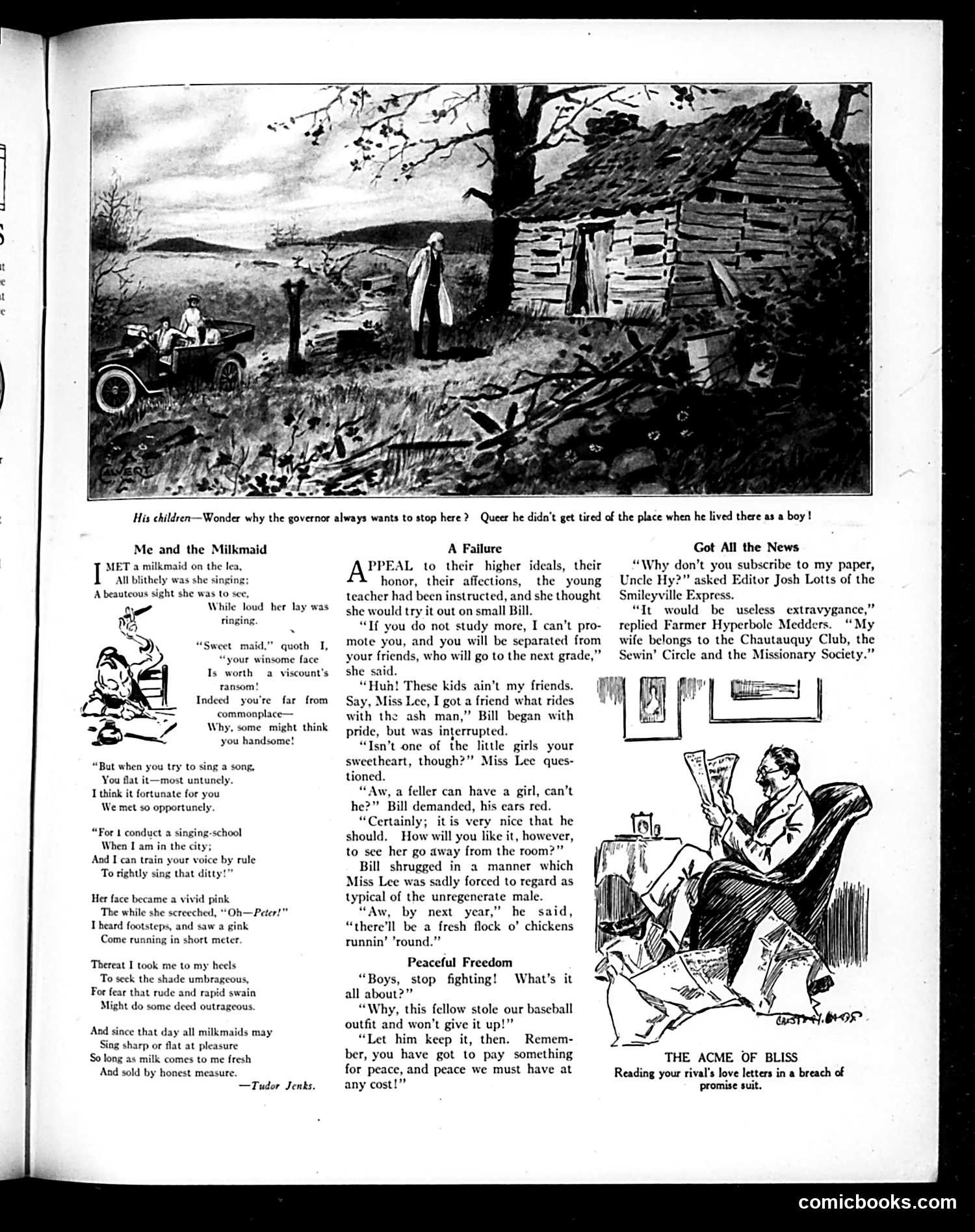
This page contains three separate satirical pieces rather than unified political cartoons: 1. **"Me and the Milkmaid"** — A poem by Tudor Jenks about flirtation with a dairy worker, featuring light romantic humor typical of the era. 2. **"A Failure"** — A story about a young teacher (Miss Lee) attempting to discipline rural students through moral instruction. The satire targets the gap between urban educational ideals and rural resistance; students like Bill care more about practical matters (girlfriends, baseball) than abstract morality lessons. 3. **"Got All the News"** — A brief joke about a farmer dismissing a newspaper subscription, preferring local gossip networks (sewing circles, missionary societies) — mocking rural insularity versus urban information-seeking. The top illustration depicts an early automobile visitor encountering rural poverty, likely satirizing class contrasts or rural decline.
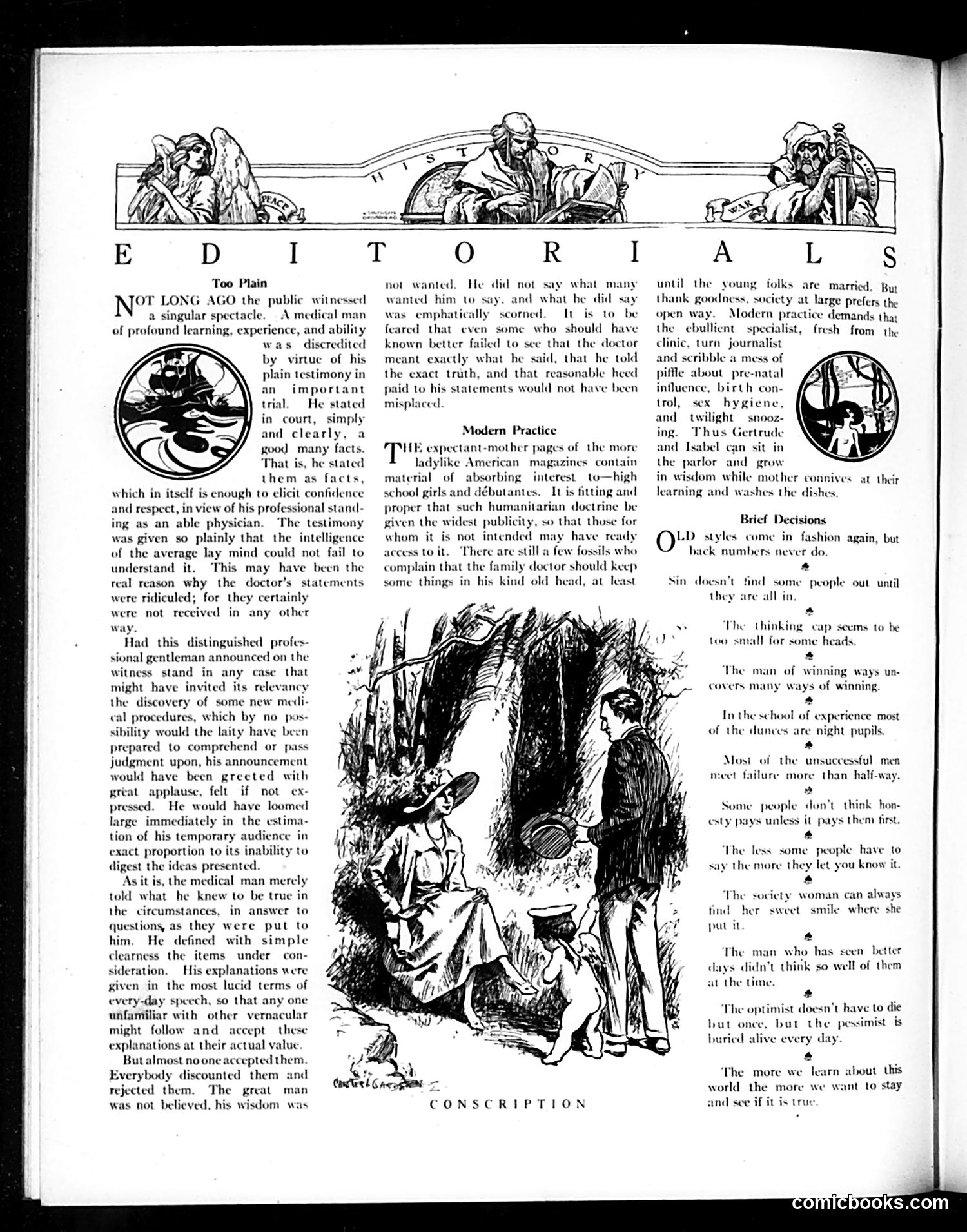
This Judge magazine page satirizes two targets: the courtroom dismissal of expert testimony and the proliferation of unsolicited advice in popular magazines. The main article ("Too Plain") criticizes a medical expert who testified clearly and truthfully in court, only to be ridiculed and disbelieved. The satire suggests the public prefers impressive jargon to honest simplicity—experts gain credibility through obscurity, not accuracy. The doctor's straightforward language made his testimony seem less authoritative, a critique of how truth and expertise are valued. The second section ("Modern Practice") mocks magazines publishing detailed health and childbirth advice for young unmarried women. The cartoon depicts working-class domestic life, suggesting elite publications inappropriately expose girls to sophisticated topics while their mothers remain ignorant, doing dishes. The satire targets paternalistic gatekeeping—information intended for married women reaches unmarried ones anyway. The "Brief Decisions" are aphoristic quips about human nature and social hypocrisy, typical of Judge's filler content.
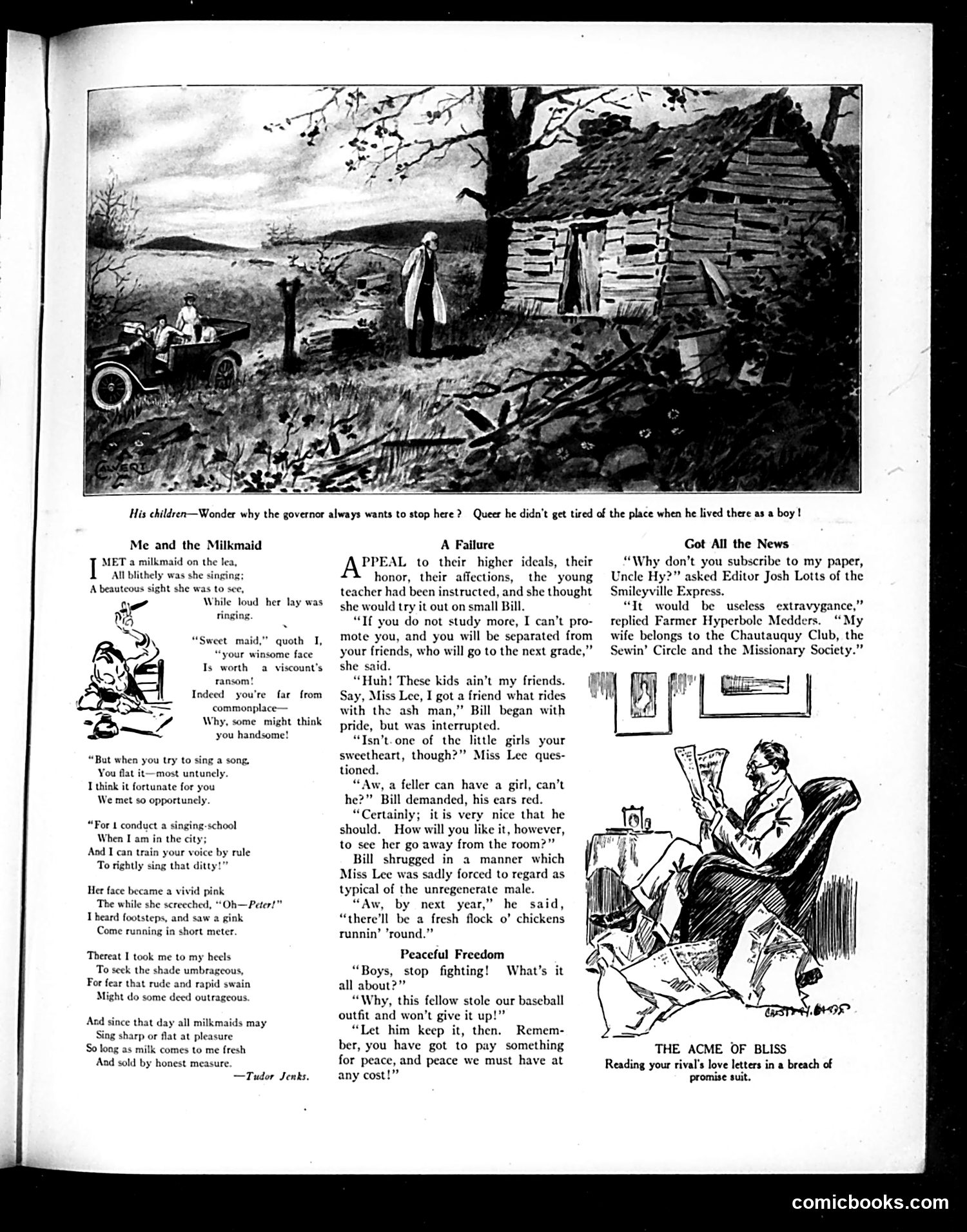
This page contains three satirical pieces reflecting early 20th-century American social attitudes: **"Me and the Milkmaid"**: A poem by Tudor Jenks mocking a presumptuous man who insults a milkmaid's singing voice then offers to train her. When her boyfriend ("Peter") arrives, the narrator flees. The joke: his condescension backfires. **"A Failure"**: Satire on Progressive Era educational theory. A teacher attempts to motivate a working-class boy ("Bill") by appealing to sentiment—friendship, romance—to encourage studying. Bill dismisses it all casually, caring only for his ash-man friend and assuming girls are replaceable. The "failure" is that sentimental appeals don't work on boys from this social class, suggesting class-based cynicism about reform efforts. **"Peaceful Freedom"** and **"Got All the News"**: Brief gags about accepting losses for peace and wives' club memberships replacing newspapers as information sources—gentle domestic humor. **"The Acme of Bliss"**: Caption joke about scandal and breach-of-promise lawsuits, common entertainment fodder. The page is primarily humorous fiction rather than political commentary.
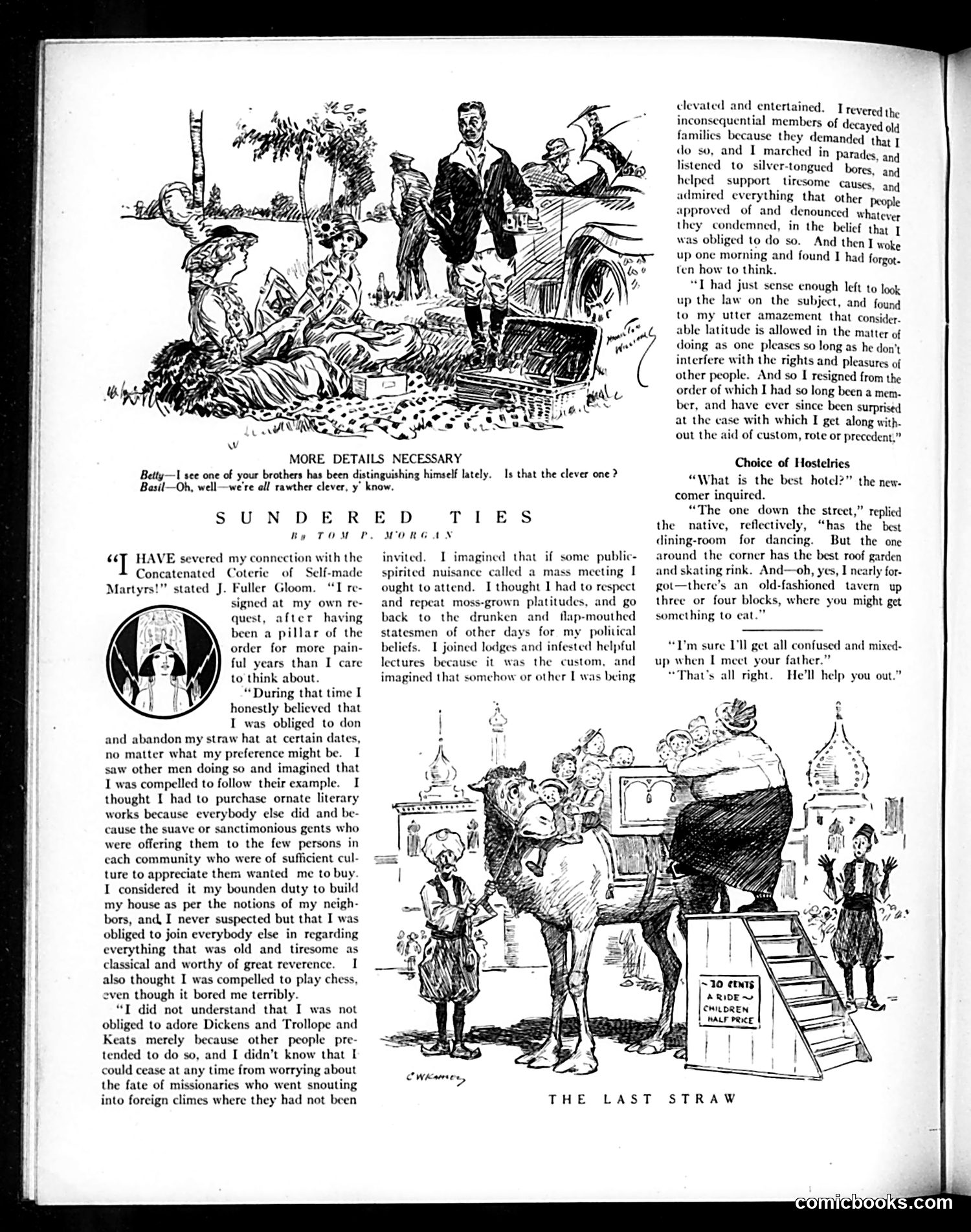
This page satirizes **conformity and blind adherence to social convention**. The main article features J. Fuller Gloom describing his resignation from the "Concatenated Coterie of Self-made Martyrs"—apparently a satirical name for organizations that enforce arbitrary rules. Gloom recounts wasting years following needless customs: wearing specific hats on certain dates, buying ornate books nobody truly enjoyed, building houses to match neighbors' preferences, and pretending to admire Dickens and Trollope out of social obligation. He mocks people who attend mass meetings, join lodges, and march in parades simply because "custom" demands it, all while worrying about distant missionaries. The satire's point: respectable society pressures people to abandon independent thinking and personal preference for hollow conformity. Gloom's realization—that he "forgot how to think"—is the punchline. By resigning, he discovers considerable freedom exists within the law. The brief dialogue jokes about similar absurdities: upper-class British characters discussing whether their brothers are "clever," and tourists receiving contradictory hotel recommendations based on trivial amenities rather than actual comfort. **Target:** Victorian-era social pretension and the tyranny of respectability.
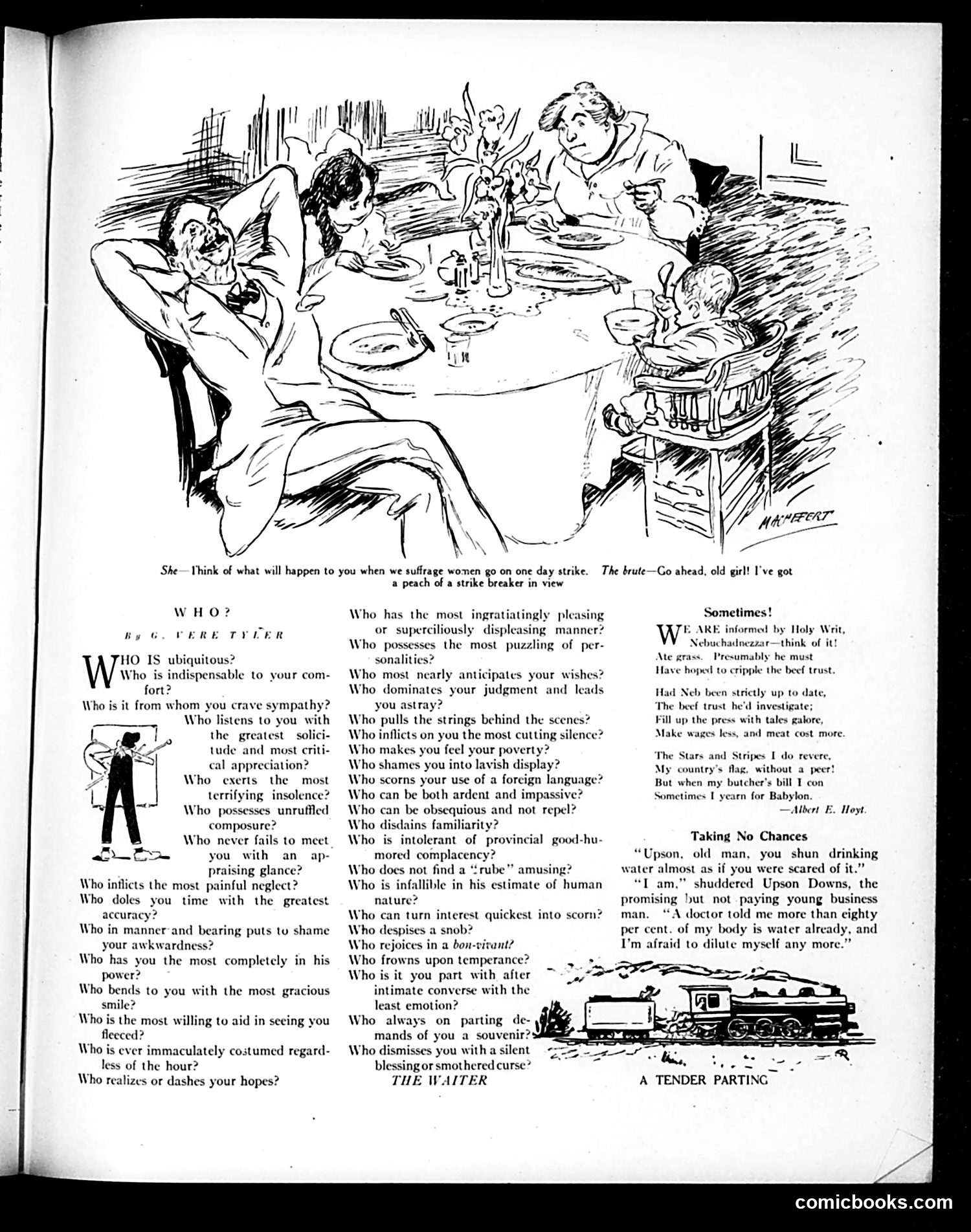
This page contains early 20th-century satirical content about women's suffrage and gender relations. The main cartoon depicts a dinner scene where a woman threatens a man with what suffragettes called a "strike"—women refusing domestic labor. The man dismissively calls her "a peach of a strike breaker," mocking the threat. The accompanying quiz by G. Vere Tyler sarcastically lists all the ways waiters (and by extension, service workers and wives) control men through indispensability, manipulation, and emotional power—undermining the woman's threat by suggesting men already lack power in these relationships. The satire works by inverting suffrage arguments: rather than acknowledging women's legitimate grievances about legal inequality, it suggests women already wield domestic power, making their demands for political rights unnecessary. Additional content includes unrelated humor about beef trust investigations and water consumption—typical filler material for the magazine's satirical format.
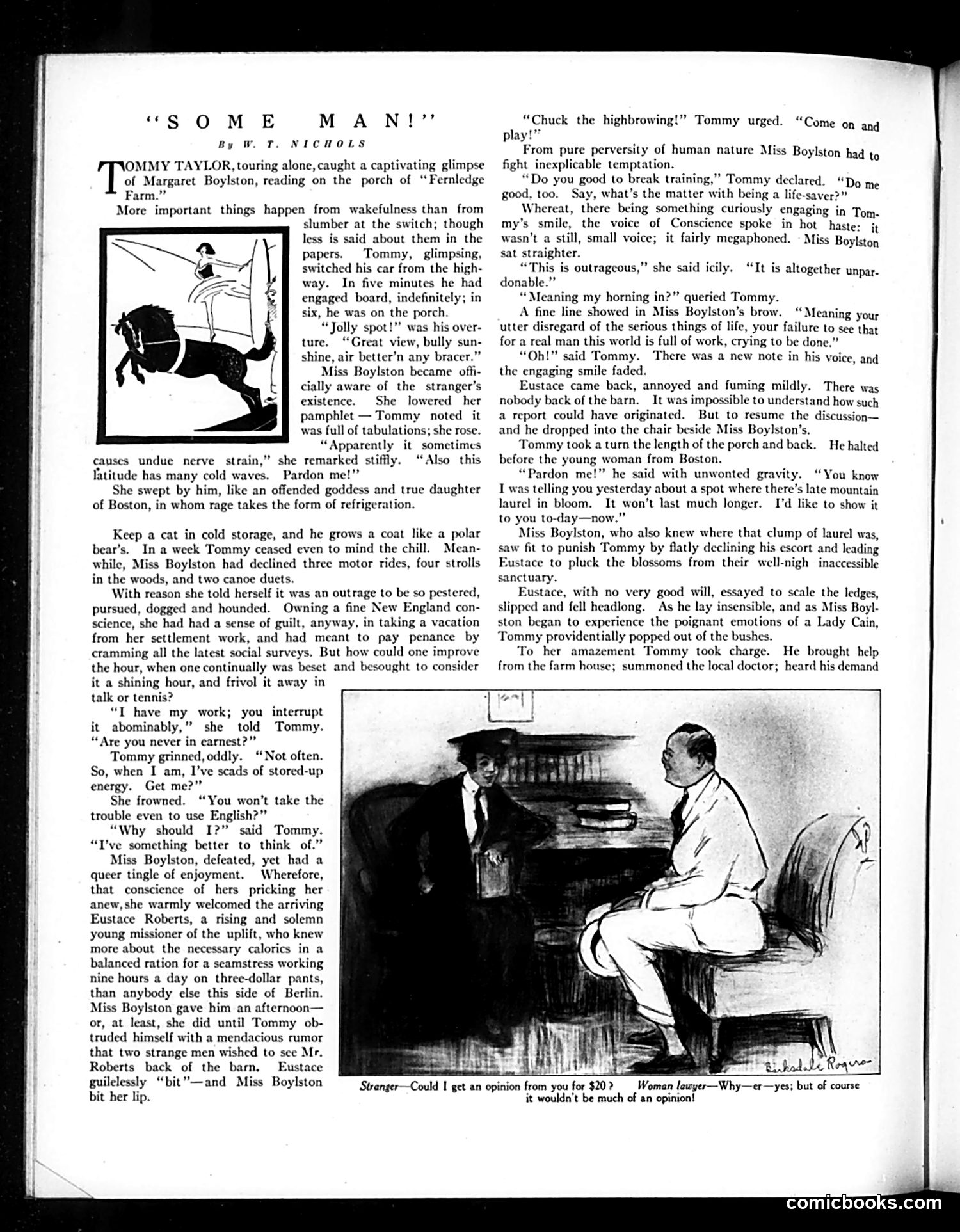
This is a romantic comedy story by W.T. Nichols about Tommy Taylor, a young man who pursues Miss Margaret Boylston, a serious Boston woman devoted to social reform work. The satire targets two character types: the carefree male romantic lead who dismisses serious work ("Chuck the highbrowing!"), and the earnest, duty-bound female reformer who speaks in moral absolutes and treats pleasure as morally suspect. The joke is situational irony: Miss Boylston's rigid principles and disdain for Tommy are tested when Eustace (apparently a rival suitor or acquaintance) falls while fetching mountain laurel she requested. Tommy's practical competence and concern—summoning help, getting a doctor—contradicts his frivolous image and suggests character depth beneath his playful manner. The accompanying illustration shows what appears to be a doctor or professional consulting with a patient, likely advancing the plot.
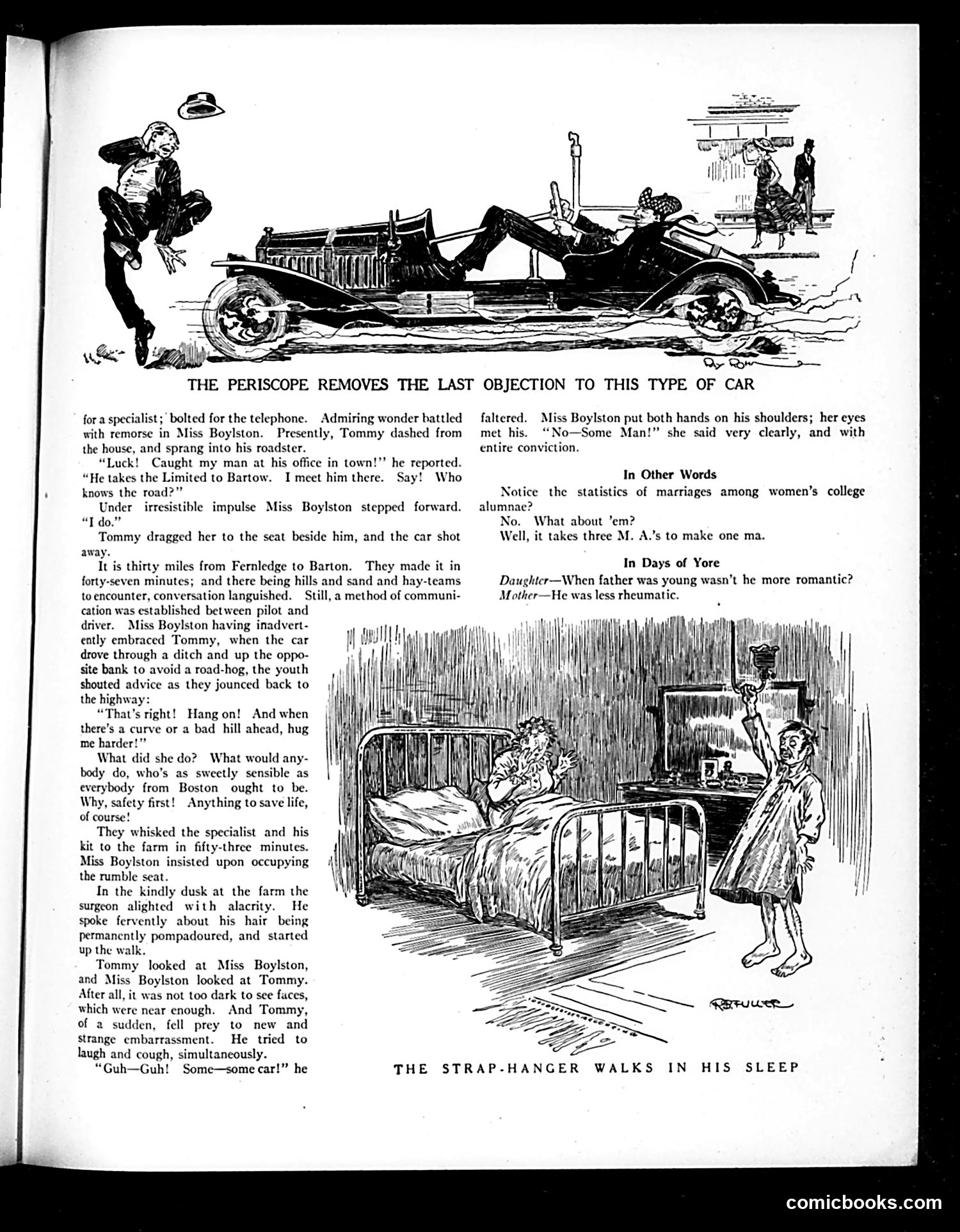
This Judge magazine page satirizes early automotive romance and the "safety first" movement of the 1910s-1920s. **Main cartoon (top):** A woman uses a car's periscope (a novel safety feature) to see the road ahead, removing the "last objection" to this car type—likely implying women drivers. The joke mocks both new automotive technology and contemporary anxieties about women operating vehicles. **Story below:** Tommy and Miss Boylston drive urgently to fetch a surgeon. During the bumpy ride, Miss Boylston accidentally embraces Tommy for safety. Later, embarrassed by the intimate moment, Tommy awkwardly credits the car ("Some car!") rather than acknowledge the romantic encounter. The satire targets how "safety first" becomes a convenient excuse to rationalize improper behavior. **Sidebar jokes:** Mock women's college education and aging husbands' lost romanticism—typical period humor targeting educated women and marriage. The broader satire critiques how modern technology (cars, periscopes) disrupts Victorian propriety while providing plausible deniability.
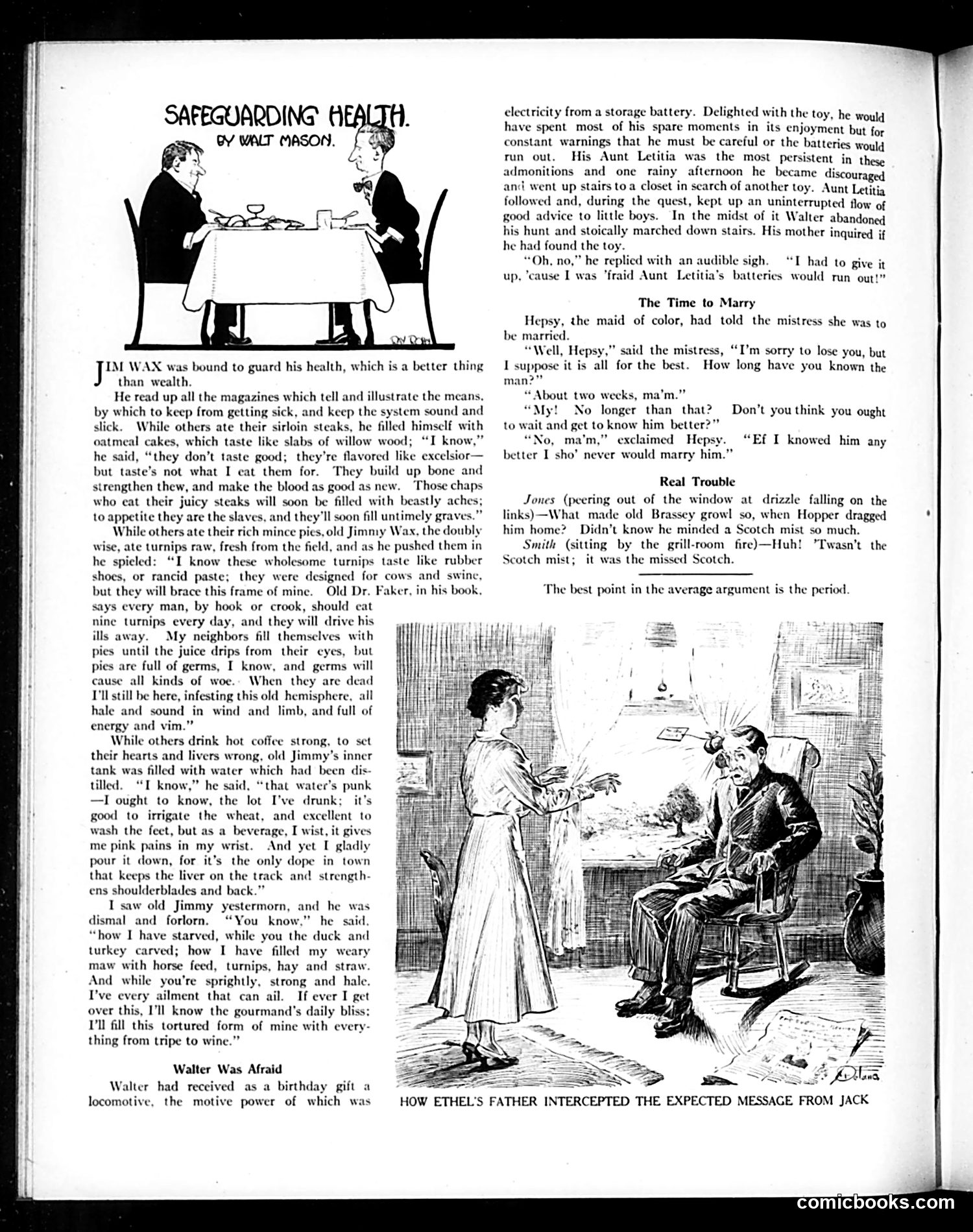
This page contains three humorous stories satirizing American health fads and domestic life, likely from the early 1900s. **"Safeguarding Health"** mocks the era's obsession with health pseudoscience. Jim Wax rigidly follows dubious advice—eating tasteless turnips and plain water while avoiding normal food—convinced this will make him live forever. The joke's irony: his ascetic regimen leaves him sickly and miserable, while those eating normally thrive. This satirizes both faddish "health experts" peddling bad advice and zealots who follow them blindly. **"Walter Was Afraid"** jokes about overprotective parenting, specifically Aunt Letitia's constant warnings that Walter's toy locomotive's batteries will "run out." Walter becomes so anxious he abandons the toy entirely—the warnings defeat their purpose. **"The Time to Marry"** uses ethnic humor (Hepsy is identified as "the maid of color") typical of the era. Hepsy's quick engagement after two weeks is presented as foolish, but her punchline—that *knowing* the man better would make her *less* likely to marry him—suggests marriage is inherently unwise, a common comedic theme.
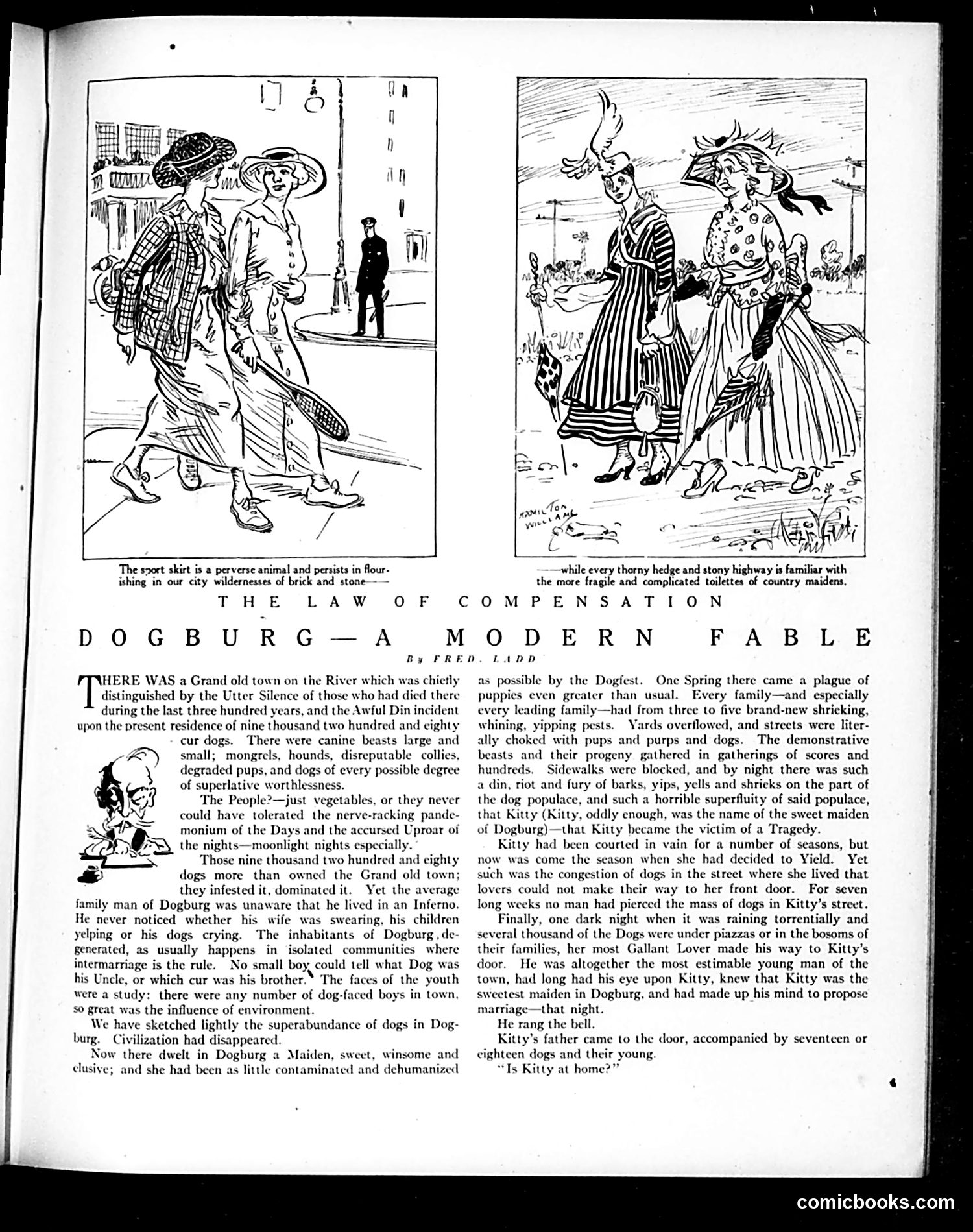
This satirical fable critiques urban social decay and environmental determinism. The fictional town of Dogburg is overrun with dogs—literally and figuratively representing chaos, degeneracy, and moral decline in a crowded city. The story uses dogs as metaphor for how environment corrupts people. Citizens have become "dog-faced," dehumanized by constant noise and disorder. Even the sweet maiden Kitty becomes a "victim of Tragedy" when suitors cannot reach her through the literal pack of dogs blocking the streets. The satire's point: unchecked urban problems (overcrowding, filth, noise) destroy civilization and human connection. The "Law of Compensation" title suggests ironic justice—those who tolerated the dog-infested chaos now suffer romantic and social paralysis as consequence. The top cartoons mock women's fashion (the "sport skirt") and country versus city contrasts, reinforcing themes about urban degradation versus rural simplicity.
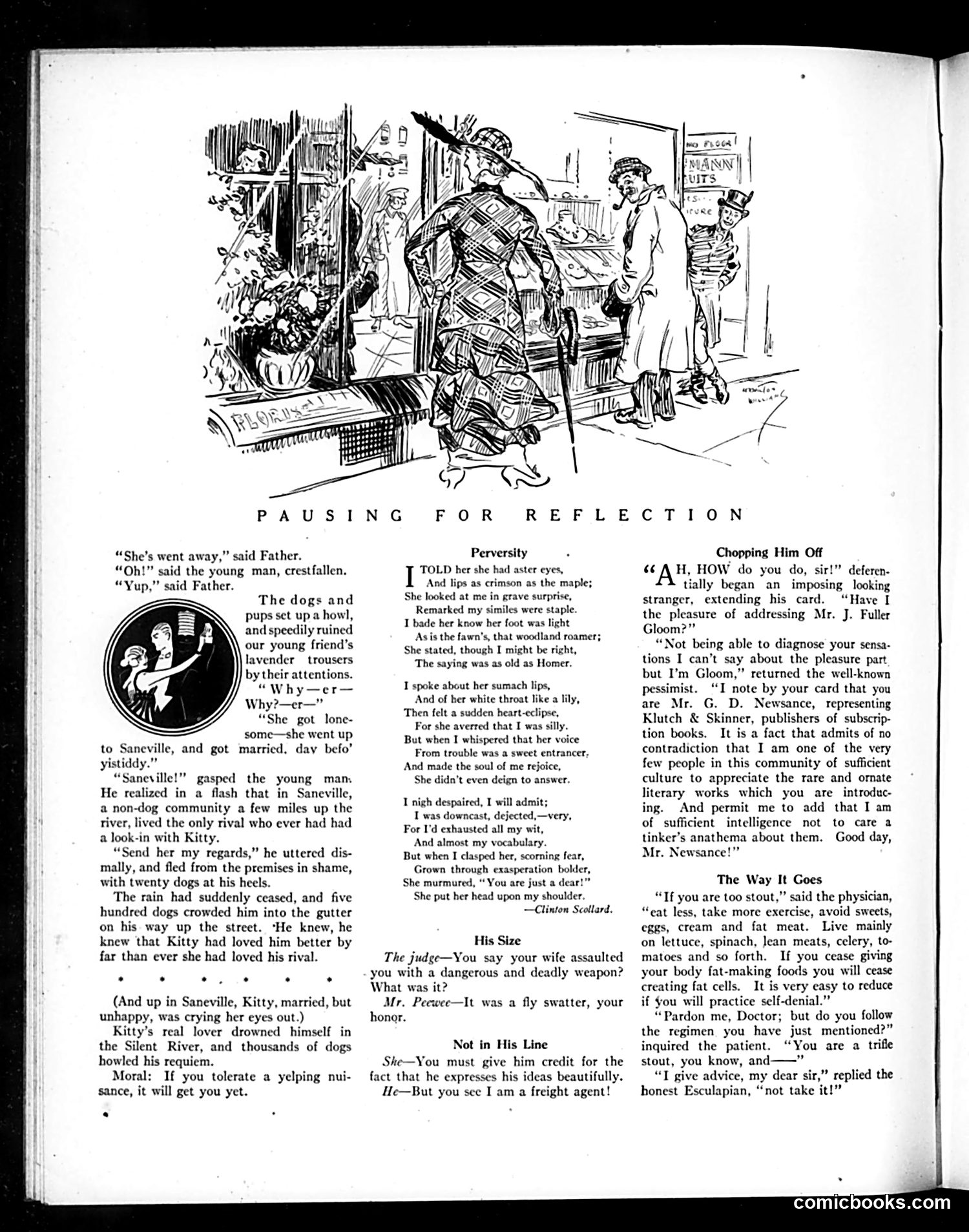
This page contains three unrelated humor pieces typical of Judge magazine's satirical style: **"Pausing for Reflection"** (top): A sentimental story-poem about a young man's romantic rival who marries his beloved Kitty in the distant town of Saneville. The lover drowns himself, and dogs—the story's running gag—pursue him throughout. The "moral" satirizes melodramatic literary romance tropes. **Three short jokes below:** - **"His Size"**: A pun where Mr. Peewee's wife attacks him with a fly swatter, deflating the seriousness of the courtroom language. - **"Not in His Line"**: A man can't appreciate beautiful expression of ideas because he's merely a freight agent—satirizing class and professional pretension. - **"The Way It Goes"**: A physician prescribes strict dieting advice but is himself overweight, mocking hypocrisy in expertise. The illustration shows a street scene with figures in period dress (early 1900s), likely accompanying one story.
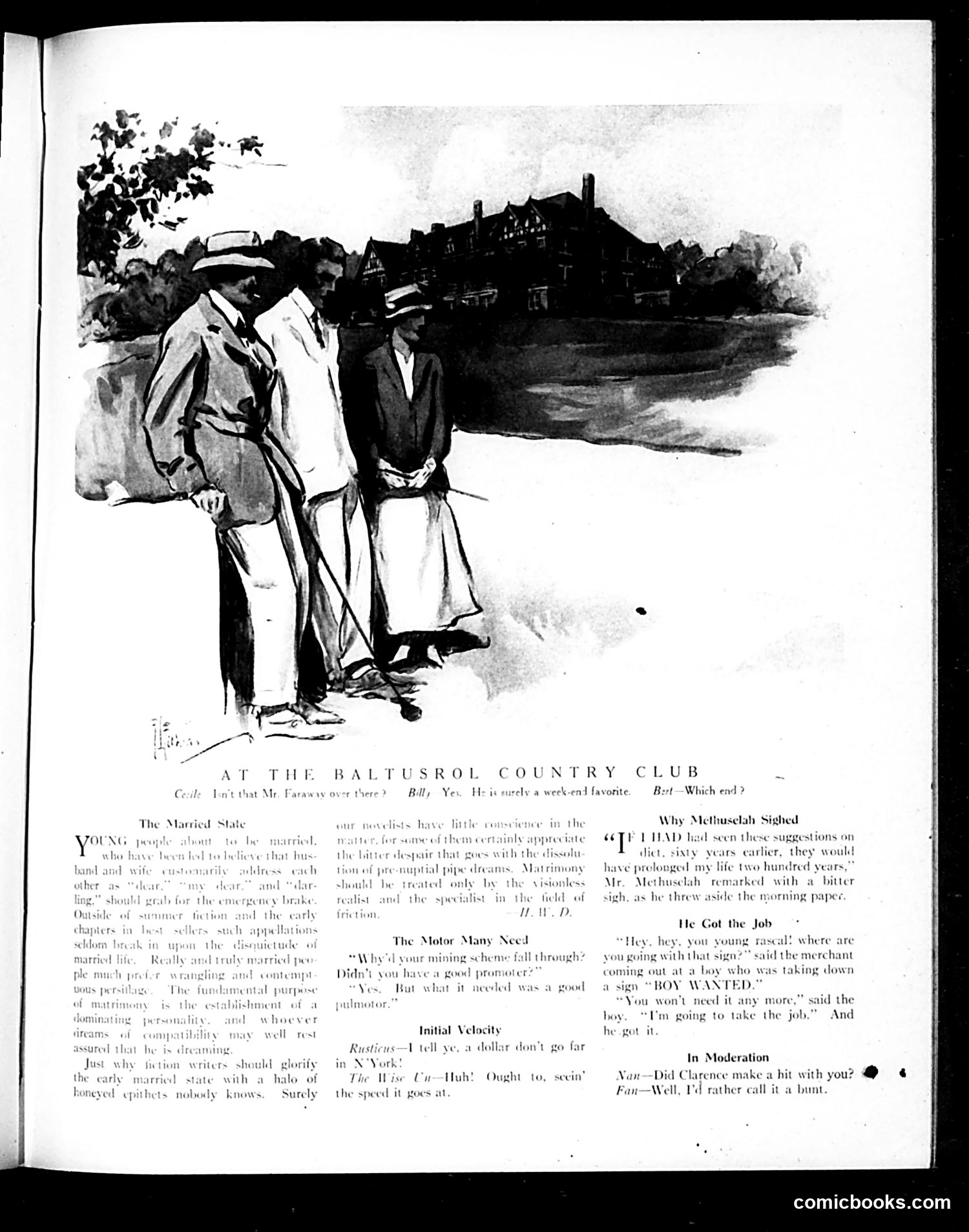
This page from **Judge** magazine presents several satirical vignettes set at an upscale country club, mocking social pretenses and contemporary attitudes. **Main cartoon**: Three men in suits and hats discuss a fourth absent member ("Mr. Faraway"), establishing an upper-class setting. **Satirical segments**: - **"The Married State"**: Mocks romantic idealism in marriage, suggesting newlyweds' grand expectations clash with mundane reality. - **"The Motor Many Need"**: Jokes about a failed business scheme, possibly referencing early automobile industry hype. - **"Initial Velocity"**: A brief quip about urban cost-of-living (money doesn't stretch far in New York). - **"Why Methuselah Sighed"**: Biblical humor—the ancient patriarch regrets he didn't receive modern life advice earlier. - **"He Got the Job"**: Humorous anecdote about a boy taking any job offered, even one originally marked "BOY WANTED." - **"In Moderation"**: A mild sports joke equating romantic success with baseball ("bunt"). The overall tone ridicules wealthy club members' pretensions while gently satirizing marriage, business, and social ambition typical of early 20th-century American life.
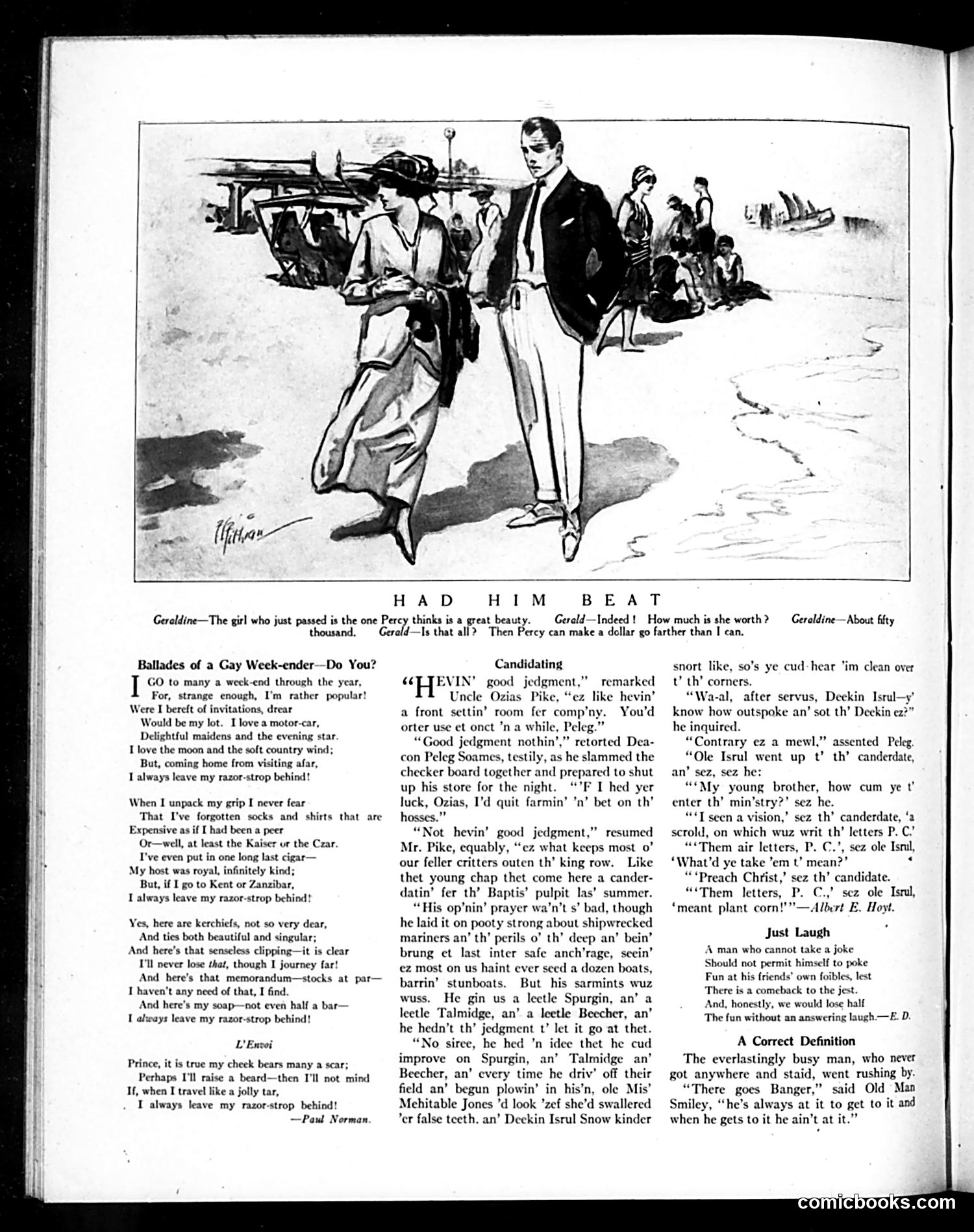
The top cartoon depicts a romantic seaside scene with the caption "Had Him Beat." The dialogue reveals a social satire: Gerald boasts that Percy thinks a passing girl is "a great beauty" worth "fifty thousand" dollars. Gerald dismissively responds "Is that all?" — the joke being that he casually deflates Percy's romantic assessment with crude financial calculation, suggesting wealth and shallow materialism trump genuine beauty. Below are three pieces of light verse and short humor pieces typical of Judge's satirical format: "Ballades of a Gay Week-ender" pokes fun at the forgetful weekend visitor who meticulously packs everything except his razor-strop; "Candidating" mocks a presumptuous Baptist minister candidate who foolishly tries to improve upon established preachers; and brief humorous observations about laughter and busy men round out the page. The overall tone is genteel American satire targeting upper-class social pretension and rural American speech patterns.
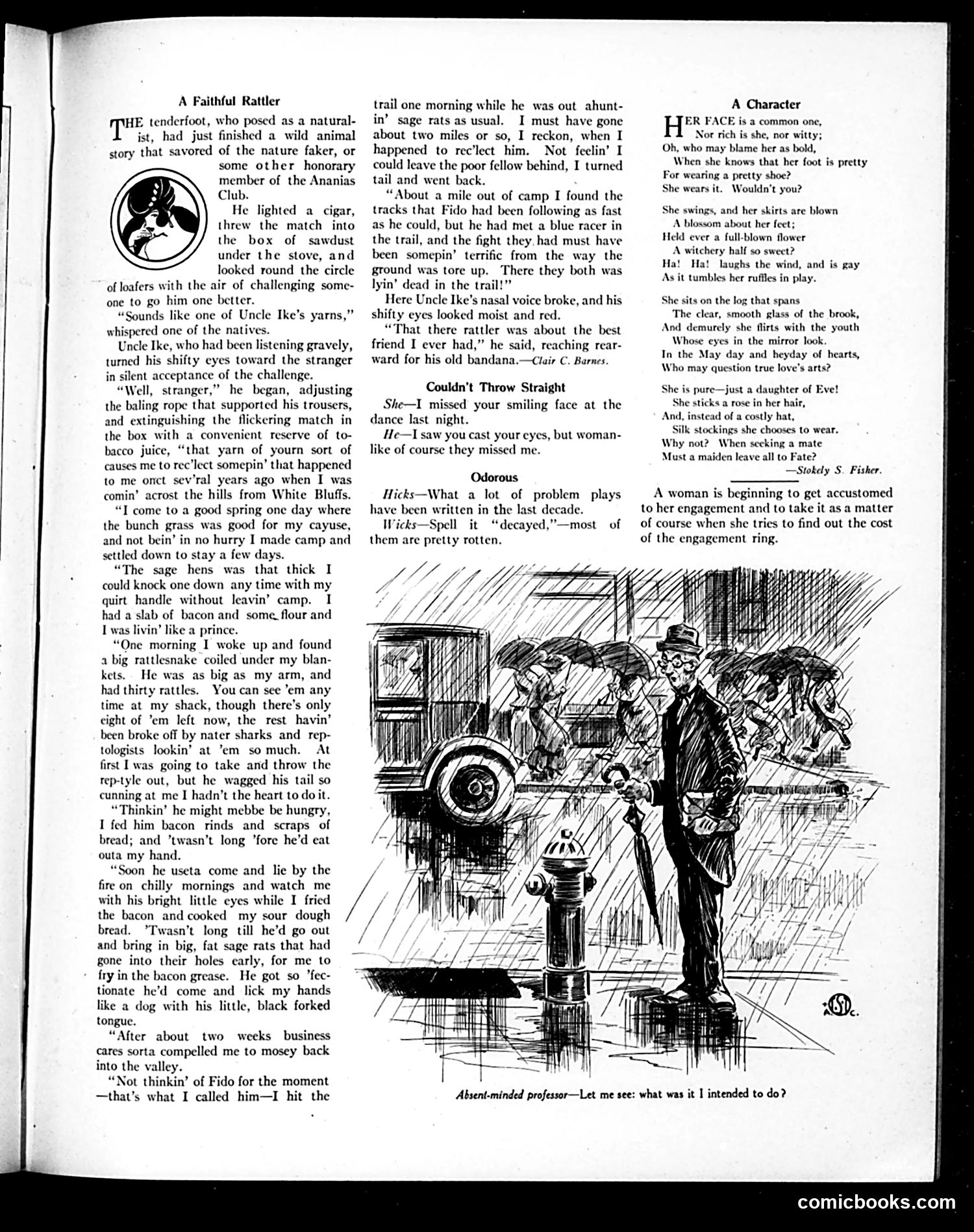
This page from Judge magazine contains three distinct pieces: **"A Faithful Rattler"** is the main story—a tall tale where a tenderfoot brags about an animal encounter, prompting "Uncle Ike," a weathered Westerner, to one-up him with an absurd story about befriending a rattlesnake named Fido. The satire targets "nature fakers"—a contemporary concern about writers and speakers who fabricated exaggerated wildlife stories. Uncle Ike's yarn (about a rattlesnake acting like a loyal dog, even hunting for him) is obviously ridiculous, mocking both tall-tale tradition and the credulous audiences who enjoyed such yarns. **"Couldn't Throw Straight"** is a brief joke about gender stereotypes—a woman's supposed poor aim, here applied metaphorically to her eyes/attention. **"A Character"** is a poem about an ordinary, plain-looking woman. The illustration depicts an absent-minded professor—a stock figure of gentle fun in period humor. The pages reflect Judge's satirical focus on American social foibles, exaggeration, and type characters.
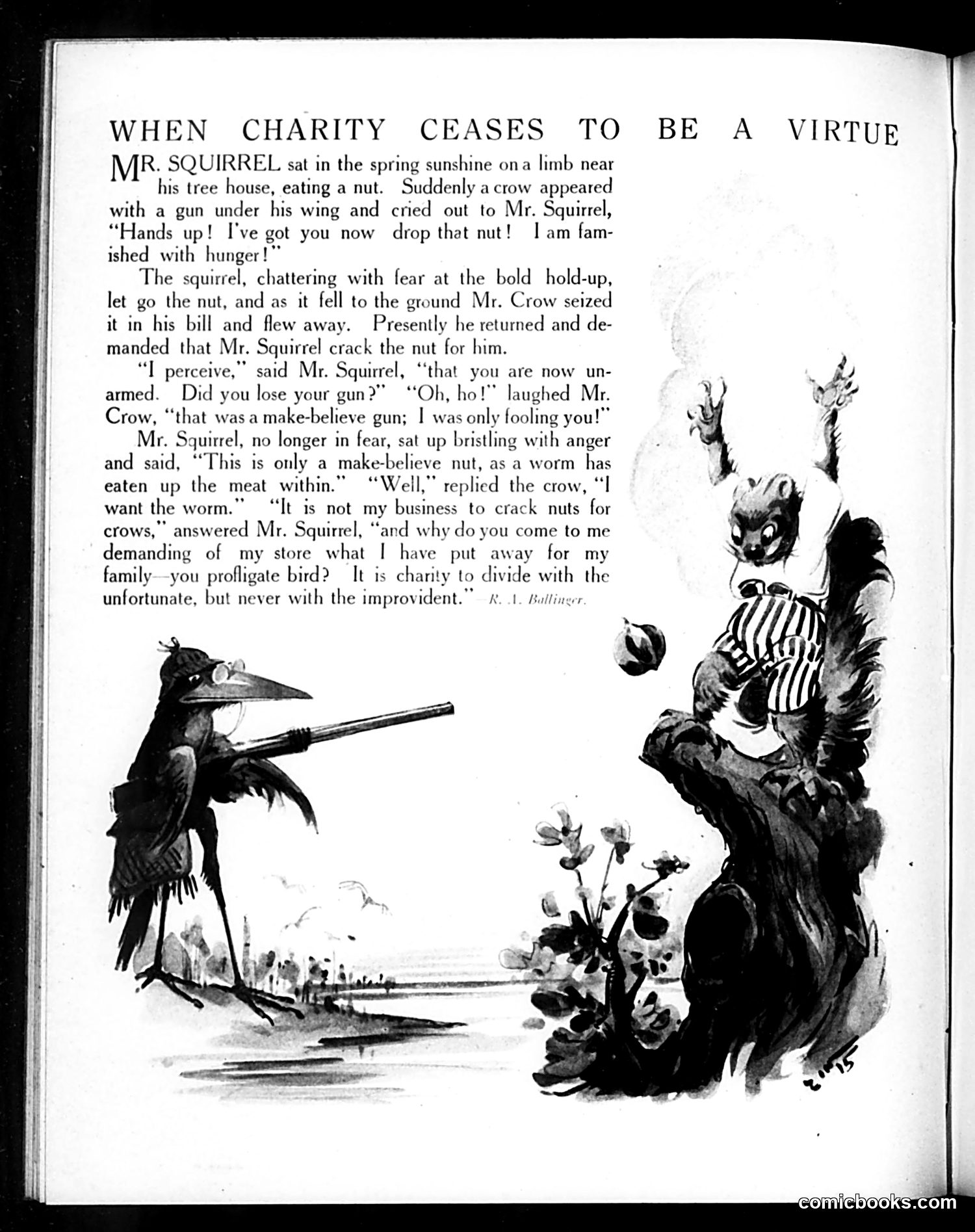
This fable-style story satirizes debates about welfare and charity in the Gilded Age. Mr. Squirrel represents the industrious, self-reliant worker who has saved for his family's needs. Mr. Crow embodies the improvident poor or undeserving applicant—first using deception (fake gun) to steal, then demanding handouts without effort or gratitude. The moral, attributed to R.J. Burdette, argues that true charity aids the genuinely unfortunate, but should never reward idleness or entitlement. The "make-believe" elements (false gun, wormy nut) emphasize that deception and manipulation characterize those seeking unearned aid. This reflects late 19th-century conservative rhetoric opposing expanded welfare, viewing poverty as often self-inflicted rather than structural. The anthropomorphic animals make the argument digestible for a general audience while delivering a pointed social message about who deserves assistance.
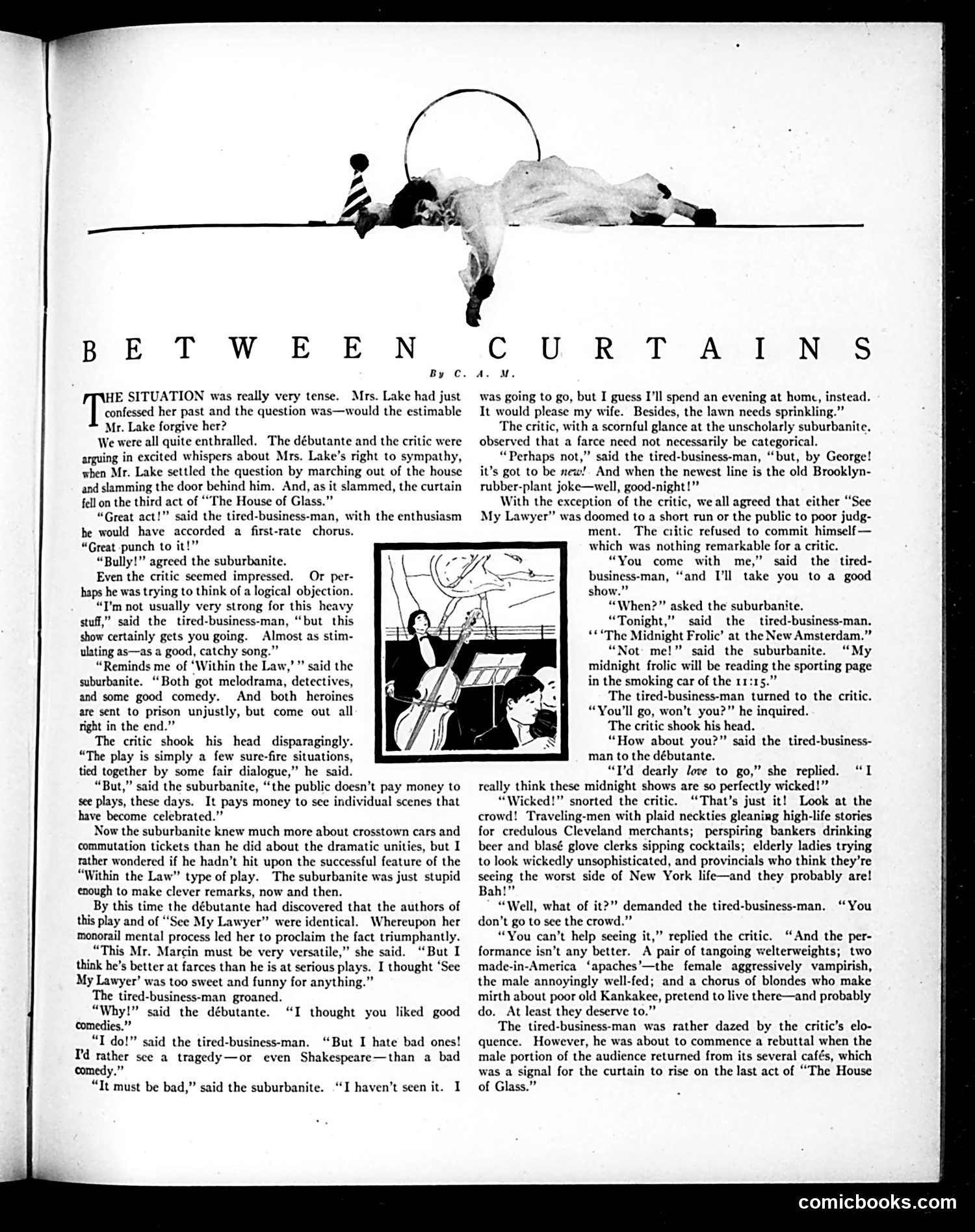
This piece satirizes early 20th-century theater criticism and audience tastes. Three characters discuss a play called "The House of Glass" (appears to be real): **The Players:** - A **tired-business-man**: practical, working-class; enjoys entertainment for entertainment's sake - A **suburbanite**: well-meaning but pretentious, makes half-informed observations about drama - A **critic**: pedantic, dismissive, refuses to engage meaningfully with popular theater - A **débutante**: shallow, impressed by trivia (the playwright's name) **The Satire's Point:** The critic represents intellectual snobbery—he dismisses "sure-fire situations" and melodrama while offering no genuine insight. Meanwhile, the suburbanite accidentally articulates a truth: audiences pay for memorable *scenes*, not dramatic structure. The tired-business-man, seemingly least sophisticated, proves most honest about what entertainment should do. The humor lies in inverting expectations: the "stupid" suburbanite speaks wisdom; the educated critic adds nothing of value. This mocks highbrow theater criticism's pretension versus popular theater's genuine appeal.
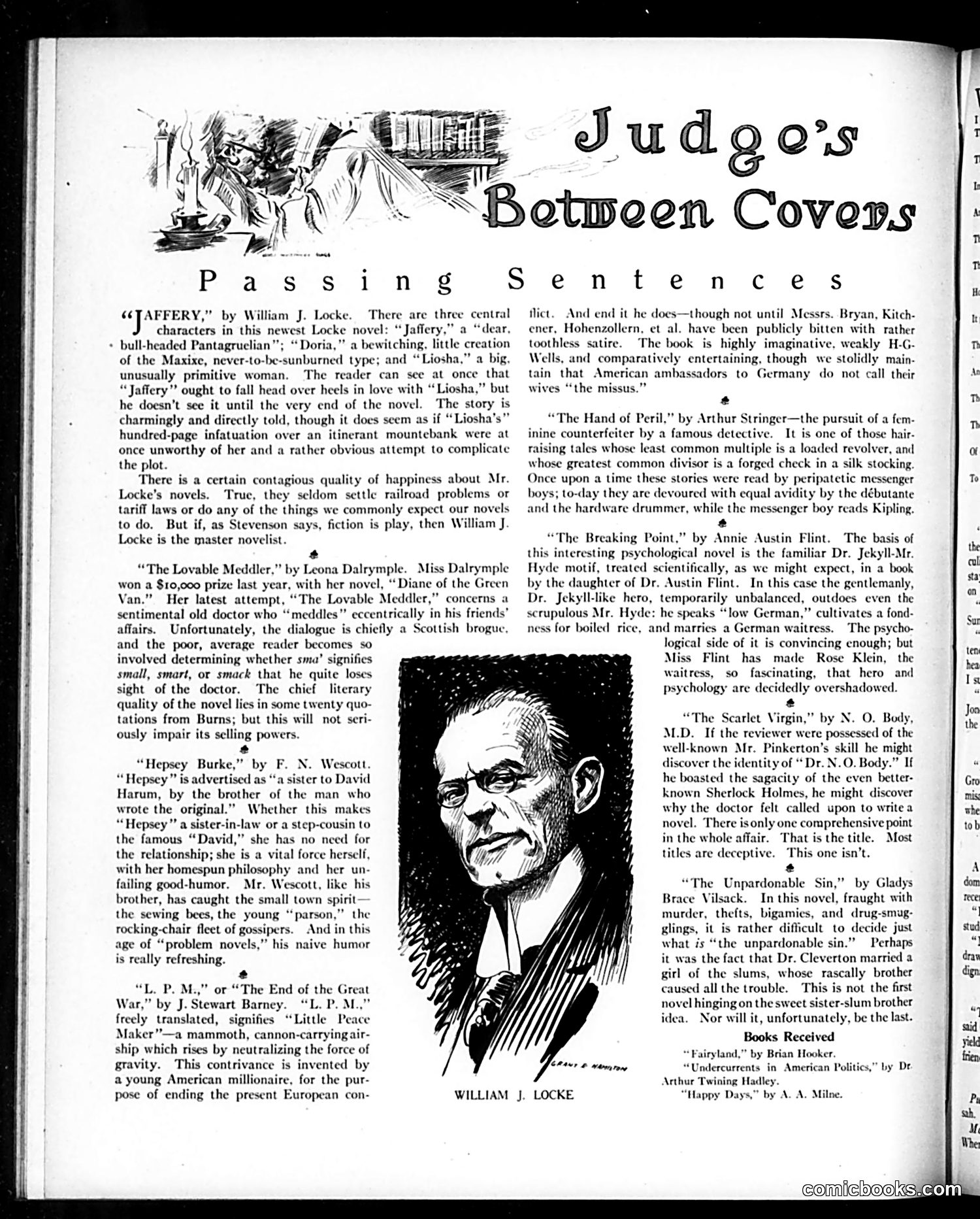
This page from *Judge* magazine presents literary reviews of contemporary novels, accompanied by a portrait sketch of author William J. Locke. The reviews satirize popular fiction trends of the era (likely early 1910s based on references). The satire targets several conventions: Locke's novels are praised for being entertaining "play" rather than addressing serious issues like "railroad problems or tariff laws"—gently mocking fiction's irrelevance to contemporary concerns. The review of Dalrymple's work ridicules heavy Scottish dialect, suggesting readers struggle more with linguistic decoding than plot. References to *David Harum* and *Jekyll and Hyde* indicate these were established literary touchstones readers recognized. The mention of Bryan, Kitchener, and Hohenzollern places this during WWI, suggesting a novel satirizing the war through an airship invention—allowing *Judge* to mock both the book's weak satire and contemporary political figures simultaneously. Overall, the page demonstrates *Judge's* role critiquing middlebrow literature and popular reading tastes through irreverent book commentary.
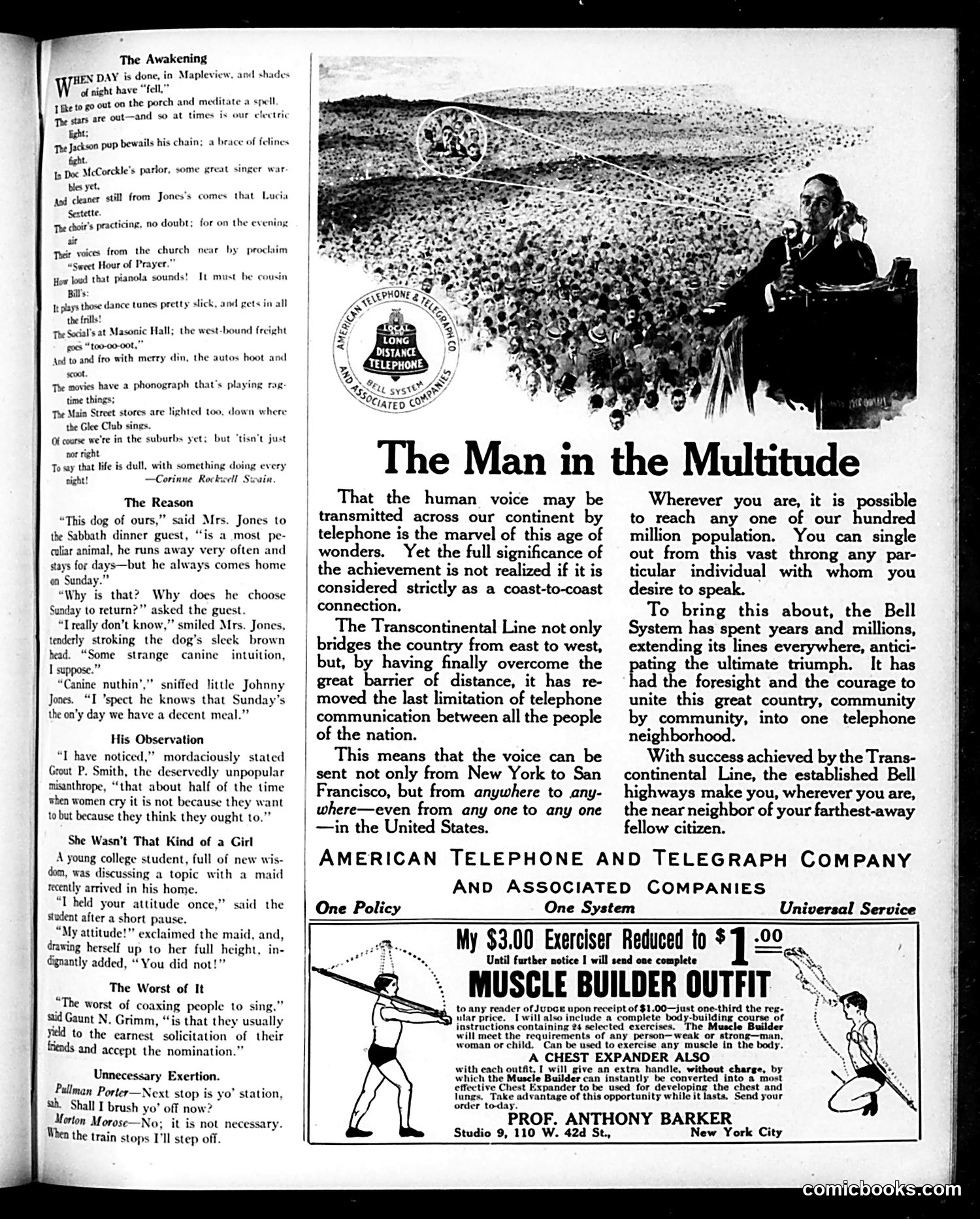
This page mixes short humorous pieces with a major AT&T advertisement disguised as editorial content. **The Cartoons/Humor Pieces:** Several brief jokes satirize everyday American life circa 1910s: a dog that only behaves on Sundays (implying the family eats better then), a misanthrope observing women cry performatively, a college student lecturing a maid about her "attitude" (she indignantly refuses the condescension), and complaints about people reluctantly accepting invitations to sing. **The Main Advertisement:** The large illustrated piece "The Man in the Multitude" presents the transcontinental telephone as revolutionary infrastructure that democratically connects any individual to any other across America—emphasizing that the Bell System unified the nation. The accompanying illustration shows a man speaking into a telephone with crowds visible below, literally visualizing the idea that one voice can reach millions. **The Context:** This represents early-20th-century corporate messaging celebrating technological progress and American interconnectedness, presented as public service rather than commercial self-interest.
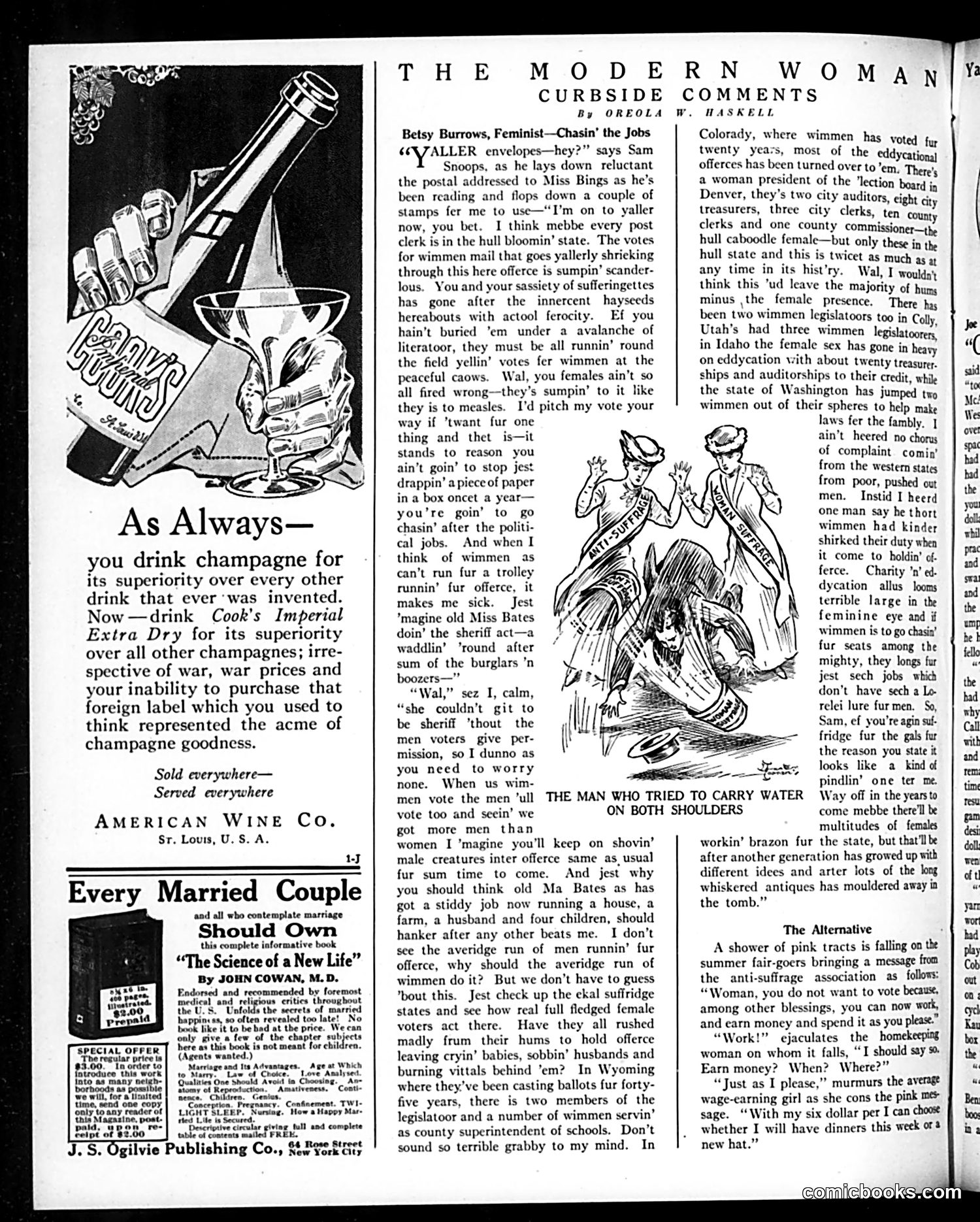
This page contains two distinct sections: **advertising** (top half) and **satirical commentary** (bottom half). The **main satirical piece** is "Curbside Comments" by Oreola W. Haskell, featuring dialogue between Sam Snoops (a rural male skeptic) and an unnamed female suffragist. Sam mocks women's suffrage activism, complaining that pro-voting mail clutters the post office and joking about women like "Miss Bates" being unfit for public office. The female responder counters by citing actual evidence from Wyoming and Colorado—states where women have voted for 40+ years—showing that women haven't abandoned their homes en masse for political positions, but have quietly filled educational and administrative roles. Her point: women's participation in governance is moderate and responsible, not the chaotic power-grab men fear. The cartoon "The Man Who Tried to Carry Water on Both Shoulders" illustrates the futility of opposing women's suffrage while benefiting from female labor. **Context**: This reflects 1910s-era suffrage debates, where anti-suffrage arguments centered on women's "natural" domestic role, while pro-suffrage evidence pointed to successful women voters in western states.
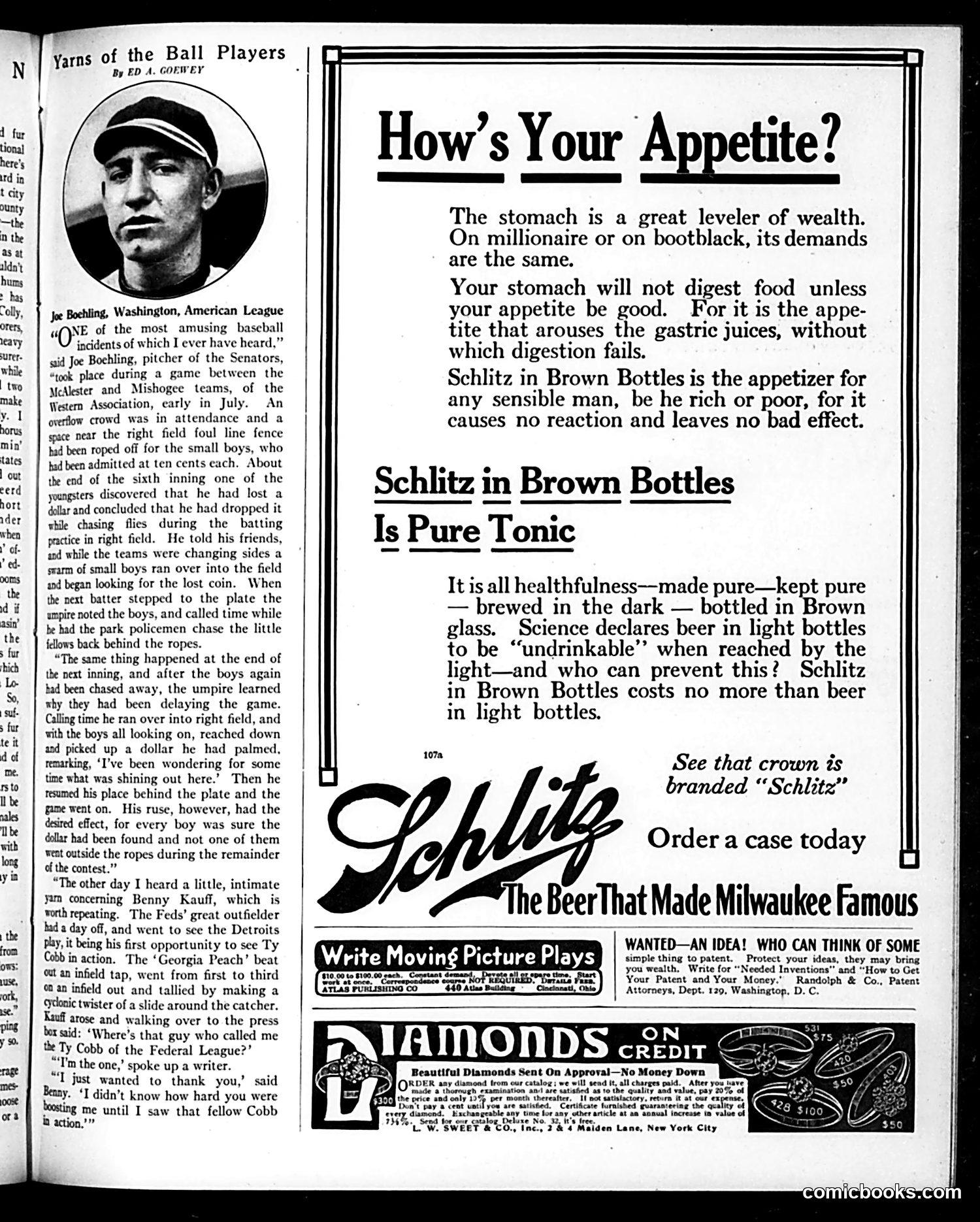
**The Content:** This Judge magazine page combines two sections: 1. **"Yarns of the Ball Players"** — A humorous sports column by Ed A. Goewey featuring anecdotes about early 20th-century baseball players, including Joe Boehling (Washington Senators pitcher) and references to Benny Kauff and Ty Cobb. The stories illustrate clever tactics and competitive spirit. 2. **The Advertisement** — A Schlitz beer ad dominating the right side, claiming brown bottles preserve beer quality better than clear ones, and asserting beer aids digestion and appetite. **The Satire/Context:** The juxtaposition is typical of early 1900s magazines—editorial content mixed freely with advertising. The Schlitz ad's health claims (beer as "pure tonic," digestive aid) reflect pre-Prohibition attitudes toward alcohol as medicinal. Modern readers should note this predates food/drug regulation and represents openly dubious marketing claims we'd find illegal today. The baseball stories themselves are straightforward entertainment requiring no special decoding.
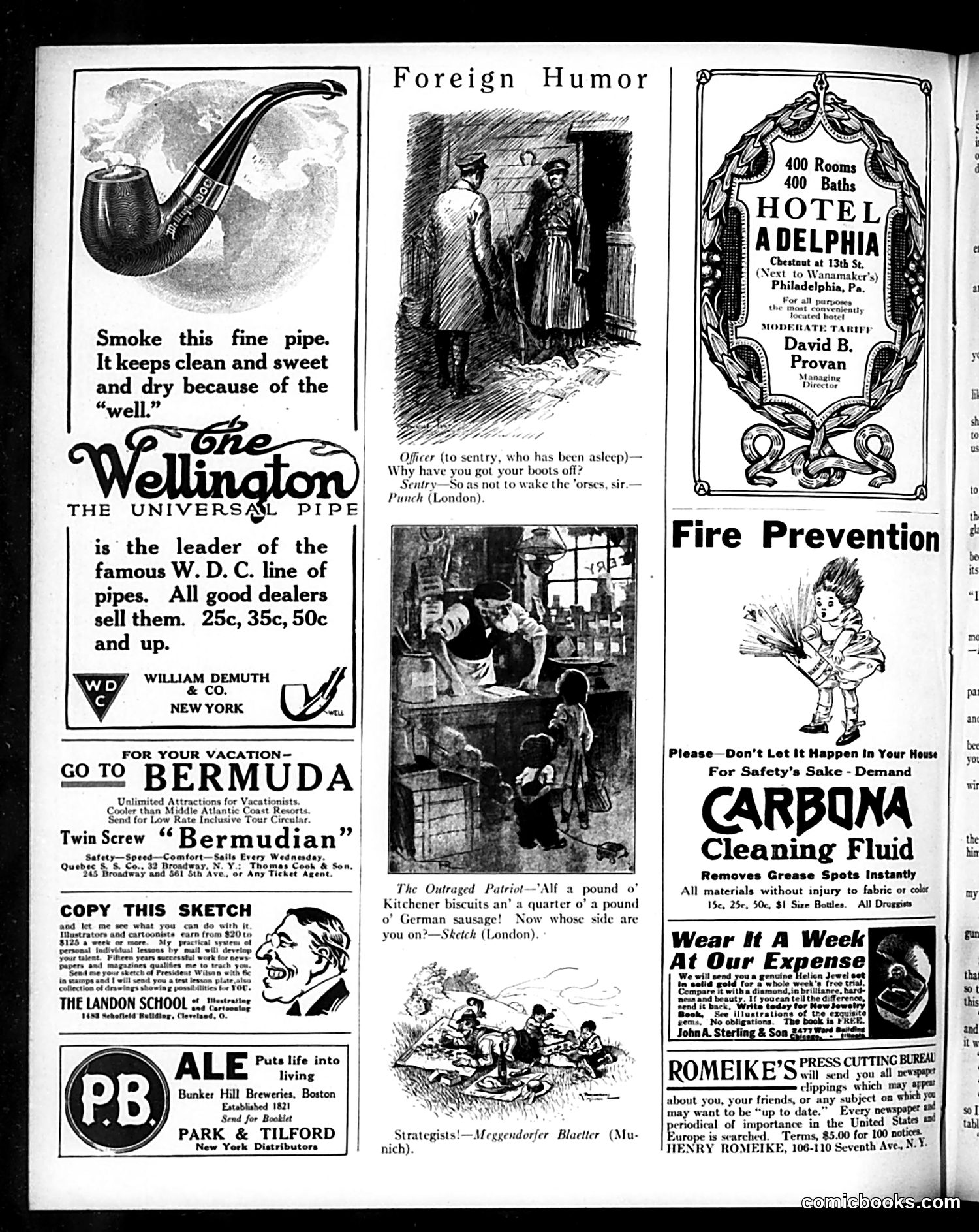
This page is primarily **advertisements with a small "Foreign Humor" section** in the center. The humor cartoons are reprinted from European publications: 1. **"The Outraged Patriot"** (Sketch, London): A British cartoon about conflicting loyalties during World War I. A soldier is caught eating both Kitchener biscuits (British) and German sausage, accused of being disloyal to Britain by consuming enemy provisions—satirizing wartime anxieties about patriotism and food rationing. 2. **"Strategists"** (Meggendorfer Blaetter, Munich): A German publication cartoon (image shows figures in strategic discussion, likely military-related satire from WWI era). The page demonstrates how *Judge* magazine featured international political humor, reflecting the transatlantic culture of the era. The surrounding ads (pipes, Bermuda travel, ale, cleaning fluid) are standard period advertisements.
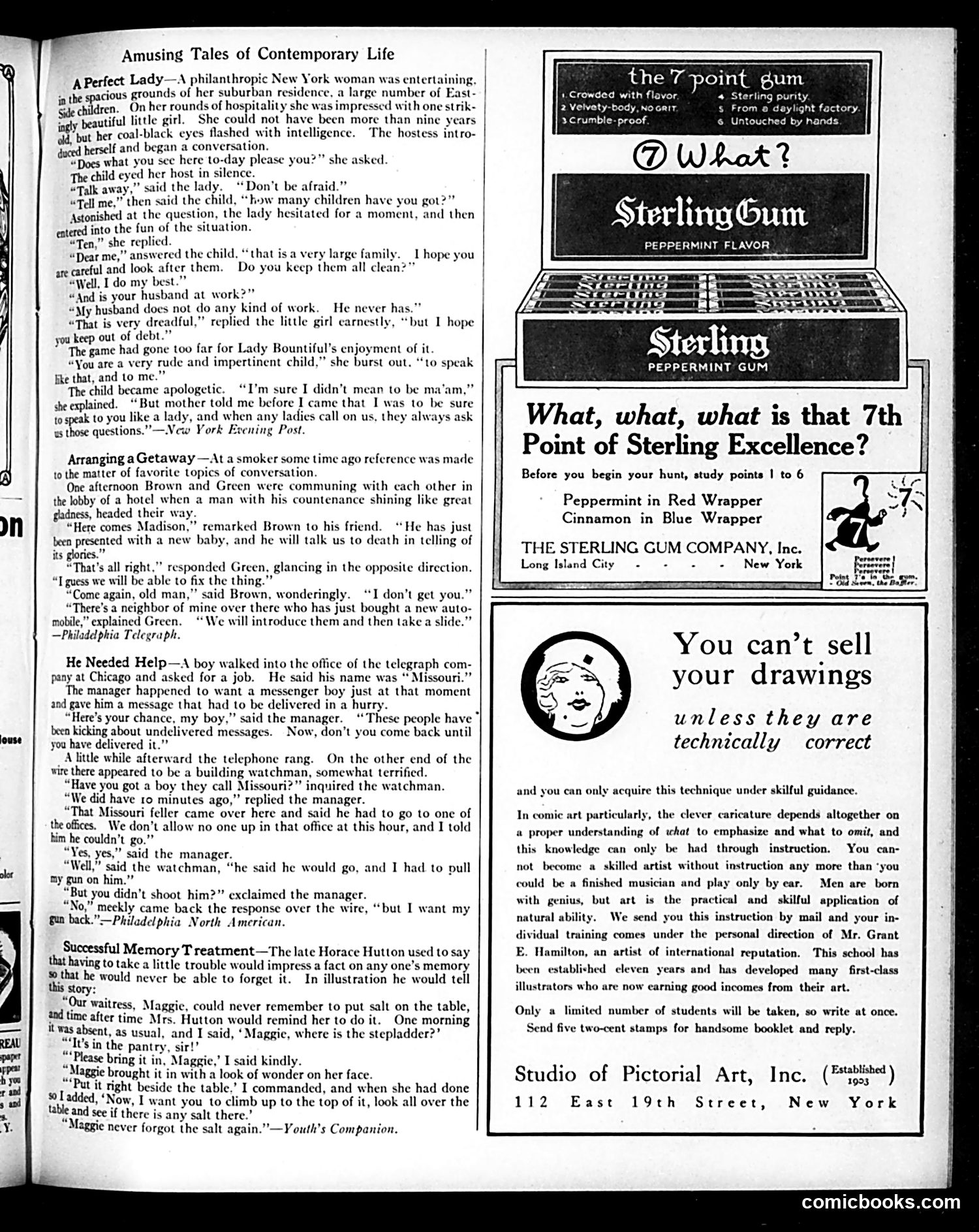
This page contains three humorous anecdotes typical of early 20th-century American humor: **"A Perfect Lady"** satirizes class pretensions. A wealthy philanthropist entertaining poor children is embarrassed when a young guest asks pointed questions about the family's finances and the husband's idleness—questions the child was coached by her mother to ask when visiting "ladies." The joke mocks both the wealthy woman's false charity and working-class mothers' cynical instruction of their children. **"Arranging a Getaway"** uses the tired trope of avoiding a bore (a man obsessed with his new baby) by introducing him to another pest (a neighbor with a new automobile), allowing friends to escape. **"He Needed Help"** plays on the name "Missouri" and the phrase "I'm from Missouri" (meaning skeptical), as a messenger boy literally confronts a building watchman who must draw a gun to stop him from entering an off-limits office. The right page is primarily **advertising**: Sterling Gum's "7-point excellence" promotion and an art instruction school. These reflect period consumer marketing and correspondence-course education.
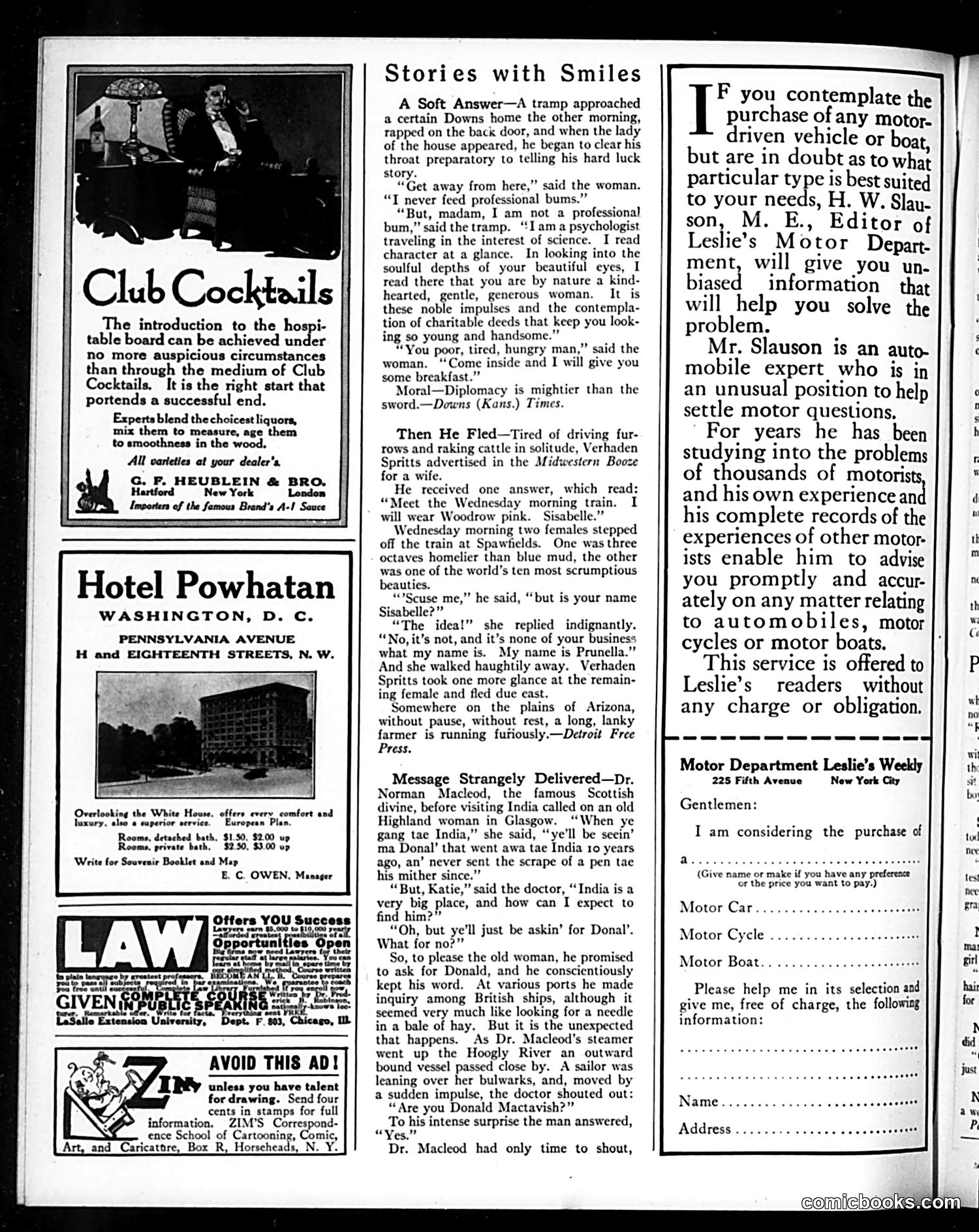
This page from Judge magazine contains three humorous stories rather than political cartoons: 1. **"A Soft Answer"**: A beggar uses flattery and pseudo-intellectual language (calling himself a "psychologist") to manipulate a woman into feeding him. The moral emphasizes diplomacy's power. 2. **"Then He Fled"**: A farmer advertises for a wife and arranges to meet a respondent at the train station. Two women arrive; he approaches the homely one but learns she's not his correspondent. Embarrassed, he flees across Arizona rather than face the beautiful woman he was actually seeking. The humor relies on slapstick misunderstanding and his cowardice. 3. **"Message Strangely Delivered"**: An incomplete story about a Scottish doctor visiting India, promising an old Highland woman he'll find her son Donald there—despite India's vast size. The humor lies in the absurdity of the promise. The page is primarily advertising (cocktails, hotels, education programs) with these brief comic stories interspersed—typical Judge magazine fare mixing humor with commercial content.
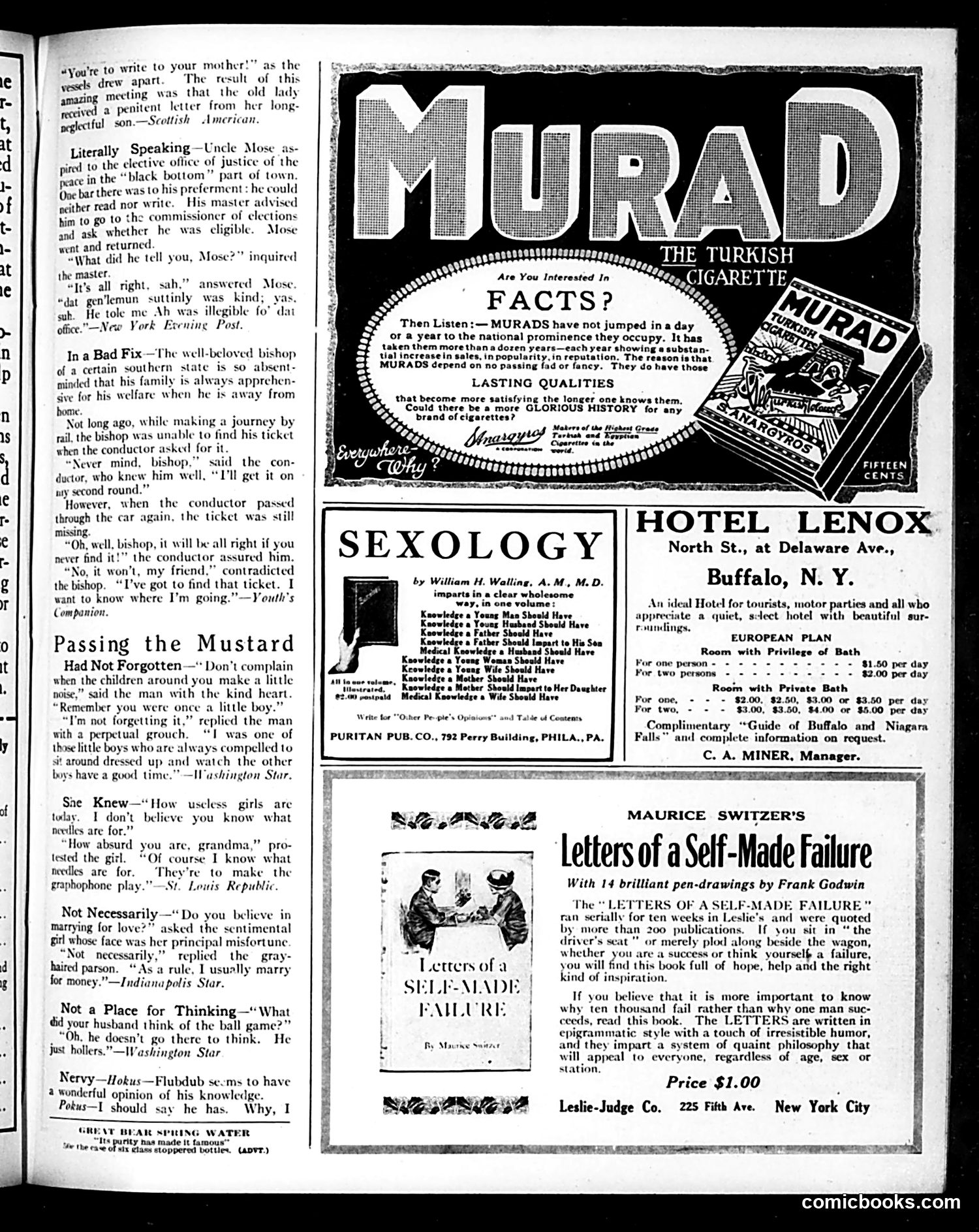
This is primarily an **advertising and humor page** from Judge magazine, a satirical American publication. The content includes: **Humorous anecdotes** (left column): Short jokes playing on racial stereotypes and social situations—a Black man named "Uncle Mose" seeking election office but being illiterate; a absentminded bishop losing his train ticket; children's innocent misunderstandings of adult words. **Advertisements** (center and right): The dominant content includes cigarette ads (Murad Turkish cigarettes), a book advertisement for "Letters of a Self-Made Failure," and a hotel advertisement for the Hotel Lenox in Buffalo. These reflect early 20th-century commercial culture. **Historical context**: The racial humor reflects period attitudes (now offensive). The "Sexology" book advertisement reflects early 1900s attitudes toward education on intimate topics as scandalous yet commercially viable. The page demonstrates Judge's mixed purpose: satirizing contemporary society while serving as a vehicle for advertising and mass entertainment.
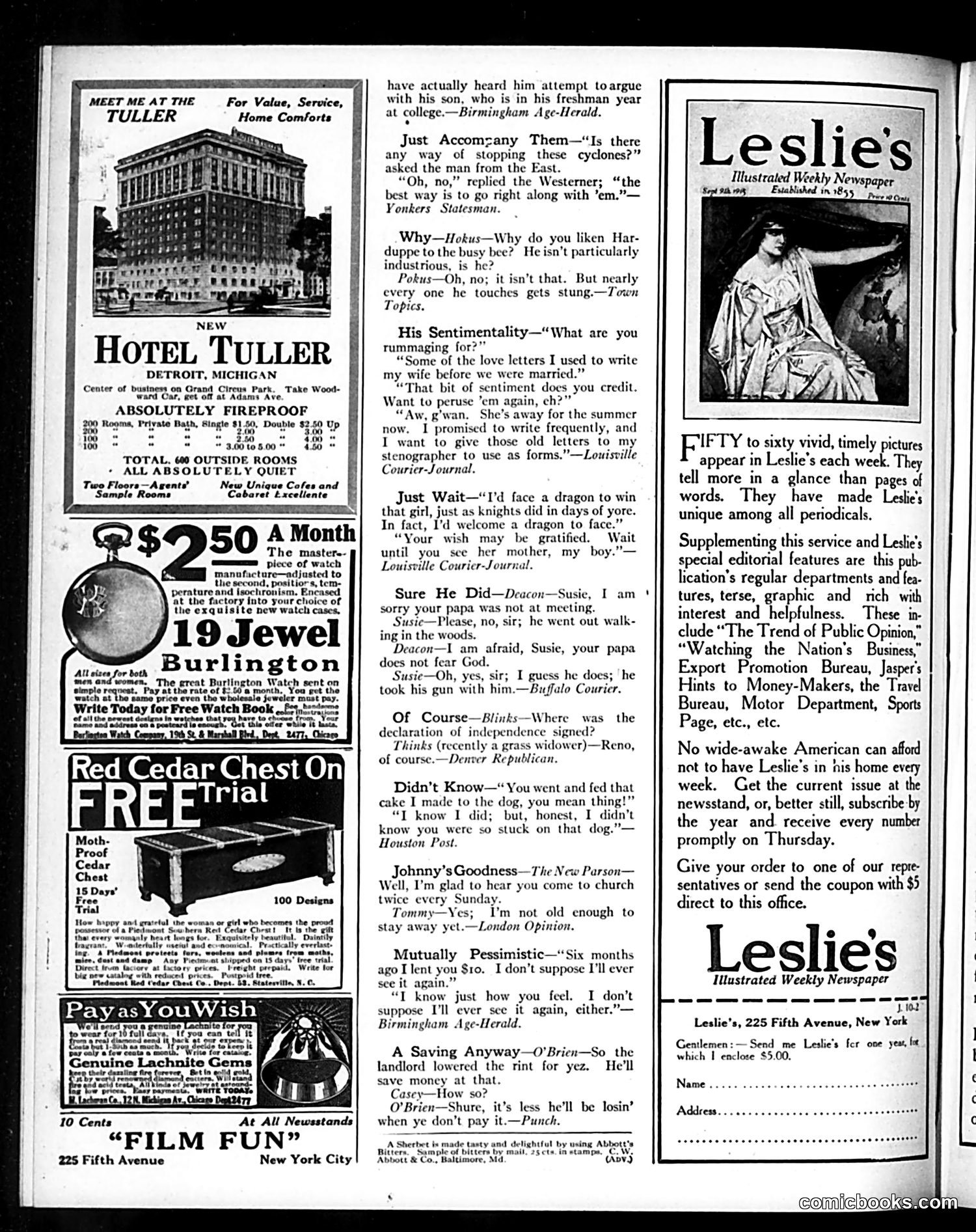
This is primarily an **advertising page** with a collection of brief humor jokes interspersed among commercial advertisements. The advertisements include the Hotel Tuller (Detroit), a Burlington pocket watch, a Red Cedar Chest, and Leslie's Illustrated Weekly Newspaper—typical turn-of-the-century product pitches. The **jokes** are genteel, domestic humor typical of this era: a father can't argue with his college-son; a cyclone joke about Western fatalism; wordplay about a man named Harduppe (suggesting "hard up"/poor) who "stings" everyone he touches; romantic sentimentality contrasted with practical stenography; a young man facing a prospective mother-in-law instead of a dragon; a deacon's concern about church attendance; declarations of independence signed in Reno (implying divorce); and Irish/working-class dialect humor about unpaid rent. None reference specific political figures or events—they're **timeless social observations** about marriage, courtship, poverty, and respectability rather than satire.
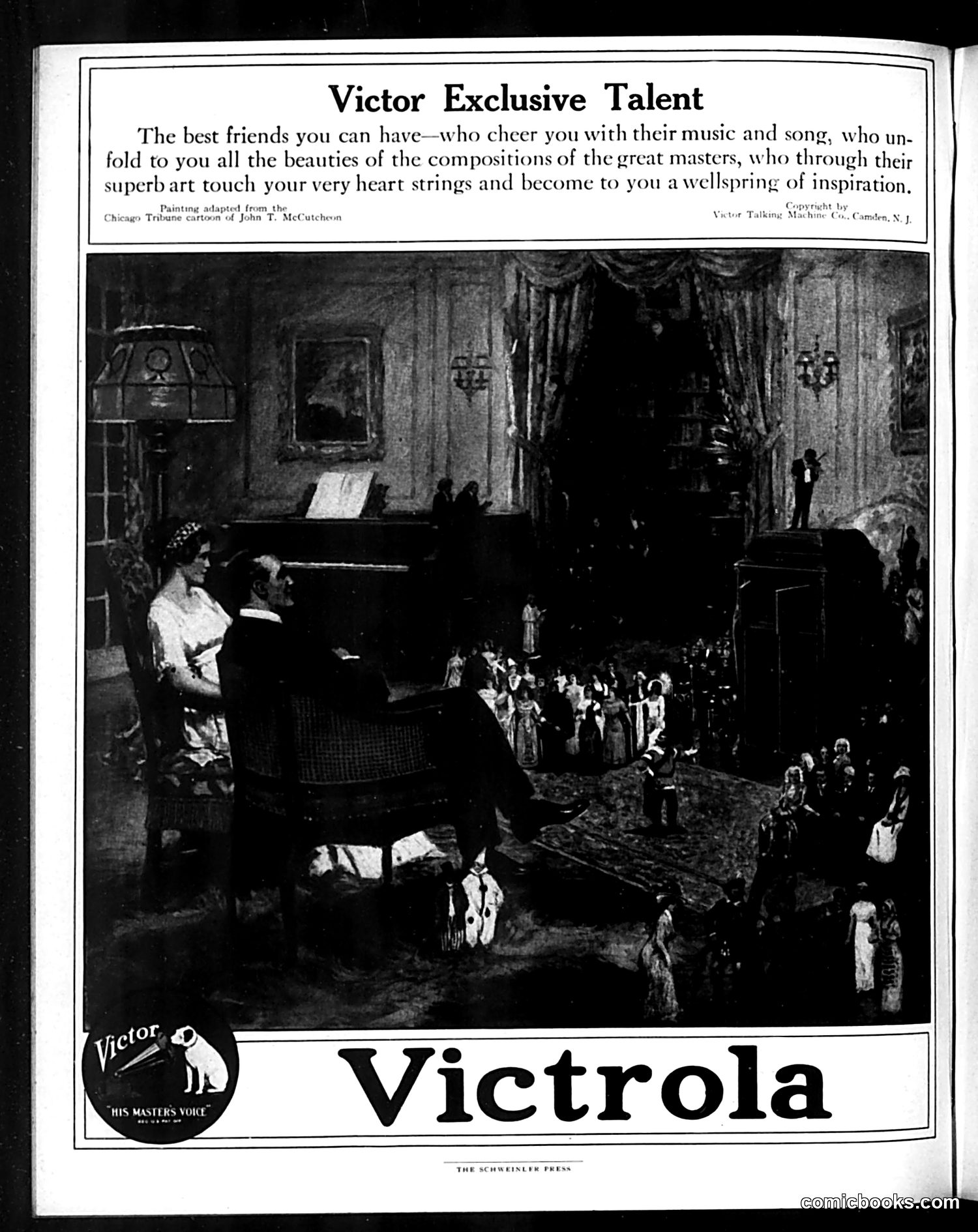
This is primarily a **Victor Victrola phonograph advertisement**, not political satire. The page shows an elegantly dressed couple listening to music from a Victrola (a gramophone) in a formal parlor setting, with what appears to be an imagined audience of formally-dressed figures materializing from the sound. The "satire" is gentle and commercial: it humorously suggests that the phonograph brings the "great masters" of composition into your home as companions and friends. The text uses flowery language about music as emotional sustenance. The painting is credited to John T. McCutcheon (Chicago Tribune cartoonist), but this is primarily promotional content for Victor talking machines—advertising the aspirational lifestyle and cultural sophistication their product supposedly provides.