
Judge, 1915-10-02 · page 8 of 30
Judge — October 2, 1915 — page 8: what you’re looking at
What you’re looking at
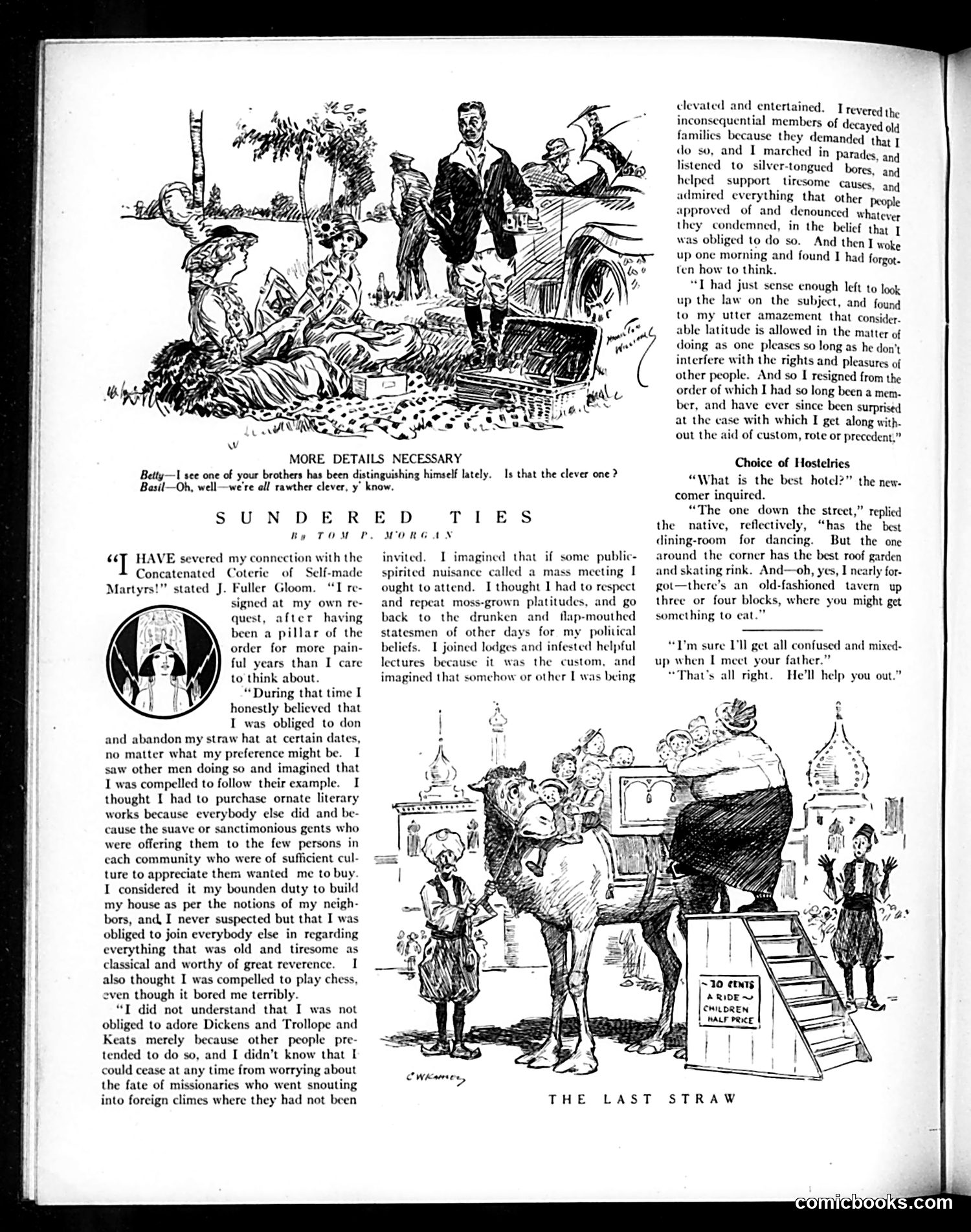
This page satirizes **conformity and blind adherence to social convention**. The main article features J. Fuller Gloom describing his resignation from the "Concatenated Coterie of Self-made Martyrs"—apparently a satirical name for organizations that enforce arbitrary rules. Gloom recounts wasting years following needless customs: wearing specific hats on certain dates, buying ornate books nobody truly enjoyed, building houses to match neighbors' preferences, and pretending to admire Dickens and Trollope out of social obligation. He mocks people who attend mass meetings, join lodges, and march in parades simply because "custom" demands it, all while worrying about distant missionaries. The satire's point: respectable society pressures people to abandon independent thinking and personal preference for hollow conformity. Gloom's realization—that he "forgot how to think"—is the punchline. By resigning, he discovers considerable freedom exists within the law. The brief dialogue jokes about similar absurdities: upper-class British characters discussing whether their brothers are "clever," and tourists receiving contradictory hotel recommendations based on trivial amenities rather than actual comfort. **Target:** Victorian-era social pretension and the tyranny of respectability.
📄 Transcribed text from this page (OCR, searchable)
Machine-transcribed from the original scan — historical spelling and the odd misread are preserved.
MORE DETAILS NECESSARY Betty—I see one of your brothers has been distinguishing himself lately. we're all rawther clever, y’ know, Basil—Oh, well SUNDER Re TOM P 667 HAVE severed my connection with the Concatenated Coterie of Self-made Martyrs!” stated J. Fuller Gloom. “I re- signed at_ my own re- quest, after having been a pillar of the order for more pain- ful years than I care to think about. “During that time I honestly believed that I was obliged to don and abandon my straw hat at certain dates, no matter what my preference might be. 1 saw other men doing so and imagined that I was compelled to follow their example. I thought I had to purchase ornate literary works because everybody else did and be- cause the suave or sanctimonious gents who were offering them to the few persons in cach community who were of sufficient cul- ture to appreciate them wanted me to buy. I considered it my bounden duty to build my house as per the notions of my neigh- bors, and I never suspected but that I was obliged to join everybody else in regarding everything that was old and tiresome as classical and worthy of great reverence. I also thought I was compelled to play chess, even though it bored me terribly. “I did not understand that I was not obliged to adore Dickens and Trollope and Keats merely because other people pre- tended to do so, and I didn’t know that I could cease at any time from worrying about the fate of missionaries who went snouting into foreign climes where they had not been E Is that the clever one ? Ee D TIES MORGAN invited. I imagined that if some public- spirited nuisance called a mass meeting | ought to attend. I thought I had to respect and repeat moss-grown platitudes, and go ck to the drunken and flap-mouthe: nen of other days for my politica I joined lodges and infested helpful : it was the custom, and somehow or other L was being CWkemen, THE clevated and entertained. Trevered the inconsequential members of decayed ald familics because they demanded that I do so, and I marched in parades and listened to silver-tongued bores,” and helped support tiresome causes, and admired everything that other People approved of and denounced whatever they condemned, in the belief that 1 was obliged to do so. And then T woke up one morning and found I had forgot. ten how to think. “T had just sense enough left to look up the law on the subject, and found to my utter amazement that consider. able latitude is allowed in the matter of doing as one pleases so long as he don’t interfere with the rights and pleasures of other people. And so I resigned from the order of which I had so long been a mem- ber, and have ever since been surprised at the e with which I get along with- out the aid of custom, rote or precedent,” Choice of Hostelries “What is the best hotel?” the new. comer inquired. “The one down the street,” replied the native, reflectively, “has the best dining-room for dancing. But the one around the corner has the best roof garden and skating rink. And—oh, yes, I nearly for- got—there’s an old-fashioned tavern up three or four blocks, where you might get something to eat.”” “Tm sure I'll get all confused and mixed- your fathe He'll help you out.” up when I me “That's all right. ~10 ernTs ARIDE CHILDREN RAUF LF PRE LAST STRAW