
Judge, 1915-10-02 · page 17 of 30
Judge — October 2, 1915 — page 17: what you’re looking at
What you’re looking at
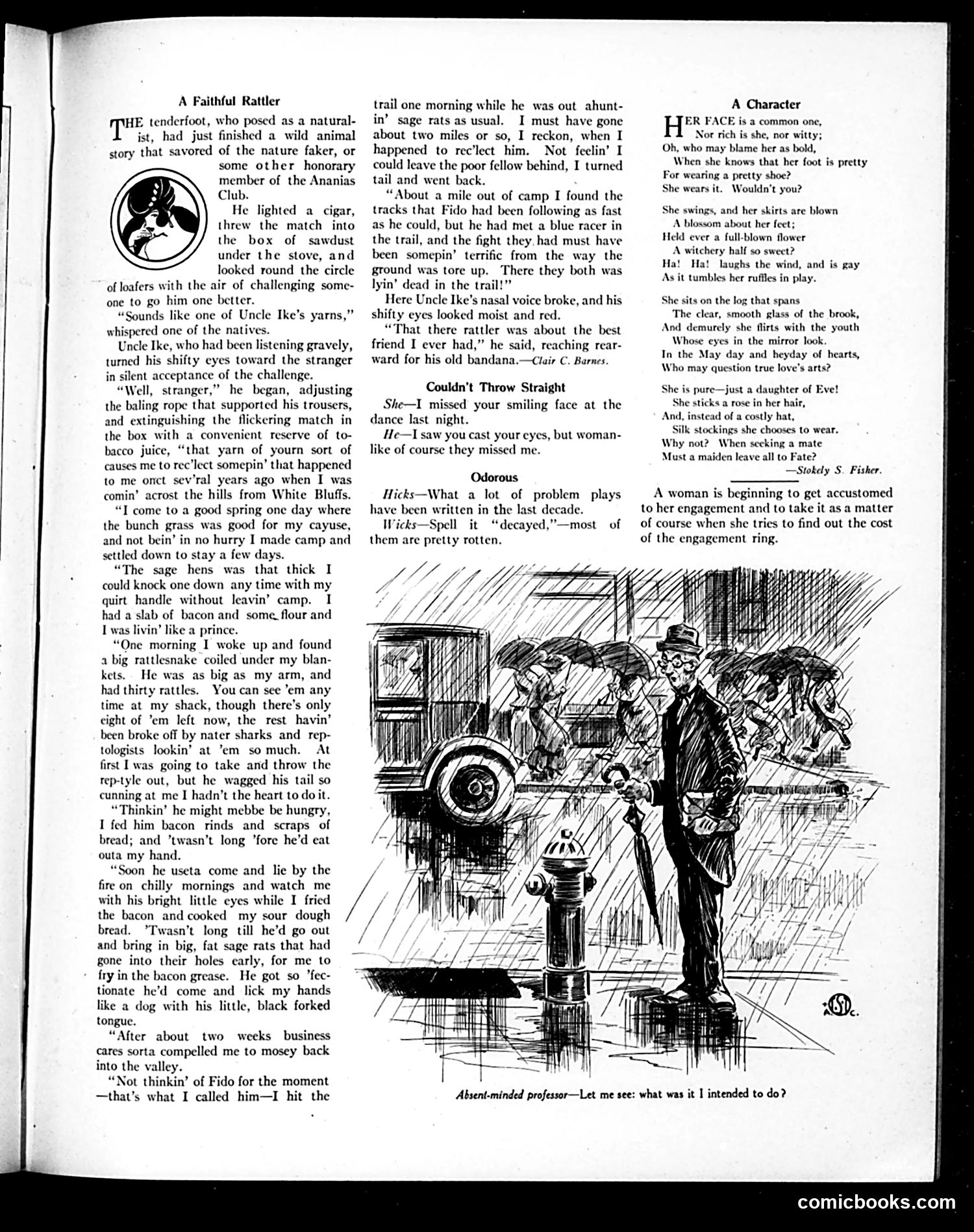
This page from Judge magazine contains three distinct pieces: **"A Faithful Rattler"** is the main story—a tall tale where a tenderfoot brags about an animal encounter, prompting "Uncle Ike," a weathered Westerner, to one-up him with an absurd story about befriending a rattlesnake named Fido. The satire targets "nature fakers"—a contemporary concern about writers and speakers who fabricated exaggerated wildlife stories. Uncle Ike's yarn (about a rattlesnake acting like a loyal dog, even hunting for him) is obviously ridiculous, mocking both tall-tale tradition and the credulous audiences who enjoyed such yarns. **"Couldn't Throw Straight"** is a brief joke about gender stereotypes—a woman's supposed poor aim, here applied metaphorically to her eyes/attention. **"A Character"** is a poem about an ordinary, plain-looking woman. The illustration depicts an absent-minded professor—a stock figure of gentle fun in period humor. The pages reflect Judge's satirical focus on American social foibles, exaggeration, and type characters.
📄 Transcribed text from this page (OCR, searchable)
Machine-transcribed from the original scan — historical spelling and the odd misread are preserved.
A Faithful Rattler HE tenderfoot, who posed as a natural- T ist, had just finished a wild animal story that savored of the nature faker, or some other honorary member of the Ananias Club. He lighted a cigar, threw the match into the box of sawdust under the stove, and looked round the circle of loafers with the air of challenging some- one to go him one better. “Sounds like one of Uncle Ike’s yarns,” whispered one of the natives. Uncle Ike, who had been listening gravely, turned his shifty eyes toward the stranger in silent acceptance of the challenge. “Well, stranger,” he began, adjusting the baling rope that supported his trousers, and extinguishing the flickering match in the box with a convenient reserve of to- bacco juice, “that yarn of yourn sort of causes me to rec’lect somepin’ that happened to me onct sev’ral years ago when I was comin’ acrost the hills from White Bluffs. “T come to a good spring one day where the bunch grass was good for my cayuse, and not bein’ in no hurry I made camp and settled down to stay a few days. “The sage hens was that thick I could knock one down any time with my quirt handle without leavin’ camp. I had a slab of bacon and some flour and I was livin’ like a prince. “One morning I woke up and found a big rattlesnake coiled under my blan- kets. He was as big as my arm, and had thirty rattles. You can see ’em any time at my shack, though there’s only cight of ’em left now, the rest havin’ been broke off by nater sharks and rep- tologists lookin’ at ’em so much. At first I was going to take and throw the rep-tyle out, but he wagged his tail so cunning at me I hadn’t the heart to do it. “Thinkin’ he might mebbe be hungry, I fed him bacon rinds and scraps of bread; and ’twasn’t long ’fore he'd eat outa my hand. “Soon he useta come and lie by the fire on chilly mornings and watch me with his bright little eyes while I fried the bacon and cooked my sour dough bread. ’Twasn’t long till he’d go out and bring in big, fat sage rats that had gone into their holes early, for me to fry in the bacon grease. He got so ’fec- tionate he’d come and lick my hands like a dog with his little, black forked tongue. “After about two weeks business cares sorta compelled me to mosey back into the valley. “Not thinkin’ of Fido for the moment —that’s what I called him—I hit the trail one morning while he was out ahunt- in’ sage rats as usual. I must have gone about two miles or so, I reckon, when I happened to rec’lect him. Not feelin’ I could leave the poor fellow behind, I turned tail and went back. “About a mile out of camp I found the tracks that Fido had been following as fast as he could, but he had met a blue racer in the trail, and the fight they, had must have been somepin’ terrific from the way the ground was tore up. There they both was lyin’ dead in the trail!” Here Uncle Ike’s nasal voice broke, and his shifty eyes looked moist and red. “That there rattler was about the best friend I ever had,” he said, reaching rear- ward for his old bandana.—Clair C. Barnes. Couldn't Throw Straight She—I missed your smiling face at the dance last night. He—I saw you cast your eyes, but woman- like of course they missed me. Odorous Hicks—What a lot of problem plays have been written in the last decade. Wicks—Spell it “decayed,”—most of them are pretty rotten. Absent-minded professor—Let me see: what was it I intended to do? A Character ER FACE is a common one, Nor rich is she, nor witty; Oh, who may blame her as bold, When she knows that her foot is pretty For wearing a pretty shoe? She wears it. Wouldn't you? She swings, and her skirts are blown A blossom about her feet; Held ever a full-blown flower A witchery half so sweet? Ha! Ha! laughs the wind, and is gay As it tumbles her ruffles in play. She sits on the log that spans The clear, smooth glass of the brook, And demurely she flirts with the youth Whose eyes in the mirror look. In the May day and heyday of hearts, Who may question true love's arts? She is pure—just a daughter of Eve! She sticks a rose in her hair, instead of a costly hat, k stockings she chooses to wear, Why not? When seeking a mate Must a maiden leave all to Fate? okely S. Fisher. An A woman is beginning to get accustomed to her engagement and to take it as a matter of course when she tries to find out the cost of the engagement ring. comicbooks.com