
Judge, 1915-10-02 · page 13 of 30
Judge — October 2, 1915 — page 13: what you’re looking at
What you’re looking at
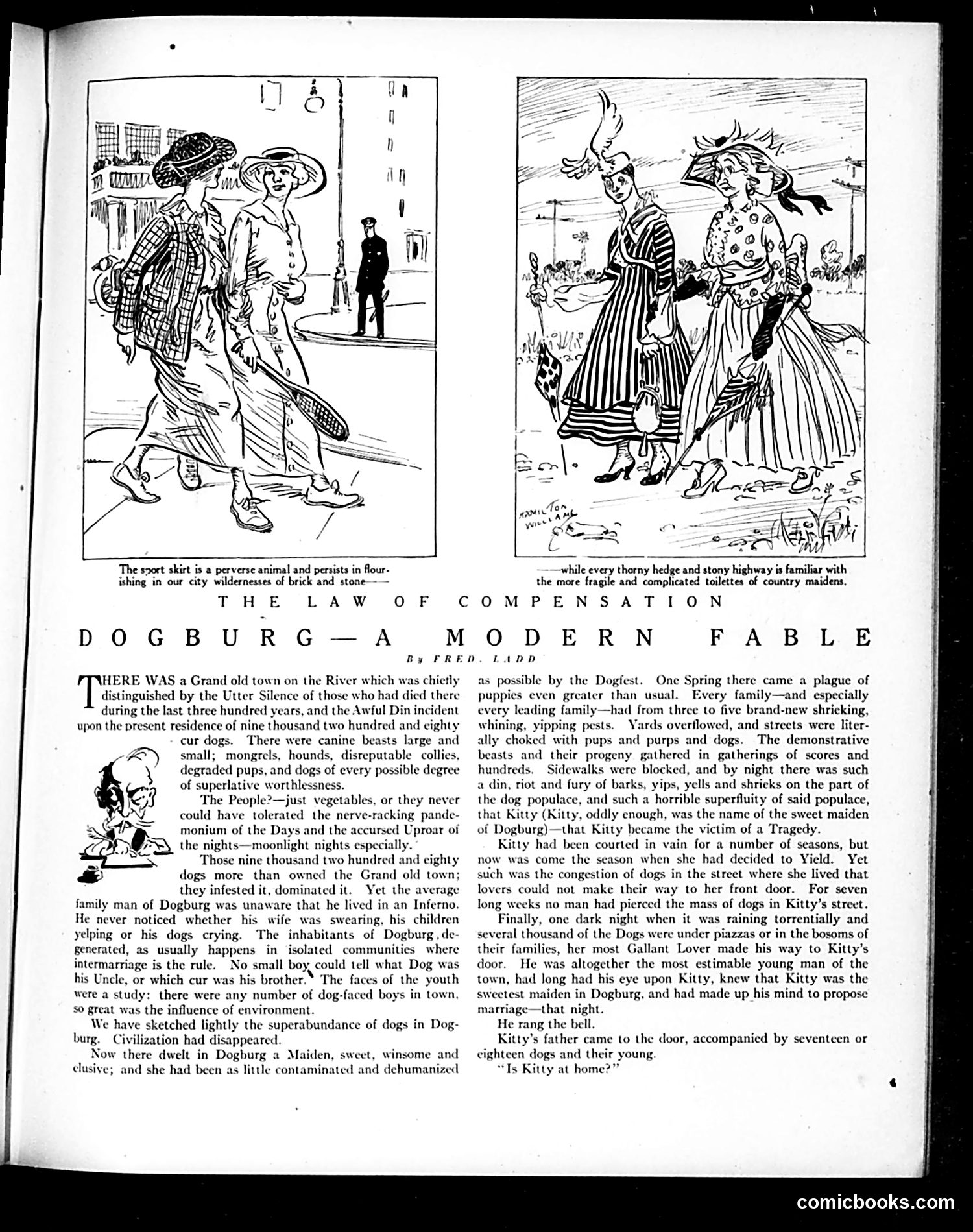
This satirical fable critiques urban social decay and environmental determinism. The fictional town of Dogburg is overrun with dogs—literally and figuratively representing chaos, degeneracy, and moral decline in a crowded city. The story uses dogs as metaphor for how environment corrupts people. Citizens have become "dog-faced," dehumanized by constant noise and disorder. Even the sweet maiden Kitty becomes a "victim of Tragedy" when suitors cannot reach her through the literal pack of dogs blocking the streets. The satire's point: unchecked urban problems (overcrowding, filth, noise) destroy civilization and human connection. The "Law of Compensation" title suggests ironic justice—those who tolerated the dog-infested chaos now suffer romantic and social paralysis as consequence. The top cartoons mock women's fashion (the "sport skirt") and country versus city contrasts, reinforcing themes about urban degradation versus rural simplicity.
📄 Transcribed text from this page (OCR, searchable)
Machine-transcribed from the original scan — historical spelling and the odd misread are preserved.
The sport skirt is a perverse animal and persists in flour- ishing in our city wildernesses of brick and stone—— THE LAW DOGBURG ) A FC M Ry FRED chietly distinguished by the Utter Silence of those who had died there and the Awful Din incident upon the present residence of nine thousand two hundred and eighty Tasting WAS a Grand old town on the River which during the last three hundred ye cur dogs. There were canine beasts large and small; mongrels, hounds, disreputable collies, degraded pups, and dogs of every possible degree of superlative worthlessness. The People?—just vegetables, or they never could have tolerated the nerve-racking pande- monium of the Days and the accursed Uproar of Dy the nights—moonlight nights especially. Those nine thousand two hundred and eighty dogs more than owned the Grand old town; they infested it, dominated Yet the average family man of Dogburg was unaware that he lived in an Inferno. He never noticed whether his wife was swearing, his children yelping or his dogs crying. The inhabitants of Dogburg ,de- generated, as usually happens in isolated communities where intermarriage is the rule. No small boy. could tell what Dog was his Uncle, or which cur was his brother.’ The faces of the youth were a study: there were any number of dog-faced boys in town, So great was the influence of environment. tched lightly the superabundance of dogs in Dog- n had disappeared Now there dwelt in Dogburg a Maiden, sweet, winsome and elusive; and she had been as little contaminated and dehumanized -—while every thorny hedge and stony highway is familiar with the more fragile and complicated toilettes of country maidens. OMPENSATION O DERN FABLE LADD ble by the De Onc Spring there came a plague of even greater than usual. Every family—and especially every leading family from three to five brand-new shricking, whining, yipping pe Yards overflowed, and streets were liter- ally choked with pups and purps and dogs. The demonstrative beasts and their progeny gathered in gatherings of scores and hundreds. Sidewalks were bloc! and by night there was such a din, riot and fury of barks, yips, yells and shrieks on the part of the dog populace, and such a horrible superfluity of said populace, that Kitty (Kitty, oddly enough, was the name of the sweet maiden of Dogburg)—that Kitty became the victim of a Tragedy. Kitty had been courted in vain for a number of seasons, but now was come the season when she had decided to Yield. Yet such was the congestion of dogs in the street where she lived that lovers could not make their way to her front door. For seven long weeks no man had pierced the mass of dogs in Kitty’s street. Finally, one dark night when it was raining torrentially and several thousand of the Dogs were under piazzas or in the bosoms of their families, her most Gallant Lover made his way to Kitty’s door. He was altogether the most estimable young man of the town, had long had his eye upon Kitty, knew that Kitty was the sweetest maiden in Dogburg, and had made up his mind to propose marriage—that night. He rang the bell. Kitty’s father came to the door, accompanied by seventeen or d their young. aS po: puppie comicbooks.com