
Judge, 1915-10-02 · page 20 of 30
Judge — October 2, 1915 — page 20: what you’re looking at
What you’re looking at
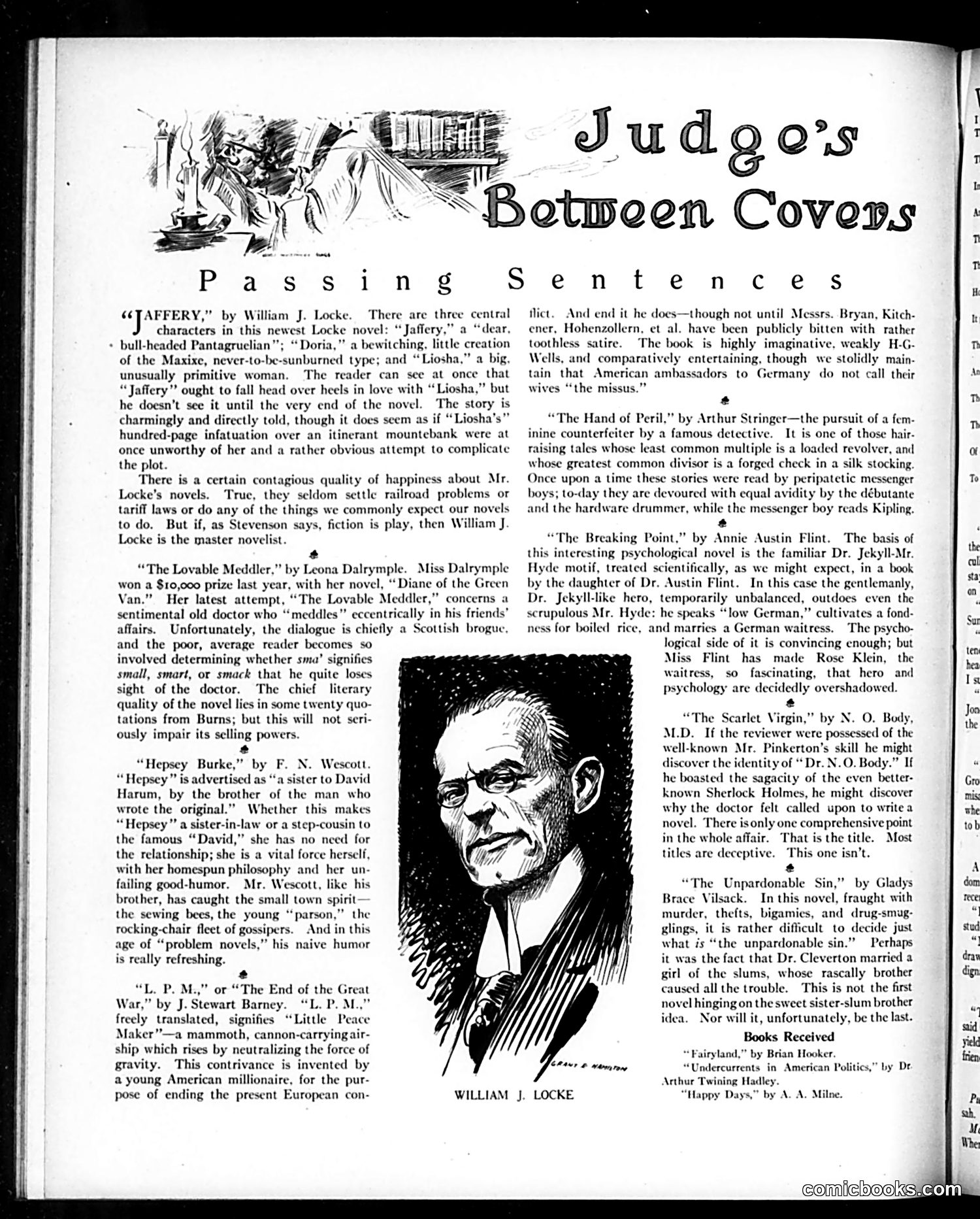
This page from *Judge* magazine presents literary reviews of contemporary novels, accompanied by a portrait sketch of author William J. Locke. The reviews satirize popular fiction trends of the era (likely early 1910s based on references). The satire targets several conventions: Locke's novels are praised for being entertaining "play" rather than addressing serious issues like "railroad problems or tariff laws"—gently mocking fiction's irrelevance to contemporary concerns. The review of Dalrymple's work ridicules heavy Scottish dialect, suggesting readers struggle more with linguistic decoding than plot. References to *David Harum* and *Jekyll and Hyde* indicate these were established literary touchstones readers recognized. The mention of Bryan, Kitchener, and Hohenzollern places this during WWI, suggesting a novel satirizing the war through an airship invention—allowing *Judge* to mock both the book's weak satire and contemporary political figures simultaneously. Overall, the page demonstrates *Judge's* role critiquing middlebrow literature and popular reading tastes through irreverent book commentary.
📄 Transcribed text from this page (OCR, searchable)
Machine-transcribed from the original scan — historical spelling and the odd misread are preserved.
ng There are three central novel: “ Jaffery,” a “dear, + bull-headed Pantagruelian”; “ Doria, bewitching, little creation of the Maxixe, never-to-be-sunburned type; and “Liosha,” a big, unusually primitive woman. The reader can see at once that “Jaffery”’ ought to fall head over heels in love with “Liosha,” but he doesn’t see it until the very end of the novel. The story is charmingly and directly told, though it does seem as if “Liosha’s” hundred-page infatuation over an itinerant mountebank were at once unworthy of her and a rather obvious attempt to complicate the plot. There is a certain contagious quality of happiness about Mr. Locke's novels. True, they seldom settle railroad problems or tariff laws or do any of the things we commonly expect our novels to do. But if, as Stevenson says, fiction is play, then William J Locke is the master novelist. Locke. AFFERY,” by William J. * “The Lovable Meddler,” by Leona Dalrymple. Miss Dalrymple won a $10,000 prize last year, with her novel, “Diane of the Green Van.” Her latest attempt, “The Lovable Meddler,” concerns a sentimental old doctor who “meddles” eccentrically in his friends’ affairs. Unfortunately, the dialogue is chiefly a Scottish brogue, and the poor, average reader becomes so involved determining whether sma’ signifies small, smart, or smack that he quite loses sight of the doctor. The chief literary quality of the novel lies in some twenty quo- tations from Burns; but this will not seri- ously impair its selling powers. 2 “Hepsey Burke,” by F. N. Wescott. “Hepsey” is advertised as ter to David Harum, by the brother of the man who wrote the original.” Whether this makes “Hepsey”’ a sister-in-law or a step-cousin to the famous “David,” she has no need for the relationship; she is a vital force herself, with her homespun philosophy and her un- failing good-humor. Mr. Wescott, like his brother, has caught the small town spirit— the sewing bees, the young “parson,” the rocking-chair fleet of gossipers. And in this age of “problem novels,” his naive humor is really refreshing. War, by fe Stewart Bonen freely translated, signifies Maker”—a mammoth, cannon-carrying air- ship which rises by neutralizing the force of gravity. This contrivance is invented by a young American millionaire, for the pur- pose of ending the present European con- Senteon WILLIAM J. LOCKE ces flict. And end it he does—though not until Messrs. Bryan, Kitch- ener, Hohenzollern, et al. have been publicly bitten with rather toothless satire. The book is highly imaginative, weakly H-G- Wells, and comparatively entertaining, though we stolidly main- tain that American ambassadors to Germany do not call their wives “the missus.” £ “The Hand of Peril,” by Arthur Stringer—the pursuit of a fem- inine counterfeiter by a famous detective. It is one of those hair- raising tales whose least common multiple is a loaded revolver, and whose greatest common divisor is a forged check in a silk stocking. Once upon a time these stories were read by peripatetic messenger boys; to-day they are devoured with equal avidity by the débutante and the hardware drummer, while the messenger boy reads Kipling. 2 he Breaking Point,” by Annie Austin Flint. The basis of this interesting psychological novel is the familiar Dr. Jekyll-Mr. Hyde motif, treated scientifically, as we might expect, in a book by the daughter of Dr. Austin Flint. In this case the gentlemanly, Dr. Jekyll-like hero, temporarily unbalanced, outde en the scrupulous Mr. Hyde: he speaks “low German,” cultivates a fond- ness for boiled rice, and marries a German waitress. The psycho- logical side of it is convincing enough; but Miss Flint has made Rose Klein, the waitress, so fascinating, that hero and psychology are decidedly overshadowed. “The Scarlet Virgin,” by N. O. Body, M.D. If the reviewer were possessed of the nown Mr. Pinkerton’s skill he might discover the identity of “Dr. N.O. Body.” If he boasted the sagacity of the even better- known Sherlock Holmes, he might discover why the doctor felt called upon to write a novel. There isonly one comprehensive point in the whole affair. That is the title. Most titles are deceptive. This one isn’t. ¢ “The Unpardonable Sin,” by Gladys Brace Vilsack. In this novel, fraught with murder, thefts, bigamies, and drug-smug- glings, it is rather difficult to decide just what is “the unpardonable sin.” Perhaps it was the fact that Dr. Cleverton married a girl of the slums, whose rascally brother caused all the trouble. This is not the first novel hinging on the sweet sister-slum brother Nor will it, unfortunately, be the last. Books Received * Fairyland,” by Brian Hooker. “Undercurrents in American Politics,” Arthur Twining Hadley. “Happy Days,” by A. A. Milne. idea. by De