
Judge, 1915-10-02 · page 4 of 30
Judge — October 2, 1915 — page 4: what you’re looking at
What you’re looking at
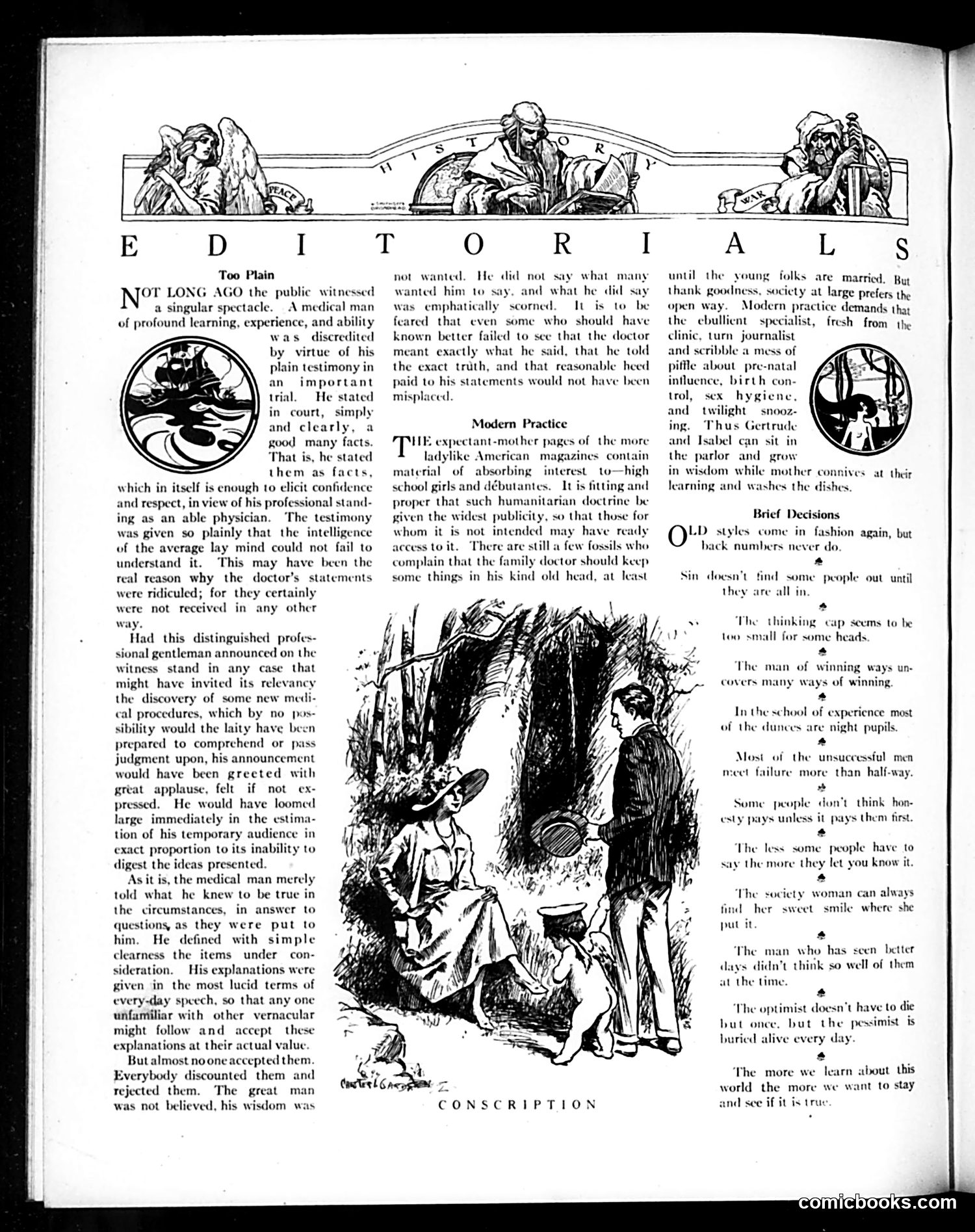
The large central illustration depicts a figure (appearing to be Uncle Sam or a military recruiter) forcibly conscripting a reluctant young man into military service. The man is being pulled or dragged into what appears to be a military structure or tunnel. The accompanying editorial text criticizes a doctor's courtroom testimony about medical matters, discussing how his statements were received skeptically by the public. The juxtaposition suggests Judge is satirizing both military conscription practices and institutional authority figures who lack public credibility. The "Brief Decisions" section contains cynical aphorisms about human nature and society. Without specific dating context, the conscription reference likely alludes to either WWI-era draft debates or general anti-conscription sentiment prevalent in American satirical magazines of that era.
📄 Transcribed text from this page (OCR, searchable)
Machine-transcribed from the original scan — historical spelling and the odd misread are preserved.
Too Plain OT LOD AGO the public witnessed a singular spectacle. A medical man of profound learning, experience, and ability was discredited by virtue of his plain testimony in an nportant trial. He stated in court, simply and clearly, a good many facts. That is, he stated them as facts, which in itself is enough to elicit confidence and respect, in view of his professional stand- ing as an able physician. The testimony was given so plainly that the intelligence of the average lay mind could not fail to understand it. This may have been the real reason why the doctor’s statements were ridiculed; for they certainly were not received in any other way. Had this distinguished profes- sional gentleman announced on the witness stand in any ¢ that might have invited its relevancy the discovery of some new medi- cal procedures, which by no pos- sibility would the laity have been prepared to comprehend or pass judgment upon, his announcement would have been greeted with great applause, felt if not ex- pressed. He would have loomed large immediately in the estima- tion of his temporary audience in exact proportion to its inability to digest the ideas presented. As it is, the medical man merely told what he knew to be true in the circumstances, in answer to questions as they were put to him. He defined with simple clearness the items under con- sideration. His explanations were in the most lucid terms of -day speech, so that any one unfamiliar with other vernacular might follow and accept these explanations at their actual valuc. But almost noone accepted them. Everybody discounted them and rejected them. The great man was not believed, his wisdom was not wanted He did not say what many wanted him to say i and what he say was emphatically scorned. It is to. be feared that some who should have known better failed to see that the doctor meant exactly what he said, that he told the exact trith, and that reasonable heed paid to his statements would not have been even misplaced. Modern Practice HE expectant-mother pages of the more ladylike American magazines contain material of absorbing interest to—high school girls and débutantes. It is fitting and proper that such humanitarian doctrine be given the widest public so that those for whom it is not intended may have re access to it. There are still a few fossils who complain that the family doctor should keep some things in his kind old head, a CONSCRIPTION until the Iks are married, But thank goodness, society at large prefers the open way. Modern practice demands that the ebullient specialist, fresh from the clinic, turn journalist and scribble a mess of pifle about pre-natal influence, th con- trol, sex hygiene, and twilight snooz- ing. Thus Gertrude and Isabel can sit in the parlor and grow in wisdom while mother connives at their learning and washes the dishes. young Brief Decisions LD styles come in fashion again, but back numbers never do. * Sin doesn’t find some people out until they are all in * The thinking cap seems to be too small for some heads. 2 ‘The man of winning ways un- covers many ways of winning * In the school of experience most of the dunces are night pupils. * Most of the unsuccessful men meet failure more than half-way. * Some people don’t think hon- esty pays unless it pays them first. cd The less some people have to say the more they let you know it, 2 ‘The society woman can always fined smile where she put it her sweet 2 The man who has scen better days didn’t think so well of them at the time. ¢ The optimist doesn’t have to die but once. but the pessimist is buried alive e ¢ ‘The more we learn about this world the more we want to stay and see if it is tru icbooks.com