
A complete issue · 28 pages · 1915
Judge — September 25, 1915
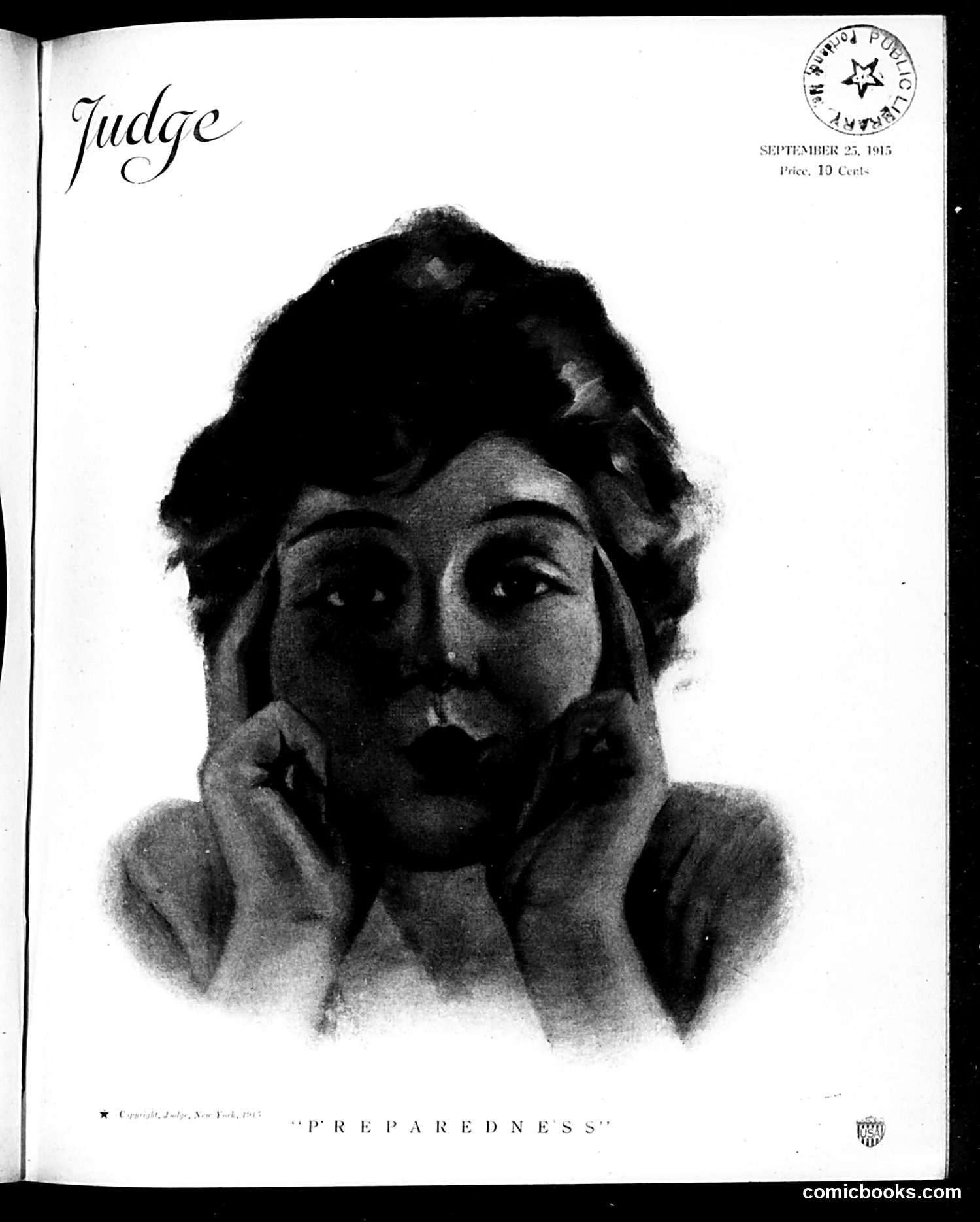
This illustration depicts a worried face with hands cradling the chin, titled **"Preparedness."** The cartoon likely satirizes American debates about military readiness in 1915, when World War I was raging in Europe but the U.S. remained neutral. The anxious expression suggests concern about the nation's defensive capabilities. "Preparedness" was a hotly debated political issue—advocates wanted increased military spending and readiness, while opponents feared it meant moving toward war involvement. The emotional distress conveyed by the face implies Judge's perspective: that anxiety about preparedness itself troubled the nation, whether the concern was justified or exaggerated remains the cartoon's ambiguous point.
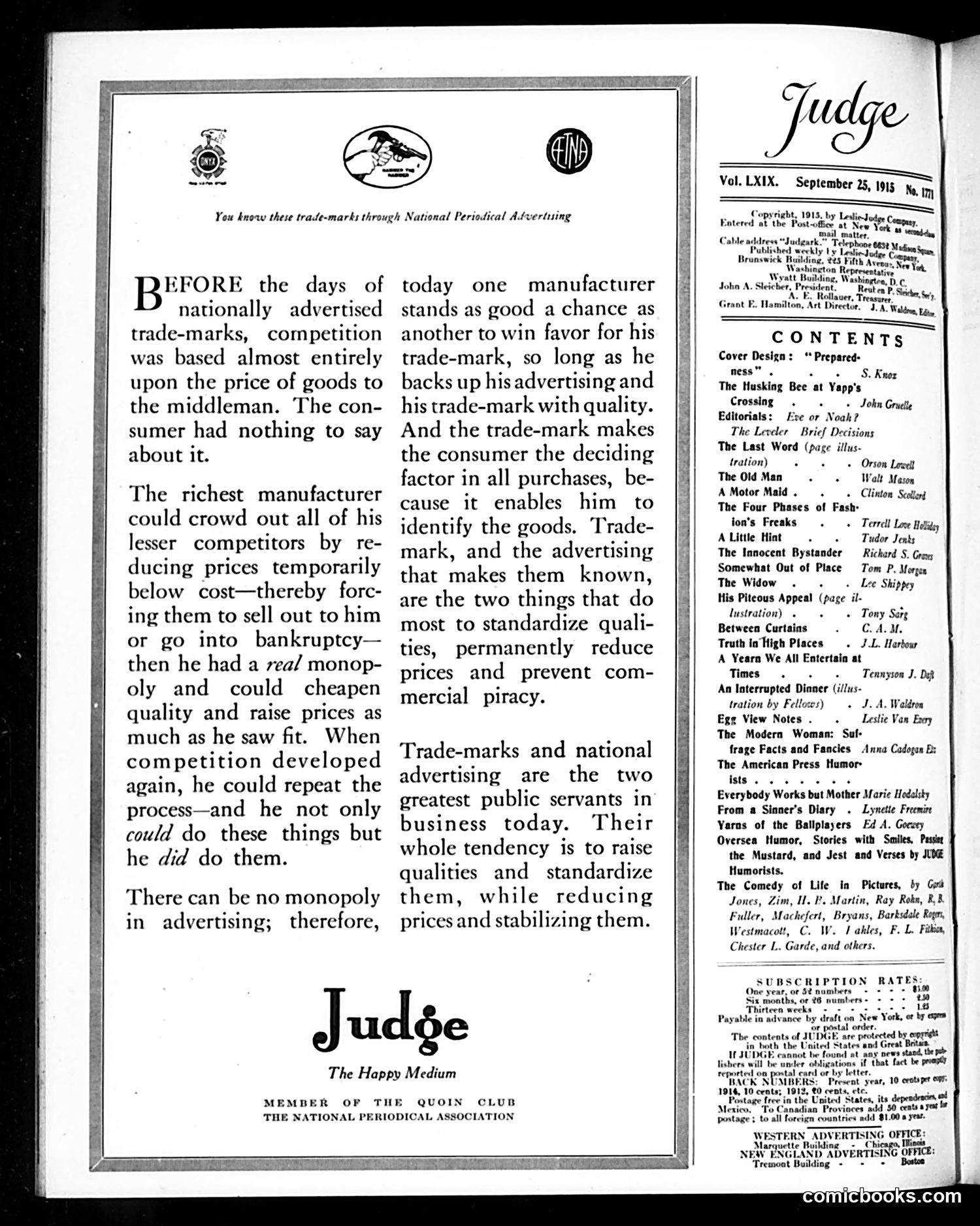
This page is primarily **advertising and editorial content rather than political cartoon**. The main visible text is an advertisement for Judge magazine itself, arguing that trade-marks and national advertising serve the public good by standardizing quality, reducing prices, and preventing monopolies. The advertisement defends commercial competition and branding against anti-business sentiment of the Progressive Era. It claims trade-marks empower consumers to identify quality goods and prevent price-fixing. The right column shows a **table of contents** listing various satirical articles and illustrations inside the magazine, including pieces on politics, social commentary, and humor—typical of Judge's format as a weekly satirical publication. No specific political figures or events are caricatured on this visible page.
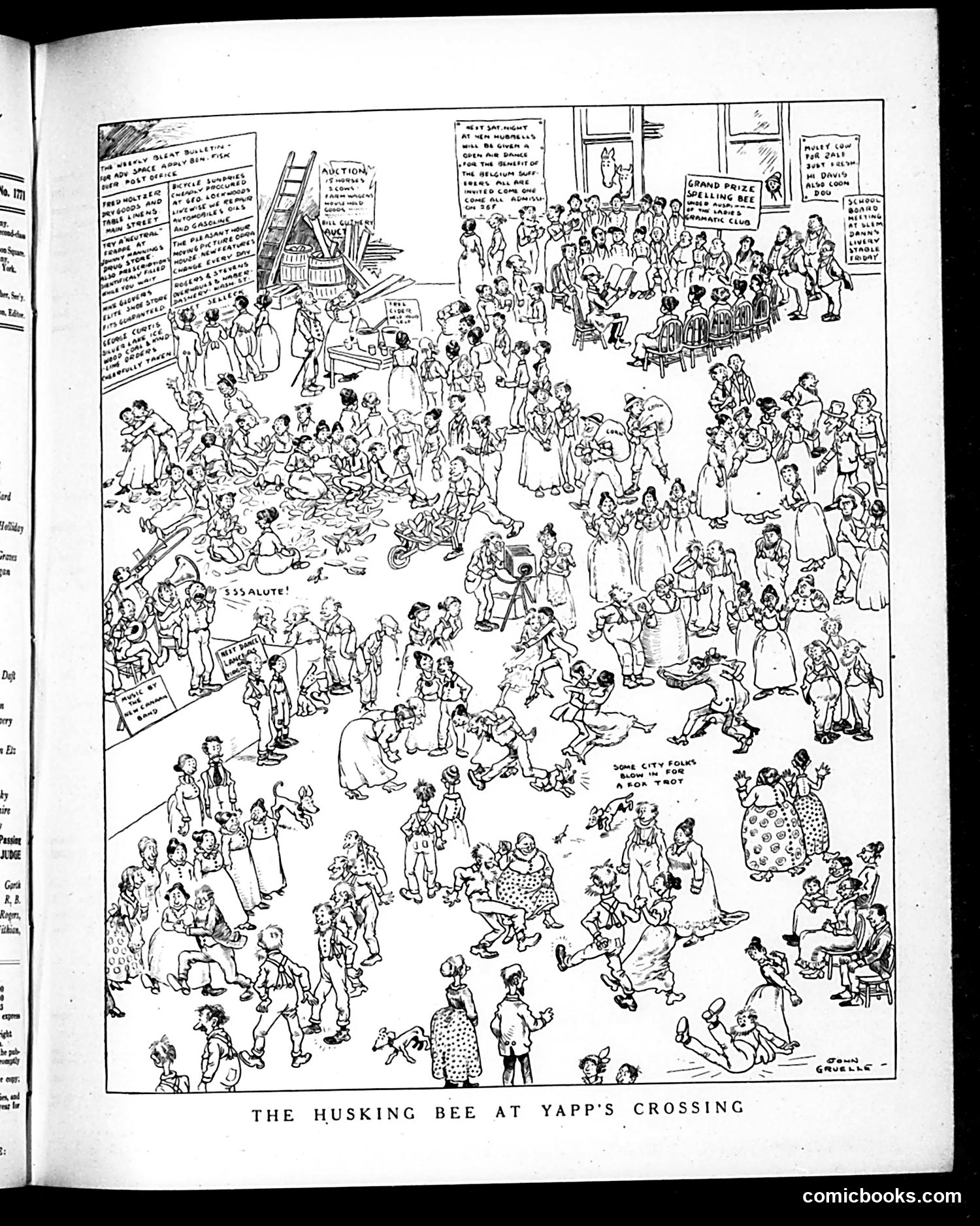
This cartoon depicts a chaotic rural community gathering—a "husking bee" (a traditional corn-husking social event). The scene shows dozens of people in various activities: some husking corn, others socializing, children playing, and various comic situations unfolding simultaneously. The detailed, crowded composition satirizes small-town American rural life, with numerous sight gags and character types visible throughout. Multiple text boxes contain dialogue and commentary (though difficult to read at this resolution). The cartoon appears to be social satire about rural American customs and community gatherings, likely poking fun at the disorganized chaos and colorful personalities present at such events. Without clearer text, the specific political references remain unclear, but it represents Judge magazine's typical approach to lampooning American provincial life and customs.
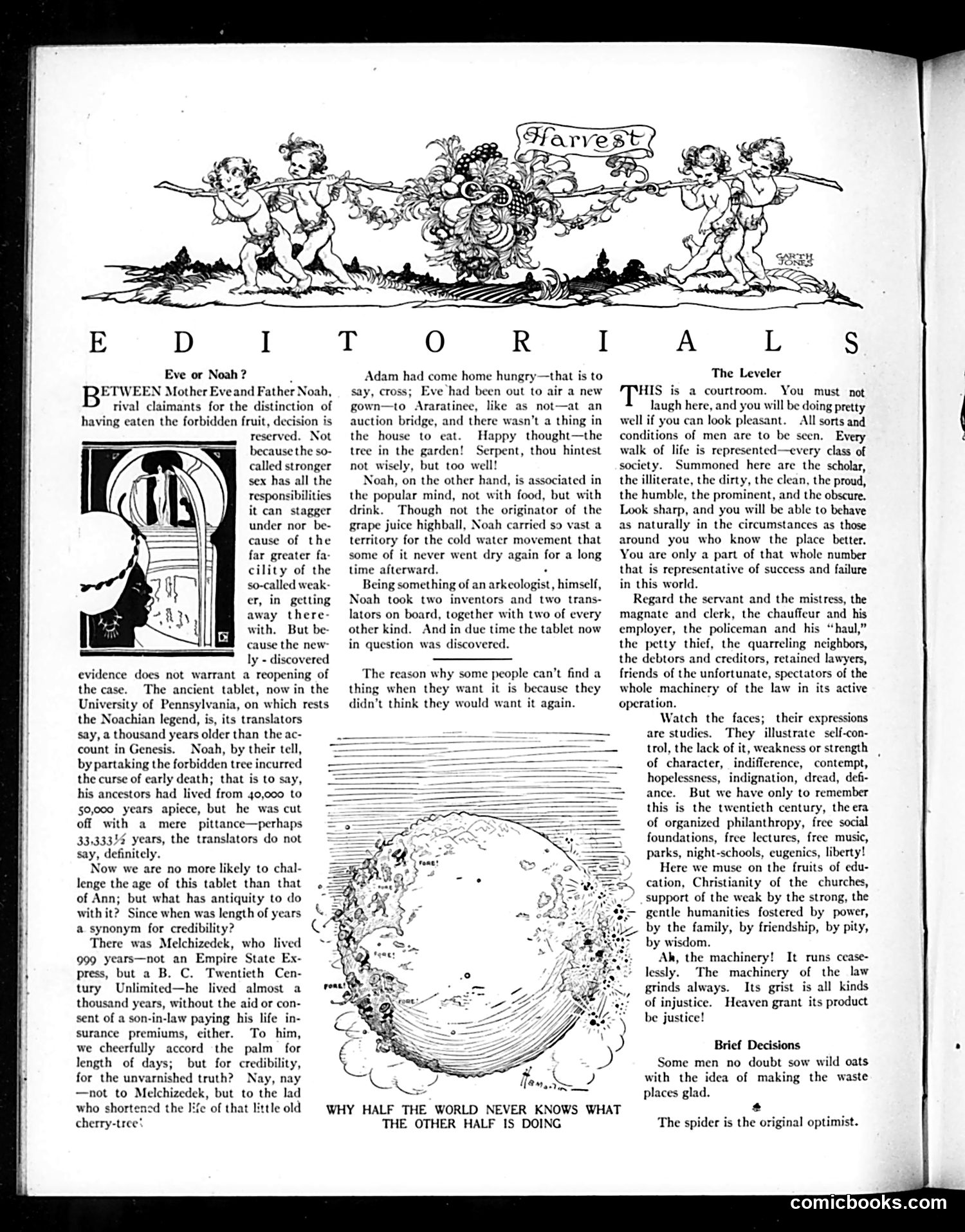
This page from *Judge* magazine contains three distinct sections: **Left column**: A debate about whether Eve or Noah caused humanity's fall, using the forbidden fruit and the flood as theological reference points. The satire critiques how people selectively blame figures to suit their arguments. **Center**: An illustration titled "Why Half the World Never Knows What the Other Half is Doing"—likely satirizing the gap between wealthy and poor classes, or perhaps the information divide between different social spheres during this era. **Right column ("The Leveler")**: Social commentary on courtroom conduct and class distinctions, advocating that all social classes should be treated equally in legal proceedings—reflecting Progressive Era concerns about justice and equality. The page emphasizes social observation and critique rather than partisan politics.
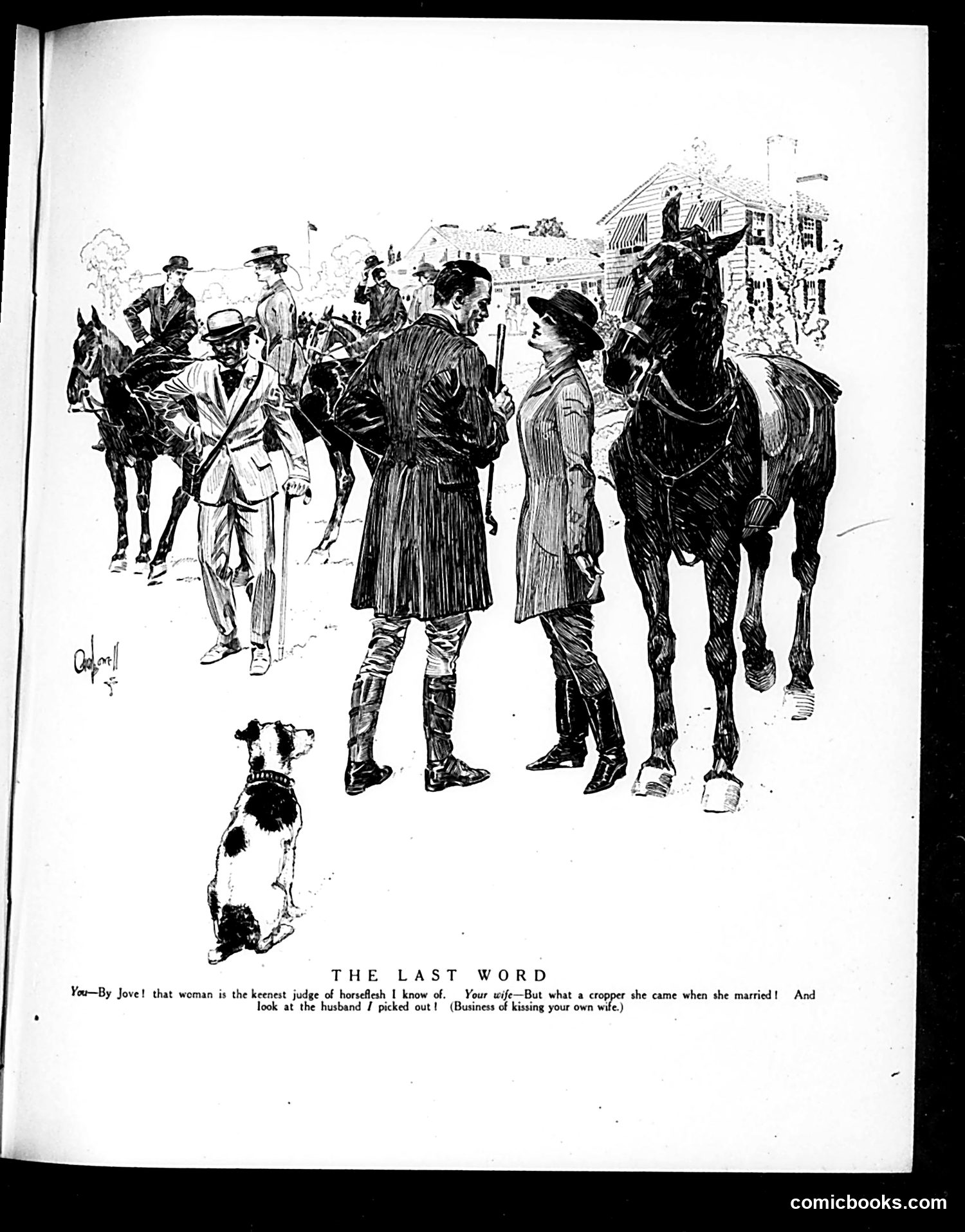
This cartoon satirizes marital dynamics, specifically female judgment and authority in relationships. The title "The Last Word" refers to the common domestic trope of wives having the final say in arguments. The scene depicts a woman expertly evaluating a horse while men discuss it—the joke being she's portrayed as an excellent judge of horseflesh. The caption's punchline suggests she married poorly ("what a cropper the came when she married!"), implying the husband is an inferior specimen compared to the horse she'd select. The small dog observing the scene adds comedic witnessing. The satire critiques both husbands (for being poor choices) and wives (for their critical nature), reflecting early 20th-century humor about marriage tensions and female judgment.
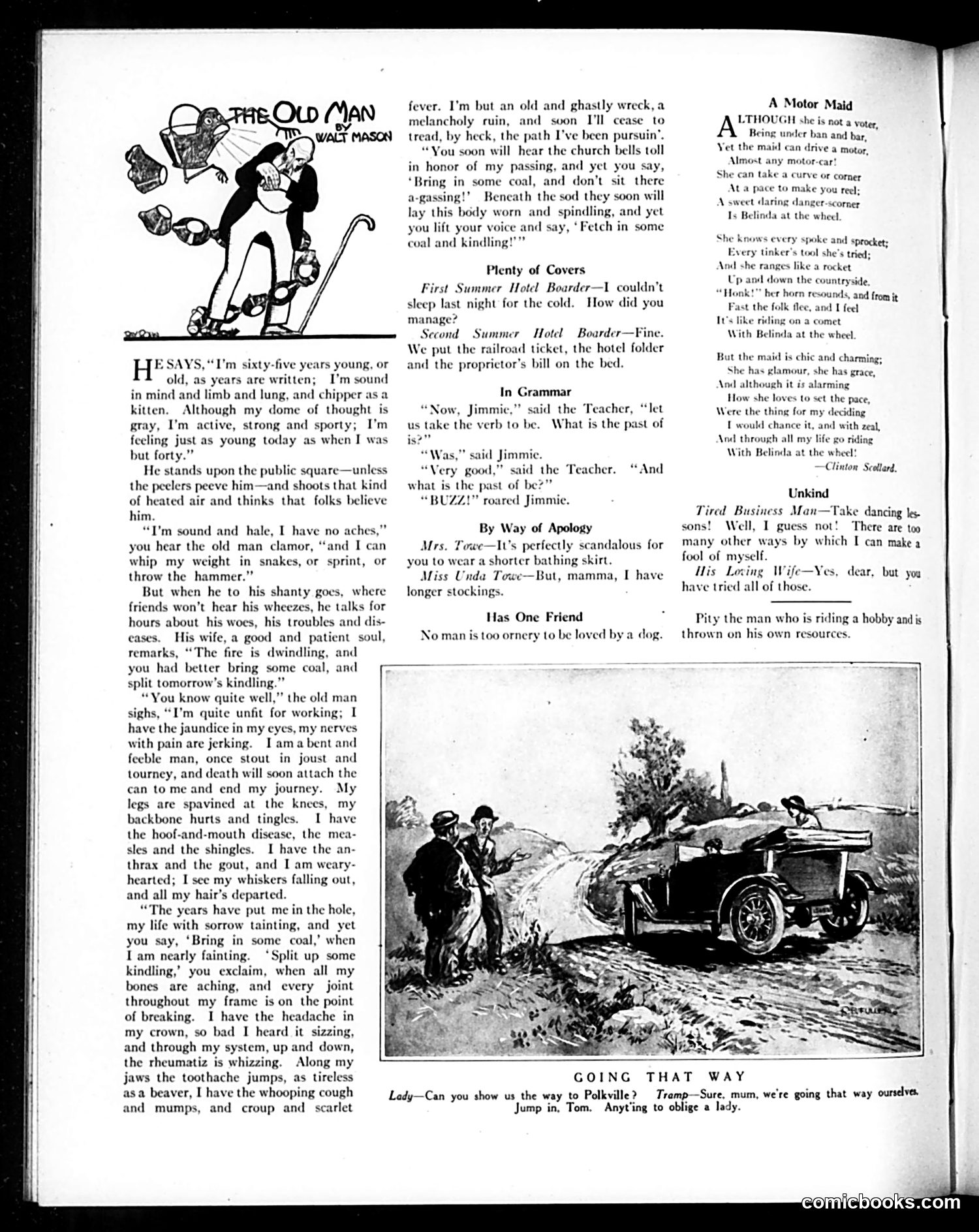
This page satirizes male hypocrisy and self-deception through two main pieces: **"The Old Man by Walt Mason"** mocks a man who publicly brags about his vigor and strength—boasting he can "whip my weight in snakes"—while privately complaining to his wife about countless ailments: rheumatism, gout, failing hair, toothaches. The satire targets men who perform masculine bravado for public audiences but reveal their actual infirmities at home. His wife remains unmoved by his excuses, pragmatically demanding he fetch coal and kindling. **"A Motor Maid"** is a lighter piece celebrating a young woman's competence and daring as a motorist—a relatively novel phenomenon for the era. Though framed as "unkind" or perhaps unusual (women weren't voters yet), the poem admires her mechanical knowledge, fearlessness, and charm behind the wheel, presenting her as modern and liberated. Both pieces reflect early-20th-century gender anxieties: declining male authority and the emerging independence of women.
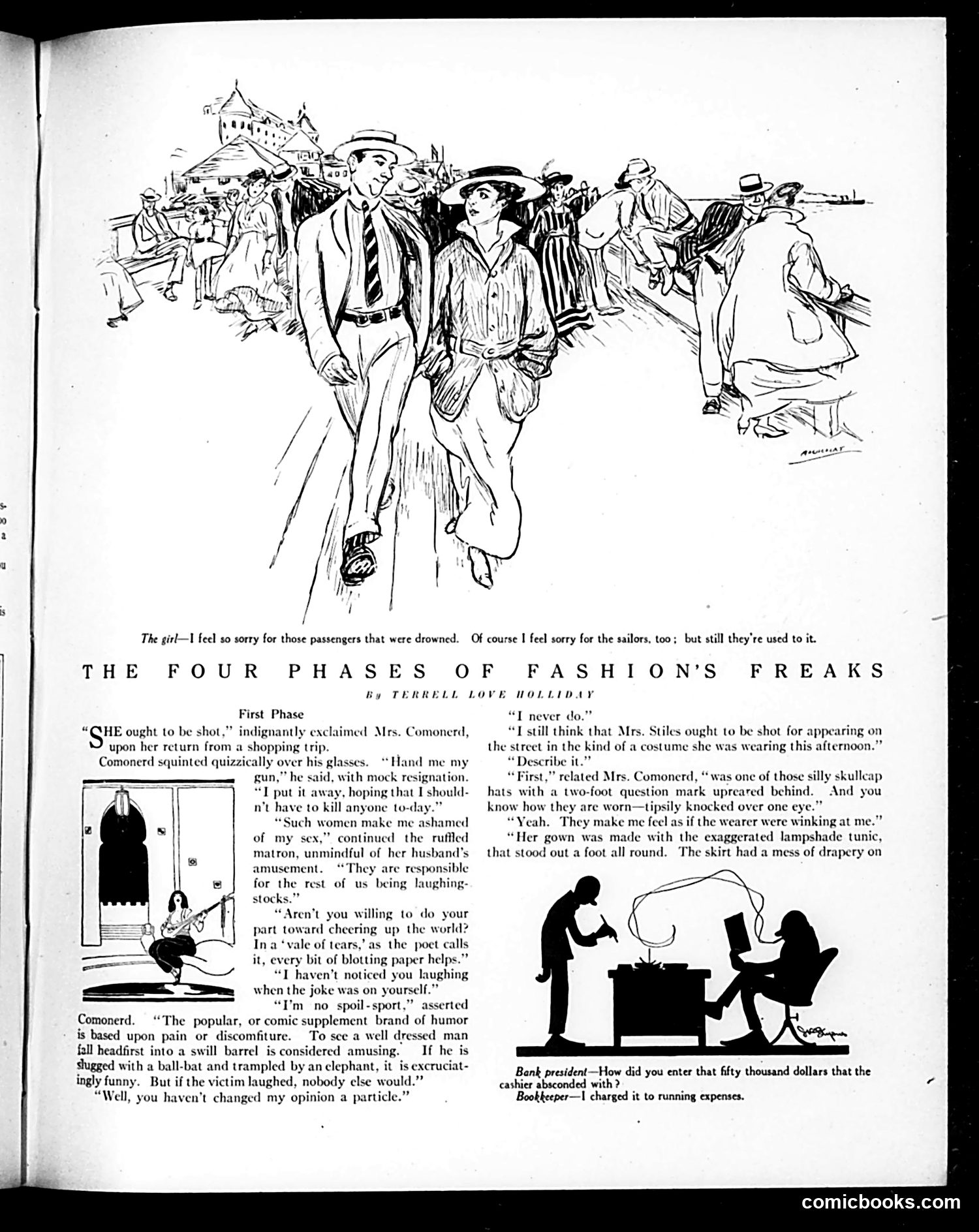
This satirical piece mocks absurd women's fashion trends of the era. The main cartoon depicts an exaggerated "lampshade tunic" dress with a drooping skirt and a ridiculous hat featuring a two-foot question mark—actual fashion elements that Judge deemed worthy of ridicule. The dialogue between Mr. and Mrs. Comonerd establishes the satire's target: women who adopt extreme fashion trends are portrayed as foolish and deserving of mockery. Mrs. Comonerd expresses outrage at such fashions while her husband philosophizes that popular humor relies on others' misfortune and discomfort—implying women in these costumes are unwitting comedians. The secondary cartoon jokes about a bank scandal, unrelated to fashion. The piece reflects Judge's conservative stance on women's fashion innovation, treating experimental designs as both ridiculous and symptomatic of broader social disorder.
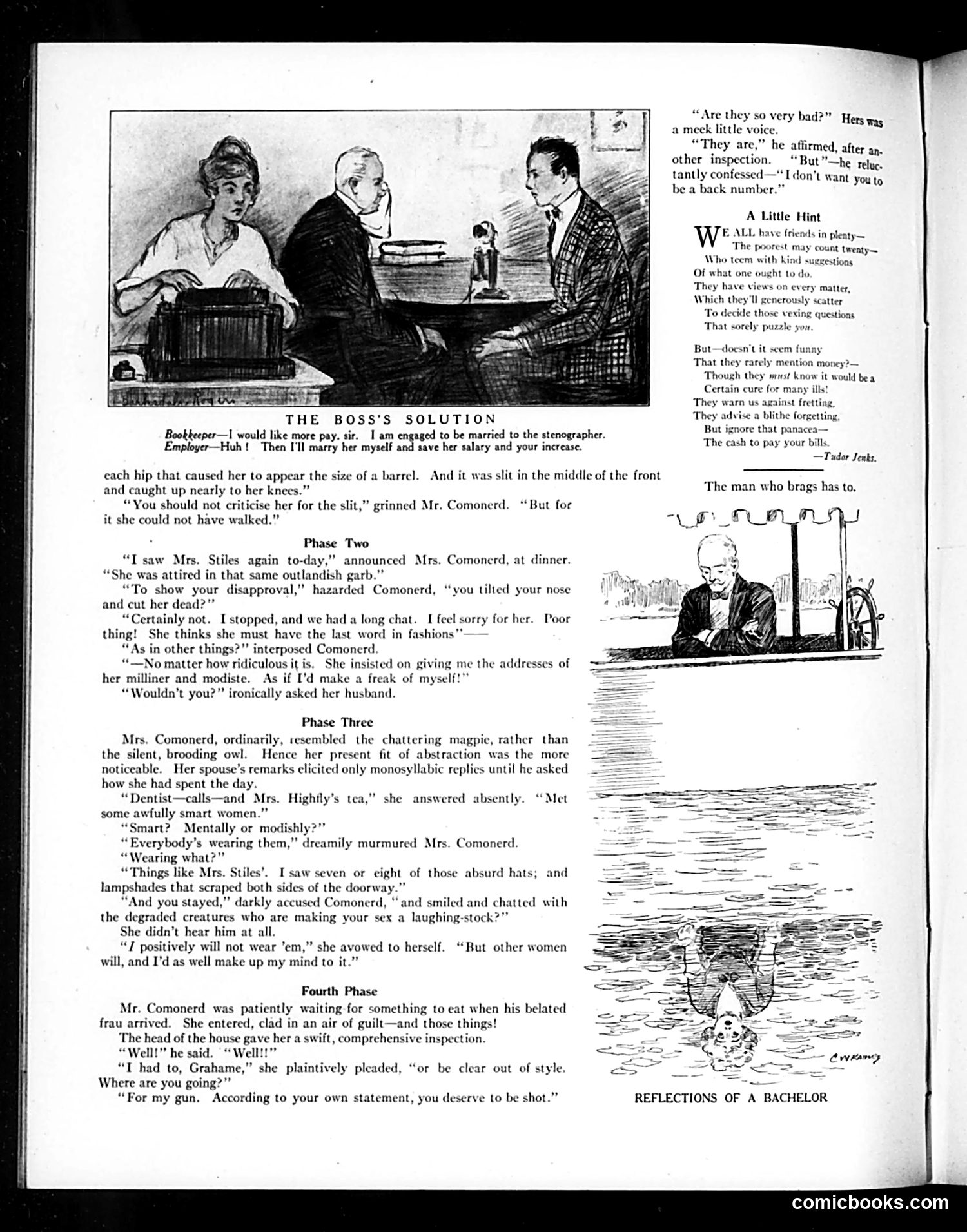
This page contains two separate satirical pieces about early 20th-century social dynamics: **"The Boss's Solution"** (top cartoon): A brief joke mocking workplace hierarchies. A bookkeeper requests a raise to fund his engagement to the stenographer. The employer's cruel "solution" is to marry the stenographer himself, thus eliminating both salary costs. The satire targets both the boss's callous abuse of power and the transactional view of women's labor. **"Phase" story (main text)**: A serialized domestic comedy about Mrs. Comonerd adopting absurd fashion—specifically ridiculous wide hats—after initially criticizing them. The satire mocks women's fashion conformity: despite claiming the trend is foolish, she eventually surrenders to peer pressure ("other women will...I'd as well make up my mind"). Her husband's exasperation ("I'll get my gun") is darkly comic hyperbole about marital frustration with female inconsistency. The humor relies on period assumptions about women's irrationality regarding fashion and social status, making these pieces dated social commentary rather than timeless satire.
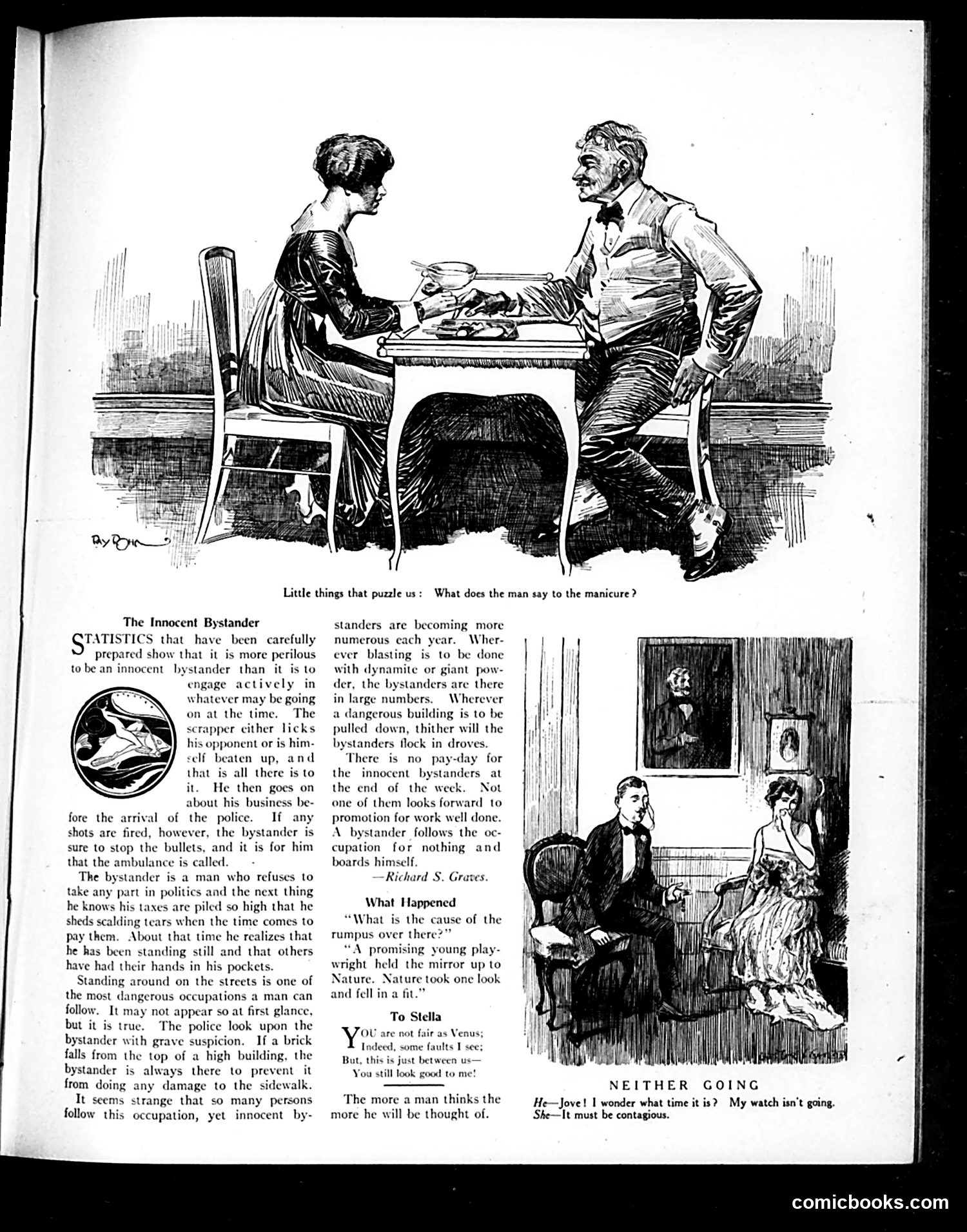
This page contains satirical commentary typical of early 20th-century Judge magazine. The main article, "The Innocent Bystander" by Richard S. Graves, mocks the paradox that uninvolved citizens suffer disproportionately in dangerous situations—caught in crossfire, hit by falling debris, or struck by dynamite blasts—while active participants escape relatively unscathed. The piece extends this to politics, suggesting that those who avoid political engagement still suffer through taxation. The cartoon at top illustrates this concept: a woman receives a manicure while a man sits across from her, likely representing the "innocent bystander" trapped in an uncomfortable social situation. The remaining items are light humor: brief jokes about a playwright, romantic verse, and a pun about a broken watch ("contagious"). The satire targets society's absurd risks and the futility of attempting neutrality in civic life.
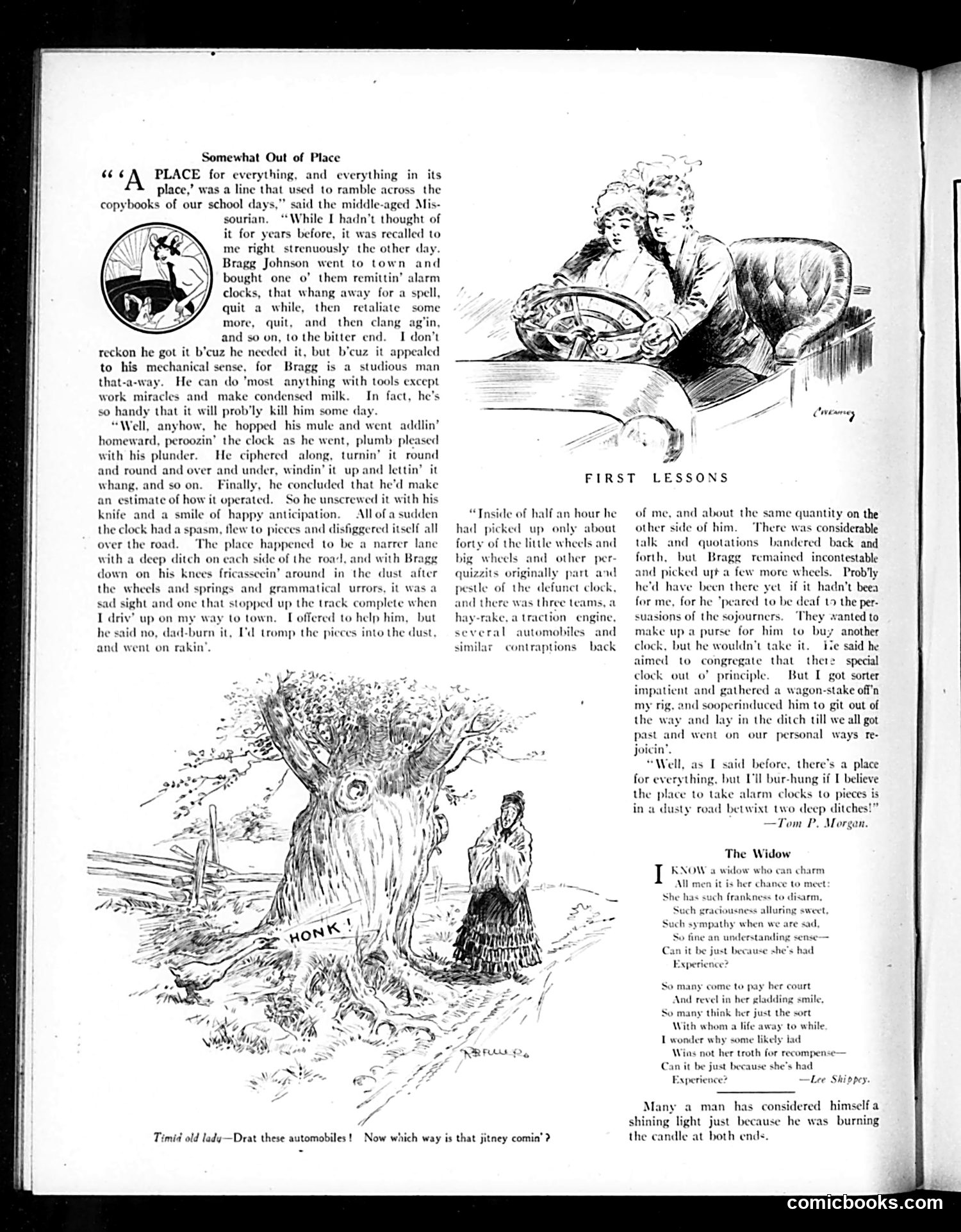
This rural humor story satirizes the impracticality of mechanical tinkering. A Missourian named Bragg Johnson buys an alarm clock, becomes fascinated by its workings, and disassembles it roadside with a knife—scattering springs and gears across a dusty lane between two ditches. The joke exemplifies the old saying "a place for everything"—implying that taking apart a clock in the middle of a road is spectacularly the wrong place for such work. The accompanying cartoon shows an elderly woman puzzled by automobile traffic, asking "which way is that jitney comin'?" This captures rural/urban culture clash: newly common automobiles and "jitneys" (cheap public transit vehicles) bewildering older townspeople unfamiliar with this modern transportation. The page also includes poetry "The Widow," celebrating a charming widow's appeal, and a final quip about men "burning the candle at both ends." The content reflects early 20th-century American rural-urban tension and changing technology.
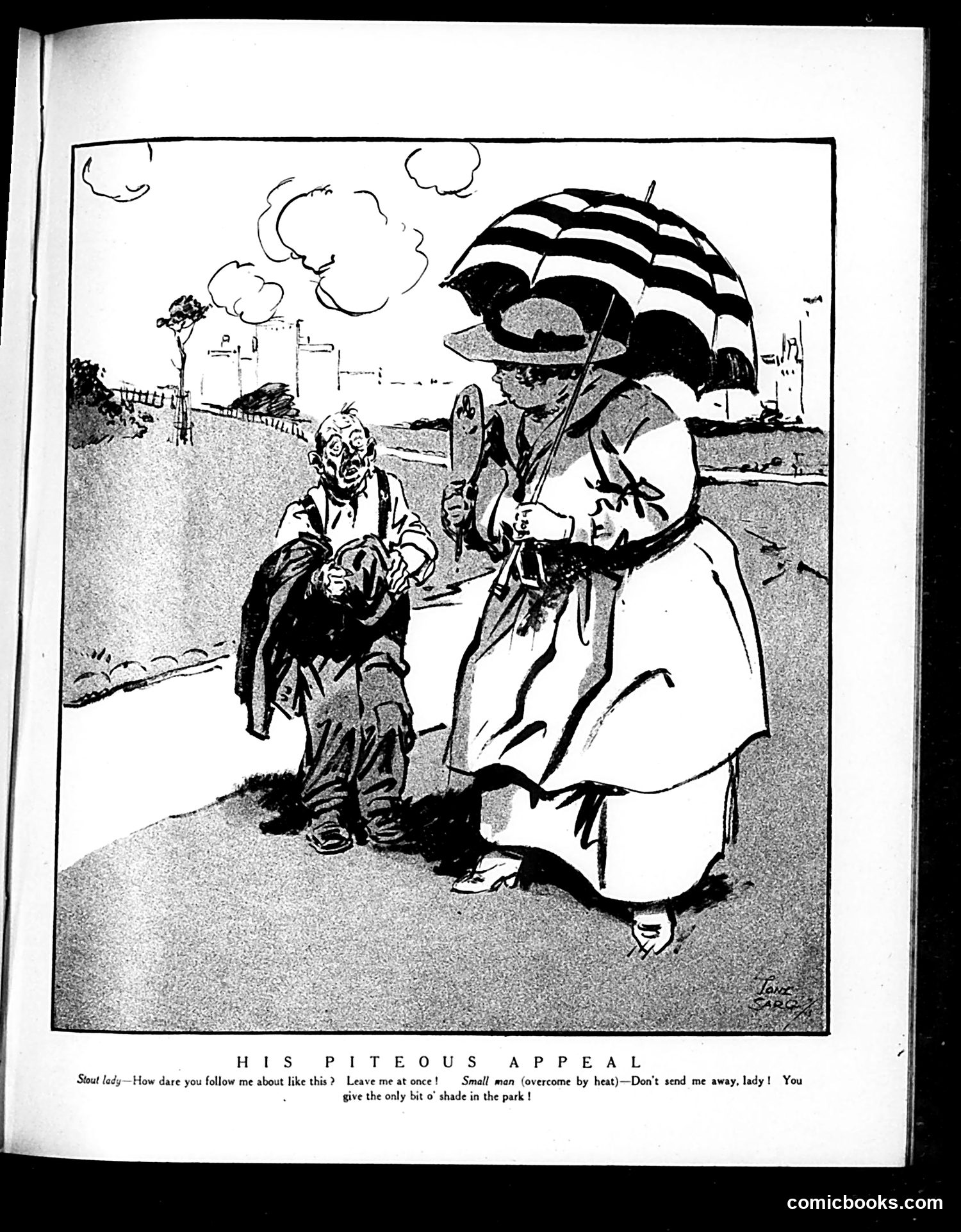
This cartoon depicts a rotund woman with a striped umbrella being pursued by a small, overheated man in a park. The humor relies on body-shaming: the joke is that the woman's substantial size provides enough shade that the desperate man follows her for relief from the heat, rather than seeking shade from trees or structures visible in the background. The satire targets both figures—the woman's vanity (implied by her indignation at being followed) and the man's desperation. It's a period piece reflecting early-to-mid 20th century attitudes, when such jokes about women's weight were considered acceptable magazine humor. The title "His Piteous Appeal" undercuts the man's dignity, emphasizing the absurdity of his situation and the casual cruelty of the joke itself.
This page presents a theatrical debate following a performance of "Young America," a play apparently featuring a dog as a dramatic device. The cartoon (top) shows the dog and theatrical props. The satire contrasts cultural perspectives: a tired businessman enjoys the entertainment and praises American vigor; a pretentious critic dismisses it as artistically base, invoking Henrik Ibsen as the standard of serious drama. A débutante and suburbanite join the discussion. The joke targets intellectual snobbery: the critic's invocation of Ibsen (representing "serious" European theater) clashes with popular American audiences' preferences for accessible entertainment. The tired businessman's boast that the dog will "make a bigger hit...than half a dozen Ibsens" captures the satire's central point—mocking critics who prioritize artistic purity over what audiences actually enjoy. The discussion of plot absurdities (the lawyer being the girl's lost father) further ridicules theatrical melodrama, while the critic remains humorlessly superior throughout.
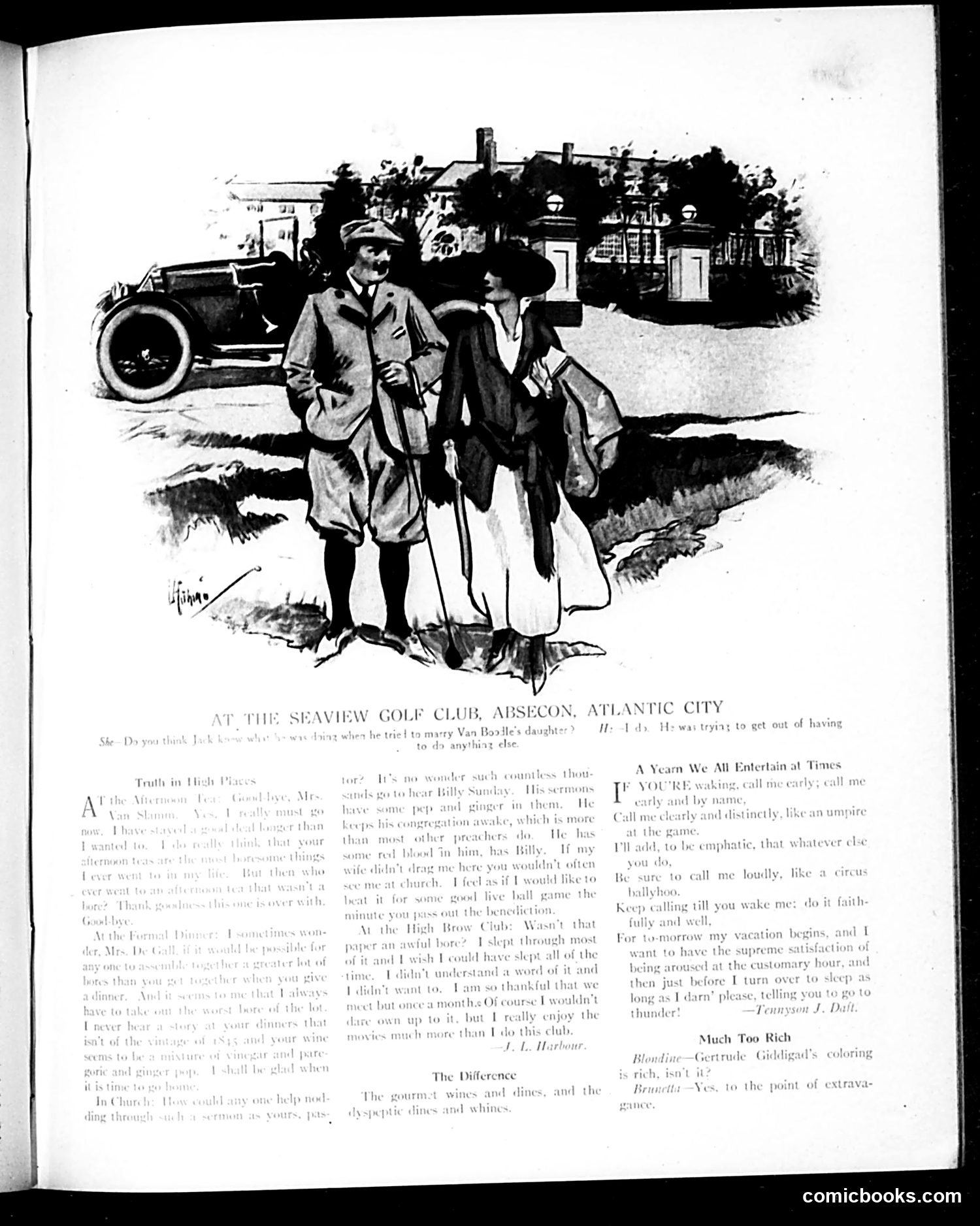
The main illustration depicts two women at the Seaview Golf Club in Atlantic City. The cartoon satirizes social pretension and class aspiration among the leisure class during the Jazz Age. The accompanying text snippets—"Truth in High Places," "At the Formal Dinner," "In Church," and "The Difference"—suggest this is part of a larger satirical feature about the gap between how people present themselves publicly versus their private behavior and thoughts. The illustration itself appears to mock the artificiality of upper-class social gatherings, where women dressed in fashionable attire engage in superficial conversation while positioned near an expensive automobile and grand estate—visual markers of wealth meant to impress. The overall satire targets the performative nature of 1920s high society, where maintaining appearances and social status took precedence over authenticity.
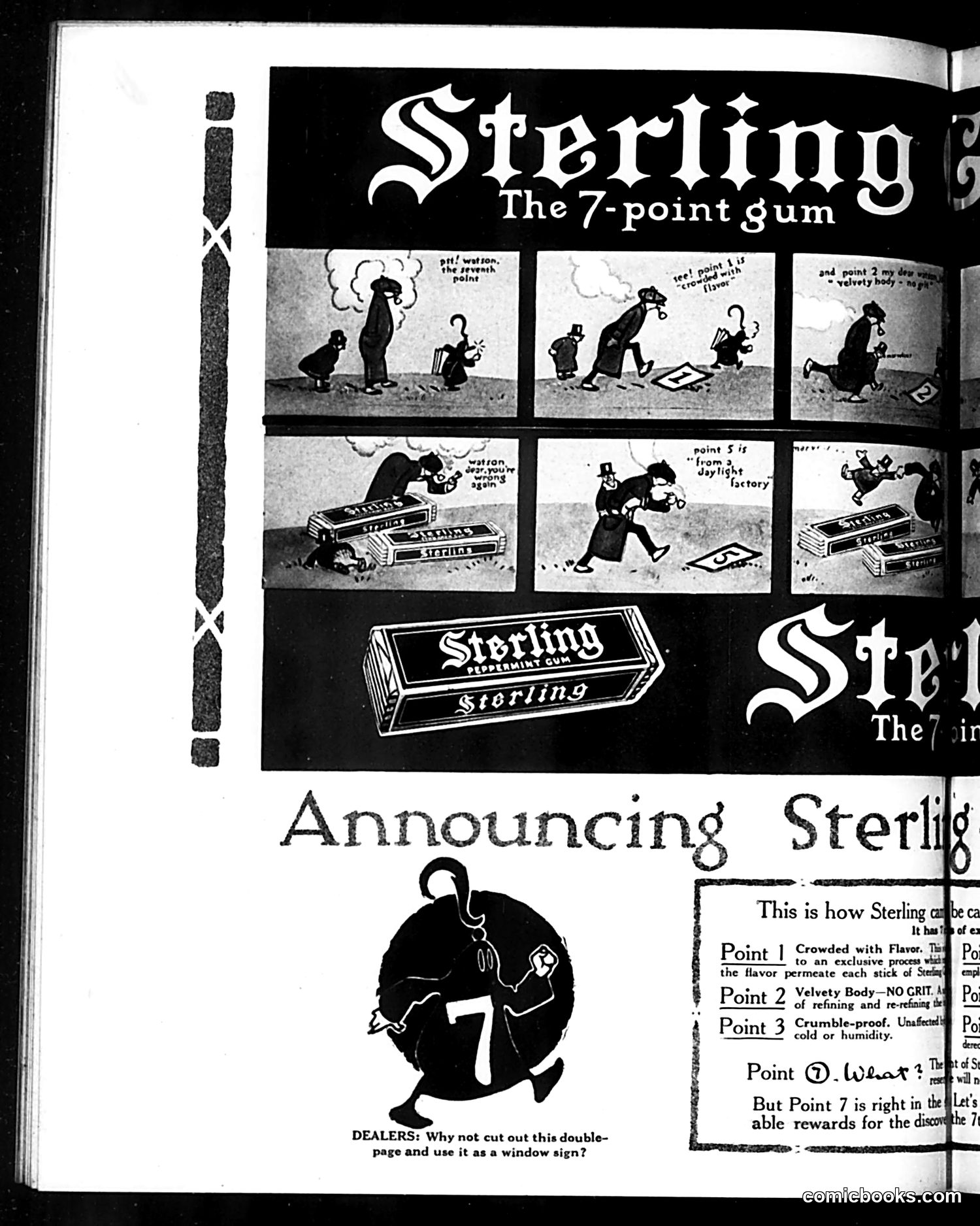
This page is primarily **advertising for Sterling chewing gum**, not political satire. The top half contains comic strips demonstrating the gum's seven selling points through humorous scenarios with characters using Sterling gum. The bottom half announces "Sterling—The 7-point gum" and lists its features: flavor saturation, velvety texture without grittiness, and crumble-proof durability. The circular emblem shows the number "7" as the product's branding hook. A note directs dealers to cut out the double-page spread as a window display advertisement. This is a commercial advertisement typical of early-20th-century magazine promotions, not editorial or satirical content.
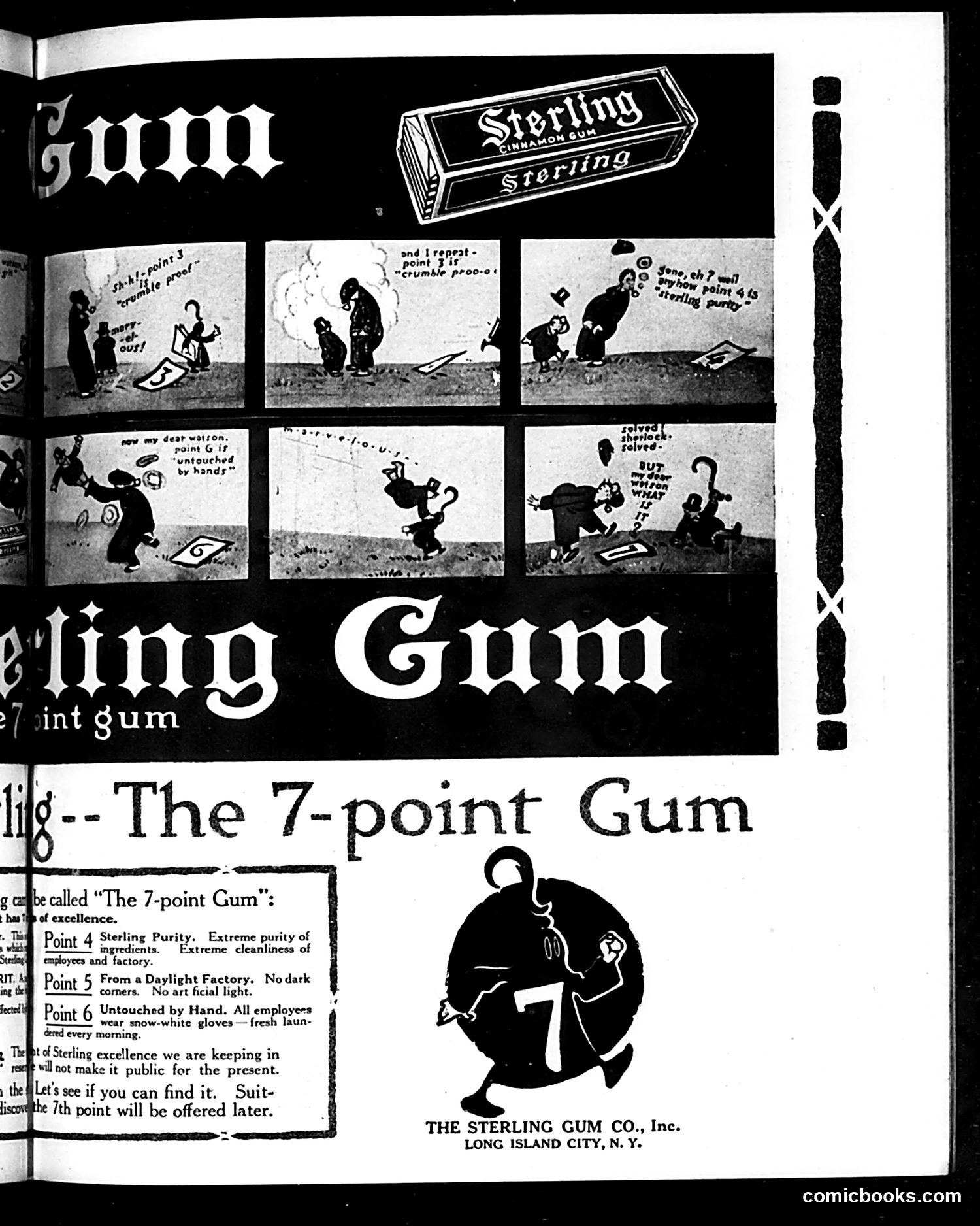
This is primarily an **advertisement for Sterling chewing gum** rather than political satire. The comic strip panels above show a Sherlock Holmes-style detective ("my dear Watson") investigating gum quality through humorous scenarios. The "7-point Gum" refers to Sterling's marketing claims about manufacturing excellence: purity of ingredients, factory cleanliness, daylight production, and hand-hygiene (employees wear fresh white gloves). The ad invites readers to identify the mysterious seventh point themselves, implying hidden quality. This reflects early-20th-century advertising conventions where brands emphasized *hygiene and purity* as selling points—concerns that resonated after food-safety scandals of the era. The Holmes parody adds whimsy to what is essentially a product pitch, positioning Sterling as meticulously quality-controlled compared to competitors.
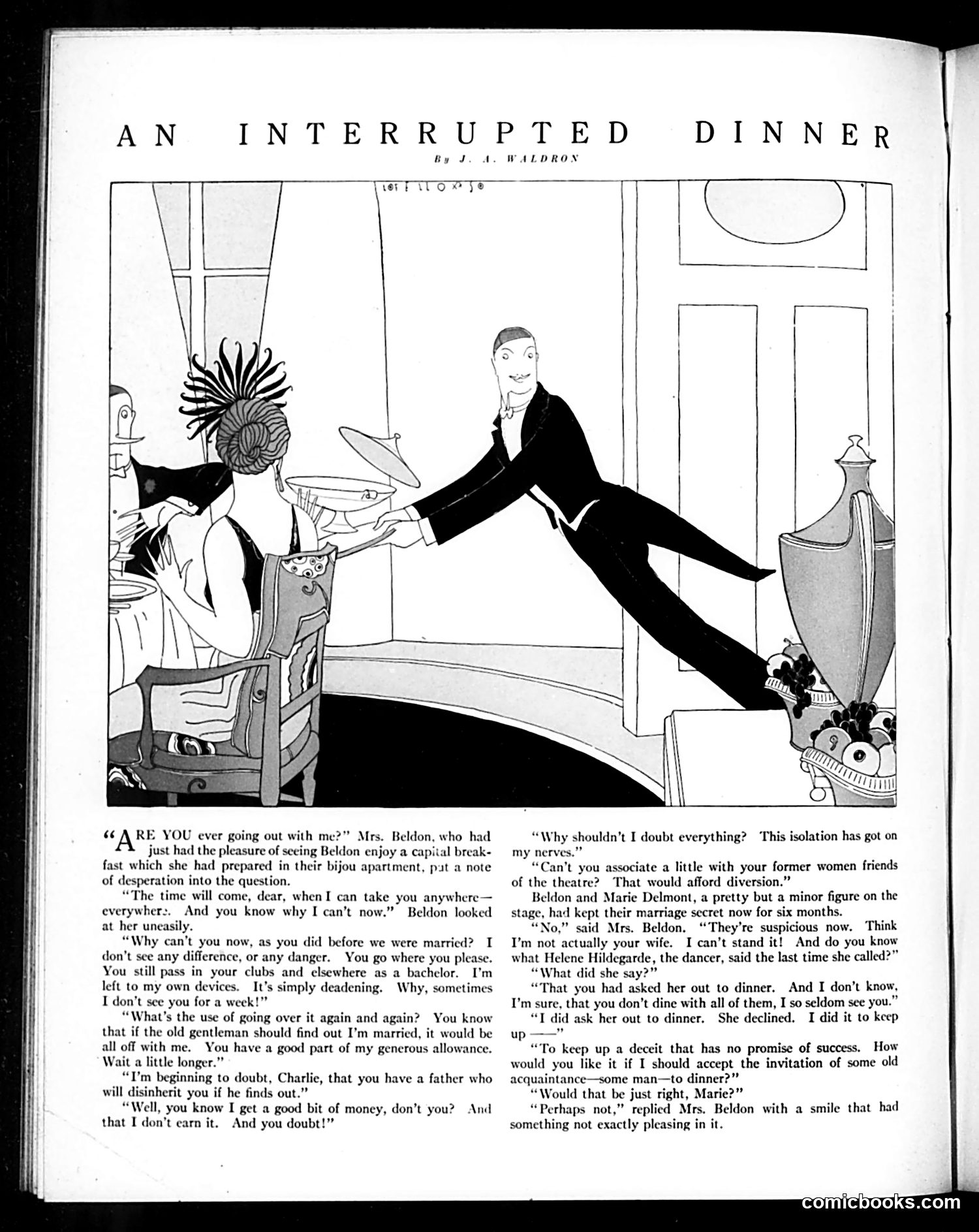
This is a domestic comedy about a secret marriage. Charlie Beldon has married Marie Delmont, a stage actress of minor standing, but keeps the marriage hidden from his father—apparently to preserve an allowance that supports them both. The satire targets the hypocrisy of the arrangement: Charlie maintains a public "bachelor" lifestyle, attending clubs and dining with other women, while Marie is confined to their apartment, isolated and increasingly suspicious. The cartoon depicts Charlie gracefully presenting a dinner plate to Marie while she sits rigidly—a visual joke about his attempt to appease her. The humor lies in the unstable deception: Marie doubts his excuses about his father's disinheritance threat, resents his social freedom versus her confinement, and suspects he dines with former actresses. Charlie's casual suggestion that Marie associate with "theatre women friends" backfires when she reveals he's been asking other women to dinner. The underlying satire critiques male privilege and the precarious position of women in theatrical circles during this era—trapped between respectability and scandal.
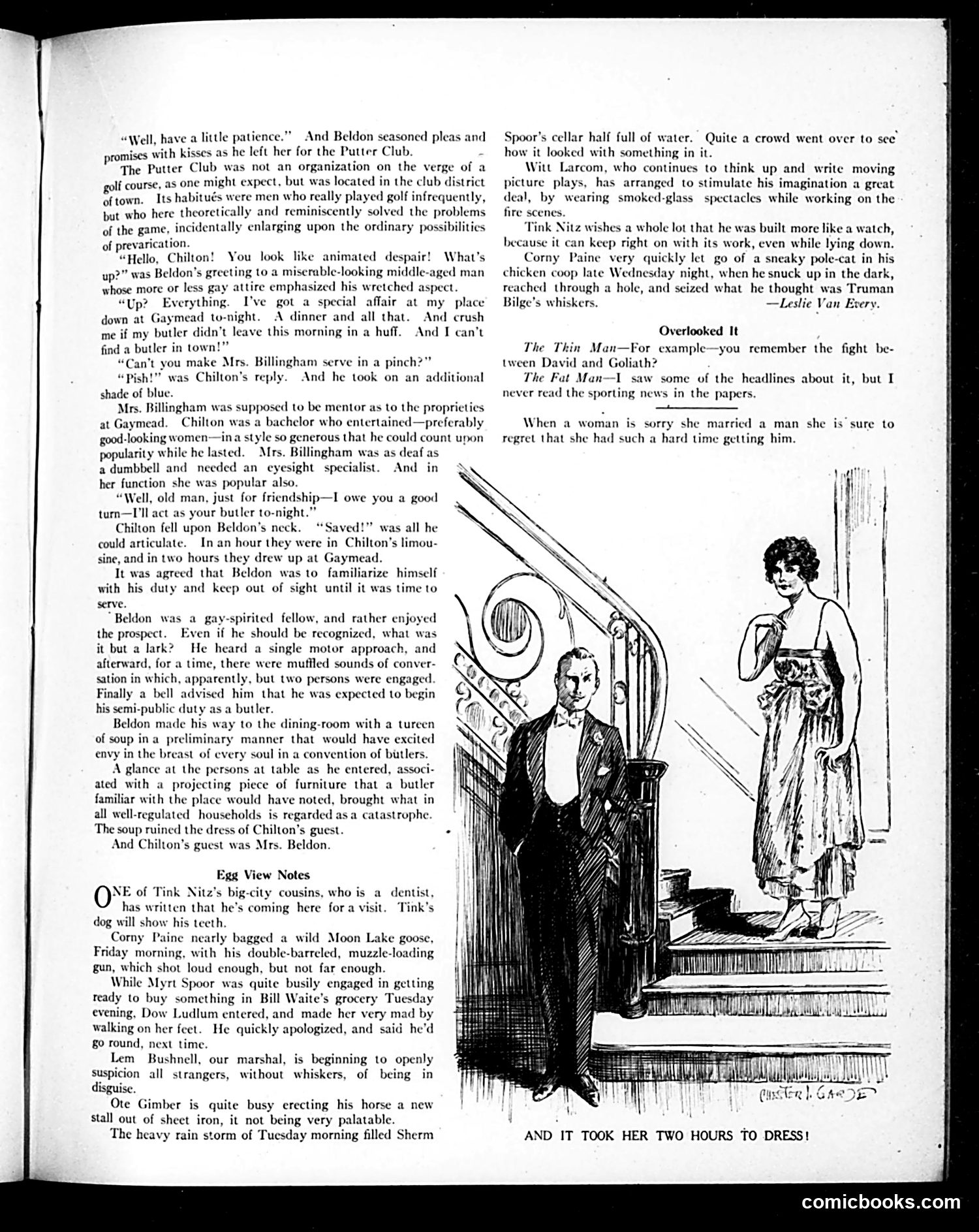
This page contains a short humorous story illustrated by a single cartoon. The joke involves ironic marital deception: Chilton, a bachelor hosting a dinner party, asks his friend Beldon to serve as butler after his actual butler quits. Beldon agrees, unaware that Chilton's secret wife—Mrs. Beldon—is the dinner guest. When Beldon serves soup, he spills it on her dress, revealing the deception. The cartoon shows the moment of catastrophe: Beldon (in butler's livery) confronts the woman, while she stands indignantly in her stained dress. The caption emphasizes the social humiliation—a ruined fancy dress taking two hours to prepare. The satire targets the leisured class's casual deceptions and the butler's traditionally invisible role. The humor relies on slapstick disaster exposing hidden marital arrangements among the wealthy.
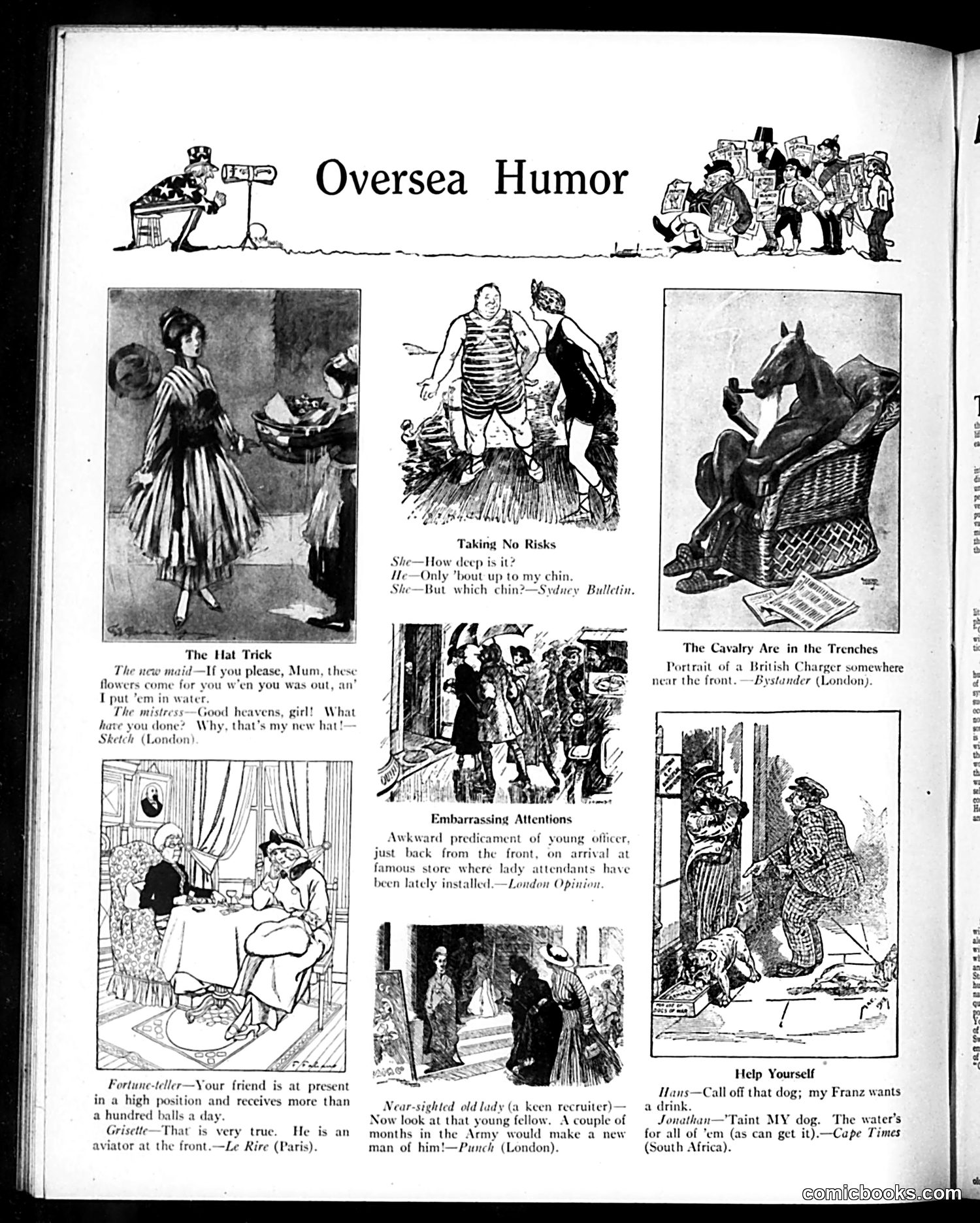
This page collects war-related humor from international satirical publications during World War I. The jokes reflect home-front anxieties and battlefield realities: **Key themes:** - **"The Hat Trick"**: Domestic comedy about a servant's mistake—placing flowers in the employer's hat instead of a vase. Typical lower-class humor. - **Aviation references**: Multiple jokes about aviators at the front receiving "a hundred balls a day" (artillery shells), treating combat danger humorously. - **Gender anxiety**: "Embarrassing Attentions" jokes about female shop attendants replacing male employees (who've enlisted), creating awkward social situations for returning soldiers. - **Body humor**: The "chin" joke mocks overweight soldiers. - **International camaraderie**: "Help Yourself" shows Allied soldiers (Jonathan/American, Hans/German) sharing water during combat—humanizing the enemy. The page demonstrates how WWI humor often masked serious subjects—injury, death, social displacement—through wordplay and gentle satire, collected from *Punch*, *Le Rire*, and other publications to entertain American readers.
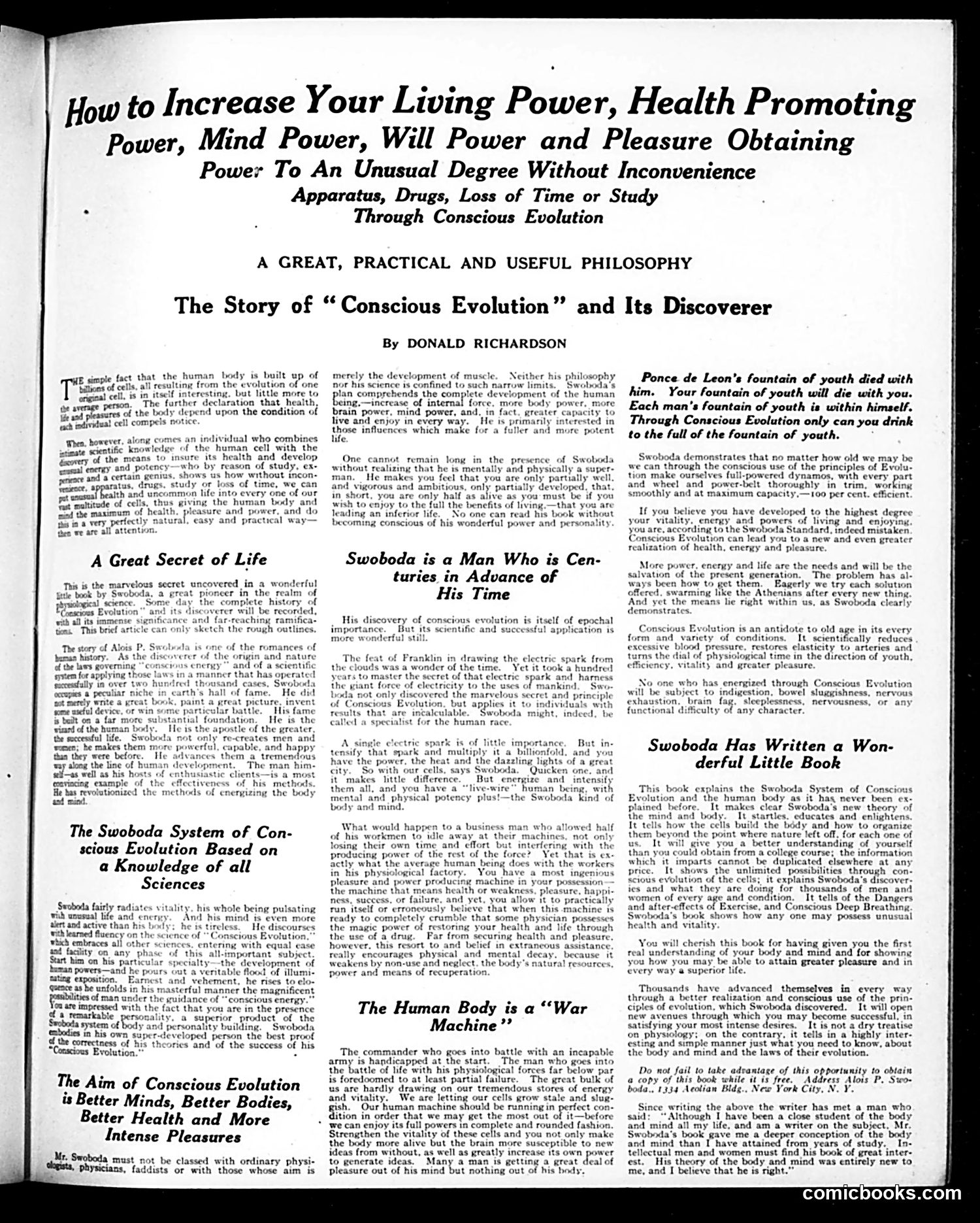
This page is **not a cartoon or satire** — it's a **genuine advertisement and promotional article** from Judge magazine, likely early 20th century. The content promotes "Conscious Evolution," a pseudo-scientific self-improvement system by someone named **Swoboda**. The article claims this method can increase "living power, health promoting power, mind power, will power" without drugs, apparatus, or time investment — purely through understanding how human cells work. **Key elements:** - Swoboda is presented as a pioneering figure who has helped thousands - The system is framed as based on "knowledge of all sciences" - Claims include restoring youth, vitality, and pleasure through cellular consciousness - No actual scientific mechanism is explained — only vague promises **For modern readers:** This exemplifies early-1900s pseudoscience marketing: grandiose promises, pseudo-scientific language, celebrity endorsement rhetoric, and appeals to self-improvement without effort. Judge apparently ran such advertisements alongside satire.
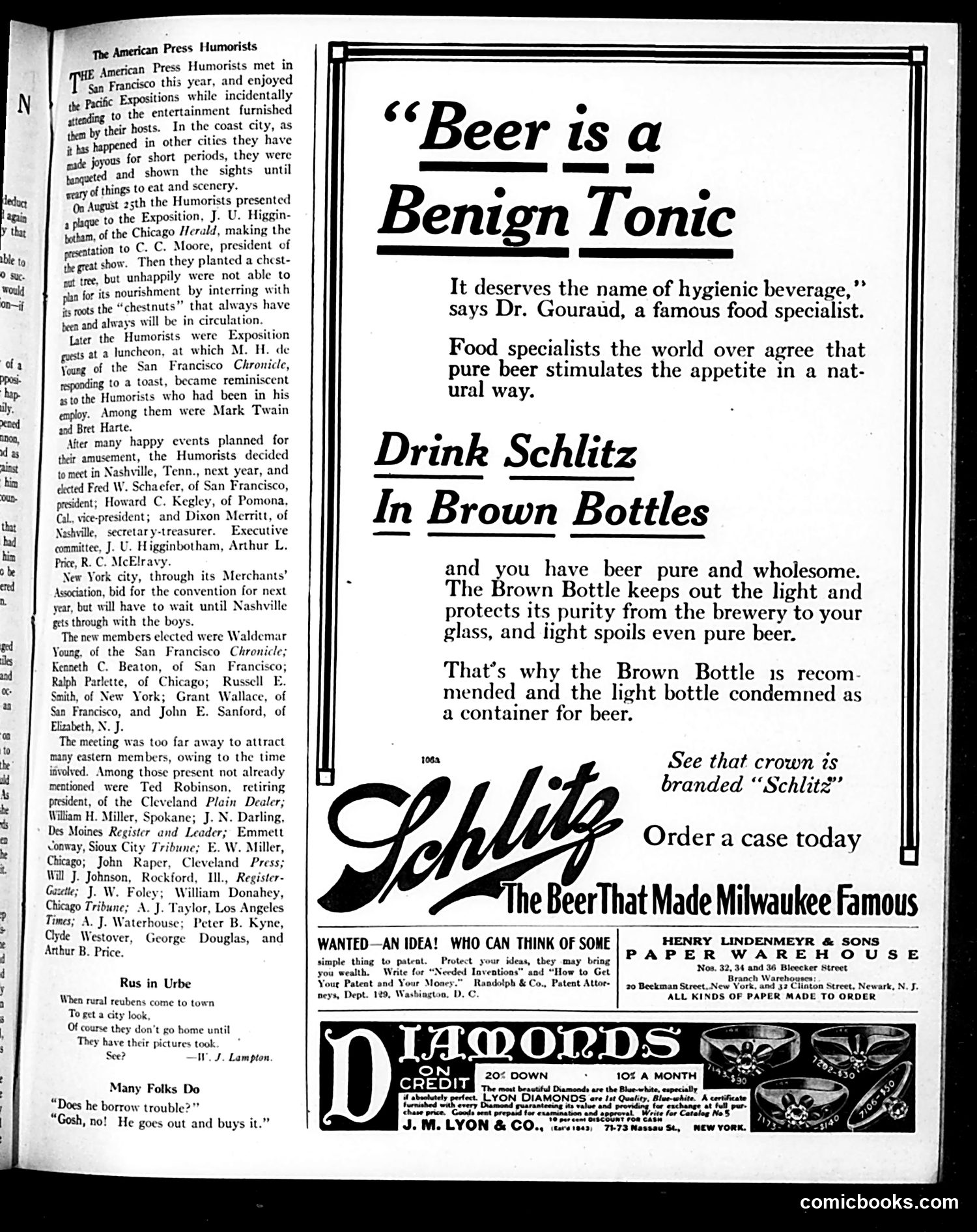
This page is primarily **advertising**, not satire or political commentary. The left column contains a straightforward news item about the American Press Humorists' convention in San Francisco, mentioning notable attendees like Mark Twain and Bret Harte. The dominant content is a **Schlitz beer advertisement** claiming beer is a "benign tonic" and "hygienic beverage" endorsed by "Dr. Gouraud, a famous food specialist." This reflects early 20th-century marketing that positioned beer as healthful—a common claim before modern health science and alcohol regulation. The ad emphasizes brown bottles protect beer from light damage. Below are smaller ads for patent services, diamonds, and a Henry Lindenmeyer & Sons paper warehouse. A brief humor item mentions rural visitors getting photographs taken in the city. **No political cartoon or satirical commentary is present.** The page demonstrates how magazines like *Judge* mixed humor content with commercial advertising.
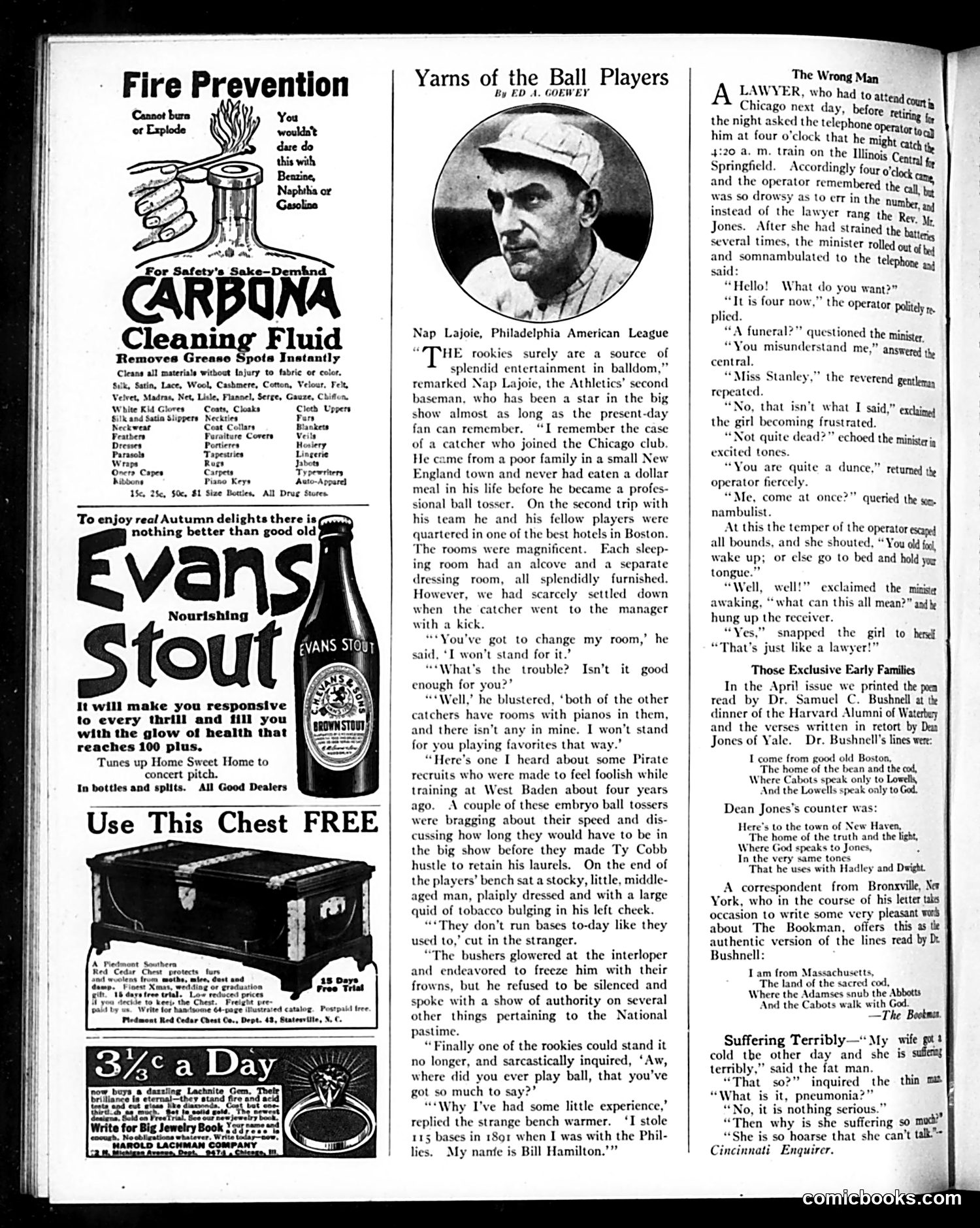
This page is primarily **advertising with one substantial feature article** — a baseball story by Ed A. Goewey about Nap Lajoie, a real Philadelphia Athletics player. The article recounts anecdotes about rookie baseball players and their naïveté. The main story involves arrogant young pitchers who boast about their speed, only to be humbled by an unassuming older man in shabby clothes watching from the bench. The punch line reveals he's **Bill Hamilton** (likely Billy Hamilton, a famous 19th-century player), who casually mentions stealing bases in 1891 with the Philadelphia Phillies—establishing his authority and deflating the rookies' ego. The humor targets **rookie cockiness and disrespect for baseball veterans**. The satire assumes readers know Hamilton's reputation, making his modest introduction and devastating comeback the joke's payoff. The page also contains advertisements for Carbona cleaning fluid, Evans Stout beer, and a cedar chest—typical period marketing.
This is a satirical story critiquing gender roles and domestic labor inequality in early 20th-century America. The narrative follows Mrs. Brown through an exhausting day: she wakes the entire family, prepares multiple breakfasts, finds lost items, manages children's clothing crises, does laundry, and cleans—while her husband and children rest or pursue their own activities. The satire peaks when a city directory man visits and lists "Robert Brown, carpenter" and "William Brown, clerk," but notes Mrs. Martha Brown has "no occupation"—despite her relentless work. The story exposes how women's unpaid domestic labor was systematically invisible and unvalued, even as they carried the family's entire operation. The title's irony is the point: everyone works except mother, who works constantly but receives no recognition or status.
This page is primarily **advertising and fiction** rather than political satire. The main content includes: **Featured Content:** - A book advertisement for Zane Grey's western novel "The Rainbow Trail" (sequel to "Riders of the Purple Sage"), emphasizing adventure and romance - Hotel Lenox advertisement for Buffalo accommodations - Multiple product ads (anti-snoring device, art school, cigars, Ford automobiles book) **Short Stories Section ("Stories with Smiles"):** Several humorous anecdotes about everyday situations: - A deaf farmer rejecting a hearing aid device - A hotel lobby conversation where deafness becomes advantageous (ironic twist) - A story about a mysterious dog named Rex - A fairy tale dialogue These are gentle, domestic humor pieces—the type of light entertainment common in early 20th-century magazines. There is **no political satire visible** on this page. The humor derives from misunderstandings, character quirks, and situational irony rather than social commentary.
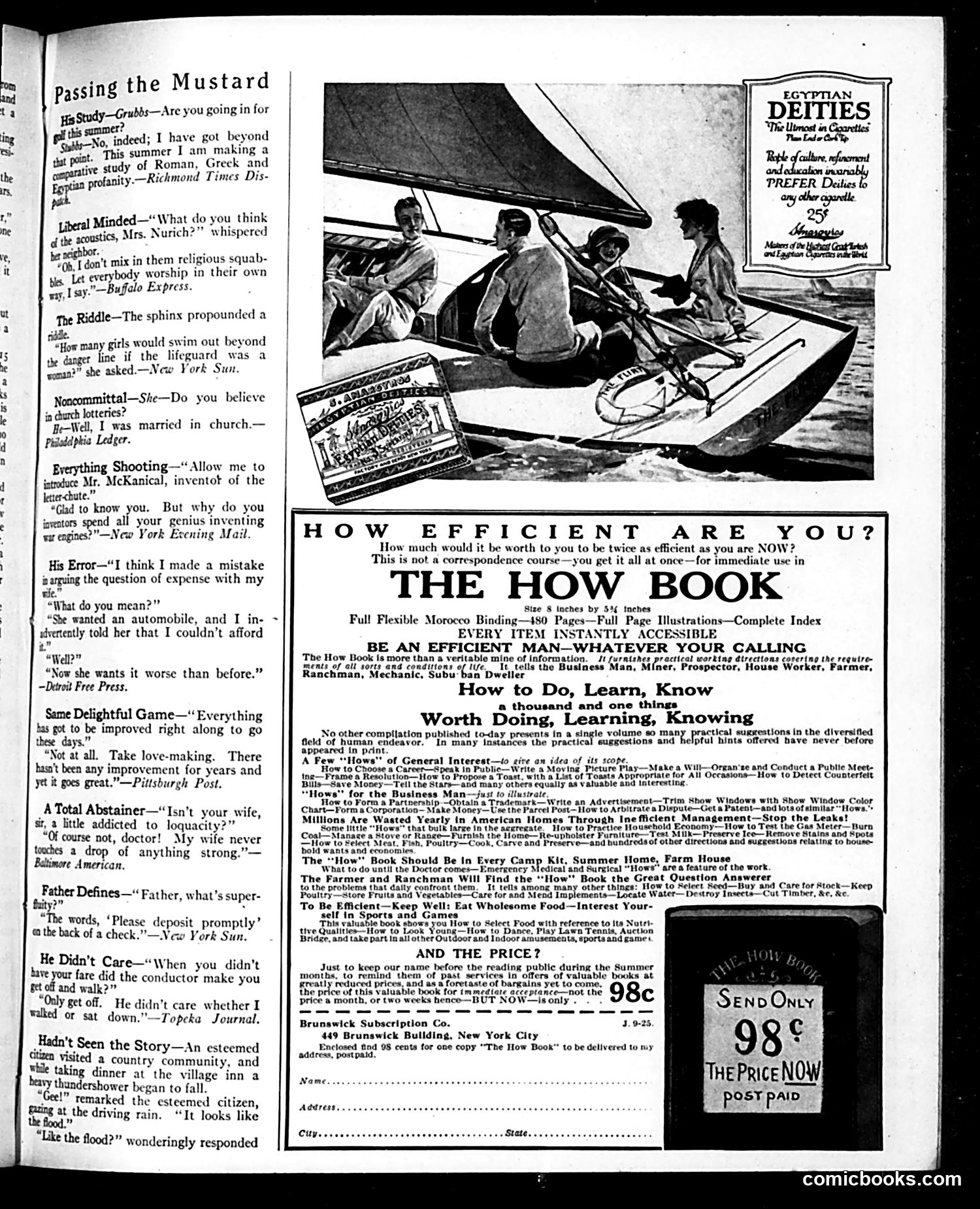
This page is primarily **advertising content** for "The How Book," a practical self-help guide promising efficiency tips across various life domains. The small text at left contains brief humor snippets typical of Judge magazine's satirical format. The cartoons visible include jokes about: - **Romance and courtship** (lifeguards, love-making needing no improvement) - **Marriage dynamics** (wives' spending habits, chattiness) - **Class/social commentary** (a visitor to a rural town confused by thunderstorms) These are genteel, domestic humor pieces reflecting early 20th-century magazine conventions—poking gentle fun at wives, efficiency, and social pretensions rather than sharp political satire. The boat scene with multiple passengers appears illustrative rather than specifically satirical. The page's true purpose is selling the advertised book for 98¢—substantial for the era—positioning it as a self-improvement manual for the ambitious reader wanting to become more "efficient" in business and life.
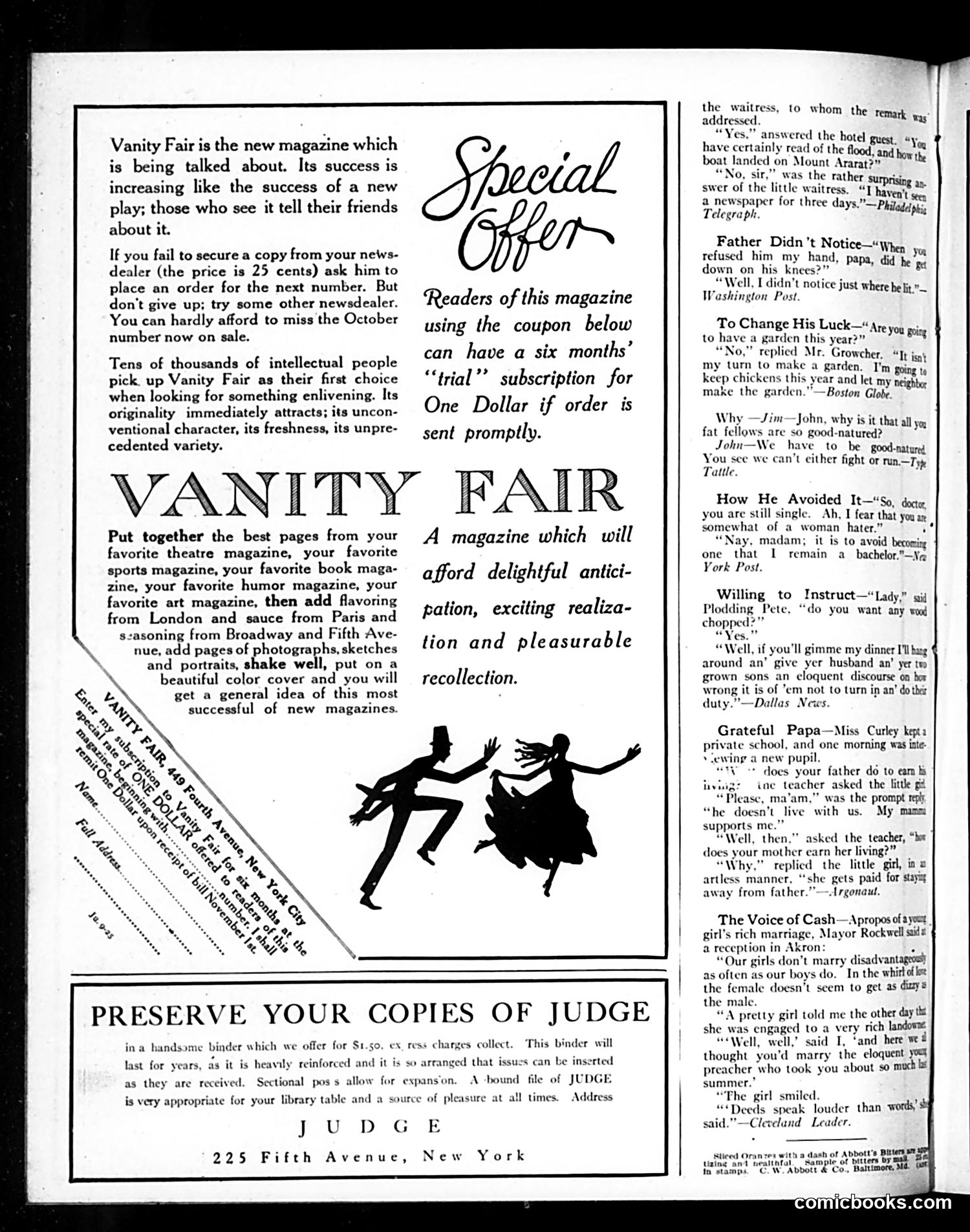
This page primarily advertises **Vanity Fair**, a new competing magazine, while promoting Judge's own subscription and preservation binder. The left side is an advertisement targeting "intellectual people" who want sophisticated content mixing theater, sports, humor, art, and international (London/Paris) flavoring. The right side contains brief **humorous anecdotes** typical of Judge's satirical humor—short jokes about domestic life, courtship, and social behavior. These include: - A waitress who hasn't read about a boat landing - A father unnoticed during a proposal rejection - A man avoiding bachelorhood by staying single - A laborer offering to lecture on marital duty - A child explaining his mother earns money by staying away from his father These jokes reflect early 20th-century American attitudes toward marriage, gender roles, and class differences, relying on wordplay and ironic observations about social conventions rather than visual caricature or political commentary.
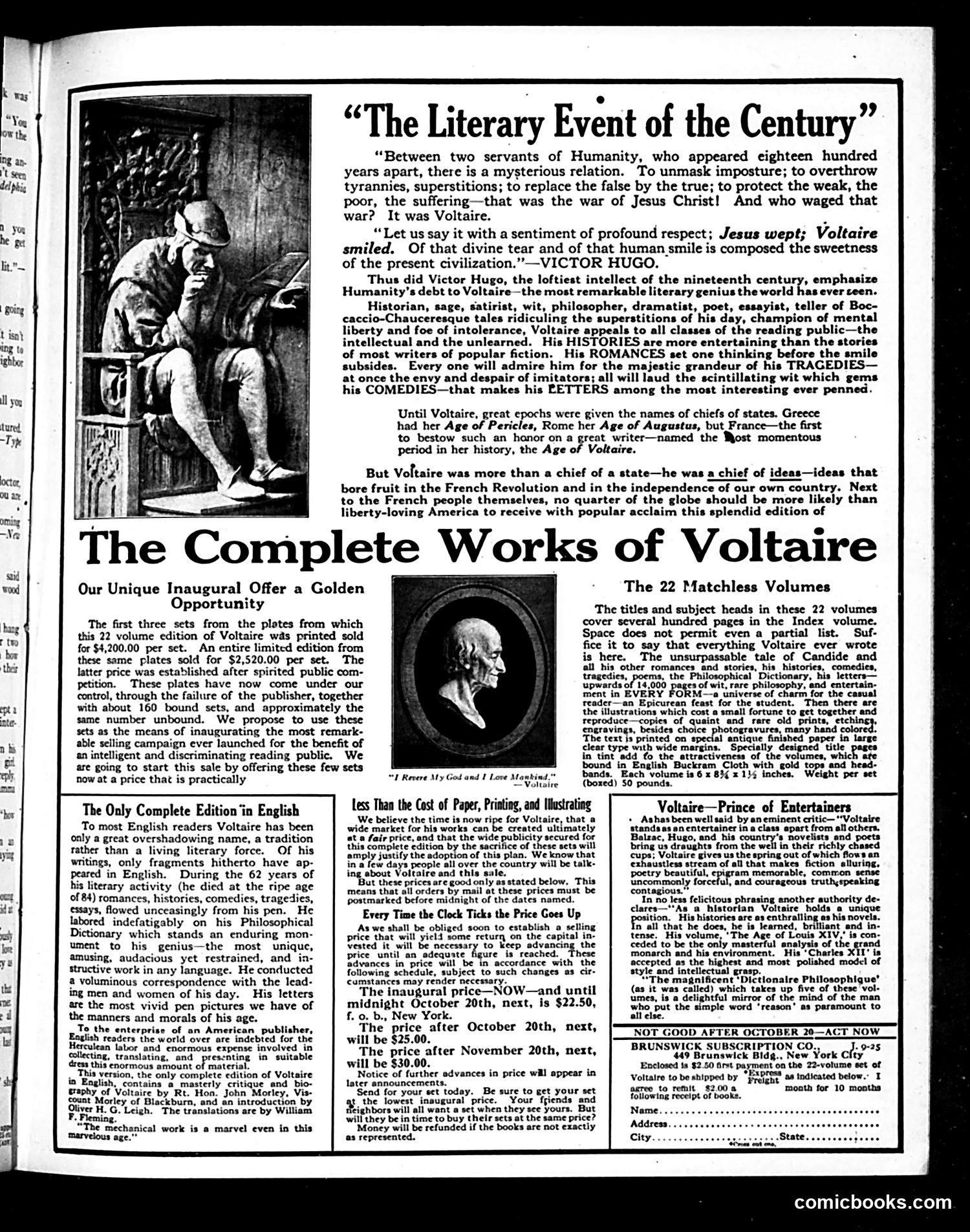
This is primarily a **full-page advertisement** for a complete works of Voltaire, not a political cartoon. The page uses Voltaire's reputation to market an expensive 22-volume set. The ad invokes **Victor Hugo's famous comparison** of Jesus Christ and Voltaire as "servants of Humanity," positioning Voltaire as an Enlightenment hero who challenged religious superstition and tyranny. This framing would resonate with American readers valuing intellectual freedom and anti-authoritarian ideals. The ad emphasizes that Voltaire's ideas "bore fruit in the French Revolution and in the independence of our own country," making him relevant to American identity. By calling this "The Literary Event of the Century," the publisher appeals to educated middle-class readers seeking cultural refinement. The illustration shows a **classical figure (likely Voltaire) writing at a desk**, reinforcing his intellectual authority. The bottom section announces a price-reduction offer, exploiting scarcity ("limited edition") and competitive bidding history to create urgency—a marketing tactic recognizable today.
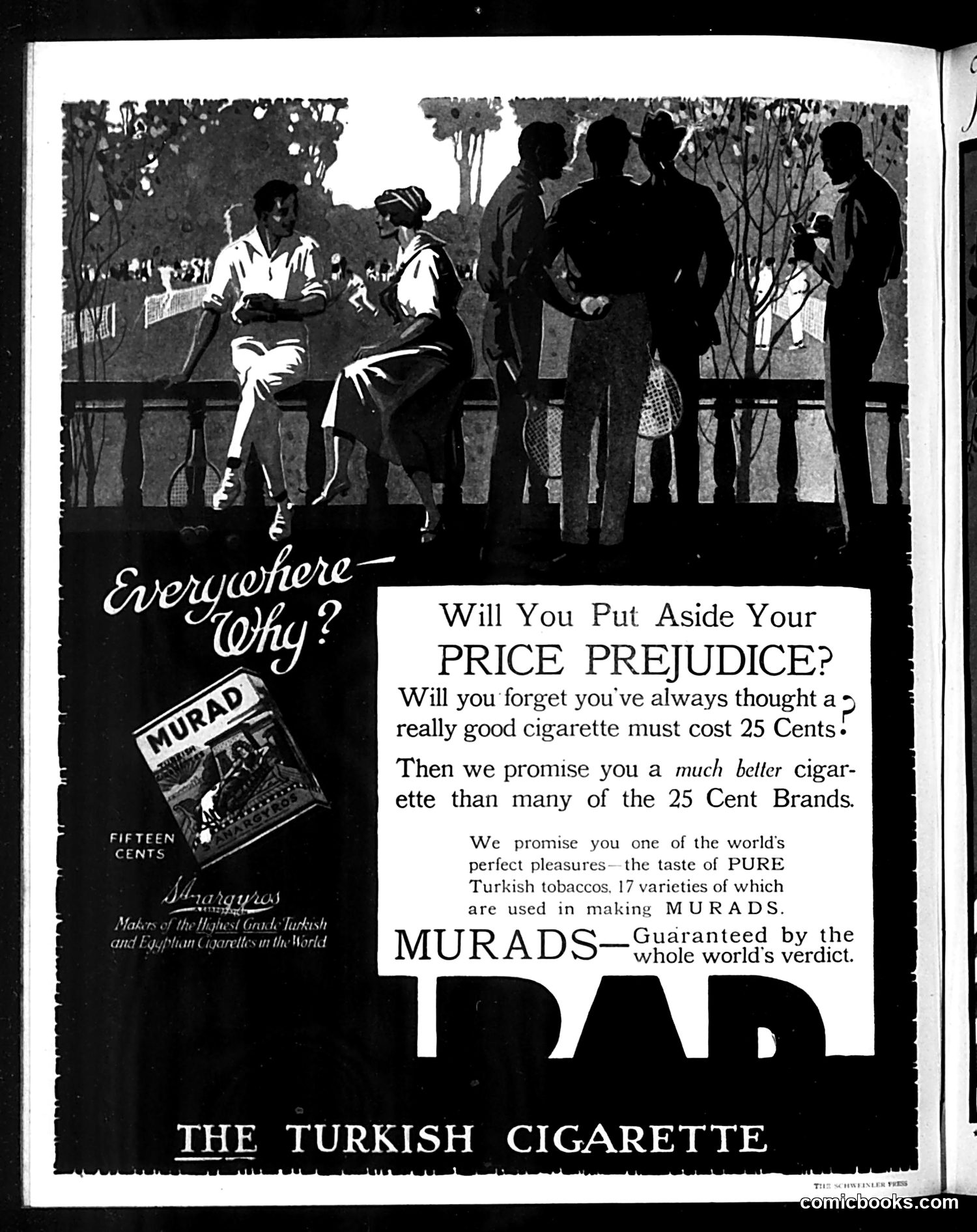
This page is primarily a **cigarette advertisement**, not political satire. It promotes Murad brand Turkish cigarettes at 15 cents—undercutting premium 25-cent competitors. The illustration shows people at what appears to be a social gathering, establishing aspirational lifestyle messaging. The ad's rhetorical strategy challenges consumer "price prejudice"—the assumption that higher cost equals better quality. Murad positions itself as offering superior tobacco (17 Turkish and Egyptian varieties) at a lower price point, appealing to value-conscious buyers who assumed quality required premium pricing. The phrase "Guaranteed by the whole world's verdict" suggests Murads' international reputation. This represents early-twentieth-century marketing targeting middle-class consumers during an era when Turkish tobacco was considered prestigious. The ad reflects no obvious political content—it's straightforward commercial persuasion through social aspiration and value proposition.