
Judge, 1915-09-25 · page 26 of 28
Judge — September 25, 1915 — page 26: what you’re looking at
What you’re looking at
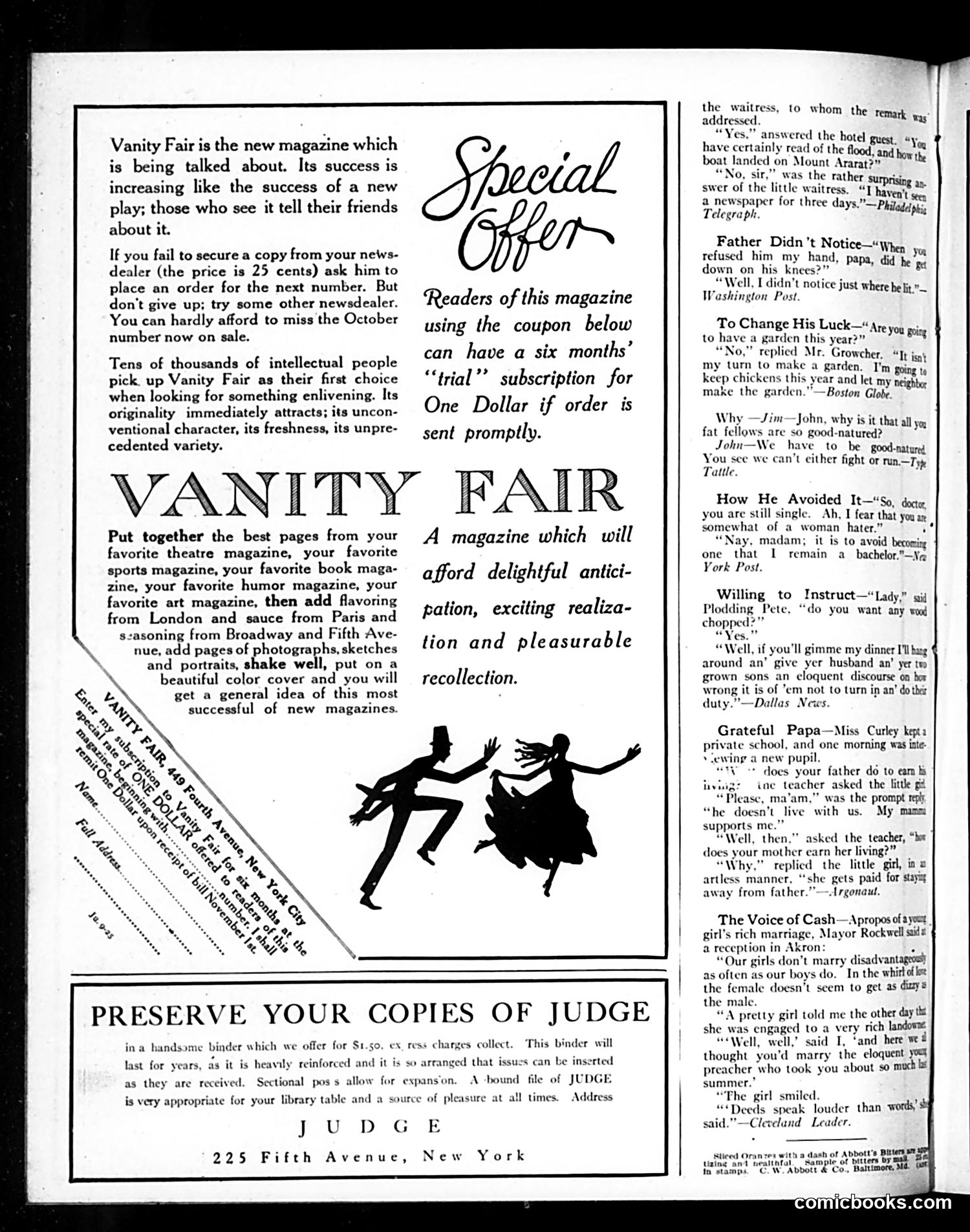
This page primarily advertises **Vanity Fair**, a new competing magazine, while promoting Judge's own subscription and preservation binder. The left side is an advertisement targeting "intellectual people" who want sophisticated content mixing theater, sports, humor, art, and international (London/Paris) flavoring. The right side contains brief **humorous anecdotes** typical of Judge's satirical humor—short jokes about domestic life, courtship, and social behavior. These include: - A waitress who hasn't read about a boat landing - A father unnoticed during a proposal rejection - A man avoiding bachelorhood by staying single - A laborer offering to lecture on marital duty - A child explaining his mother earns money by staying away from his father These jokes reflect early 20th-century American attitudes toward marriage, gender roles, and class differences, relying on wordplay and ironic observations about social conventions rather than visual caricature or political commentary.
📄 Transcribed text from this page (OCR, searchable)
Machine-transcribed from the original scan — historical spelling and the odd misread are preserved.
Vanity Fair is the new magazine which is being talked about. Its success is increasing like the success of a new play; those who see it tell their friends about it. If you fail to secure a copy from your news- dealer (the price is 25 cents) ask him to place an order for the next number. But don’t give up; try some other newsdealer. You can hardly afford to miss the October number now on sale. Tens of thousands of intellectual people pick up Vanity Fair as their first choice when looking for something enlivening. Its originality immediately attracts; its uncon- ventional character, its freshness, its unpre- cedented variety. Readers of this magazine using the coupon below can have a six months’ “trial”? subscription for One Dollar if order is sent promptly. VANITY FAIR Put together the best pages from your favorite theatre magazine, your favorite sports magazine, your favorite book maga- zine, your favorite humor magazine, your favorite art magazine, then add flavoring from London and sauce from Paris and s:asoning from Broadway and Fifth Ave- nue, add pages of photographs, sketches and portraits, shake well, put on a beautiful color cover and you will get a general idea of this most successful of new magazines. A magazine which will afford delightful antici- pation, exciting realiza- tion and pleasurable recollection. PRESERVE YOUR COPIES OF JUDGE ina handsome binder which we offer for $1.50, ex, ress charges collect. This binder will last for years as they are received. Sectional pos s allow f it is heavily reinforced and it is so arranged that issues can be inserted expans’on. A -bound file of JUDGE is very appropriate for your library table and a source of pleasure at all times. Address J UDG 225 Fifth Avenue, E New York e waitress, to whom the d Temark was nswered the hotel Ruest, “y, ainly read of the fl how boat landed on Mount Aracsciot PO te “No, sir," was the rather surprsin swer of the little waitress. “T havea a newspaper for three days.” pangs Telegraph. 7 remaed i Father Didn 't Notice—“When yo refused him my hand, papa, did ben” down on his Knees?” ” Pontnupe 6 “Well, I didn’t notice just w » Washington Post. WB belt” To Change His Luck—«4, ‘ toh garden this year?” 8 “ replied Mr. Growcher, “It isnt my turn to make a garden. I'm Roi, a keep chickens this year and let my neggtc make the garden.”"—Boston Globe Why —Jim—John, why is i tal tho ee. coo neta John—We have to be good-natured You see we can’t either fight or Tun.—Typ Tattle. se How He Avoided It—“So, doce you are still single. Ah, I fear that you ax somewhat of a woman hater,” oy “Nay, madam; it is to avoid becoming one that I remain a_ bachelor.”—Ve York Post. Willing to Instruct—“Lady,” sii Plodding Pete, “do you want any wood chopped?” “Well, if you'll gimme my dinner I'll bag around an’ give yer husband an’ yer tw grown sons an cloquent discourse on bor wrong it is of em not to turn in an’ do ther duty.”"—Dallas News. Grateful Papa—Miss Curley kepta private school, and one morning was inte- ing a new pupil. * does your father do to eam bs cher asked the little ga was the prompt rep, ith us. My mamm supports me. “Well, then,” asked the teacher, “be does your mother earn her living?” “Why,” replied the litte girl, in 2 or, ‘she gets paid for stayay y from father.” —Argonaut. The Voice of Cash—A propos of ayout girl’s rich marriage, Mayor Rockwell sid# a reception in Akron: 3 “Our girls don’t marry disadvantageos} as often as our boys do. In the whirl oflet the female doesn't seem to get as dizy® the male. “A pretty girl told me the other day tht she was engaged to a very rich la e “Well, well,’ said I, ‘and here wee thought you'd marry the eloquent you preacher who took you about so much summer.” he girl smiled. : Deeds speak louder than words said.”"—Cleveland Leader.