
Judge, 1915-09-25 · page 9 of 28
Judge — September 25, 1915 — page 9: what you’re looking at
What you’re looking at
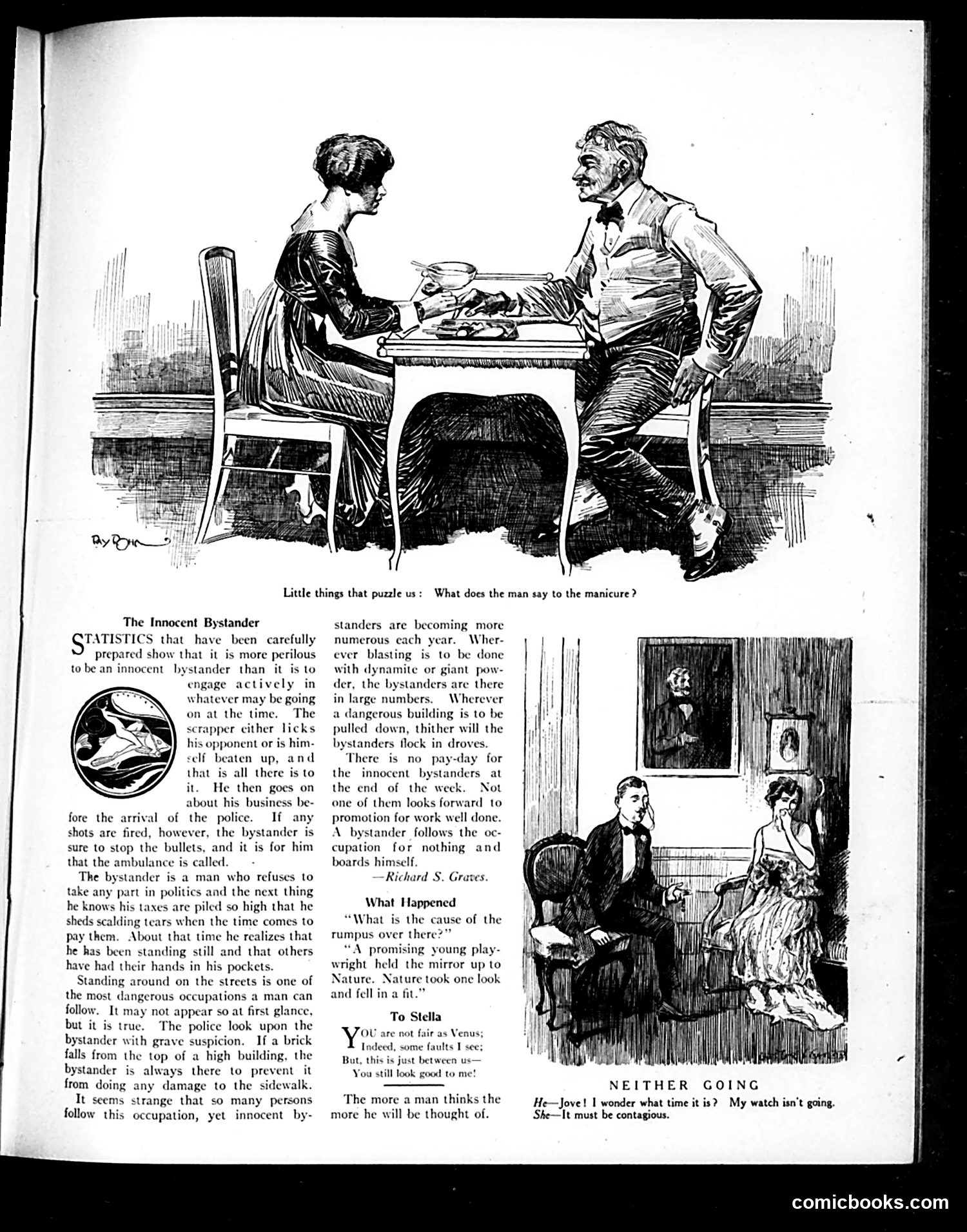
This page contains satirical commentary typical of early 20th-century Judge magazine. The main article, "The Innocent Bystander" by Richard S. Graves, mocks the paradox that uninvolved citizens suffer disproportionately in dangerous situations—caught in crossfire, hit by falling debris, or struck by dynamite blasts—while active participants escape relatively unscathed. The piece extends this to politics, suggesting that those who avoid political engagement still suffer through taxation. The cartoon at top illustrates this concept: a woman receives a manicure while a man sits across from her, likely representing the "innocent bystander" trapped in an uncomfortable social situation. The remaining items are light humor: brief jokes about a playwright, romantic verse, and a pun about a broken watch ("contagious"). The satire targets society's absurd risks and the futility of attempting neutrality in civic life.
📄 Transcribed text from this page (OCR, searchable)
Machine-transcribed from the original scan — historical spelling and the odd misread are preserved.
The Innocent Bystander TATISTICS that have been carefully prepared show that it is more perilous tobe an innocent bystander than it is to engage actively in whatever may be going on at the time. The scrapper either licks his opponent or is him- self beaten up, and that is all there is to it. He then goes on about his business be- fore the arrival of the polic If any shots are fired, however, the bystander is sure to stop the bullets, and it is for him that the ambulance is called. The bystander is a man who refuses to take any part in politics and the next thing he knows his taxes are piled so high that he sheds scalding tears when the time comes to pay them. About that time he realizes that he has been standing still and that others have had their hands in his pocket Standing around on the streets is one of the most dangerous occupations a man can follow. It may not appear so at first glance, but it is true. The police look upon the bystander with grave suspicion. If a brick falls from the top of a high building, the bystander is always there to prevent it from doing any damage to the sidewalk. Tt seems strange that so many persons follow this occupation, yet innocent by- Little things that puzzle us : standers are becoming more numerous each year. Wher- ever blasting is to be done with dynamite or giant pow- der, the bystanders are there in large numbers. Wherever a dangerous building is to be pulled down, thither will the bystanders flock in droves. There is no pay-day for the innocent bystanders at the end of the week. Not one of them looks forward to promotion for work well done. A bystander follows the oc- cupation for nothing and boards himself. Richard S. Graves. What Happened “What is the se of the Tumpus over there?” “A. promising young play- wright held the mirror up to Nature. Nature took one look and fell ina fit.” To Stella Y: DU are not fair as Venus; Inc ome faults I see; But, this is just between us— You still look good to me! The more a man thinks the more he will be thought of. What does the man say to the manicure ? NEITHER GOING He—Jove! | wonder what time it is? My watch isn’t going. She—It must be contagious. comicbooks.com