
Judge, 1915-09-25 · page 4 of 28
Judge — September 25, 1915 — page 4: what you’re looking at
What you’re looking at
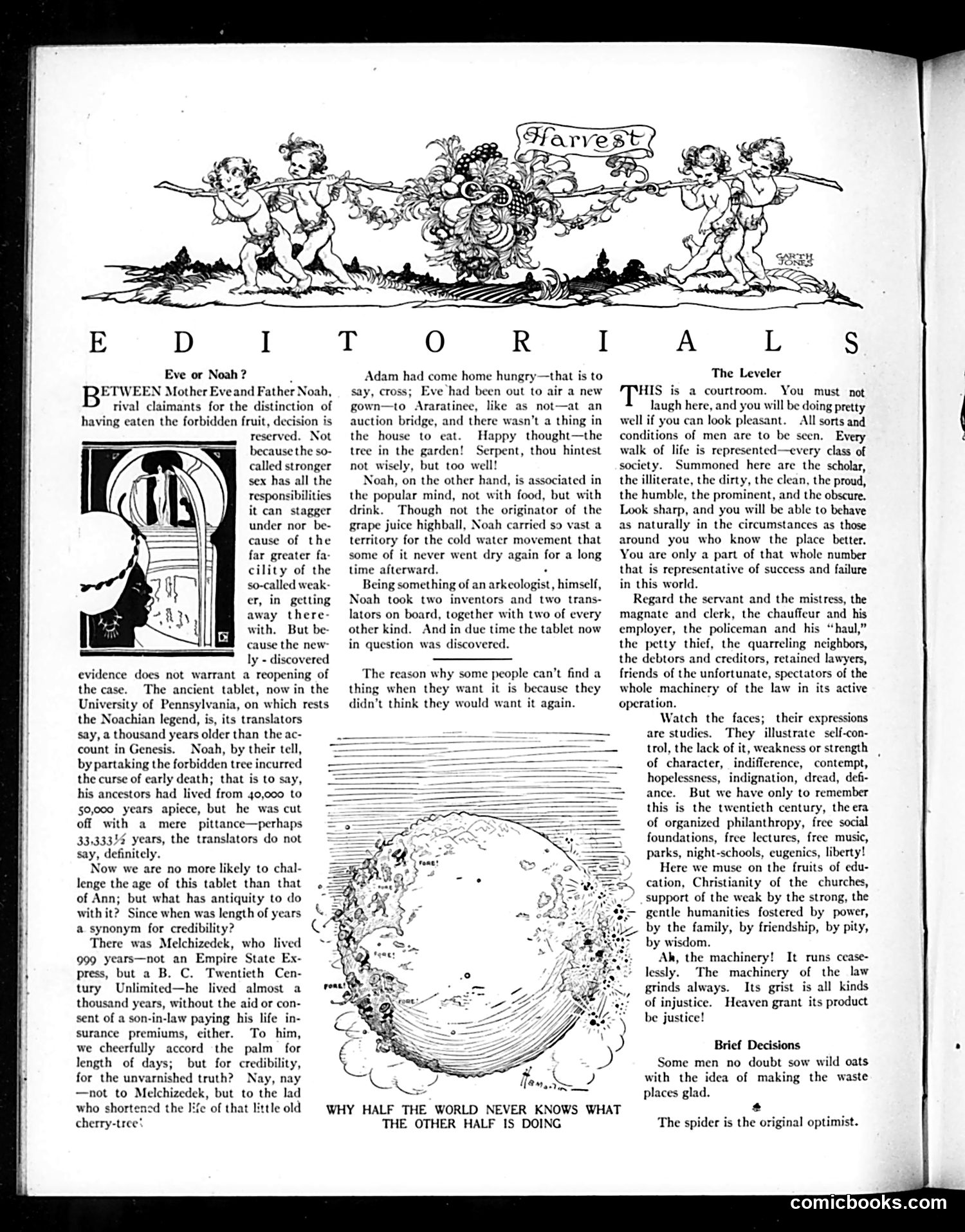
This page from *Judge* magazine contains three distinct sections: **Left column**: A debate about whether Eve or Noah caused humanity's fall, using the forbidden fruit and the flood as theological reference points. The satire critiques how people selectively blame figures to suit their arguments. **Center**: An illustration titled "Why Half the World Never Knows What the Other Half is Doing"—likely satirizing the gap between wealthy and poor classes, or perhaps the information divide between different social spheres during this era. **Right column ("The Leveler")**: Social commentary on courtroom conduct and class distinctions, advocating that all social classes should be treated equally in legal proceedings—reflecting Progressive Era concerns about justice and equality. The page emphasizes social observation and critique rather than partisan politics.
📄 Transcribed text from this page (OCR, searchable)
Machine-transcribed from the original scan — historical spelling and the odd misread are preserved.
Eve or Noah ? ¥ ETWEEN Mother Eveand Father Noah, rival claimants for the distinction of having eaten the forbidden fruit, decision is reserved. Not because the so- called stronger sex has all the responsibilities it can stagger under nor be- cause of the far greater fa- cility of the so-called weak- er, in getting away there- with. But be- cause the new- ly - discovered evidence does not warrant a reopening of the case. The ancient tablet, now in the University of Pennsylvania, on which rests the Noachian legend, is, its translators say, a thousand years older than the ac- count in Genesis. Noah, by their tell, by partaking the forbidden tree incurred the curse of early death; that is to say, his ancestors had lived from 40,000 to 50,000 years apiece, but he was cut off with a mere pittance—perhaps 33,333!4 years, the translators do not say, definitely. Now we are no more likely to chal- lenge the age of this tablet than that of Ann; but what has antiquity to do with it? Since when was length of years a synonym for credibility? There was Melchizedek, who lived 999 years—not an Empire State Ex- press, but a B. C. Twentieth Cen- tury Unlimited—he lived almost a thousand years, without the aid or con- sent of a son-in-law paying his life in- surance premiums, either. To him, we cheerfully accord the palm for length of days; but for credibility, for the unvarnished truth? Nay, nay —not to Melchizedek, but to the lad who shortened the Jife of that little old cherry-tree WG HRI pe aa Adam had come home hungry—that is to say, cross; Eve had been out to air a new gown—to Araratinee, like as not—at an auction bridge, and there wasn’t a thing in the house to eat. Happy thought—the tree in the garden! Serpent, thou hintest not wisely, but too well! Noah, on the other hand, is associated in the popular mind, not with food, but with drink. Though not the originator of the grape juice highball, Noah carried so vast a territory for the cold water movement that some of it never went dry again for a long time afterward. . Being something of an arkcologist, himself, Noah took two inventors and two trans- lators on board, together with two of every other kind. And in due time the tablet now in question was discovered. The reason why some people can’t find a thing when they want it is because they didn’t think they would want it again. The Leveler HIS is a courtroom. You must not laugh here, and you will be doing pretty well if you can look pleasant. All sorts and conditions of men are to be seen. Every walk of life is represented—every class of society. Summoned here are the scholar, the illiterate, the dirty, the clean, the proud, the humble, the prominent, and the obscure. Look sharp, and you will be able to behave as naturally in the circumstances as those around you who know the place better. You are only a part of that whole number that is representative of success and failure in this world. Regard the servant and the mistress, the magnate and clerk, the chauffeur and his employer, the policeman and his “haul,” the petty thief, the quarreling neighbors, the debtors and creditors, retained lawyers, friends of the unfortunate, spectators of the whole machinery of the law in its active operation. Watch the faces; their expressions are studies. They illustrate self-con- trol, the lack of it, weakness or strength of character, indifference, contempt, hopelessness, indignation, dread, defi- fh ms. a, THE OTHER HALF IS DOING ance. But we have only to remember this is the twentieth century, the era of organized philanthropy, free social foundations, free lectures, free music, parks, night-schools, eugenics, liberty! Here we muse on the fruits of edu- cation, Christianity of the churches, support of the weak by the strong, the gentle humanities fostered by power, by the family, by friendship, by pity, by wisdom. Ah, the machinery! It runs cease- lessly. The machinery of the law grinds always. Its grist is all kinds of injustice. Heaven grant its product be justice! Brief Decisions Some men no doubt sow wild oats with the idea of making the waste places glad. WHY HALF THE WORLD NEVER KNOWS WHAT ¢ The spider is the original optimist. comicbooks.com