
Judge, 1915-09-25 · page 12 of 28
Judge — September 25, 1915 — page 12: what you’re looking at
What you’re looking at
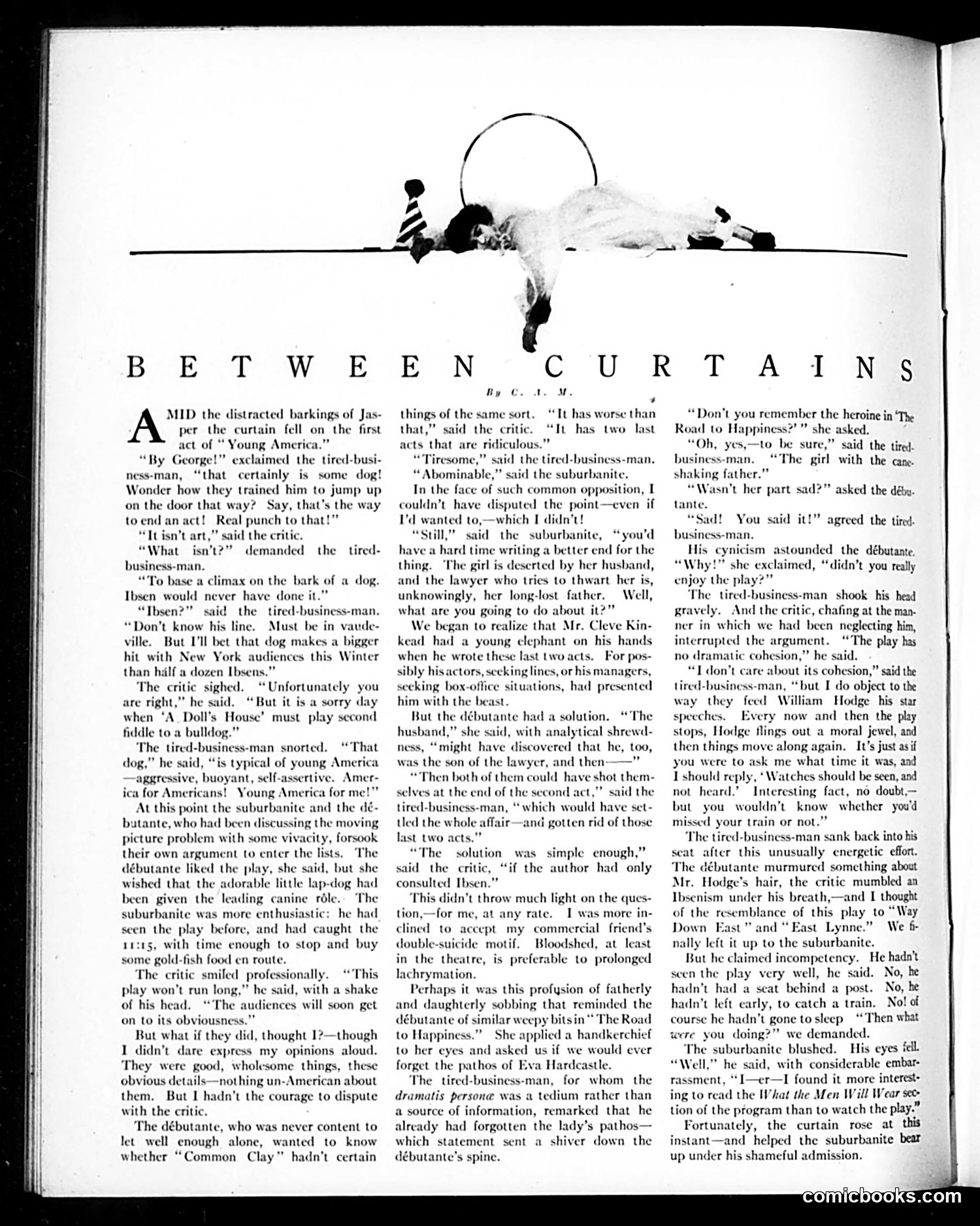
This page presents a theatrical debate following a performance of "Young America," a play apparently featuring a dog as a dramatic device. The cartoon (top) shows the dog and theatrical props. The satire contrasts cultural perspectives: a tired businessman enjoys the entertainment and praises American vigor; a pretentious critic dismisses it as artistically base, invoking Henrik Ibsen as the standard of serious drama. A débutante and suburbanite join the discussion. The joke targets intellectual snobbery: the critic's invocation of Ibsen (representing "serious" European theater) clashes with popular American audiences' preferences for accessible entertainment. The tired businessman's boast that the dog will "make a bigger hit...than half a dozen Ibsens" captures the satire's central point—mocking critics who prioritize artistic purity over what audiences actually enjoy. The discussion of plot absurdities (the lawyer being the girl's lost father) further ridicules theatrical melodrama, while the critic remains humorlessly superior throughout.
📄 Transcribed text from this page (OCR, searchable)
Machine-transcribed from the original scan — historical spelling and the odd misread are preserved.
11D the distracted barkings of Jas- BOE TW E per the curtain fell on the first A act of “ Young Americ By George!” exclaimed the tired-busi- ness-man, “that certainly is some dog! Wonder how they trained him to jump up on the door that way? Say, that's the way to end an act! Real punch to that!” “Ttisn’t art,” said the c “What isn’t?” demanded business-man. ‘o base a climax on the bark of a dog. Ibsen would never have done it.” “Tbsen?” said the tired-business-man. “Don’t know his line. Must be in vaude- ville. But [ll bet that dog makes a bigger hit with New York audiences this Winter than half a dozen [bsens.”” The critic sighed. “Unfortunately you are right,” he said. “But it is a sorry day when ‘A Doll's House’ must play second fiddle to a bulldog.” he tired-business-man snorted. “That he said, “is typical of young America agressive, buoyant, self-assertive. Amer: ica for Americans! Young America for me At this point the suburbanite and the dé- butante, who had been discussing the moving picture problem with some ity, forsook their own argument to enter the lists, The débutante liked the play, she said, but she wished that the adorable little lap-dog had been given the leading canine réle. The suburbanite was more enthusiastic: he had seen the play before, and had caught the un with time enough to stop and buy some gold-fish food en route. The critic smiled professionally. “This play won't run long,” he said, with a shake of his head. “The audiences will soon get ‘on to its obviousness.” But what if they did, thought 1?—though I didn’t dare express my opinions aloud. They were good, wholesome things, these obvious details—nothing un-American about them. But I hadn’t the courage to dispute with the critic The débutante, who was never content to let well enough alone, nted to know whether “Common Clay” hadn't certain the tired- E N things of the same sort. that,” said the critic. acts that are ridiculous Tiresome,” said the tired-business-man, “Abominable,” said the suburbanite. In the face of such common opposition, I couldn’t have disputed the point—even if I'd wanted to,—which I didn’t! Still,” said the suburbanite, “you'd have a hard time writing a better end for the thing. The girl is deserted by her husband, and the lawyer who tries to thwart her is, unknowingly, her long-lost fathe! Well, what are you going to do about it?” We began to realize that Mr. Cleve Kin- kead had a young elephant on his hands when he wrote these last two acts. For pos- sibly his actors, seeking lines, or his managers, seeking box-office situations, had presented him with the beast. But the débutante had a solution. “The husband,” she said, with analytical shrewd- ness, “might have discovered that he, too, was the son of the lawyer, and then——"" “Then both of them could have shot them- selves at the end of the second act,” said the tired-business-man, “which would have set- tled the whole affair—and gotten rid of those last two acts.”” “The — solution ” ’ “Tt has worse than “Tt has two last was simple enough,” said the critic, “if the author had only consulted [bse This didn’t throw much light on the ques- tion,—for me, at any rate. I was more in- clined to accept my commercial friend's double-suicide motif. Bloodshed, at least in the theatre, is preferable to prolonged lachrymation. Perhaps it was this profysion of fatherly and daughterly sobbing that reminded the débutante of similar weepy bitsin “ The Road to Happiness.” She applied a handkerchief to her eyes and asked us if we would ever forget the pathos of Eva Hardcastle. The tired-business-man, for whom the dramatis persone was a tedium rather than a source of information, remarked that he already had forgotten the lady’s pathos— ement sent a shiver down the débutante’s spine. C U RT ATTN S “Don't you remember the heroine in ‘The Road to Happiness?’ ” she asked, “Oh, yes,—to be sure,” said the tired- business-man. “The girl with the cane. shaking father. Wasn't her part sad?” asked the déby- tante. ad! You said it!” agreed the tired. business-man. His cynicism astounded the débutante. “Why!” she exclaimed, “didn’t you really enjoy the play?” The tired-business-man shook his head gravely. And the critic, chafing at the man- ner in which we had been neglecting him, interrupted the argument. “The play has no dramatic cohesion,” he said. “I don’t care about its cohesion,” said the tired-business-man, “but I do object to the way they feed William Hodge his star speeches. Every now and then the ply stops, Hodge flings out a moral jewel, and then things move along It’s just as if you were to ask me what time it was, and 1 should reply, ‘ Watches should be seen, and not heard.’ Interesting fact, no doubt but you wouldn't know whether you'd missed your train or not.” The tired-business-man sank back into his after this unusually energetic effort. ‘butante murmured something about Mr. Hodge’s hair, the critic mumbled an Ibsenism under his breath nd I thought of the resemblance of this play to “Way Down East” and “East Lynne.” We f- nally left it up to the suburbanite. But he claimed incompetency. He hadn't seen the play very well, he said. No, he hadn’t had a seat behind a post. hadn't left early, to catch a train. course he hadn't gone to sleep “Then what were you doing?” we demanded. The suburbanite blushed. His eyes fell. “Well,” he said, with considerable embar- rassment, “I—er—I found it more interest- ing to read the What the Men Will Wear sec tion of the program than to watch the play.” Fortunately, the curtain rose at this instant—and helped the suburbanite bear up under his shameful admission.