
A complete issue · 28 pages · 1915
Judge — September 18, 1915
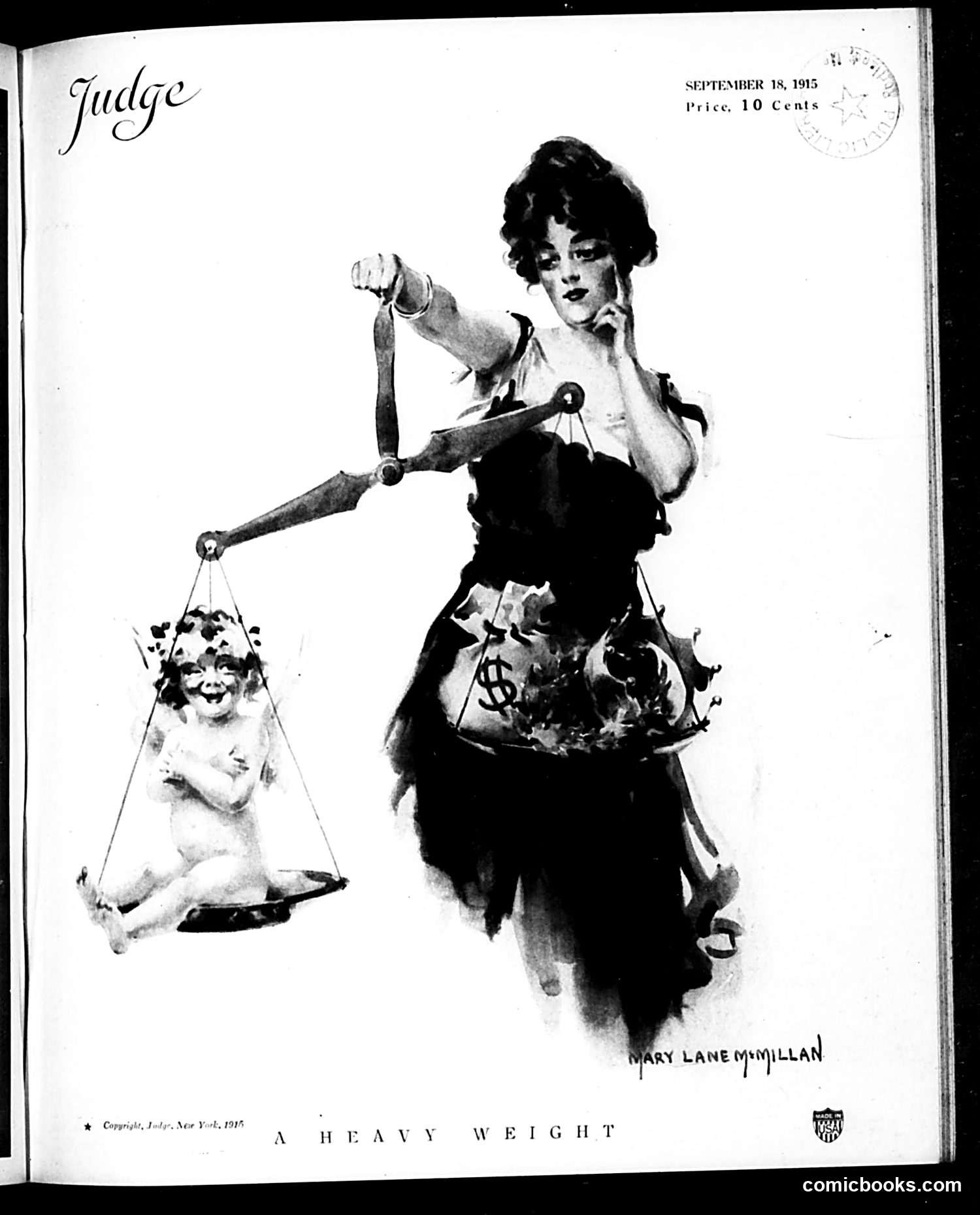
This illustration by Mary Lane McMillan depicts a woman holding a balance scale. On one side hangs a cherubic baby or cupid figure marked with a dollar sign ($). On the other side sits a money bag, also marked with a dollar sign. The cartoon satirizes the financial burden of motherhood and childcare costs in early 20th-century America. The title "A Heavy Weight" suggests that raising children—represented by the baby—carries equivalent weight to actual monetary expense. This likely comments on the economic pressures facing families, particularly women responsible for child-rearing, during a period of rapid industrialization and changing family economics. The satire critiques the commodification of parenthood.
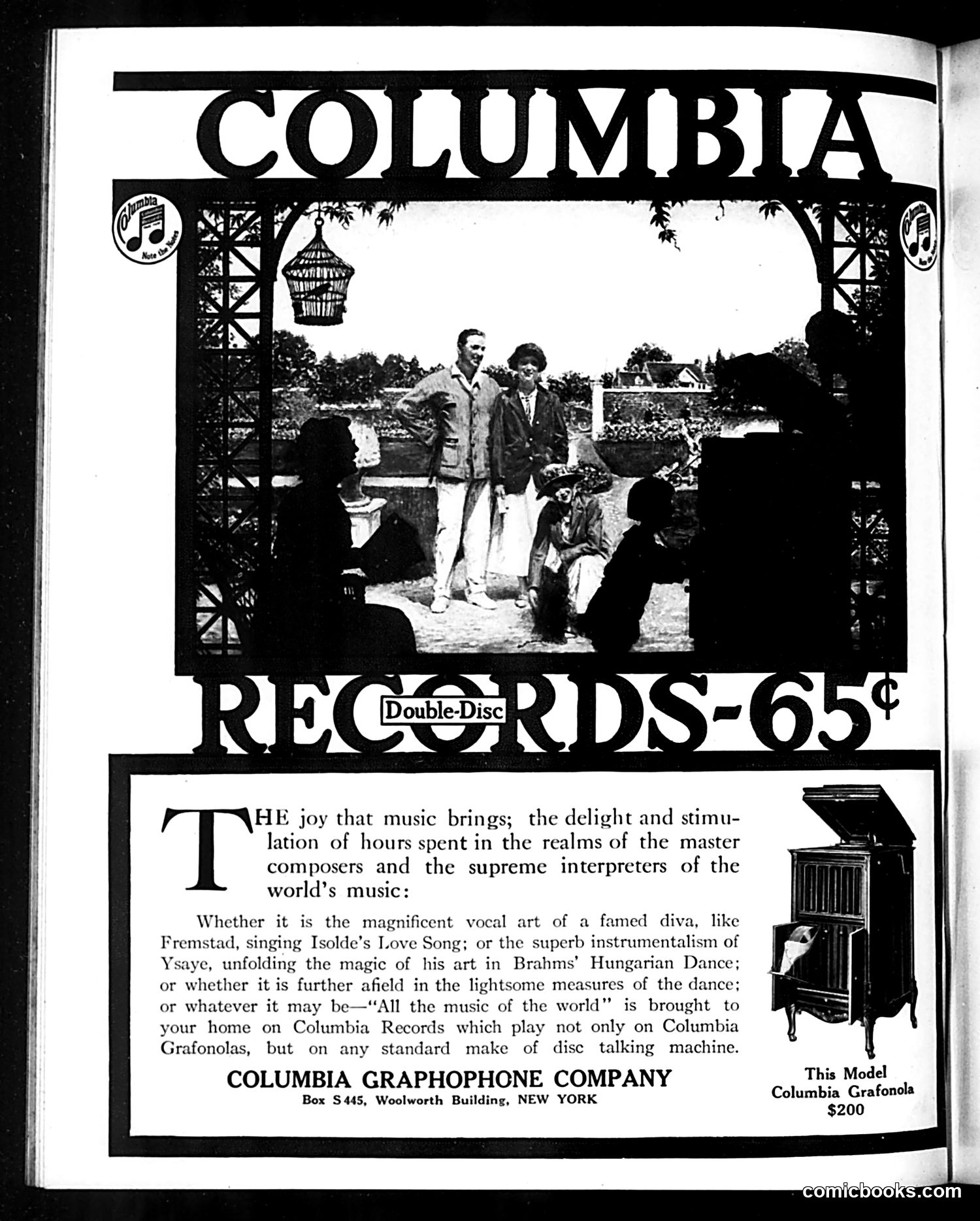
This is primarily a **Columbia Records advertisement**, not a political cartoon. The page advertises Columbia's "Double-Disc Records" priced at 65 cents, featuring their gramophone player model ($200). The central image shows what appears to be a **garden party or social gathering** with well-dressed figures, likely meant to evoke refined cultural settings. The ad text emphasizes that Columbia records play music by "famed diva" Fremstad and references Brahms' Hungarian Dance, appealing to listeners of classical music and opera. The tagline promises that "All the music of the world" is available on Columbia Records, which work on any standard phonograph—a competitive claim positioning Columbia against other manufacturers. This reflects the early 20th-century gramophone market's expansion into middle-class homes.
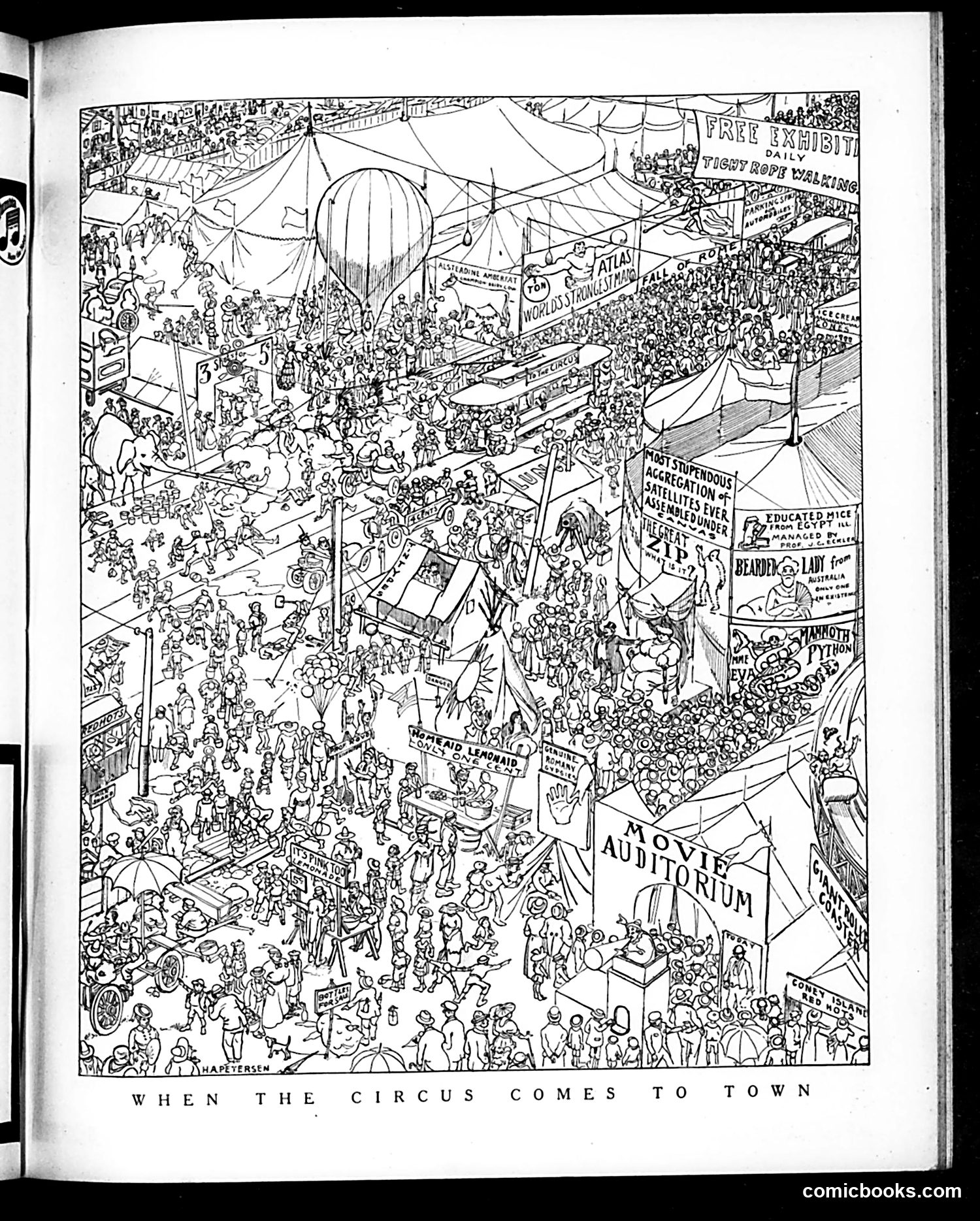
This is a densely packed satirical illustration depicting a circus grounds filled with numerous attractions and crowds. The detailed scene shows multiple tents, a hot air balloon, and various circus acts. Visible text references include "Free Exhibit," "World's Strangest Atlas," "Educated Mice," "Mammoth Python," and "Movie Auditorium," among other attractions. The cartoon satirizes the chaotic excitement and sensationalism surrounding circus arrivals in American towns. The crowded composition suggests how circuses captivated public attention across all social classes, drawing enormous audiences. The multiple sideshows and "freak" exhibitions reference the era's popular circus culture, where exotic animals, oddities, and novelty acts were primary attractions. The title captures the disruptive, carnival-like atmosphere such events generated in communities.
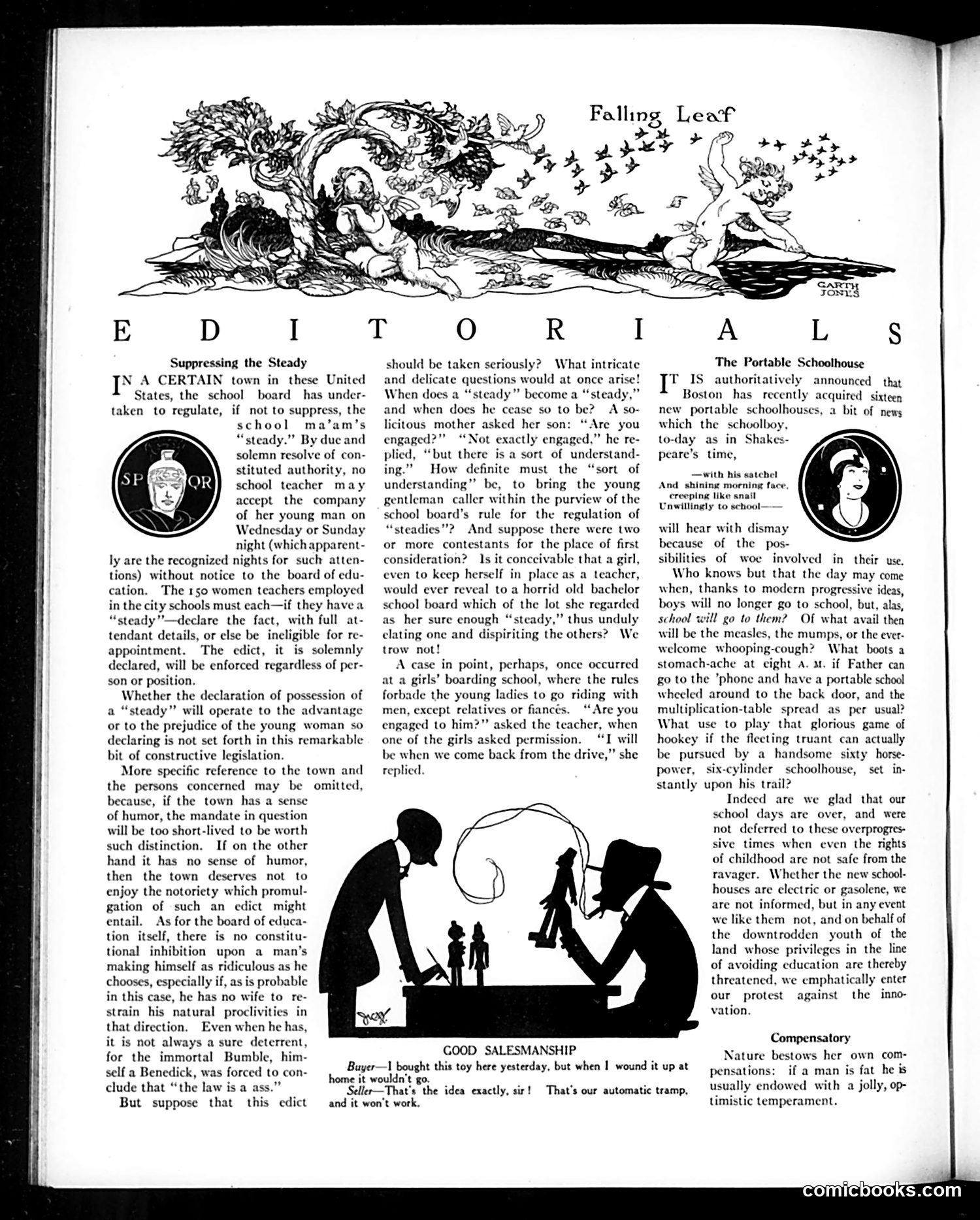
This *Judge* magazine page contains three distinct sections: **"Suppressing the Steady"** (left column): An editorial arguing against school boards regulating whether students can date or "go steady." The writer contends such rules are overreach and unenforceable, comparing them to ridiculous historical laws. **"The Portable Schoolhouse"** (right column): A humorous piece about Boston acquiring portable schoolhouses, satirizing their impracticality and questioning whether modern conveniences (telephones, mechanical furniture) can actually improve education. **"Good Salesmanship"** (bottom cartoon): A silhouetted scene showing a toy salesman explaining that an automatic toy won't work—the joke being the salesman's own defective merchandise undermines his credibility. All three pieces use satire to critique bureaucratic overreach, technological blind spots, and commercial dishonesty in early 20th-century American life.
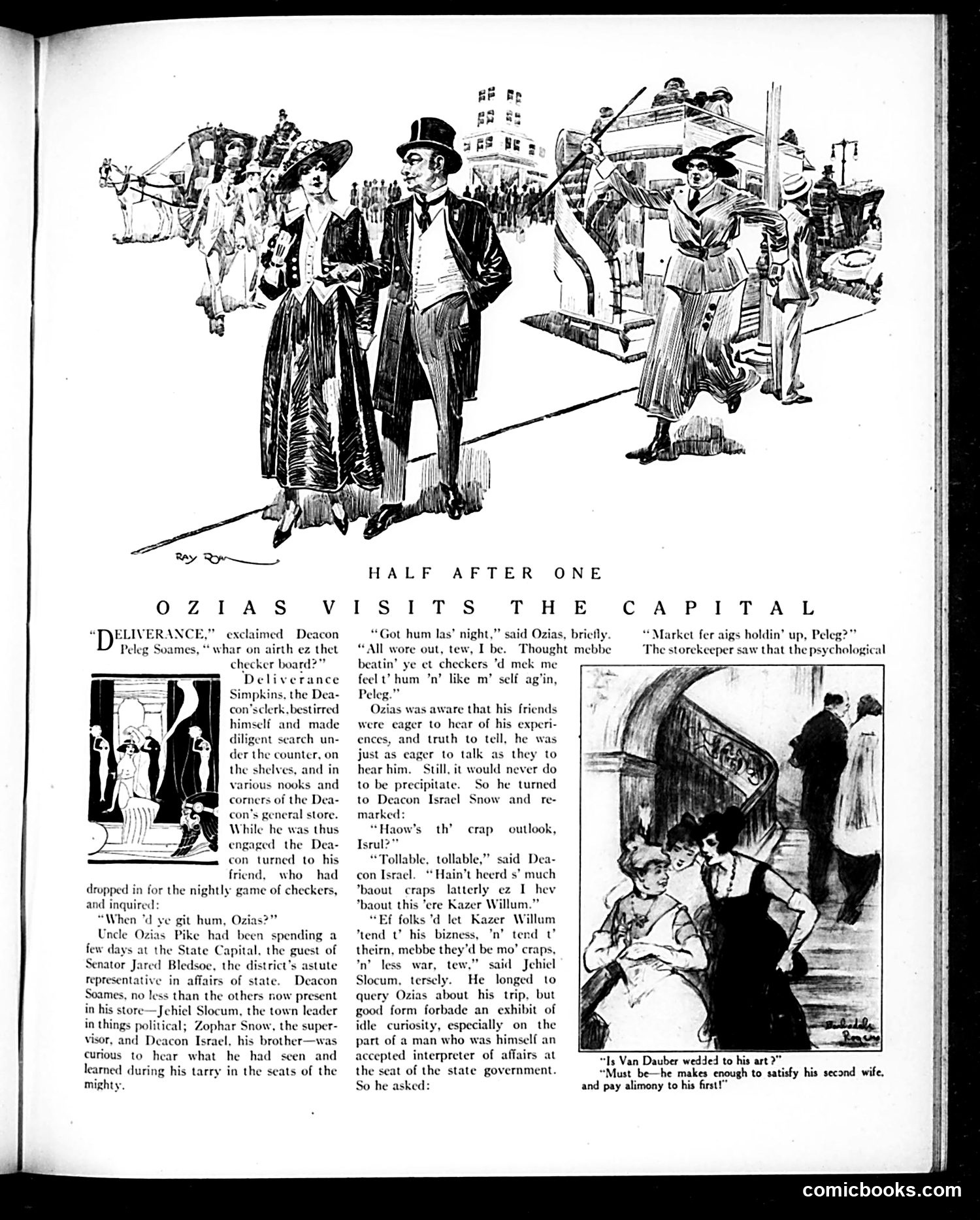
This satirical story depicts Ozias Pike, a rural character, visiting the State Capital. The narrative mocks small-town naïveté encountering urban politics and commerce. Key figures include Deacon Peleg Soames (the Deacon), Deacon Israel Snow, Jehiel Slocum (a town leader), and Zophar Snow (a supervisor)—all appearing to be provincial politicians or businessmen. The satire targets: - **Rural ignorance of state affairs**: Ozias eagerly seeks gossip about city politics he doesn't understand - **Small-town power dynamics**: Local figures boasting about their limited influence - **Market speculation**: References to "Kazer William" suggest financial/business scheming The accompanying illustration shows Ozias as a country visitor amid fashionable urbanites, emphasizing the comedy of provincial outsiders in sophisticated settings.
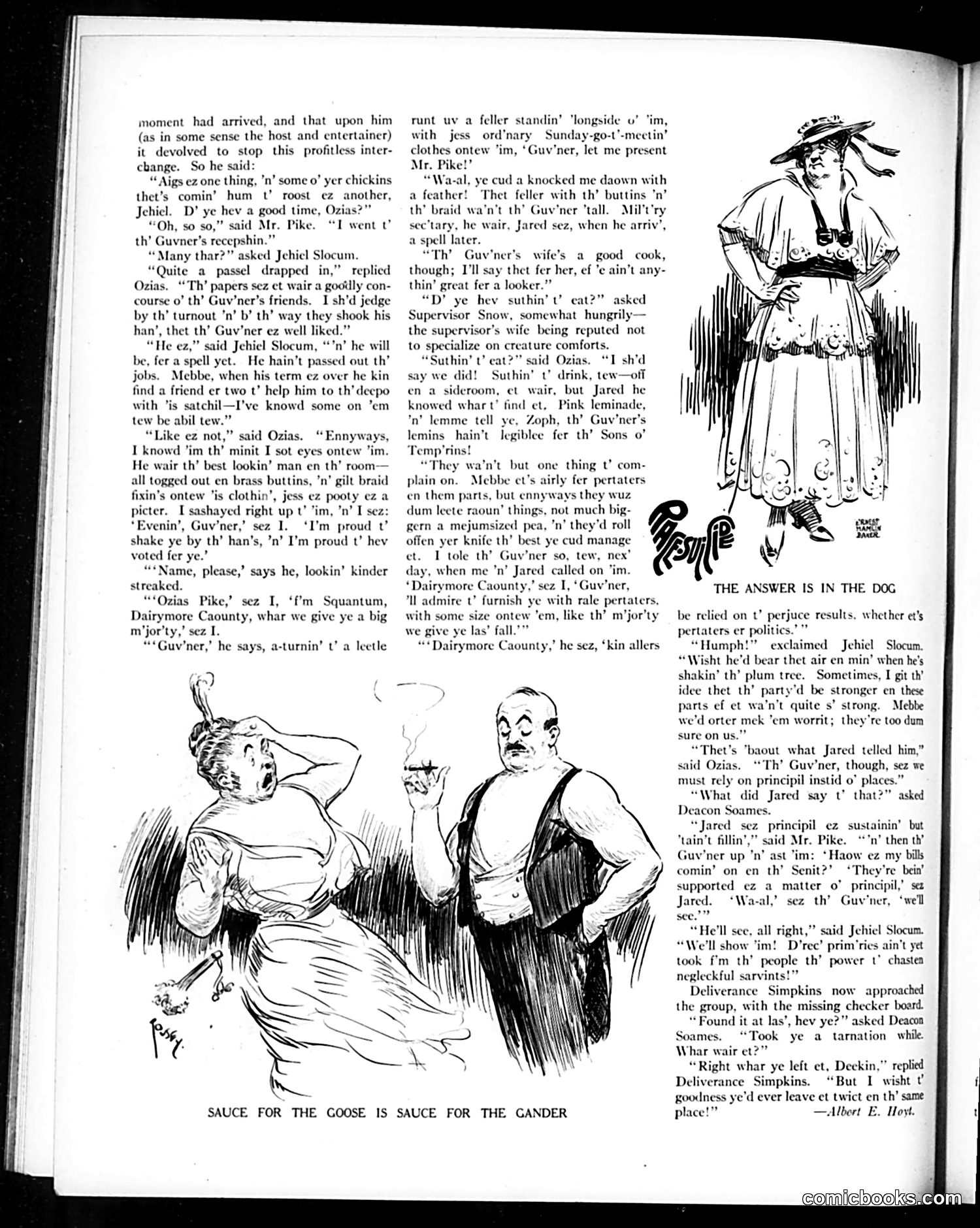
This page satirizes political hypocrisy and empty promises through rural characters discussing a Governor's reception. The central joke involves Ozias Pike attending the Governor's event in his Sunday best, only to realize the impressive uniformed military figure he approached wasn't the Governor at all—the actual Governor was the plainly-dressed man beside him. The satire deepens when characters discuss the Governor's broken promises: he served inferior potatoes while boasting about Dairymore County's agricultural superiority. Pike and Jared point out the Governor relies on "principle" rather than delivering results—a dig at politicians who offer rhetoric instead of action. The caption "Sauce for the Goose is Sauce for the Gander" suggests standards should apply equally to all, likely mocking the Governor's selective integrity. The cartoon critiques political pretension, empty campaign promises, and the gap between politicians' public presentations and actual performance—themes timeless enough to resonate today.
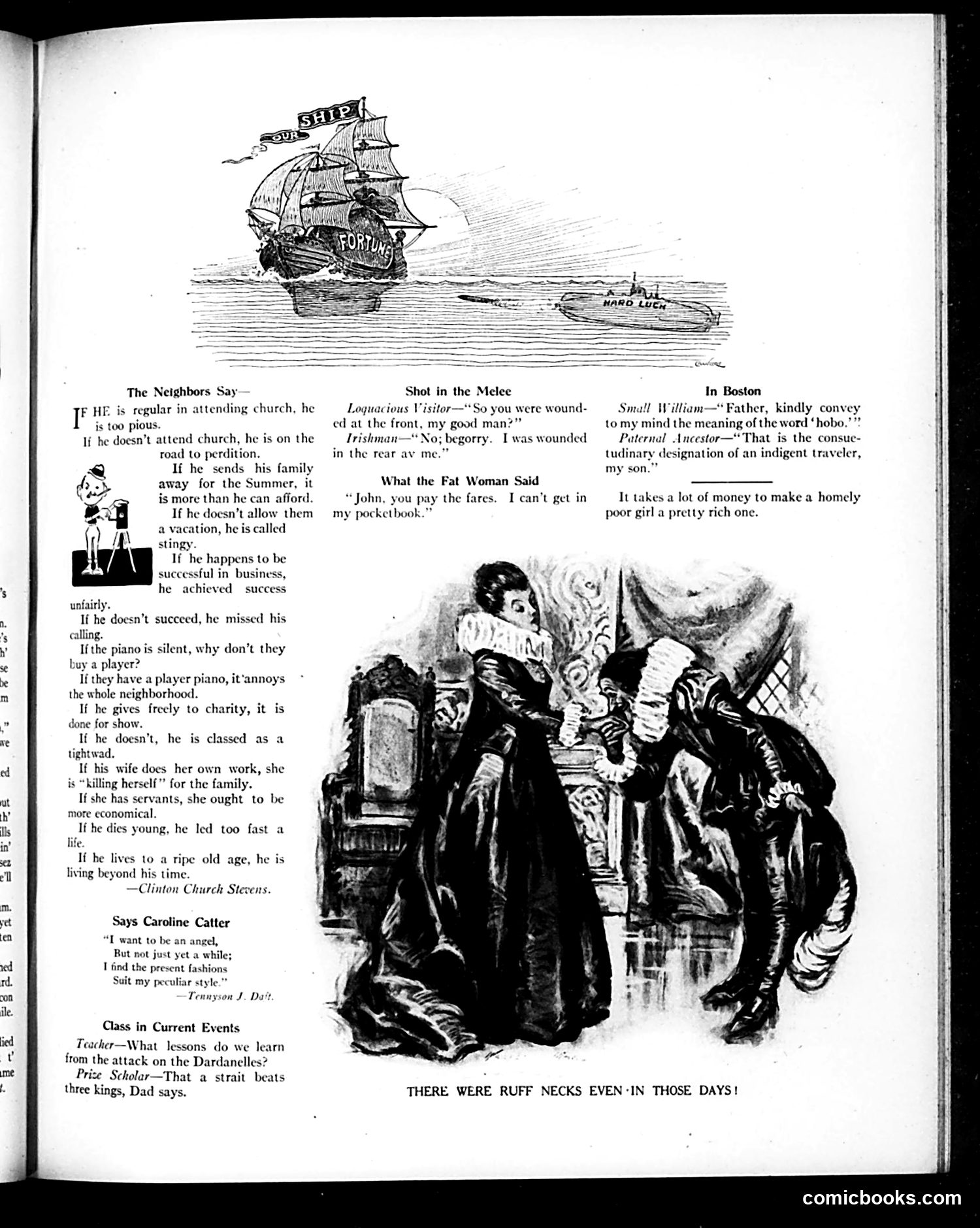
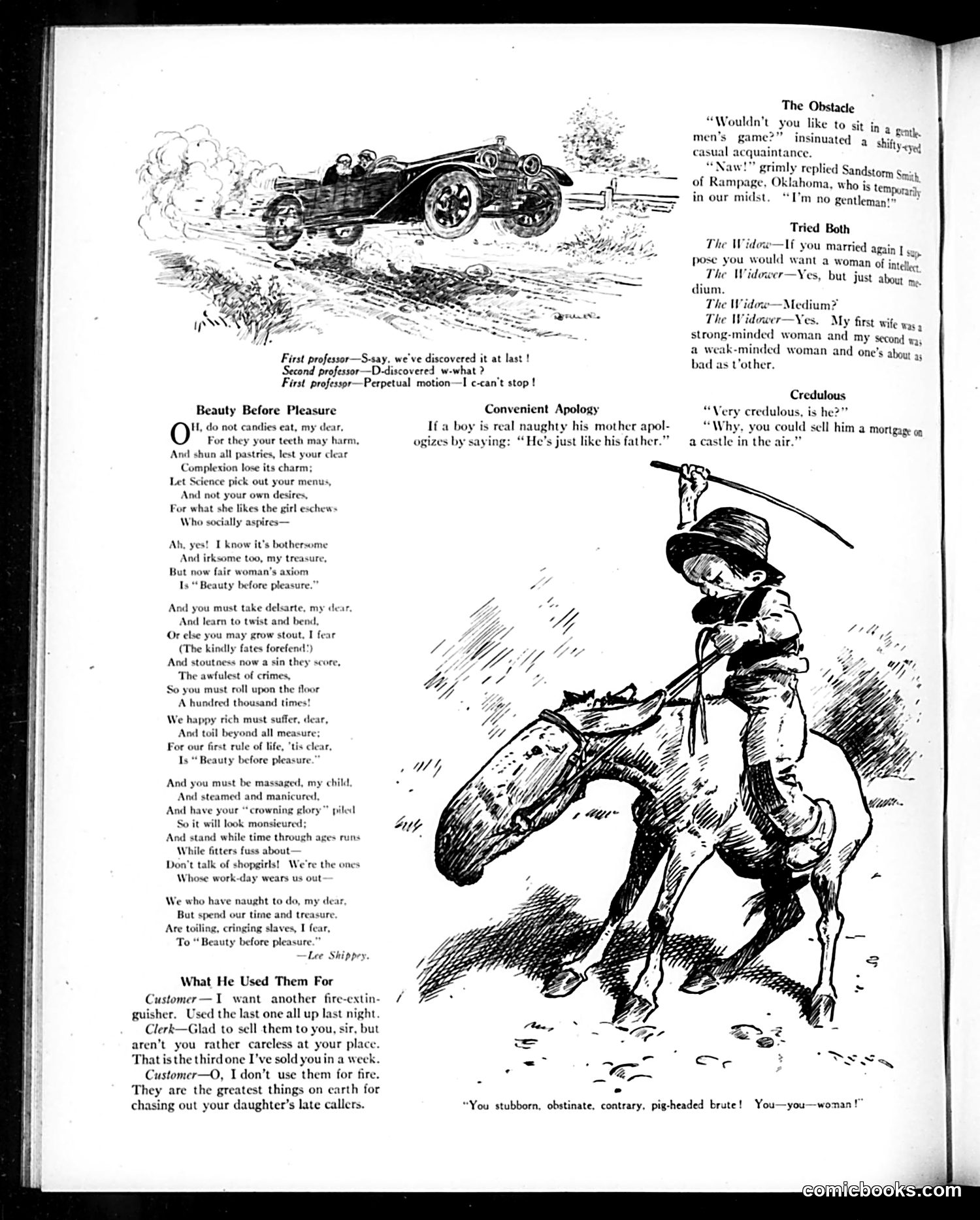
This page contains several short humorous pieces satirizing early 20th-century American social conventions: **"The Obstacle"** mocks genteel pretensions—a woman from Oklahoma refuses a card game invitation, insisting "I'm no gentleman," rejecting the affectation of refined behavior. **"Tried Both"** jokes about remarriage, where a widower describes his first wife as "strong-minded" and second as "weak-minded," implying women are impossible either way—a common misogynistic trope. **"Beauty Before Pleasure"** is a longer poem lamenting how women torture themselves with restrictive beauty standards (corseting, exercise, fasting) while wealthy women have leisure to do so. Working women suffer doubly, grinding through labor while maintaining appearance standards. **"Convenient Apology"** and **"Creduluous"** are brief jokes about parental excuses and gullibility. **"What He Used Them For"** humorously suggests fire extinguishers work better for intimidating suitors than fighting fires. The tone throughout is light satirical commentary on gender roles, courtship rituals, and class anxieties of the era.
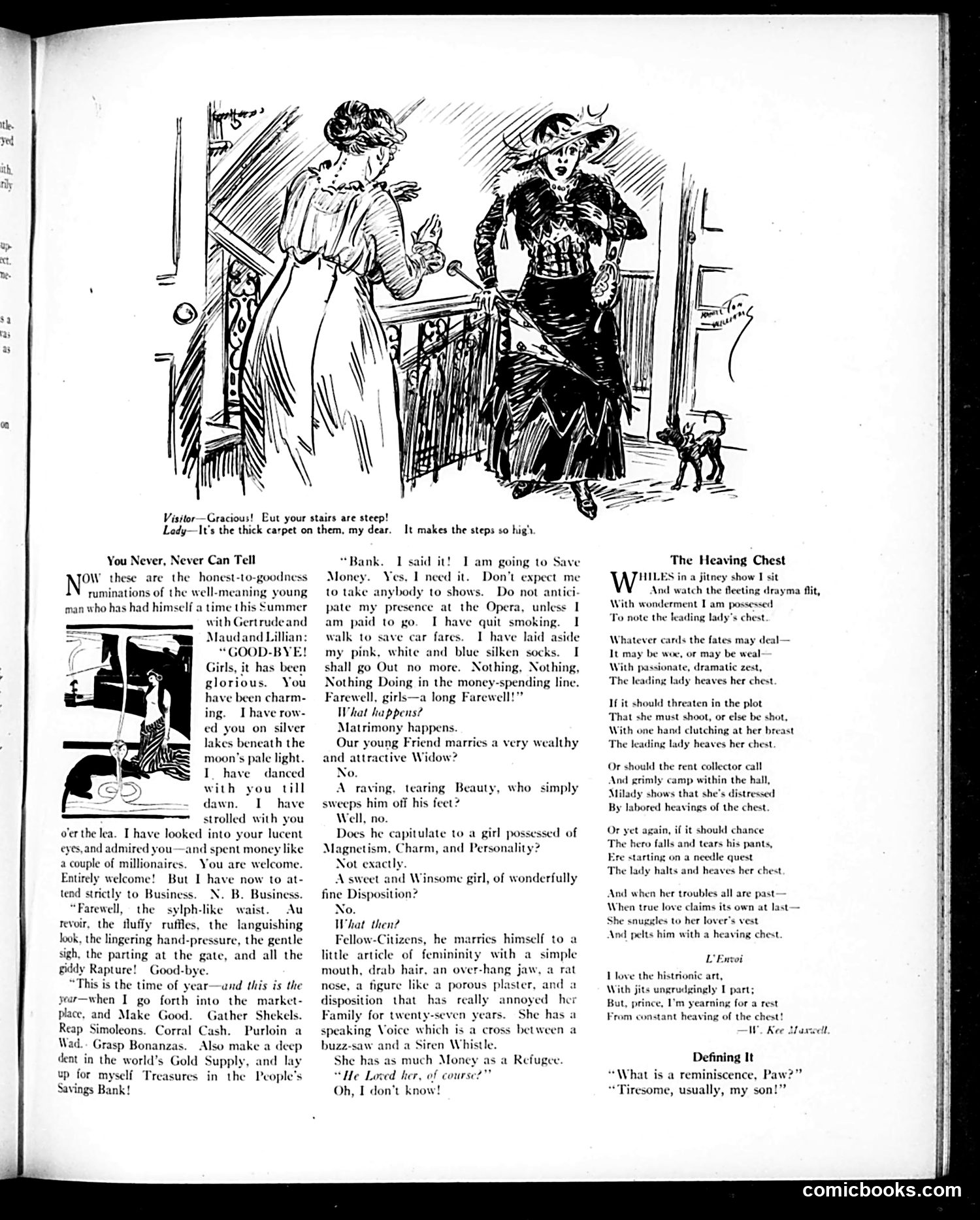
This page contains two satirical pieces typical of early 20th-century American humor magazines. **"You Never, Never Can Tell"** mocks the predictability of young men's romantic intentions. A bachelor swears off romance and spending to focus on making money and building savings, but inevitably marries an unattractive woman with an unpleasant personality and voice—not for love or beauty, but apparently by circumstance. The satire targets both male hypocrisy (the gap between stated intentions and actual behavior) and the absurdity of matrimonial outcomes. **"The Heaving Chest"** is a theatrical parody mocking stage melodrama conventions. It ridicules how actresses constantly heave their chests to express emotion—whether facing danger, eviction, romantic disappointment, or resolution. The poem humorously catalogs this repeated gesture as the go-to theatrical shorthand for all emotional situations, suggesting the artificiality and over-reliance on physical gesture in contemporary stage acting. Both pieces employ witty wordplay and exaggeration characteristic of Judge's satirical approach to American social life and popular entertainment.
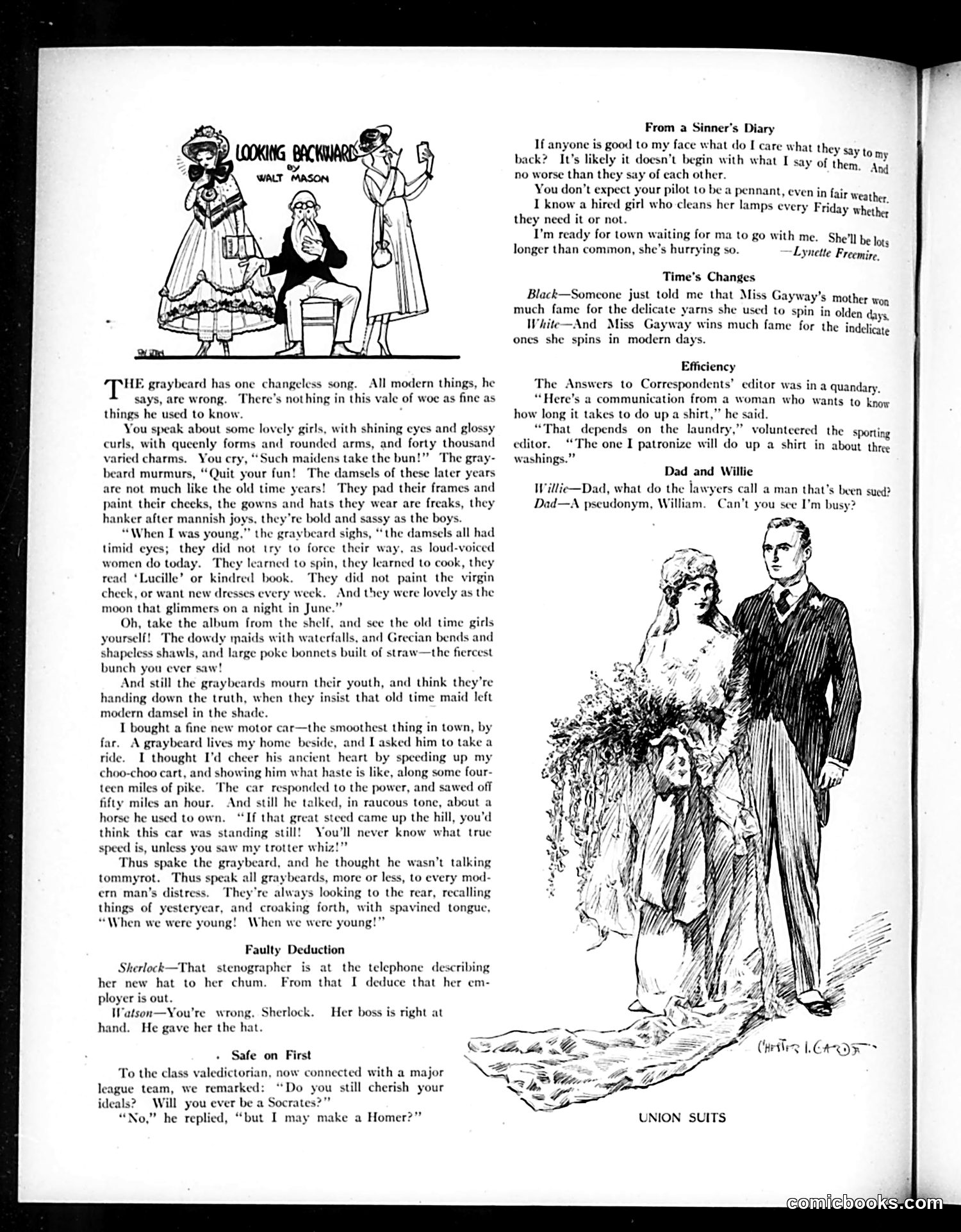
The main cartoon, "Looking Backwards" by Walt Mason, satirizes elderly nostalgia. An old man complains that modern women—who wear fashionable clothes, pursue independent activities, and resist domestic confinement—are inferior to women of his youth. Mason's satire works by having the graybeard romanticize the past while riding in a modern automobile. He refuses to acknowledge progress, insisting an old horse was faster, embodying the stubborn refusal of older generations to appreciate contemporary improvements. The accompanying text features brief satirical pieces mocking similar themes: a stenographer's frivolous hat (suggesting women's materialism), and a baseball player abandoning ideals for fame. The overall message critiques how older men selectively remember the past while dismissing modern progress and women's evolving social roles.
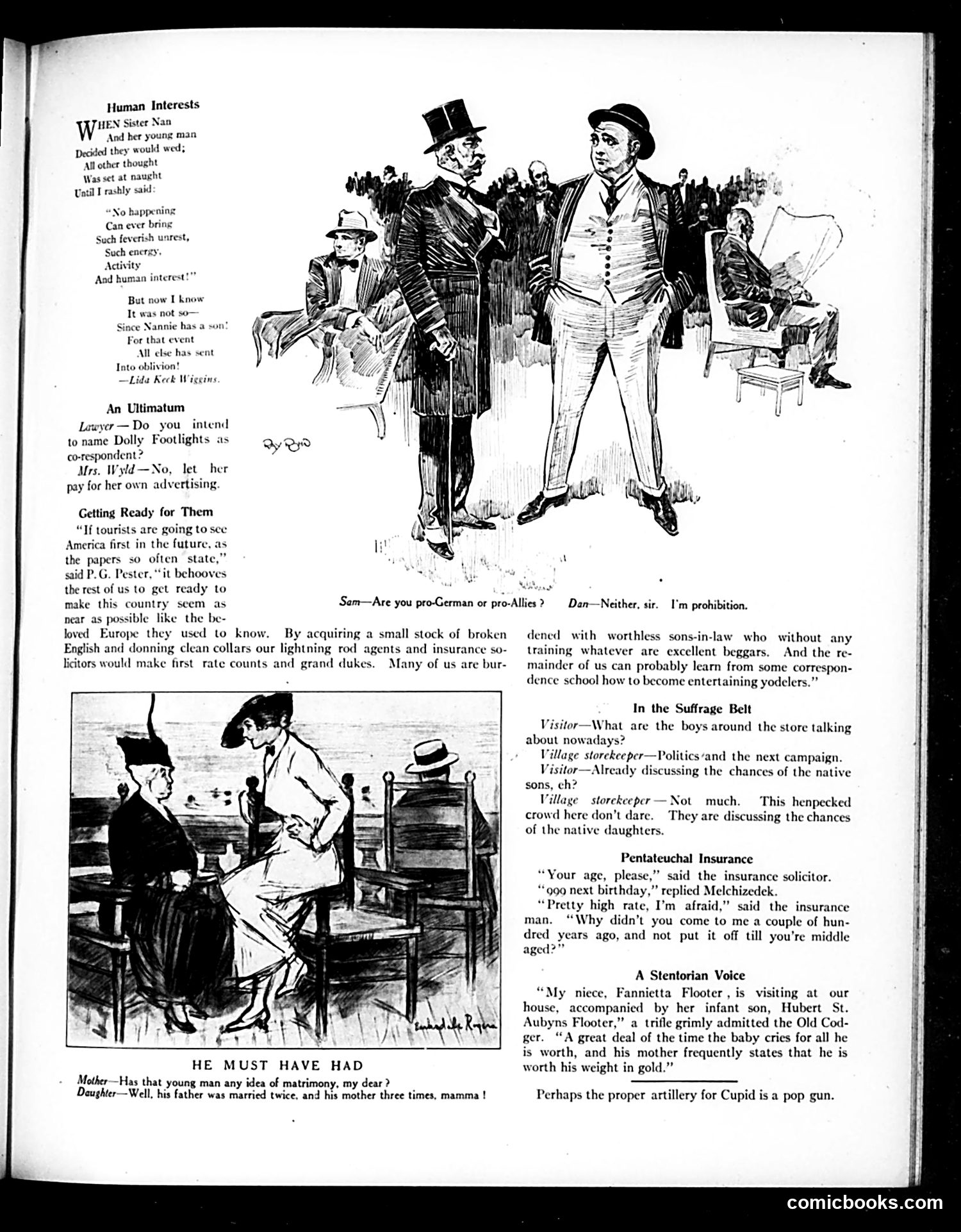
This page contains several brief humorous pieces targeting early 20th-century American social concerns: **"Human Interests"** jokes that a new baby generates more excitement than any other life event. **"An Ultimatum"** satirizes a divorce proceeding where the wife refuses to name her husband's mistress as co-respondent, quipping that the woman should "pay for her own advertising"—mocking both infidelity and the publicity-seeking behavior of stage actresses. **"Getting Ready for Them"** ridicules American snobbery: wealthy tourists wanting Europe-like experiences in America, suggesting locals adopt fake accents and pretentious airs. **"Sam and Dan"** makes a joke about Prohibition-era politics: when asked about allegiances (pro-German or pro-Allied, likely WWI-era), Dan deflects by claiming he's pro-Prohibition instead. **"Suffrage Belt"** jokes about women's suffrage: henpecked husbands now discuss their wives' political chances rather than men's. The remaining anecdotes mock insurance salesmen and exaggerate family drama for comedic effect.
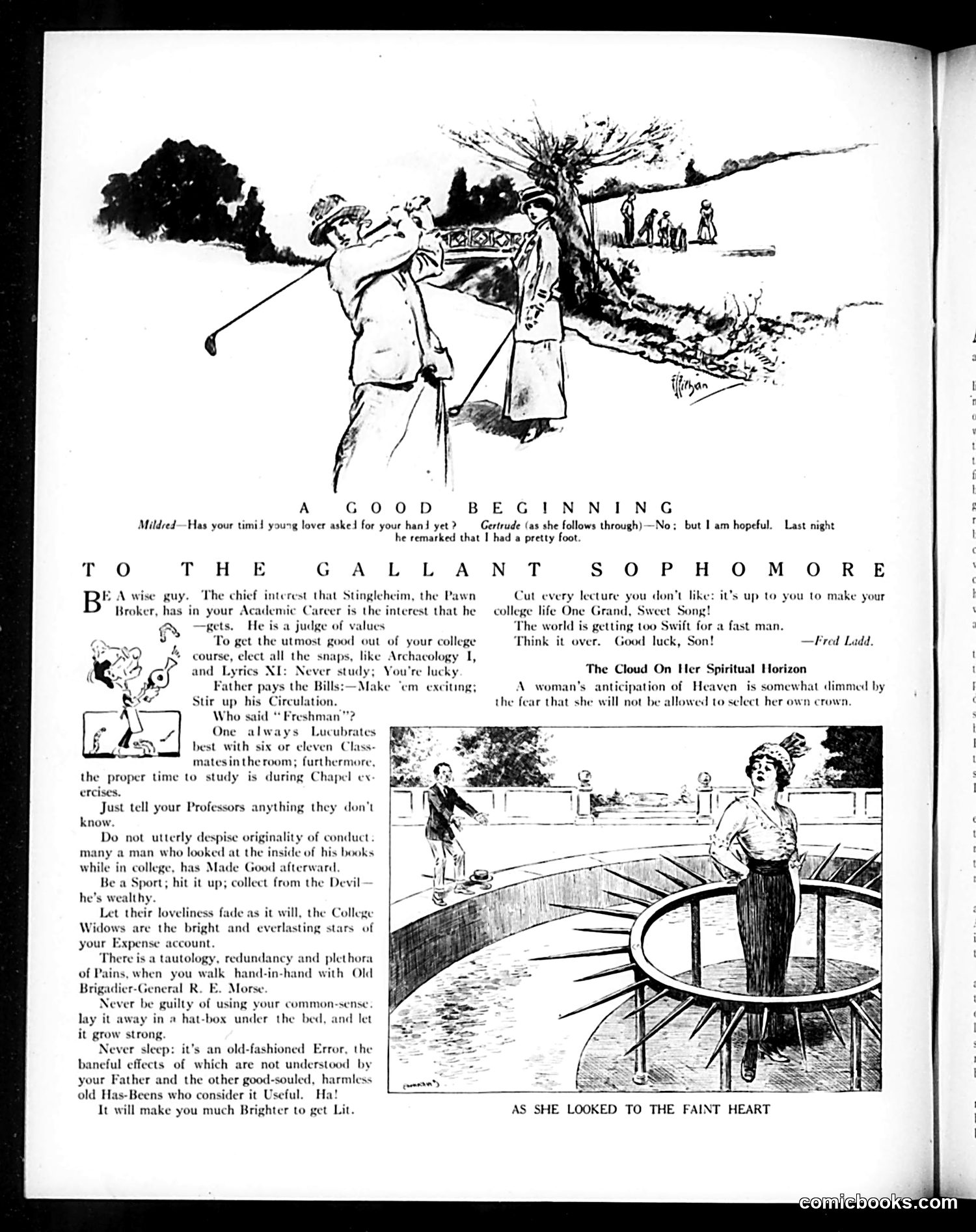
This page contains **satirical advice to college sophomores** and two separate cartoon jokes. **The main text** ("To the Gallant Sophomore") ironically mocks wasteful college behavior: skipping lectures, studying only during chapel, lying to professors, collecting money from wealthy "College Widows" (a period term for older women who pursued young male students), and avoiding sleep and common sense. The satire targets both frivolous students and the enabling wealthy parents funding their excess. **Top cartoon**: A golfer asks his date if her shy boyfriend has proposed; she replies he hasn't asked directly, but complimented her foot—a modest romantic gesture typical of early-20th-century courtship. **Bottom cartoon** ("As She Looked to the Faint Heart"): A woman worries that heaven won't let her choose her own crown, satirizing women's desire for personal choice and vanity even in spiritual matters. The overall tone mocks collegiate excess, gender dynamics, and social pretension of the era.
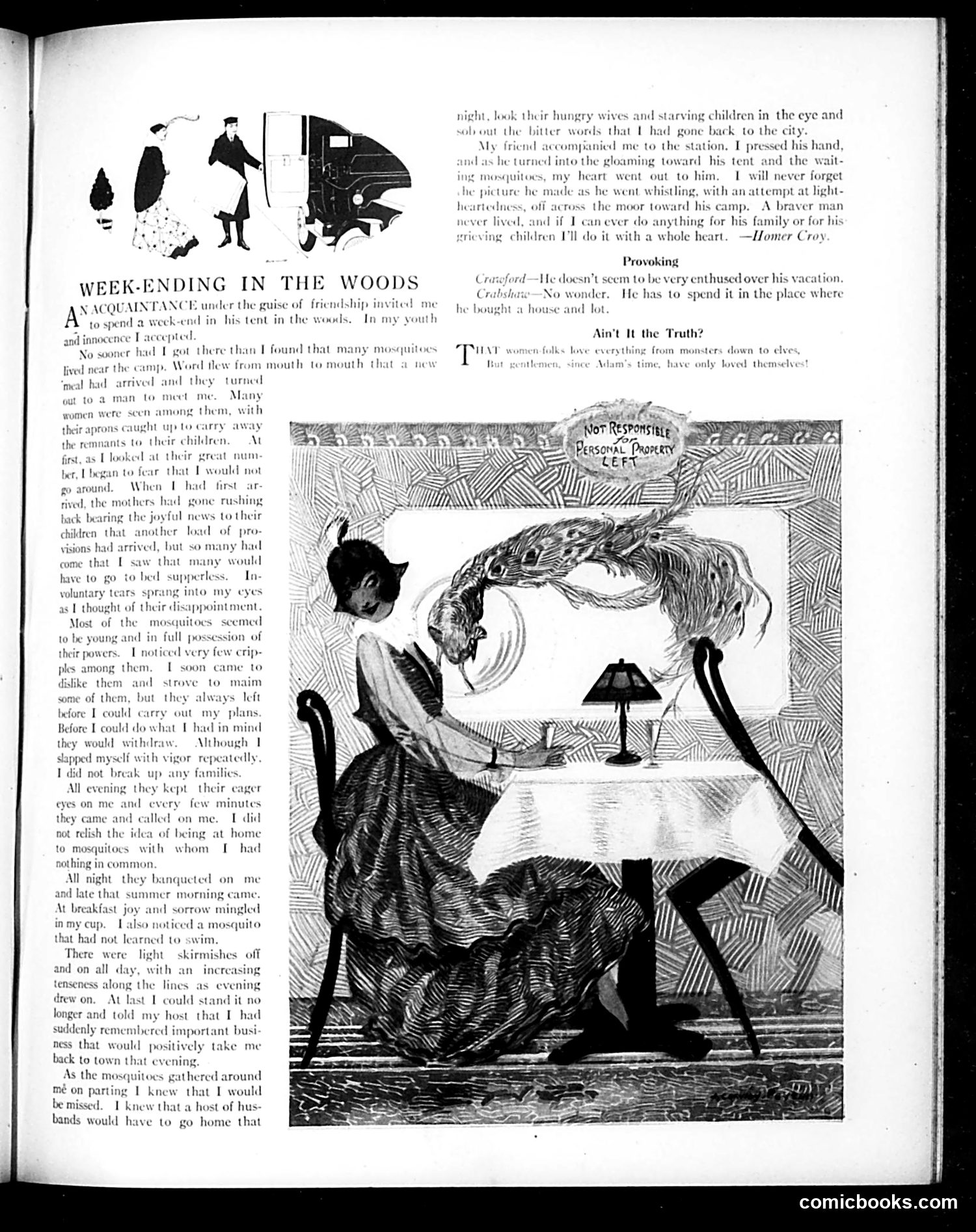
This is a humorous essay with accompanying illustration about a man's miserable camping trip. The piece satirizes the popular "back to nature" vacation trend by describing the author's actual experience: endless mosquito attacks, a host family's disappointment at his early departure, and the guilt-ridden realization that husbands across America are dreading returning home to angry wives and hungry children after their woodland getaway. The illustration shows anthropomorphized mosquitoes dining at a table in the woods—a visual joke depicting them as the real beneficiaries of the camping trip, feasting on human visitors. The sidebar "Ain't It the Truth?" presents a cynical aphorism about women and truth-telling, reflecting the era's casual gender stereotyping. The overall satire mocks both the romantic idealization of camping and suggests the financial/domestic strain such vacations place on working-class families.
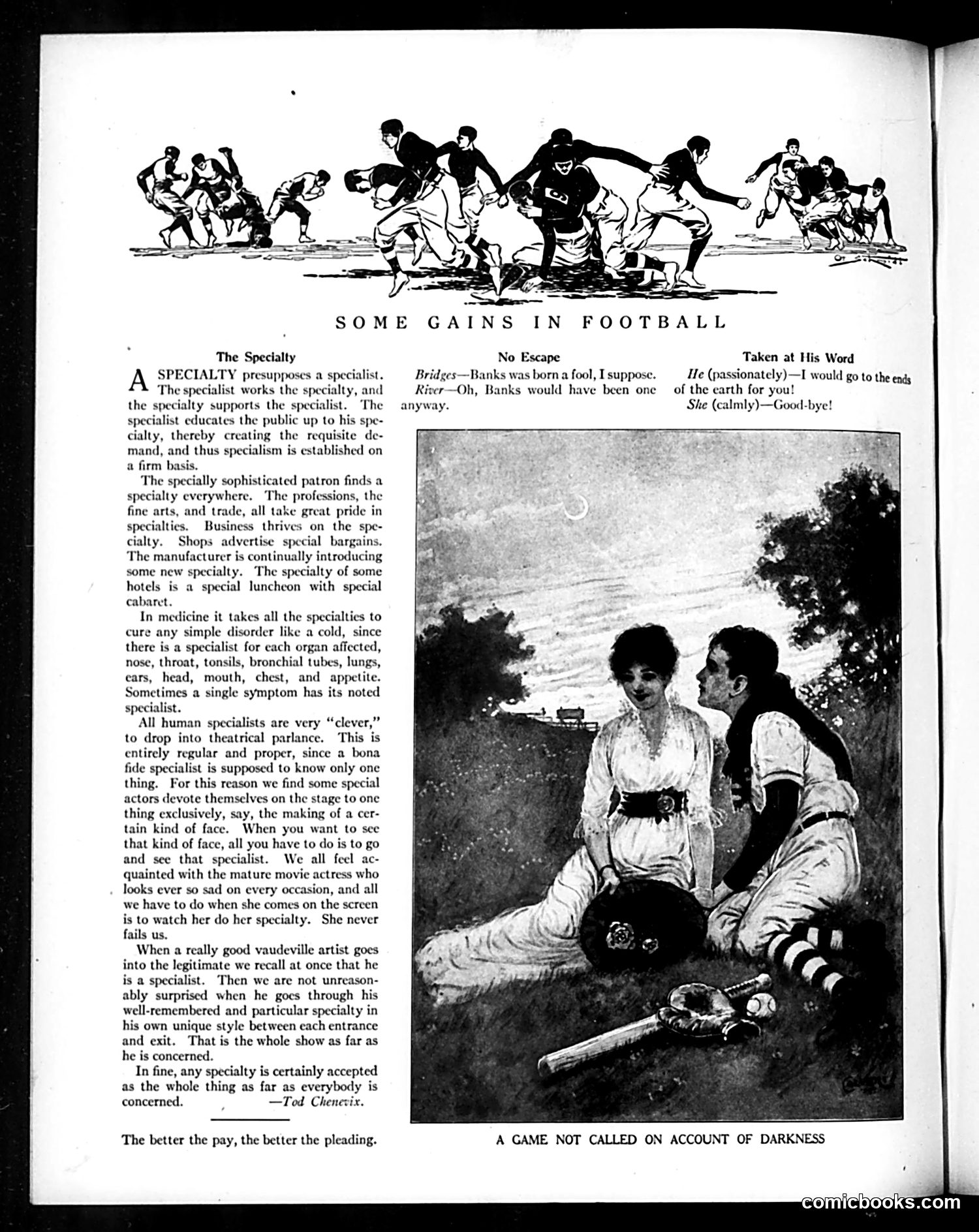
This page satirizes **professional specialization** in early 20th-century American society. The left column's essay by Tod Chenevix mocks how specialists—in medicine, theater, vaudeville, and business—claim expertise in narrowly defined areas, becoming one-trick performers. The humor lies in exposing this as absurd: a medical specialist for each body part, an actress who only knows how to look sad, or a vaudeville performer repeating the same act in legitimate theater. The three small comedic exchanges at top right continue this theme through wordplay and situational humor typical of Judge's style. The football illustration above appears decorative, framing "Some Gains in Football"—likely unrelated editorial content. The bottom photograph, captioned "A Game Not Called on Account of Darkness," shows young people in romantic repose outdoors, suggesting a joke about leisure activities or courtship replacing sports.
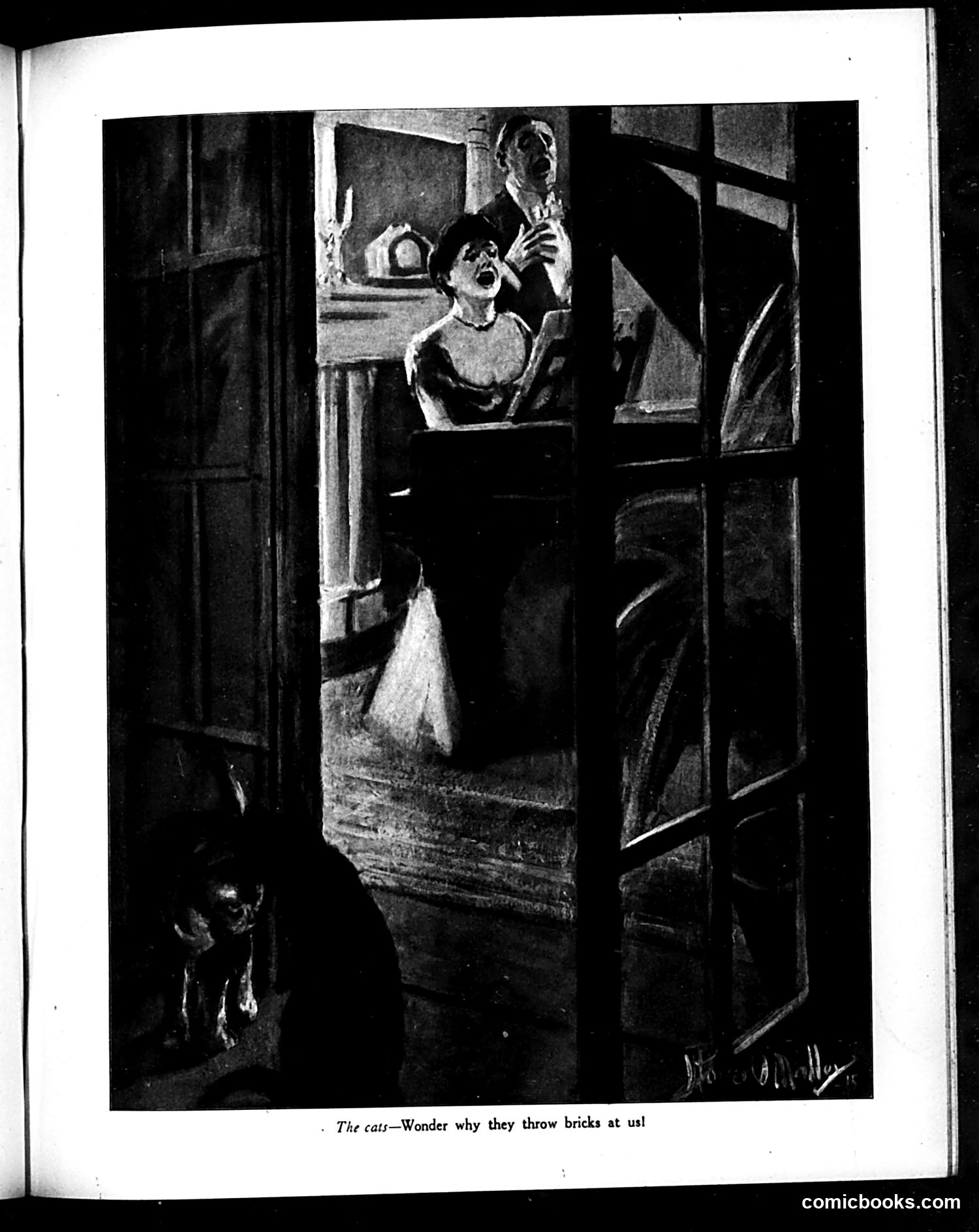
This cartoon depicts a domestic scene viewed through open doors. A woman kneels in apparent distress or prayer while a man stands behind her in an aggressive posture. A cat sits in the foreground, observing the scene. The caption's darkly humorous point is ironic: the cat wonders why humans throw bricks at cats, when the cartoon itself depicts human domestic violence. The satire suggests that if cats could witness such brutality between humans, they might question why *they* receive blame or punishment from these same violent people. This appears to be social commentary on domestic abuse, using the cat as an innocent observer to highlight the hypocrisy of humans mistreating animals while engaging in worse behavior toward each other. The joke relies on audience recognition of casual animal cruelty as a contemporary problem.
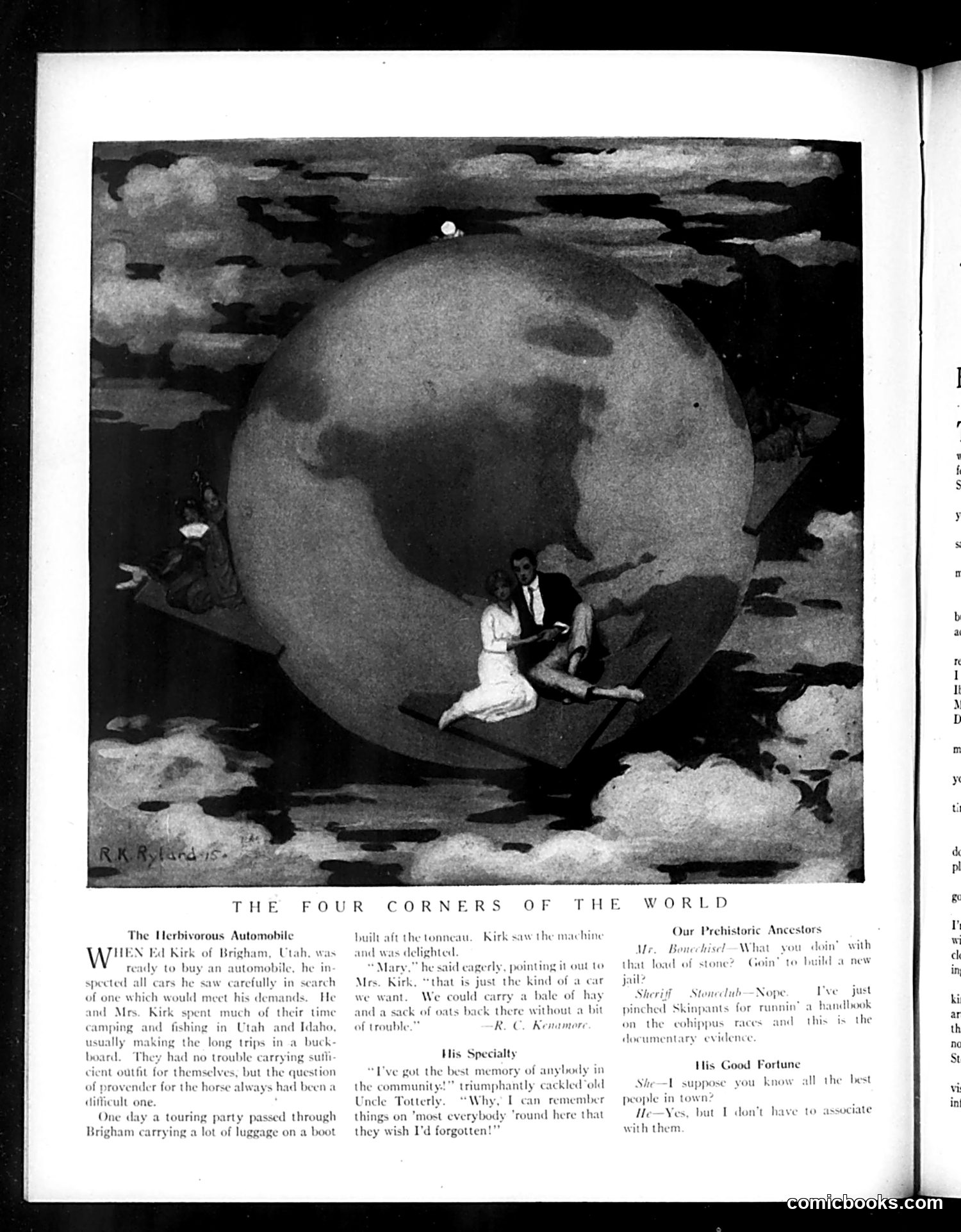
This page contains three separate humorous sketches satirizing rural/small-town American life, circa early 1900s. **"The Herbivorous Automobile"** mocks the novelty of automobiles in rural Utah. Ed Kirk, inspecting cars, hears a companion suggest using an automobile instead of a horse-drawn wagon—they could carry hay and oats in the car for their own provisions during trips. The joke plays on the absurdity of treating a car as merely a replacement for horse transport, missing the point of motorized vehicles entirely. **"His Specialty"** satirizes gossipy small-town characters—Uncle Totterly boasts of having the best memory in town, but reveals it's only for remembering embarrassing things locals wish forgotten. It's gentle mockery of busybodies. **"Our Prehistoric Ancestors"** and **"His Good Fortune"** appear fragmentary in the OCR, but seem to continue the small-town satire. The overall theme: rural America's slow adaptation to modernity and timeless human foibles (gossip, pretension, social climbing).
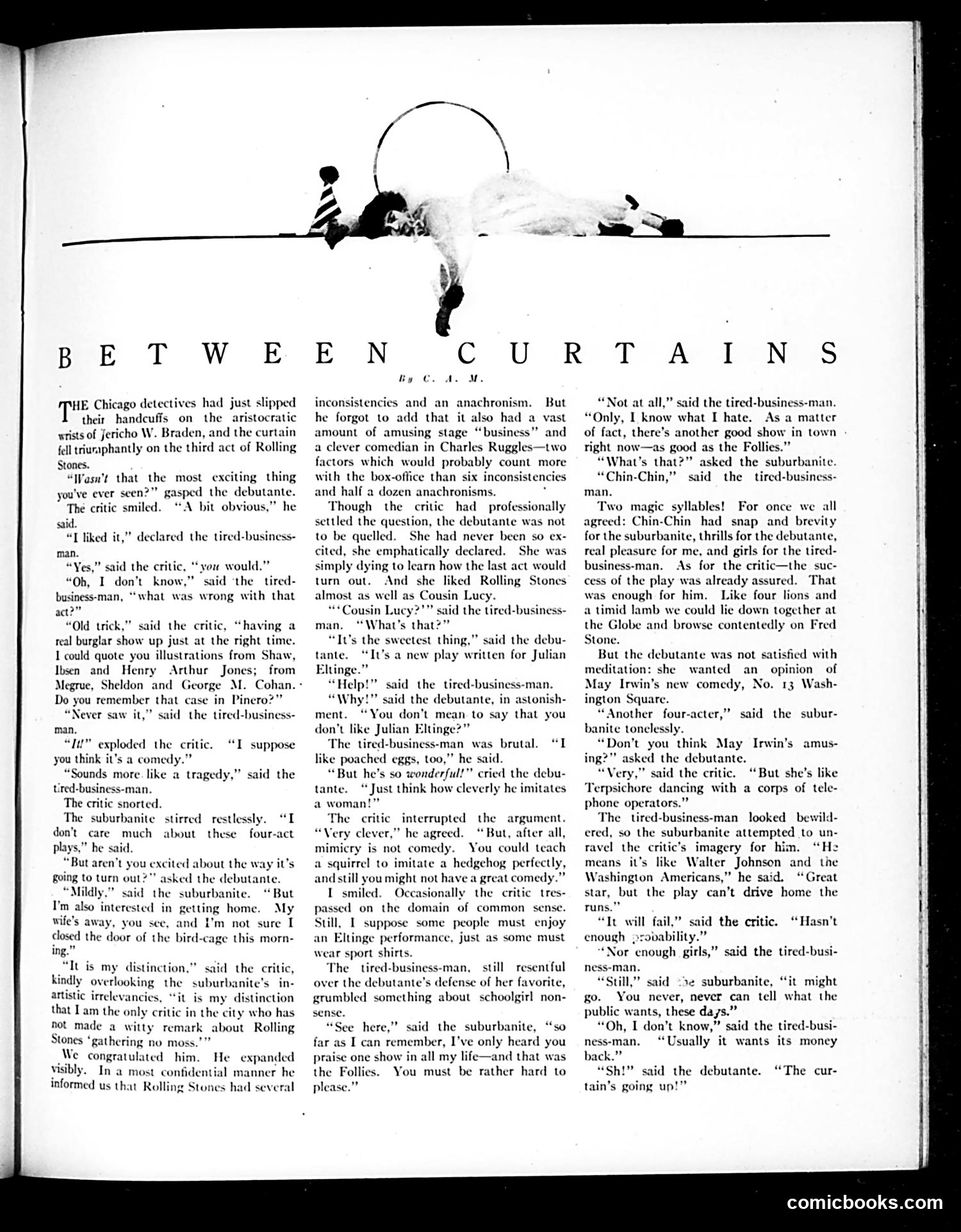
This page satirizes the clash between theatrical critics and ordinary theatergoers. The dialogue follows a critic, a tired businessman, a debutante, and a suburbanite discussing the play "Rolling Stones." The satire targets: 1. **Pretentious critics**: The critic dismisses "Rolling Stones" as obvious and derivative, citing obscure playwrights (Shaw, Ibsen, Pinero) to establish superiority, yet admits the play has entertainment value the audience actually enjoys. 2. **The debutante**: Represents naive enthusiasm, excited by spectacle and celebrity performers like Julian Eltinge (a famous female impersonator of the era). 3. **The tired businessman**: Voice of common sense—he enjoyed the show and doesn't care about artistic pedigree; he's concerned his bird-cage door might be open at home. The core joke: The critic's intellectual posturing about anachronisms and "old tricks" misses what makes theater work—entertainment. The businessman's straightforward enjoyment proves more honest than the critic's affected analysis.
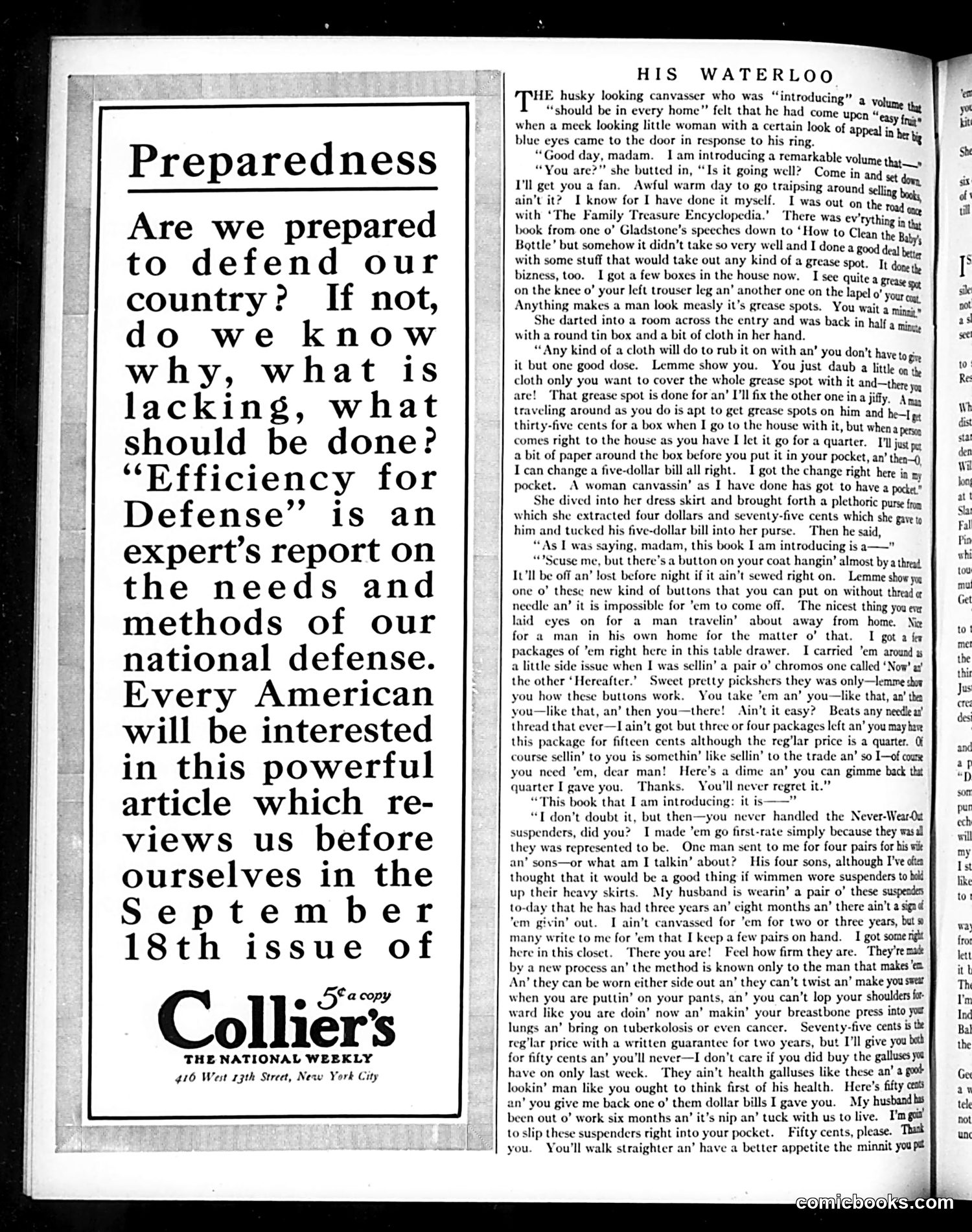
This is a humorous short story satirizing door-to-door salesmanship. A male book canvasser arrives at a woman's home confidently pitching an encyclopedia, believing he's found an easy sale. However, he encounters a shrewd female canvasser herself—experienced at selling household products. The joke reverses expectations: instead of the woman being a passive customer, she dominates the interaction, redirecting his sales pitch to demonstrate *her* products (grease cleaner, sewing buttons). She expertly out-sells the salesman, eventually purchasing his book almost as an afterthought while making him change her five-dollar bill. The title "His Waterloo" refers to Napoleon's decisive defeat, suggesting the male canvasser has met his match. The satire mocks both aggressive 1910s-era salesmanship tactics and contemporary gender assumptions—the "meek looking little woman" proves far more commercially savvy than the "husky" male salesman. The piece likely amused Judge's readers by subverting stereotypes about women's business acumen.
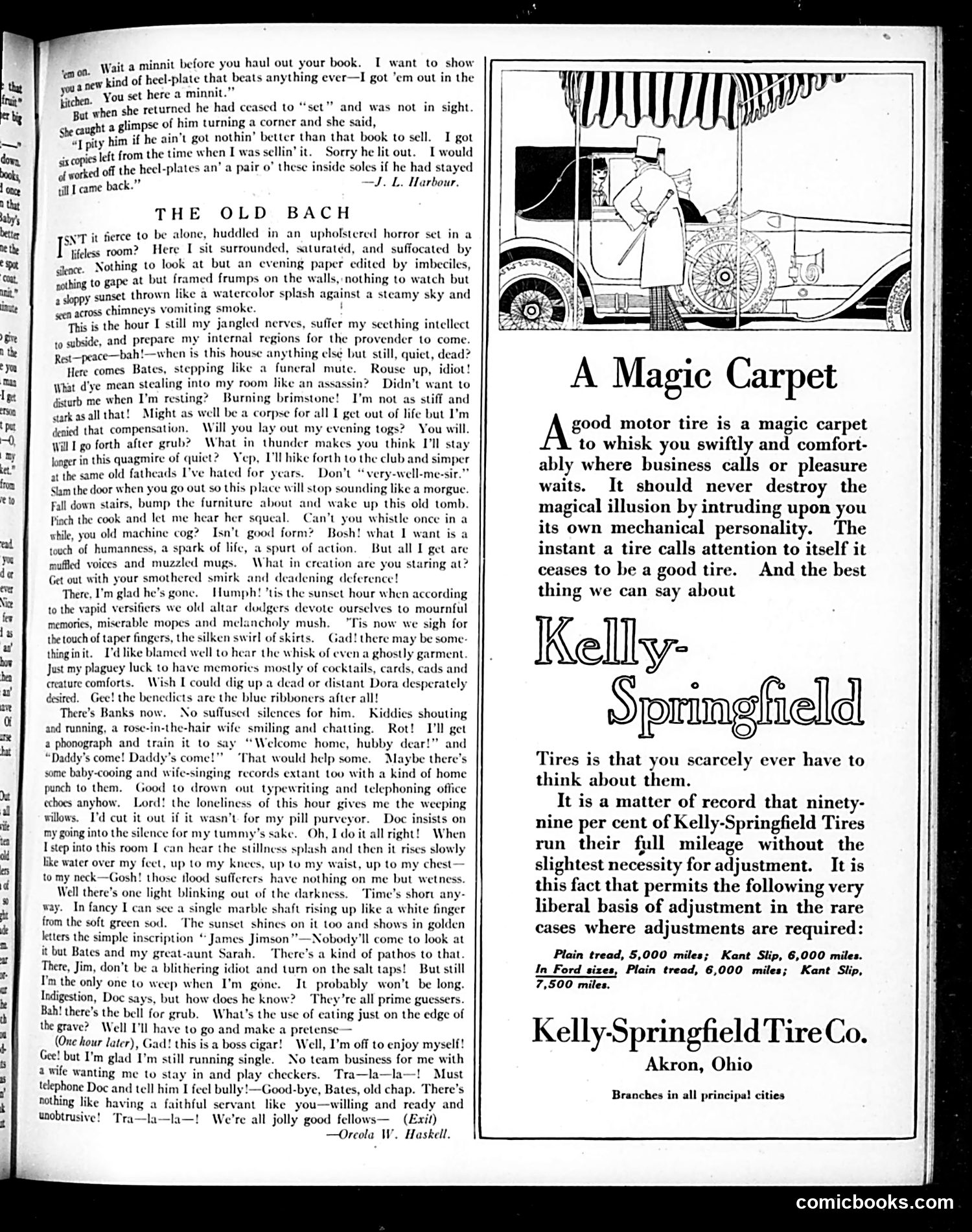
This page contains two distinct pieces: **"The Old Bach"** (left column): A monologue satirizing the bitter, lonely bachelor. The narrator—an aging unmarried man—complains bitterly about his solitary domestic life, his servant Bates, his evening routine, and his envious observations of married men like "Banks" who return home to wives and children. The satire mocks both the bachelor's self-pitying misanthropy and the era's assumptions that marriage (particularly for men with families) represents fulfillment, while bachelorhood is inherently miserable and dehumanizing. **"A Magic Carpet"** (right): A Kelly-Springfield Tire Company advertisement using metaphorical language about tires as magical transportation, claiming 99% of their tires run full mileage without adjustment. The accompanying illustration shows a stylized car. The page juxtaposes serious (if humorous) social commentary on masculine loneliness with commercial advertising—typical of Judge's mixed editorial and advertising format from this era.
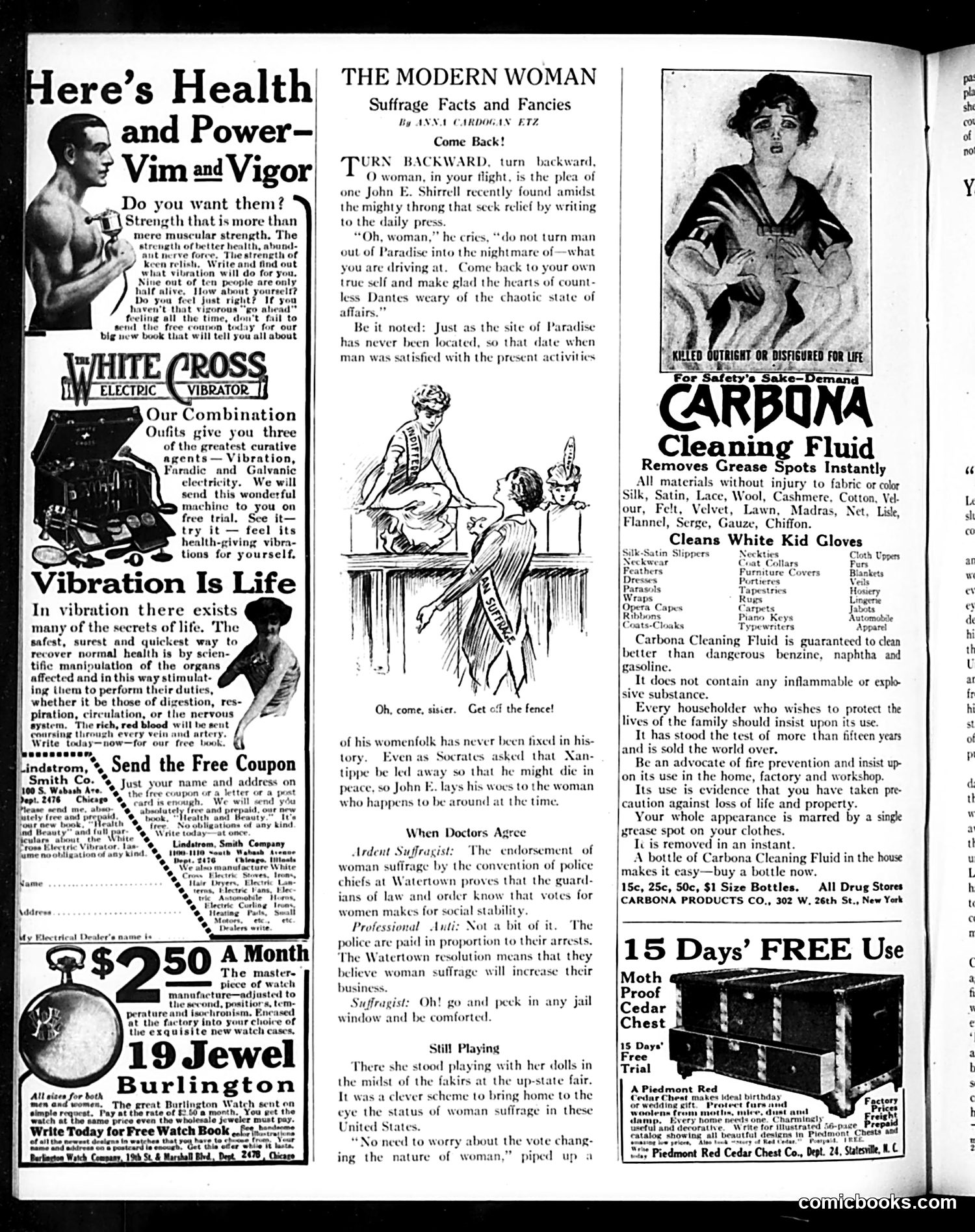
This page mixes advertisements with political satire about women's suffrage. The central cartoon titled "The Modern Woman: Suffrage Facts and Fancies" presents opposing viewpoints on voting rights through dialogue. The "Ardent Suffragist" argues that police chiefs endorsing women's suffrage proves it promotes social stability. The "Professional Anti" counters cynically that police support it only because more voters means more arrests and higher budgets—a jab at both anti-suffragists and institutional self-interest. A separate sketch shows a woman playing with dolls at a fair, symbolizing how opponents dismissed women as childlike and unfit for voting. The satire suggests anti-suffragists viewed political engagement as unnatural for women. The page also advertises "health" products like electric vibrators—reflecting the era's pseudoscientific medical claims. This juxtaposition of empowerment rhetoric with patronizing ads subtly underscores the contradiction: society marketed "vigor" to women while denying them political agency.
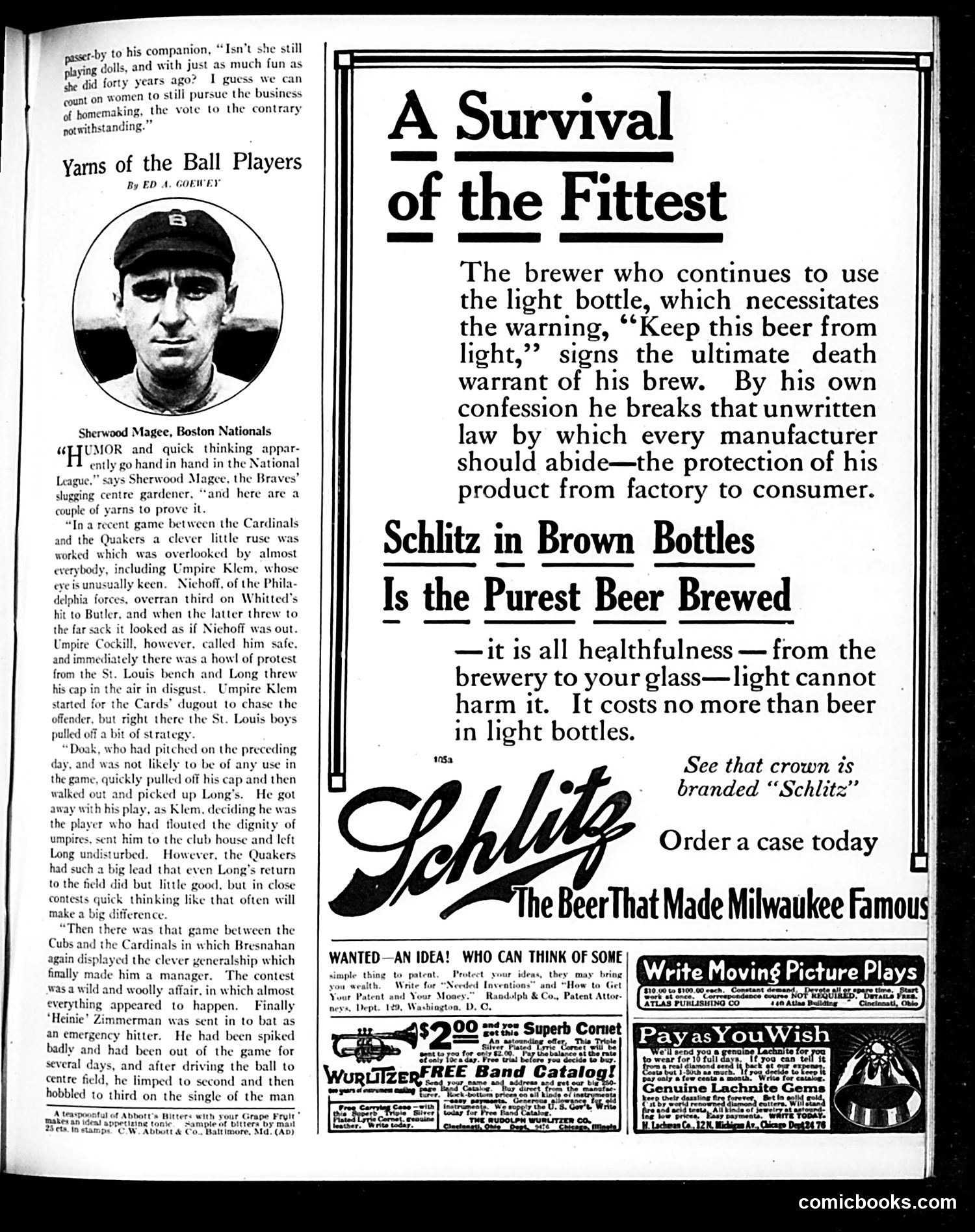
This page combines sports anecdotes with advertising, typical of Judge magazine's format. **The Baseball Content:** "Yarns of the Ball Players" features Sherwood Magee (Boston Nationals player) recounting clever plays from recent games involving Cardinals, Quakers, and Cubs. The anecdotes illustrate quick thinking—players exploiting umpire confusion, injured players persevering. This celebrates baseball strategy and humor from the early 20th-century game. **The Satire:** The page's title, "A Survival of the Fittest," ironically connects Darwin's evolutionary concept to beer bottle design. Schlitz beer argues that competitors using light bottles are "unfit" because light damages beer—only brown bottles ensure product quality. This anthropomorphizes commercial competition as natural selection. **The Gender Joke (top left):** A man tells his companion a woman still enjoys dolls at 40, with "just as much fun"—implying women remain childish. The closing snark about women getting voting rights despite this supposed frivolousness reflects anti-suffrage sentiment common in 1910s satirical magazines. The page is primarily **advertising disguised as editorial content**.
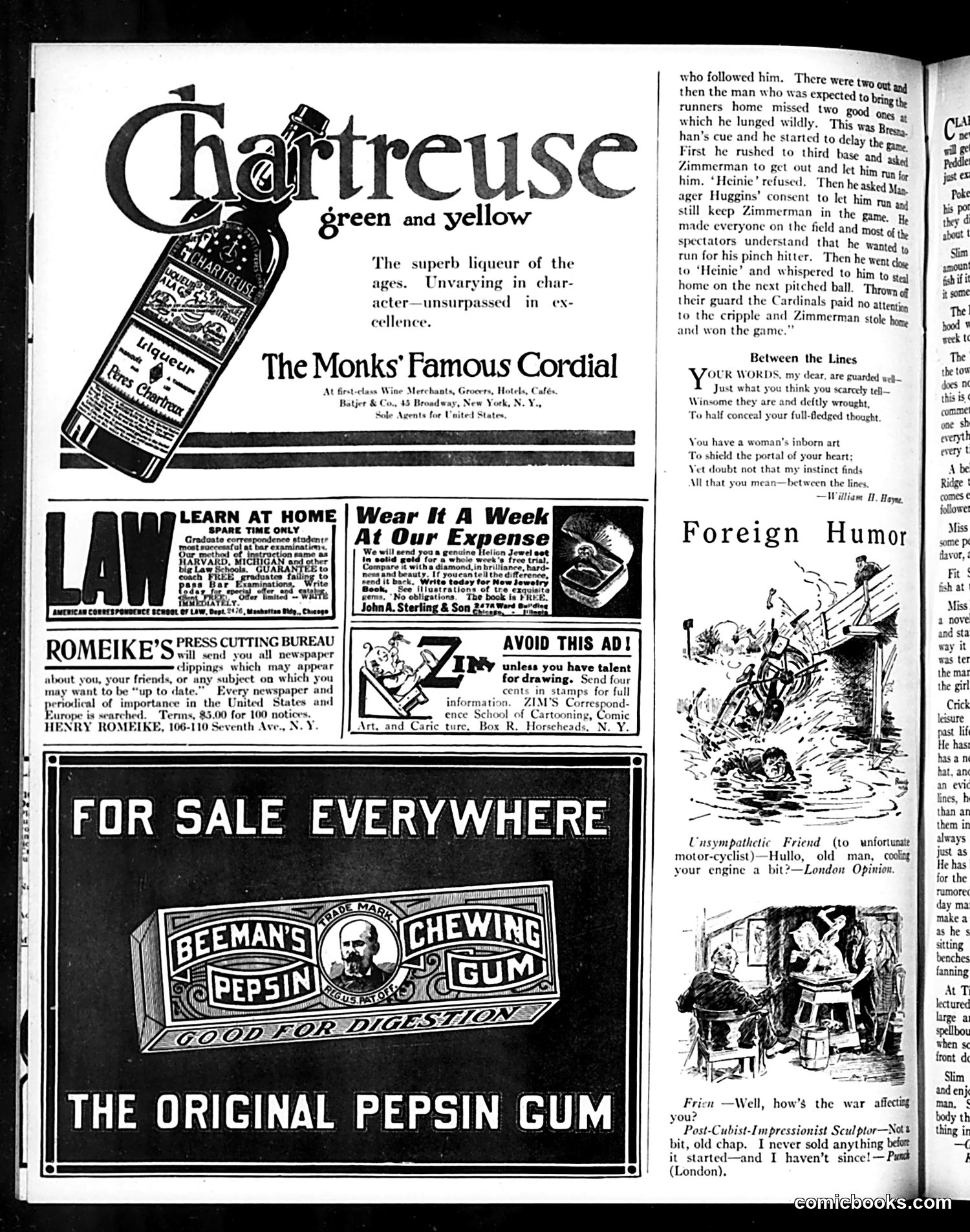
This page is primarily **advertising and filler content** rather than political satire. The dominant features are commercial ads for Chartreuse liqueur, Beeman's Pepsin Gum, and services like a clipping bureau and correspondence school for cartooning. The "Foreign Humor" section contains two brief jokes unrelated to American politics: one about a motorcyclist (London Opinion) and another about a sculptor struggling during wartime (Punch, London). The text fragment at top appears to be a sports anecdote about baseball—possibly involving players Zimmerman and Heinie—where a strategic substitution affects game outcome, but lacks sufficient context for full interpretation. The poem "Between the Lines" is romantic verse about unspoken feelings in courtship, not satirical. **Overall**: This is a typical early-20th-century magazine page mixing advertisements with light entertainment and reprinted foreign humor—not a platform for the political cartooning Judge was known for.
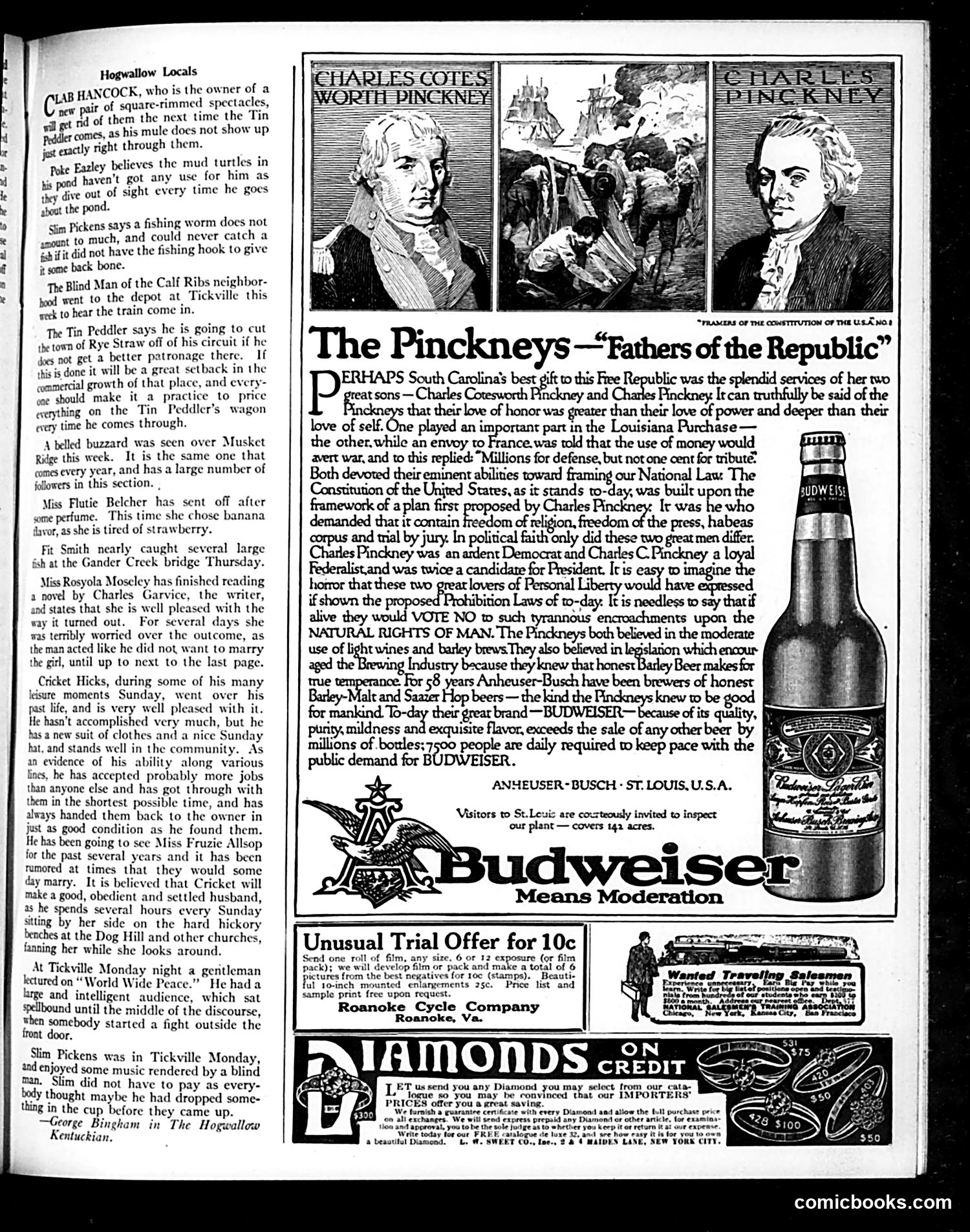
This page contains two distinct sections: humor and advertising. **"Hogwallow Locals"** is a satirical humor column mocking rural American life through absurd anecdotes—a man with spectacles his mule won't look through, fishermen's illogical complaints, a man courting for years without proposing. The humor relies on depicting rural people as simple-minded or eccentric. **"The Pinckneys—'Fathers of the Republic'"** is a lengthy advertisement for Budweiser beer disguised as patriotic history. It praises South Carolina's Charles Cotesworth Pinckney and Charles Pinckney as Founding Fathers, then pivots to claim Budweiser exemplifies American values—"moderation" and quality—comparable to the founders' principles. The ad uses patriotic framing to sell beer, arguing that just as these statesmen built the nation responsibly, Budweiser maintains honest standards for the public good. This is early-20th-century "advertorial" propaganda linking a commercial product to national identity.
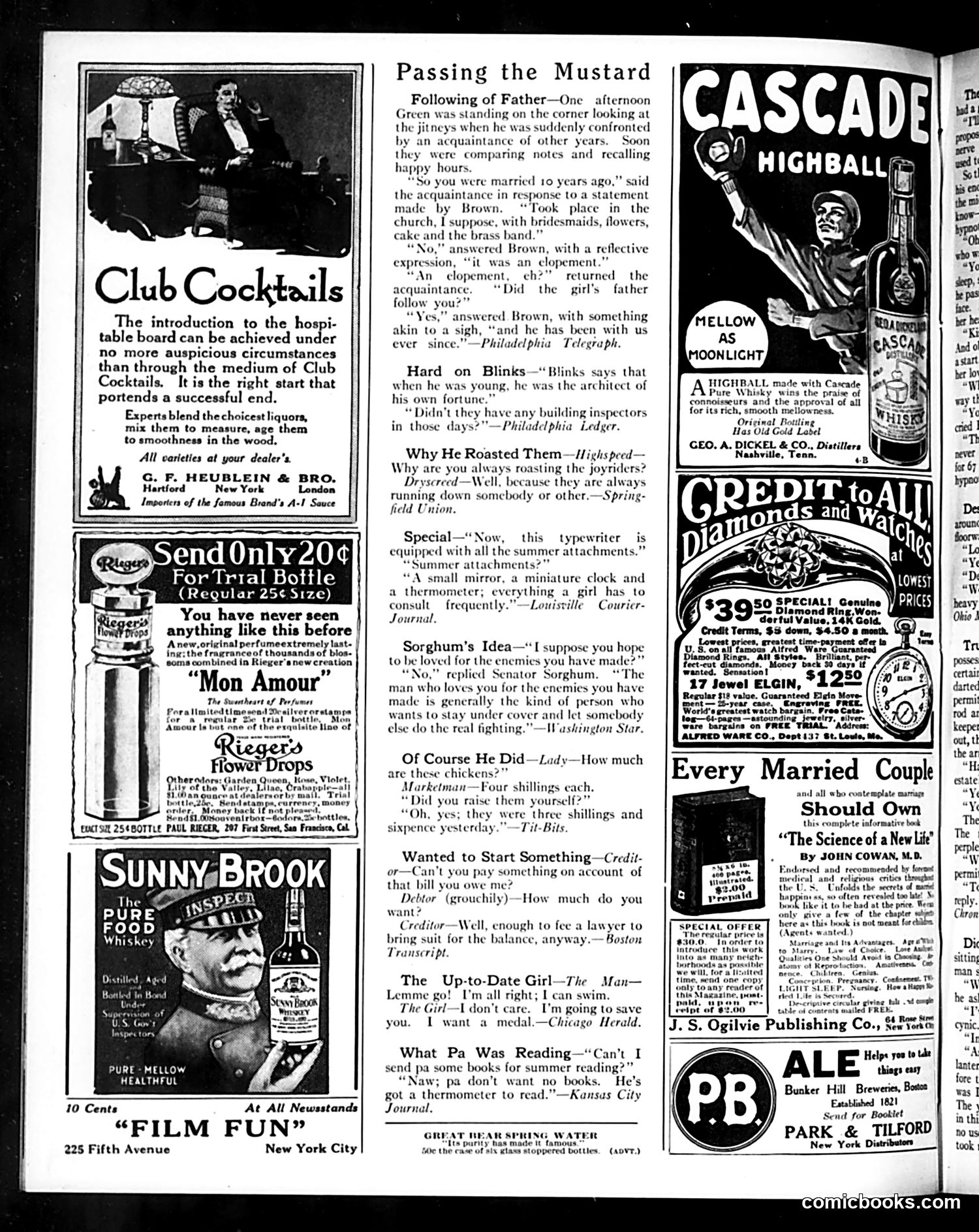
This page consists primarily of **advertisements and humorous short anecdotal jokes**, not political cartoons. The major advertisement is for Club Cocktails, promoting alcohol during what appears to be the Prohibition era (based on the prominently featured whiskey and perfume ads as apparent alcohol substitutes). The jokes scattered throughout are lightweight social humor typical of the period: - "Passing the Mustard" jokes about an eloped couple and building inspectors - Light ribbing of "joy riders" - A Senator Sorghum quip about loving enemies - A marketplace exchange about chicken prices The humor targets no specific political figures or movements—it's generic domestic comedy about married life, creditors, and courtship. The advertisements (Cascade whiskey, Elgin watches, "The Science of a New Life" marriage guide) suggest the magazine's audience: middle-class men concerned with consumer goods and social propriety. This is fundamentally an **advertising-heavy entertainment page** rather than satirical commentary.
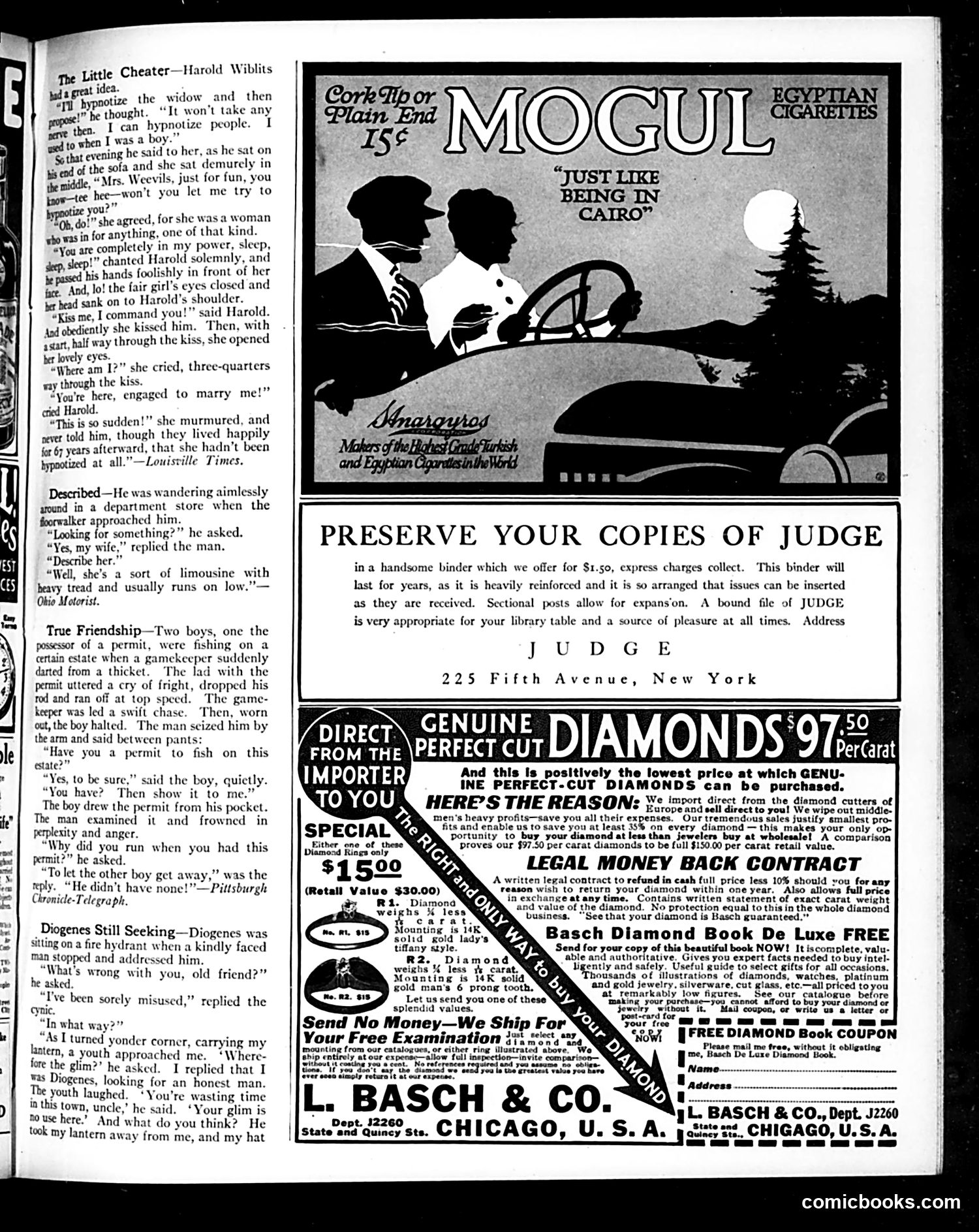
This page is primarily **advertising and filler content** with minimal satirical commentary. The left column contains three brief humor anecdotes typical of early 20th-century magazines: 1. **"The Little Cheater"** — A joke about a man hypnotizing a widow, commanding a kiss, then being tricked into engagement. The humor relies on outdated ideas about hypnosis and female deception. 2. **"Described"** — A brief joke comparing a wife to a heavy-running automobile, playing on emerging car culture humor. 3. **"True Friendship" and "Diogenes Still Seeking"** — Short anecdotes about loyalty and urban rudeness. The right side features **commercial advertisements**: a Mogul cigarette ad showing an automobile scene (with Orientalist framing), a Judge magazine binder offer, and notably, a **Basch & Co. diamond company ad** with aggressive pricing claims and a coupon. There is **no political satire** on this page. The content reflects period attitudes toward gender and consumption but lacks the pointed social commentary one might expect from Judge's satirical tradition.
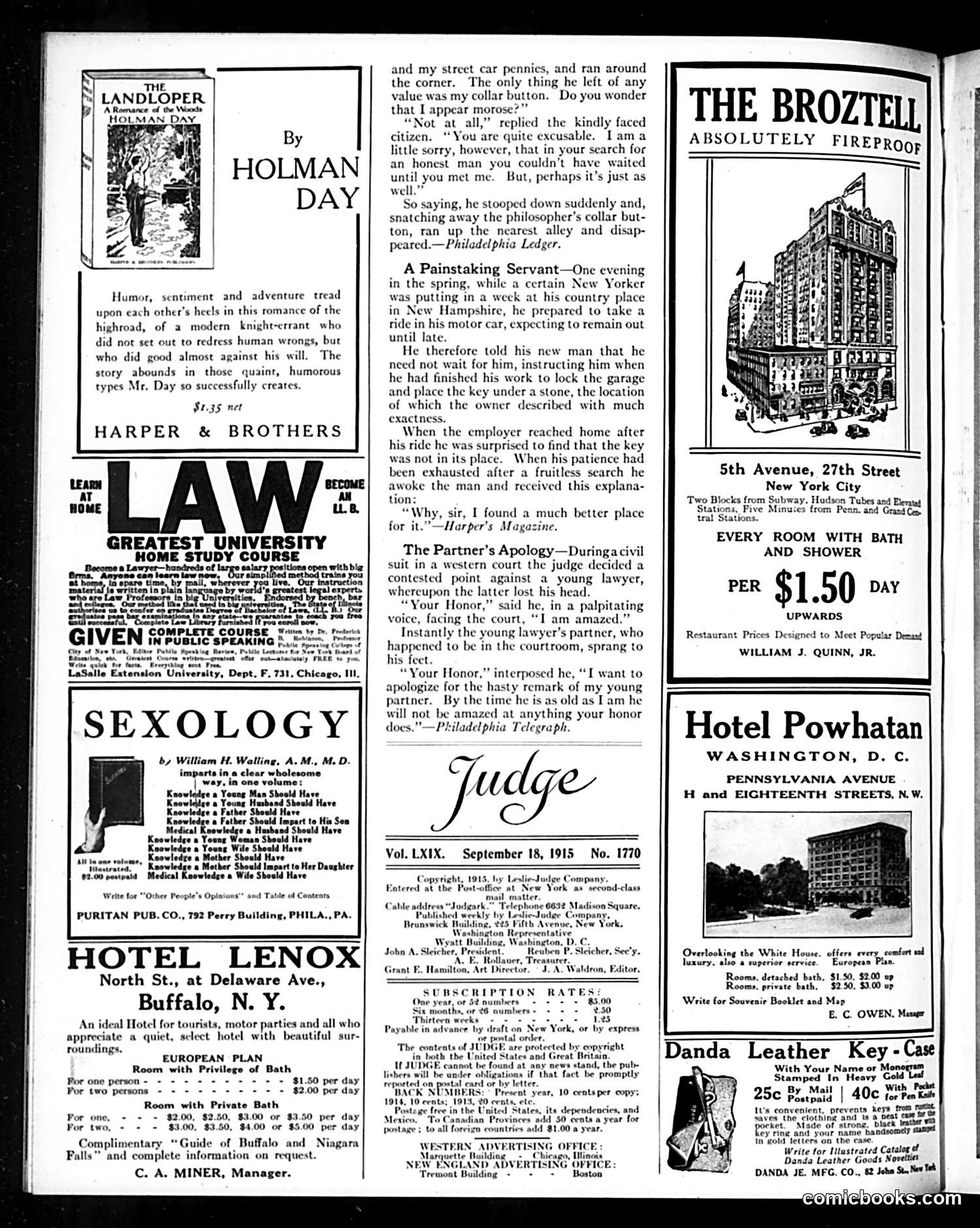
This page from *Judge* magazine (September 18, 1915) is primarily an **advertising and literary page** rather than a satirical cartoon page. The main content consists of three **humorous anecdotes** presented as text: 1. **"A Painstaking Servant"** — A wealthy New Yorker's employee takes literal instructions too seriously (hiding a key in an unexpectedly different place), satirizing servant stupidity or pedantic obedience. 2. **"The Partner's Apology"** — A young lawyer loses composure in court; his older partner sarcastically "apologizes" by insulting the judge's arbitrary rulings, mocking both legal arrogance and judicial hubris. 3. **"The Philosopher's Loss"** — A man complaining about losing valuables to a thief is himself robbed by the "honest man" he was seeking, a darkly comedic irony about urban crime and misplaced optimism. The page is otherwise filled with **period advertisements**: hotel listings (Broztell, Powhatan, Lenox), a book promotion for *The Landloper*, a correspondence course advertisement, and a *Sexology* educational text — typical of early 20th-century magazine advertising.
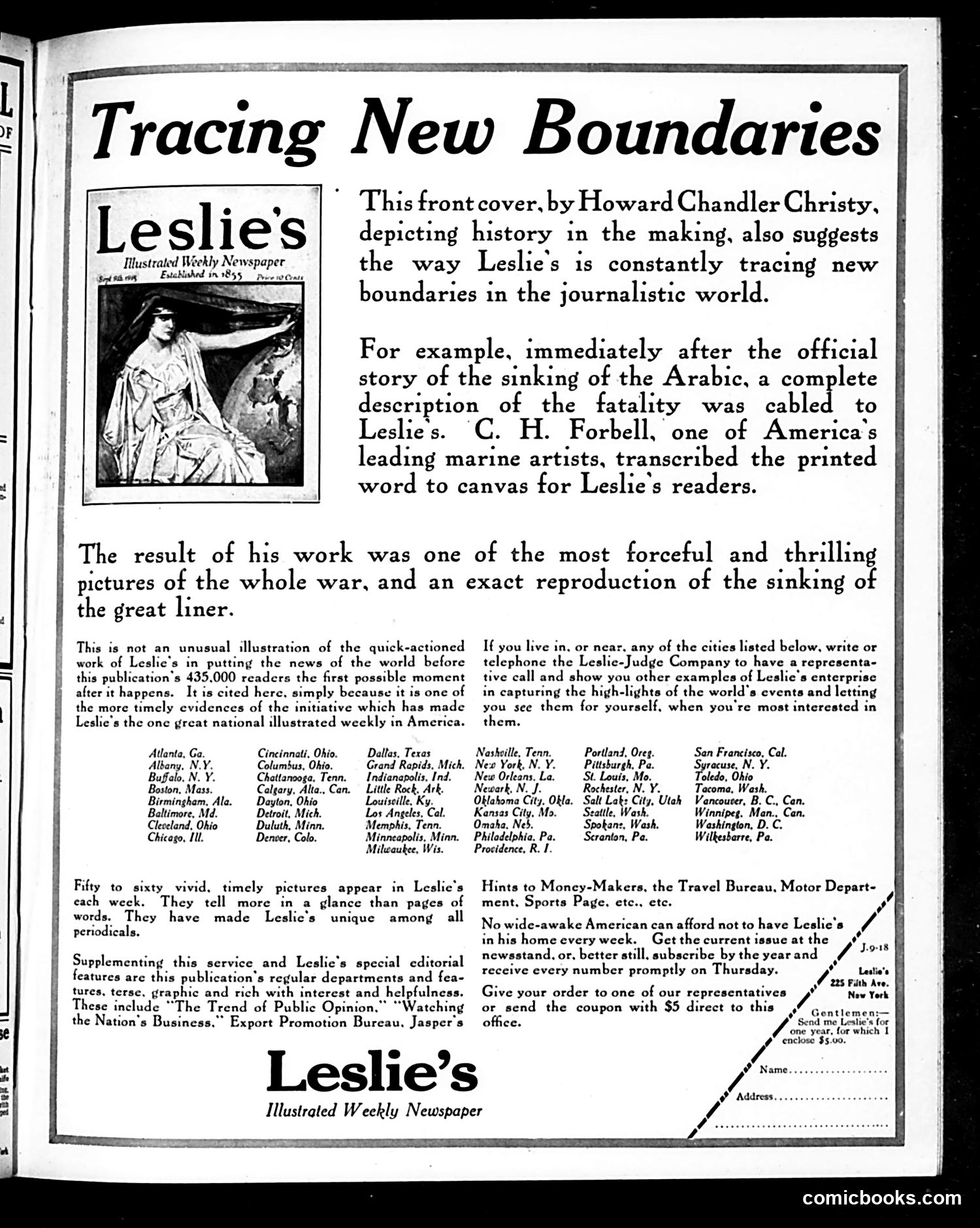
This is primarily **advertising content**, not a political cartoon. It's a full-page promotional piece for *Leslie's Illustrated Weekly Newspaper* appearing in *Judge* magazine. The page promotes *Leslie's* as a cutting-edge news publication by highlighting its rapid coverage of major events—specifically the sinking of the *Arabic* (a British liner torpedoed in WWI, likely 1915). The advertisement emphasizes that *Leslie's* employed leading artist C. H. Forbell to quickly convert eyewitness accounts into illustrations for readers, claiming this demonstrates the publication's superior speed and visual journalism compared to competitors. The front cover image by Howard Chandler Christy depicts a classical female allegorical figure (likely representing History or Liberty), reinforcing *Leslie's* self-presentation as documenting significant historical moments. The page includes a subscription coupon and lists *Leslie's* representatives across major American cities, making it a straightforward circulation-building advertisement rather than satirical commentary.
This is a **Postum advertisement**, not a political cartoon. Postum was a popular caffeine-free coffee substitute of the early 20th century, marketed as a healthier alternative to regular coffee. The circular design reads "HEALTH FIRST" around the outer ring, with "POSTUM" prominently displayed in the center and the company's famous slogan "There's a Reason" below it. The advertisement appeals to health-conscious consumers by emphasizing that choosing Postum over coffee was a sensible decision for one's wellbeing. This was typical marketing strategy for the era, when dietary concerns and health consciousness were growing consumer interests. The formal, serious design reflects the earnest health-promotion messaging common in early 1900s advertising.