
Judge, 1915-09-18 · page 17 of 28
Judge — September 18, 1915 — page 17: what you’re looking at
What you’re looking at
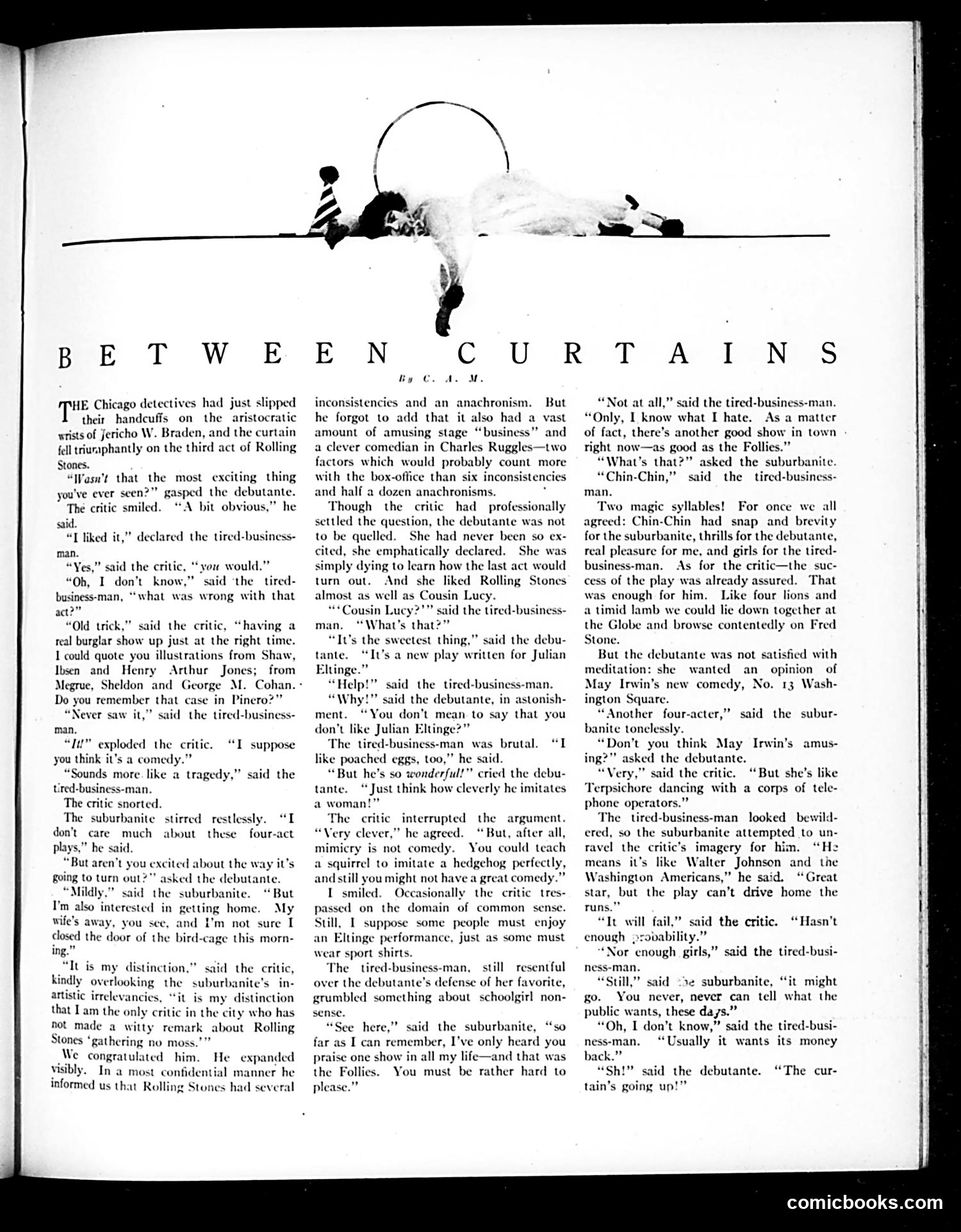
This page satirizes the clash between theatrical critics and ordinary theatergoers. The dialogue follows a critic, a tired businessman, a debutante, and a suburbanite discussing the play "Rolling Stones." The satire targets: 1. **Pretentious critics**: The critic dismisses "Rolling Stones" as obvious and derivative, citing obscure playwrights (Shaw, Ibsen, Pinero) to establish superiority, yet admits the play has entertainment value the audience actually enjoys. 2. **The debutante**: Represents naive enthusiasm, excited by spectacle and celebrity performers like Julian Eltinge (a famous female impersonator of the era). 3. **The tired businessman**: Voice of common sense—he enjoyed the show and doesn't care about artistic pedigree; he's concerned his bird-cage door might be open at home. The core joke: The critic's intellectual posturing about anachronisms and "old tricks" misses what makes theater work—entertainment. The businessman's straightforward enjoyment proves more honest than the critic's affected analysis.
📄 Transcribed text from this page (OCR, searchable)
Machine-transcribed from the original scan — historical spelling and the odd misread are preserved.
BET W E HE Chicago detectives had just slipped T their handcuffs on the ari: i wrists of Jericho W. Braden, and the curtain fell triuraphantly on the third act of Rolling Stones. “Waesn't that the most exciting thing you've ever seen?” gasped the debutante. The critic smiled. “A bit obvious,” he said. “I liked it,” declared the tired-business- man. “Yes,” said the critic, “you would.” “Oh, I don’t know,” said ‘the tired- business-man, “what was wrong with that act?” “Old trick,” said the critic, “having a real burglar show up just at the right time. 1 could quote you illustrations from Shaw, Ibsen and Henry Arthur Jones; from Megrue, Sheldon and George M. Cohan. - Do you remember that case in Pinero? Never saw it,” said the tired-business- man. “It!” exploded the critic. you think it’s a comedy.” “Sounds more. like a tragedy,” said the tired-business-man. The critic snorted. The suburbanite stirred ri don’t. care much about thes plays,” he said. “But aren't you excited about the way it’s going to turn out?” asked the debutante. “Mildly,” said the suburbanite. “But I'm also interested in getting home. My wife’s away, you see, and I’m not sure I closed the door of the bird-cage this morn- ing.” “I suppose lessly. “TL four-act inction,”” said the critic, overlooking the suburbanite’s in- artistic irrelevancies, “it is my distinction that Iam the only critic in the city who has not made a witty remark about Rolling Stones ‘gathering no moss.’” We congratulated him. He expanded visibly. In a most confidential manner he informed us that Rolling Stones had several E N 9 inconsistencies and an anachronism. But he forgot to add that it also had a vas! amount of amusing stage “business” and a clever comedian in Charles Ruggles—two factors which would probably count more with the box-office than six inconsistencies and half a dozen anachronisms. c Though the critic had professionally settled the question, the debutante was not to be quelled. She had never been so ex- cited, she emphatically declared. She was simply dying to learn how the last act would turn out. And she liked Rolling Stones almost as well as Cousin Lucy. “* Cousin Lucy?'” said the tired-business- man. “What's that?” “I's the sweetest thing,” said the debu- ante. “It’s a new play written for Julian slrings “Help!” said the tired-business-man. “Wh: id the debutante, in astonish- ment. ‘You don't mean to say that you don’t like Julian Eltinge?” The tired-business-man was brutal. “I like poached eggs, too,” he said. “But he’s so wonderful!” cried the debu- tante. “Just think how cleverly he imitates a woman The critic interrupted the argument. “Very clever,” he agreed. “But, after all, mimicry is not comedy. You could teach a squirrel to imitate a hedgchog perfectly, and still you might not have a great comedy. I smiled. Occasionally the critic tres- passed on the domain of common sense. Still, I suppose some people must enjoy an Eltinge performance, just as some must ur sport shirts. The tired-business-man, still resentful over the debutante’s defense of her favorit grumbled something about schoolgirl non- sen: ee here,” said the suburbanite, ‘so far as I can remember, I’ve only heard you praise one show in all my life—and that was the Follies. You must be rather hard to please.” Cc U ® T Ae Pens “Not at all,” said the tired-business-man. “Only, 1 know what I hate. As a matter of fact, there’s another good show in town right now good as the Follies.” at's that?” asked the subur “Chin-Chin,” said the — tired-business- man. Two magic syllables! For once we all agreed: Chin-Chin had snap and brevity for the suburbanite, thrills for the debutante, ure for me, and girls for the tired- man. As for the critic—the suc- cess of the play already assured. That was enough for him. Like four lions and a timid lamb we could lie down together at the Globe and browse contentedly on Fred Stone. But the debutante was not meditation: she wanted an opinion of May Irwin’s new comedy, No. 13 Wash- ington Square. “Another four-acter,” said the subur- banite tonelessly. “Don’t you think May Irwin's amus- ing?” asked the debutante. “Very,” said the critic. “But she’s like Terpsichore dancing with a corps of tele- phone operators.” The tired-business-man looked _bewild- ered, so the suburbanite attempted to un- avel the critic’s imagery for him. “He means it’s like Walter Johnson and the Washington Americans,” he said. “Great star, but the play can’t drive home the runs.” “It will fail,” said the critic. enough »rovability.” ‘Nor cnough girls,” ness-man. “Still,” said se suburbanite, “it might go. You never, never can tell what the public wants, these days.” “Oh, I don’t know,” said the tired-bus ness-man. ‘Usually it wants its money back.” “Sh!” said the debutante. tain’s going up!” “Hasn't said the tired-busi- “The cur- comicbooks.com