
A complete issue · 28 pages · 1915
Judge — August 28, 1915
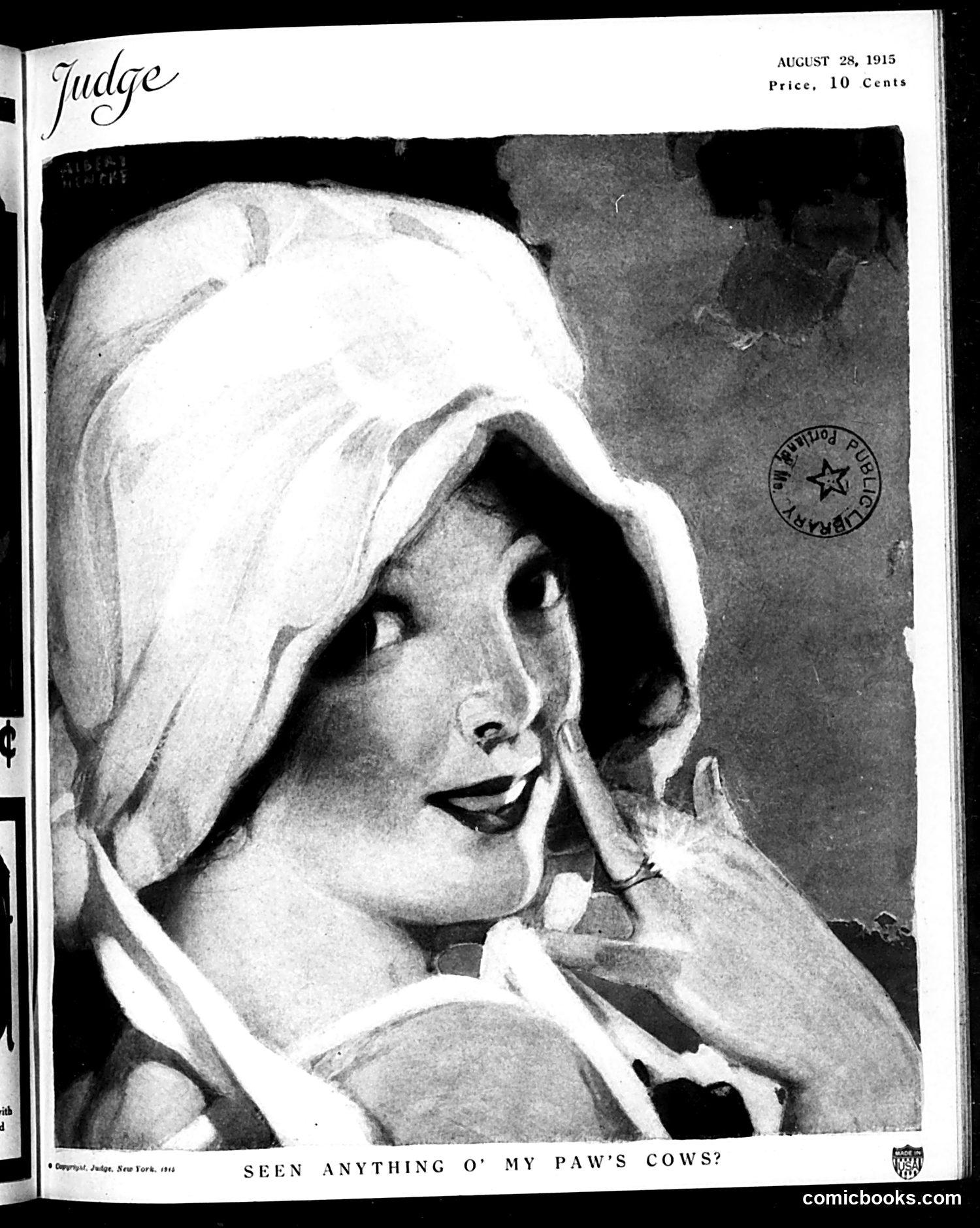
This cover features a woman in an elaborate white head covering/bonnet asking "SEEN ANYTHING O' MY PAW'S COWS?" The caption suggests rural or farm humor, playing on dialect ("o'" for "of," "paw's" for "pa's"). The joke appears to reference missing livestock, a common comedic scenario in early 20th-century American humor. The woman's exaggerated fashion—the enormous, fashionable head covering contrasted with her rural dialect—creates satire: she's dressed in expensive city fashion while asking about farm animals in rural speech patterns. This likely mocks the collision between modern urban fashion and rural life, a popular theme in Judge's humor during this era. The specific reference to missing cows remains unclear without additional context.
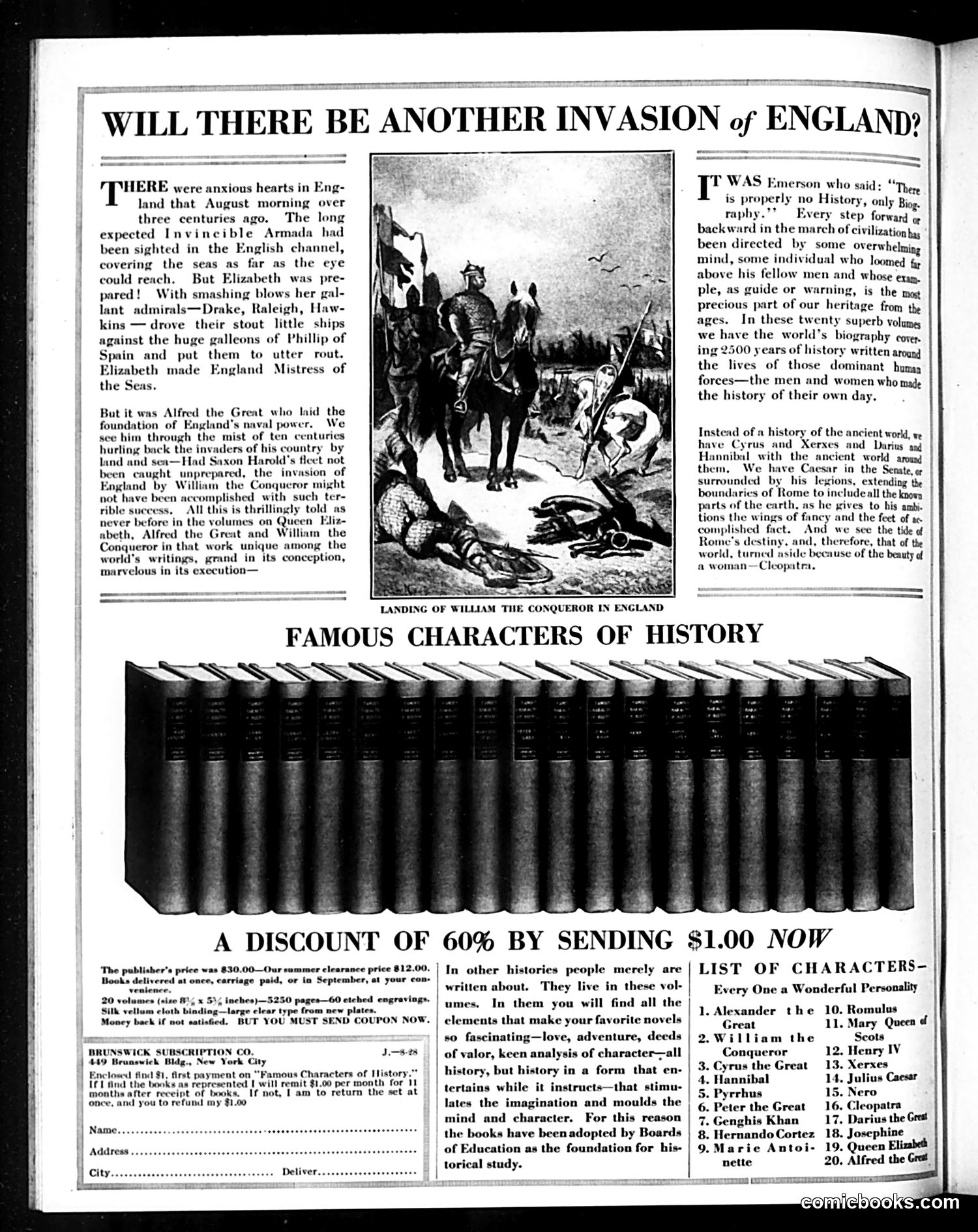
This page is primarily an **advertisement** for a book series titled "Famous Characters of History," not political satire. The central image depicts William the Conqueror's 1066 landing in England, illustrating the book's historical content. The headline "Will There Be Another Invasion of England?" appears designed to grab reader attention by invoking contemporary anxiety—likely referencing early 20th-century concerns about European conflicts or naval threats. However, the actual content pivots immediately to promoting the historical book series, using the invasion reference as a hook rather than making a satirical point. The accompanying text emphasizes how these volumes present history through compelling biographical narratives of historical figures (Alexander the Great, Julius Caesar, etc.), marketed as superior to dry historical accounts. This is essentially a subscription sales pitch disguised within Judge magazine's format.
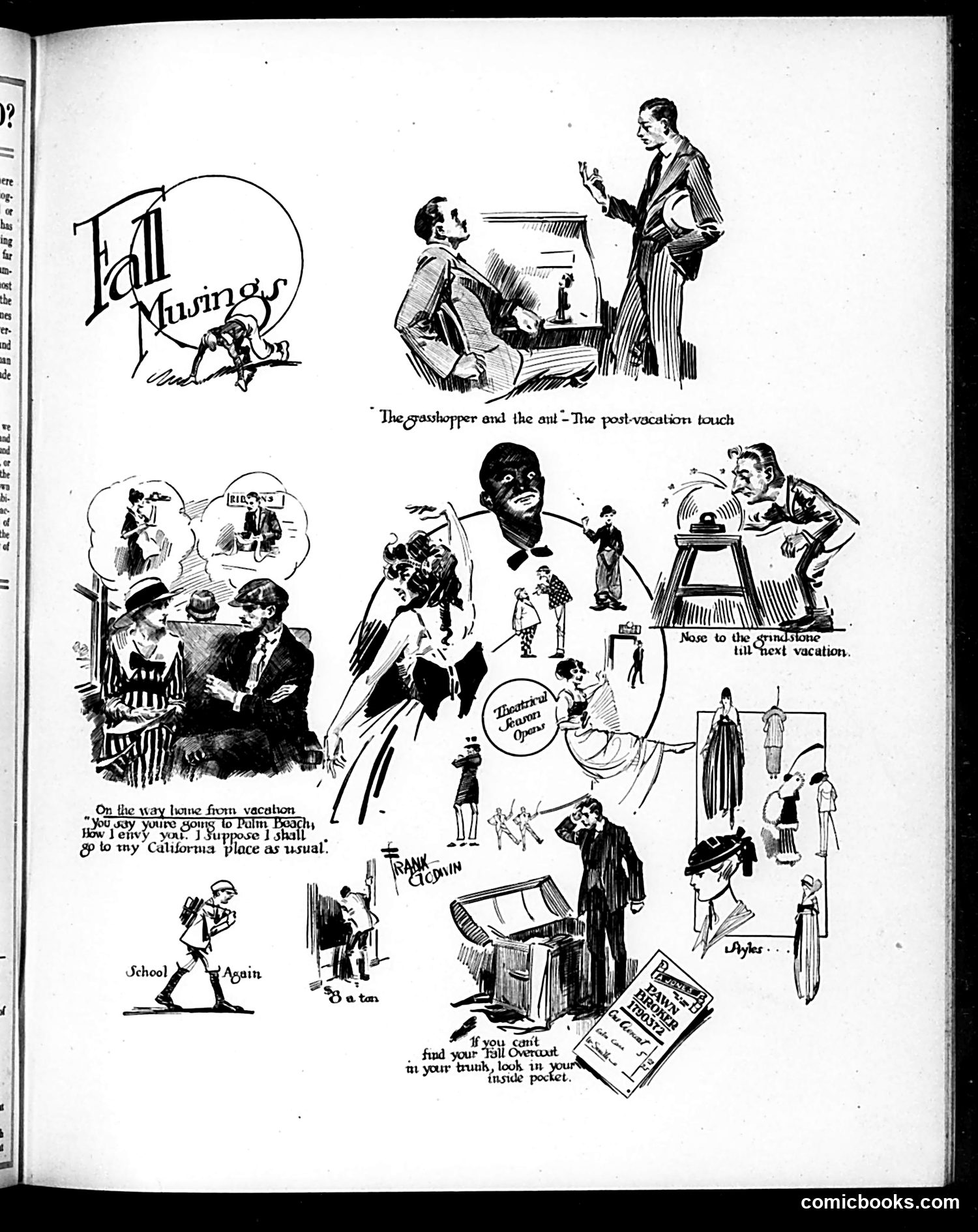
This page satirizes the common experience of returning from vacation. The top panel shows "The Grasshopper and the Ant"—a reference to Aesop's Fable—where an office worker must confront his accumulated work after vacation while his colleague stayed behind working. The central cartoons depict vacation destinations (Palm Beach, California) and the conflict between wanting leisure versus returning to responsibilities. References include theatrical productions, school resuming, and a "Tall Overcoat" trunk—apparently a luggage brand being advertised/joked about. The humor targets the typical post-vacation blues: the gap between idyllic vacation fantasies and the harsh reality of overflowing desks, looming bills, and routine obligations. The caricatured Black face in the center (reflecting period publication standards) appears to represent a porter or service worker—common in vintage period humor.
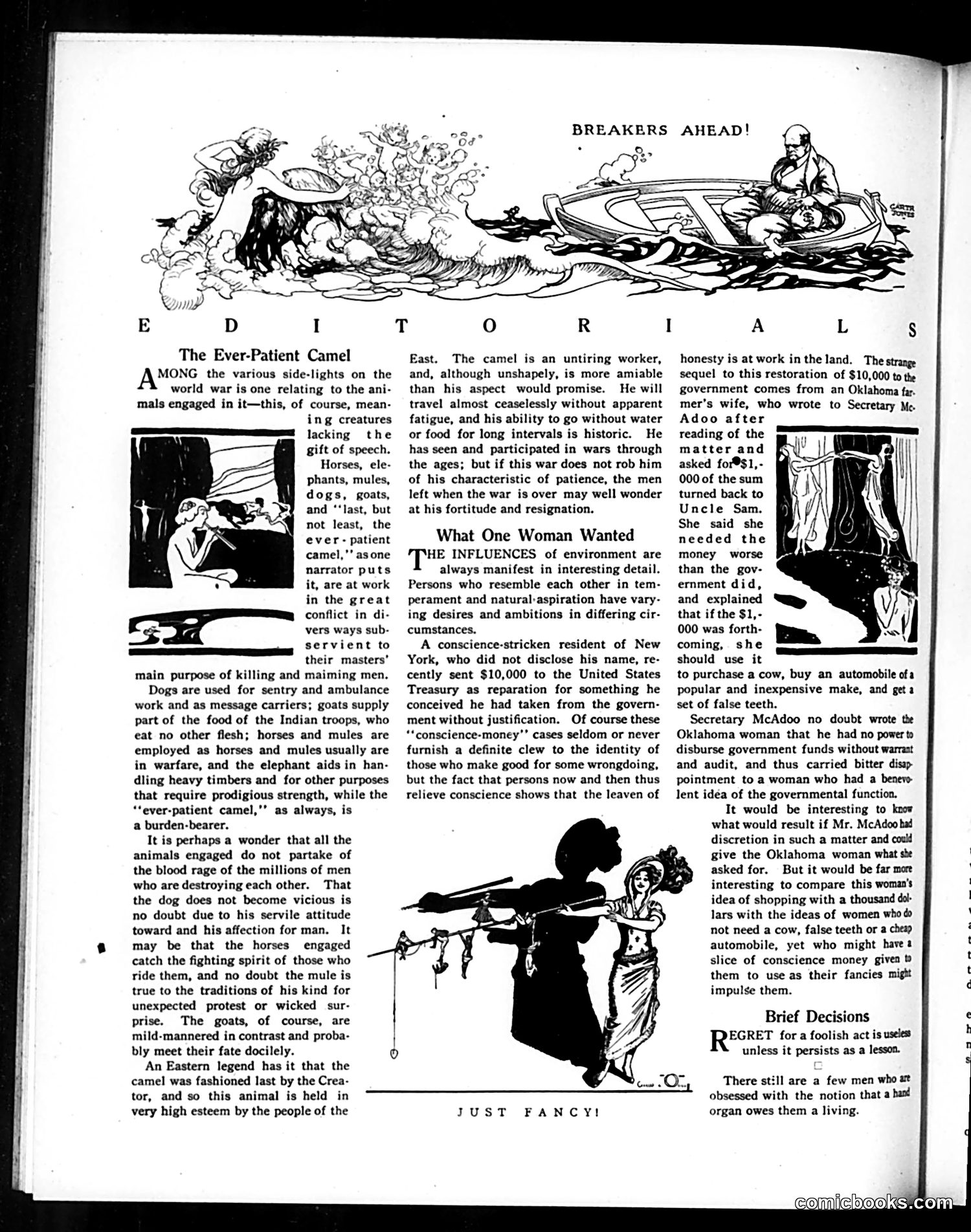
This page from *Judge* magazine contains three distinct sections: 1. **"Breakers Ahead!"** (top): A nautical cartoon warning of danger ahead, with passengers in a boat and what appears to be turbulent waters or obstacles. 2. **"The Ever-Patient Camel"** (main article): A lengthy editorial praising camels' work ethic and patience, using them as a metaphor for endurance during wartime. It contrasts animals' steadfast service with human nature. 3. **"What One Woman Wanted"** (right): A story about a New York woman who sent $10,000 to the U.S. Treasury as reparation for funds she believed wrongfully obtained from government. The satire critiques her naive attempt to purchase a cow, automobile, and false teeth instead—mocking both her conscience and governmental waste. The page reflects WWI-era concerns about patriotism, government accountability, and moral responsibility.
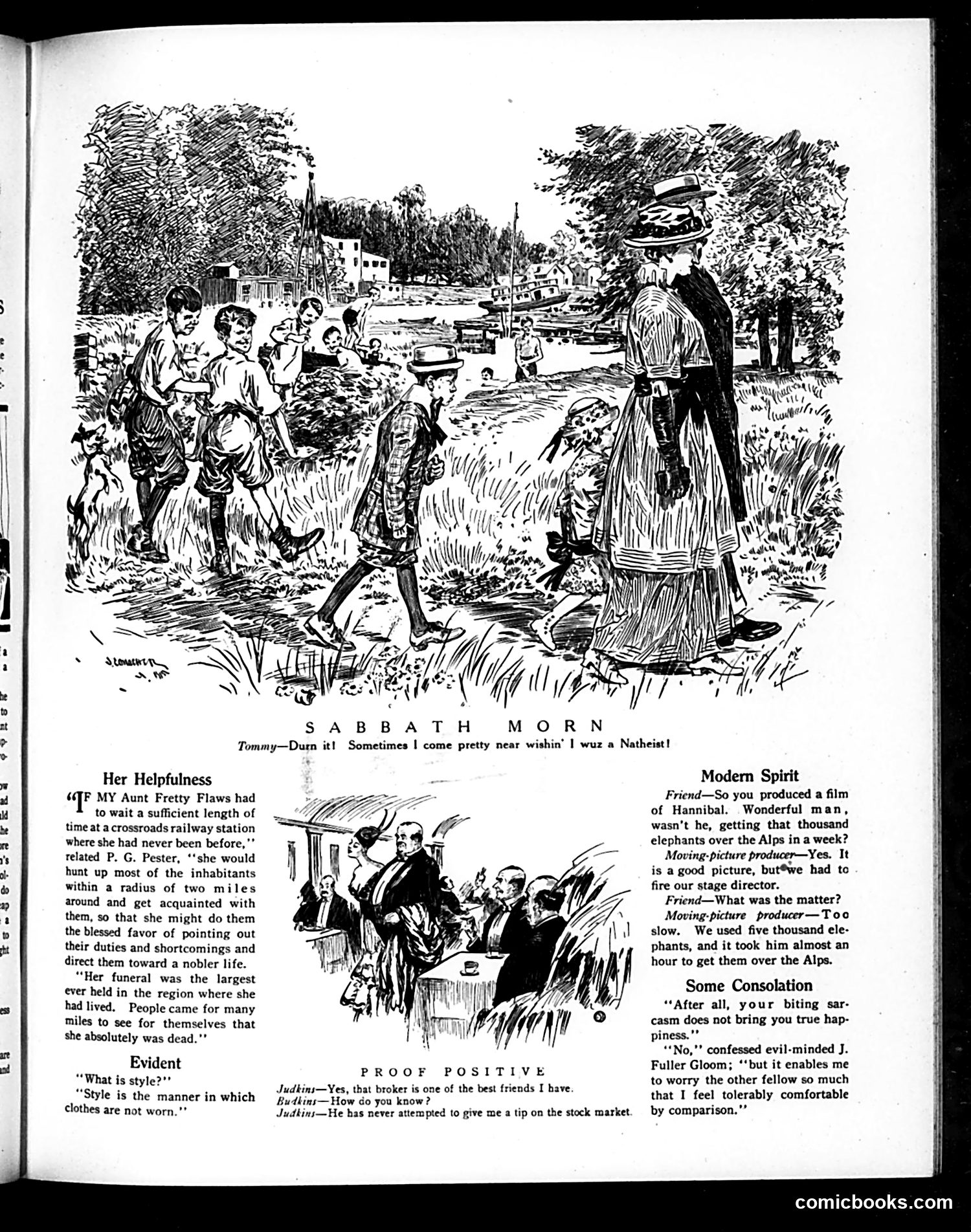
The top cartoon "Sabbath Morn" depicts a woman (likely representing proper Victorian society) encountering children playing near a river on Sunday, apparently distressed that they're engaged in secular recreation rather than religious observance. The caption references a child's near-blasphemous comment. The surrounding text items are brief humorous anecdotes rather than political commentary: - "Her Helpfulness" mocks an aunt's social climbing through railroad networking - "Evident" jokes about fashion terminology - "Modern Spirit" satirizes a film producer's excessive use of elephants in production - "Proof Positive" contains a stock-market joke - "Some Consolation" offers dark humor about comparative misery The page reflects turn-of-the-century American humor focused on social customs, upper-class pretension, and everyday absurdities rather than partisan politics.
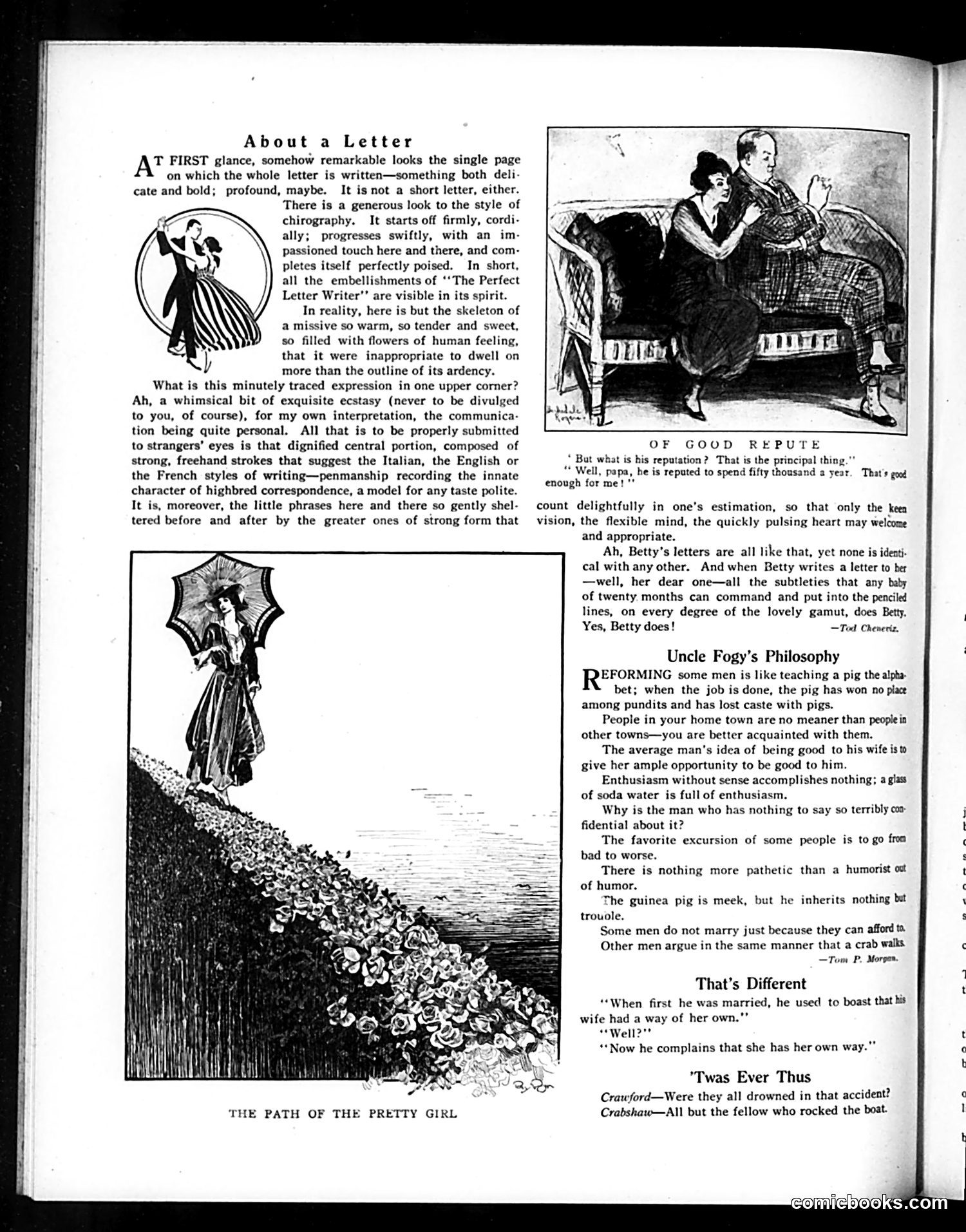
This page from Judge combines romantic and satirical content typical of early 20th-century American humor magazines. **"About a Letter"** celebrates refined letter-writing as an art form, describing how a properly composed letter reveals character and emotion through penmanship and phrasing. The illustration "The Path of the Pretty Girl" depicts a woman on a hillside amid flowers—romanticizing feminine virtue and beauty. **"Of Good Repute"** satirizes materialistic courtship: a father asks about a suitor's reputation; the daughter answers she cares only that he spends fifty thousand dollars yearly. This mocks how "respectability" could be purchased rather than earned. **"Uncle Fogy's Philosophy"** offers cynical observations on human nature—comparing reform efforts to teaching pigs, attacking hypocrisy in marriage, and lampooning false enthusiasm. **"'Twas Ever Thus"** delivers a brief punchline: in a boating accident, everyone drowns except the man who rocked the boat—implying those who cause trouble often escape consequences. The overall tone blends Victorian romance with biting social commentary on courtship, morality, and human folly.
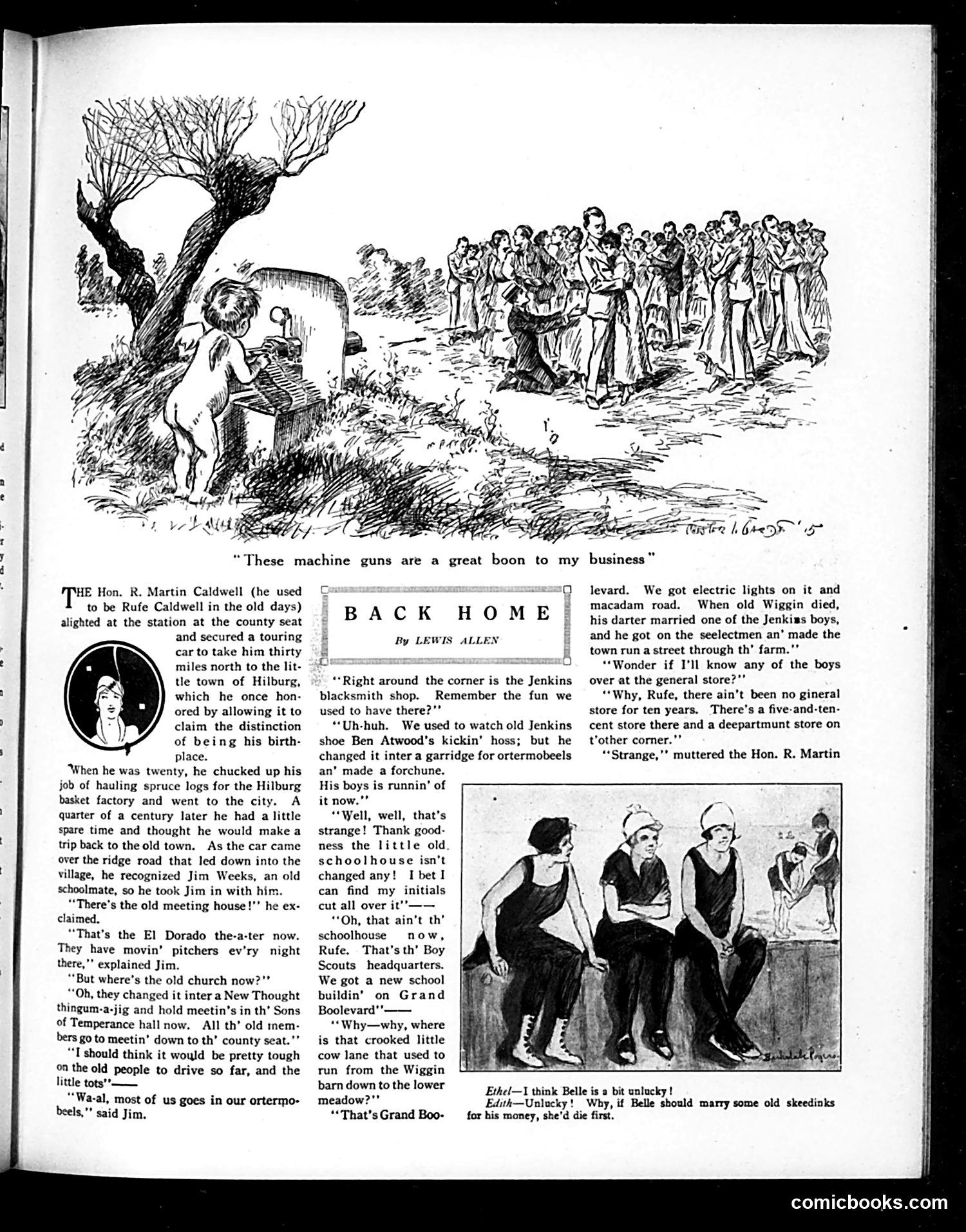
This story by Lewis Allen satirizes the disorientation of a successful city man (Hon. R. Martin Caldwell) returning to his small hometown after 25 years. The humor derives from his shock at modernization: the meeting house is now a movie theater; the blacksmith shop became an automobile garage; the old schoolhouse is a Boy Scouts headquarters; unpaved cow lanes are now macadamized streets with electric lights; the general store has been replaced by chain retail. The satire targets both nostalgia for the "old ways" and rapid American industrialization circa 1900-1920. Caldwell expected stasis but finds progress—a theme common to Judge magazine's commentary on social change. The caption quote about "machine guns" and "business" (visible in the sketch) appears unrelated, possibly from another page section or advertisement.
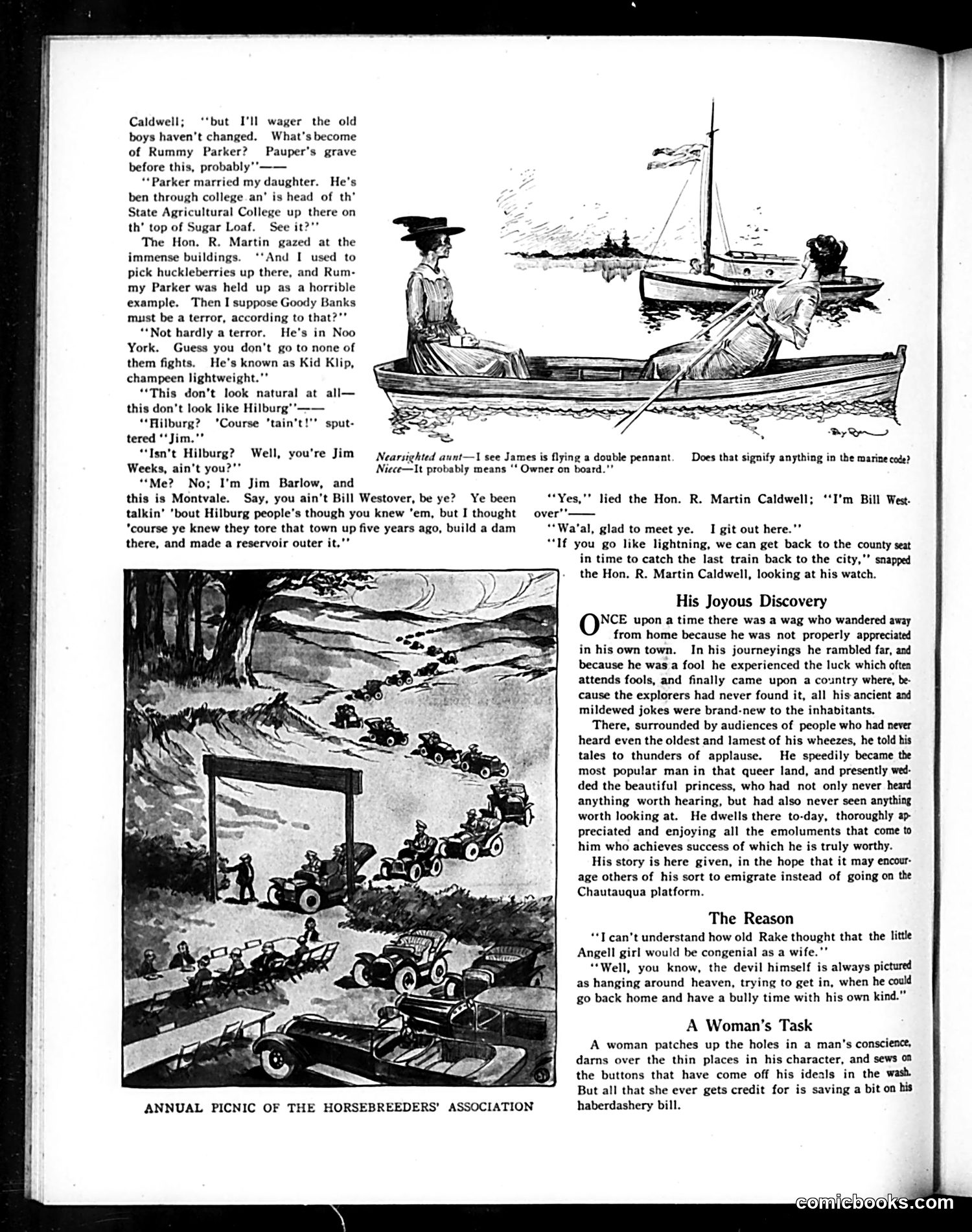
This page contains multiple satirical pieces typical of Judge's early 20th-century humor: **Main Narrative:** A dialogue between "the Hon. R. Martin Caldwell" and a local man discussing how a small town (Hilburg) has been transformed—its residents dispersed by a dam project five years prior. The satire mocks both the old gentleman's nostalgia for disreputable former townspeople (Rummy Parker, now respectable; Kid Klip, now famous) and the irony that rural modernization has erased the town itself. **"His Joyous Discovery":** A fable mocking mediocrity: a failed humorist finds success abroad only because audiences there lack cultural reference points to recognize his jokes as stale. The satire critiques both the traveling lecturer circuit (Chautauqua) and the gullibility of unsophisticated audiences. **Smaller quips** ("The Reason," "A Woman's Task") offer cynical observations on marriage and domestic labor—typical Judge fare emphasizing women's thankless work. The large illustration shows the "Annual Picnic of the Horsebreeders' Association," featuring early automobiles—the page's only non-satirical content.
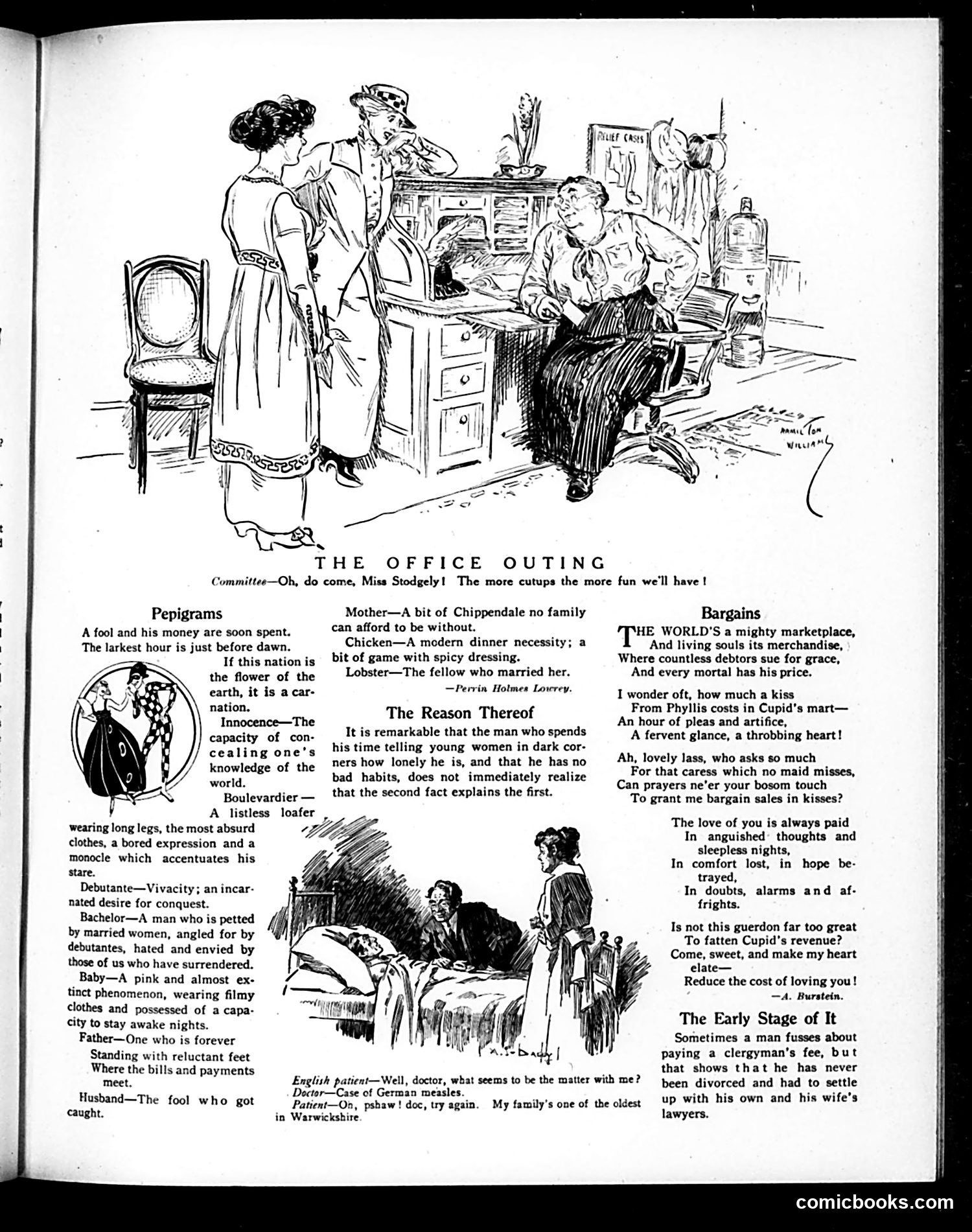
The main cartoon depicts a workplace committee inviting "Miss Stodgely" to an office outing, with the chairman saying they want more "cutups" (lively, amusing people) for fun. The joke satirizes forced corporate socializing—the committee member's enthusiasm masks the awkwardness of mandatory social events mixing coworkers of different ranks and personalities. The surrounding content includes satirical definitions (a "Husband" is "the fool who got caught"; a "Debutante" is "vivacity; an incarnated desire for conquest") mocking social conventions and gender roles of the era. Other pieces—a poem about romantic "bargains," medical jokes, and witticisms—are typical Judge fare: light satire targeting middle-class pretension, courtship rituals, and domestic life. The overall page reflects early 20th-century magazine humor: cynical observations about marriage, gender dynamics, and social climbing presented as clever wordplay rather than sharp political commentary.
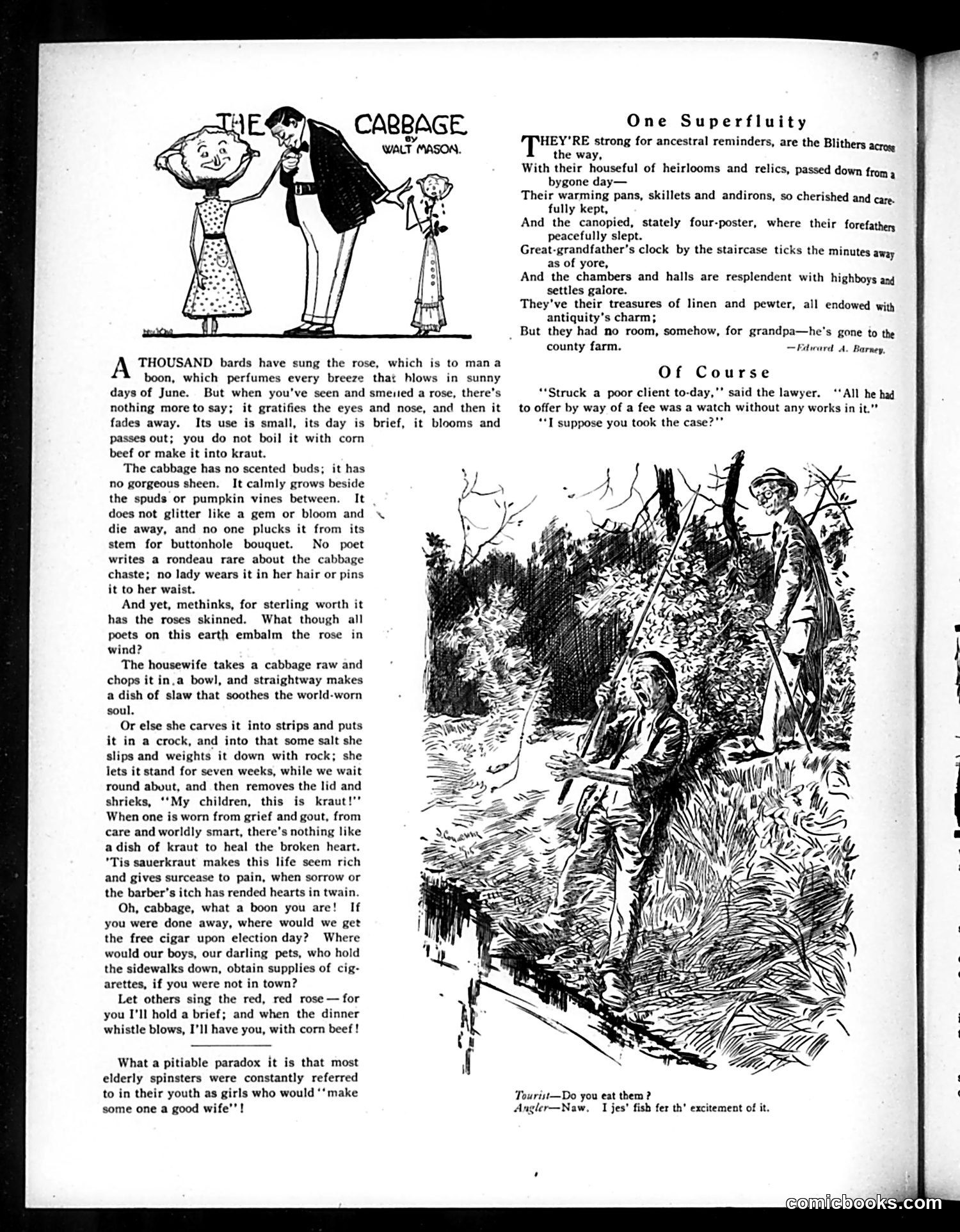
**"The Cabbage" (left):** A humorous poem elevating the humble cabbage over the romanticized rose. The satire mocks poetry's obsession with beautiful but useless flowers, arguing the cabbage—transformed into slaw and sauerkraut—genuinely improves people's lives. It's also a subtle jab at German/immigrant cuisine (sauerkraut), suggesting "common" working people's food has more practical value than elite aesthetic pursuits. The final lines reference political patronage: free cigars distributed on election day, implying cabbage-growing communities provided voters. **"One Superfluity" (top right):** Satirizes the Blithers family's obsession with ancestral heirlooms and antiques while neglecting their elderly grandfather, whom they've institutionalized ("county farm"). The irony: they preserve great-grandfather's possessions but abandoned the actual living relative. Critiques materialism and false gentility. **"Of Course" (bottom):** Brief legal joke—a poor client offers a broken watch as payment; the lawyer accepts, implying desperate lawyers will take any fee, however worthless.
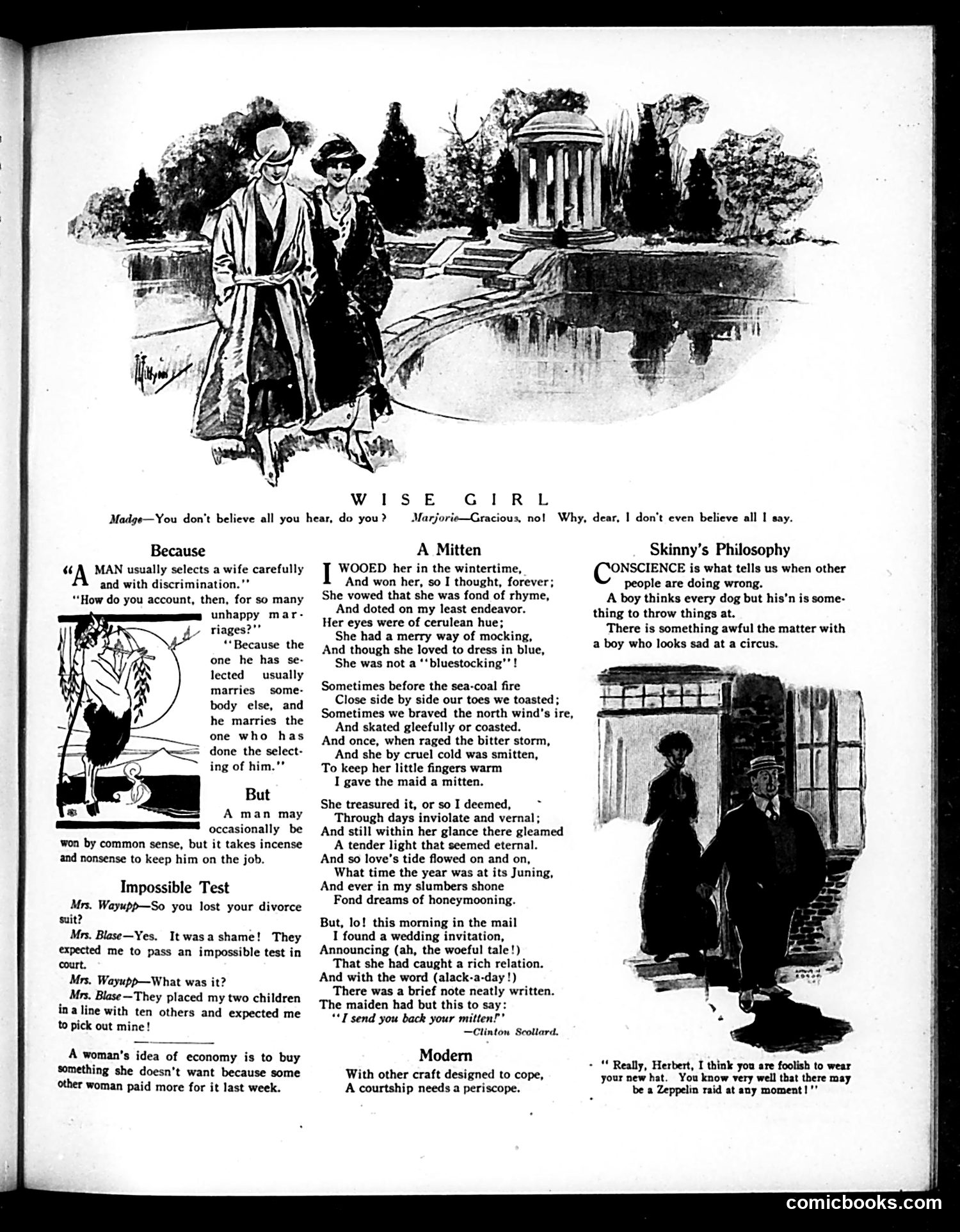
This page contains several brief satirical pieces on courtship, marriage, and gender relations typical of early 20th-century American humor. **"Wise Girl" dialogue** mocks women's selective credulity—Madge claims she doesn't believe everything she hears, then contradicts herself. **"Because"** jokes about marriage selection: men choose wives carefully, yet unhappy marriages result because the woman selected him instead, or he married someone else's choice. **"A Mitten"** (poem by Clinton Scollard) is romantic satire: a suitor woos a woman throughout winter, gives her a mitten to keep her hands warm, imagines eternal love—only to receive a wedding invitation to someone wealthy with his mitten returned as a rejection note. **"Impossible Test"** satirizes divorce court: a woman lost her suit because she couldn't identify her own children among others—absurdist humor about maternal identification. **"Skinny's Philosophy"** offers cynical observations on conscience and boyhood behavior. **"Modern"** makes a brief joke about courtship requiring a "periscope"—likely referencing WWI-era submarine warfare concerns. The overall tone reflects period cynicism about romance, women's materialism, and marriage.
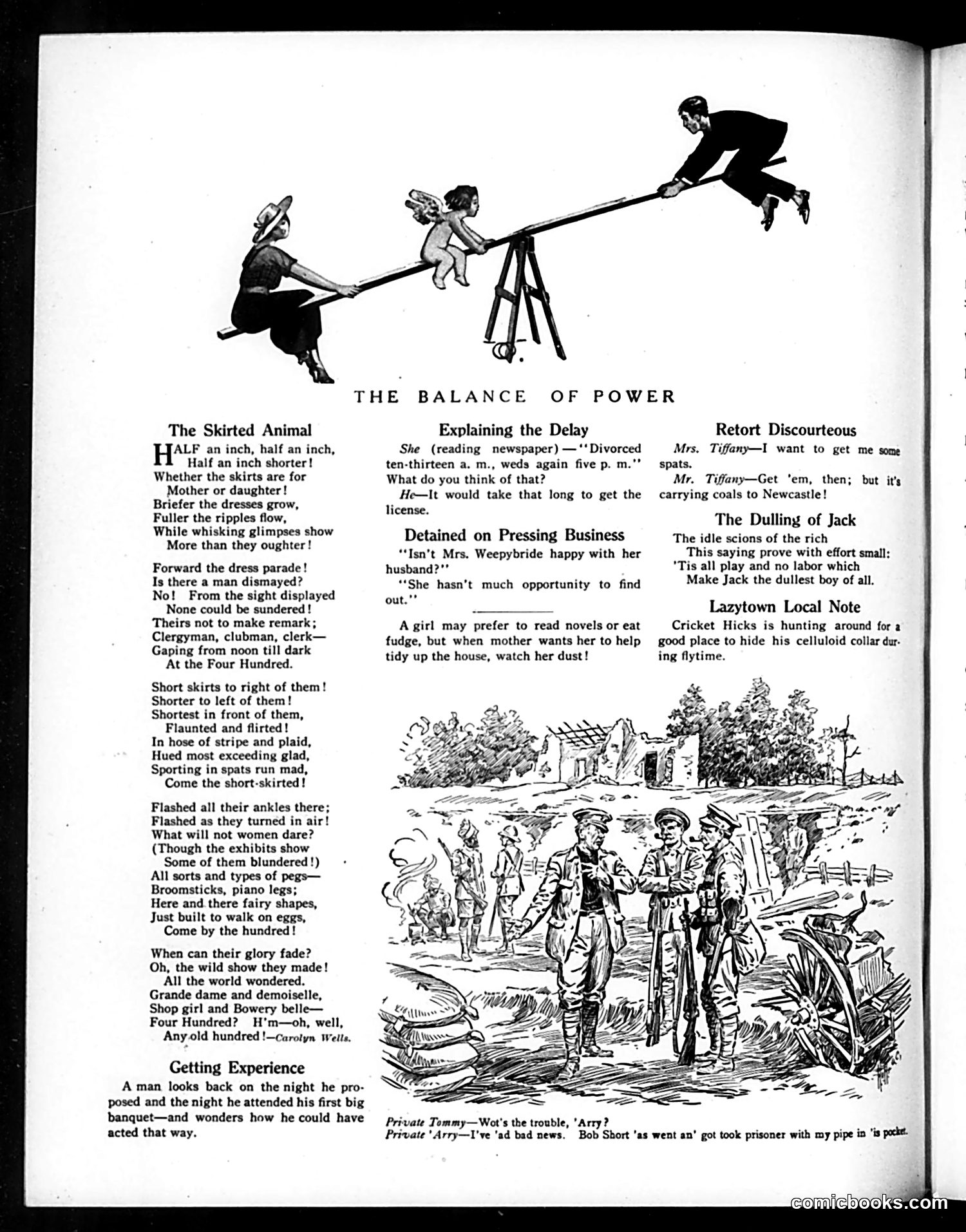
The main cartoon parodies Tennyson's "Charge of the Light Brigade," reimagined as women's fashion progressing toward shorter skirts. The illustration shows a seesaw with two women and a child, representing the social tension over hemlines—a genuine controversy of the early 20th century when women's skirts were gradually rising, shocking conservative society. The satire mocks male obsession with this trend ("Is there a man dismayed? No!") while poking fun at women's legs, described variously as "broomsticks, piano legs," and "fairy shapes." The poem's final stanzas democratize the fashion across class lines ("Grande dame and demoiselle, / Shop girl and Bowery belle"), suggesting this wasn't just an upper-class phenomenon. The surrounding humor pieces continue Judge's satirical tone on gender relations, marriage, and social propriety—typical content for this era's magazine.
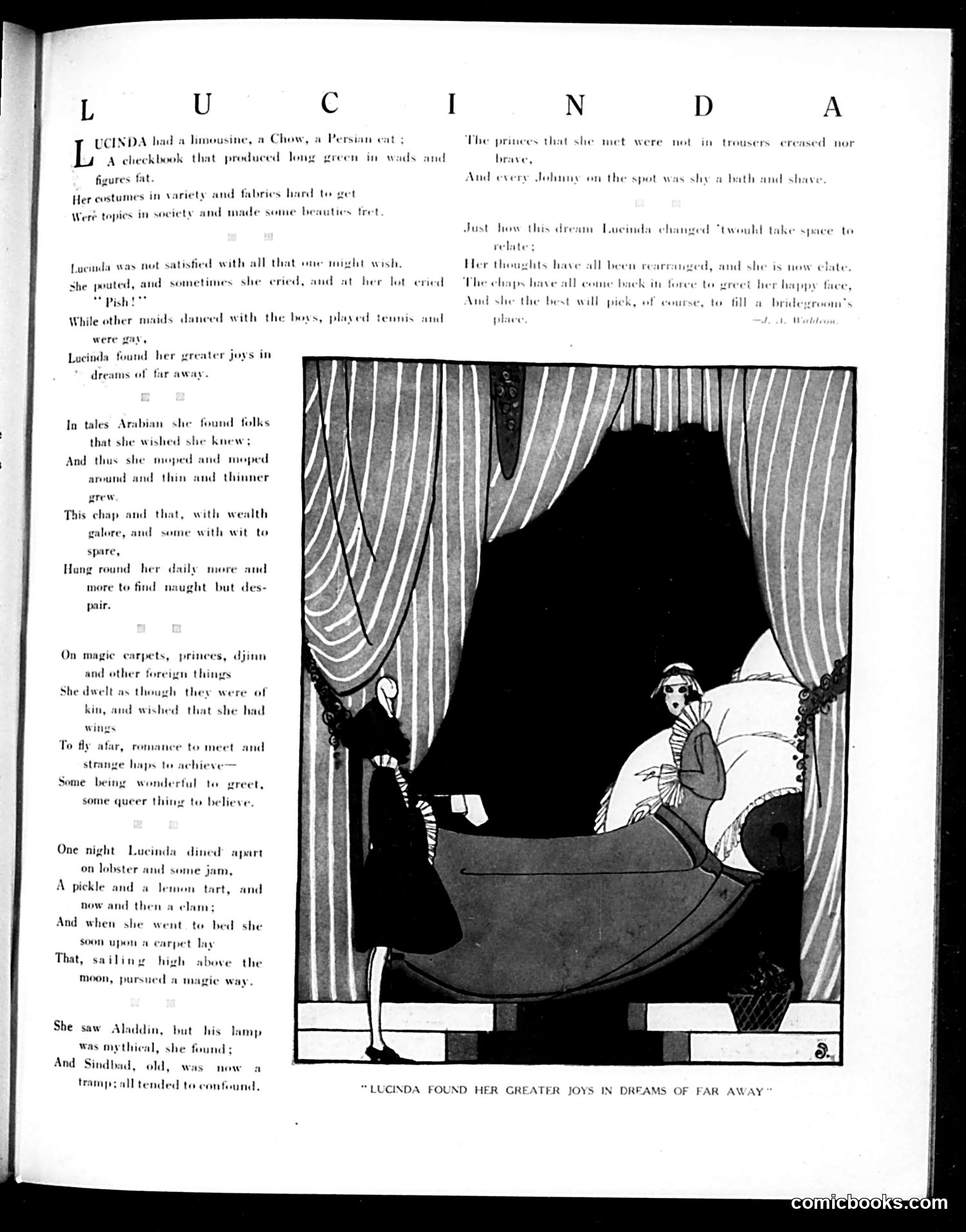
This illustrated story satirizes a wealthy, dissatisfied young woman named Lucinda who has everything materially—a limousine, fashionable clothes, suitors—yet remains perpetually unhappy, dreaming of exotic romance instead. The cartoon shows Lucinda reclining on a magic carpet, escaping into fantasies of Arabian Nights adventures (Aladdin, Sindbad) rather than accepting the respectable suitors available to her in real life. The satire targets female restlessness and unrealistic romantic expectations: Lucinda pines for adventure and "strange haps" while actual eligible men ("every Johnny") court her unsuccessfully. The moral is clear: her dissatisfaction stems from preferring fantasy to reality. The magic-carpet fantasy sequence literalizes her psychological escapism—she's literally fleeing the ordinary world of marriage prospects for mythical romance that cannot exist. This reflects early 20th-century anxiety about modern women's education and independence making them dissatisfied with traditional domestic roles.
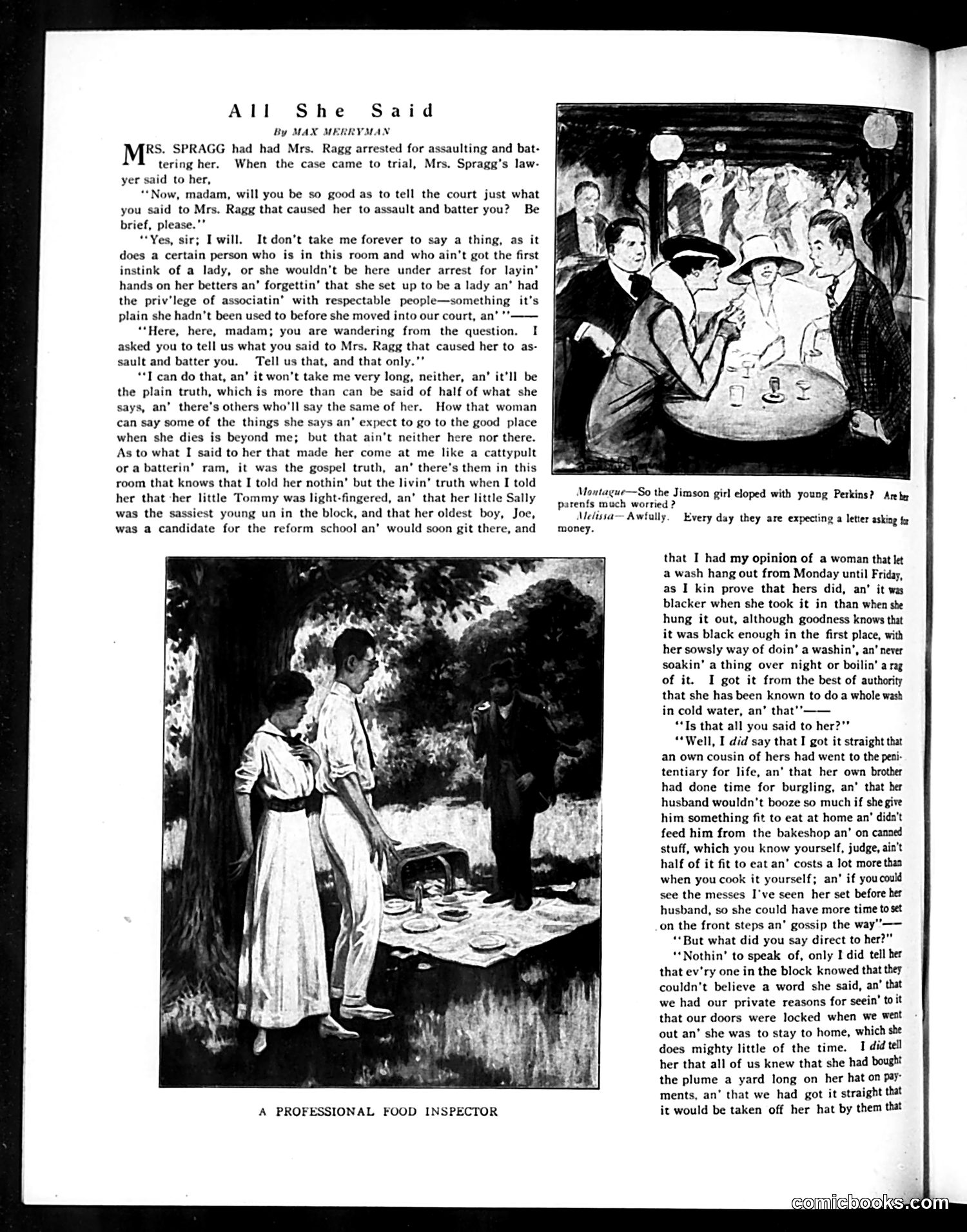
This story satirizes working-class women's gossip and verbosity in the courtroom. Mrs. Spragg has sued Mrs. Ragg for assault, but when testifying, Mrs. Spragg launches into extended character assassination rather than stating what she actually *said* to provoke the attack. The judge repeatedly asks her to be brief and direct, but Mrs. Spragg ignores him, airing neighborhood scandals: Mrs. Ragg's dirty laundry habits, her children's criminal tendencies (theft, reform school), her cousin's prison time, her husband's drinking, her poor cooking, and her installment-plan feathered hat. The satire targets both the gossiping working-class woman unable to distinguish relevant fact from malicious rumor, and her utter disrespect for courtroom authority. The judge's frustration represents civilized society's contempt for this social class's inability to communicate properly or behave respectfully. The accompanying illustration shows what appears to be a food inspector—likely another working-class figure—creating an ironic visual parallel about judgment and standards.
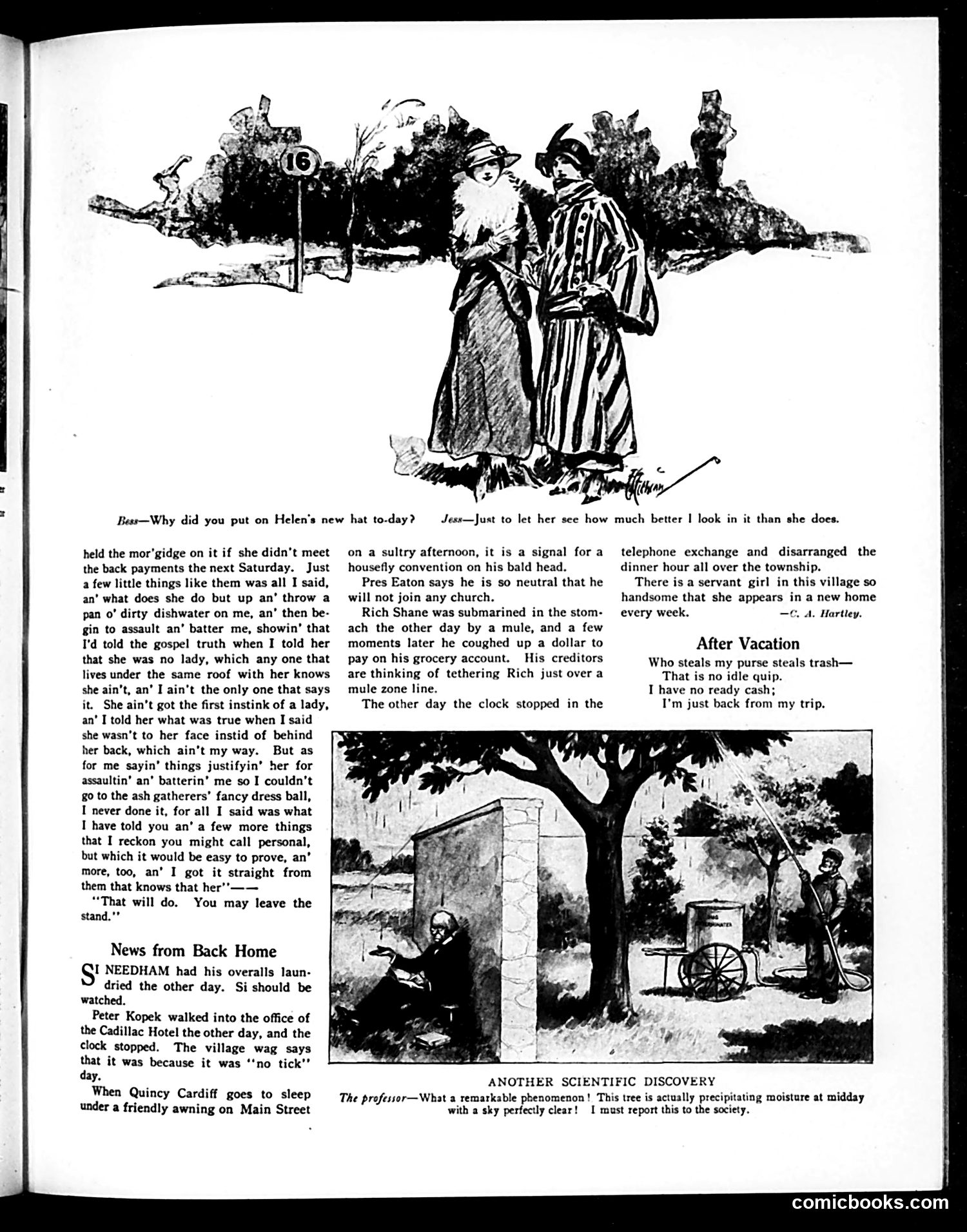
This page contains two distinct satirical pieces: **Top cartoon:** A domestic dispute dialogue. A man defends insulting his wife by claiming he was merely stating truth about her lack of refinement—she responded by throwing dishwater and assaulting him. The satire targets working-class marital conflict and the man's self-righteous justification for verbal cruelty, ending when a judge tells him to leave the stand. It mocks both the couple's rough behavior and the man's attempt to position himself as the wronged party. **"News from Back Home" section:** Rural humor vignettes mocking small-town characters and incidents—a man getting overalls laundered (deemed suspicious), a hotel clock stopping when a vagabond enters, a bald man attracting flies while sleeping rough. The satire targets rural eccentricity and poverty. **Bottom cartoon:** A professor observing a tree "precipitating moisture" (sweating) on a clear day, planning to report it to his society. This mocks pseudoscientific pretension—missing an obvious explanation (likely the tree's natural moisture or ground dew). All employ *Judge* magazine's typical format: gentle mockery of American social types and intellectual pretension.
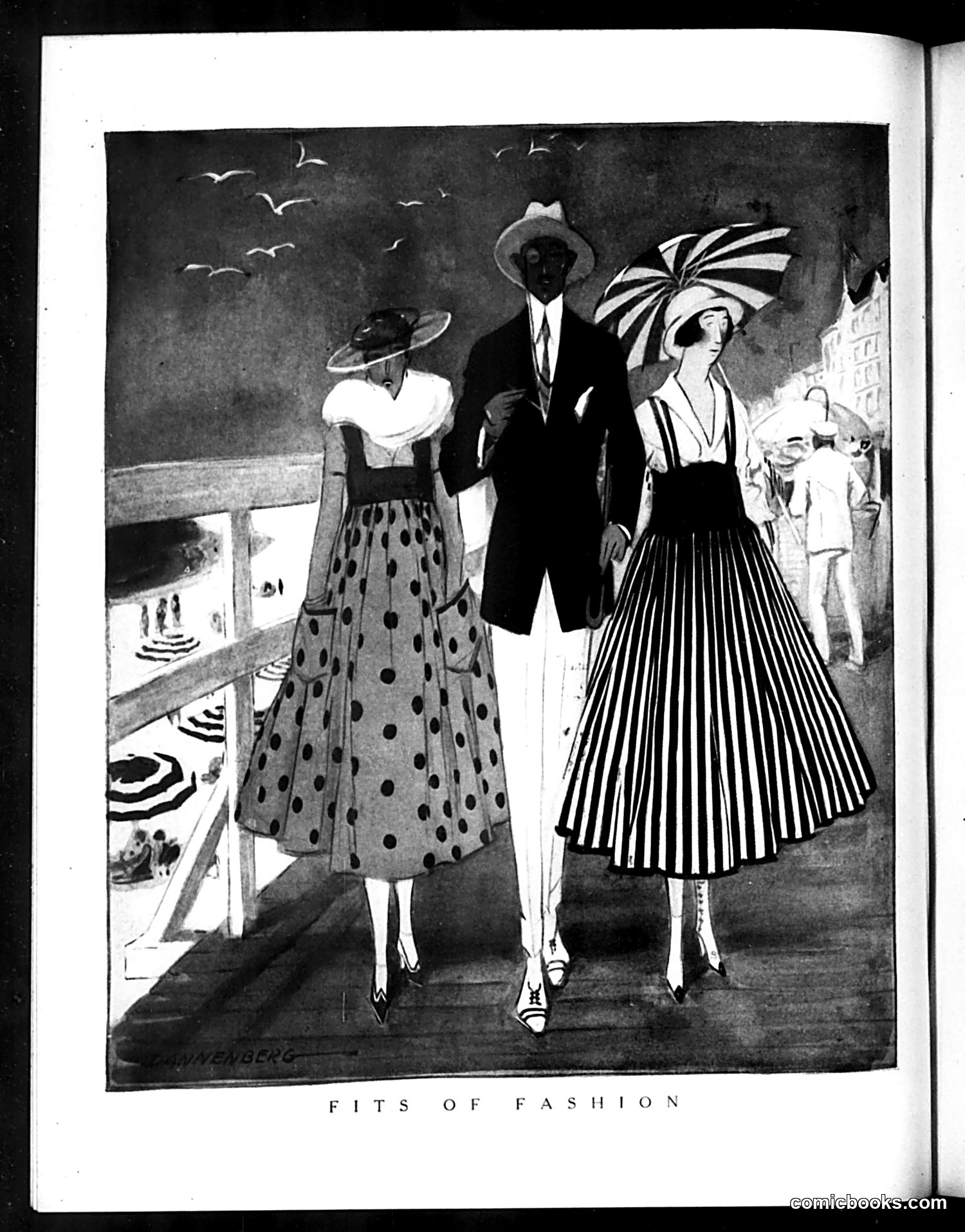
This illustration from *Judge* magazine satirizes women's fashion trends through three stylishly dressed figures on what appears to be a seaside promenade. The caption "Fits of Fashion" suggests the satire targets the absurdity and rapid changes in women's clothing styles. The three women display exaggerated fashion elements typical of the era—polka-dotted skirts, striped pleated skirts, and elaborate hats with decorative elements. The figures appear somewhat caricatured, with their elongated proportions emphasizing fashionable silhouettes. The scene's coastal setting and well-dressed bystanders in the background suggest this depicts fashionable society on display. The satire likely mocks how women blindly followed extreme fashion trends and how these styles changed unpredictably—the "fits" being both fashion choices and emotional whims.
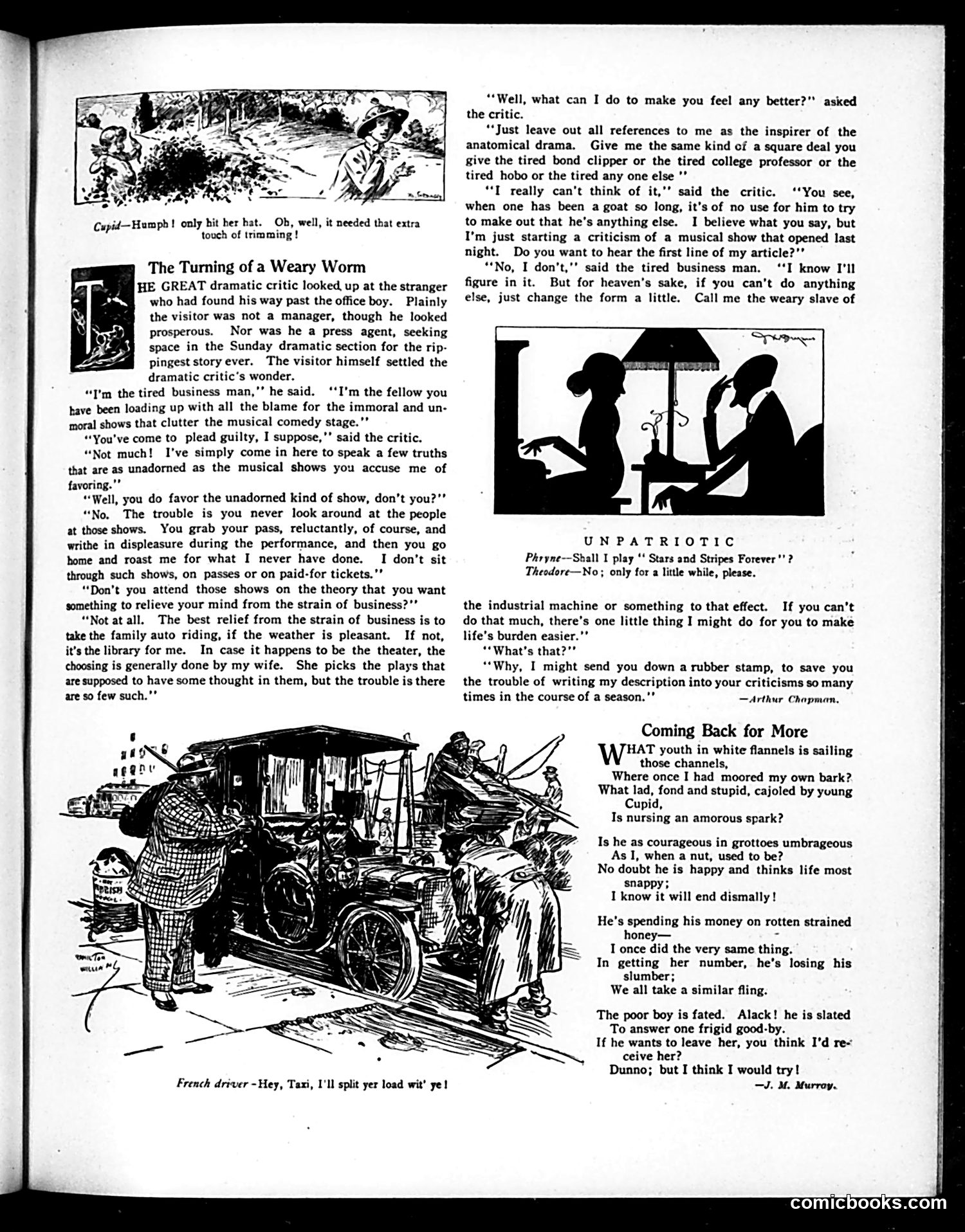
This satirical dialogue mocks the "tired business man"—a stock character of the era blamed by theater critics for supporting morally questionable musical comedies. The "weary worm" is this businessman, finally confronting the critic who habitually blames him for theatrical tastelessness. The businessman argues he's a scapegoat: he actually prefers family car rides or libraries, and when he attends theater, *his wife* chooses the shows. He accuses the critic of mechanically repeating the same accusation without investigation. His final joke—offering to send a rubber stamp so the critic can stamp his description repeatedly—satirizes predictable, lazy criticism. The piece, credited to Arthur Chapman, defends ordinary working men against intellectual snobbery while criticizing press reviewers for formulaic thinking. The "anatomical drama" reference suggests the shows featured scantily-clad performers—the actual target of moral concern, not the audience.
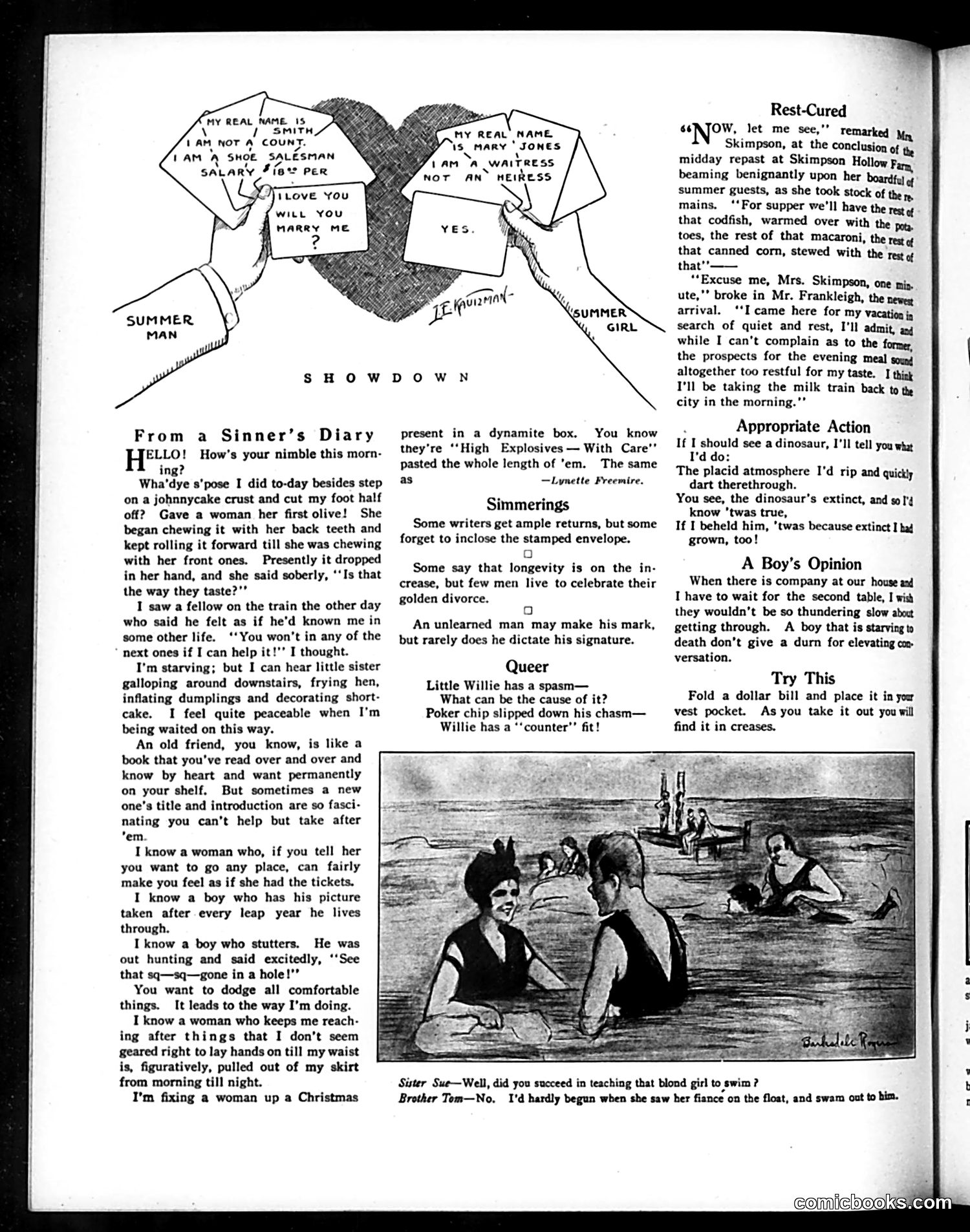
The "Showdown" cartoon depicts a romantic confrontation between a "Summer Man" and "Summer Girl" — likely vacationers engaging in a flirtation or courtship. The man claims to be a wealthy count earning 16% salary, while the woman claims to be "Mary Jones," a waitress, not an heiress. The satire targets the **class pretense and deception common among summer resort socializing** — both parties are lying about their social status, each trying to appear wealthier or more prestigious than they are. The exaggerated heart and theatrical declarations mock the artificial romance and social climbing that characterized leisure-class vacation dynamics of the era. The surrounding text—"From a Sinner's Diary," brief humorous observations, and other comedic snippets—represents typical Judge magazine filler: light social commentary on courtship, marriage, human foibles, and contemporary life aimed at middle-class readers seeking gentle satire of their own social pretensions.
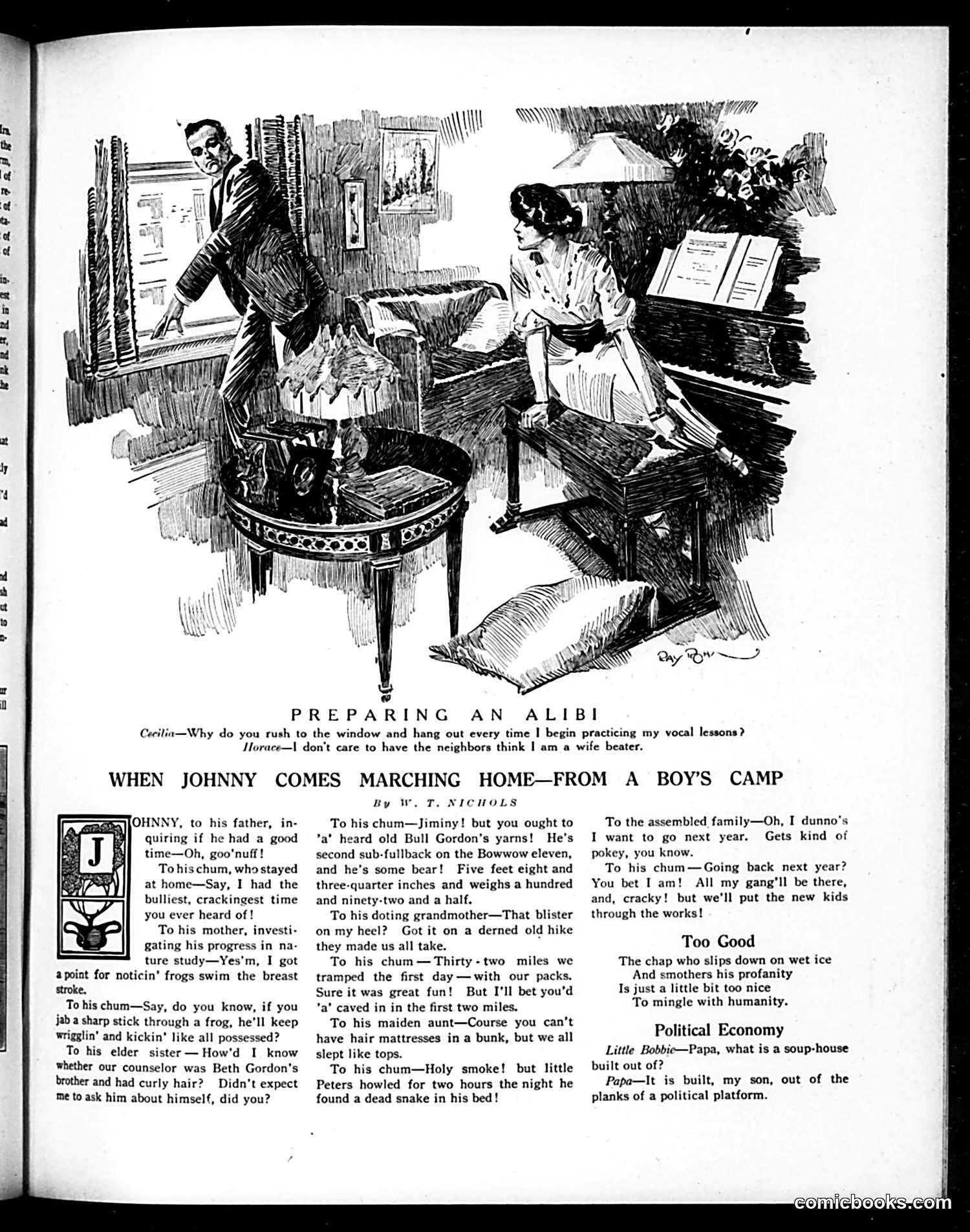
The top cartoon depicts a husband claiming he doesn't want neighbors to think he's beating his wife—his excuse for not wanting to hear her vocal practice. It's satire on both martial discord and women's artistic pursuits being treated as noise rather than legitimate activity. The larger piece humorously illustrates a boy returning from camp, telling wildly different stories to different people. To his father he's blasé; to his stay-at-home chum he exaggerates wildly; to his mother he emphasizes nature study; to his aunt he brags about camp comforts. The joke exposes how people—especially children—tailor their narratives for their audience, inflating experiences for peers while downplaying them for authority figures. It's gentle satire on human vanity and storytelling habits rather than political commentary.
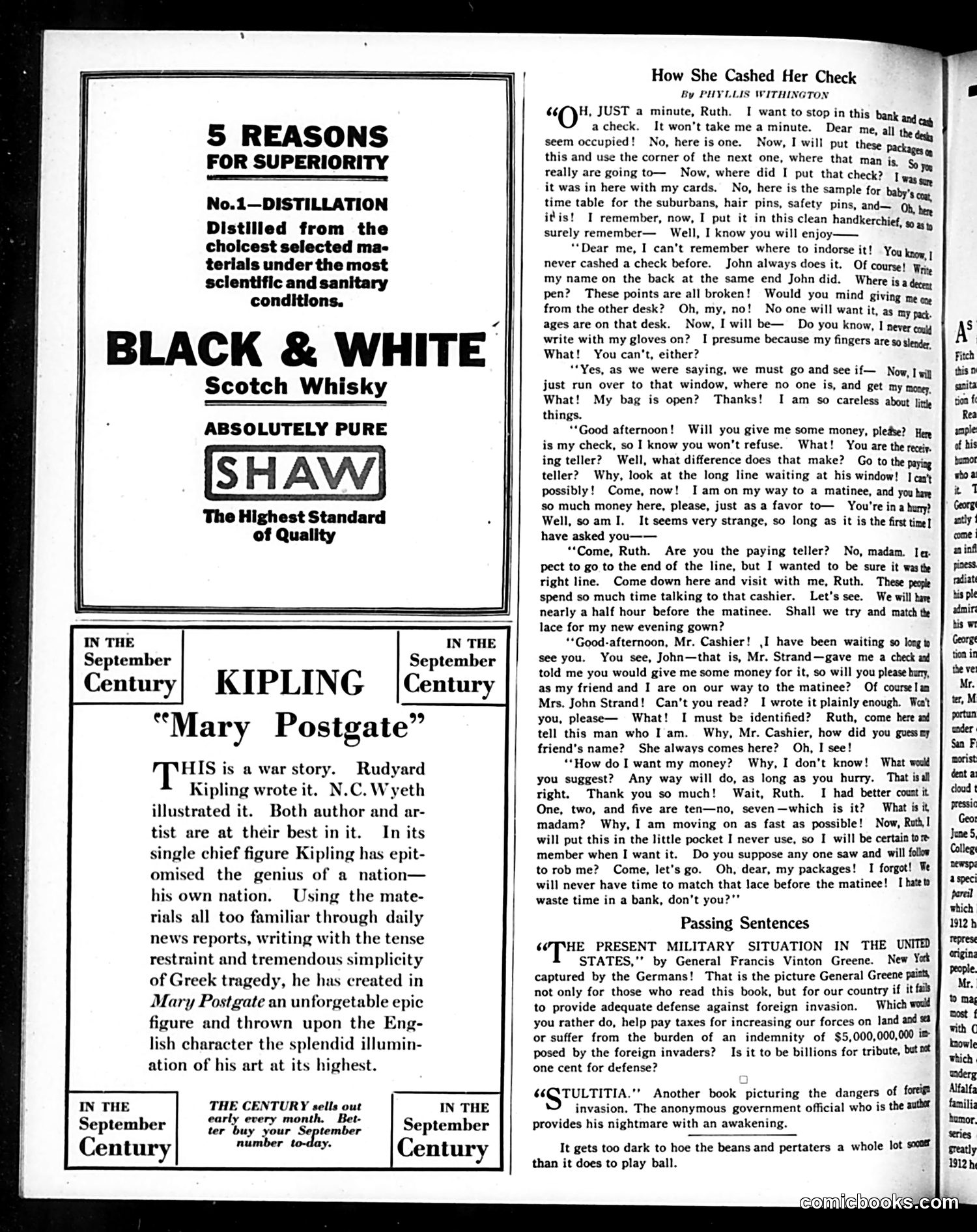
This page contains two distinct pieces: **Left side:** An advertisement for Black & White Scotch Whisky and a notice about Rudyard Kipling's short story "Mary Postgate" (illustrated by N.C. Wyeth) appearing in *The Century* magazine. The text praises Kipling's war story as expressing "the genius of a nation." **Right side:** A humorous story by Phyllis Withington titled "How She Cashed Her Check." It satirizes an absent-minded, wealthy woman attempting to cash a check at a bank. She's comically disorganized—can't find the check, forgets how to endorse it, removes her gloves to write, complains about waiting, and treats the bank teller like a social companion while trying to rush to a matinee. The satire mocks upper-class women's frivolousness, dependency on husbands (mentioning "John always does it"), and entitled behavior toward service workers. The juxtaposition of serious war literature with light domestic comedy was typical of *Judge* magazine's mixed content appeal.
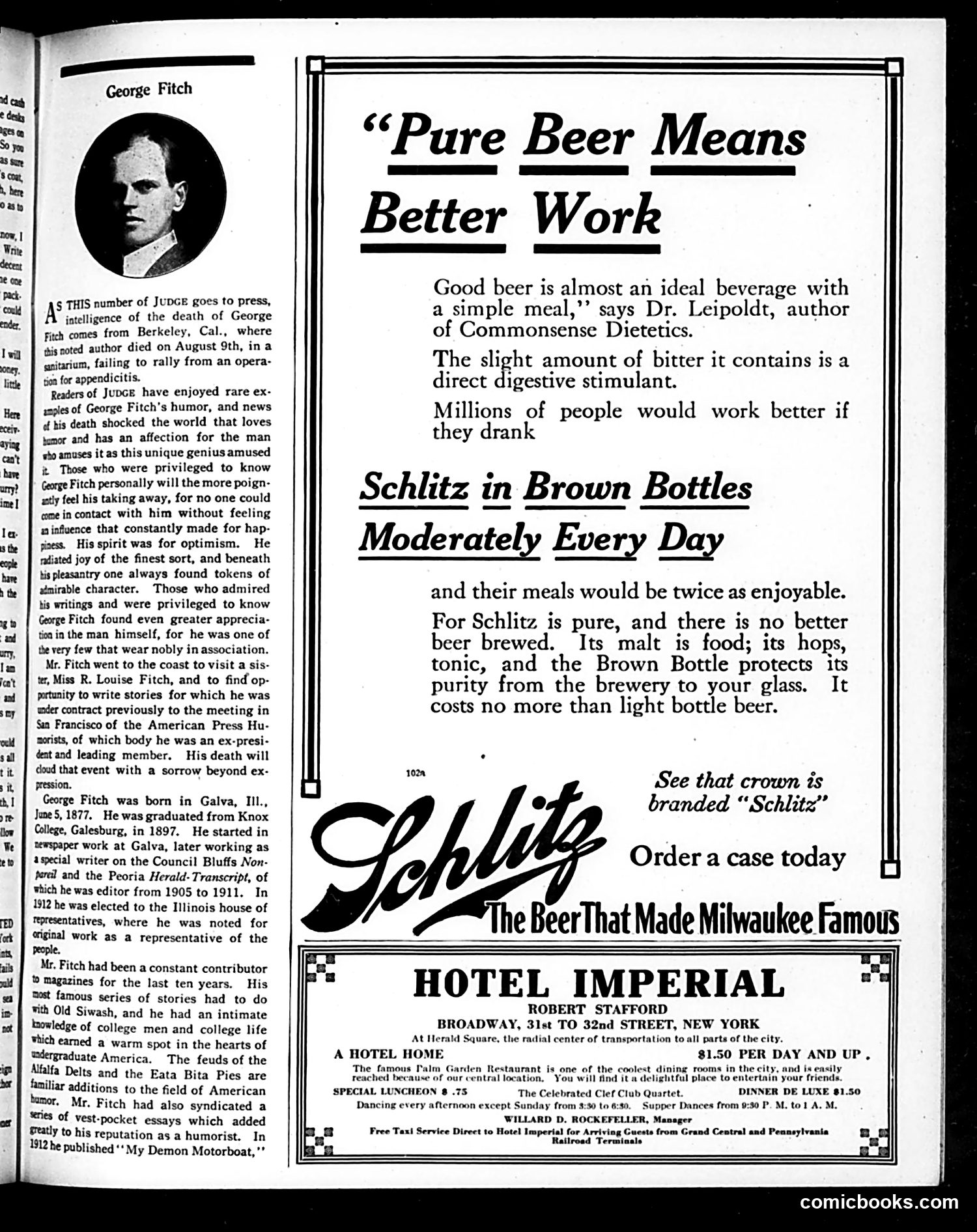
This page is primarily an **obituary and tribute to George Fitch**, a noted American humorist who died August 9th. The text praises his wit, optimism, and contributions to *Judge* magazine and other publications. He was known for humorous college stories (featuring "Old Siwash") and satirical essays. The right side is a **Schlitz beer advertisement** claiming beer improves worker productivity and digestion—a common health claim of the era before modern food and drug regulation. The ad cites "Dr. Leipoldt" as authority. **Historical context**: This appears to be from the early 1900s-1910s, when patent medicines and beverages routinely made unsubstantiated health claims. The juxtaposition of mourning an American humorist with beer advertising is characteristic of *Judge*'s editorial practice of mixing editorial content with advertisements.
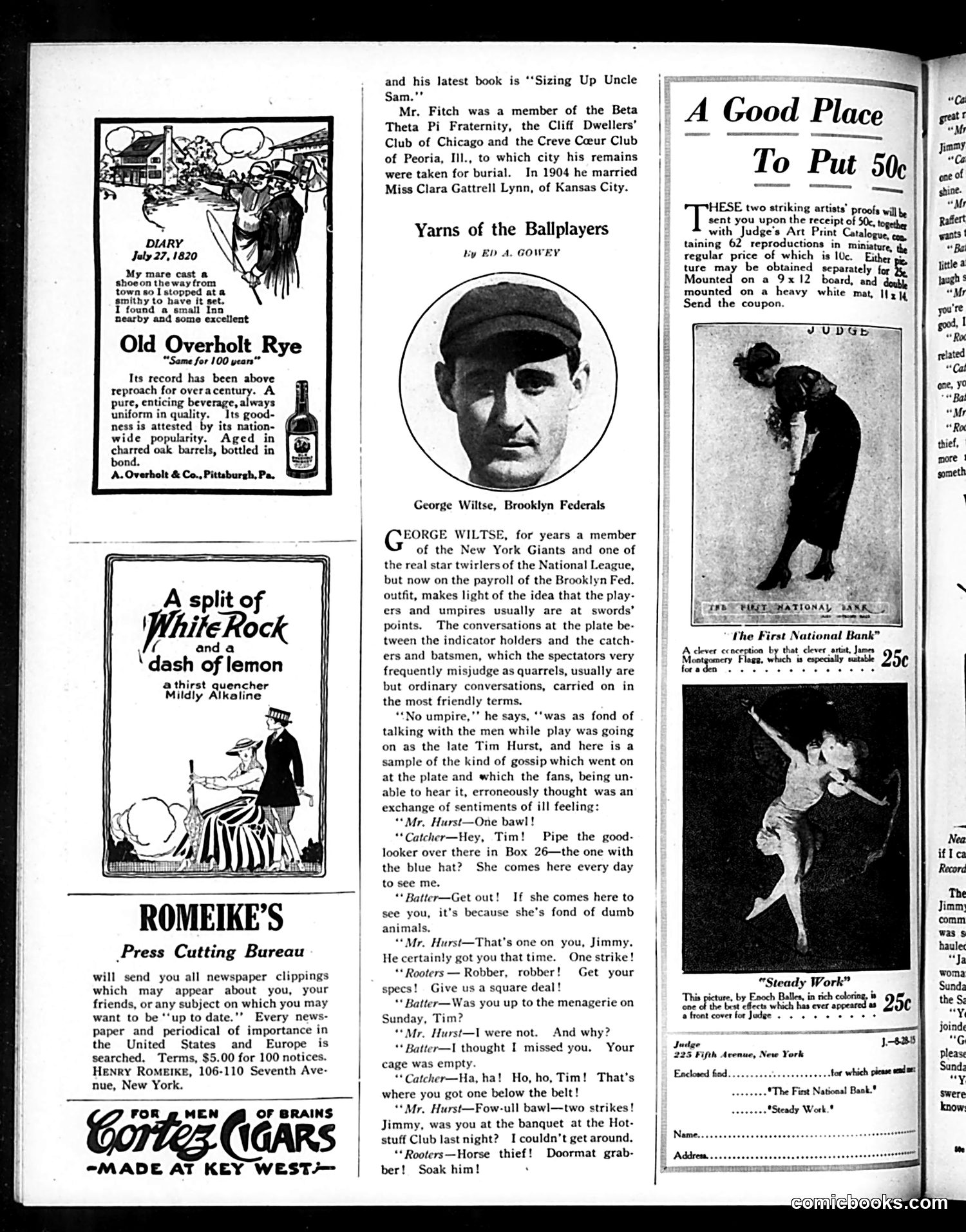
This Judge magazine page (July 27, 1920) contains mostly **advertisements and sports content**, not political satire. The main article, "Yarns of the Ballplayers" by Ed A. Gowey, features **George Wiltse**, a real pitcher who played for the New York Giants and Brooklyn Federals. The piece disputes a common misconception: that heated arguments between umpires, catchers, and batters reflected genuine animosity. Instead, Wiltse claims these were friendly exchanges. The dialogue example—featuring umpire **Tim Hurst** (a famous real umpire)—shows banter with sexual and insult humor typical of the era. A woman in the stands becomes the subject of crude jokes about the batter's intelligence and the umpire's previous "cage" (jail). The humor relies on period-appropriate ribaldry and dumb-animal comparisons. **Context lost today**: Readers would recognize Wiltse and Hurst as notable baseball figures; the "menagerie" and "cage" references would land as familiar locker-room humor. The piece celebrates baseball camaraderie beneath surface conflict.
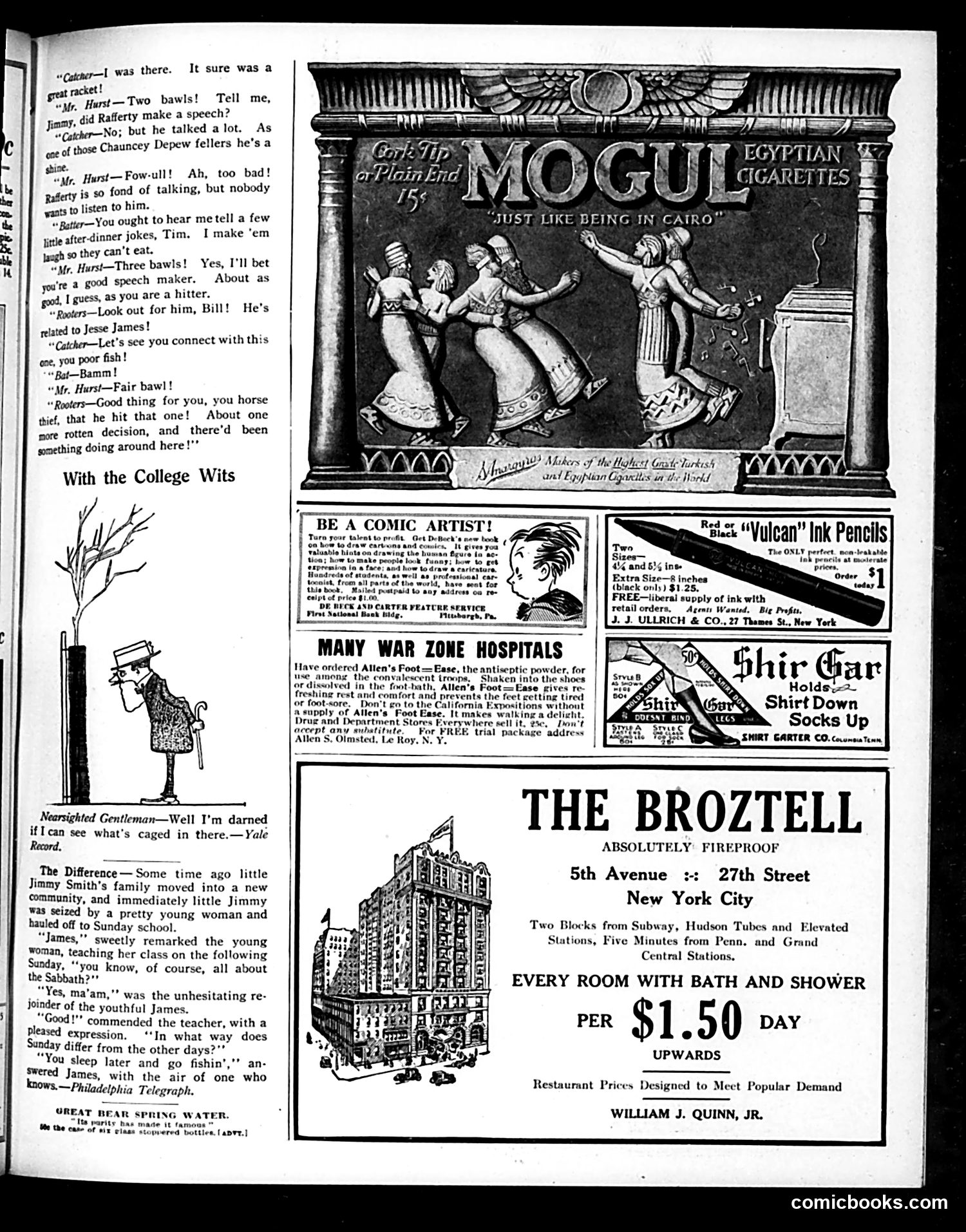
This page is primarily **advertising** with minimal satirical content. The small "With the College Wits" section contains two brief humor pieces: 1. **"Nearsighted Gentleman"**: A simple visual joke about someone unable to see into a cage (the punchline is unclear without seeing what's "caged"). 2. **"The Difference"**: A children's humor piece where young Jimmy Smith defines Sunday as the day "you sleep later and go fishin'" — satirizing how children prioritize leisure over religious instruction. This gently mocks both childhood irreverence and adults' expectations about religious knowledge. The rest comprises **period advertisements**: Egyptian cigarettes, ink pencils, foot powder for soldiers in war zones, shirt garters, and the Broztell hotel in New York ($1.50/day rooms). The war-zone hospital reference suggests this dates to WWI era. The content reflects early 20th-century concerns and advertising targets rather than substantive political satire.
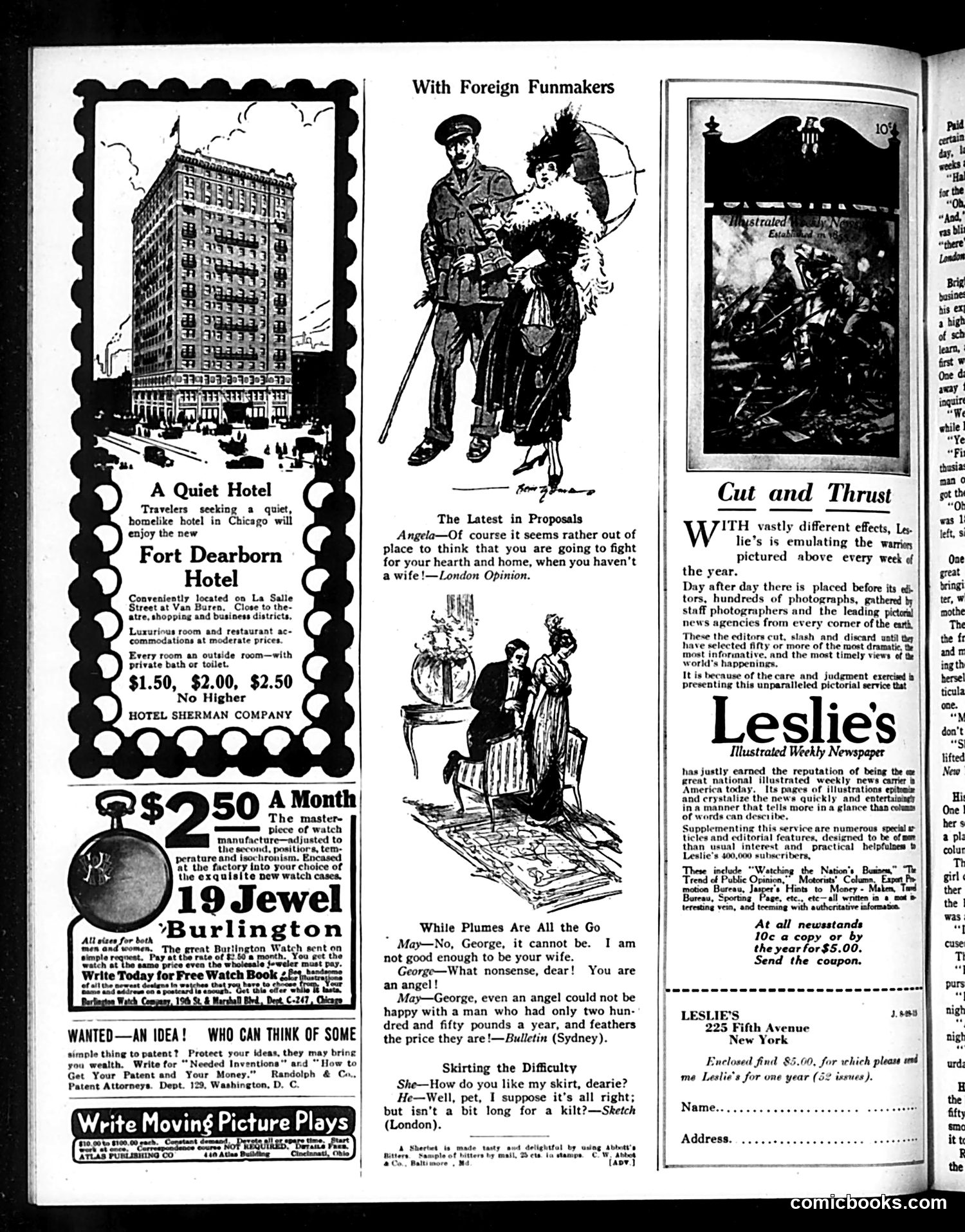
This page combines advertisements with international humor comics typical of early 20th-century Judge magazine. **The cartoons** feature brief comedic exchanges reprinted "With Foreign Funmakers" — jokes sourced from British publications like *London Opinion* and *Sketch*. These include: - A proposal scene where a woman rejects a suitor lacking sufficient income and feathers (fashionable plumage) - A husband-wife exchange about a woman's excessively short skirt, with the husband joking it resembles a Scottish kilt **The satire** targets contemporary gender dynamics and marital expectations: women's mercenary concerns about wealth, anxiety over fashion and appearance, and the tension between spouses over propriety. The humor assumes readers will find amusement in domestic friction and women's materialistic priorities. **The advertisements** (Fort Dearborn Hotel, Burlington Watch, Leslie's Illustrated Weekly) occupy significant space, reflecting the magazine's revenue model. The page demonstrates Judge's practice of recycling British humor for American audiences, suggesting shared Anglo-American sensibilities about marriage and fashion among middle-class readers.
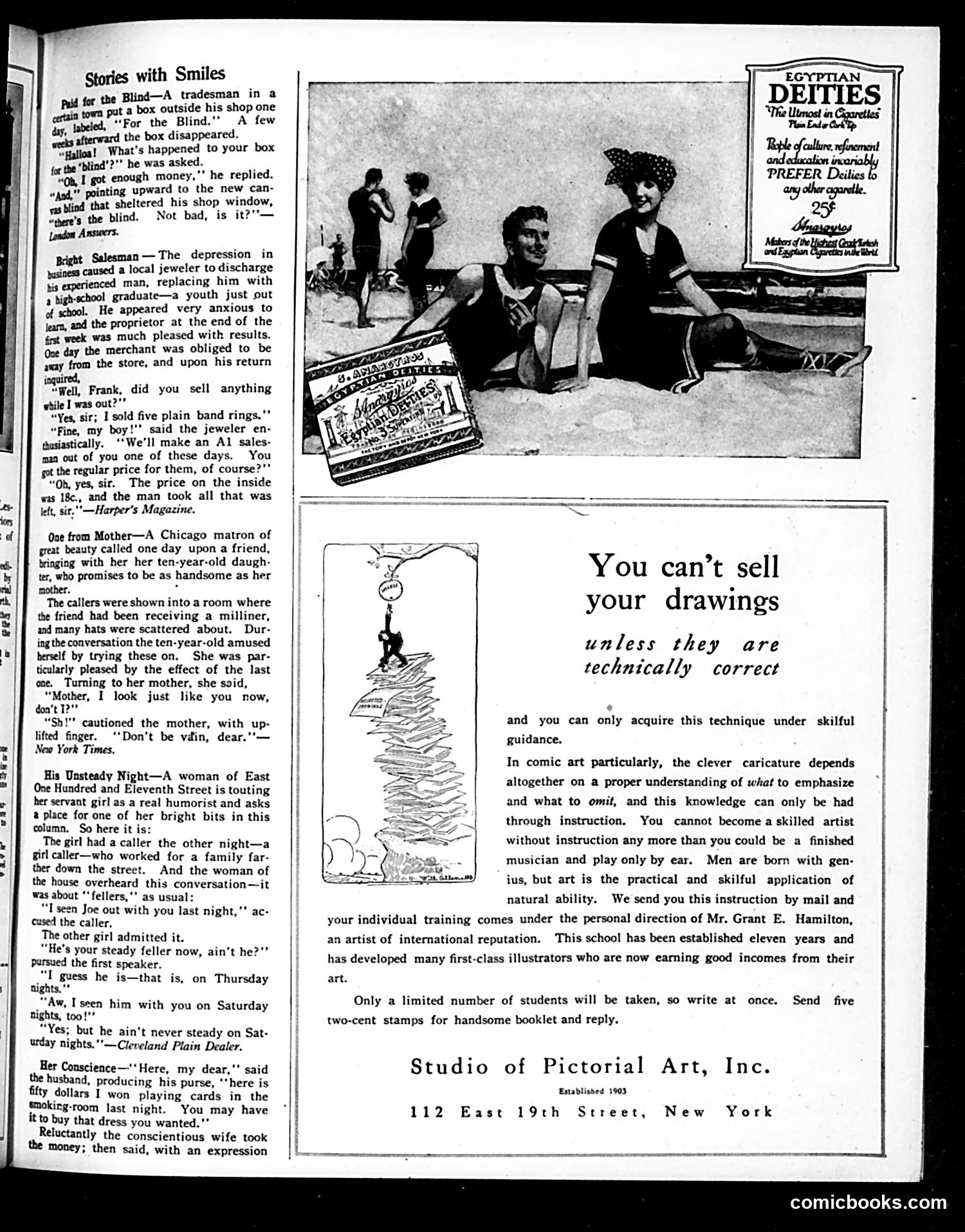
This page contains **humorous short stories** ("Stories with Smiles") rather than political cartoons. The jokes reflect early 20th-century social attitudes: 1. **"Paid for the Blind"**: A tradesman collects money for the blind but uses it to buy a canopy for his shop—a joke about charitable hypocrisy. 2. **"Bright Salesman"**: A high school boy replaces an experienced jeweler's clerk and sells plain rings marked at 18¢ for their full marked price, foolishly thinking he's made a good sale. The humor mocks youth inexperience and employer satisfaction with cheap labor. 3. **"One from Mother"**: A child, trying on hats, tells her mother she looks like her now—implying the mother is homely. The joke plays on children's unfiltered honesty. 4. **"His Unsteady Night"**: A girl admits meeting a man regularly, revealing infidelity. The humor comes from the casual admission. The page is **primarily advertising** for the "Studio of Pictorial Art, Inc.," offering mail-order art instruction.
This page is primarily **advertisements and filler content** rather than political satire. The main elements are: **Advertisements:** Carbona cleaning fluid, Evans ale/stout, a public speaking course, and paper warehouse services dominate the layout. **Humorous anecdotes** (not political cartoons) fill the text columns: - A joke about a wife pressuring her husband to stop gambling - A law professor's lecture where a student cynically quips that lawyers will inherit criminals' property - A Louisville railroad anecdote where an attorney jokes that a drunk, rough-looking man is his "cousin" These are mild, genteel humor pieces typical of *Judge*'s content—observational jokes about marriage, legal profession stereotypes, and social awkwardness. They contain **no partisan politics or sharp satire**, reflecting the magazine's shift toward lighter, mainstream humor by 1915.
This page combines satirical humor shorts with a branded advertising feature. The left column contains brief comedic anecdotes mocking everyday situations—a husband avoiding his wife at clubs, a police force consisting of one heavy man, a servant misinterpreting her mistress's medical advice about "staying at home" as permanent employment. The right side features a full-page advertisement for **Judge** magazine itself, disguised as editorial commentary. It argues that traveling peddlers and traders have disappeared because consumers now demand accountability. The piece champions "trade-marked, nationally advertised goods" as superior because manufacturers and established dealers stand behind them, guaranteeing quality. This is essentially **pro-corporate messaging**—promoting brand loyalty and retail establishments over independent peddlers. The advertisement uses three logos (Cook's Champagne, Northern Pacific) to exemplify the trustworthy branded goods it advocates for. For modern readers: this represents early 20th-century consumer culture celebrating mass marketing and established retail over informal street commerce.
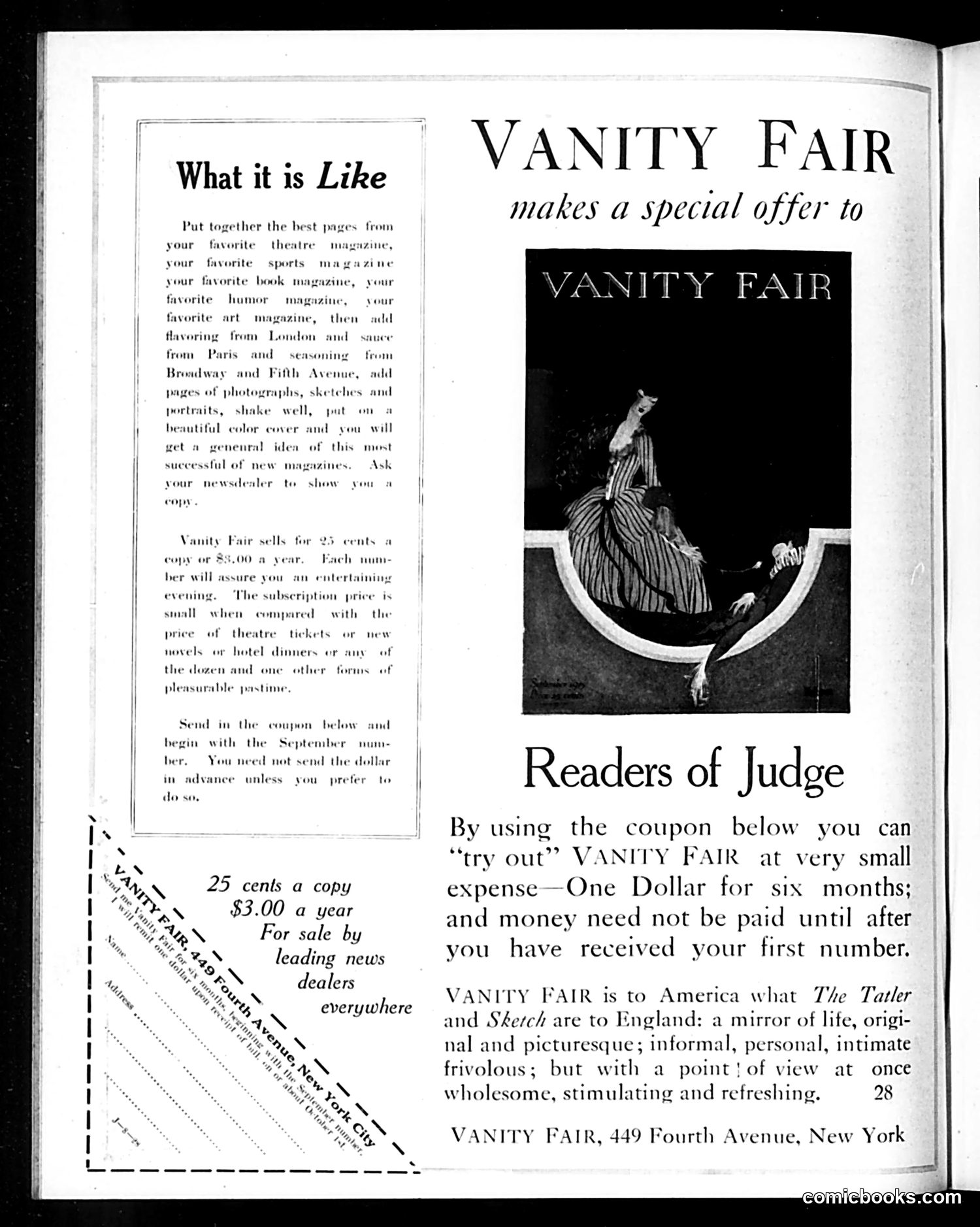
This page is primarily **advertising**, not satire or political commentary. It promotes Vanity Fair magazine to readers of Judge (a competing satirical publication). The ad describes Vanity Fair as a curated collection of content from theater, sports, books, humor, and art magazines, plus international material from London, Paris, and Broadway. The accompanying illustration shows a stylized art deco figure in an elegant pose—typical 1920s imagery for a sophisticated lifestyle magazine. The pitch emphasizes affordability: 25 cents per copy or $3 annually, compared favorably to theater tickets or hotel dinners. A special offer targets Judge readers: one dollar for six months' subscription, with payment deferred until after receiving the first issue. Notably, the ad claims Vanity Fair is "to America what *The Tatler* and *Sketch* are to England"—positioning it as a sophisticated, urbane magazine for cultured audiences. This is largely a straightforward commercial appeal with no evident satirical commentary visible on this page.