
Judge, 1915-08-28 · page 17 of 28
Judge — August 28, 1915 — page 17: what you’re looking at
What you’re looking at
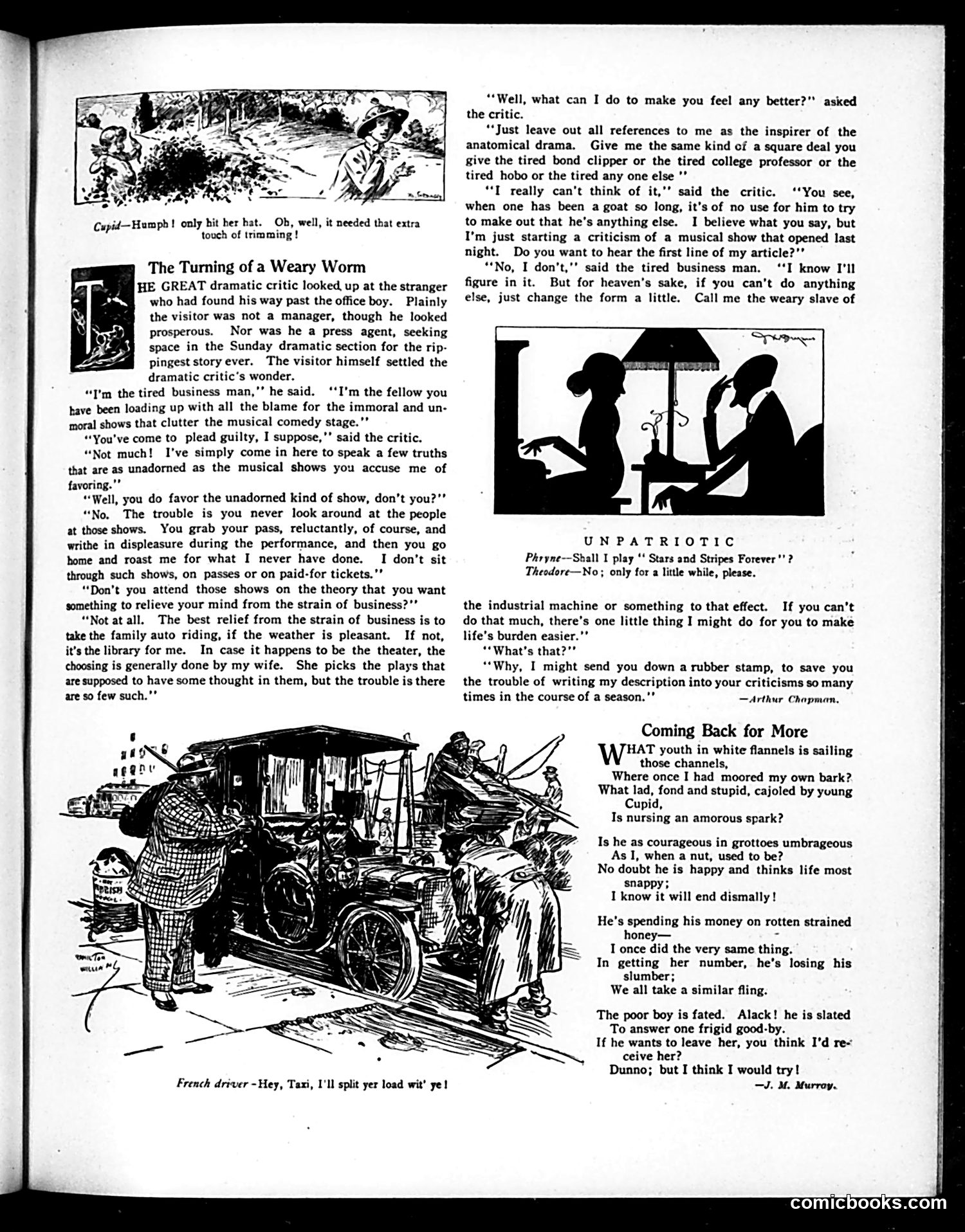
This satirical dialogue mocks the "tired business man"—a stock character of the era blamed by theater critics for supporting morally questionable musical comedies. The "weary worm" is this businessman, finally confronting the critic who habitually blames him for theatrical tastelessness. The businessman argues he's a scapegoat: he actually prefers family car rides or libraries, and when he attends theater, *his wife* chooses the shows. He accuses the critic of mechanically repeating the same accusation without investigation. His final joke—offering to send a rubber stamp so the critic can stamp his description repeatedly—satirizes predictable, lazy criticism. The piece, credited to Arthur Chapman, defends ordinary working men against intellectual snobbery while criticizing press reviewers for formulaic thinking. The "anatomical drama" reference suggests the shows featured scantily-clad performers—the actual target of moral concern, not the audience.
📄 Transcribed text from this page (OCR, searchable)
Machine-transcribed from the original scan — historical spelling and the odd misread are preserved.
Cupid—Humph ! only bit her hat. Ob, well, it needed that extra touch of trimming! The Turning of a Weary Worm HE GREAT dramatic critic looked up at the stranger who had found his way past the office boy. Plainly the visitor was not a manager, though he looked prosperous. Nor was he a press agent, seeking space in the Sunday dramatic section for the rip- pingest story ever. The visitor himself settled the dramatic critic's wonder. “I’m the tired business man,’’ he said. ‘‘I'm the fellow you have been loading up with all the blame for the immoral and un- moral shows that clutter the musical comedy stage.’’ “You've come to plead guilty, I suppose,’’ said the critic. “Not much! I've simply come in here to speak a few truths that are as unadorned as the musical shows you accuse me of favoring.’’ “Well, you do favor the unadorned kind of show, don’t you?’’ “No. The trouble is you never look around at the people at those shows. You grab your pass, reluctantly, of course, and writhe in displeasure during the performance, and then you go home and roast me for what I never have done. I don’t sit through such shows, on passes or on paid-for tickets."’ “Don’t you attend those shows on the theory that you want something to relieve your mind from the strain of business?’’ “Not at all. The best relief from the strain of business is to take the family auto riding, if the weather is pleasant. If not, it’s the library for me. In case it happens to be the theater, the choosing is generally done by my wife. She picks the plays that are supposed to have some thought in them, but the trouble is there are so few such.’’ French driver ~Hey, Taxi, I'll split yer load wit’ ye! “Well, what can I do to make you feel any better?" asked the critic. “Just leave out all references to me as the inspirer of the anatomical drama. Give me the same kind of a square deal you give the tired bond clipper or the tired college professor or the tired hobo or the tired any one else '’ “IT really can't think of it,’’ said the critic. ‘‘You see, when one has been a goat so long, it’s of no use for him to try to make out that he’s anything else. I believe what you say, but I'm just starting a criticism of a musical show that opened last night. Do you want to hear the first line of my article?’’ “No, I don’t,’’ said the tired business man. ‘‘I know I'll figure in it. But for heaven’s sake, if you can’t do anything else, just change the form a little. Call me the weary slave of UNPATRIOTIC Phryne—Sball I play ‘‘ Stars and Stripes Forever" ? Theodore—No ; only for a little while, please. the industrial machine or something to that effect. If you can’t do that much, there's one little thing I might do for you to make life's burden easier.”* ‘*What’s that?"’ “*Why, I might send you down a rubber stamp, to save you the trouble of writing my description into your criticisms so many times in the course of a season."’ —arthur Chapman, Coming Back for More wt youth in white flannels is sailing those channels, Where once I had moored my own bark?. What lad, fond and stupid, cajoled by young Cupid, Is nursing an amorous spark? Is he as courageous in grottoes umbrageous As I, when a nut, used to be? No doubt he is happy and thinks life most snappy; 1 know it will end dismally! He’s spending his money on rotten strained honey— a I once did the very same thing. In getting her number, he’s losing his slumber; We all take a similar fling. The poor boy is fated. Alack! he is slated To answer one frigid good-by. If he wants to leave her, you think I'd re- ceive her? Dunno; but I think I would try! —J. M. Murray. comicbooks.com