
Judge, 1915-08-28 · page 6 of 28
Judge — August 28, 1915 — page 6: what you’re looking at
What you’re looking at
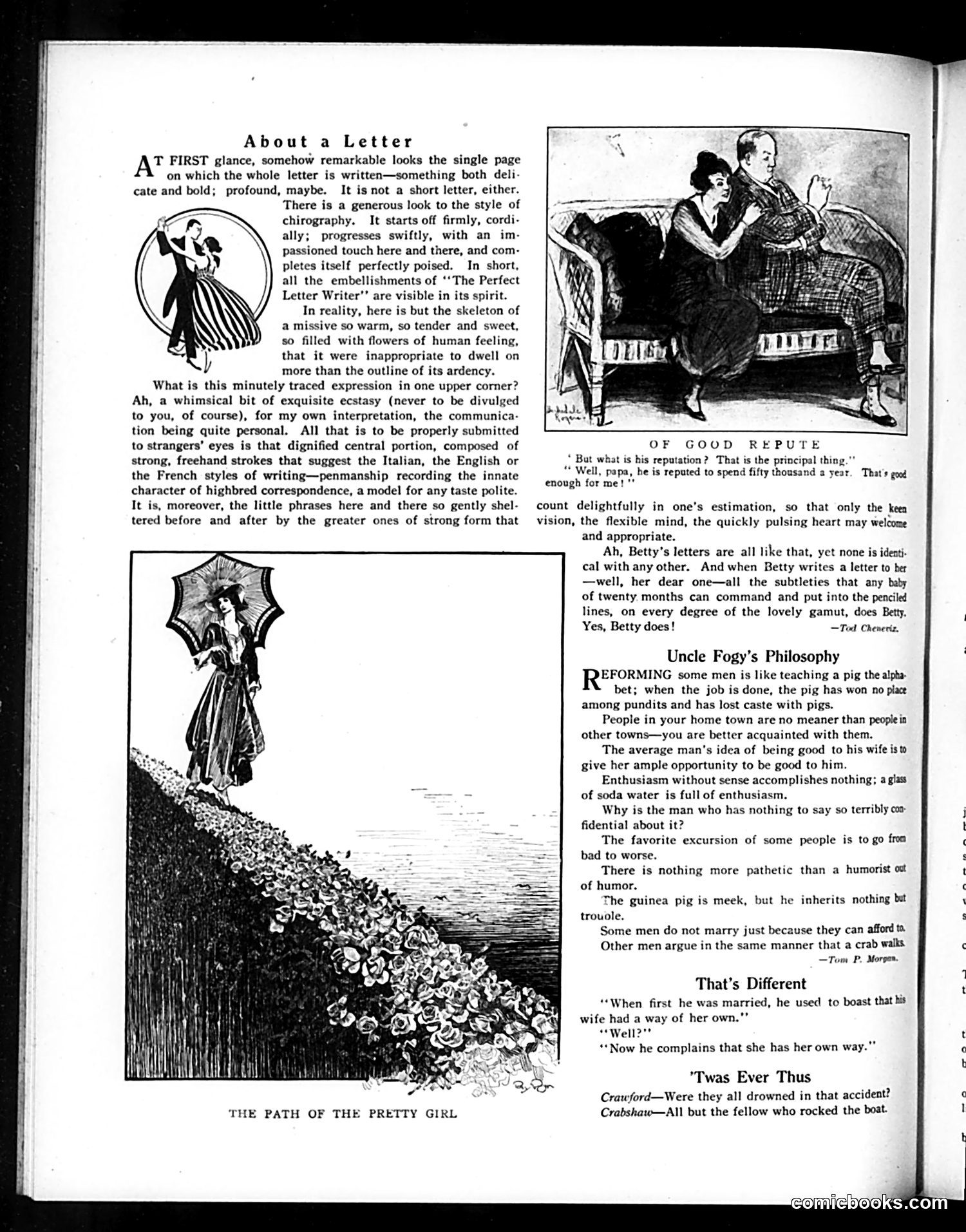
This page from Judge combines romantic and satirical content typical of early 20th-century American humor magazines. **"About a Letter"** celebrates refined letter-writing as an art form, describing how a properly composed letter reveals character and emotion through penmanship and phrasing. The illustration "The Path of the Pretty Girl" depicts a woman on a hillside amid flowers—romanticizing feminine virtue and beauty. **"Of Good Repute"** satirizes materialistic courtship: a father asks about a suitor's reputation; the daughter answers she cares only that he spends fifty thousand dollars yearly. This mocks how "respectability" could be purchased rather than earned. **"Uncle Fogy's Philosophy"** offers cynical observations on human nature—comparing reform efforts to teaching pigs, attacking hypocrisy in marriage, and lampooning false enthusiasm. **"'Twas Ever Thus"** delivers a brief punchline: in a boating accident, everyone drowns except the man who rocked the boat—implying those who cause trouble often escape consequences. The overall tone blends Victorian romance with biting social commentary on courtship, morality, and human folly.
📄 Transcribed text from this page (OCR, searchable)
Machine-transcribed from the original scan — historical spelling and the odd misread are preserved.
About a Letter T FIRST glance, somehow remarkable looks the single page on which the whole letter is written—something both deli- cate and bold; profound, maybe. It is not a short letter, either. There is a generous look to the style of chirography. It starts off firmly, cordi- ally; progresses swiftly, with an im- passioned touch here and there, and com- pletes itself perfectly poised. In short, all the embellishments of ‘‘The Perfect Letter Writer’’ are visible in its spirit. In reality, here is but the skeleton of a missive so warm, so tender and sweet, so filled with flowers of human feeling, that it were inappropriate to dwell on more than the outline of its ardency. What is this minutely traced expression in one upper corner? Ah, a whimsical bit of exquisite ecstasy (never to be divulged to you, of course), for my own interpretation, the communica- tion being quite personal. All that is to be properly submitted to strangers’ eyes is that dignified central portion, composed of strong, freehand strokes that suggest the Italian, the English or the French styles of writing—penmanship recording the innate character of highbred correspondence, a model for any taste polite. It is, moreover, the little phrases here and there so gently shel- tered before and after by the greater ones of strong form that THE PATH OF THE PRETTY GIRL OF GOOD REPUTE * But what is his reputation? That is the principal thing.”" “* Well, papa, he is reputed to spend fifty thousand a year. That's good enough for me! "" count delightfully in one’s estimation, so that only the keea vision, the flexible mind, the quickly pulsing heart may welcome and appropriate. Ah, Betty’s letters are all like that, yet none is identi. cal with any other. And when Betty writes a letter to ber —well, her dear one—all the subtleties that any baby of twenty months can command and put into the penciled lines, on every degree of the lovely gamut, does Betty. Yes, Betty does! —Tod Cheneriz. Uncle Fogy’s Philosophy EFORMING some men is like teaching a pig the alpha bet; when the job is done, the pig has won no place among pundits and has lost caste with pigs. People in your home town are no meaner than people in other towns—you are better acquainted with them. The average man's idea of being good to his wife is ® give her ample opportunity to be good to him. Enthusiasm without sense accomplishes nothing; a glass of soda water is full of enthusiasm. Why is the man who has nothing to say so terribly com fidential about it? The favorite excursion of some people is to go froa bad to worse. There is nothing more pathetic than a humorist ost of humor. The guinea pig is meek, but he inherits nothing bat trouole. Some men do not marry just because they can afford to. Other men argue in the same manner that a crab walks —Tom P. Morgen. That’s Different ‘When first he was married, he used to boast that his had a way of her own."’ Well?"* w he complains that she has her own way.” ’Twas Ever Thus Crawford—Were they all drowned in that accident? Crabshaw—All but the fellow who rocked the boat.