
Judge, 1915-08-28 · page 10 of 28
Judge — August 28, 1915 — page 10: what you’re looking at
What you’re looking at
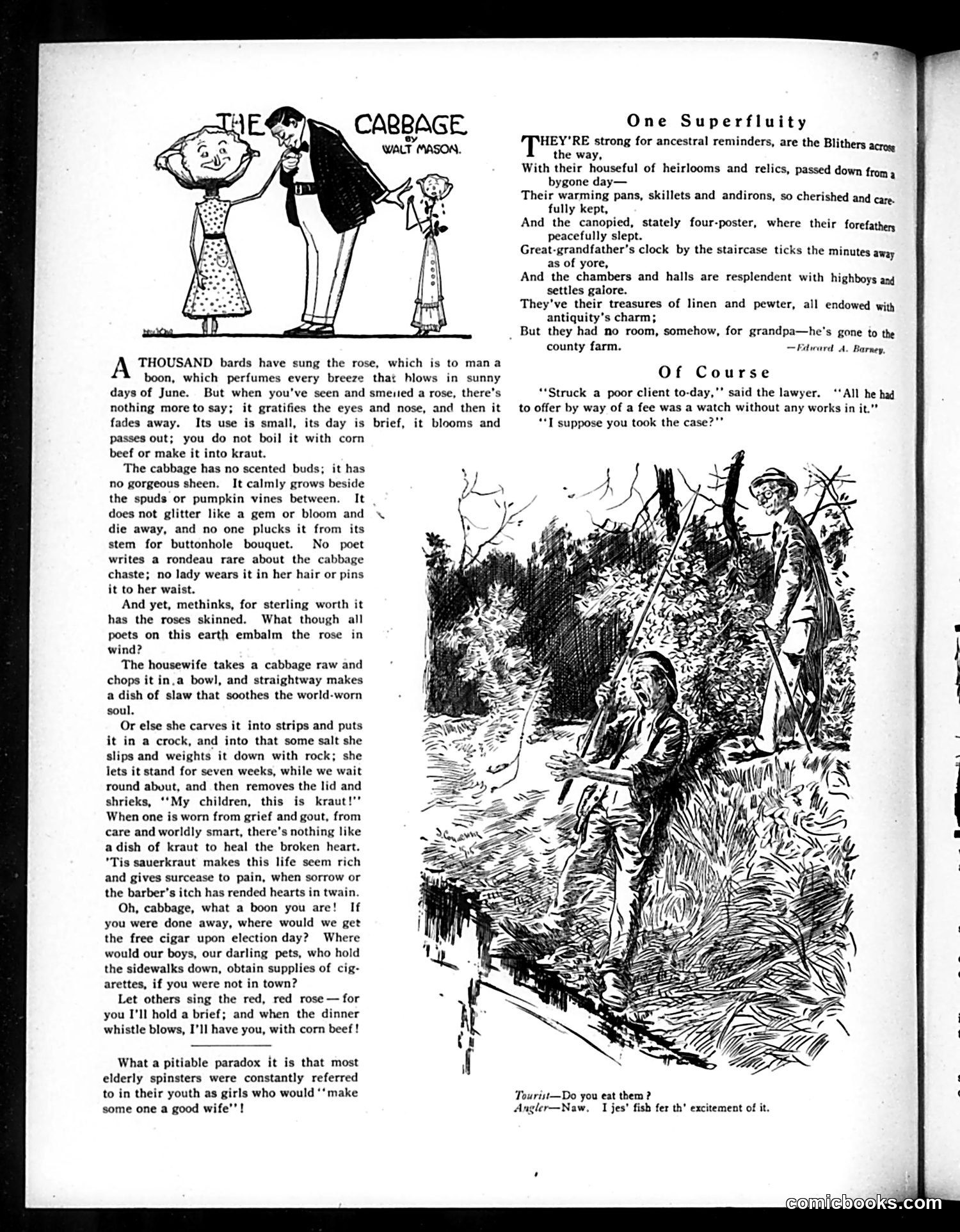
**"The Cabbage" (left):** A humorous poem elevating the humble cabbage over the romanticized rose. The satire mocks poetry's obsession with beautiful but useless flowers, arguing the cabbage—transformed into slaw and sauerkraut—genuinely improves people's lives. It's also a subtle jab at German/immigrant cuisine (sauerkraut), suggesting "common" working people's food has more practical value than elite aesthetic pursuits. The final lines reference political patronage: free cigars distributed on election day, implying cabbage-growing communities provided voters. **"One Superfluity" (top right):** Satirizes the Blithers family's obsession with ancestral heirlooms and antiques while neglecting their elderly grandfather, whom they've institutionalized ("county farm"). The irony: they preserve great-grandfather's possessions but abandoned the actual living relative. Critiques materialism and false gentility. **"Of Course" (bottom):** Brief legal joke—a poor client offers a broken watch as payment; the lawyer accepts, implying desperate lawyers will take any fee, however worthless.
📄 Transcribed text from this page (OCR, searchable)
Machine-transcribed from the original scan — historical spelling and the odd misread are preserved.
THOUSAND bards have sung the rose, which is to mana boon, which perfumes every breeze that hlows in sunny days of June. But when you've seen and smeuied a rose, there's nothing more to say; it gratifies the eyes and nose, and then it fades away. Its use is small, its day is brief, it blooms and passes out; you do not boil it with corn beef or make it into kraut. The cabbage has no scented buds; it has no gorgeous sheen. It calmly grows beside the spuds or pumpkin vines between. It does not glitter like a gem or bloom and die away, and no one plucks it from its stem for buttonhole bouquet. No poet writes a rondeau rare about the cabbage chaste; no lady wears it in her hair or pins it to her waist. And yet, methinks, for sterling worth it has the roses skinned. What though all poets on this earth embalm the rose in wind? The housewife takes a cabbage raw and chops it in,a bowl, and straightway makes a dish of slaw that soothes the world-worn soul. Or else she carves it into strips and puts it in a crock, and into that some salt she slips and weights it down with rock; she lets it stand for seven weeks, while we wait round about, and then removes the lid and shrieks, ‘‘My children, this is kraut!" When one is worn from grief and gout, from care and worldly smart, there's nothing like adish of kraut to heal the broken heart. Tis sauerkraut makes this life seem rich and gives surcease to pain, when sorrow or the barber's itch has rended hearts in twain. Oh, cabbage, what a boon you are! If you were done away, where would we get the free cigar upon election day? Where would our boys, our darling pets, who hold the sidewalks down, obtain supplies of cig- arettes, if you were not in town? Let others sing the red, red rose — for you I'll hold a brief; and when the dinner whistle blows, I'll have you, with corn beef! What a pitiable paradox it is that most elderly spinsters were constantly referred to in their youth as girls who would ‘make some one a good wife’’! One Superfluity HEY’RE strong for ancestral reminders, are the Blithers acroe the way, With their houseful of heirlooms and relics, passed down froma bygone day— Their warming pans, skillets and andirons, so cherished and care. fully kept, And the canopied, stately four-poster, where their forefathers peacefully slept. Great-grandfather’s clock by the staircase ticks the minutes away as of yore, And the chambers and halls are resplendent with highboys and settles galore. They've their treasures of linen and pewter, all endowed with antiquity’s charm; _ But they had no room, somehow, for grandpa—he’s gone to the county farm. —Fdward A. Barney, Of Course “Struck a poor client to-day,’’ said the lawyer. ‘‘All he had to offer by way of a fee was a watch without any works in it.” “*T suppose you took the case?" Tourist—Do you eat them? Angler—Naw, I jes’ fish fer th’ excitement of it,