
Judge, 1915-08-28 · page 4 of 28
Judge — August 28, 1915 — page 4: what you’re looking at
What you’re looking at
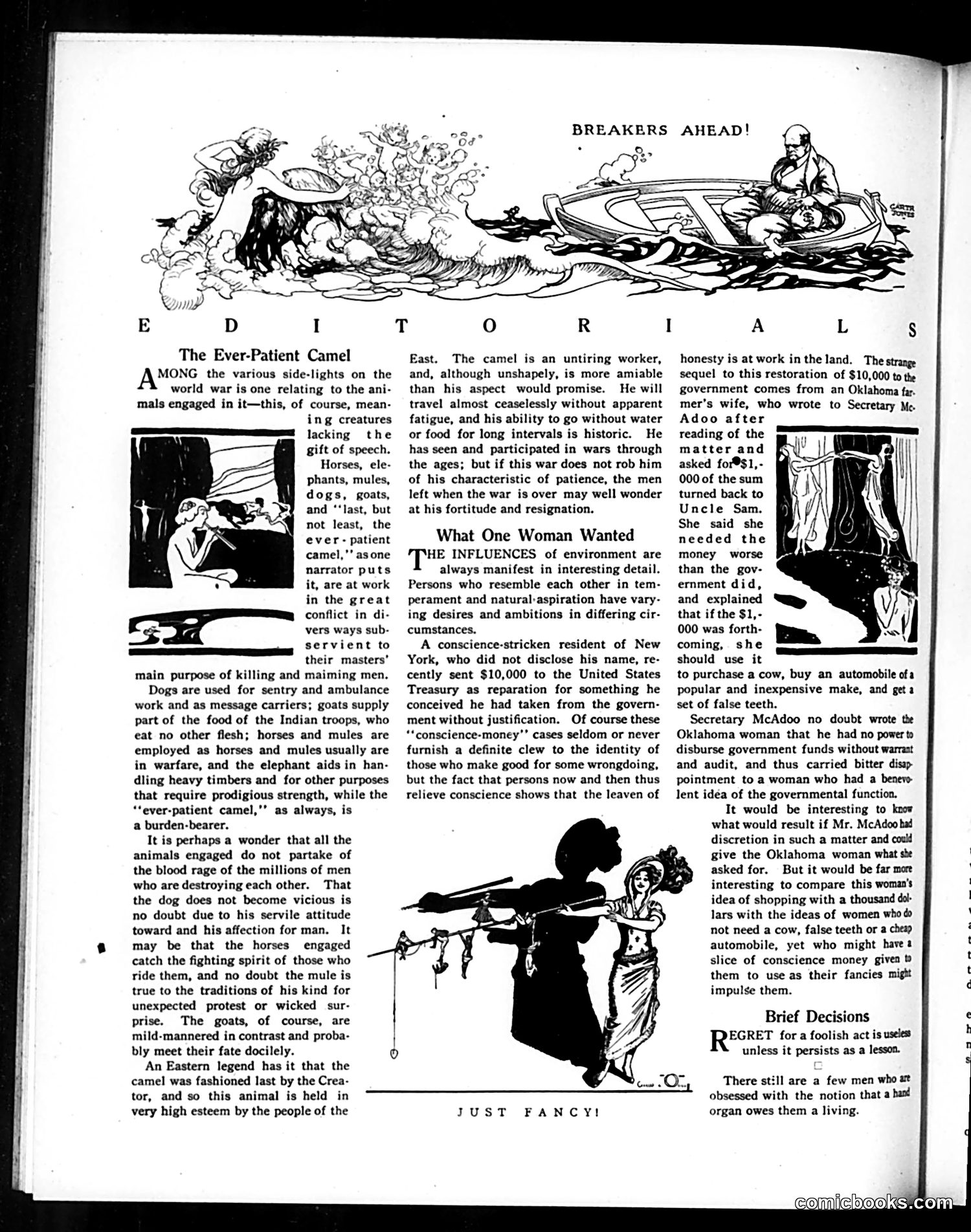
This page from *Judge* magazine contains three distinct sections: 1. **"Breakers Ahead!"** (top): A nautical cartoon warning of danger ahead, with passengers in a boat and what appears to be turbulent waters or obstacles. 2. **"The Ever-Patient Camel"** (main article): A lengthy editorial praising camels' work ethic and patience, using them as a metaphor for endurance during wartime. It contrasts animals' steadfast service with human nature. 3. **"What One Woman Wanted"** (right): A story about a New York woman who sent $10,000 to the U.S. Treasury as reparation for funds she believed wrongfully obtained from government. The satire critiques her naive attempt to purchase a cow, automobile, and false teeth instead—mocking both her conscience and governmental waste. The page reflects WWI-era concerns about patriotism, government accountability, and moral responsibility.
📄 Transcribed text from this page (OCR, searchable)
Machine-transcribed from the original scan — historical spelling and the odd misread are preserved.
The Ever-Patient Camel MONG the various side-lights on the world war is one relating to the ani- mals engaged in it—this, of course, mean- ing creatures lacking the gift of speech. Horses, ele- phants, mules, dogs, goats, and ‘‘last, but not least, the ever- patient camel,”’ asone narrator puts it, are at work in the great conflict in di- vers ways sub- servient to their masters’ main purpose of killing and maiming men. Dogs are used for sentry and ambulance work and as message carriers; goats supply part of the food of the Indian troops, who eat no other flesh; horses and mules are employed as horses and mules usually are in warfare, and the elephant aids in han- dling heavy timbers and for other purposes that require prodigious strength, while the “‘ever-patient camel,’’ as always, is a burden-bearer. It is perhaps a wonder that all the animals engaged do not partake of the blood rage of the millions of men who are destroying each other. That the dog does not become vicious is no doubt due to his servile attitude toward and his affection for man. It may be that the horses engaged catch the fighting spirit of those who ride them, and no doubt the mule is true to the traditions of his kind for unexpected protest or wicked sur- prise. The goats, of course, are mild-mannered in contrast and proba- bly meet their fate docilely. An Eastern legend has it that the camel was fashioned last by the Crea- tor, and so this animal is held in very high esteem by the people of the BREAKERS AHEAD! East. The camel is an untiring worker, and, although unshapely, is more amiable than his aspect would promise. He will travel almost ceaselessly without apparent fatigue, and his ability to go without water or food for long intervals is historic. He has seen and participated in wars through the ages; but if this war does not rob him of his characteristic of patience, the men left when the war is over may well wonder at his fortitude and resignation. What One Woman Wanted HE INFLUENCES of environment are always manifest in interesting detail. Persons who resemble each other in tem- perament and natural-aspiration have vary- ing desires and ambitions in differing cir- cumstances. A conscience-stricken resident of New York, who did not disclose his name, re- cently sent $10,000 to the United States Treasury as reparation for something he conceived he had taken from the govern- ment without justification. Of course these **conscience-money’’ cases seldom or never furnish a definite clew to the identity of those who make good for some wrongdoing, but the fact that persons now and then thus relieve conscience shows that the leaven of JUST FANCY! honesty is at work in the land. The strange sequel to this restoration of $10,000 to the government comes from an Oklahoma far. mer's wife, who wrote to Secretary Mc. Adoo after reading of the matter and asked for®$1,- 000 of the sum turned back to Uncle Sam. She said she needed the money worse than the gov- ernment did, and explained => that if the $1,- 000 was forth- coming, she aN should use it to purchase a cow, buy an automobile ofa popular and inexpensive make, and get a set of false teeth. Secretary McAdoo no doubt wrote the Oklahoma woman that he had no power to disburse government funds without warrast and audit, and thus carried bitter disap pointment to a woman who had a benevo- lent idéa of the governmental function. It would be interesting to know what would result if Mr. McAdoo bad discretion in such a matter and could give the Oklahoma woman what ste asked for. But it would be far more interesting to compare this woman's idea of shopping with a thousand dol- lars with the ideas of women who not need a cow, false teeth or a cheap automobile, yet who might have? slice of conscience money given 8 them to use as their fancies migt impulse them. Brief Decisions EGRET for a foolish act is useles unless it persists as a lesson. There still are a few men who at obsessed with the notion that a bast organ owes them a living.