
Judge, 1915-08-28 · page 27 of 28
Judge — August 28, 1915 — page 27: what you’re looking at
What you’re looking at
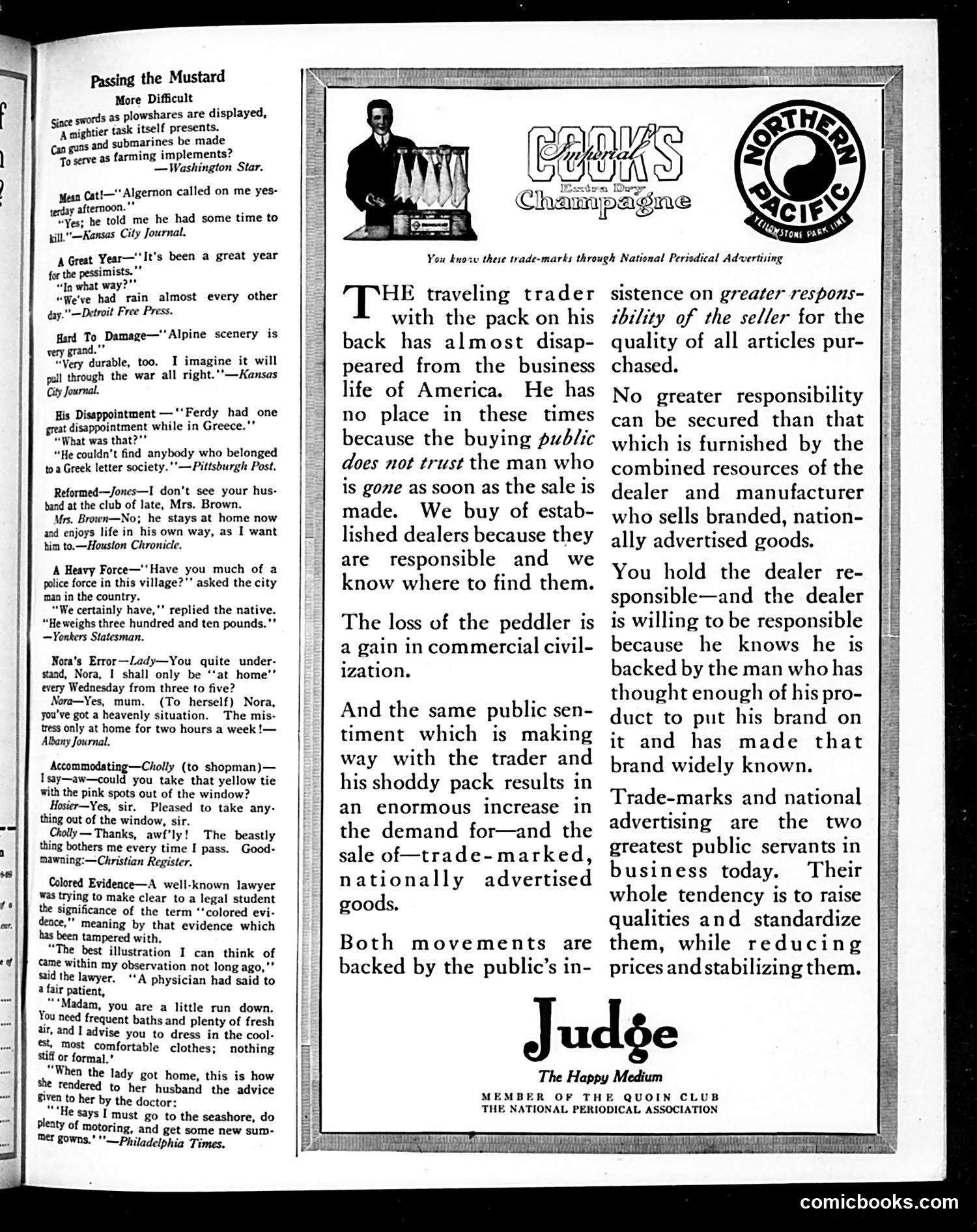
This page combines satirical humor shorts with a branded advertising feature. The left column contains brief comedic anecdotes mocking everyday situations—a husband avoiding his wife at clubs, a police force consisting of one heavy man, a servant misinterpreting her mistress's medical advice about "staying at home" as permanent employment. The right side features a full-page advertisement for **Judge** magazine itself, disguised as editorial commentary. It argues that traveling peddlers and traders have disappeared because consumers now demand accountability. The piece champions "trade-marked, nationally advertised goods" as superior because manufacturers and established dealers stand behind them, guaranteeing quality. This is essentially **pro-corporate messaging**—promoting brand loyalty and retail establishments over independent peddlers. The advertisement uses three logos (Cook's Champagne, Northern Pacific) to exemplify the trustworthy branded goods it advocates for. For modern readers: this represents early 20th-century consumer culture celebrating mass marketing and established retail over informal street commerce.
📄 Transcribed text from this page (OCR, searchable)
Machine-transcribed from the original scan — historical spelling and the odd misread are preserved.
Passing the Mustard More Difficult displayed, ince swords aS plowshares are ‘Amightier task itself presents. guns and submarines be made as farming implements? eae —Washington Star. Mean Cat!—"‘ Algernon called on me yes- fternoon."* . Cant he told me he had some time to kill." —Kansas City Journal. day.""—Detroit Free Press. Hard To Damage—‘‘Alpine scenery is rand."* Nery durable, too. I imagine it will pall through the war all right.'’—Kansas City Journal. His Disappointment —‘‘Ferdy had one great disappointment while in Greece.”’ “What was that?"’ “He couldn't find anybody who belonged toa Greek letter society.''—Pittsburgh Post. Reformed—Jones—I don’t see your hus- band at the club of late, Mrs. Brown, Mrs. Brown—No; he stays at home now and enjoys life in his own way, as I want him to.—Houston Chronicle. A Heavy Force—‘‘Have you much of a police force in this village?’’ asked the city man in the country. “We certainly have,"’ replied the native. “He weighs three hundred and ten pounds."” —Yonkers Statesman. Nora's Error—Lady—You quite under- stand, Nora, I shall only be ‘‘at home’’ every Wednesday from three to five? Nora—Yes, mum. (To herself) Nora, you've got a heavenly situation. The mis- tress only at home for two hours a week !— Albany Journal. Accommodating—Cholly (to shopman)— Isay—aw—could you take that yellow tie with the pink spots out of the window? Hosier—Yes, sir. Pleased to take any- thing out of the window, sir. Cholly — Thanks, awf'ly! The beastly thing bothers me every time I pass. Good- mawning:—Christian Register. Colored Evidence—A well-known lawyer was trying to make clear to a legal student the significance of the term ‘‘colored evi- dence,"’ meaning by that evidence which has been tampered with. The best illustration I can think of Came within my observation not long ago,”” said the lawyer. “*A physician had said to a fair patient, 7 Madam, you are a little run down. fou need frequent baths and plenty of fresh ad p= erie you to dress in the cool- st, most comfortable ; i si or formal clothes; nothing titres the lady got home, this is how ne rendered to her husband the advice Siven to her by the doctor: bis He sars I must go to the seashore, do ty of Motoring, and get some new sum- mer gowns. '—Philadelphia Times. You know these trade-marks through National Perisdical Advertising ‘PE traveling trader with the pack on his back has almost disap- peared from the business life of America. He has no place in these times because the buying public does not trust the man who is gone as soon as the sale is made. We buy of estab- lished dealers because they are responsible and we know where to find them. The loss of the peddler is a gain in commercial civil- ization. And the same public sen- timent which is making way with the trader and his shoddy pack results in an enormous increase in the demand for—and the sale of—trade-marked, nationally advertised goods. Both movements are backed by the public’s in- sistence on greater respons- thility of the seller for the quality of all articles pur- chased. No greater responsibility can be secured than that which is furnished by the combined resources of the dealer and manufacturer who sells branded, nation- ally advertised goods. You hold the dealer re- sponsible—and the dealer is willing to be responsible because he knows he is backed by the man who has thought enough of his pro- duct to put his brand on it and has made that brand widely known. Trade-marks and national advertising are the two greatest public servants in business today. Their whole tendency is to raise qualities and standardize them, while reducing prices and stabilizing them. MEMBER OF THE QUOIN CLUB THE NATIONAL PERIODICAL ASSOCIATION Die SINT era comicbooks.com