
A complete issue · 28 pages · 1915
Judge — July 10, 1915
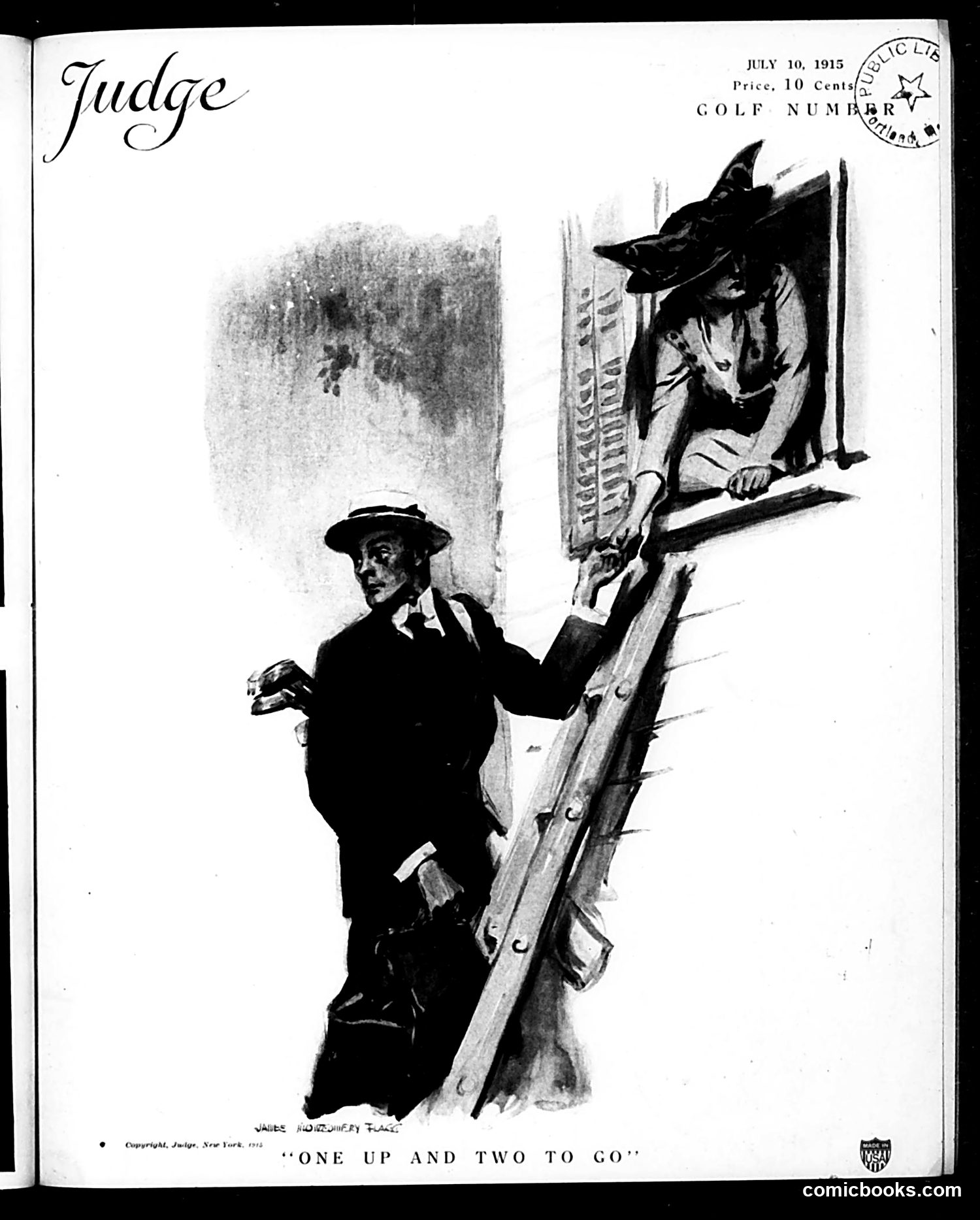
This Judge magazine cover from July 10, 1915 appears to be a golf-themed political cartoon. The title "One Up and Two to Go" suggests a golf match score. A man in formal attire climbs a ladder while a woman in a witch's hat peers from a window above, implying domestic conflict or marital strife presented as a "game." The specific political reference is unclear from the image alone, though the witch imagery and ladder-climbing suggest themes of henpecked husbands—a common satirical trope of the era. Without additional context about which public figures or current events from 1915 this references, the exact targets of the satire cannot be definitively identified. The cartoon likely mocked contemporary domestic relations or gender dynamics that Judge's readers would have recognized.
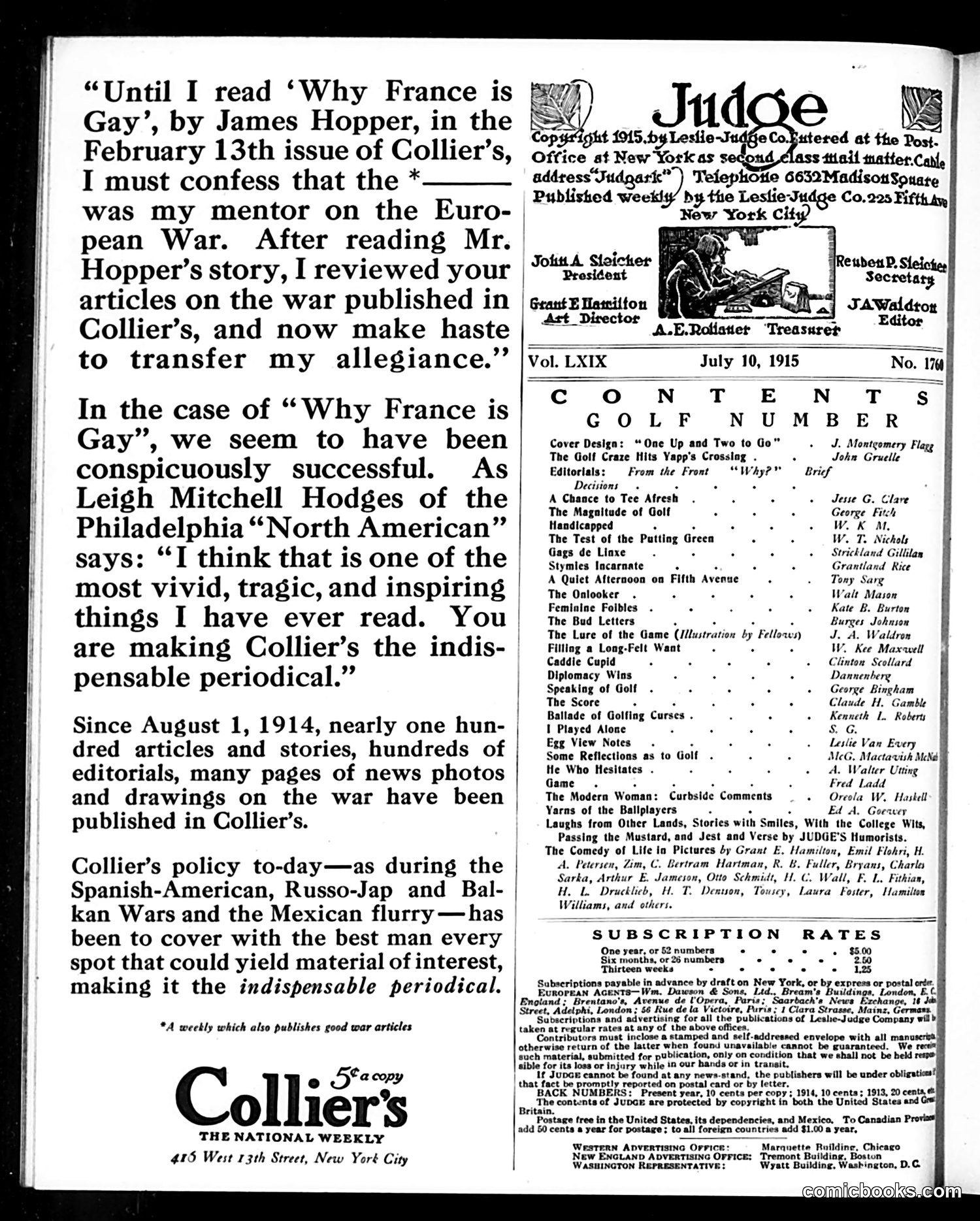
This page is primarily **advertising and masthead information** for Judge, a weekly satirical publication. The left column contains a testimonial praising Collier's magazine's coverage of World War I, specifically James Hopper's article "Why France is Gay." A Philadelphia editor calls it "vivid, tragic, and inspiring." The right side shows Judge's masthead and table of contents for a "Golf Number" issue, listing articles and illustrations about golf—a leisure activity popular with the wealthy during this period. **Historical context:** This 1915 issue reflects America's pre-WWI moment, with publications actively covering the European conflict while American readers maintained interest in peacetime pursuits like golf.
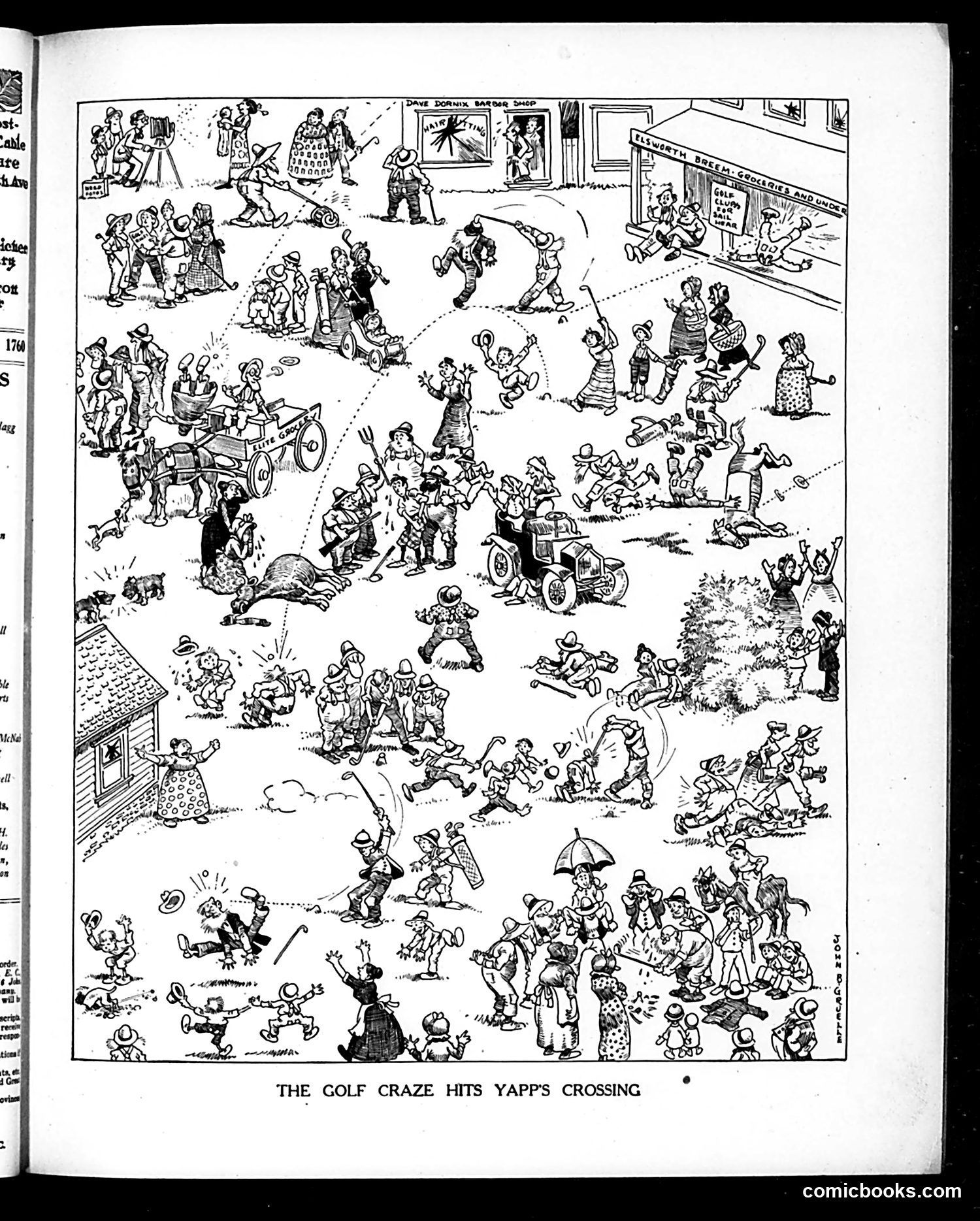
This satirical cartoon mocks the sudden popularity of golf in early 20th-century America. The title suggests golf mania has reached even a small, rural community called "Yapp's Crossing." The image depicts chaos: dozens of people of various ages and social classes are engaged in golf activities—swinging clubs, chasing balls, and playing everywhere simultaneously. The scene includes vehicles, spectators, and general pandemonium throughout a town landscape. The satire targets two things: first, golf's transformation from an elite sport into a mass fad affecting all social classes; second, the disruption and absurdity this causes in ordinary communities. The "craze" language and crowded, chaotic composition suggest satirists viewed golf's popularity as an irrational mania rather than a legitimate pastime.
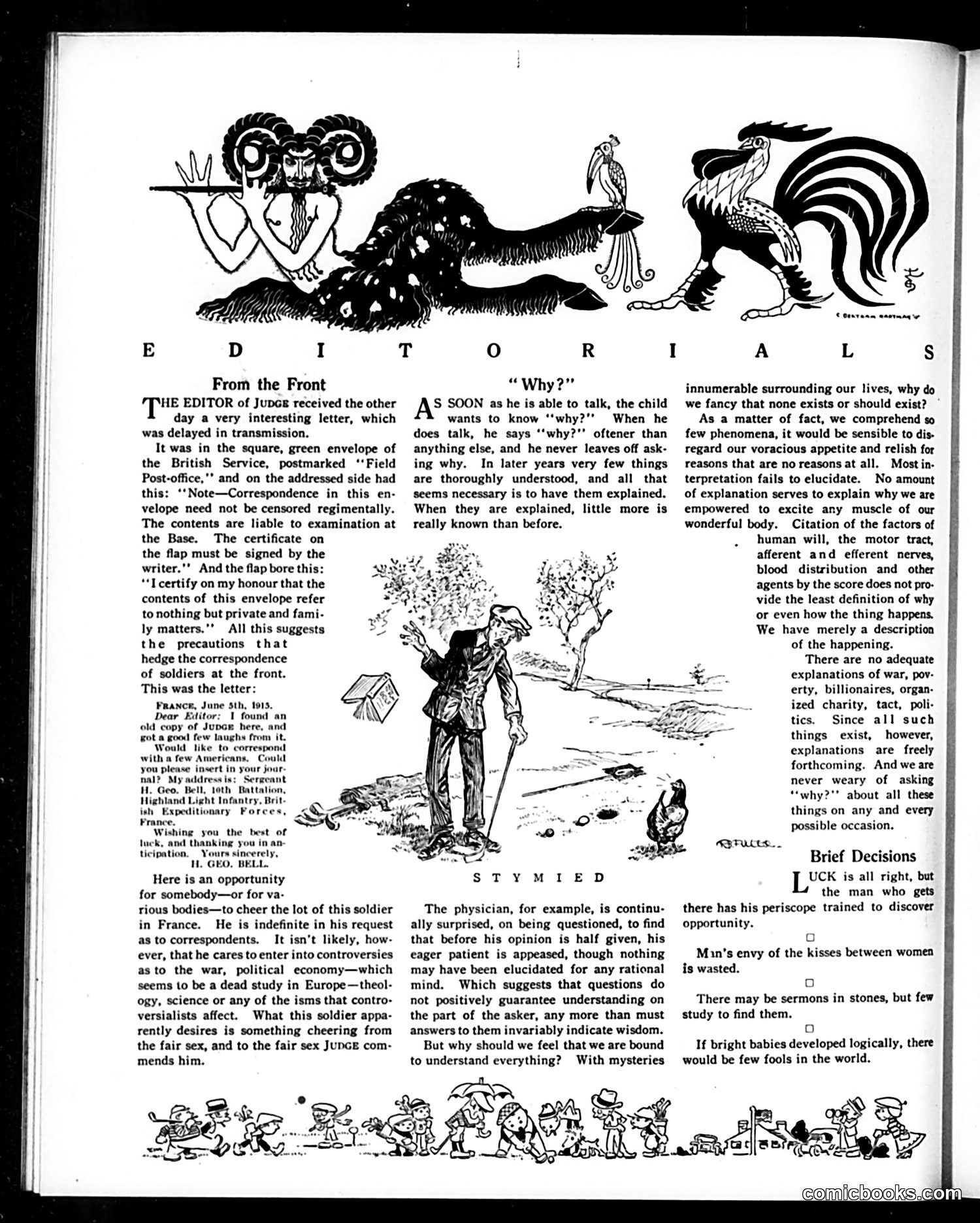
**Top Cartoon ("Editorials"):** The anthropomorphic animals represent different national stereotypes or political figures engaging in diplomatic or military posturing. The ram with horns (likely Germany), the rooster (France), and other creatures appear to reference World War I tensions, though specific identities aren't definitively clear from the image alone. **Main Content:** "From the Front" discusses a soldier's letter seeking correspondence. The accompanying sketch shows a WWI soldier amid battlefield devastation—a poignant commentary on trench warfare's human cost. **Editorial Commentary:** The text reflects on perpetual questions about war ("Why?")—its causes, poverty, and suffering. Judge suggests explanations remain elusive and humans endlessly seek understanding of conflict's rationale. This page blends satirical commentary on geopolitical tensions with serious reflection on war's futility.
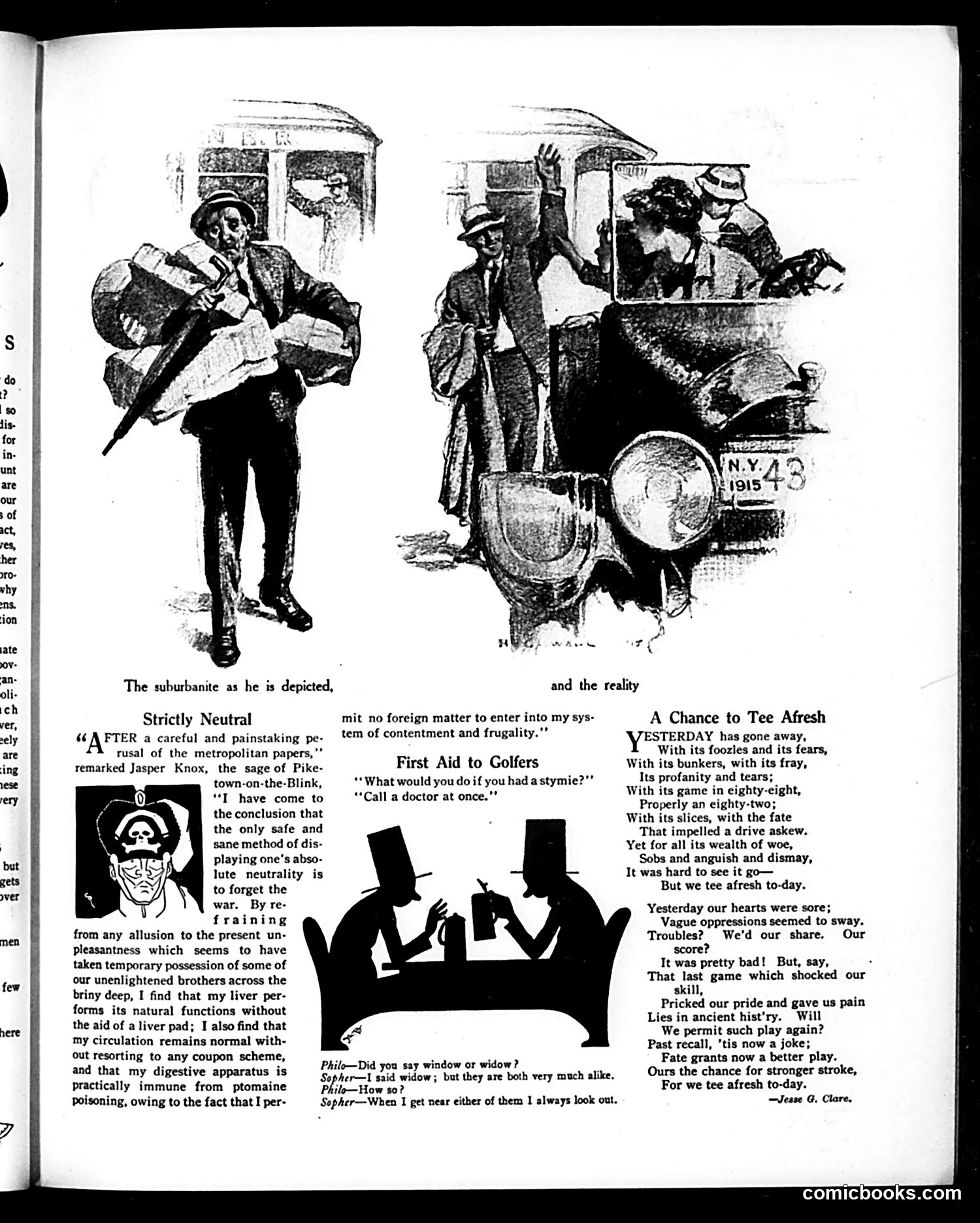
This page satirizes American neutrality during World War I. The left cartoon contrasts "the suburbanite as he is depicted" (a gentleman carrying fish from fishing) with "and the reality" (chaos of people loading supplies into a car). The satire mocks claims of neutrality and peaceful leisure while war rages abroad. The "Strictly Neutral" section quotes Jasper Knox dismissing concerns about the war, arguing one can remain detached from European conflict. The silhouette cartoon "First Aid to Golfers" shows men discussing a golf injury, with dialogue suggesting golf terminology ("window or widow"). The poem "A Chance to Tee Afresh" nostalgically reflects on yesterday's golf game, using golf metaphors to obliquely address the war's impact on American life. The overall message critiques American complacency regarding the conflict.
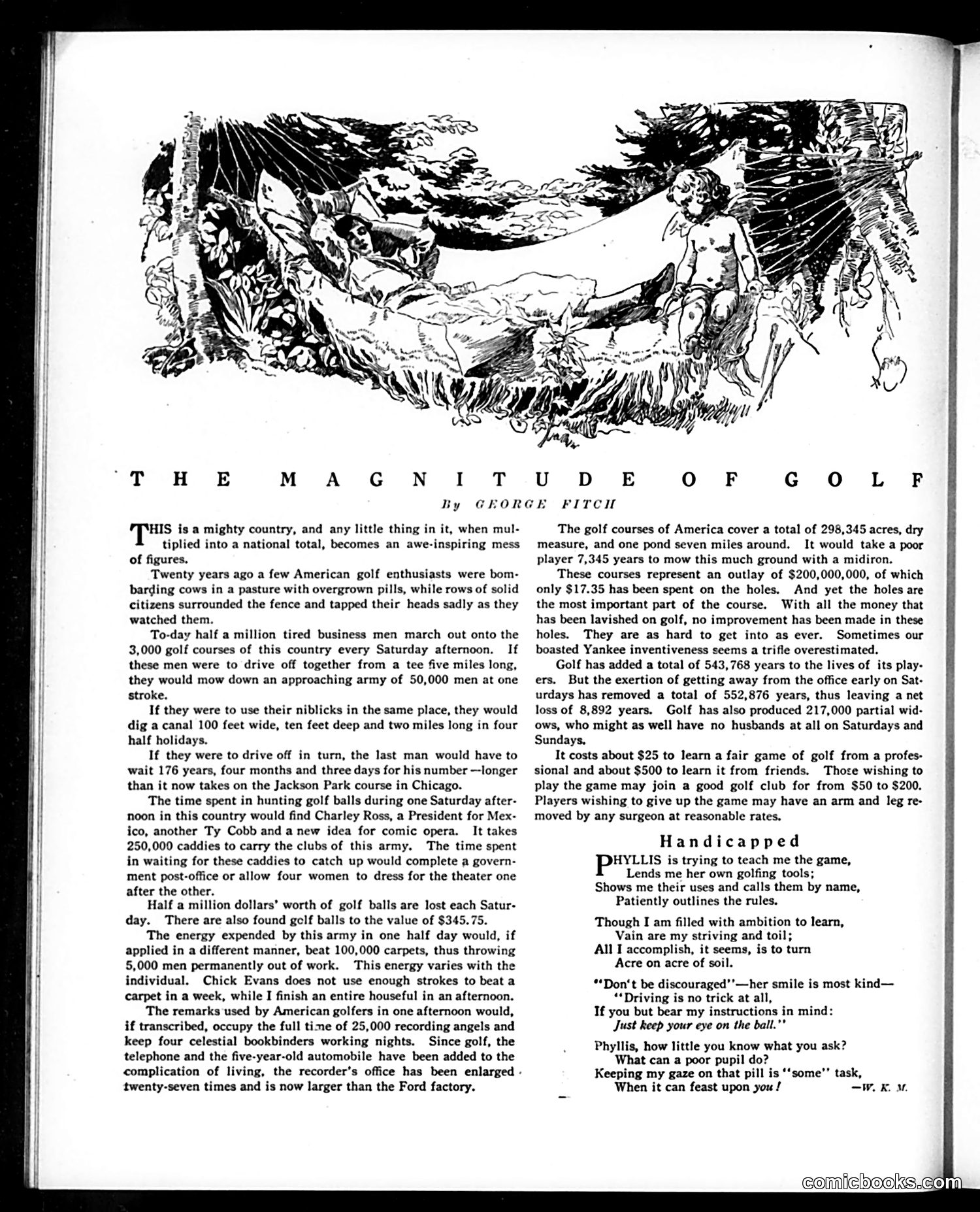
This satirical piece mocks golf's explosive popularity in early 20th-century America through absurdist mathematics. Fitch ridicules how a niche hobby has become a national obsession among "tired business men," using exaggerated calculations to expose golf's social impact: half a million players on Saturdays, 3,000 courses, and massive economic investment ($200 million). The satire targets multiple anxieties: lost productivity (men abandoning work), wasted resources (half-million dollars in lost balls weekly), and domestic disruption ("217,000 partial widows" whose husbands vanish Saturdays). The accompanying illustration shows cherubic figures in a pastoral landscape, ironically romanticizing this time-consuming pursuit. The accompanying poem "Handicapped" continues the joke, depicting a woman teaching golf to a reluctant male student—gentle domestic comedy within broader social critique.
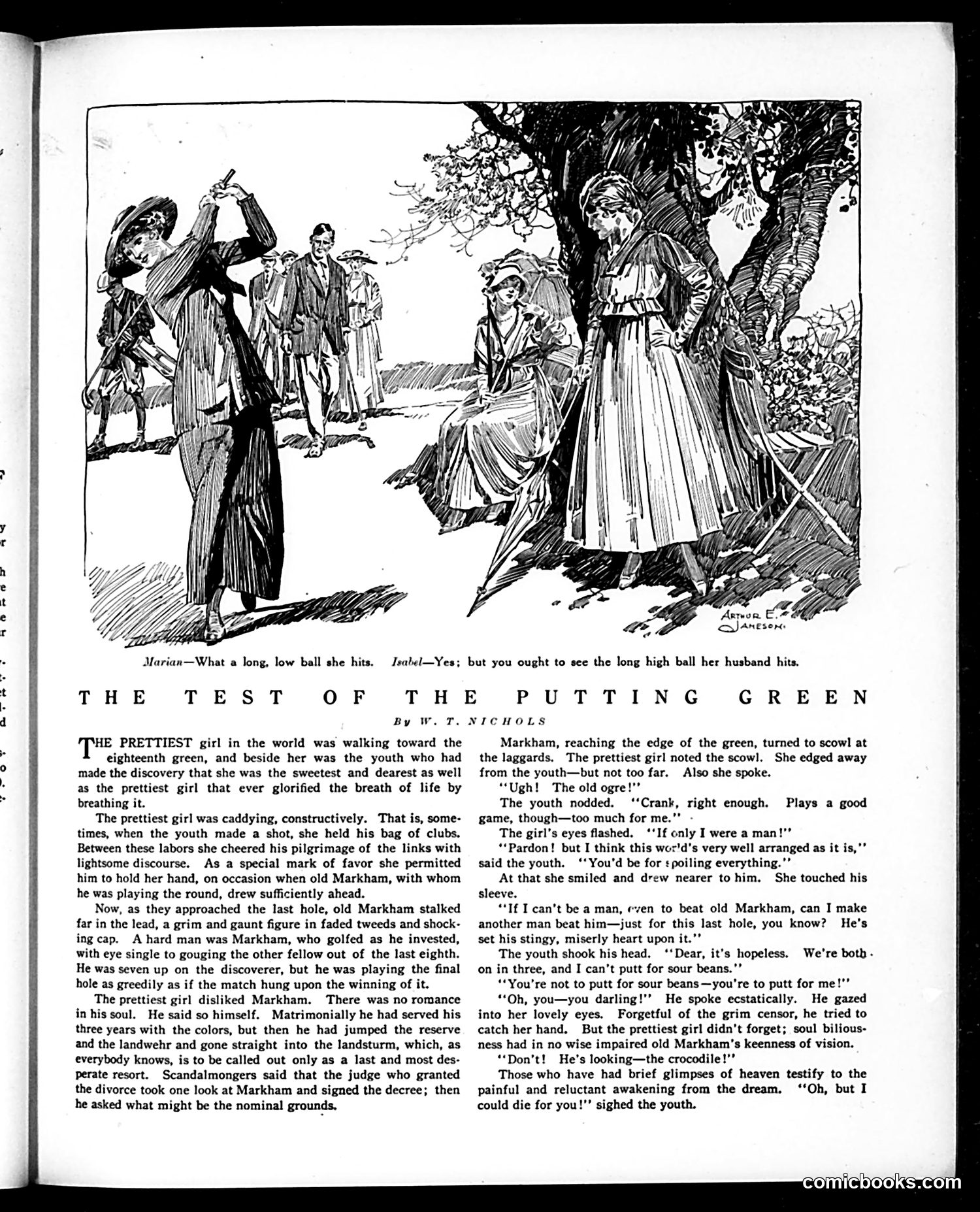
This is a romantic comedy story illustrated with a golf narrative. The plot concerns a young couple—"the prettiest girl in the world" and her admiring youth—playing golf with the antagonist Markham, an older, disagreeable man. The satire targets **Markham as a specimen of unattractive masculinity**: he's described as unromantic, divorced (apparently deservedly), and obsessed with winning at golf with the same ruthlessness he applies to business. The "censor" reference suggests he's watchful and controlling. The humor lies in romantic tension: the young woman manipulates her boyfriend into attempting an impossible putt to beat Markham—framing it as a test of love. The cartoon caption jokes about gender and athletic performance: she hits a "long, low ball" while her (absent) husband hits a "long high ball." The underlying message appears to critique both aggressive masculine competitiveness (Markham) and female manipulation through sentiment, while celebrating romantic earnestness in youth.
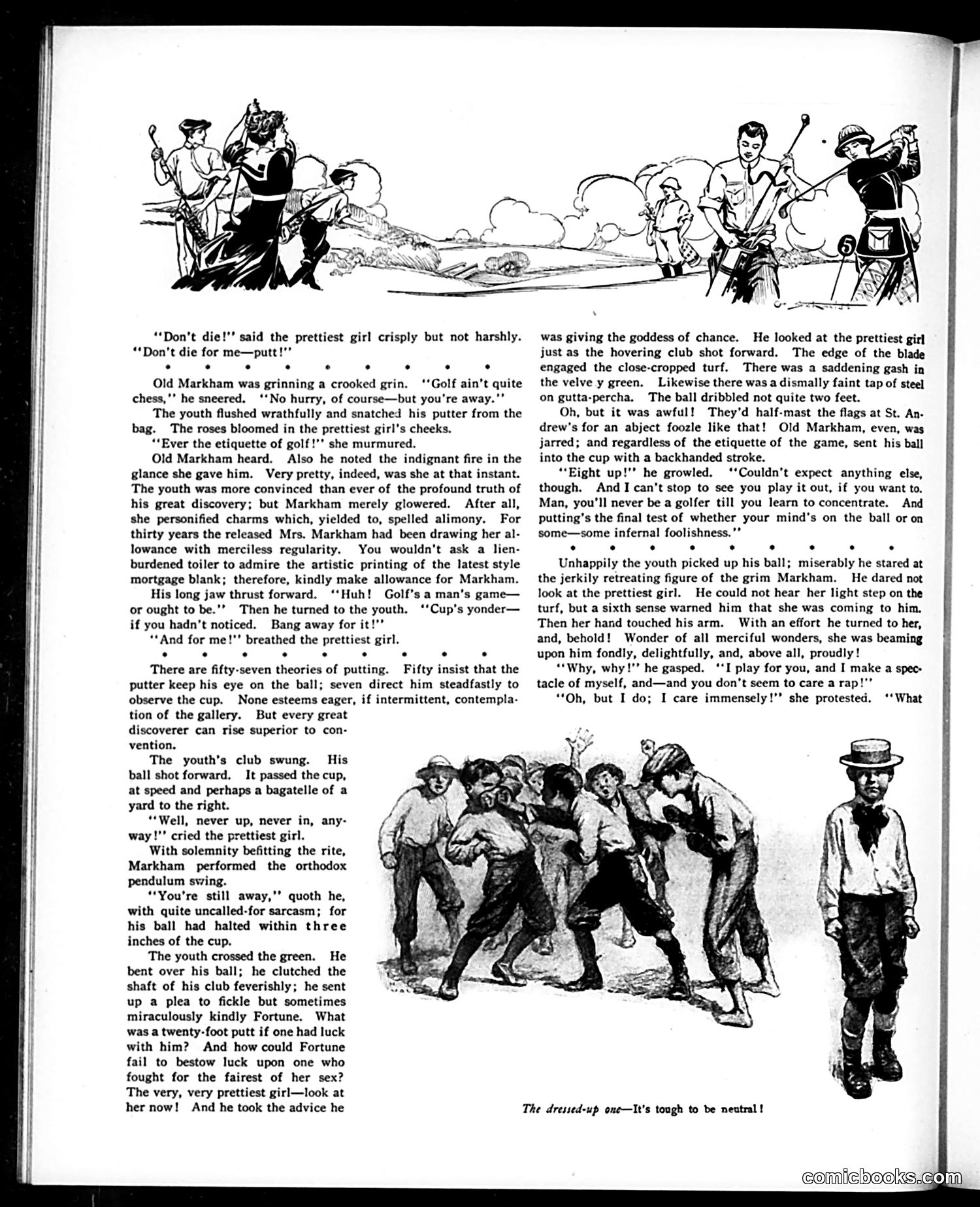
This page satirizes early 20th-century golf culture and masculine competition. The narrative follows a young man playing golf against the gruff, cynical Old Markham, with "the prettiest girl" as audience and prize. The satire targets several subjects: Old Markham represents bitter divorced men (he pays alimony to his ex-wife), whose jaded worldview contrasts with the youth's romantic idealism. The golf match itself mocks how men perform masculinity for female attention—the youth plays poorly because he's distracted by the girl, while Markham dominates through emotional detachment. The caption "The dressed-up one—it's tough to be neutral!" (visible in illustration) suggests the satire's core: the girl observing these masculine displays with apparent neutrality, though the story implies she ultimately rewards the lovelorn youth despite his inferior play. Judge uses this romantic-athletic scenario to satirize male insecurity and the performative nature of courtship among the leisure class.
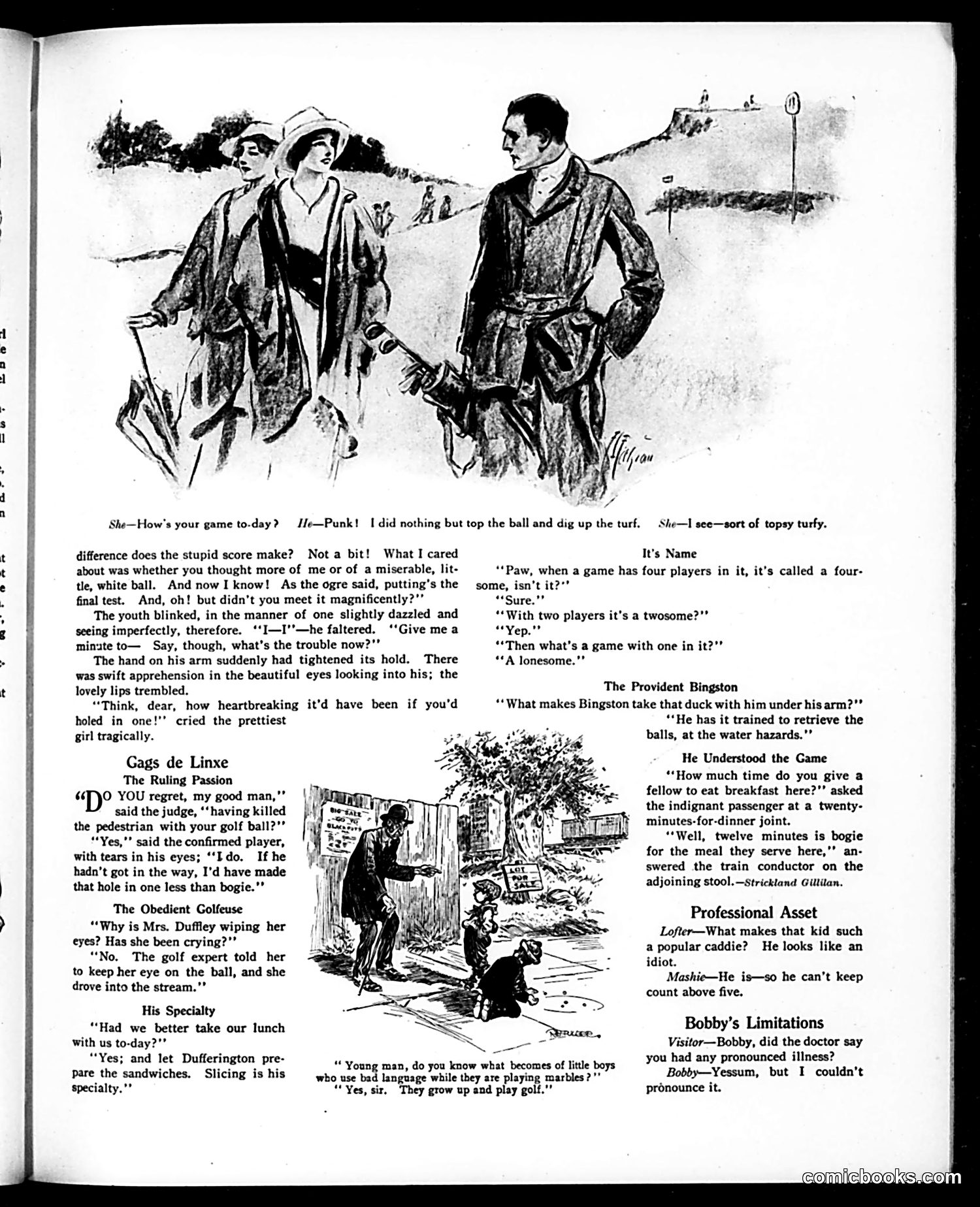
This page from *Judge* collects humorous anecdotes mocking golf's obsessive appeal to early 20th-century American leisure-class players. The central joke across all pieces: golf players care *only* about the game, prioritizing it above human decency, romance, and practical concerns. Key examples: - **"The Ruling Passion"**: A man regrets killing a pedestrian solely because it ruined his hole-in-one attempt—satirizing misplaced priorities. - **"Gags de Linxe"** sketches parody golf's consuming nature: a woman tests her boyfriend's love through golf performance; a golfer's specialty is slicing sandwiches (a pun). - **"It's Name"**: A child's wordplay joke—"lonesome" for one-player golf—plays on the sport's isolation. - **"The Provident Bingston"** and other pieces use golf terminology applied absurdly to life situations. The satire targets golf as an upper-class obsession that warps values and judgment. For modern readers: this reflects Roaring Twenties anxieties about newly wealthy Americans' leisure pursuits and perceived moral distortion through wealth-enabled indulgence.
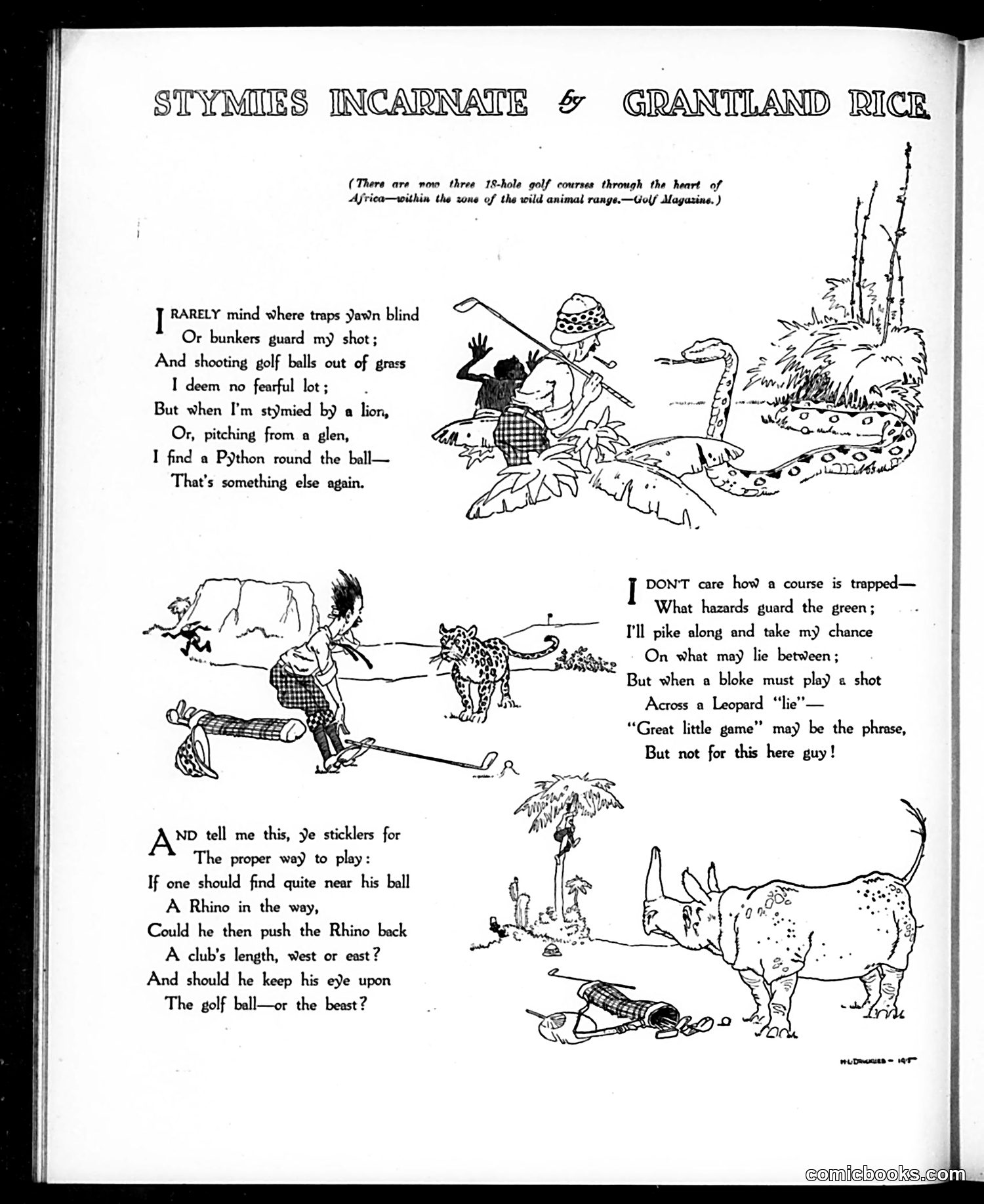
This humorous poem by Grantland Rice (a famous sportswriter) satirizes the absurdity of golf courses recently built in African wildlife reserves. The joke: golfers complain about traditional hazards like traps and bunkers, but face genuinely dangerous "obstacles"—lions, pythons, rhinos, leopards—that make the sport ridiculous rather than merely challenging. The cartoons illustrate these scenarios: a golfer encountering various African animals while trying to play. Rice's satire mocks both the pretentiousness of golf etiquette ("proper way to play") and the audacity of building recreational courses through wild animal habitats. The underlying criticism appears to be that civilization's encroachment on nature creates absurd conflicts, rendered comedic through exaggeration. The piece pokes fun at how golfers obsess over minor rules while facing actual mortal danger.
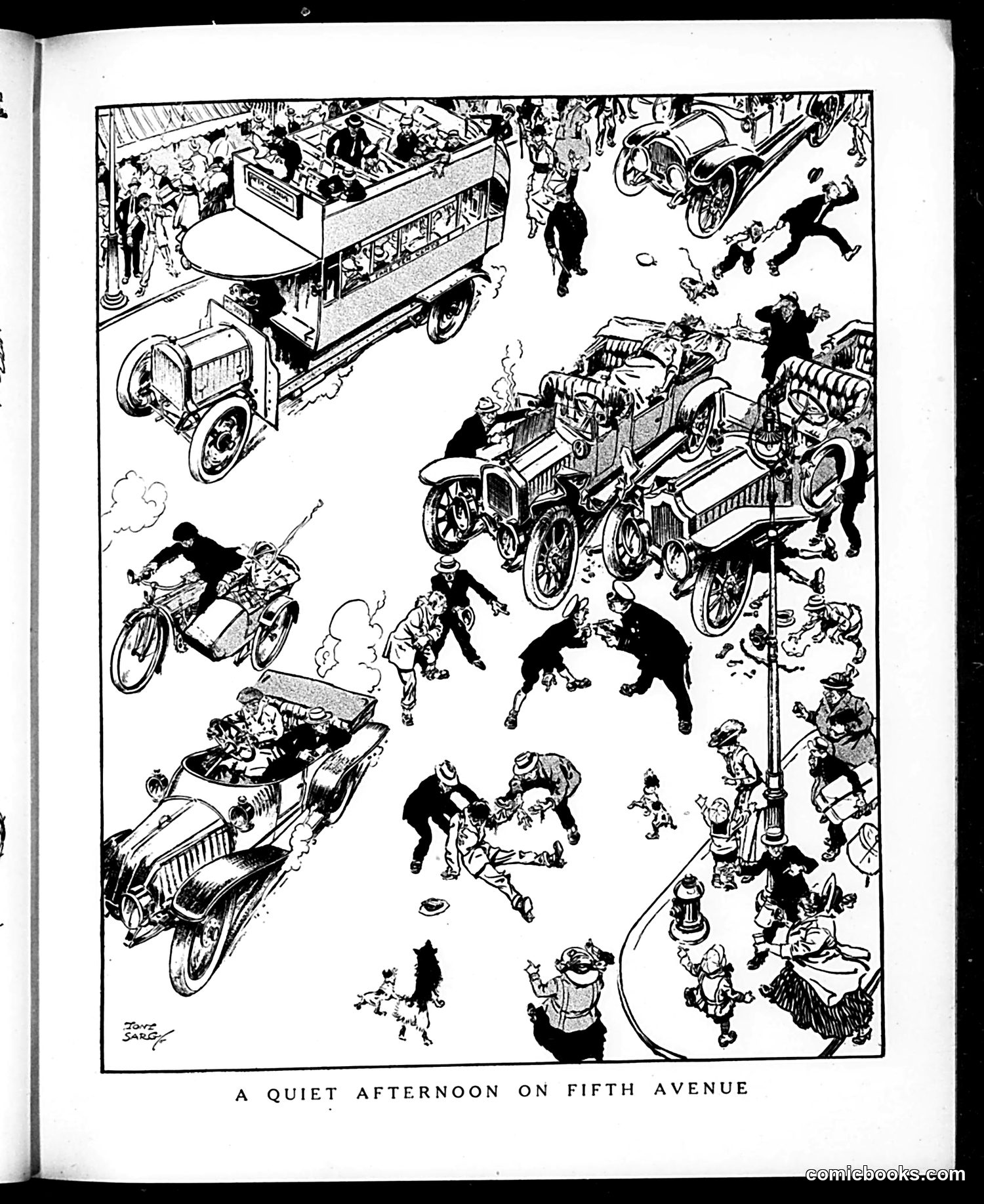
This satirical cartoon depicts the famous shopping street in Manhattan as anything but quiet. The title is ironic—the scene shows chaos: multiple automobiles and delivery trucks, bicycles, pedestrians, and children running chaotically across the street. The composition captures early 20th-century urban congestion and the collision of traditional modes of transportation (bicycles, hand-drawn carts) with modern motorized vehicles. The satire mocks the growing traffic problems and pedestrian danger of rapidly motorizing American cities. The crowded, disorderly scene illustrates how cars transformed urban life—creating hazardous, unpredictable street conditions where wealthy Fifth Avenue shoppers, delivery workers, and children competed dangerously for space. The "quiet afternoon" joke underscores the modern city's actual noise, congestion, and risk.
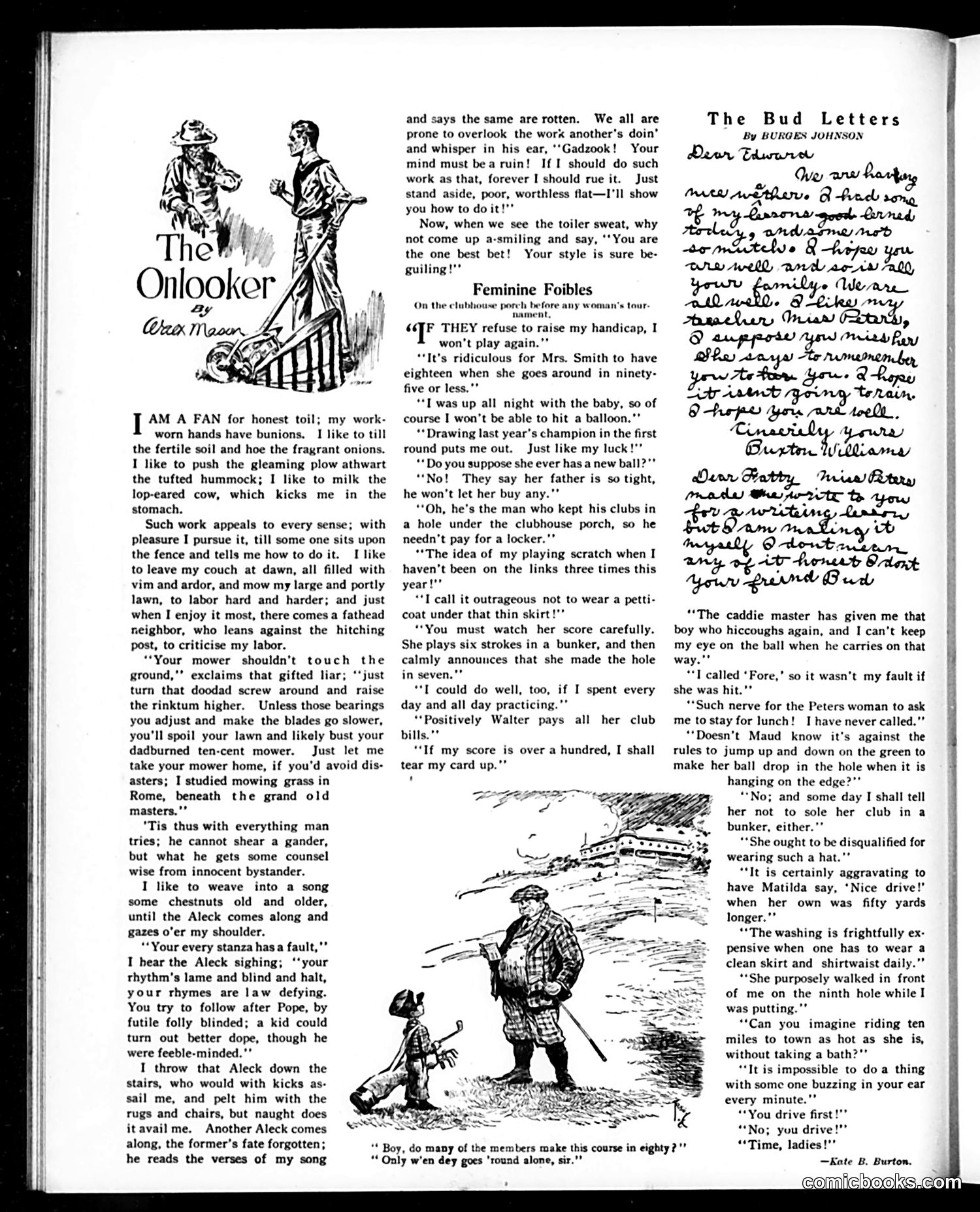
This page satirizes two related social annoyances of the early 20th century. **"The Onlooker"** mocks the ubiquitous know-it-all who offers unsolicited advice to anyone engaged in labor or creative work. The poem's speaker—a farmer, lawn-mower, and poet—is repeatedly interrupted by "Alecks" (smart-alecks) who criticize his methods despite having no expertise. The satire targets American culture's casual contempt for others' efforts and compulsive need to "correct" anyone pursuing honest work. **"Feminine Foibles"** ridicules women golfers' excuses and poor sportsmanship at a country club tournament. Women complain about handicaps, lack of new equipment, inadequate practice, opponents' cheating, and improper attire. The satire suggests women golfers are simultaneously vain, dishonest about their abilities, and prone to blaming external factors rather than accepting responsibility for poor play. Both sections reflect Judge magazine's satirical critique of contemporary social behavior, particularly the American tendency toward unsolicited judgment and excuse-making.
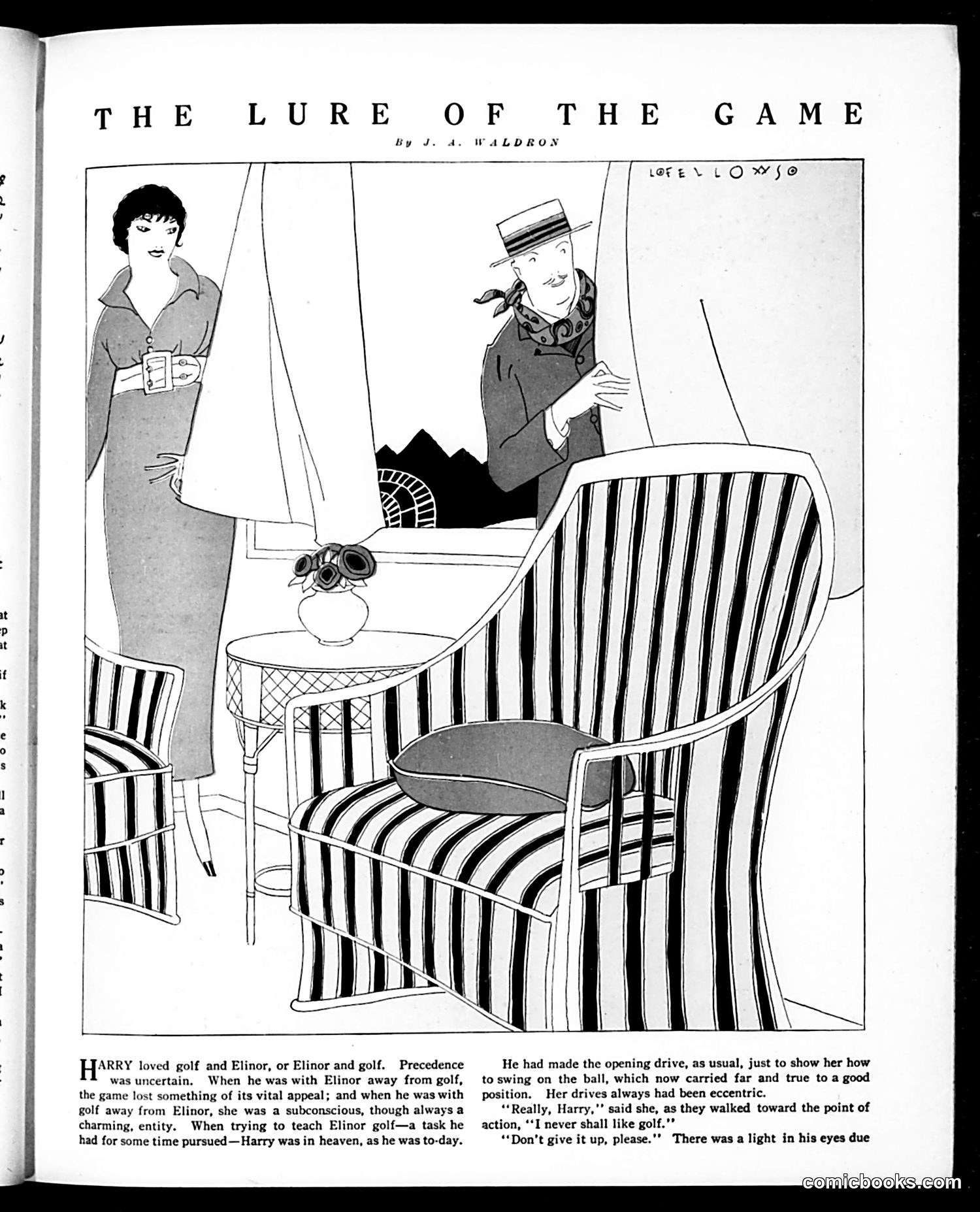
This is a romantic comedy illustration about a couple named Harry and Elinor. Harry is obsessed with golf and is attempting to teach his reluctant wife the game. The humor centers on their competing priorities: Harry loves golf almost as much as he loves Elinor, and he's determined to convert her to the sport despite her lack of enthusiasm. The satire gently mocks husbands who prioritize hobbies over spousal interests, and wives who indulge these obsessions. Elinor's repeated statement ("I never shall like golf") contrasts with Harry's optimistic persistence ("Don't give it up, please"), suggesting the futility of forcing shared interests on an unwilling partner. The illustration's 1920s style and interior setting suggest this reflects contemporary leisure-class domestic dynamics.
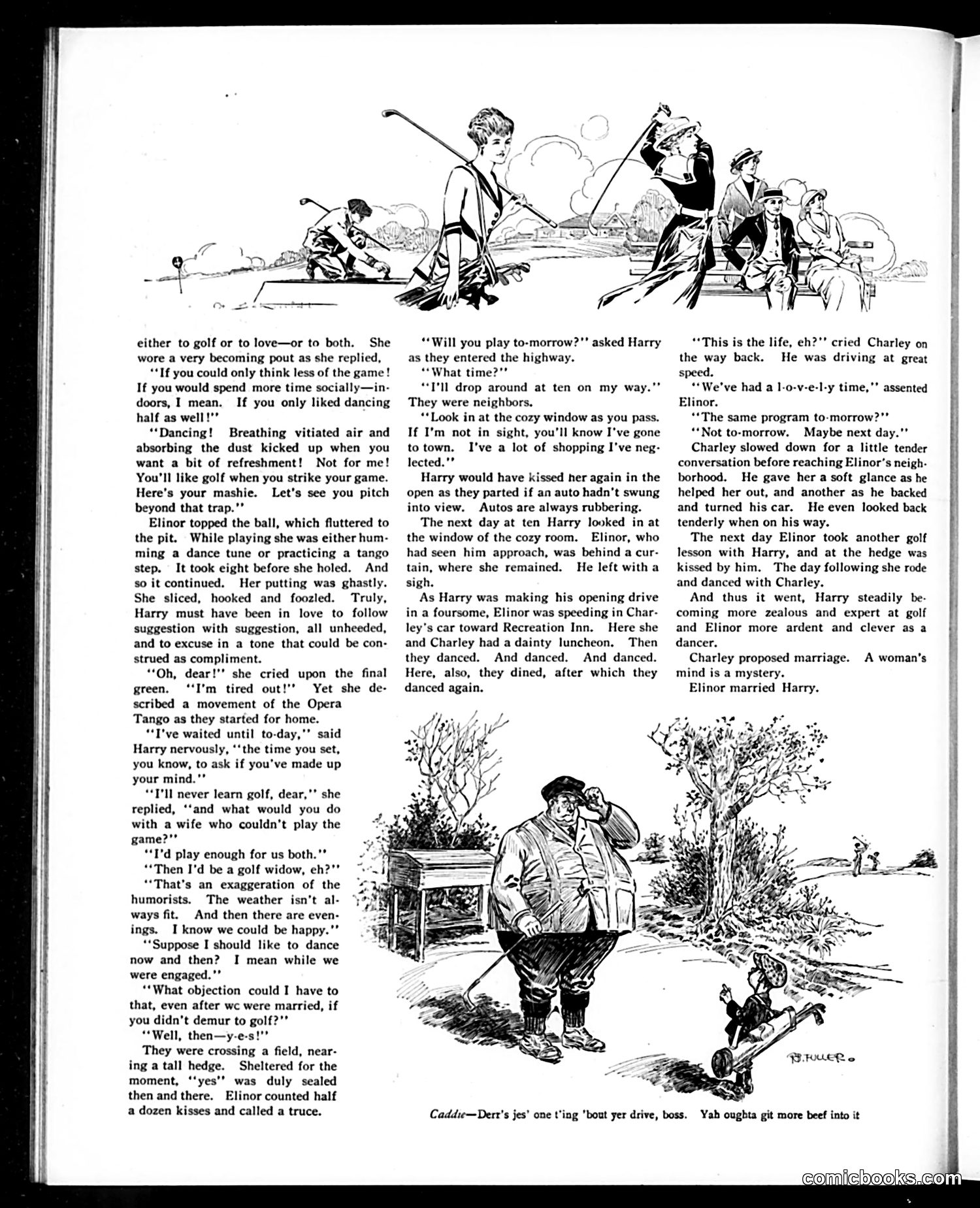
This story satirizes early 20th-century courtship and the supposed fickleness of women's preferences. Harry, a golf enthusiast, courts Elinor, a woman who prefers dancing and socializing indoors. She repeatedly criticizes his devotion to golf, yet accepts his proposal—only to later marry him anyway. The satire operates on multiple levels: it mocks both the obsessive male golfer (Harry ignores her stated preferences) and the inconsistent woman (Elinor simultaneously pursues Charley, a dancer, while accepting Harry's engagement). The punchline—"A woman's mind is a mystery. Elinor married Harry"—suggests women's choices are inexplicable and contradictory. The cartoon at page bottom (caddie commenting on the drive) reinforces golf as the story's frame. This reflects Judge magazine's upper-class audience and early 1900s assumptions about gender roles, courtship rituals, and leisure activities. The "woman's mystery" trope was common satire of the era.
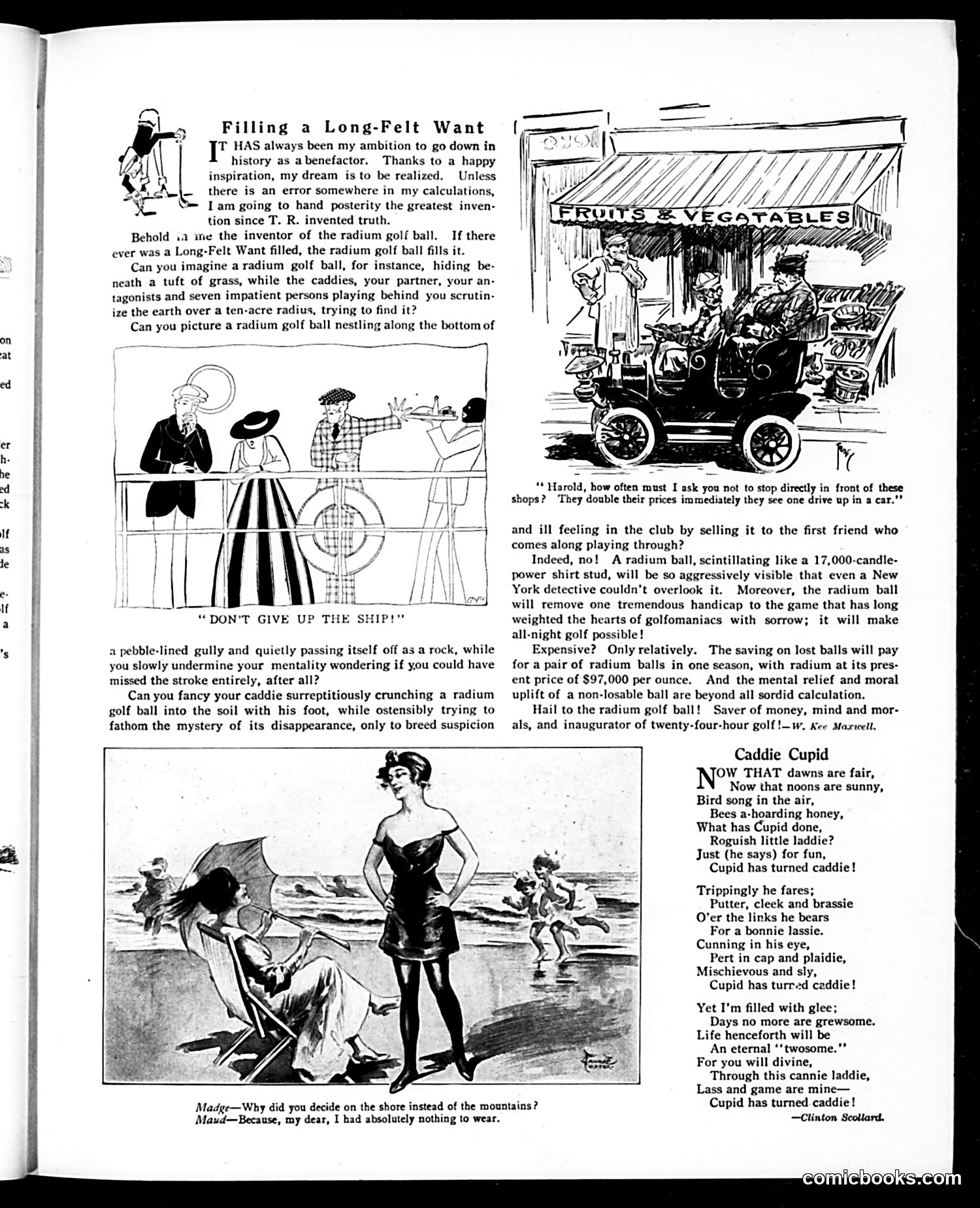
This satirical piece mocks the era's obsession with radium as a miraculous cure-all. The author humorously proposes a radium golf ball—glowing so brightly it cannot be lost—as a solution to golfers' chronic frustration with disappearing balls. The joke relies on radium's 1920s-era status as a fashionable, expensive "wonder substance" touted for implausible benefits (appearing in consumer products from cosmetics to health tonics). The author exaggerates the premise absurdly: listing $97,000-per-ounce radium costs, imagining caddies stealing glowing balls, and promoting "twenty-four-hour golf" as if nighttime golf were desirable. The cartoon also includes an unrelated satirical note about wealthy women stopping cars in front shops to avoid paying inflated prices, plus a light romantic poem ("Caddie Cupid") about romance on the golf links.
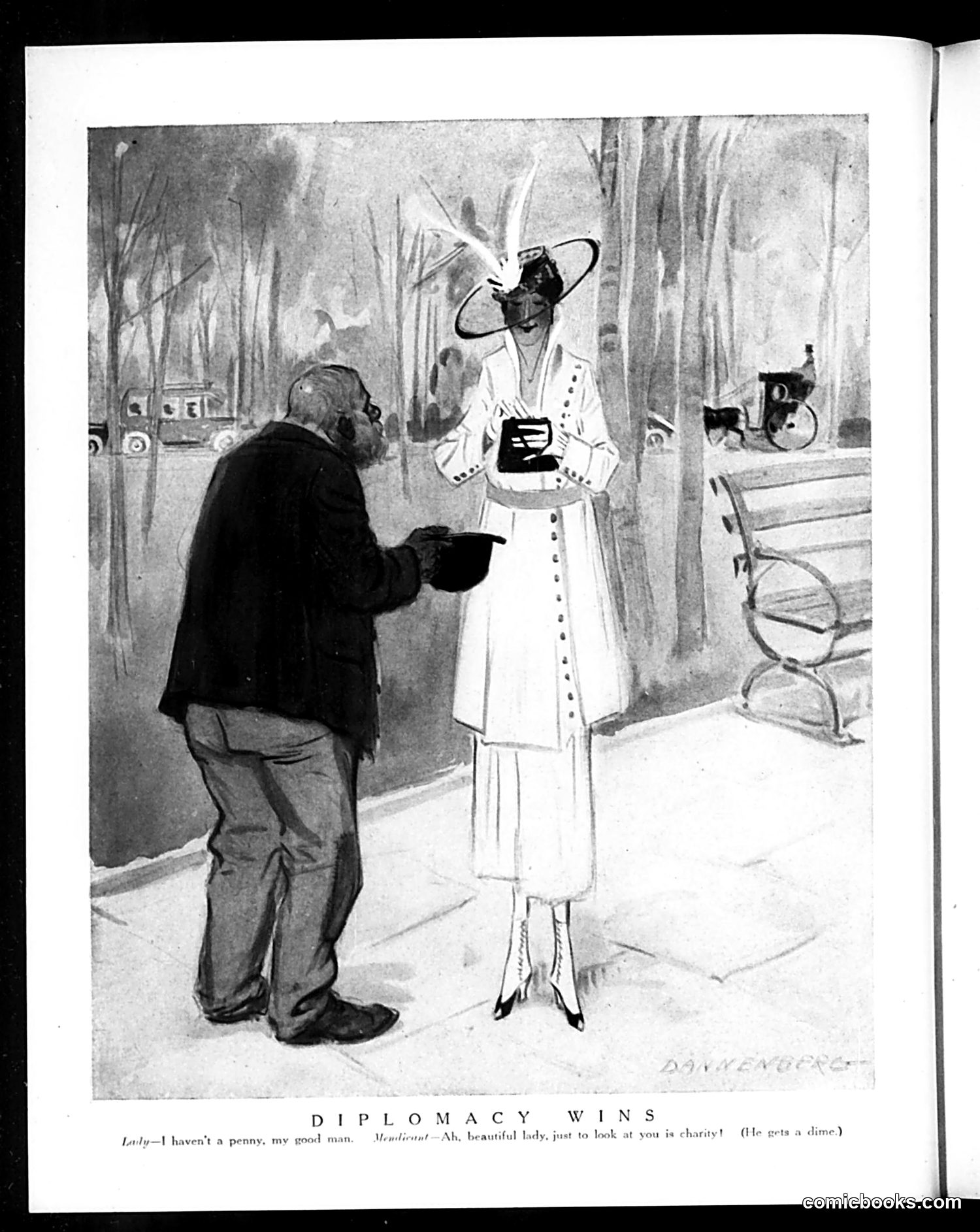
This cartoon satirizes social manipulation through charm and flattery. A shabby man without money approaches a well-dressed woman in what appears to be a park setting. He employs calculated flattery ("beautiful lady," "just to look at you is charity"), attempting to exploit her vanity to overcome her resistance to his panhandling request. The title "Diplomacy Wins" suggests that smooth talk and compliments serve as diplomatic tools to achieve financial gain. The woman's composed response—"I haven't a penny, my good man"—deflates his strategy, though her formal attire and elegant appearance contradict his claim of poverty's appeal. The satire likely critiques both manipulative begging tactics and the shallow susceptibility to flattery, reflecting early 20th-century attitudes toward vagrancy and social interaction.
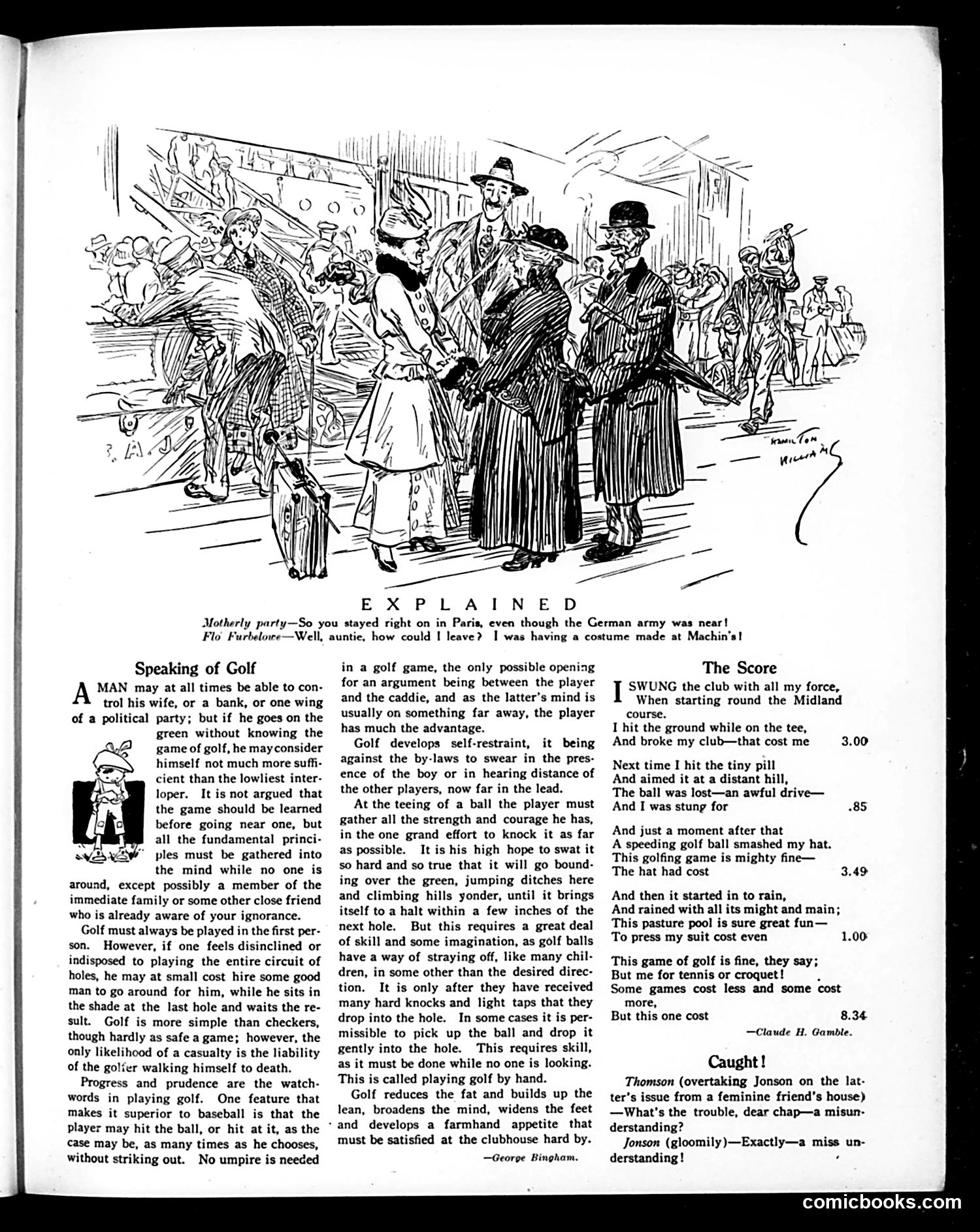
The top cartoon satirizes wealthy Americans' frivolous priorities during World War I. "Flo Furbelowe" (a name mocking pretentious society types) stays in Paris despite the approaching German army because she won't abandon her custom dress order at an exclusive shop. The joke targets American socialites for valuing fashion over safety—a commentary on privileged indifference to serious wartime concerns. The remaining content consists of humorous instructional pieces about golf. "Speaking of Golf" is a tongue-in-cheek guide mocking golf's complexity and social pretensions, while "The Score" is a comic poem tallying the financial disasters of a golfer's outing (broken clubs, lost balls, damaged property, ruined clothes). Both pieces gently ridicule golf as an expensive, frustrating sport embraced by America's leisure class, with costs mounting absurdly throughout play.
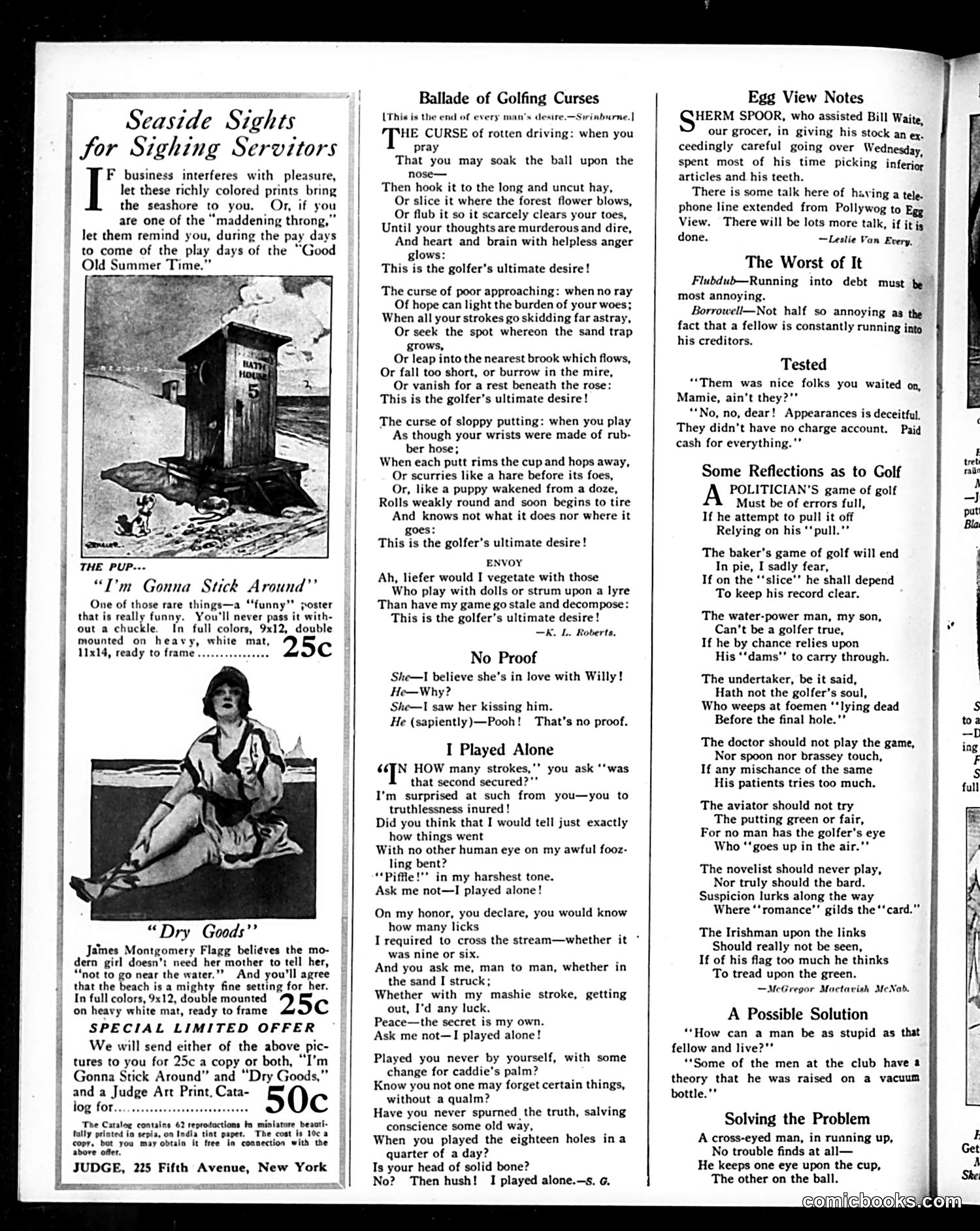
This page comprises light humor pieces typical of Judge magazine's early 20th-century content: **"Seaside Sights for Sighing Servitors"** advertises framed prints by James Montgomery Flagg—one featuring a dog ("I'm Gonna Stick Around"), another showing a modern girl at the beach ("Dry Goods"). The humor plays on office workers yearning for seaside escape during workdays. **"Ballade of Golfing Curses"** is a satirical poem (by K.L. Roberts) cataloging golfers' frustrations—poor drives, approach shots, and putting. It mocks golf's ability to transform players into anguished, rage-filled versions of themselves. The repetitive refrain "This is the golfer's ultimate desire!" uses irony throughout. **"I Played Alone"** addresses the golfer's dishonesty—asking why anyone would admit their actual score when no witnesses were present. It humorously suggests golfers routinely deceive themselves and others about their performance. The page reflects Judge's focus on satirizing middle-class leisure activities and foibles, particularly golf's grip on American professionals.
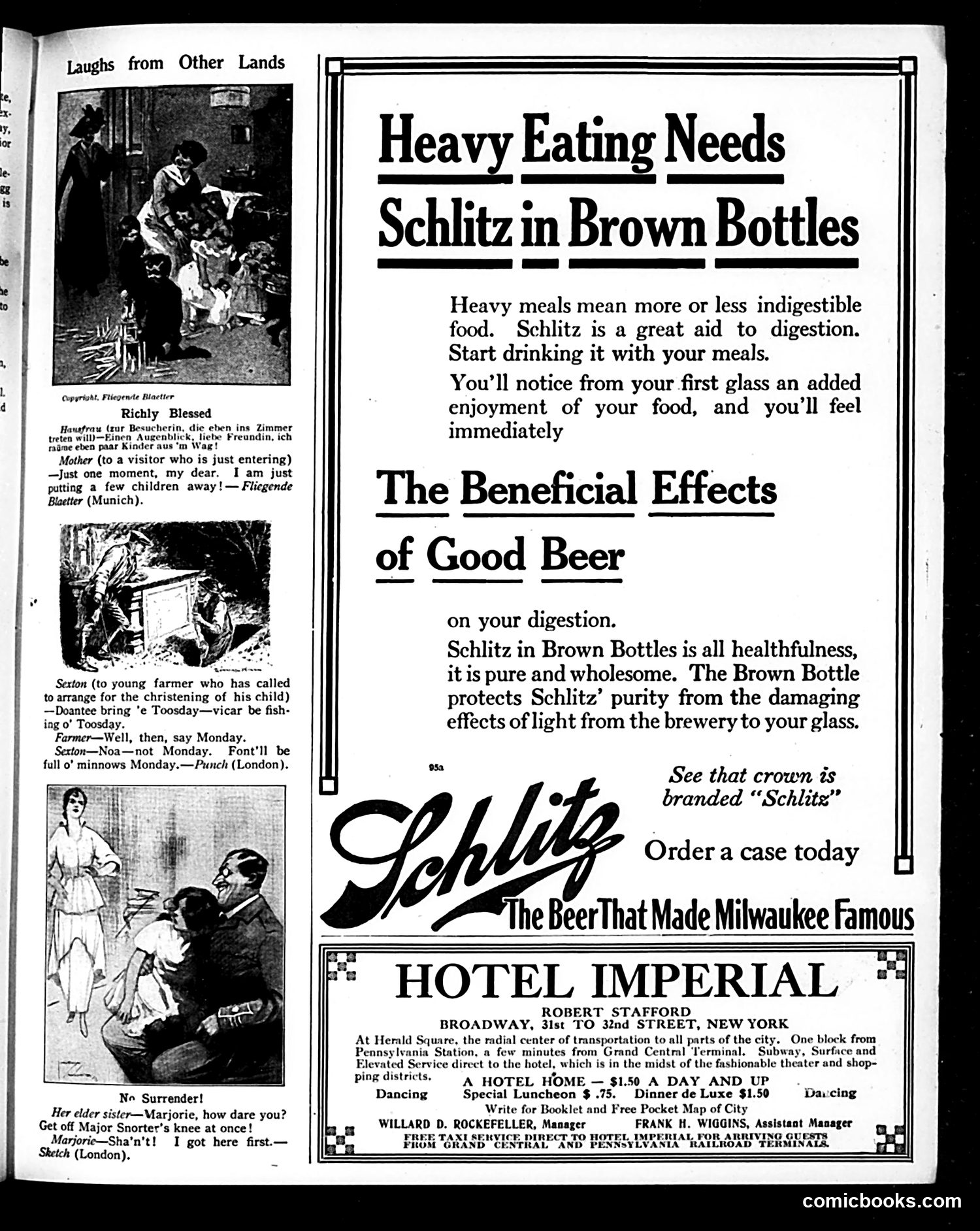
This page contains **three European cartoons** (reprinted from German and British sources) and two large **advertisements**. ## The Cartoons' Humor: The three brief comics use domestic/social situations for mild comedy: 1. **"Richly Blessed"**: A German cartoon where a mother tells a visitor she's "putting a few children away"—likely meaning storing them out of sight, playing on the phrase's double meaning. 2. **"Sexton" joke**: A British comic about scheduling a baby's christening, where both the vicar and church font are unavailable for practical, absurd reasons (fishing, minnows). 3. **"No Surrender"**: A young woman refuses to leave a man's knee during a scolding, creating cheeky romantic humor. ## The Advertisements: The page is dominated by a **Schlitz beer advertisement** claiming beer aids digestion with heavy meals, and a **Hotel Imperial** advertisement in Manhattan. Both are period-typical marketing claims—modern readers would recognize the beer health claims as now-discredited advertising. The page illustrates Judge's formula: imported European humor alongside American commercial appeals.
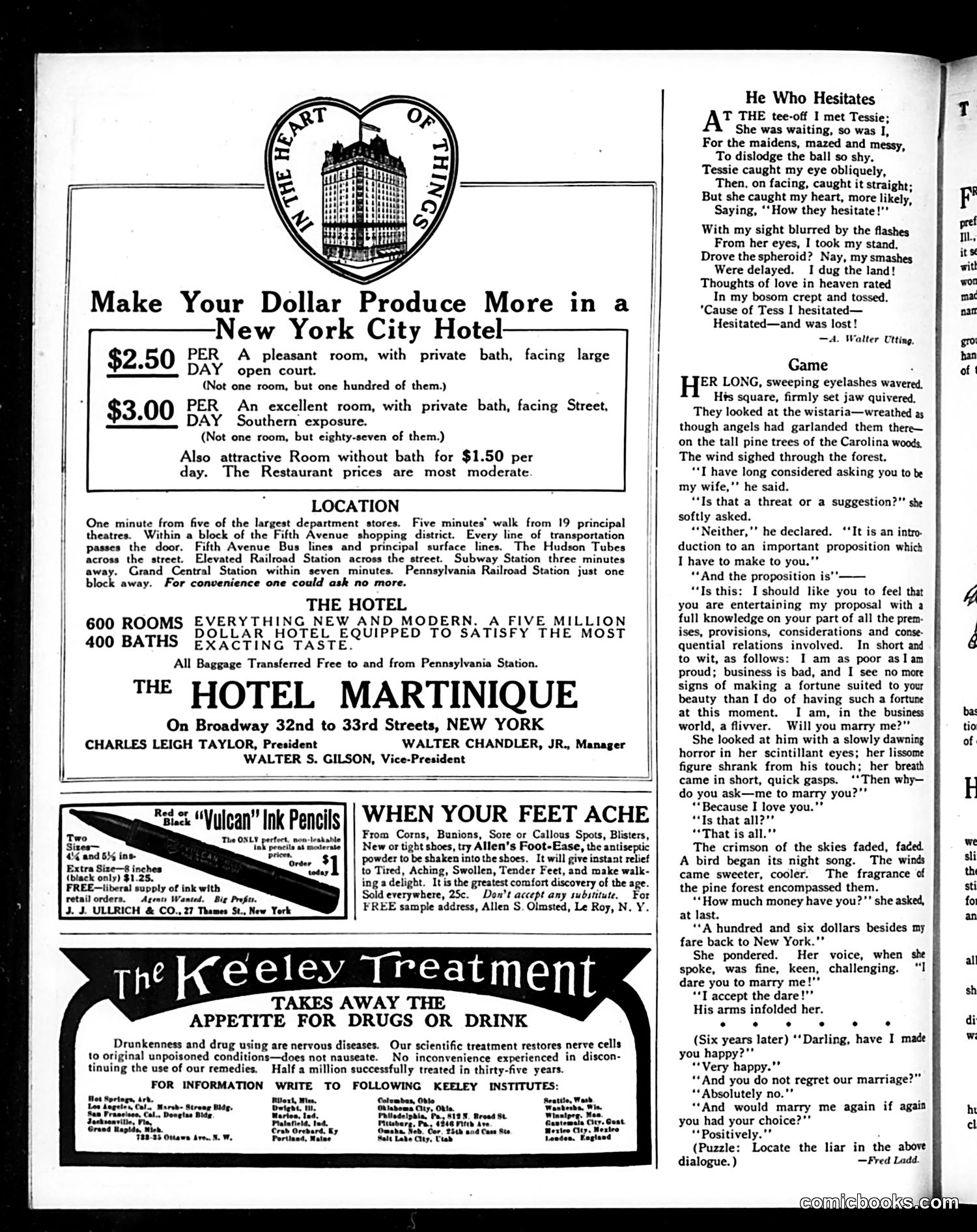
This page is primarily **advertising**, featuring a hotel promotion for the Hotel Martinique in New York City (rates $1.50-$3.00/day), alongside smaller ads for ink pencils and foot powder. The editorial content consists of two **romantic short stories in verse**: "He Who Hesitates" (about golf and love distraction) and "Game" (a marriage proposal scene). These appear to be light satirical fiction typical of Judge's humor—the "Game" story's humor derives from the protagonist's awkward, business-like marriage proposal to a woman who assumes wealth, only to learn he has $106. **No political cartoons or caricatures are visible.** The page reflects 1920s-era American values: courtship anxieties, economic preoccupation (the proposal's focus on poverty), and gender dynamics where a woman's initial interest hinges on financial prospects. The stories' tone is gently mocking of romantic convention rather than politically pointed.
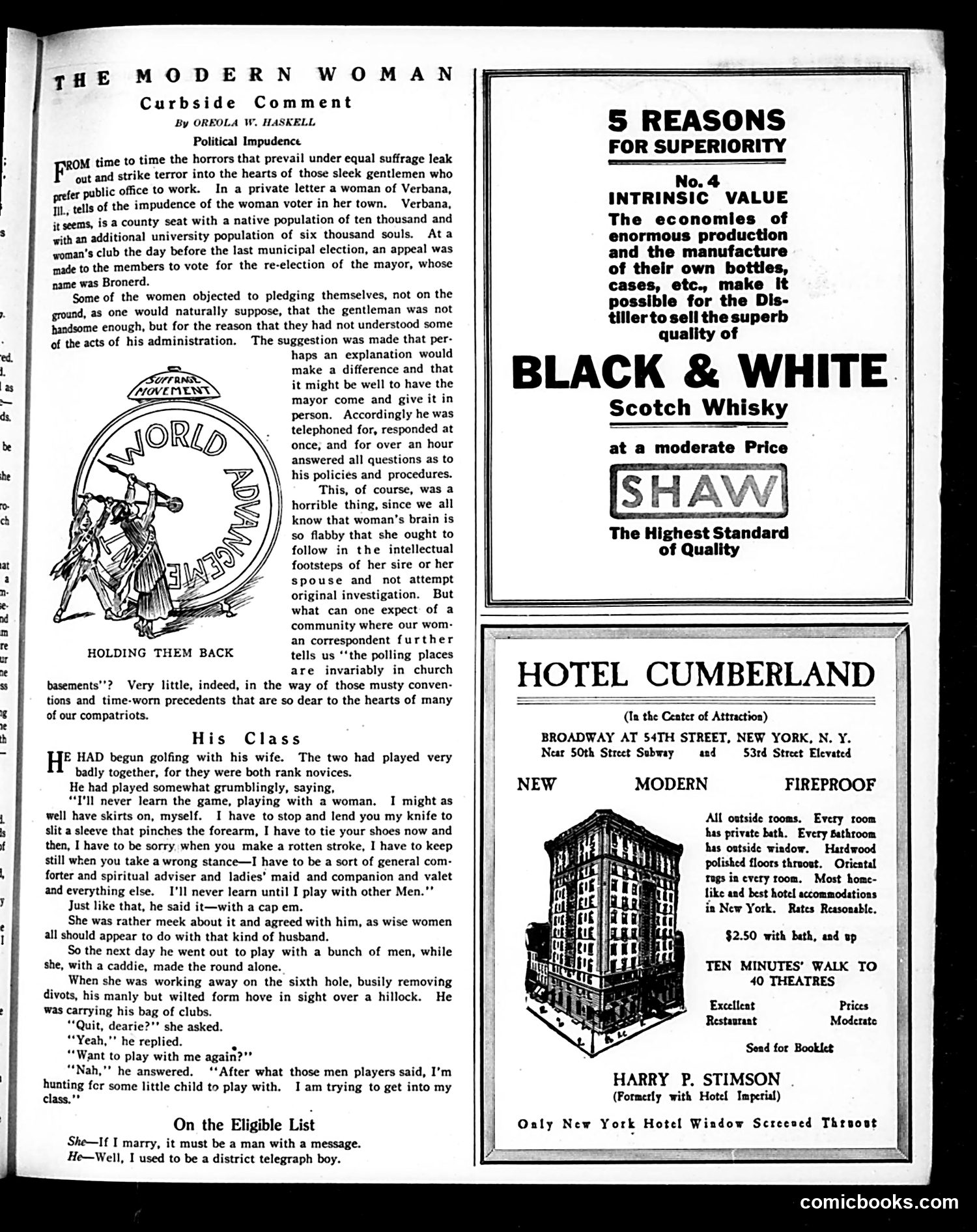
This page satirizes early 20th-century anxieties about women's suffrage and changing gender roles. **"Political Impudence"** mocks women voters in Verbana, Illinois, who dare demand the mayor explain his policies before pledging their votes. The satire is pointed: the author feigns outrage that women exercise independent judgment rather than blindly following male guidance. The complaint that women asked substantive questions—and that polling places are in church basements (accessible to women)—reveals the genuine alarm some men felt at female political participation. **"His Class"** presents a golf anecdote where a husband complains that playing with his wife requires him to be her "general comforter...ladies' maid and companion." When he plays with men and performs poorly, he declares he must find "some little child" as a partner—implying women belong in a lower category. The joke's bitter irony: his wife plays the course alone competently. Both pieces use humor to express anti-suffrage sentiment while inadvertently exposing the condescension underlying opposition to women's equality. The page is primarily satirical commentary rather than advertisement, though ads occupy the right column.
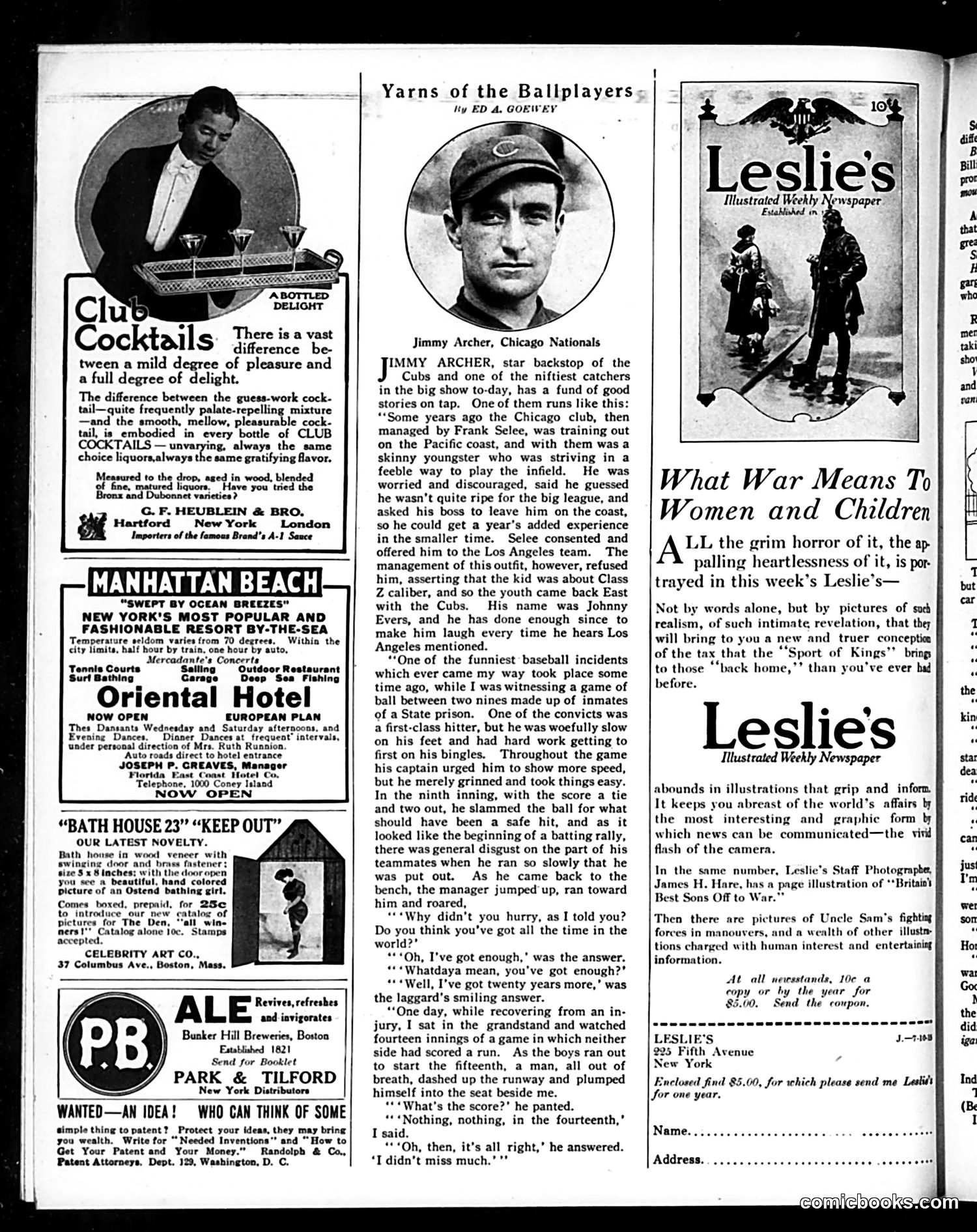
This page is primarily **advertising and sports content**, not political satire. The main article is "Yarns of the Ballplayers" by Ed A. Goewey, featuring **Jimmy Archer**, catcher for the Chicago Cubs. Archer recounts anecdotes about baseball, including a story about **Johnny Evers** (a real Cubs player) being rejected by the Los Angeles team as "Class Z caliber" before becoming successful—an ironic tale about misjudgment. The page is dominated by **period advertisements** for cocktails, resort hotels (Manhattan Beach, Oriental Hotel), novelty items, patent services, and alcoholic beverages (P.B. Ale). There is no discernible political cartoon on this page. The content reflects early 20th-century commercial culture and sports journalism typical of Judge magazine's entertainment-focused sections, distinct from its satirical editorial content.
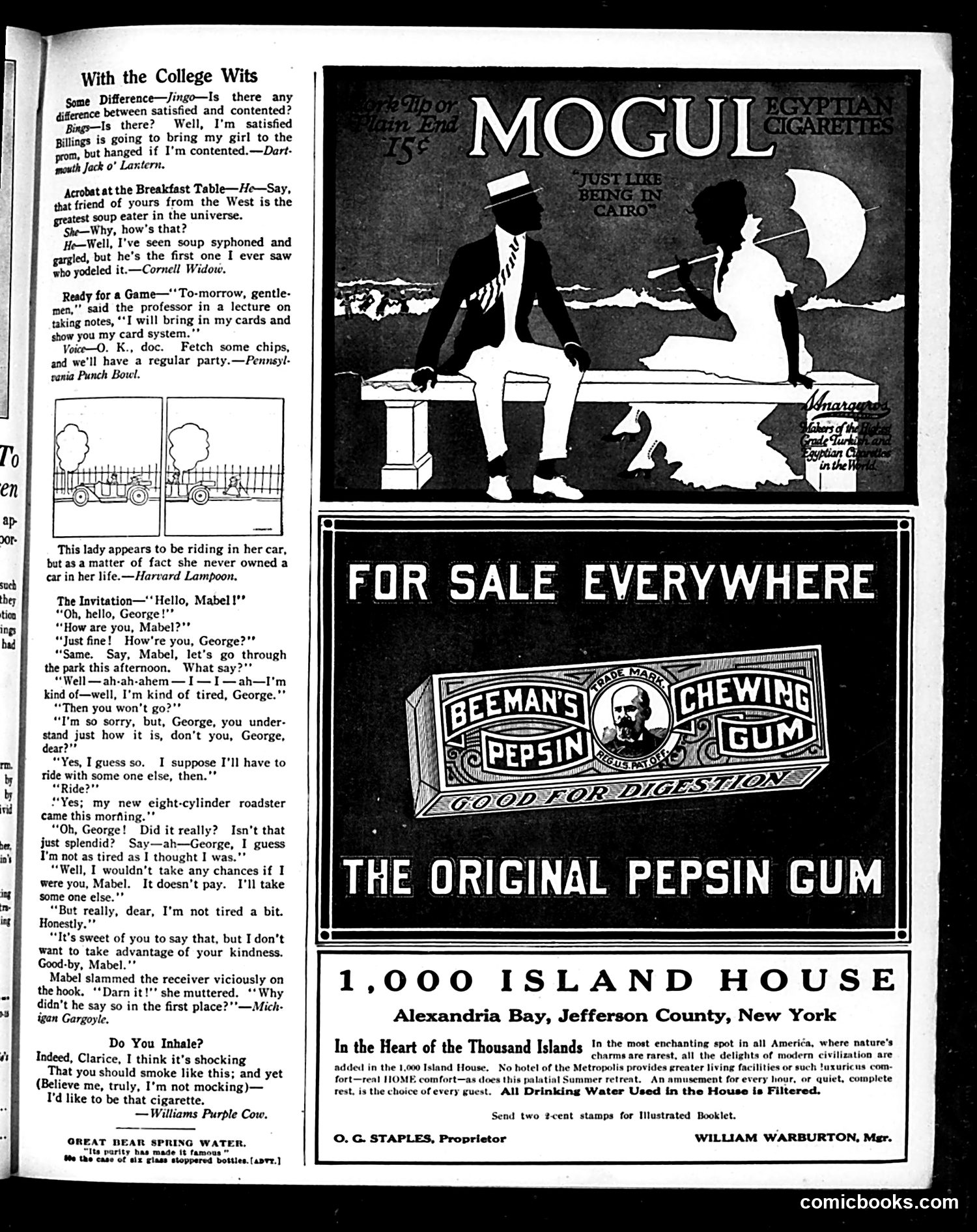
This page combines college humor with period advertisements. The left side features brief comedic sketches from various college publications, exploiting typical early-20th-century collegiate scenarios: romantic misunderstandings, professorial eccentricity, and social pretension. The humor relies on wordplay and relatable campus situations. "The Invitation" sketch satirizes shallow courtship rituals—Mabel feigns exhaustion to decline a park walk, but instantly recovers interest upon learning George has acquired an expensive new car, exposing her materialistic priorities and social climbing. The joke mocks both her transparent self-interest and George's use of material possessions as romantic leverage. The right side features advertisements for Mogul Egyptian Cigarettes and Beeman's Pepsin Chewing Gum, alongside a resort advertisement for the 1,000 Island House in New York. These ads reflect period consumer culture and leisure marketing.
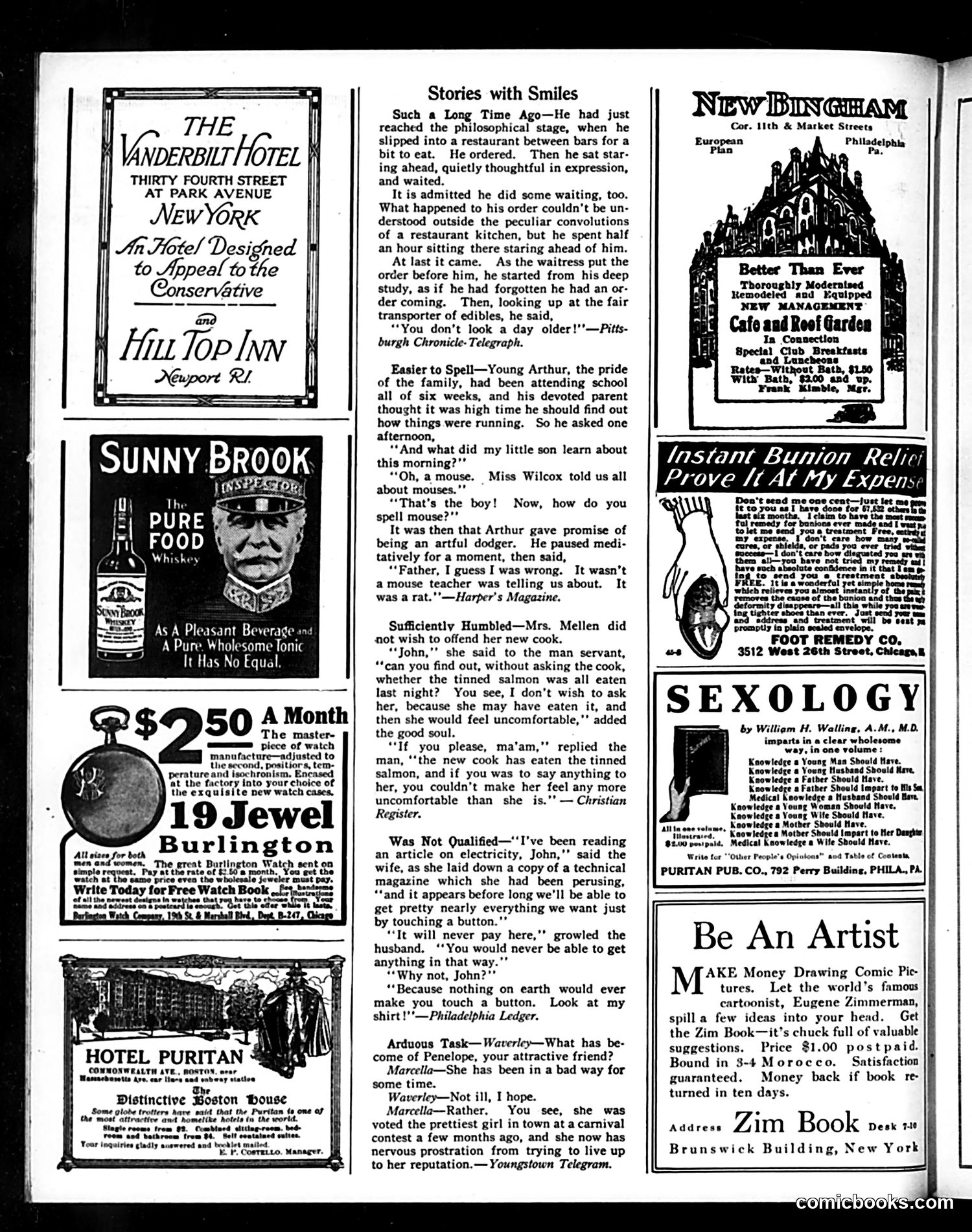
This page is primarily **advertising and humor anecdotes** rather than political satire. The "Stories with Smiles" section contains four brief humorous anecdotes: 1. **"Such a Long Time Ago"**: A joke about a diner waiting so long for food he forgets his order arrived. 2. **"Easier to Spell"**: A child's joke—when asked to spell "mouse," the boy claims the teacher was actually discussing a rat, dodging the question. 3. **"Sufficiently Humbled"**: Wordplay about a servant tactfully informing his employer that the new cook ate the tinned salmon without directly asking her. 4. **"Was Not Qualified"**: A husband's quip that buttons won't work in his home because his wife never touches anything (implying she's lazy or negligent). These are gentle domestic humor pieces typical of early 20th-century magazines—no political commentary. The surrounding advertisements promote hotels, watches, whiskey, and self-help books, reflecting the page's commercial rather than satirical purpose.
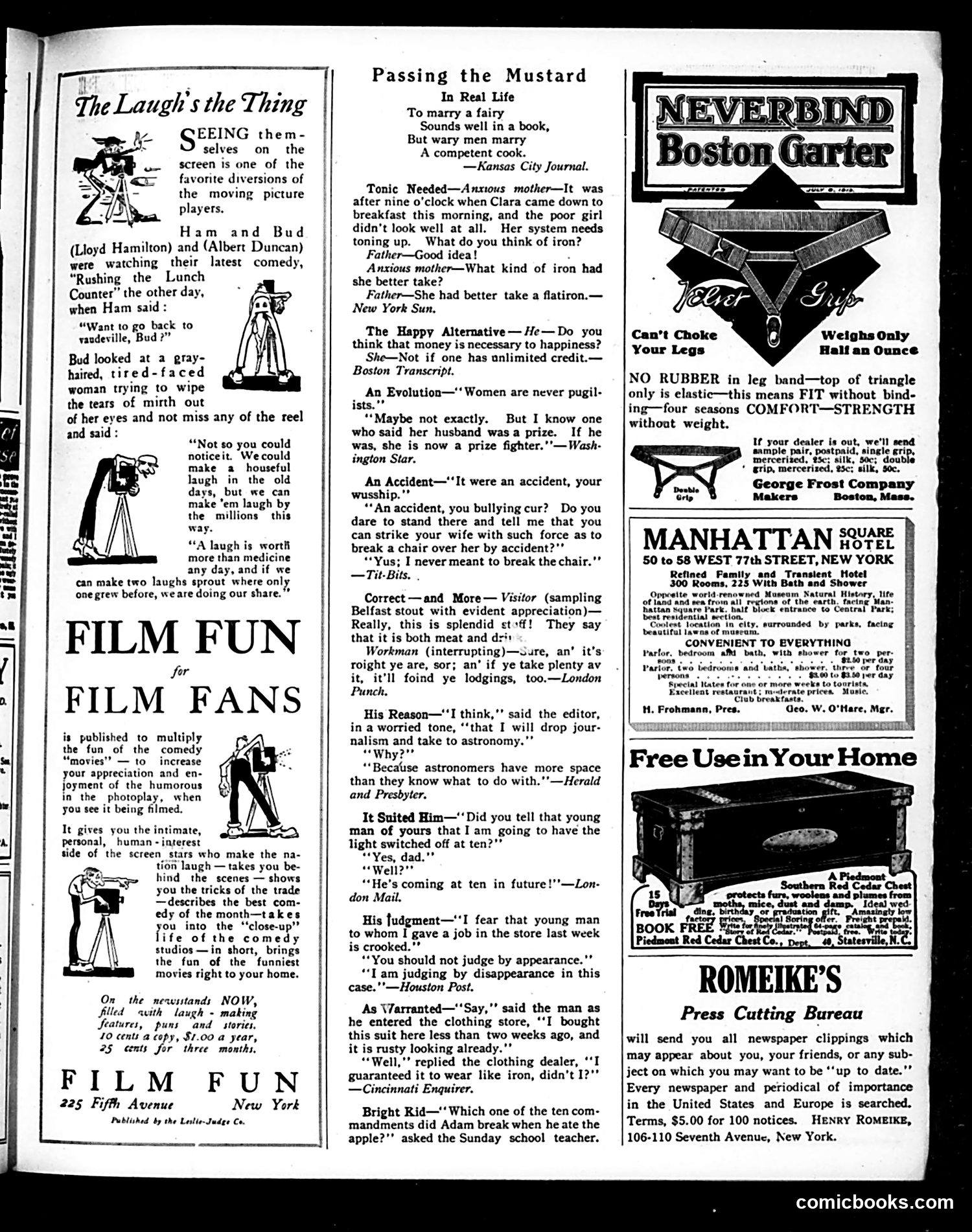
This page from *Judge* magazine contains primarily **humor columns and advertisements**, not political cartoons. The left side features "The Laugh's the Thing," a promotional piece for *Film Fun* magazine. Lloyd Hamilton and Albert Duncan, silent-film comedians, discuss how movies allow them to make "millions" laugh versus vaudeville's smaller audiences—reflecting early cinema's revolutionary reach. The center column, "Passing the Mustard," collects brief jokes about domestic life, gender roles, and Irish accents—common *Judge* fare. Recurring themes include wives as cooks, "modern woman" humor, and working-class Irish characters (stereotypically depicted). The jokes rely on puns and gentle absurdism rather than sharp satire. The advertisements (right side) promote period products: the "Neverbind Boston Garter," a leg-band device, and the Manhattan Square Hotel in New York. **Historical context**: This reflects 1920s-era American humor—attitudes toward gender, class, and ethnicity would be considered offensive today, though contemporary audiences found them mainstream entertainment.
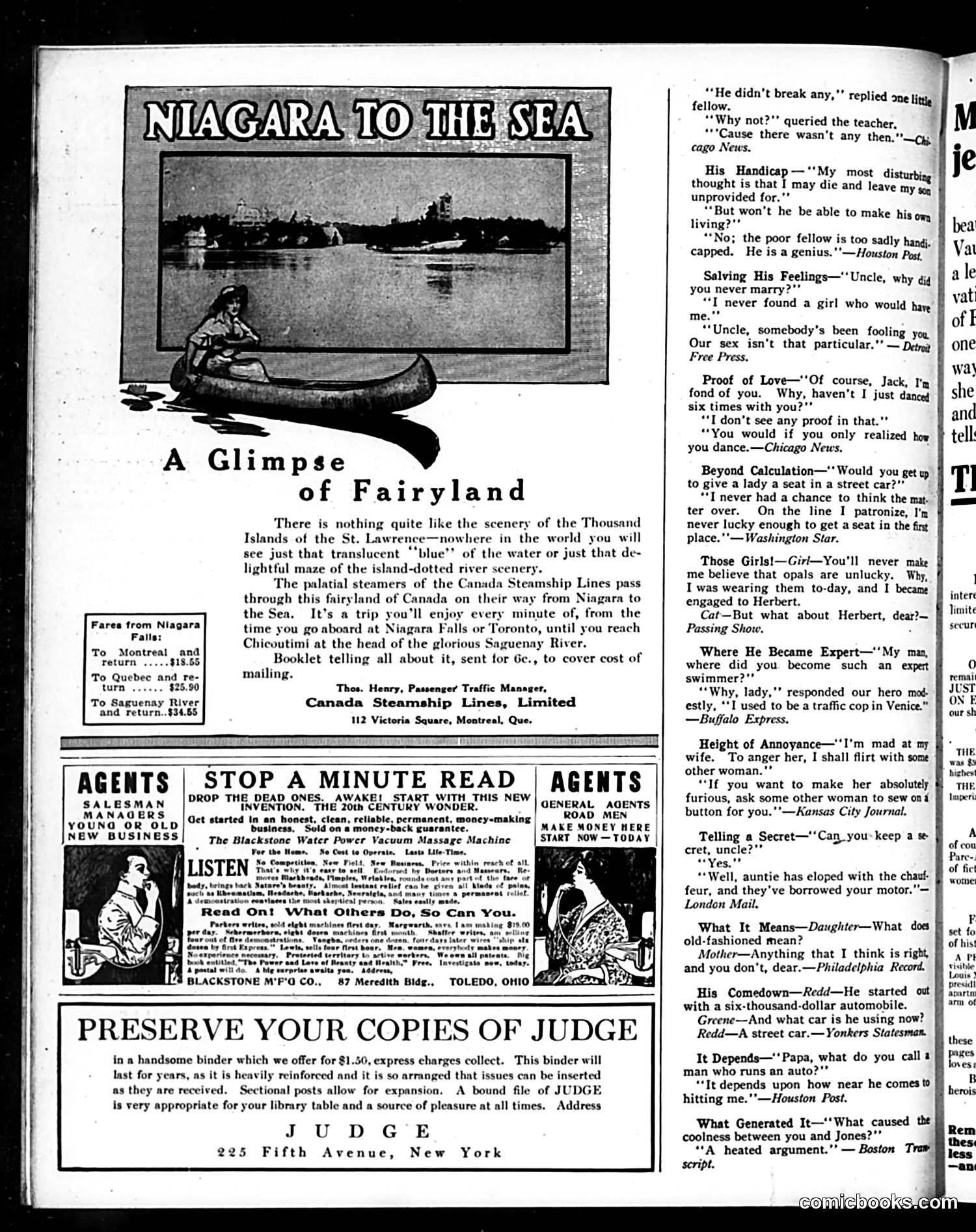
This page is primarily **advertising and humor columns**, not political satire. The main visual feature is a travel advertisement for Canada Steamship Lines depicting Niagara Falls and the Thousand Islands, promoting scenic river trips. The bulk of the page contains **short humorous anecdotes** on domestic and social topics typical of early 20th-century American humor: - Jokes about marriage reluctance and courtship - Marital bickering (wives angering husbands) - Class-conscious humor (streetcar etiquette, servants) - Gender stereotypes (women's materialism, jealousy over opals) The advertisements include patent medicine promotion (Blackstone Water Power Vacuum Massage Machine) and offers for sales agents—typical of Judge's revenue model. **No clear political figures or events** are referenced. The humor reflects period attitudes toward courtship, marriage friction, and social hierarchies rather than commenting on specific political matters. The tone is light, domestic, and conventional for mainstream American magazine humor of the era.
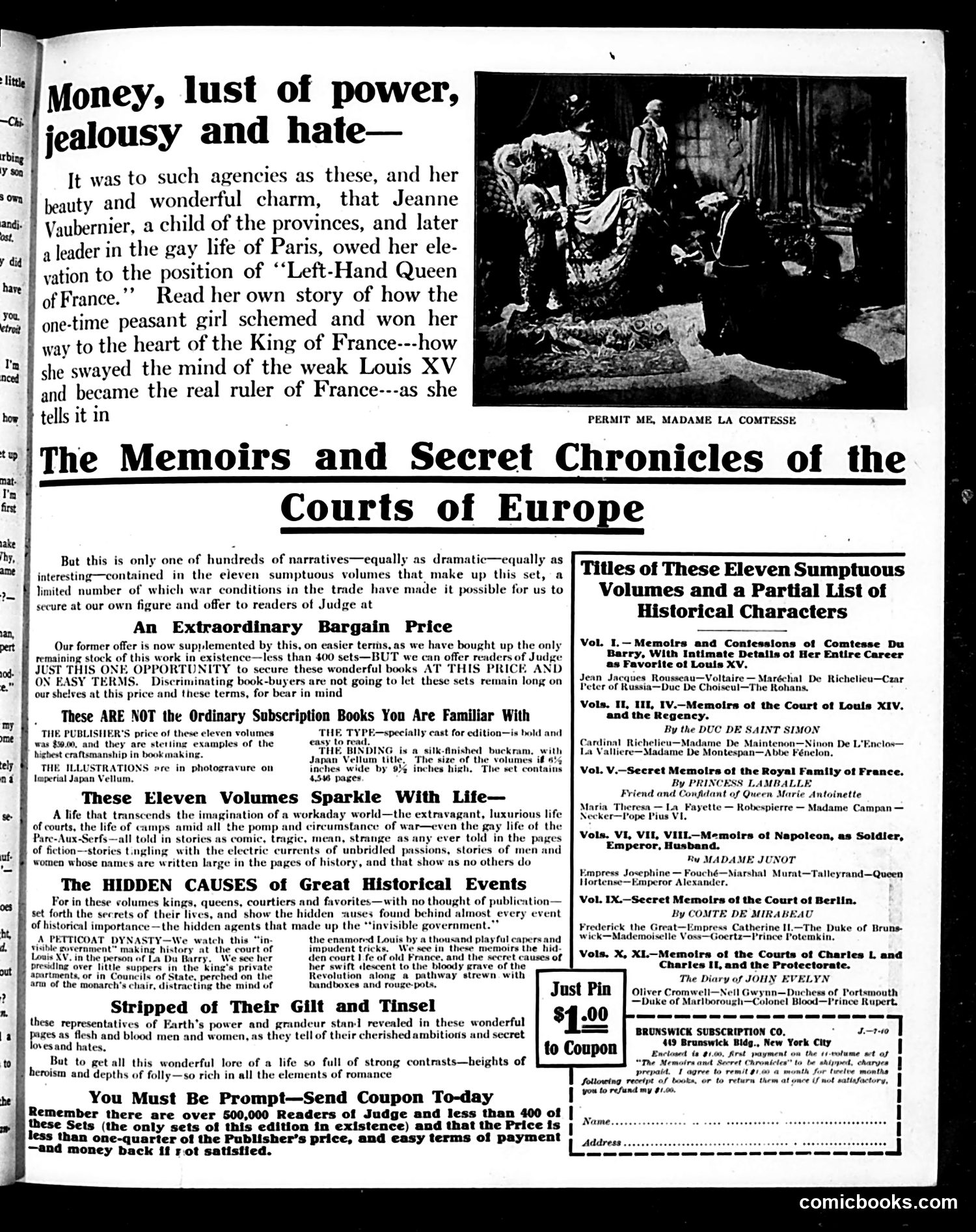
This page is primarily **advertising**, not political satire. It promotes a eleven-volume book series about European court scandals and historical gossip. The text references **Jeanne Vaubermier (Madame du Barry)**, the historical mistress of King Louis XV of France, as a featured narrative. She's presented as a peasant girl who manipulated the "weak" king into making her the power behind the throne—a sensationalized account of her actual historical rise. The advertisement's appeal targets Judge's readers with promises of scandalous "hidden causes" of history: intimate secrets of kings, queens, and courtiers "stripped of their gilt and tinsel," revealing human flesh-and-blood beneath royal pretense. The pitch emphasizes lurid drama—"unbridled passions," conspiracies, and the "invisible government" behind historical events. The satire is implicit rather than explicit: the advertisement itself mocks the appetite for gossipy, sensationalized history while exploiting exactly that appetite to sell books. It's a self-aware advertisement exploiting reader desire for court intrigue and scandal.
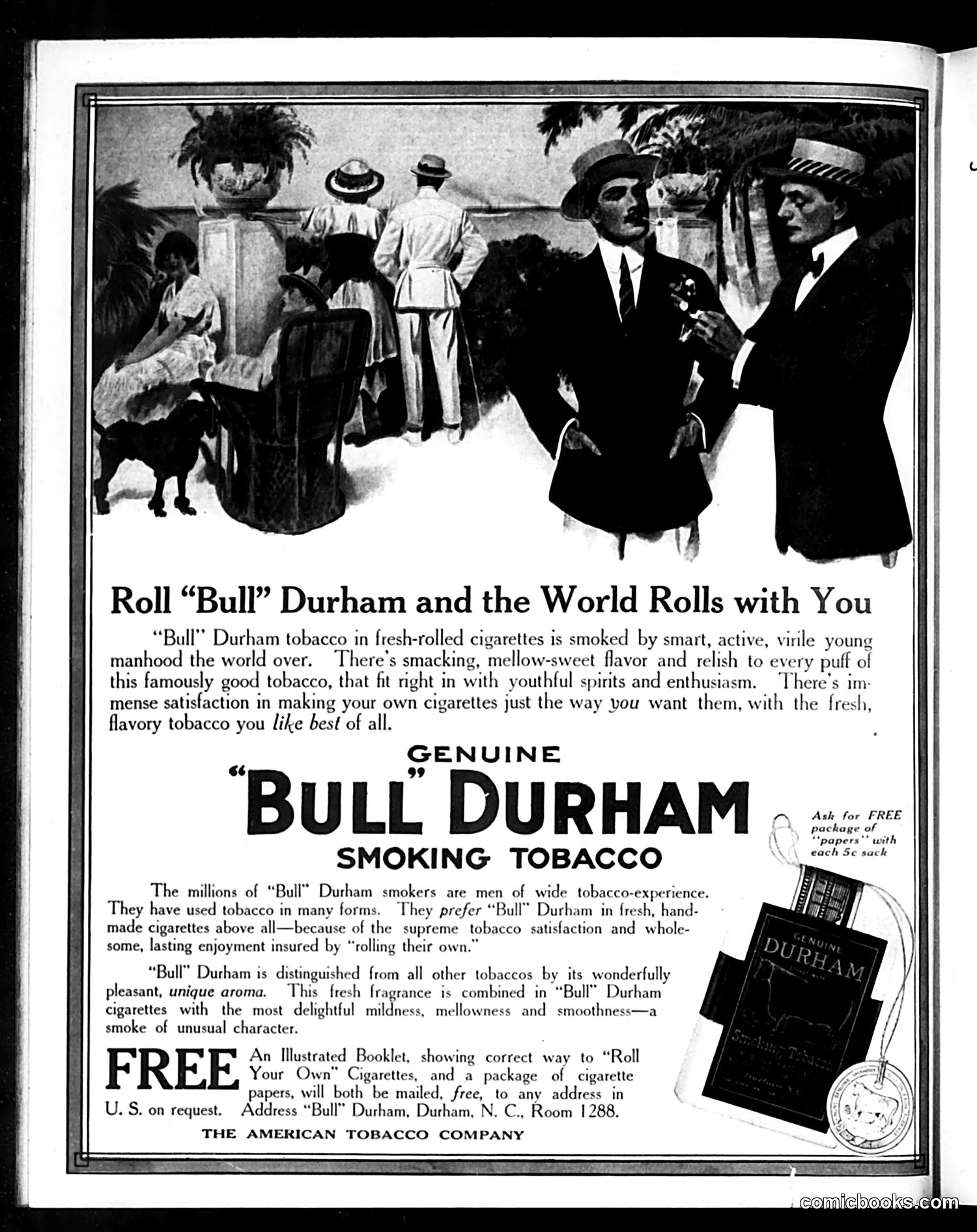
This page is primarily a **cigarette advertisement**, not satire or political commentary. It's a genuine Bull Durham tobacco ad from an early 20th-century *Judge* magazine. The image depicts well-dressed men in hats in what appears to be a tropical or colonial setting (palm trees visible), suggesting Bull Durham's aspirational appeal to "smart, active, virile young manhood the world over." The ad's key selling point: customers could purchase loose tobacco and rolling papers to hand-roll their own cigarettes—cheaper and more customizable than factory-made cigarettes. The company offers free instructional booklets and cigarette papers as incentives. The marketing emphasizes masculinity, sophistication, and personal control ("the way *you* want them"), common tobacco advertising themes of the era. There is no satire present—this represents straightforward early-1900s product promotion in what was primarily a humor magazine but carried advertisements like any publication.