
Judge, 1915-07-10 · page 7 of 28
Judge — July 10, 1915 — page 7: what you’re looking at
What you’re looking at
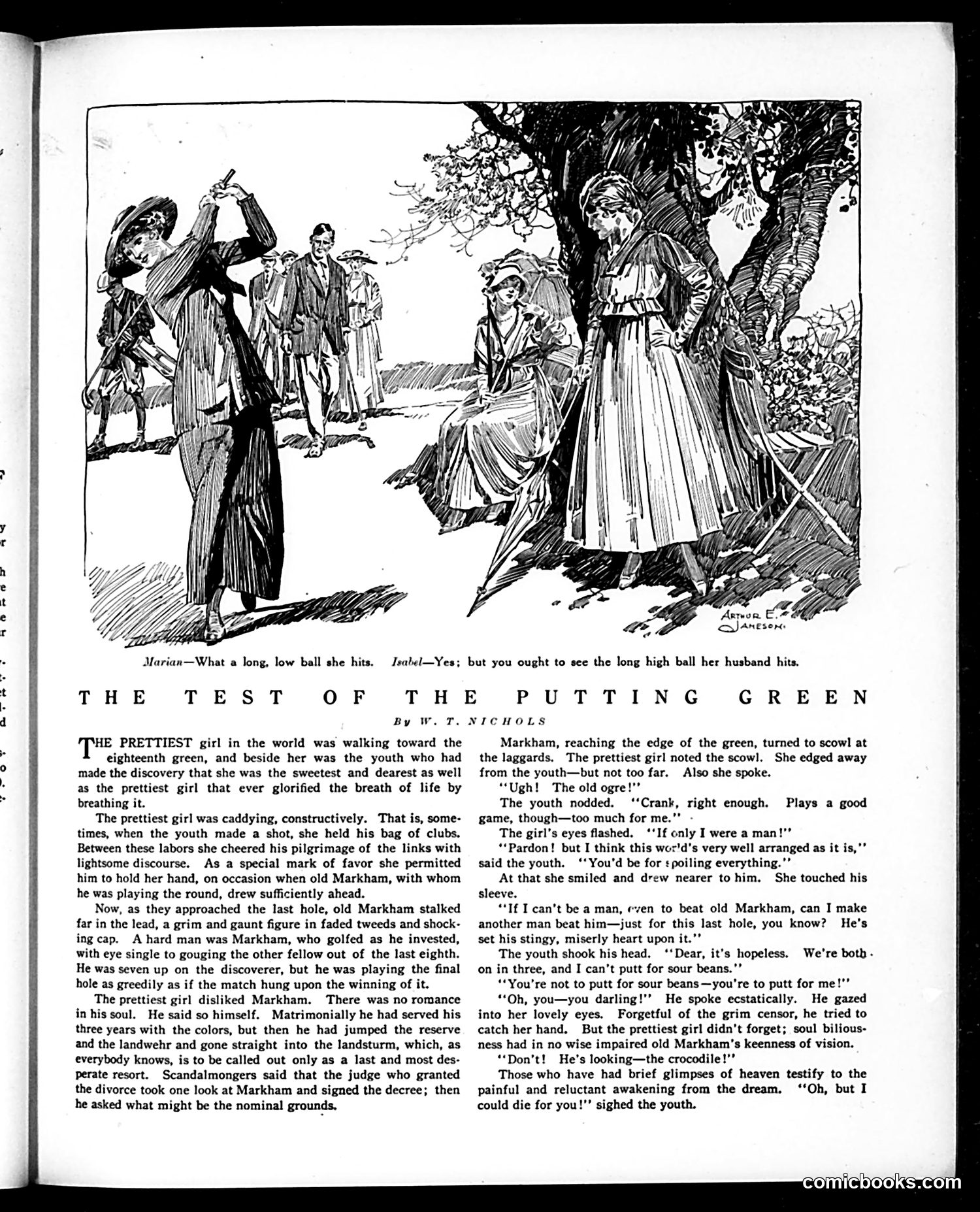
This is a romantic comedy story illustrated with a golf narrative. The plot concerns a young couple—"the prettiest girl in the world" and her admiring youth—playing golf with the antagonist Markham, an older, disagreeable man. The satire targets **Markham as a specimen of unattractive masculinity**: he's described as unromantic, divorced (apparently deservedly), and obsessed with winning at golf with the same ruthlessness he applies to business. The "censor" reference suggests he's watchful and controlling. The humor lies in romantic tension: the young woman manipulates her boyfriend into attempting an impossible putt to beat Markham—framing it as a test of love. The cartoon caption jokes about gender and athletic performance: she hits a "long, low ball" while her (absent) husband hits a "long high ball." The underlying message appears to critique both aggressive masculine competitiveness (Markham) and female manipulation through sentiment, while celebrating romantic earnestness in youth.
📄 Transcribed text from this page (OCR, searchable)
Machine-transcribed from the original scan — historical spelling and the odd misread are preserved.
{i 7 Marian—What a long, low ball she hits. Jsabel—Yes; T E TEST OF H By Ww. ‘HE PRETTIEST girl in the world was walking toward the eighteenth green, and beside her was the youth who had made the discovery that she was the sweetest and dearest as well as the prettiest girl that ever glorified the breath of life by breathing it. The prettiest girl was caddying, constructively. That is, some- times, when the youth made a shot, she held his bag of clubs. Between these labors she cheered his pilgrimage of the links with lightsome discourse. As a special mark of favor she permitted him to hold her hand, on occasion when old Markham, with whom he was playing the round, drew sufficiently ahead. Now, as they approached the last hole, old Markham stalked far in the lead, a grim and gaunt figure in faded tweeds and shock- ing cap. A hard man was Markham, who golfed as he invested, with eye single to gouging the other fellow out of the last eighth. He was seven up on the discoverer, but he was playing the final hole as greedily as if the match hung upon the winning of it. The prettiest girl disliked Markham. There was no romance in his soul. He said so himself. Matrimonially he had served his three years with the colors, but then he had jumped the reserve and the landwehr and gone straight into the landsturm, which, as everybody knows, is to be called out only as a last and most des- Perate resort. Scandalmongers said that the judge who granted the divorce took one look at Markham and signed the decree; then he asked what might be the nominal grounds, T. THE but you ought to see the long high ball her husband hits. PUTTING GREEN NICHOLS Markham, reaching the edge of the green, turned to scowl at the laggards. The prettiest girl noted the scowl. She edged away from the youth—but not too far. Also she spoke. “Ugh! The old ogre!"’ The youth nodded. ‘‘Crank, right enough. game, though—too much for me."" The girl's eyes flashed. ‘‘If only I were a man!"" **Pardon! but I think this wor'd's very well arranged as it is,"’ said the youth. ‘‘You'd be for spoiling everything.’” At that she smiled and drew nearer to him. She touched his sleeve. “If I can’t be a man, even to beat old Markham, can I make another man beat him—just for this last hole, you know? He's set his stingy, miserly heart upon it.’” The youth shook his head. ‘‘Dear, it’s hopeless. We're both - on in three, and I can’t putt for sour beans.’’ “You're not to putt for sour beans—you're to putt for me!"’ “Oh, you—you darling!’’ He spoke ecstatically. He gazed into her lovely eyes. Forgetful of the grim censor, he tried to catch her hand. But the prettiest girl didn’t forget; soul bilious- ness had in no wise impaired old Markham’s keenness of vision. “Don't! He’s looking—the crocodile !'’ Those who have had brief glimpses of heaven testify to the painful and reluctant awakening from the dream. ‘‘Oh, but I could die for you!’’ sighed the youth. Plays a good