
Judge, 1915-07-10 · page 12 of 28
Judge — July 10, 1915 — page 12: what you’re looking at
What you’re looking at
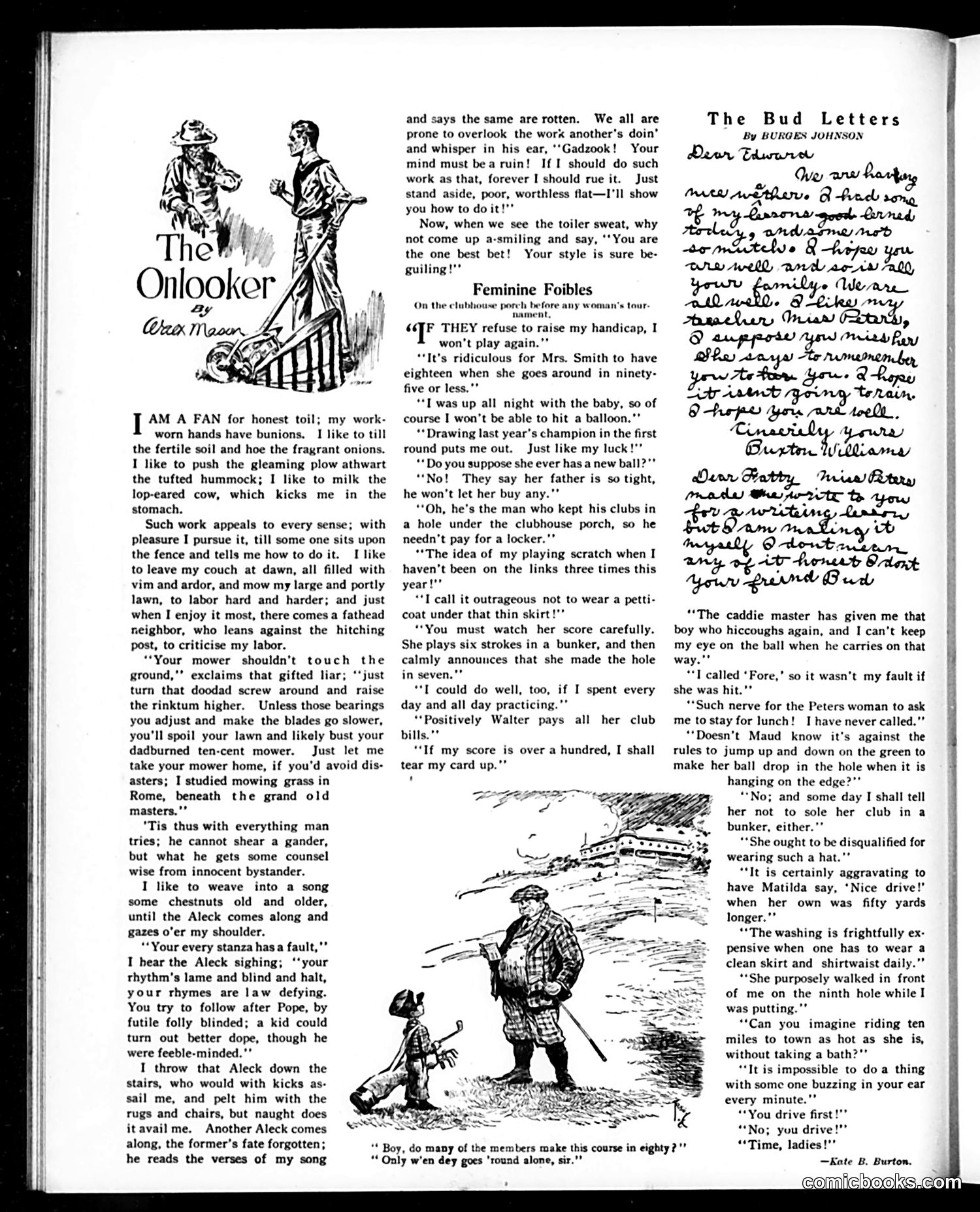
This page satirizes two related social annoyances of the early 20th century. **"The Onlooker"** mocks the ubiquitous know-it-all who offers unsolicited advice to anyone engaged in labor or creative work. The poem's speaker—a farmer, lawn-mower, and poet—is repeatedly interrupted by "Alecks" (smart-alecks) who criticize his methods despite having no expertise. The satire targets American culture's casual contempt for others' efforts and compulsive need to "correct" anyone pursuing honest work. **"Feminine Foibles"** ridicules women golfers' excuses and poor sportsmanship at a country club tournament. Women complain about handicaps, lack of new equipment, inadequate practice, opponents' cheating, and improper attire. The satire suggests women golfers are simultaneously vain, dishonest about their abilities, and prone to blaming external factors rather than accepting responsibility for poor play. Both sections reflect Judge magazine's satirical critique of contemporary social behavior, particularly the American tendency toward unsolicited judgment and excuse-making.
📄 Transcribed text from this page (OCR, searchable)
Machine-transcribed from the original scan — historical spelling and the odd misread are preserved.
— Onlook Or AM A FAN for honest toil; my work- worn hands have bunions. I like to till the fertile soil and hoe the fragrant onions. I like to push the gleaming plow athwart the tufted hummock; I like to milk the lop-eared cow, which kicks me in the stomach, Such work appeals to every sense; with pleasure I pursue it, till some one sits upon the fence and tells me how to do it. I like to leave my couch at dawn, all filled with vim and ardor, and mow my large and portly lawn, to labor hard and harder; and just when I enjoy it most, there comes a fathead neighbor, who leans against the hitching post, to criticise my labor. “Your mower shouldn't touch the ground,”’ exclaims that gifted liar; ‘**just turn that doodad screw around and raise the rinktum higher. Unless those bearings you adjust and make the blades go slower, you'll spoil your lawn and likely bust your dadburned ten-cent mower. Just let me take your mower home, if you'd avoid dis- asters; I studied mowing grass in Rome, beneath the grand old masters."” ‘Tis thus with everything man tries; he cannot shear a gander, but what he gets some counsel wise from innocent bystander. I like to weave into a song some chestnuts old and older, until the Aleck comes along and gazes o'er my shoulder. “Your every stanza hasa fault,’’ I hear the Aleck sighing; ‘‘your thythm’s lame and blind and halt, your rhymes are law defying. You try to follow after Pope, by futile folly blinded; a kid could turn out better dope, though he were feeble-minded."* I throw that Aleck down the stairs, who would with kicks as- sail me, and pelt him with the rugs and chairs, but naught does itavail me. Another Aleck comes along, the former’s fate forgotten; he reads the verses of my song “ and says the same are rotten. We all are prone to overlook the work another's doin’ and whisper in his ear, ‘‘Gadzook! Your mind must bea ruin! If I should do such work as that, forever I should rue it. Just stand aside, poor, worthless flat—I'll show you how to doit!"* Now, when we see the toiler sweat, why not come up a-smiling and say, ‘*You are the one best bet! Your style is sure be- guiling!"" Feminine Foibles On the clubhouse porch before any woman's tour- nament, 66]F THEY refuse to raise my handicap, I won't play again."” “It's ridiculous for Mrs. Smith to have eighteen when she goes around in ninety- five or less."" **T was up all night with the baby, so of course I won't be able to hit a balloon."* ** Drawing last year’s champion in the first round puts me out. Just like my luck!"* **Do you suppose she ever has a new ball?"* “‘No! They say her father is so tight, he won't let her buy any."" ‘Oh, he’s the man who kept his clubs in a hole under the clubhouse porch, so he needn't pay for a locker."’ “The idea of my playing scratch when I haven't been on the links three times this year!"" **T call it outrageous not to wear a petti- coat under that thin skirt!"" “You must watch her score carefully. She plays six strokes in a bunker, and then calmly announces that she made the hole in seven."" “*T could do well, too, if I spent every day and all day practicing." ‘Positively Walter pays all her club bills." “If my score is over a hundred, I shall tear my card up.’" aoe a Z Boy, do many of the members make this course in eighty?’ Only w'en dey goes "round alone, sir." The Bud Letters By BURGES JOHNSON “The caddie master has given me that boy who hiccoughs again, and I can’t keep my eye on the ball when he carries on that way."’ “*T called ‘Fore,’ so it wasn’t my fault if she was hit." “Such nerve for the Peters woman to ask me to stay for lunch! I have never called.” ‘‘Doesn’t Maud know it's against the tules to jump up and down on the green to make her ball drop in the hole when it is hanging on the edge?"’ “‘No; and some day I shall tell her not to sole her club in a bunker, either."” **She ought to be disqualified for wearing such a hat."" “It is certainly aggravating to have Matilda say, ‘Nice drive!’ when her own was fifty yards longer."* “The washing is frightfully ex- pensive when one has to wear a clean skirt and shirtwaist daily." “*She purposely walked in front of me on the ninth hole while I was putting."” “Can you imagine riding ten miles to town as hot as she is, without taking a bath?"’ “It is impossible to do a thing with some one buzzing in your ear every minute.’” “*You drive first !"" “No; you drive!” “Time, ladies!"" —Kate B. Burton.