
A complete issue · 24 pages · 1915
Judge — June 12, 1915
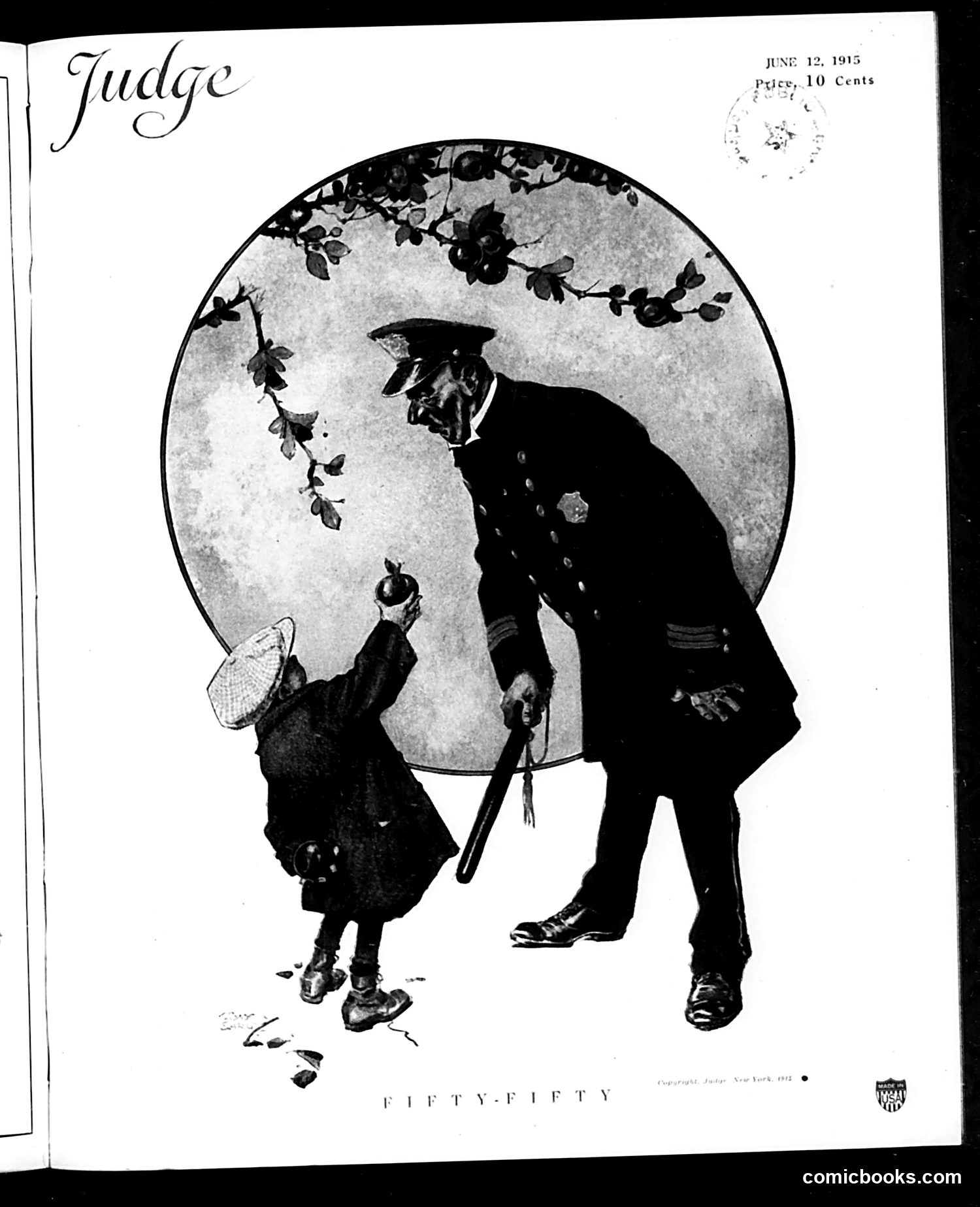
This cartoon depicts a naval officer and a young boy catching fireflies together under moonlight, with hanging foliage above them. The title "Fifty-Fifty" suggests an equal partnership or shared activity between the two figures. The specific political or social reference is unclear from the image alone. Given the 1915 date and naval uniform, it may reference naval policy, military preparedness, or American foreign relations during World War I. However, without additional context or caption text, the exact satirical target cannot be determined with certainty. The warm domestic scene—an authority figure bonding with a child—appears deliberately contrasted with whatever contemporary issue the cartoon meant to critique, though that critique remains ambiguous to modern viewers without the magazine's accompanying text.
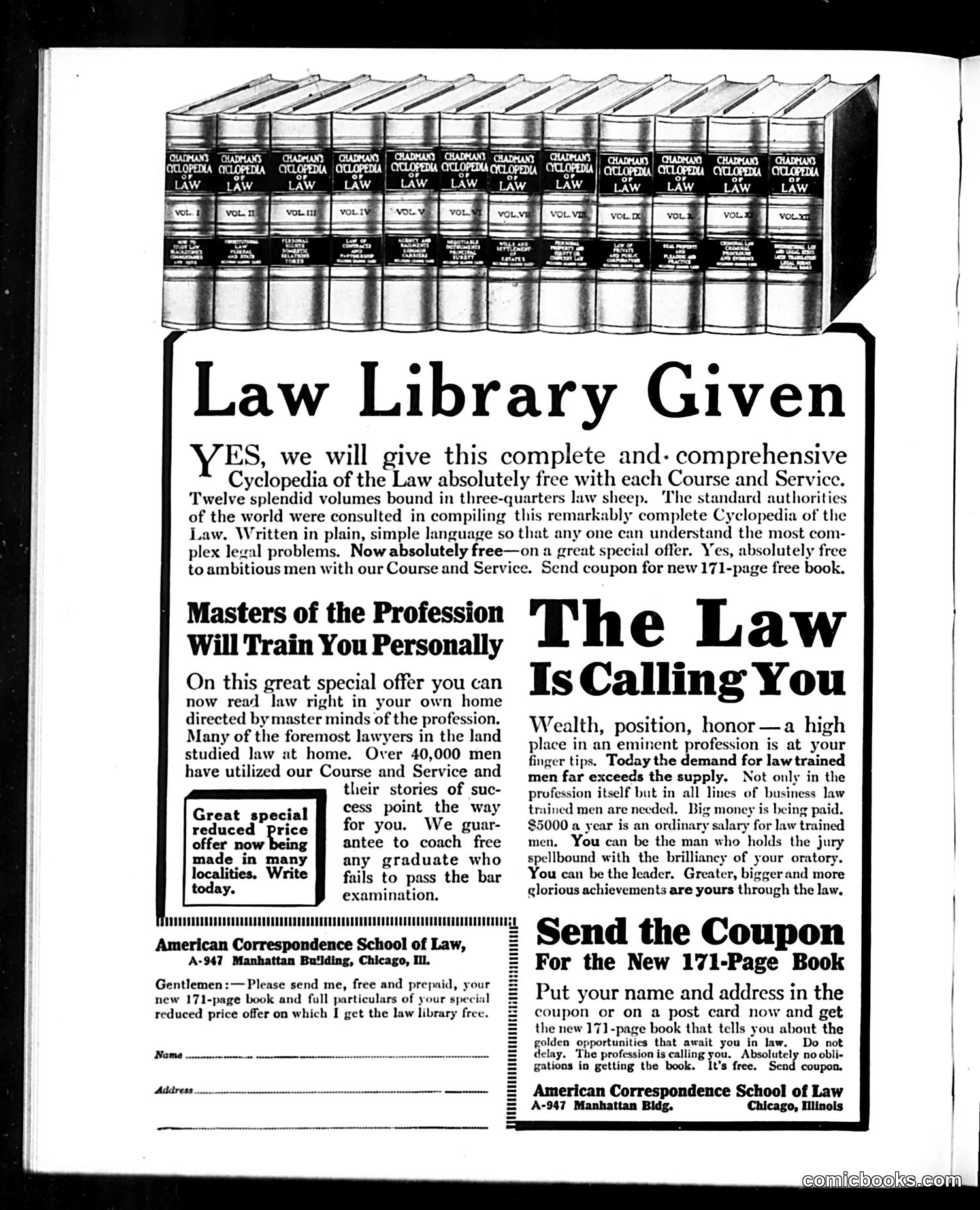
This page contains **no cartoon or satirical content**—it is entirely a full-page advertisement for the American Correspondence School of Law, located in Chicago. The ad promotes a correspondence course in law and offers a free twelve-volume "Encyclopedia of the Law" to enrollees. It emphasizes that over 40,000 men have completed the program and highlights the financial rewards of the legal profession, claiming lawyers earn $5,000 annually or more. The appeal targets ambitious working men seeking professional advancement through home study. The advertisement's presence in *Judge* magazine—a satirical publication—is itself notable, as such direct commercial pitches were common in period magazines regardless of their editorial character. No political or social satire is present on this page.
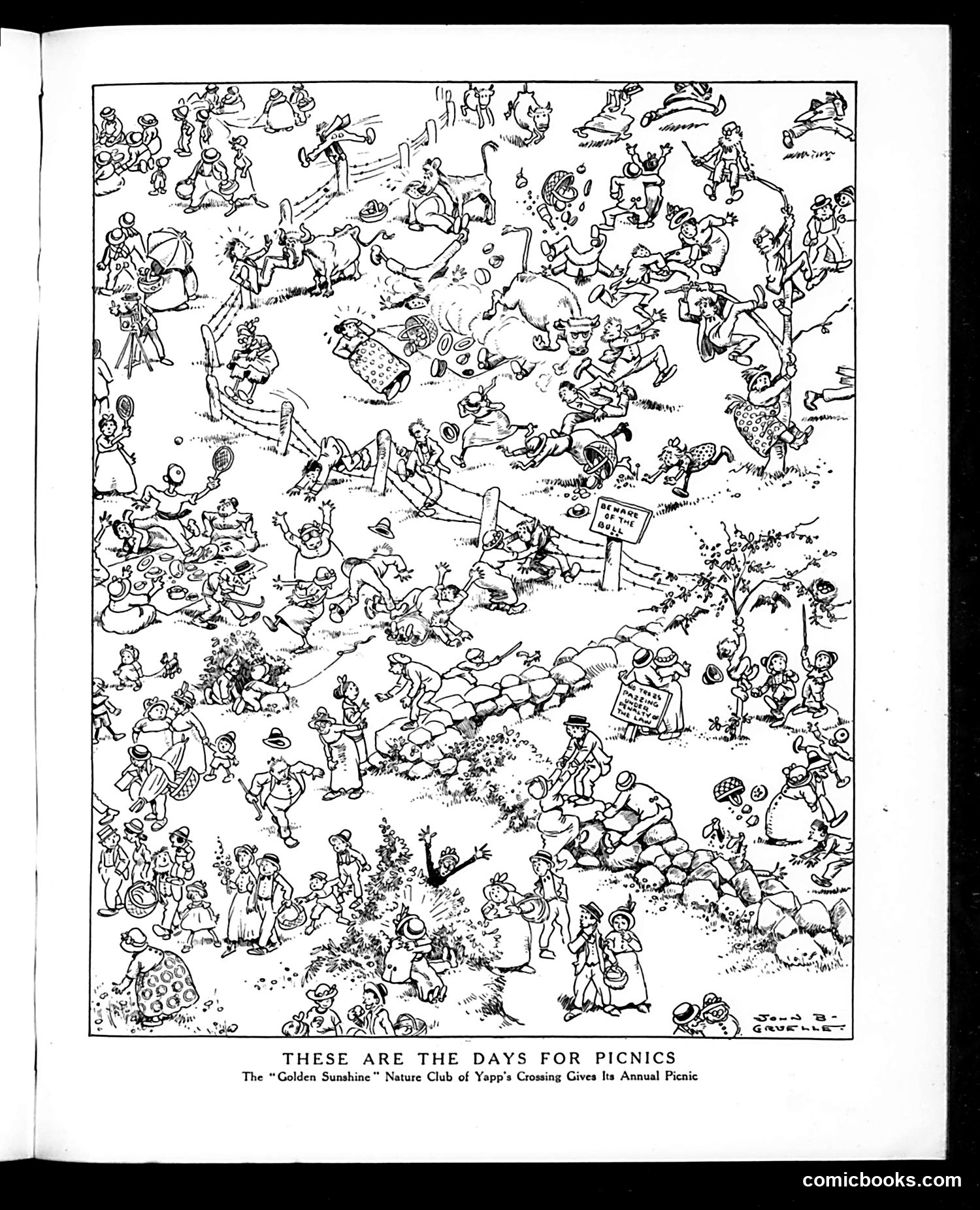
This is a humorous illustration depicting a chaotic picnic scene organized by the "Golden Sunshine" Nature Club of Yapp's Crossing. The cartoon satirizes poorly-organized community outings through densely-packed, slapstick imagery: people stumbling, food scattered everywhere, children running wild, and general disorder throughout the park setting. The satire targets small-town club activities and their inevitable mishaps—overturned baskets, people colliding, animals causing disruption. The crowded composition itself becomes the joke, emphasizing the mayhem that ensues when large groups attempt recreational activities without proper organization. The title's cheerful tone contrasts sharply with the pandemonium depicted, creating ironic humor typical of Judge magazine's social commentary on American leisure activities and community institutions.
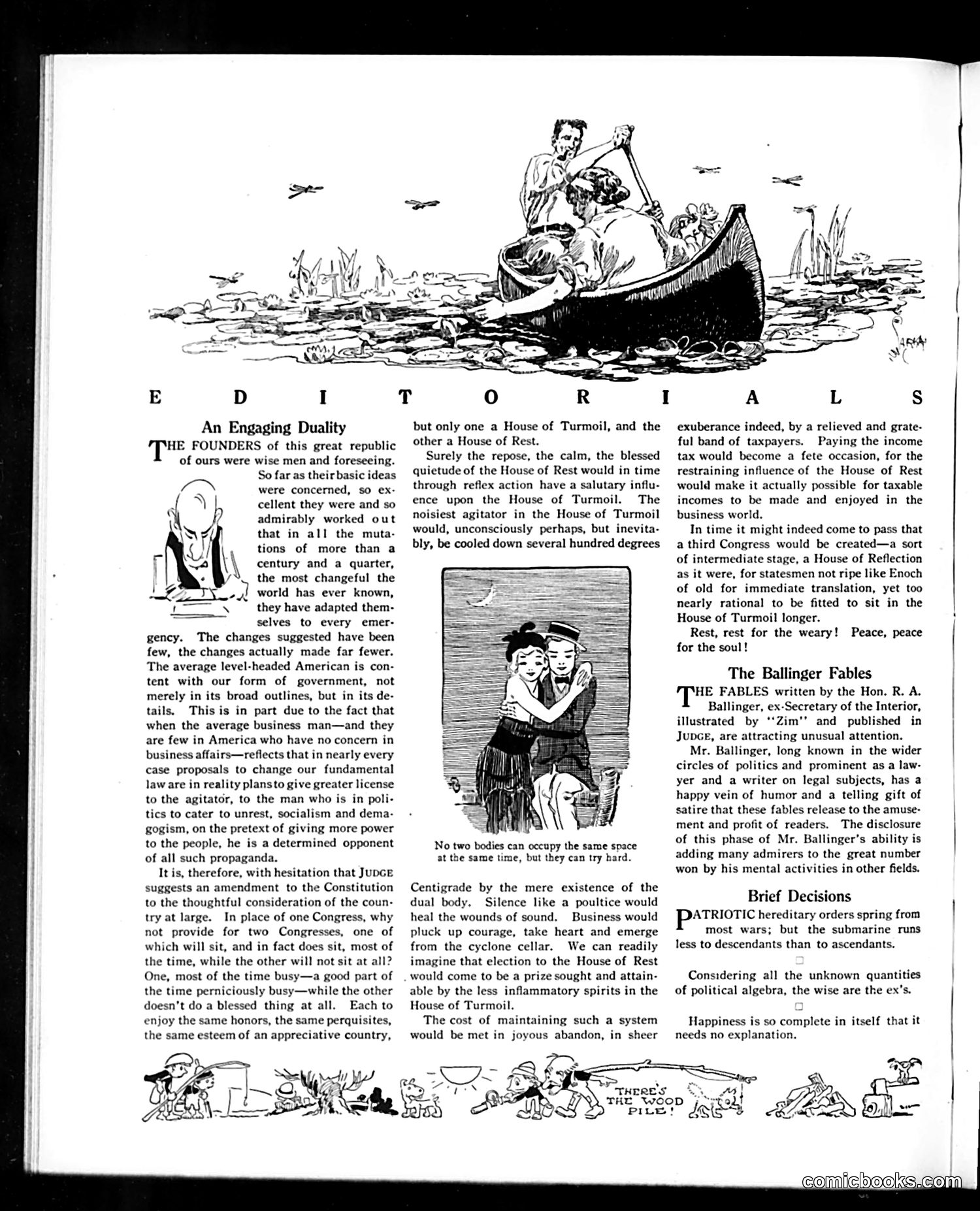
This Judge magazine page satirizes American legislative gridlock. The main editorial, "An Engaging Duality," proposes a constitutional amendment creating two separate Houses of Congress: one for "Turmoil" (contentious debate) and one for "Rest" (calm deliberation). The satire suggests that Congress functions so chaotically that splitting it into separate chambers—one for noise and conflict, another for actual governance—might improve matters. The piece mocks how American business interests constantly lobby Congress to change laws for their benefit, implying that legislative dysfunction stems from competing interests rather than principled governance. The accompanying illustration depicts contentious politicians wrestling in boats, visualizing Congressional conflict. The secondary section promotes "The Ballinger Fables" by ex-Interior Secretary Richard Ballinger, suggesting this was a contemporary political figure whose memoir attracted attention.
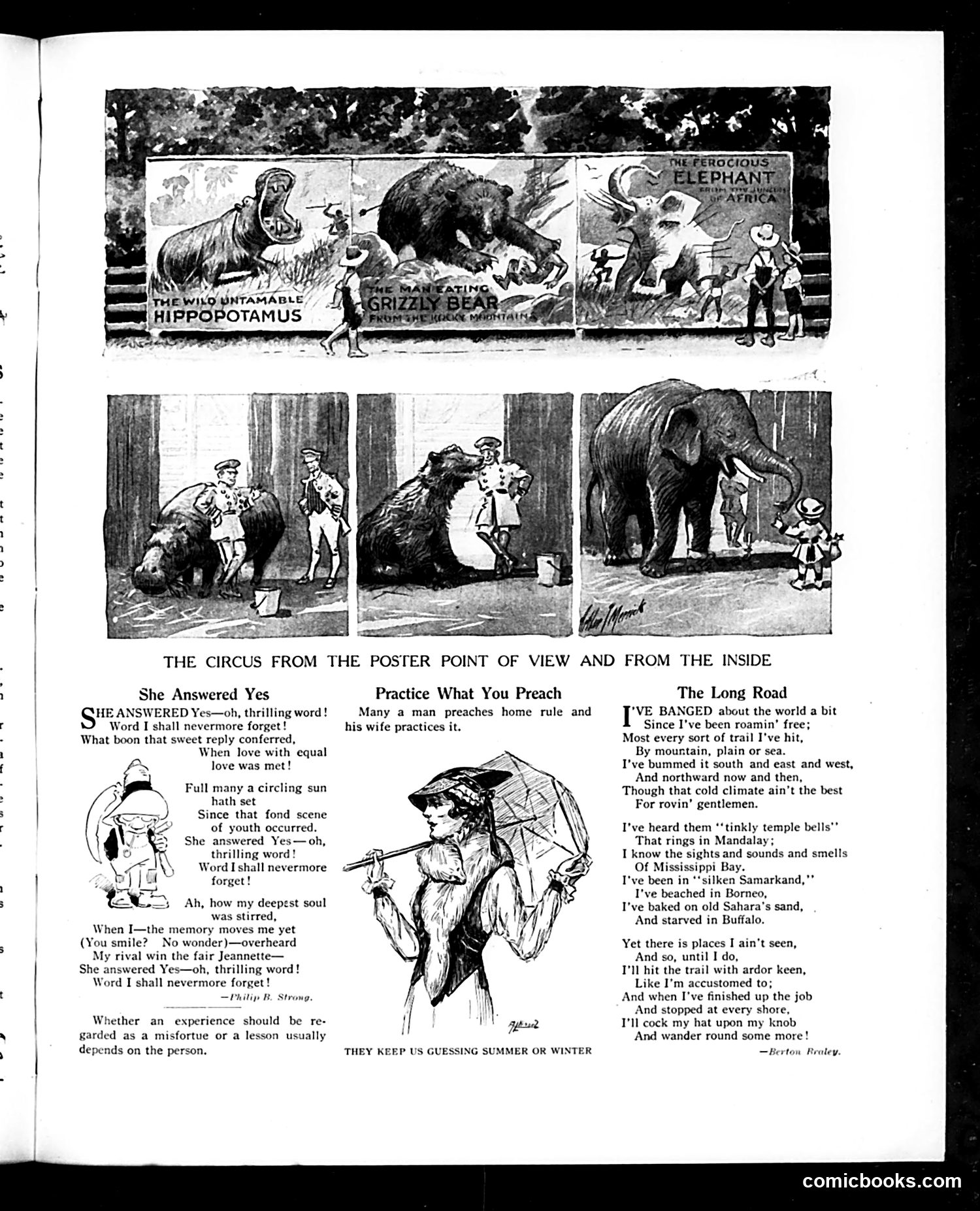
This page features circus-themed illustrations and poetry rather than political satire. The top shows three circus attractions: a hippopotamus, a grizzly bear, and an African elephant, with people viewing them from outside and inside perspectives. Below are three standalone pieces: a romantic poem titled "She Answered Yes" about a proposal; a sketch about domestic life titled "Practice What You Preach"; and a longer poem called "The Long Road" about a wanderer's travels. The central illustration depicts a woman with an umbrella. The content appears to be general entertainment and humor rather than social commentary. There's no clear political messaging or recognizable caricatures of public figures. The page demonstrates Judge's broader editorial scope beyond political cartoons, including poetry, romance, and whimsical illustrations for general amusement.
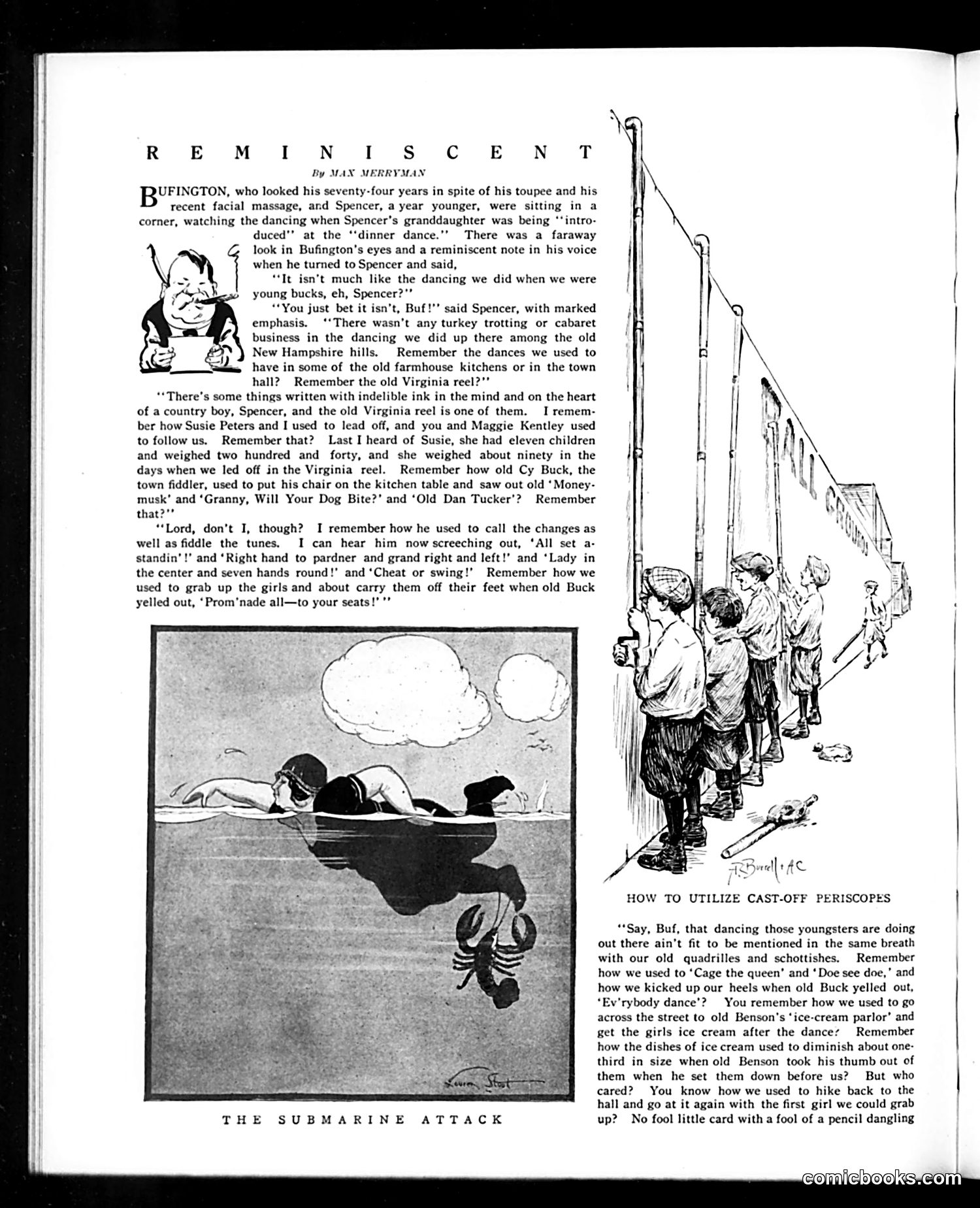
This page contains two distinct pieces: **Main Story ("Reminiscent")**: Two elderly men (Bufington and Spencer, both in their 70s) nostalgically compare modern dance—likely 1920s jazz and social dancing—unfavorably to traditional rural American dances of their youth: the Virginia reel, quadrilles, and schottishes. They reminisce about old fiddler Cy Buck calling changes in farmhouse kitchens and New Hampshire town halls, contrasting this wholesome past with contemporary youth culture they view as shallow. **Lower Cartoon ("The Submarine Attack" / "How to Utilize Cast-off Periscopes")**: Depicts a figure in a bathtub being attacked by a submarine periscope—likely satirizing World War I naval warfare anxieties by absurdly applying them to domestic life. The page reflects early 20th-century generational anxiety about changing social customs and leisure activities, with older generations viewing new dance styles as morally questionable compared to earlier, community-centered traditions.
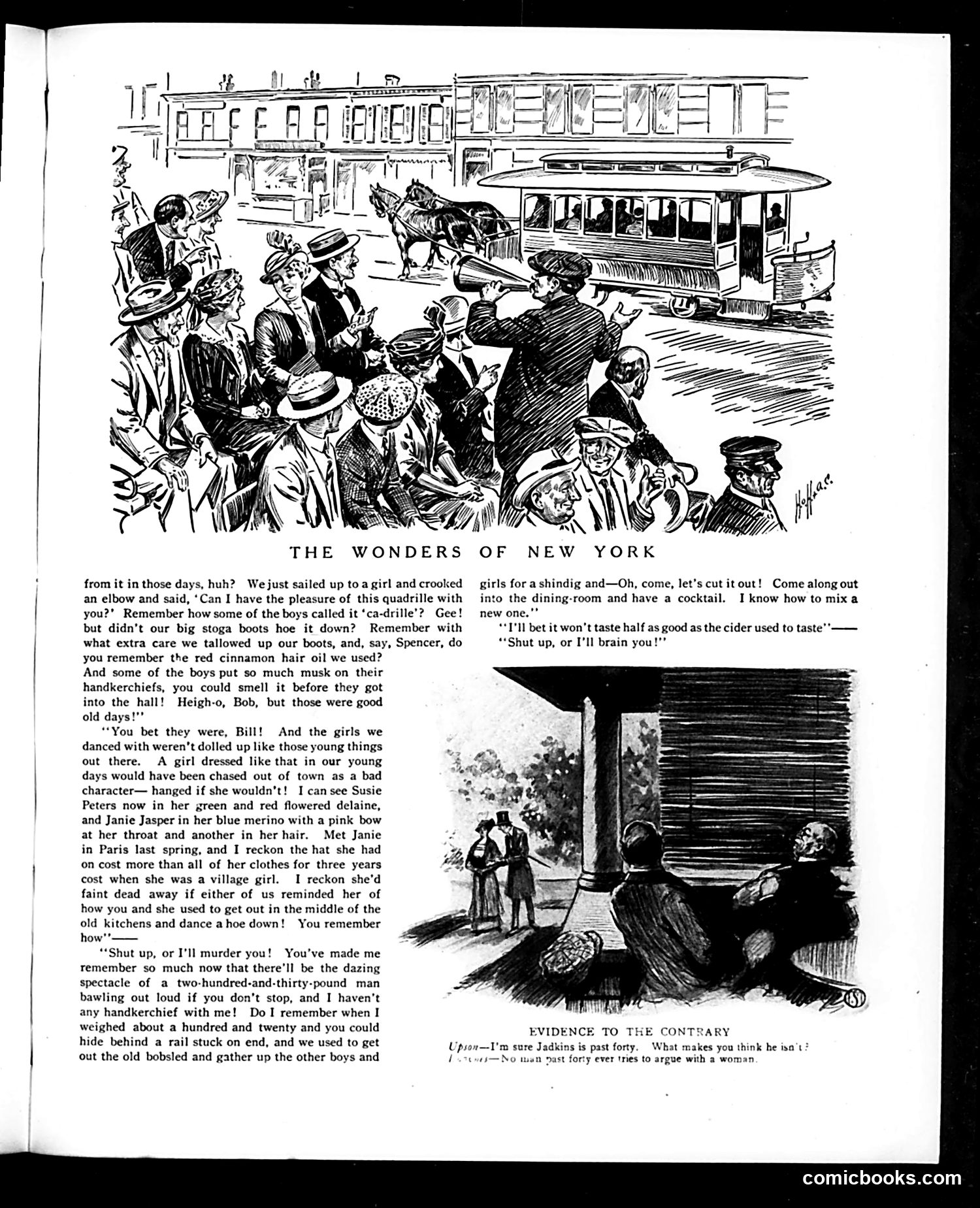
This page presents nostalgic humor contrasting old and new social customs. Two middle-aged men reminisce about their youth—dancing the "quadrille," wearing tallowed boots and cinnamon hair oil, courting modestly dressed girls in simple fabrics. They lament how contemporary young women dress extravagantly (one recalls a girl's Paris hat costing more than her entire childhood wardrobe) and behave boldly—now casually inviting men to cocktails. The satire targets turn-of-the-century anxieties about changing social mores: female independence, fashion excess, and moral decline. One man becomes so emotionally overwhelmed by nostalgia he nearly weeps—a comedic exaggeration of generational anxiety. The small cartoon below, "Evidence to the Contrary," jokes that men over forty argue with women, implying stubbornness or defensiveness about modernity—likely a dig at the older generation's resistance to women's changing roles.
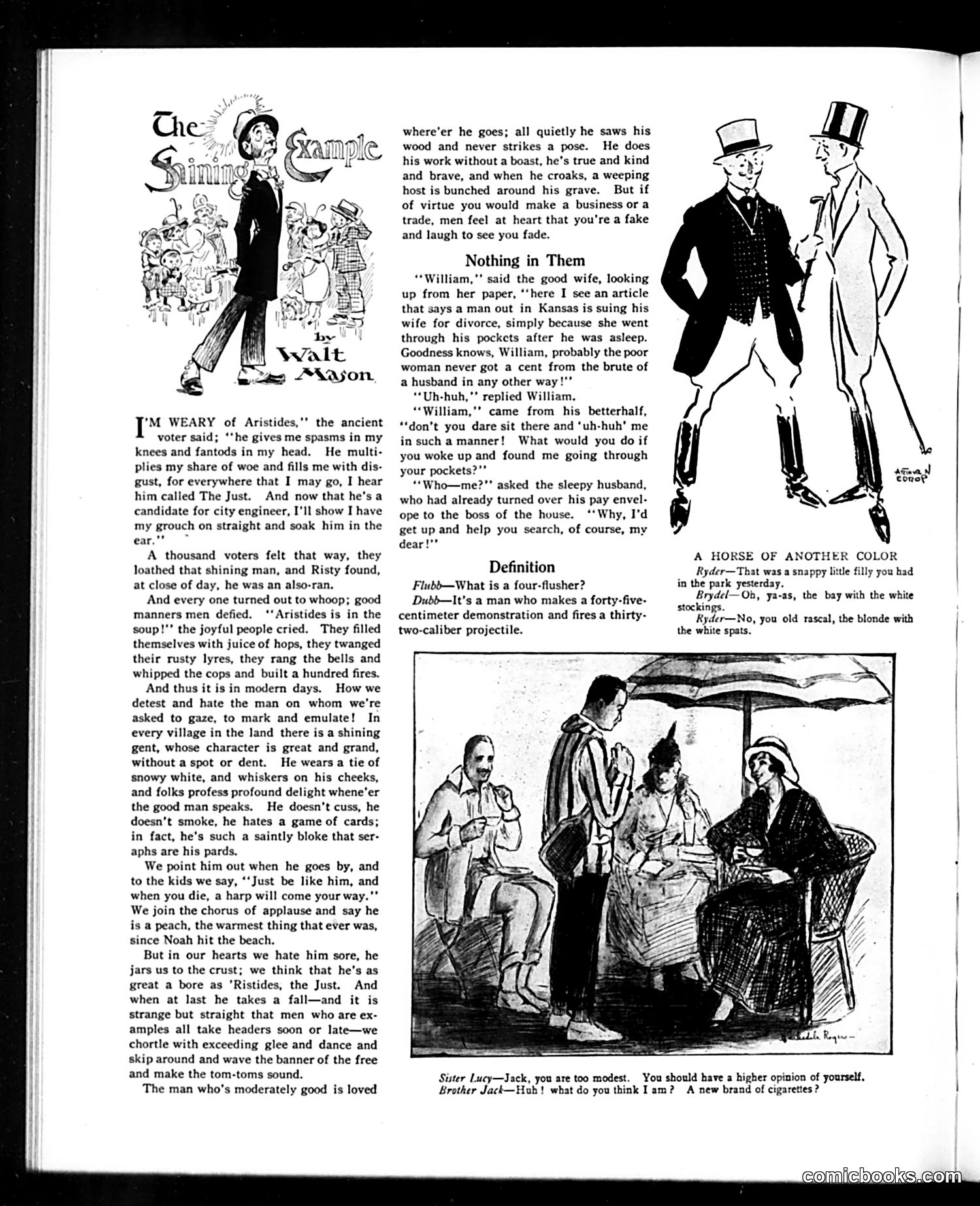
This page satirizes public hypocrisy about virtue and moral exemplars. The main article, "The Example," uses the classical reference to Aristides the Just—a famously virtuous Athenian—to mock modern society's contradictory attitudes. The satire argues that people publicly revere paragons of virtue (the perfectly moral man with white tie, clean character, no vices) but secretly resent and ridicule them. Citizens praise such figures as role models for children, yet harbor genuine hatred for their "shininess" and moral superiority. When these exemplars inevitably fall from grace, the public celebrates gleefully. The piece concludes that only the "moderately good"—those who work honestly without self-promotion or moral grandstanding—earn genuine, lasting affection and respect. The shorter comic pieces ("Nothing in Them," "Definition," "A Horse of Another Color") offer related humor about everyday hypocrisy and marital dynamics, maintaining the magazine's satirical tone.
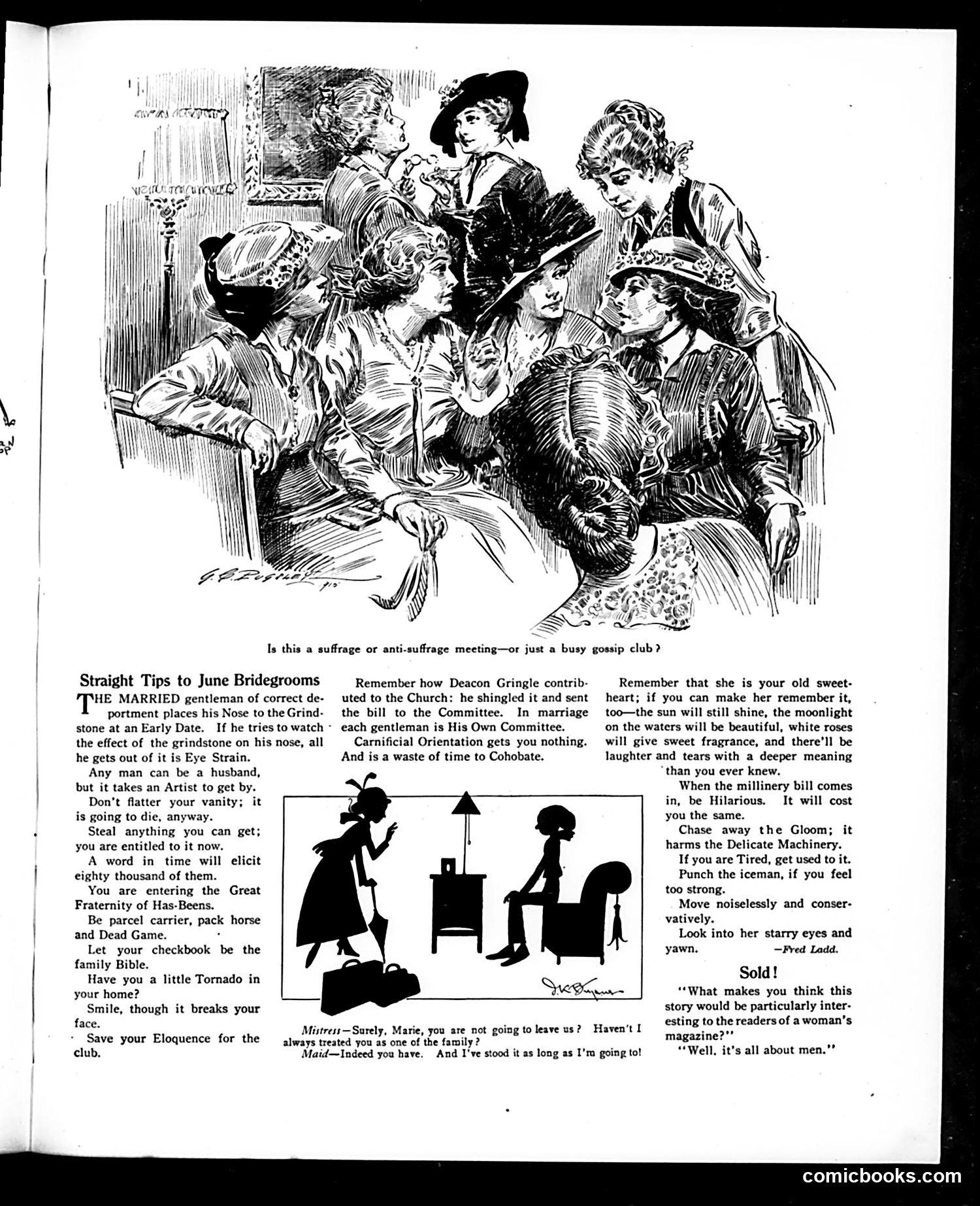
This page satirizes newlywed husbands through humorous advice supposedly addressing marriage. The main cartoon (top) depicts women gathered, asking whether it's "a suffrage or anti-suffrage meeting—or just a busy gossip club?"—mocking women's activism by suggesting they're merely gossiping. The written "tips" mock married men by inverting conventional wisdom: husbands should work hard ("grindstone"), accept subordination, steal what they want, pay bills without complaint, and tolerate their wives' expensive habits (millinery). The tone is sarcastic—presenting male submission as inevitable. The bottom vignette shows a maid leaving her employer, rejecting being treated "as one of the family" while actually being exploited—a commentary on class relations. The satirical point: marriage is fundamentally transactional and domesticating for men, while women (whether wives or servants) are economically burdensome. This reflects early-1900s anxieties about gender roles and women's increasing independence during the suffrage movement.
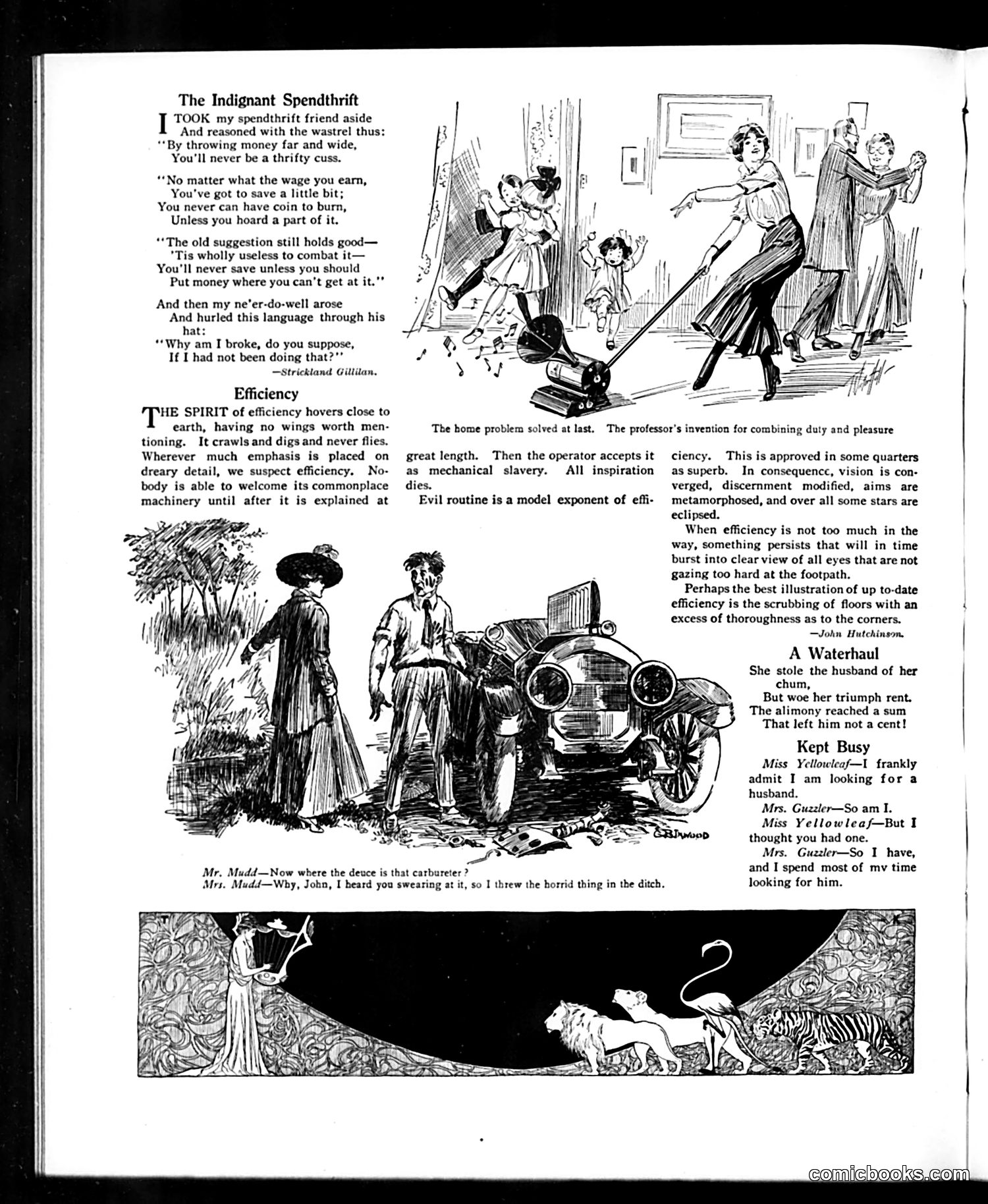
This page contains three satirical pieces typical of early 20th-century American humor: **"The Indignant Spendthrift"** mocks advice-giving about thrift. The narrator lectures a wastrel friend about saving money, only to be told the friend's already tried that—he spends money *because* he can't access it otherwise, making the advice circular and useless. **"Efficiency"** critiques the era's obsession with industrial efficiency and rigid routines. The accompanying cartoon shows Mr. Mudd's wife literally throwing his car's carburetor in a ditch after hearing him curse it—she's taking "efficiency" absurdly literally. The essay warns that over-emphasis on mechanical detail kills inspiration and vision. **"A Waterhaul"** and **"Kept Busy"** are brief joke items about marriage: one about a woman whose affair costs her alimony; another where a married woman admits she spends most her time searching for her absent husband—implying marital discord or infidelity as comedy. The tone reflects Judge's satirical stance: mocking American middle-class pretensions, efficiency culture, and domestic relationships.
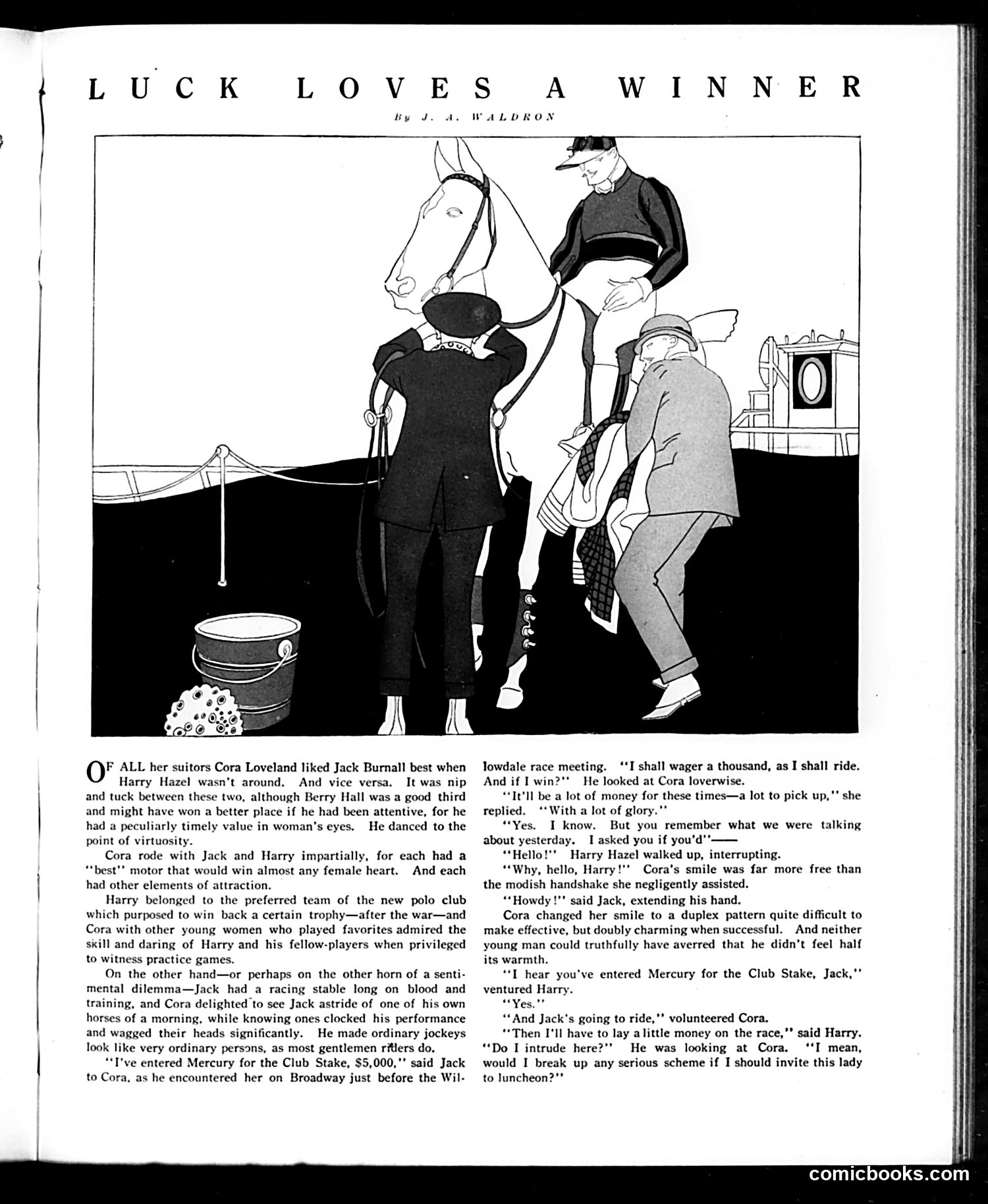
This is a romantic fiction story illustrated with a line drawing, not a political cartoon. The narrative satirizes wealthy American social circles circa WWI era through the romantic entanglements of Cora Loveland, a society woman pursued by three suitors: Jack Burnall (who owns a racing stable), Harry Hazel (a polo player), and Berry Hall (a dancer). The satire targets the superficiality of upper-class courtship: Cora's affection shifts based on which man's "motor" or sporting prowess currently impresses her. The story mocks both the young men's vanity in their competitive abilities and Cora's calculated flirtation—she performs different smiles for each suitor while they compete for her attention. The joke hinges on social climbing and materialism masquerading as romance: female preference follows male wealth and status, not genuine feeling. The title suggests that "luck" (timing, athletic performance) determines romantic success among the leisure class.
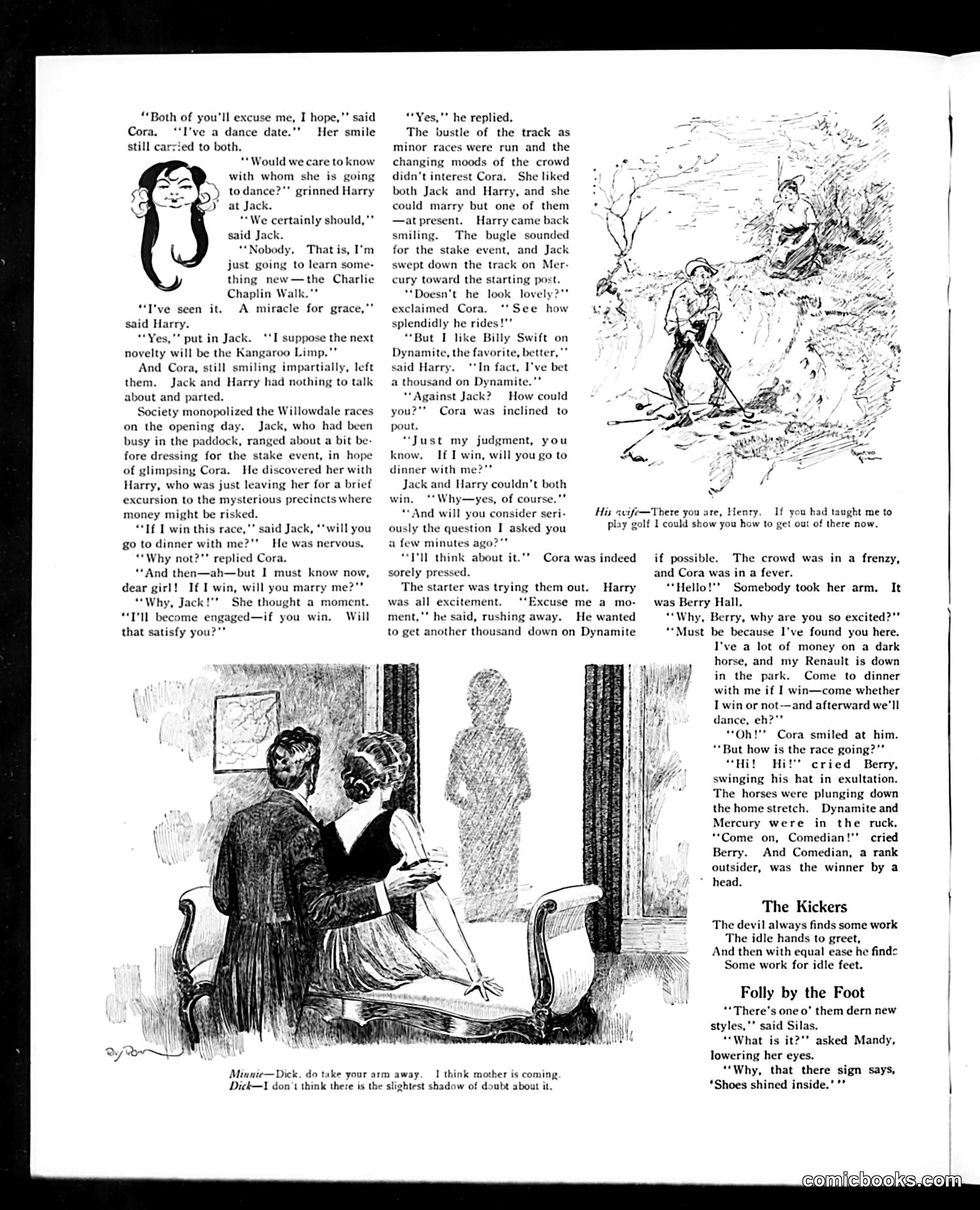
This page contains a short story with romantic and comedic elements typical of early 20th-century Judge magazine humor. **The Main Story:** Cora attends a horse race where three men (Jack, Harry, and Berry Hall) each propose conditional marriages to her—if they win their bets. Jack bets on his own horse Mercury; Harry bets against him on Dynamite; Berry bets on a long-shot called Comedian. The joke is that Cora has casually accepted engagement conditions from all three men. Unexpectedly, Comedian wins, so Berry Hall gets the prize—Cora's agreement to dinner and dancing. **The Satire:** This mocks both women's perceived fickleness and men's overconfidence in gambling. The humor lies in how easily these suitors think money and romance are interchangeable, and how Cora plays them all without commitment. **The Small Comics Below:** Include unrelated brief jokes about the "Charlie Chaplin Walk" (referencing the famous comedian's distinctive gait) and a pun about "new shoe-shining styles." The overall tone reflects period attitudes toward courtship and gender roles now considered outdated.
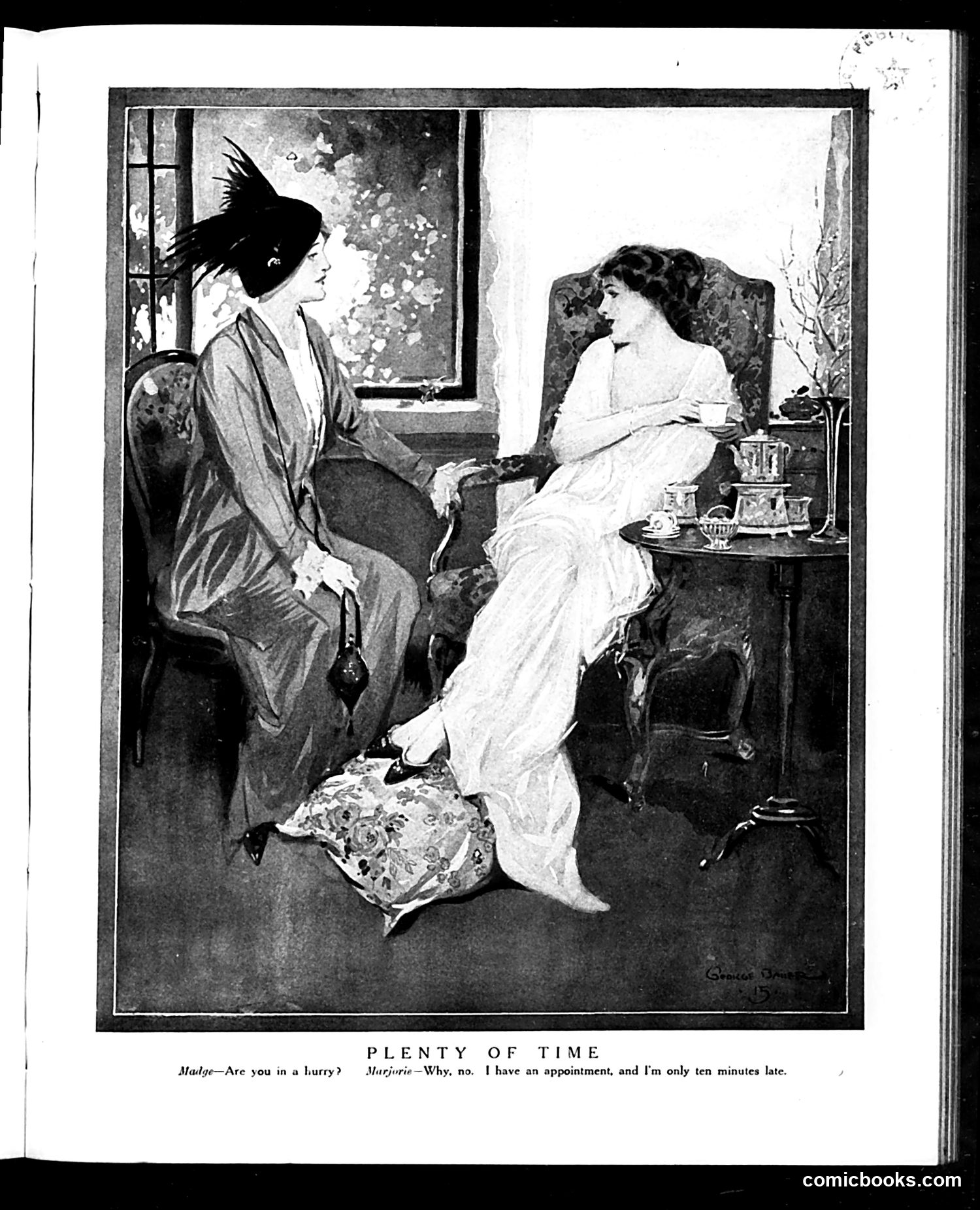
This cartoon satirizes the social casualness of early 20th-century women regarding punctuality. Two women converse in an elegant interior: Madge asks if Marjorie is in a hurry, and Marjorie responds that despite having an appointment, she's unbothered about being ten minutes late. The humor targets the contradiction in Marjorie's statement—claiming "no" hurry while simultaneously acknowledging she's already tardy. The satire likely critiques either: 1. **Women's perceived indifference to time management**, a common stereotype of the era 2. **The social acceptability of fashionable lateness** among leisured women The refined setting, Marjorie's elaborate white gown, and relaxed posture emphasize that this lateness stems not from circumstance but from attitude—suggesting carelessness or vanity as social acceptable behaviors for women of a certain class.
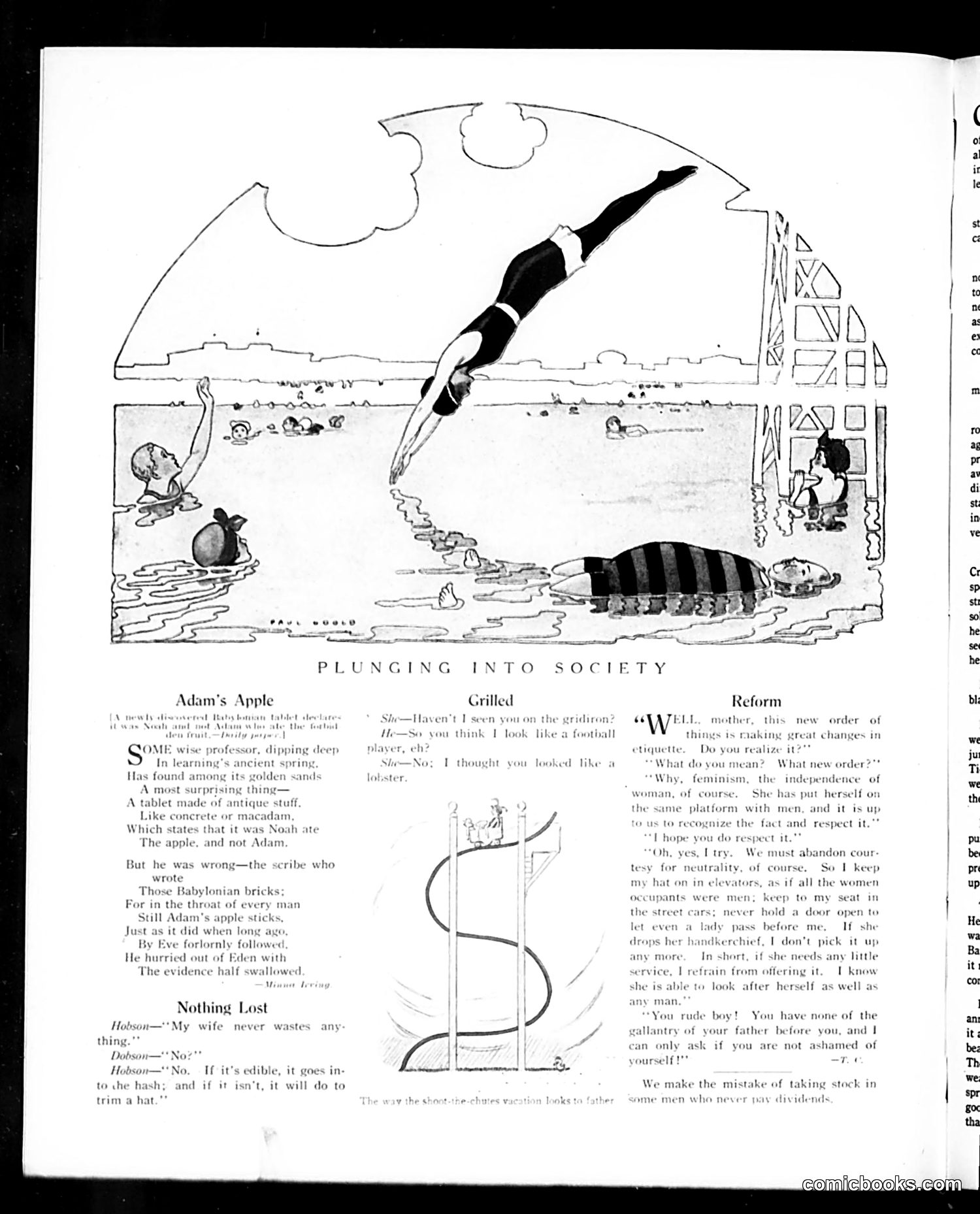
This page contains three separate humorous pieces satirizing social conventions and changing mores of the era. The main cartoon, "Plunging Into Society," depicts a woman diving into water while a man floats passively nearby. The accompanying dialogue mocks the "new order" of women's independence. A woman lectures a man about modern etiquette: women no longer expect gentlemanly courtesies like having doors held open or handkerchiefs retrieved. She demands men treat women identically to other men—no special consideration. The satire targets both the woman's aggressive assertion of equality and the man's passive acceptance, suggesting anxiety about shifting gender roles and women's emerging independence. The diving figure visually reinforces the woman's bold, assertive posture. The other brief pieces ("Adam's Apple," "Nothing Lost," "Grilled") are short joke exchanges playing on wordplay and domestic absurdities, typical of Judge's humor magazine format. Overall, the page satirizes early-20th-century anxieties about women's liberation and changing social expectations.
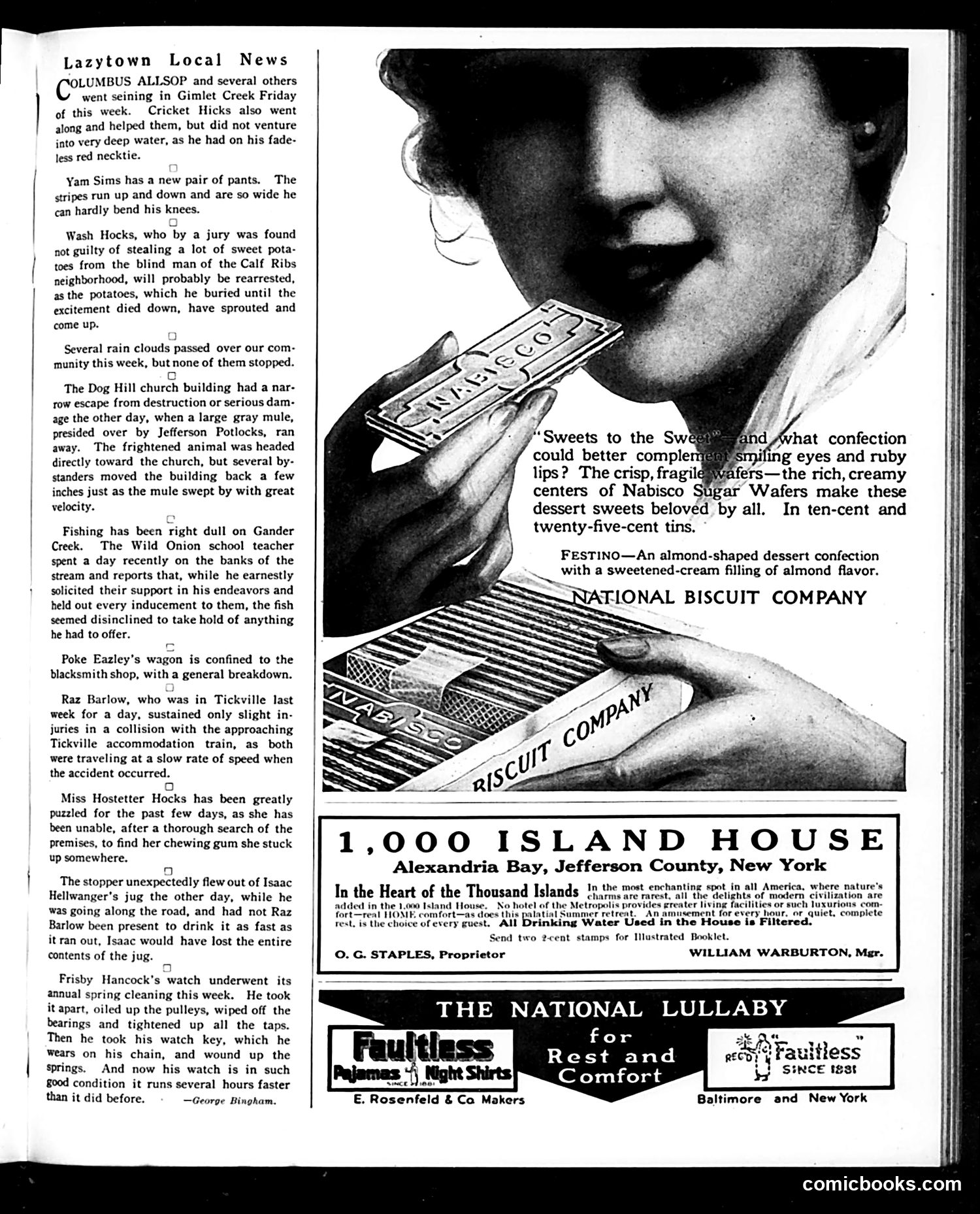
This page is primarily **advertising mixed with humorous local-interest content** rather than political satire. The main feature is "Lazytown Local News" by George Bingham, a rural humor column featuring absurdist anecdotes about fictional small-town characters and their mundane misadventures—a man whose pants are too wide to bend in, stolen potatoes that sprout underground, a church building moved inches to avoid a runaway mule, a schoolteacher unable to catch fish despite earnest effort. The humor derives from exaggeration and incongruity typical of early 20th-century rural comedy. No political commentary is evident. The column appears designed as filler alongside three product advertisements: National Biscuit Company (Festino candies), the 1,000 Island House resort, and Faultless pajamas. This layout was standard for Judge magazine's mixed content format.
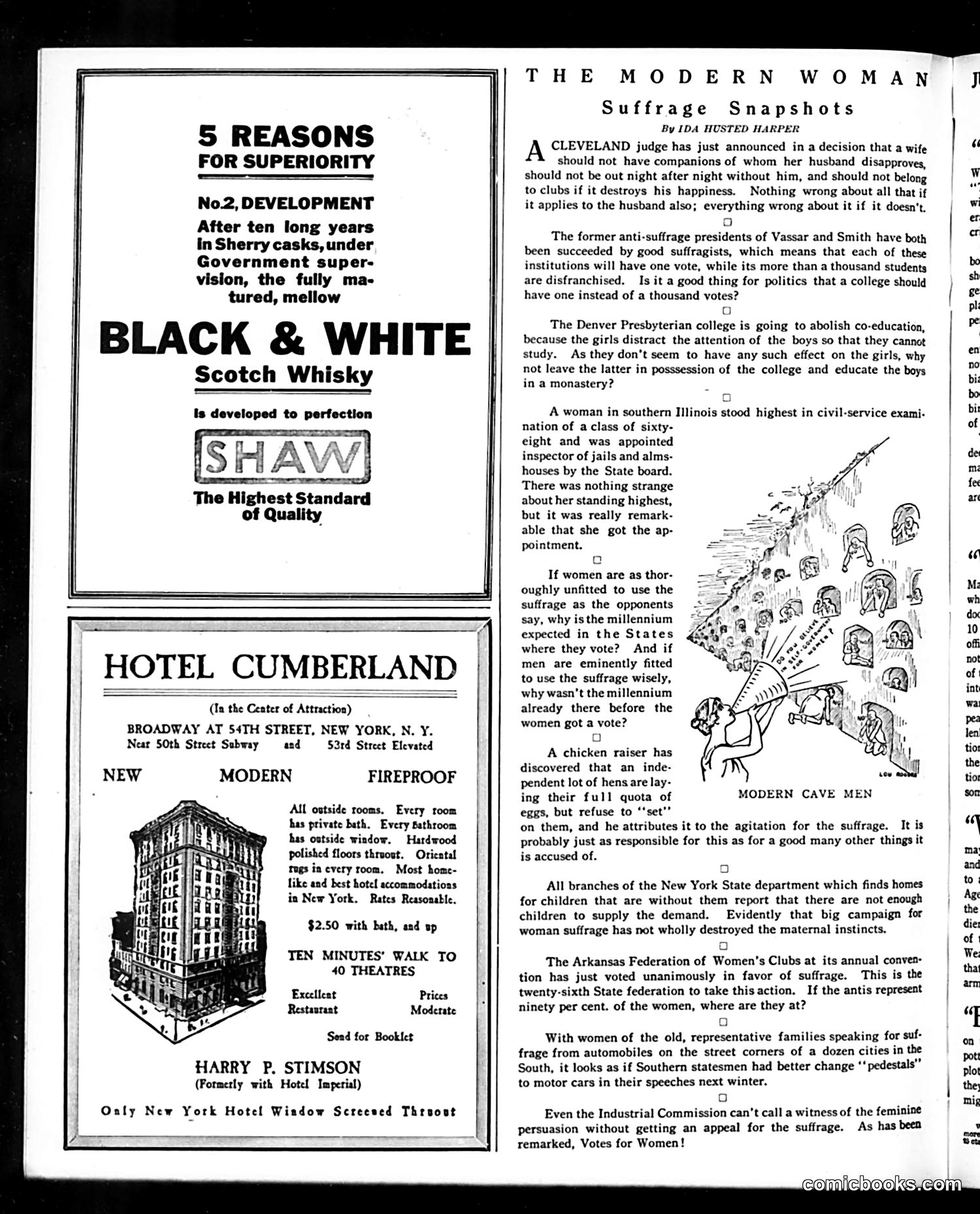
This page features a satirical column by Ida Husted Harper attacking anti-suffrage arguments through ironic commentary and rhetorical questions. The cartoon "Modern Cave Men" depicts a caveman herding women into a cave—a visual representation of the patriarchal control that Harper critiques throughout. Harper systematically dismantles anti-suffrage logic: she notes a Cleveland judge denying wives autonomy while expecting husbands' freedom; questions why colleges claim women voters corrupt politics while denying student votes; mocks Denver's all-male monastery solution for co-education problems; and highlights women's demonstrated competence in civil service. She uses absurdist examples (hens refusing to "set" eggs due to suffrage agitation) to expose the ridiculousness of anti-suffrage claims blaming women's activism for societal problems. The repeated device of citing women's continued productivity and virtue—they retain maternal instincts, join clubs for suffrage, and ride in automobiles—counters the anti-suffragists' narrative of feminine decline.
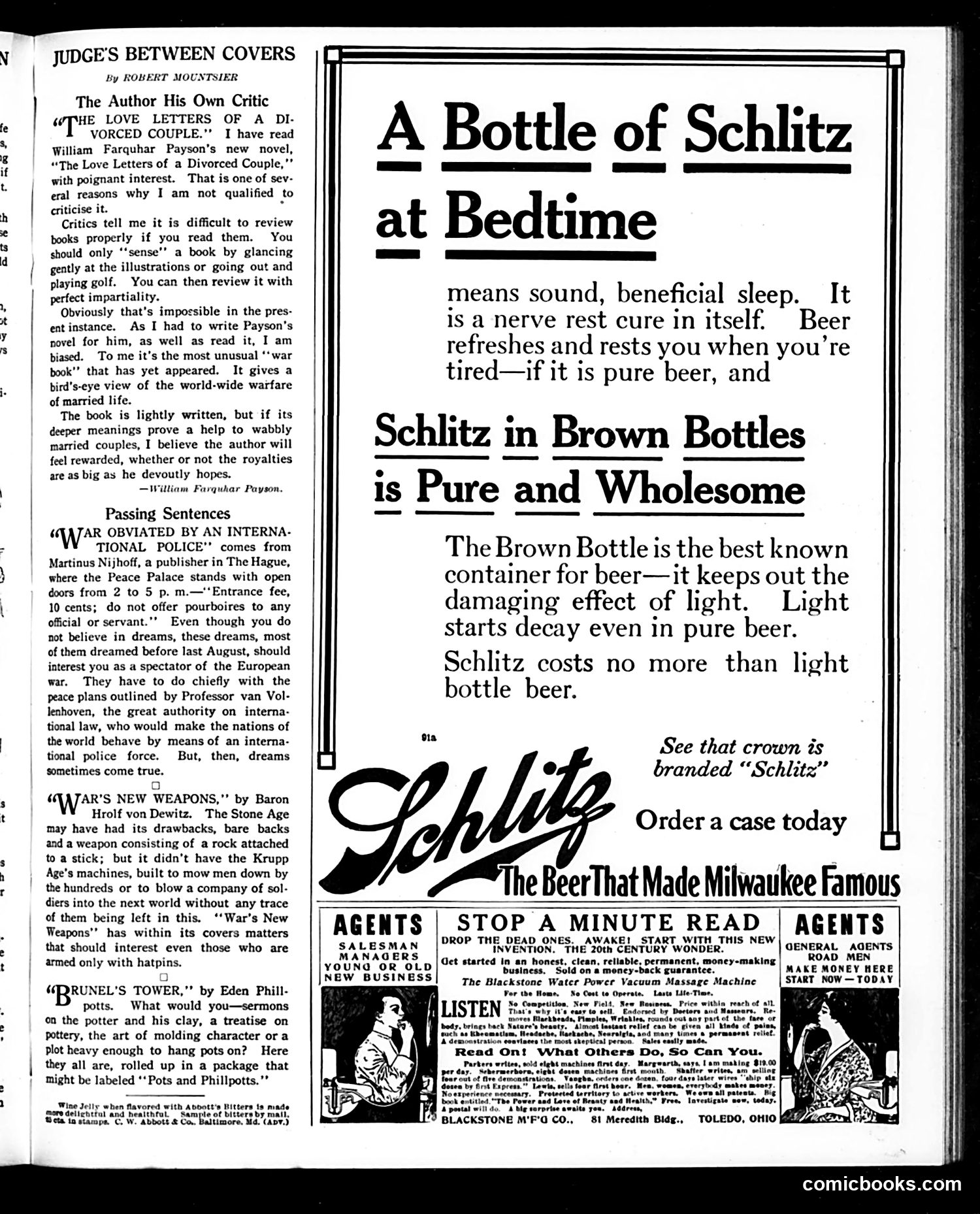
This page is primarily **advertising**, dominated by a Schlitz beer advertisement claiming the product promotes "sound, beneficial sleep" and is "Pure and Wholesome" because brown bottles protect beer from light damage. The left column contains brief book reviews by Robert Mountsier, including self-aware satire about his conflict of interest reviewing William Farquhar Payson's novel (which Mountsier apparently helped write). The reviews mention other books about WWI, international peace proposals, and pottery. Below the main ad are smaller advertisements for various business opportunities and a "Blackstone Water Power Vacuum Massage Machine." **Historical context**: This appears to be from Judge magazine during or shortly after World War I (references to "European war" and WWI weapons). The Schlitz ad exemplifies early 20th-century beer marketing's emphasis on purity and health benefits—claims later prohibited by advertising regulations. The surrounding "business opportunity" ads are typical of the era's mail-order schemes.
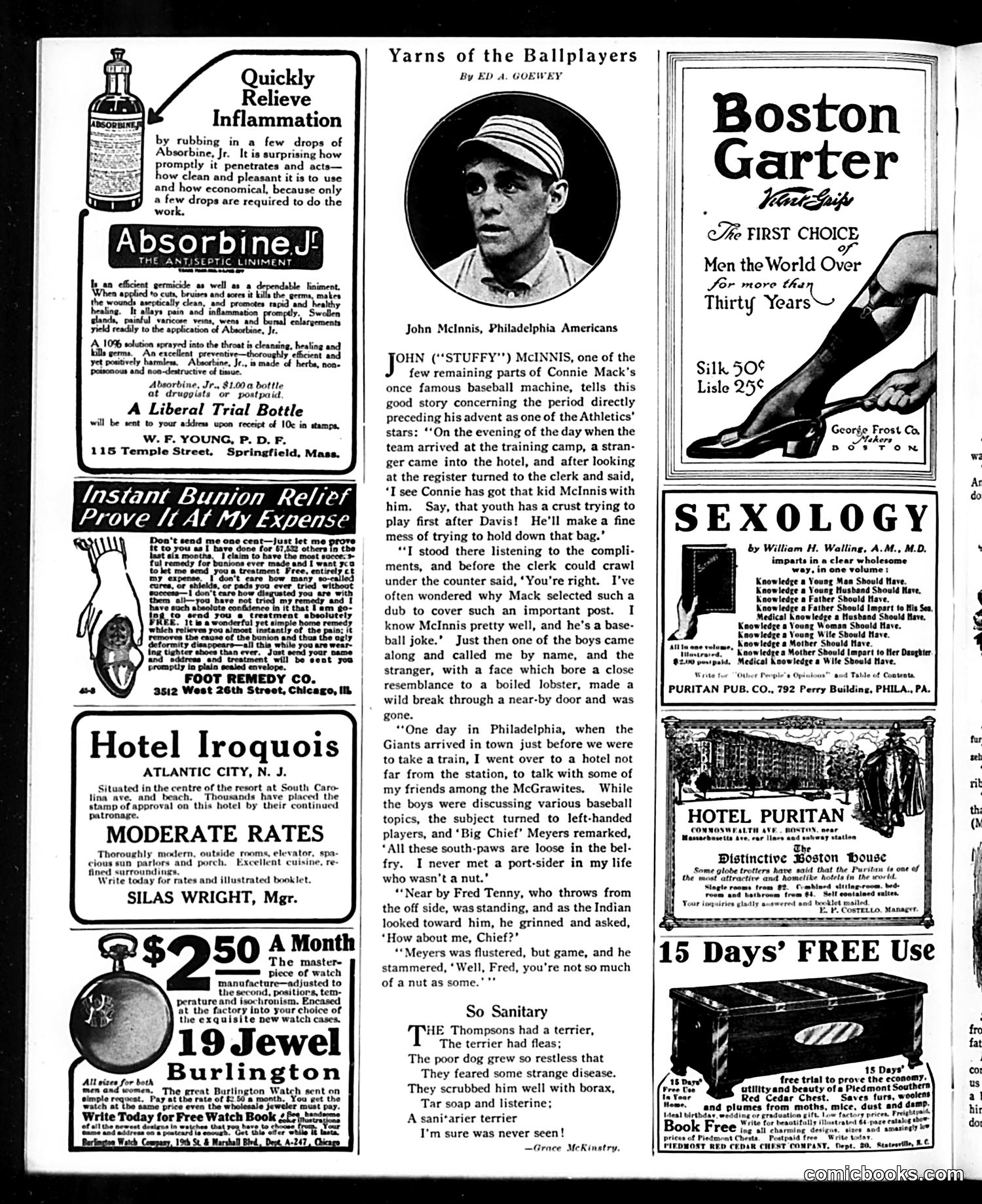
This page is primarily **advertising** with one notable editorial feature: "Yarns of the Ballplayers" by Ed A. Goewey, recounting an anecdote by John ("Stuffy") McInnis of the Philadelphia Athletics. The story illustrates **early 20th-century baseball culture**: McInnis overhears a stranger at training camp insulting him, then later confronts the man sarcastically, prompting his embarrassed exit. The narrative then shifts to a Philadelphia Giants encounter where player Fred Tenny responds to "Big Chief" Meyers' dismissive comments about left-handed ("south-paw") players. The humor relies on **localized baseball gossip** and player personalities recognizable to contemporary readers—particularly figures in Connie Mack's Athletics organization and John McGraw's Giants. The punchline about "nuts" (crazy people) and the implied comeuppance of the insults would have amused readers familiar with these rival teams' competitive dynamics. The page is otherwise filled with period advertisements for medical liniments, hotels, and watches.
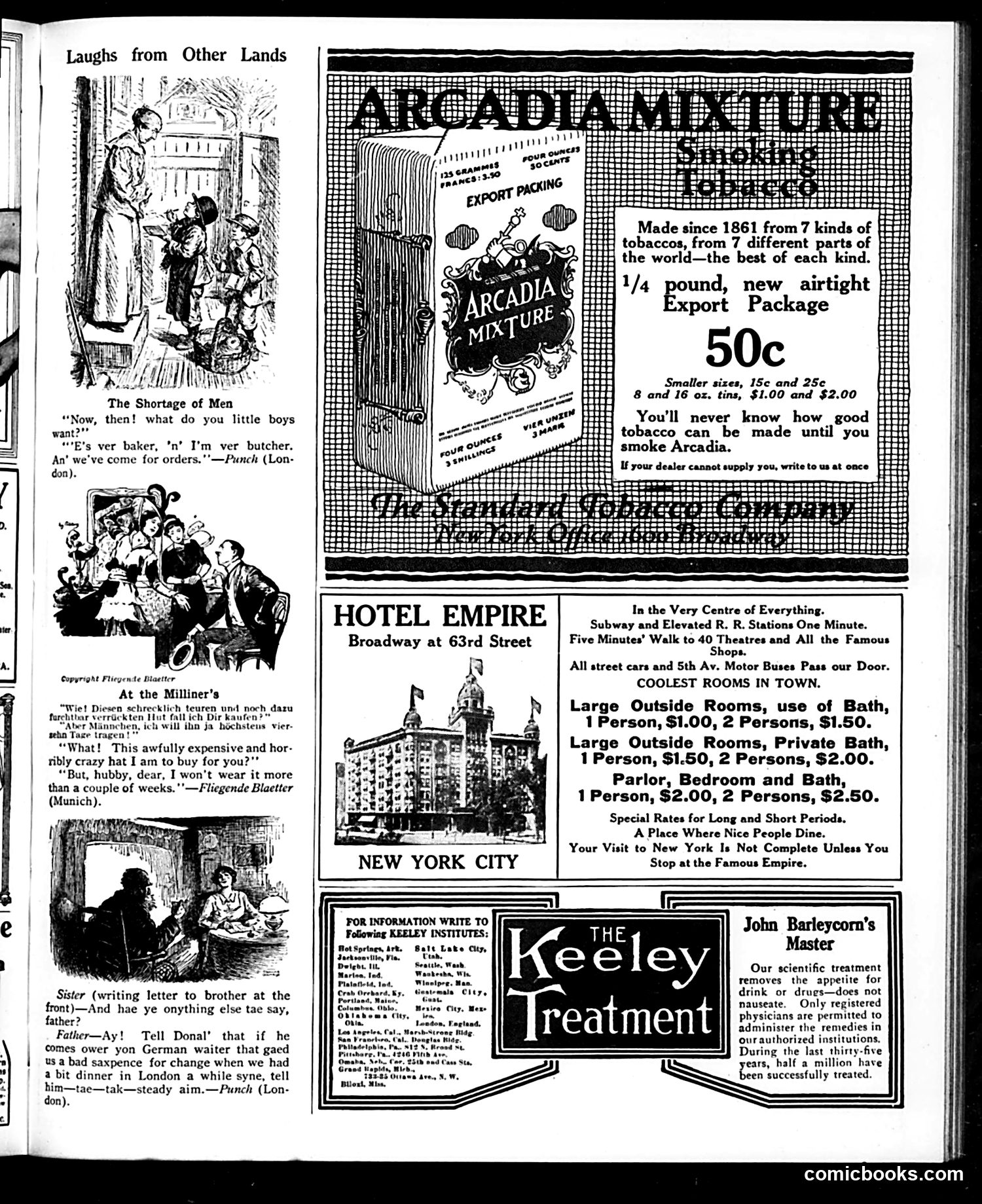
This page from Judge magazine contains three satirical cartoons about **wartime labor shortages during World War I**. All three jokes stem from the same premise: with men away fighting, women and children must fill civilian roles. **"The Shortage of Men"** shows children claiming to be a baker and butcher, offering their services—commenting on how desperately labor is needed. **"At the Milliner's"** depicts a wife justifying an expensive hat purchase by saying she'll only wear it two weeks, satirizing women's frivolous spending while men sacrifice at the front. **"Sister"** features a Scottish father telling his daughter to relay a message to her brother at the front: if he encounters a German waiter who cheated them in London, he should "steady aim"—darkly joking about battlefield revenge over a petty grievance. The cartoons use European sources (Punch, Fliegende Blaetter) to show how the war's social disruption was perceived internationally. The tone is lighthearted but reflects genuine anxiety about gender roles and wartime sacrifice.
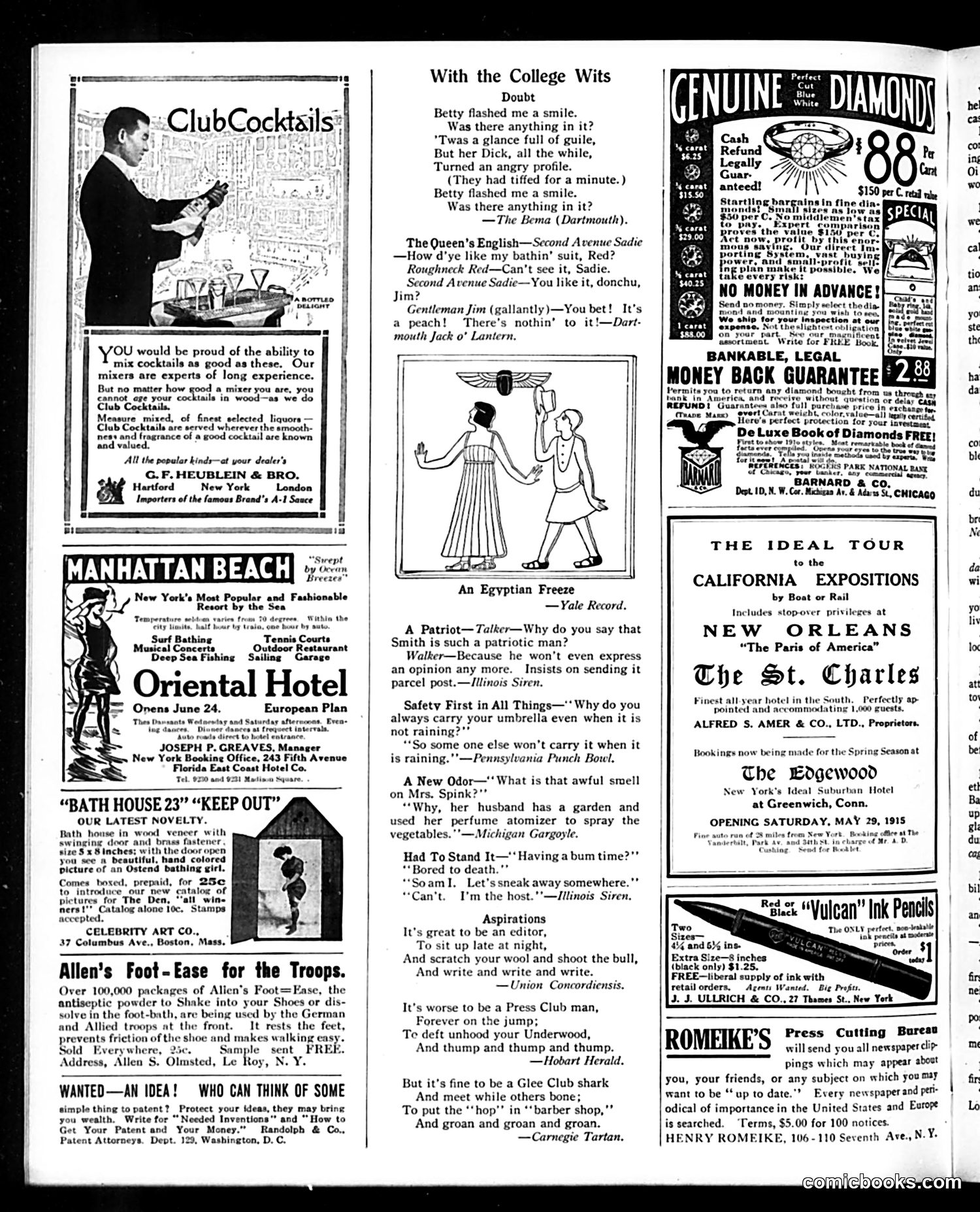
This page is primarily **advertising and humor columns** rather than political cartoons. The satire is collegiate and social rather than political. The "College Wits" section features humorous pieces from university publications (Dartmouth, Yale, etc.), poking fun at student life and contemporary manners. These include: - **"The Queen's English"**: Mocking working-class accents and flirtation ("Second Avenue Sadie") - **"A Patriot"**: Satirizing overly cautious Americans who won't express opinions, sending them "parcel post" instead—likely referencing WWI-era patriotic pressure - Various jokes about romance, laziness, and social pretension The page is dominated by **commercial advertisements**—cocktail mixers, hotels, patent services, and novelty items. One notable ad mentions **Allen's Foot-Ease for troops**, indicating this is from the WWI era (the reference to "German and Allied troops at the front"). The humor is genteel, collegiate satire rather than sharp political commentary—typical of Judge's middle-class, educated readership in the 1910s.
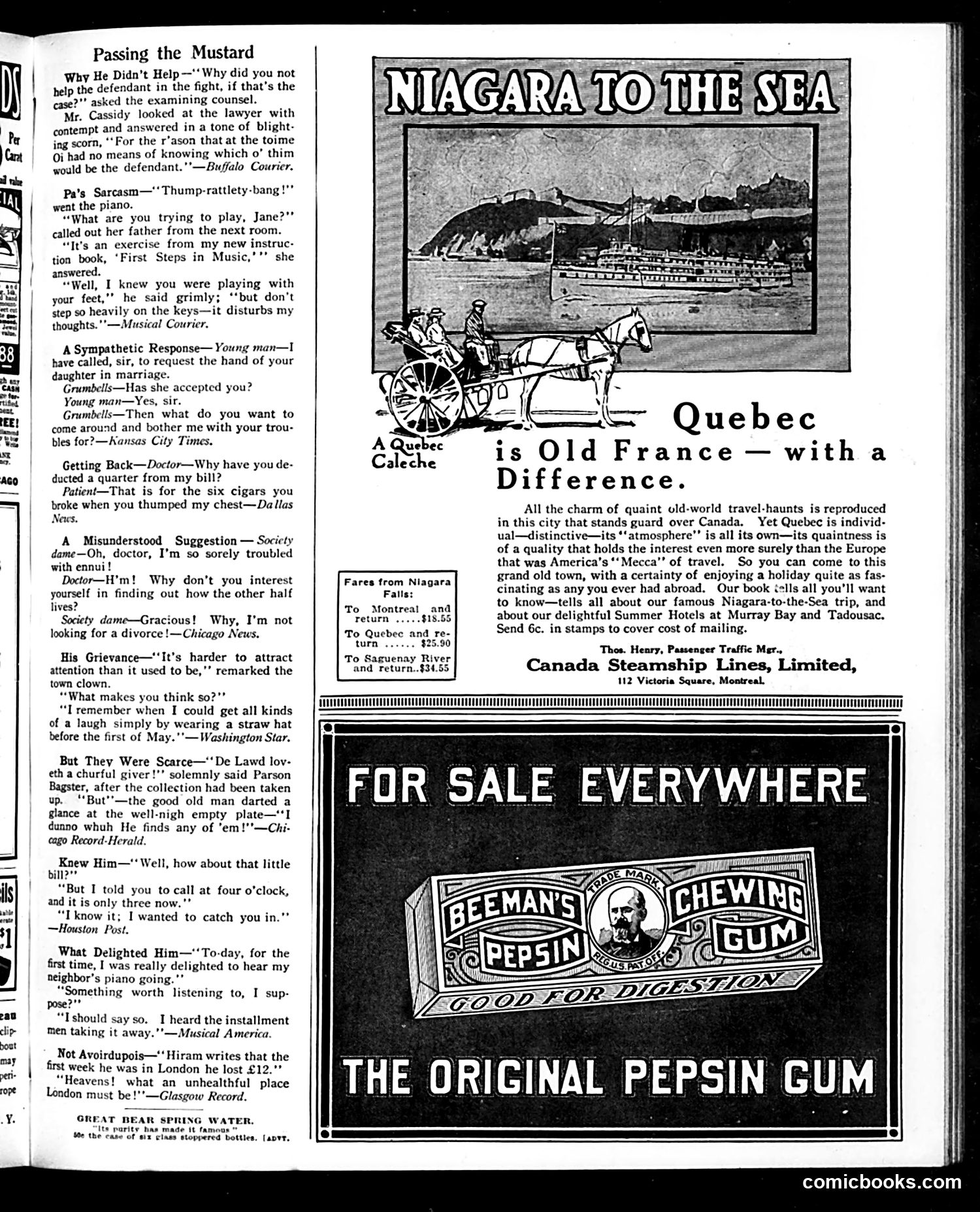
This page contains multiple short joke pieces ("Passing the Mustard" section) typical of *Judge* magazine's humor format. The jokes employ ethnic dialect humor (Irish accent in the courtroom anecdote) and domestic comedy now considered dated. Themes include: a witness unable to identify the defendant; a father annoyed by his daughter's clumsy piano practice; marriage mishaps; doctor-patient disputes; and social commentary (a wealthy woman misinterpreting advice to "know how the other half lives" as a divorce reference). The main advertisement promotes Quebec tourism as "Old France with a Difference"—emphasizing its European charm while positioning it as an accessible North American destination. A secondary ad promotes Beeman's Pepsin Chewing Gum as digestive aid. The humor relies entirely on now-obsolete comedic conventions: puns, misunderstandings, and class-based jokes rather than visual gags. The dialect humor, in particular, reflects early 20th-century attitudes toward working-class and immigrant speech patterns.
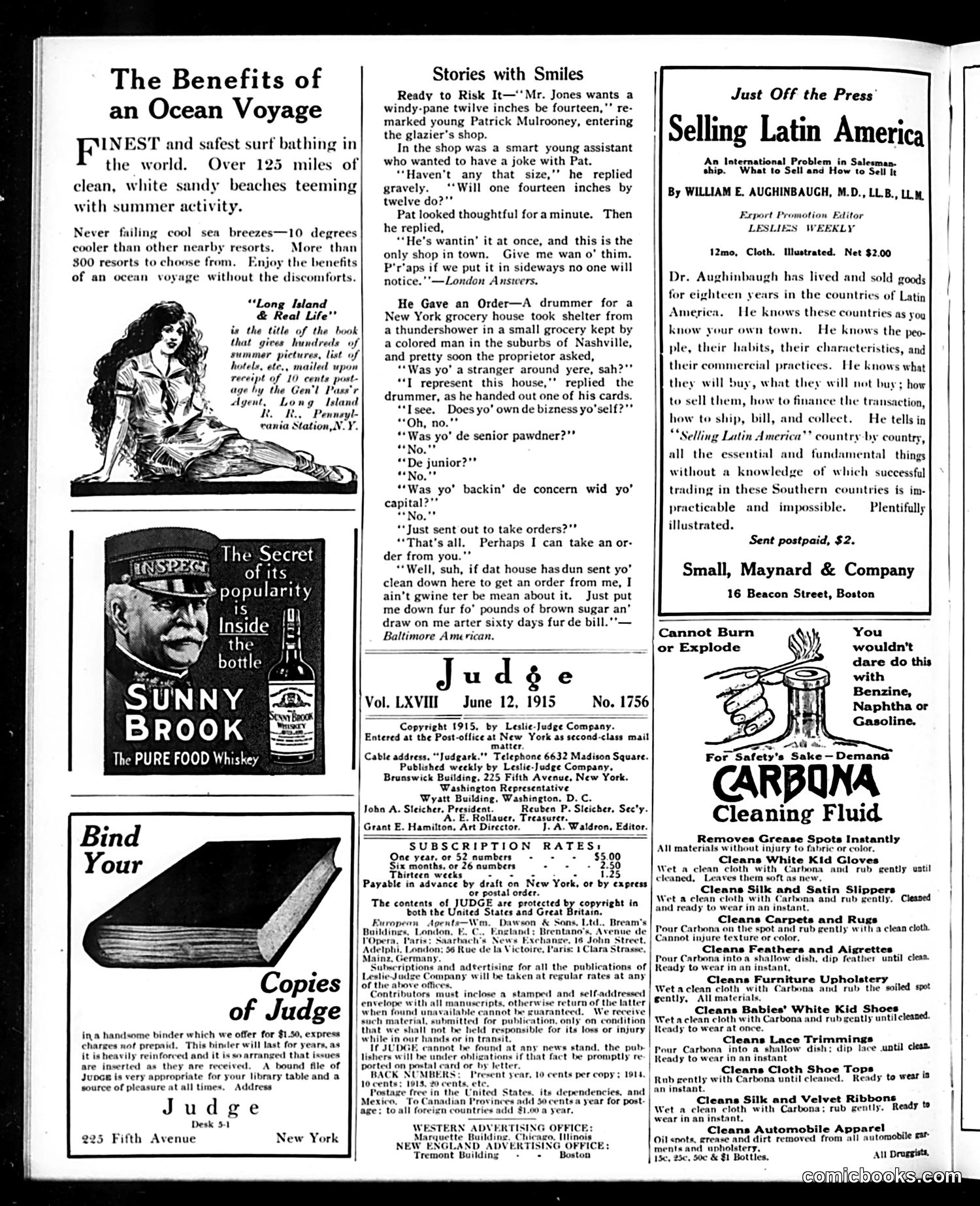
This page combines humor with advertising from June 1915. The main jokes are: **"Ready to Risk It"**: An Irish laborer named Patrick Mulrooney asks a glazier for a twelve-by-fourteen-inch windowpane. When told that size isn't available, he requests a fourteen-by-twelve instead—a meaningless reversal. The joke relies on ethnic stereotyping of Irish immigrants as dim-witted, a common prejudice of the era. **"He Gave an Order"**: A traveling salesman from a New York grocery house seeks orders from a Black grocer in Nashville. Through comedic dialect, the proprietor explains he owns nothing—not the store, capital, or goods. He jokingly agrees to buy items on credit anyway. This joke traffics in racist caricature and Southern racial dynamics of the period. Both stories use exaggerated dialect to mock working-class and minority characters for humor. The rest of the page contains advertisements for books, whiskey, and cleaning products typical of 1915 publications.
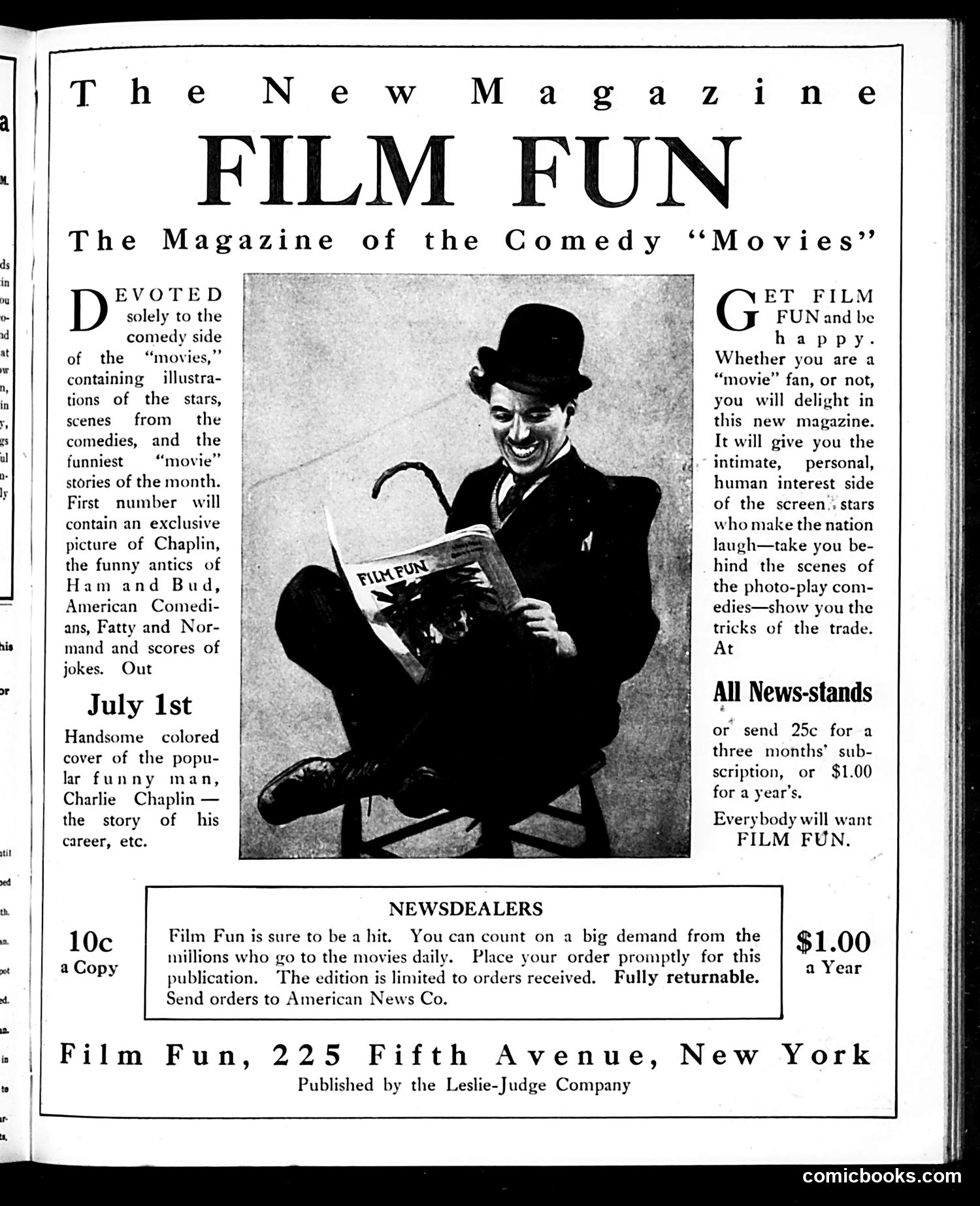
This is primarily an **advertisement for a new magazine**, not political satire. "Film Fun," published by Leslie-Judge Company, launches July 1st as a comedy-focused publication devoted entirely to funny movies. The central image shows **Charlie Chaplin** in his iconic "Tramp" character—bowler hat, cane, suit—reading the magazine itself, a visual endorsement. The ad promises exclusive pictures of Chaplin, plus coverage of other silent-film comedians: Ham and Bud (likely a vaudeville duo), and "Fatty and Normand" (likely **Fatty Arbuckle** and **Mabel Normand**, popular silent comedians). The pitch targets the mass moviegoing audience of the era, emphasizing behind-the-scenes "human interest" stories and comedy "tricks." Pricing: 10¢ per copy, 25¢ for three months, or $1 yearly. This reflects early-1910s American popular culture's enthusiasm for motion pictures and comedic entertainment.
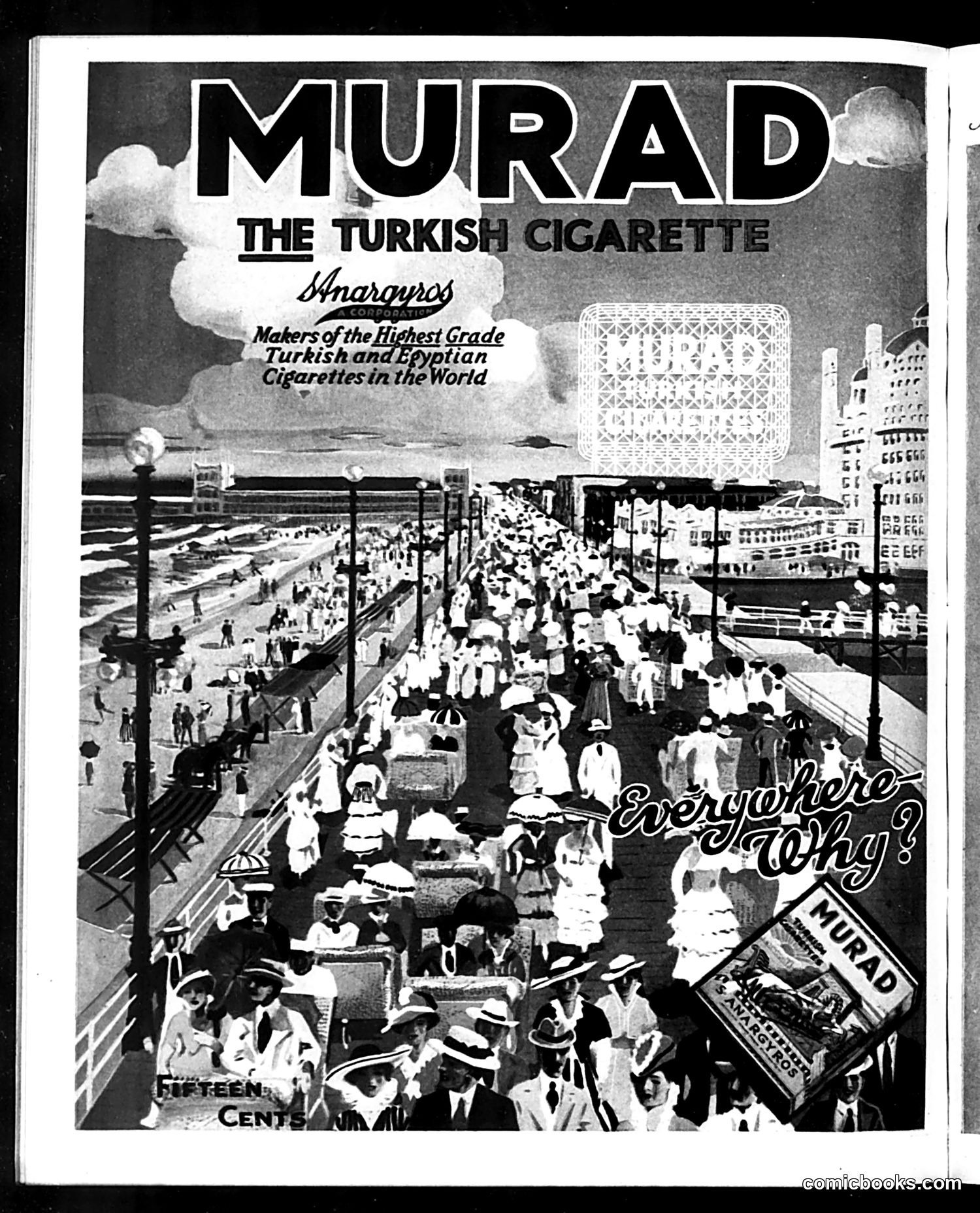
This is a **cigarette advertisement**, not political satire. It promotes Murad Turkish cigarettes, made by Anargyros, described as "Makers of the Highest Grade Turkish and Egyptian Cigarettes in the World." The image depicts a crowded boardwalk or beach scene (likely Coney Island, given the "SIXTEEN CENTS" price reference visible), with masses of people enjoying leisure time. The advertisement's tagline—"Everywhere Why?"—suggests that Murad cigarettes are ubiquitously popular among the public crowds shown. This represents typical early 20th-century cigarette marketing: associating the product with social popularity, leisure, and urban sophistication. There is no satirical content; Judge magazine, like most publications of this era, carried straightforward tobacco advertising alongside satirical material.