
Judge, 1915-06-12 · page 4 of 24
Judge — June 12, 1915 — page 4: what you’re looking at
What you’re looking at
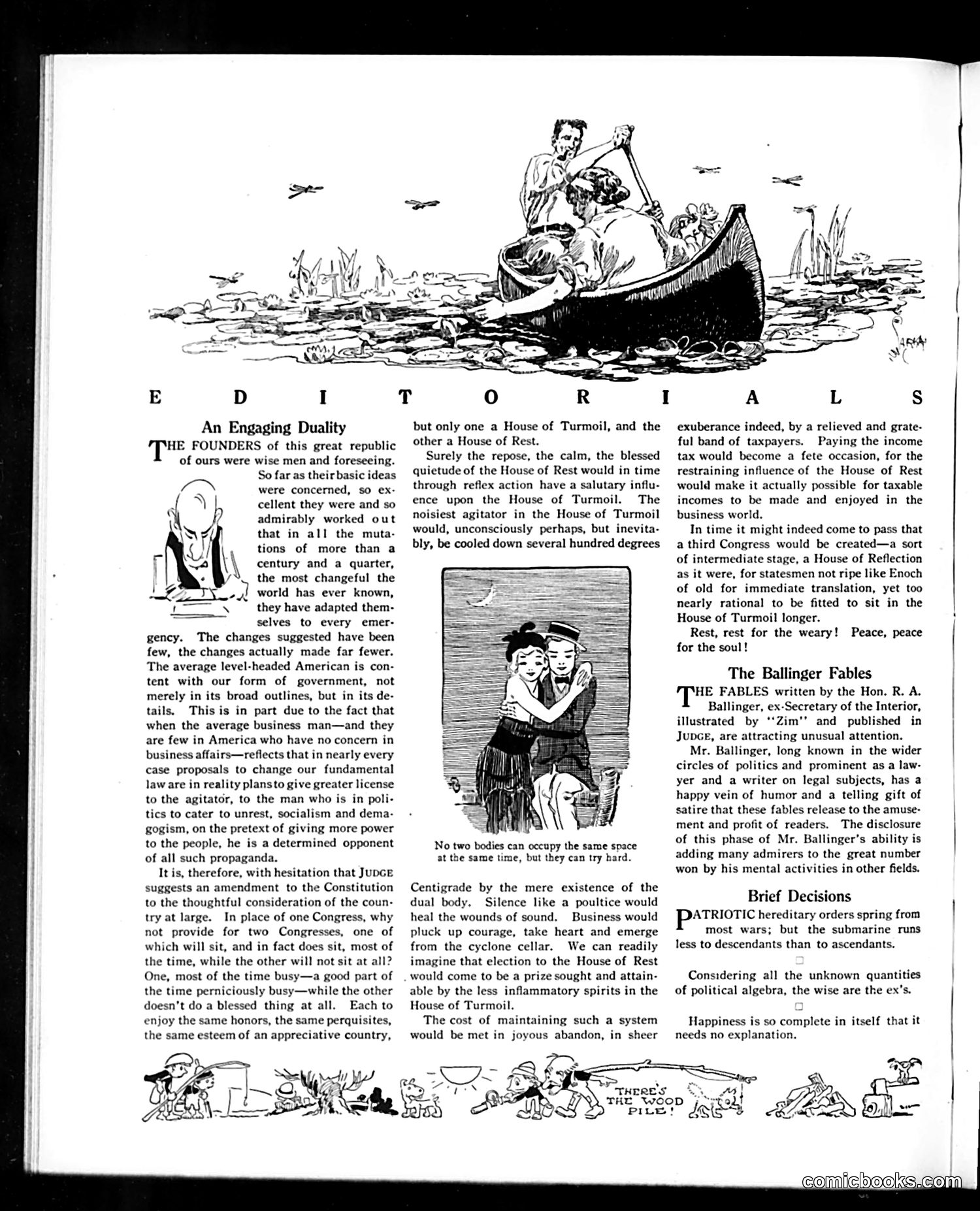
This Judge magazine page satirizes American legislative gridlock. The main editorial, "An Engaging Duality," proposes a constitutional amendment creating two separate Houses of Congress: one for "Turmoil" (contentious debate) and one for "Rest" (calm deliberation). The satire suggests that Congress functions so chaotically that splitting it into separate chambers—one for noise and conflict, another for actual governance—might improve matters. The piece mocks how American business interests constantly lobby Congress to change laws for their benefit, implying that legislative dysfunction stems from competing interests rather than principled governance. The accompanying illustration depicts contentious politicians wrestling in boats, visualizing Congressional conflict. The secondary section promotes "The Ballinger Fables" by ex-Interior Secretary Richard Ballinger, suggesting this was a contemporary political figure whose memoir attracted attention.
📄 Transcribed text from this page (OCR, searchable)
Machine-transcribed from the original scan — historical spelling and the odd misread are preserved.
An Engaging Duality HE FOUNDERS of this great republic of ours were wise men and foreseeing. So far as theirbasic ideas were concerned, so ex- cellent they were and so admirably worked out that in all the muta- tions of more than a century and a quarter, the most changeful the world has ever known, they have adapted them- selves to every emer- gency. The changes suggested have been few, the changes actually made far fewer. The average level-headed American is con- tent with our form of government, not merely in its broad outlines, but in its de- tails. This is in part due to the fact that when the average business man—and they are few in America who have no concern in business affairs—reflects that in nearly every case proposals to change our fundamental law are in reality plansto give greater license to the agitator, to the man who is in poli- tics to cater to unrest, socialism and dema- gogism, on the pretext of giving more power to the people, he is a determined opponent of all such propaganda. It is, therefore, with hesitation that JuDGE suggests an amendment to the Constitution to the thoughtful consideration of the coun- try at large. In place of one Congress, why not provide for two Congres: one of which will sit, and in fact does sit, most of the time, while the other will not sit at all? One, most of the time busy—a good part of the time perniciously busy—while the other doesn't do a blessed thing at all. Each to enjoy the same honors, the same perquisites, the same esteem of an appreciative country, eA, Sia Bs ot but only one a House of Turmoil, and the other a House of Rest. Surely the repose, the calm, the blessed quietude of the House of Rest would in time through reflex action have a salutary influ- ence upon the House of Turmoil. The noisiest agitator in the House of Turmoil would, unconsciously perhaps, but inevita- bly, be cooled down several hundred degrees No two bodies can occupy the same space at the same time, but they can try hard. Centigrade by the mere existence of the dual body. Silence like a poultice would heal the wounds of sound, Business would pluck up courage, take heart and emerge from the cyclone cellar. We can readily imagine that election to the House of Rest would come to be a prize sought and attain- able by the less inflammatory spirits in the House of Turmoil. The cost of maintaining such a system would be met in joyous abandon, in sheer >. . F; THERES THE WwooD exuberance indeed, by a relieved and grate- ful band of taxpayers. Paying the income tax would become a fete occasion, for the restraining influence of the House of Rest would make it actually possible for taxable incomes to be made and enjoyed in the business world. In time it might indeed come to pass that a third Congress would be created—a sort of intermediate stage, a House of Reflection as it were, for statesmen not ripe like Enoch of old for immediate translation, yet too nearly rational to be fitted to sit in the House of Turmoil longer. Rest, rest for the weary! for the soul! The Ballinger Fables HE FABLES written by the Hon. R. A. Ballinger, ex-Secretary of the Interior, illustrated by ‘‘Zim'’ and published in Jupce, are attracting unusual attention. Mr. Ballinger, long known in the wider circles of politics and prominent as a law- yer and a writer on legal subjects, has a happy vein of humor and a telling gift of satire that these fables release to the amuse- ment and profit of readers. The disclosure of this phase of Mr. Ballinger’s ability is adding many admirers to the great number won by his mental activities in other fields. Peace, peace Brief Decisions Patriotic hereditary orders spring from most wars; but the submarine runs less to descendants than to ascendants. Considering all the unknown quantities of political algebra, the wise are the ex's. Happiness is so complete in itself that it needs no explanation.