
Judge, 1915-06-12 · page 10 of 24
Judge — June 12, 1915 — page 10: what you’re looking at
What you’re looking at
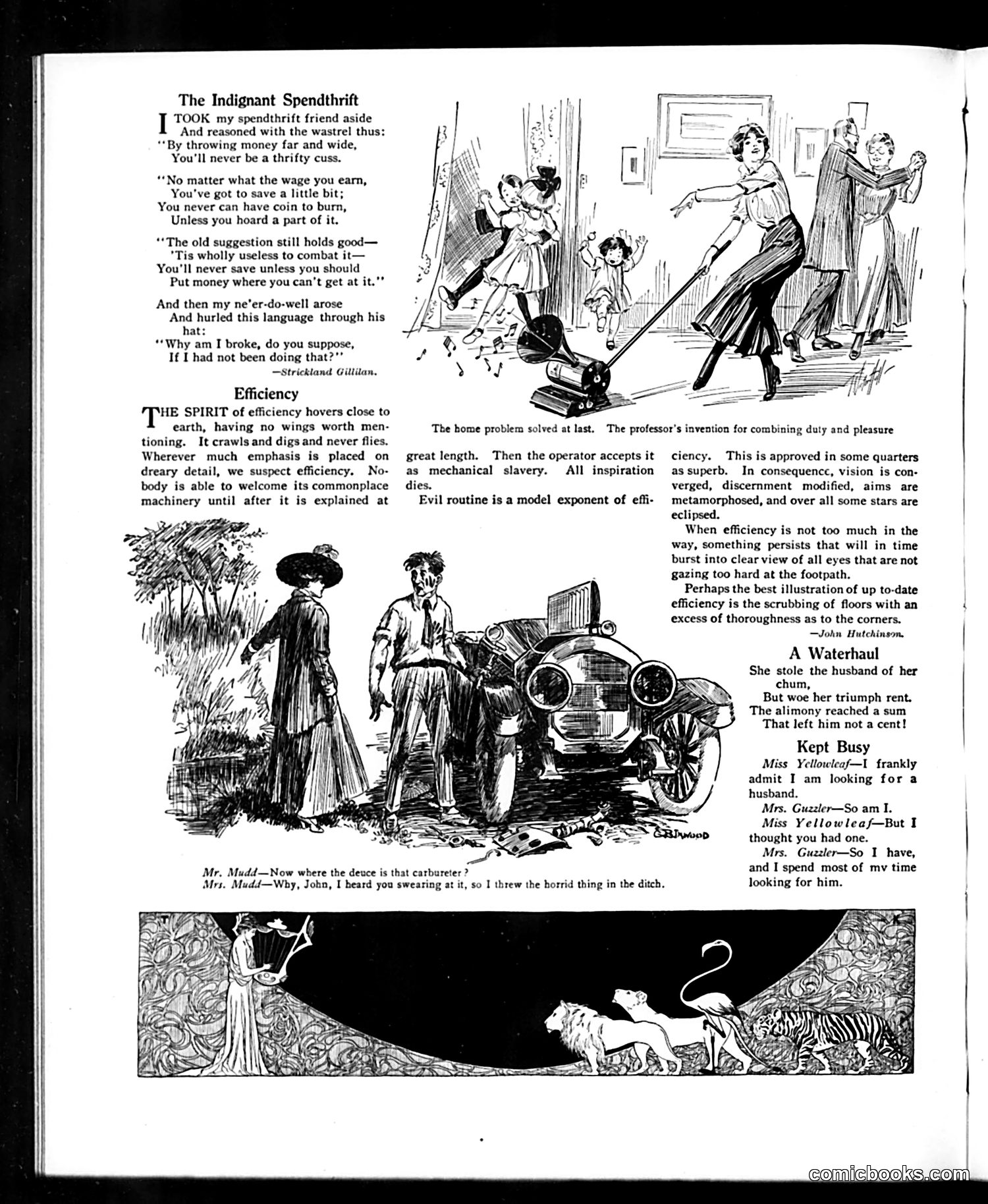
This page contains three satirical pieces typical of early 20th-century American humor: **"The Indignant Spendthrift"** mocks advice-giving about thrift. The narrator lectures a wastrel friend about saving money, only to be told the friend's already tried that—he spends money *because* he can't access it otherwise, making the advice circular and useless. **"Efficiency"** critiques the era's obsession with industrial efficiency and rigid routines. The accompanying cartoon shows Mr. Mudd's wife literally throwing his car's carburetor in a ditch after hearing him curse it—she's taking "efficiency" absurdly literally. The essay warns that over-emphasis on mechanical detail kills inspiration and vision. **"A Waterhaul"** and **"Kept Busy"** are brief joke items about marriage: one about a woman whose affair costs her alimony; another where a married woman admits she spends most her time searching for her absent husband—implying marital discord or infidelity as comedy. The tone reflects Judge's satirical stance: mocking American middle-class pretensions, efficiency culture, and domestic relationships.
📄 Transcribed text from this page (OCR, searchable)
Machine-transcribed from the original scan — historical spelling and the odd misread are preserved.
The Indignant Spendthrift TOOK my spendthrift friend aside And reasoned with the wastrel thus: “*By throwing money far and wide, You'll never be a thrifty cuss. **No matter what the wage you earn, You've got to save a little bit; You never can have coin to burn, Unless you hoard a part of it. **The old suggestion still holds good— 'Tis wholly useless to combat it— You'll never save unless you should Put money where you can’t get at it.'" And then my ne’er-do-well arose And hurled this language through his hat: “Why am I broke, do you suppose, If I had not been doing that?’" Strickland Gillilan, Efficiency HE SPIRIT of efficiency hovers close to earth, having no wings worth men- tioning. It crawls and digs and never flies. Wherever much emphasis is placed on dreary detail, we suspect efficiency. No- body is able to welcome its commonplace machinery until after it is explained at Mr. Mudd—Now where the deuce is that carbureter ? Mrs. Mudd—Wby, John, I beard you swearing at it, so I threw the horrid thing in the ditch. The home problem solved at last. The professor's invention for combining duty and pleasure great length. Then the operator accepts it as mechanical slavery. All inspiration dies. Evil routine is a model exponent of effi- ciency. This is approved in some quarters as superb. In consequence, vision is con- verged, discernment modified, aims are metamorphosed, and over all some stars are eclipsed. When efficiency is not too much in the way, something persists that will in time burst into clear view of all eyes that are not gazing too hard at the footpath. Perhaps the best illustration of up to-date efficiency is the scrubbing of floors with an excess of thoroughness as to the corners. —John Hutchinson, A Waterhaul She stole the husband of her chum, But woe her triumph rent. The alimony reached a sum That left him not a cent! Kept Busy Miss Yellowleaf—I frankly admit I am looking for a husband. Mrs. Guzzler—So am I. Miss Yellowleaf—But I thought you had one. Mrs. Guzzler—So 1 have, and I spend most of mv time looking for him.