
Judge, 1915-06-12 · page 8 of 24
Judge — June 12, 1915 — page 8: what you’re looking at
What you’re looking at
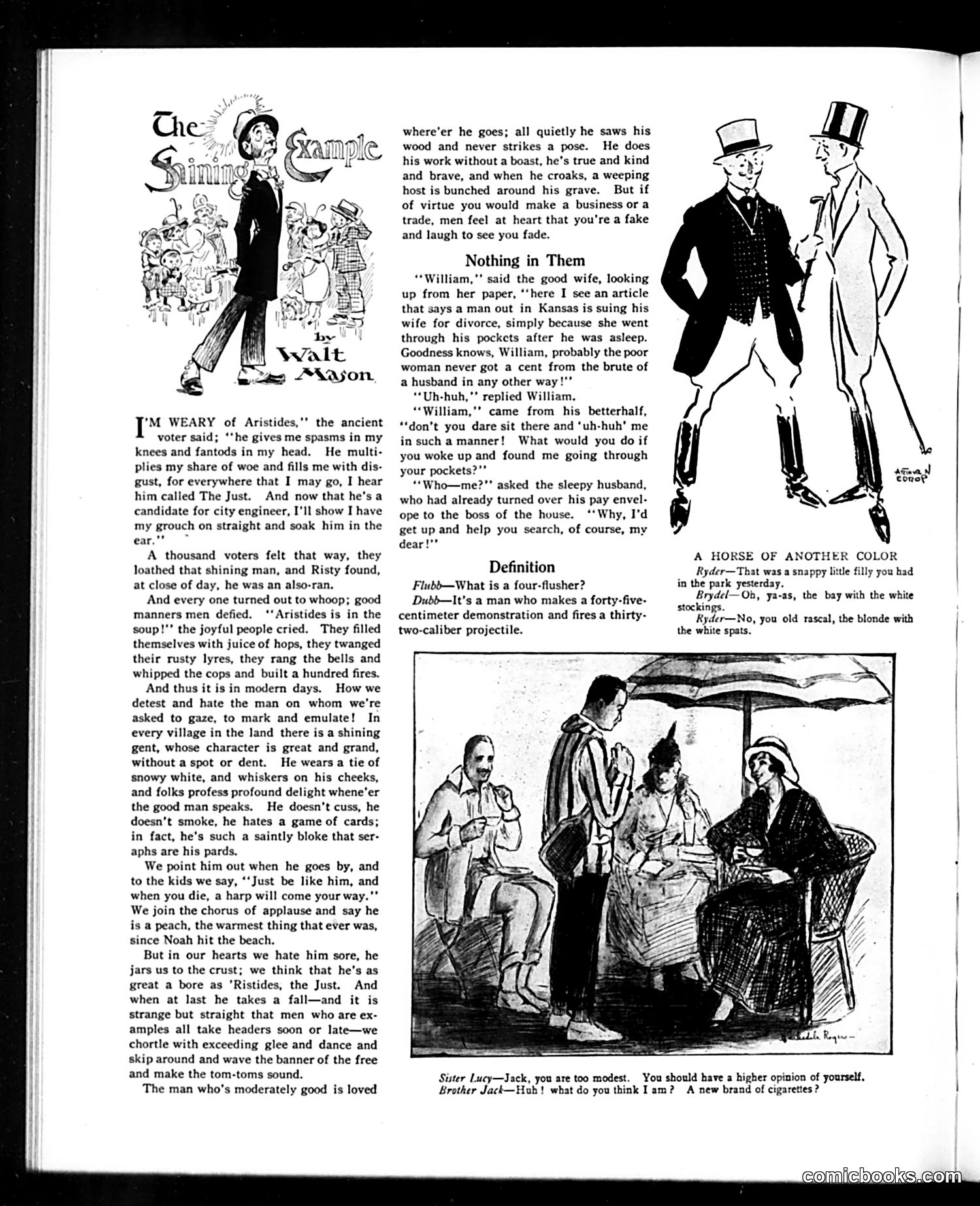
This page satirizes public hypocrisy about virtue and moral exemplars. The main article, "The Example," uses the classical reference to Aristides the Just—a famously virtuous Athenian—to mock modern society's contradictory attitudes. The satire argues that people publicly revere paragons of virtue (the perfectly moral man with white tie, clean character, no vices) but secretly resent and ridicule them. Citizens praise such figures as role models for children, yet harbor genuine hatred for their "shininess" and moral superiority. When these exemplars inevitably fall from grace, the public celebrates gleefully. The piece concludes that only the "moderately good"—those who work honestly without self-promotion or moral grandstanding—earn genuine, lasting affection and respect. The shorter comic pieces ("Nothing in Them," "Definition," "A Horse of Another Color") offer related humor about everyday hypocrisy and marital dynamics, maintaining the magazine's satirical tone.
📄 Transcribed text from this page (OCR, searchable)
Machine-transcribed from the original scan — historical spelling and the odd misread are preserved.
[I™ WEARY of Aristides," the ancient voter said; ‘‘he gives me spasms in my knees and fantods in my head. He multi- plies my share of woe and fills me with dis- gust, for everywhere that I may go, I hear him called The Just. And now that he's a candidate for city engineer, I'll show I have my grouch on straight and soak him in the ear.” ~ A thousand voters felt that way, they loathed that shining man, and Risty found, at close of day, he was an also-ran, And every one turned out to whoop; good manners men defied. ‘‘Aristides is in the soup!"’ the joyful people cried. They filled themselves with juice of hops, they twanged their rusty lyres, they rang the bells and whipped the cops and built a hundred fires. And thus it is in modern days. How we detest and hate the man on whom we're asked to gaze, to mark and emulate! In every village in the land there is a shining gent, whose character is great and grand, without a spot or dent. He wears a tie of snowy white, and whiskers on his cheeks, and folks profess profound delight whene’er the good man speaks. He doesn’t cuss, he doesn’t smoke, he hates a game of cards; in fact, he’s such a saintly bloke that ser- aphs are his pards. We point him out when he goes by, and to the kids we say, ‘‘Just be like him, and when you die, a harp will come your way.” We join the chorus of applause and say he is a peach, the warmest thing that ever was, since Noah hit the beach, But in our hearts we hate him sore, he jars us to the crust; we think that he’s as great a bore as 'Ristides, the Just. And when at last he takes a fall—and it is strange but straight that men who are ex- amples all take headers soon or late—we chortle with exceeding glee and dance and skip around and wave the banner of the free and make the tom-toms sound. The man who's moderately good is loved where’er he goes; all quietly he saws his wood and never strikes a pose. He does his work without a boast, he’s true and kind and brave, and when he croaks, a weeping host is bunched around his grave. But if of virtue you would make a business or a trade, men feel at heart that you're a fake and laugh to see you fade. Nothing in Them “‘William,"’ said the good wife, looking up from her paper, ‘‘here I see an article that says a man out in Kansas is suing his wife for divorce, simply because she went through his pockets after he was asleep. Goodness knows, William, probably the poor woman never got a cent from the brute of a husband in any other way!"" “Uh-huh,” replied William. “William,’’ came from his betterhalf, “don’t you dare sit there and ‘uh-huh’ me in such a manner! What would you do if you woke up and found me going through your pockets?"’ “*Who—me?"’ asked the sleepy husband, who had already turned over his pay envel- ope to the boss of the house. ‘*Why, I'd get up and help you search, of course, my dear!"’ Definition Flubb—What is a four-flusher? Dubb—It's a man who makes a forty-five- centimeter demonstration and fires a thirty- two-caliber projectile. A HORSE OF ANOTHER COLOR Ryder—That was a snappy little filly you had in the park yesterday. Brydel—Ob, ya-as, the bay with the white stockings. Ryder—No, you old rascal, the blonde with the white spats. Sister Lucy—Jack, you are too modest. You should have a higher opinion of yourself. Brother Jack—Hb ! what do you think Iam? A new brand of cigarettes?